2
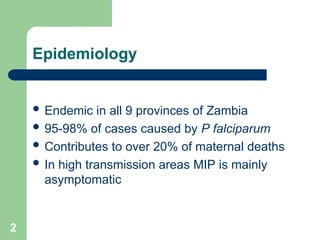
Epidemiology
Endemic inall 9 provinces of Zambia
95-98% of cases caused by P falciparum
Contributes to over 20% of maternal deaths
In high transmission areas MIP is mainly
asymptomatic
3.
3
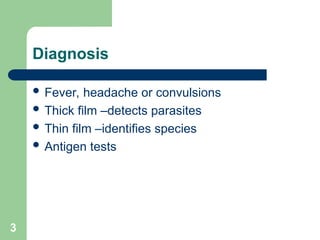
Diagnosis
Fever, headacheor convulsions
Thick film –detects parasites
Thin film –identifies species
Antigen tests
4.
4
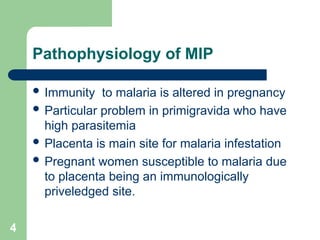
Pathophysiology of MIP
Immunity to malaria is altered in pregnancy
Particular problem in primigravida who have
high parasitemia
Placenta is main site for malaria infestation
Pregnant women susceptible to malaria due
to placenta being an immunologically
priveledged site.
5.
5
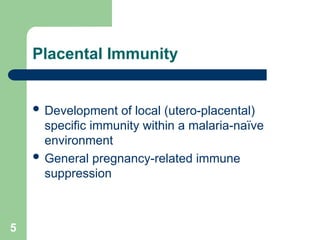
Placental Immunity
Developmentof local (utero-placental)
specific immunity within a malaria-naïve
environment
General pregnancy-related immune
suppression
6.
6
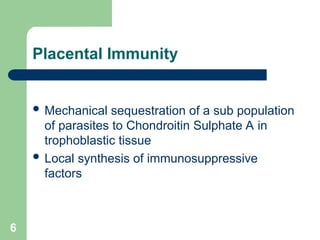
Placental Immunity
Mechanicalsequestration of a sub population
of parasites to Chondroitin Sulphate A in
trophoblastic tissue
Local synthesis of immunosuppressive
factors
7.
7
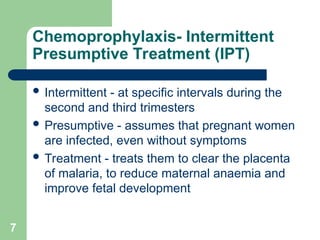
Chemoprophylaxis- Intermittent
Presumptive Treatment(IPT)
Intermittent - at specific intervals during the
second and third trimesters
Presumptive - assumes that pregnant women
are infected, even without symptoms
Treatment - treats them to clear the placenta
of malaria, to reduce maternal anaemia and
improve fetal development
8.
8
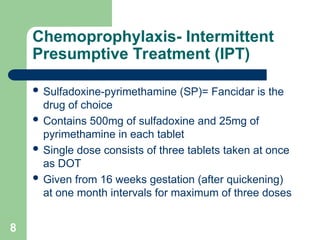
Chemoprophylaxis- Intermittent
Presumptive Treatment(IPT)
Sulfadoxine-pyrimethamine (SP)= Fancidar is the
drug of choice
Contains 500mg of sulfadoxine and 25mg of
pyrimethamine in each tablet
Single dose consists of three tablets taken at once
as DOT
Given from 16 weeks gestation (after quickening)
at one month intervals for maximum of three doses
9.
9
Chemoprophylaxis- Intermittent
Presumptive Treatment(IPT)
In Zambia ALL pregnant women are
recommended to receive IPT due to the
endemicity of malaria and the high HIV sero
prevalence rate (16% general pop, much
higher in antenatals)
10.
10
Case Management Guidelinesfor
Uncomplicated Malaria
In the first trimester, oral quinine is the first
line drug
SP is not given in the first trimester as it is an
antifolate
11.
11
Case Management Guidelinesfor
Uncomplicated Malaria
SP is the first line treatment for pregnant
women during the second and third
trimesters
Folic acid supplementation should be
delayed for a week after treatment with SP
as it antagonizes sulfadoxine action.
12.
12
Case Management Guidelinesfor
Uncomplicated Malaria
Co-Artem is the first line treatment for
uncomplicated malaria in the general
population
Since Co-Artem has not been widely tested
in pregnancy it is not recommended in
pregnancy and children less than 10kg body
weight
13.
13
Case Management Guidelinesfor
Complicated Malaria
Artesunate and quinine are the drug of
choice for case management of severe
malaria
Artesunate dose ; 2.4mg per kg @0,12,24hrs
Conversion to Cortem after clinical
improvement.
14.
14
Effects of MIPon fetal and
Newborn Morbidity
Parasitaemia may impair nutrient transfer to
the fetus, negatively affect fetal nutrient use
or stimulate early delivery
Lowered nutrient transfer to the fetus may be
caused by damage to the placenta caused
by parasites or their toxins
15.
15
Effects of MIPon fetal and New
born Morbidity
Increased use of nutrients by parasites, poor
oxygen and glucose transfer from parasitized
red blood cells, while maternal anaemia from
malaria may reduce the supply of oxygen in
the amniotic fluid
Malaria is a serious cause of fetal death,
stillbirths, low birth weight and early infant
deaths
16.
16
Congenital Malaria
Maternalto child transmission of malaria
seems to be rare.
An estimated 0.3% of infants are born with
congenital malaria and most likely affects the
umbilical cord
17.
17
Congenital Malaria
Motherspassively transfer a degree of
immunity to their newborns
The persistence of fetal Hb during the first 3
months of life can retard the growth of P
falciparum
18.
18
HIV and MIP
HIV seems to hinder a woman’s ability to
control P falciparum infections during
pregnancy
HIV positive pregnant women have higher
parasite prevalence and densities and a
greater risk of placental parasitaemia than
HIV negative women
19.
19
HIV and MIP
HIV seems to lower pregnancy specific acquired
immunity, as malaria infections in HIV positive
women are equally serious in all gravidae
Infants of all HIV positive women are also at risk. An
infant whose mother is HIV positive and had
placental parasitaemia has 3-4x greater chance of
death in the first year of life than one whose mother
has HIV but does not have placental densities
20.
20
IPT and HIV
In areas of high sero-prevalence, ALL
gravidae need IPT with SP as HIV appears to
reduce immune response to malaria
Zambia HIV seroprevalence of 16% is very
high
A minimum of three doses of SP is effective
in clearing placental malaria to the same
rates as HIV negative women
21.
21
Malaria complications inPregnancy
Malaria is a major cause of anaemia in
pregnancy in tropical Africa along with iron
deficiency, folate deficiency and HIV/AIDS
Anaemia negatively affects the immune
system and increases susceptibility to
infections, including malaria
22.
22
Malaria complications inPregnancy
In mesoendemic areas, anaemia is most
severe in the second trimester for all
gravidae
Severe anaemia is also an important cause
of low birth weight
Iron supplementation during pregnancy
improves maternal iron stores post-partum
for up to six months



![Lecture note MALARIA_IN_PREGNANCY(2)[1].pptx](https://cdn.slidesharecdn.com/ss_thumbnails/malariainpregnancy21-240605091633-2619b0fc-thumbnail.jpg?width=640&height=640&fit=bounds)


![CTEV [ clubfoot] DR ARUN LAL ,DR MOHAMED ASHRAF travancore medical college k...](https://cdn.slidesharecdn.com/ss_thumbnails/ctevclubfootdrarunlaldrmohamedashraftravancoremedicalcollegekollamkeralaindia-260208063247-18fc466c-thumbnail.jpg?width=640&height=640&fit=bounds)
