The Code of Ethics for
Counselors
REPORT BY: MS. LOVELY JOY B. BUSTOS
A. Qualifications and
Competencies of
Counselors
1. KNOWLEDGE
Guidance counsellors should seek to possess and integrate the following
competencies in knowledge of:
1.1 Major theories of counselling and psychotherapy;
1.2 Major theories of the functioning and leadership of experiential
groups;
1.3 Life span developmental psychology and its relationship to
counselling;
1.4 The main factors underlying personal development;
1.5 Contextual and systemic factors that affect human
functioning, including social, biological and family factors;
1.6 Factors affecting wellbeing and distress;
1.7 The nature of human and cultural diversity with reference to
such factors as age, class, race, gender, ethnicity, levels of ability,
language, spiritual and religious beliefs, educational achievement
and sexuality;
1.8 Current professional developments relevant to practice
settings;
1.9 Research underlying effective practice.
1. KNOWLEDGE
Guidance counsellors should seek to possess and integrate the following
competencies in knowledge of:
2. THE COUNSELLING RELATIONSHIP
Guidance counsellors should seek to exercise the following competencies
when working with client(s):
2.1 Explain the scope of practice and attend to clients’
expectations of counselling including the responsibilities of both
the guidance counsellor and client in the counselling relationship;
2.2 Explain confidentiality and its limits and obtain informed
consent where required;
2.3 Be able to contract and set boundaries appropriately;
2.4 Develop the ability and the confidence to establish and
maintain a collaborative, congruent and effective relationship
with the client informed by a theoretical framework;
2. THE COUNSELLING RELATIONSHIP
Guidance counsellors should seek to exercise the following competencies
when working with client(s):
2.5 Demonstrate core conditions of the counselling relationship
(empathy, genuineness and unconditional positive regard)
2.6 Employ an eclectic and balanced approach to assisting
clients by attending to sensations, feelings, thoughts and
behavior;
2.7 Demonstrate a range of individual and group counselling and
communication skills such as active listening, clarifying, focusing,
paraphrasing, questioning, probing, reflecting feelings, and goal
setting;
2.8 Pay attention to the significance of non-verbal
communication and respond appropriately;
2. THE COUNSELLING RELATIONSHIP
Guidance counsellors should seek to exercise the following competencies
when working with client(s):
2.10 Have the confidence to challenge clients when it is
appropriate to do so, and to be challenged in turn;
2.11 Recognize and manage conflict in the client counsellor
relationship;
2.12 Monitor the quality of the client-counsellor relationship on an
ongoing basis;
2.13 Be able to provide clients with accessible explanations about
their approach and techniques;
2. THE COUNSELLING RELATIONSHIP
Guidance counsellors should seek to exercise the following competencies
when working with client(s):
2.14 Demonstrate an ability to appropriately support clients on a
range of issues such as bereavement, bullying, health issues,
relationship issues, suicide and self-harm, transitional difficulties,
stress, personal/sexual identity and peer pressure;
2.15 Facilitate clients in identifying options, making decisions,
resolving difficulties and making a personal life plan;
2.16 Identify and respond to clients’ vulnerabilities, strengths,
resilience and resources;
2. THE COUNSELLING RELATIONSHIP
Guidance counsellors should seek to exercise the following competencies
when working with client(s):
2.17 Demonstrate an awareness of and sensitivity to the unique
familial, social, cultural, and economic circumstances of clients
and their racial/ethnic, gender, age, physical, and learning
differences;
2.18 Be aware when losing grounding and take appropriate
action (which may include re-grounding, seeking supervision, or
referring the client to other professionals);
2.19 Recognize when to conclude counselling and facilitate
effective closure process.
3. COUNSELLING SKILLS
Guidance counsellors should seek to exercise the following
competencies in the process of working with client(s):
3.1 Employ a mode of counselling, with both individuals and
groups that is based on a framework of counselling theory and
lifespan developmental psychology;
3.2 Work within their level of skill and knowledge in addressing the
concerns of clients;
3.3 Be able to prioritize issues, structure and summarize a session,
and review the process of counselling periodically with the client;
3.4 Monitor progress toward goals;
3.5 Assist clients in developing a sense of awareness and self-
worth;
3. COUNSELLING SKILLS
Guidance counsellors should seek to exercise the following
competencies in the process of working with client(s):
3.6 Develop an ability to assist individuals and groups to deal with
conflict;
3.7 Take into consideration culturally relevant resources for use
with clients.
3.8 Identify community resources relevant to client needs.
3.9 Be able to remain grounded in the presence of client distress
(including grief, fear, shame and anger);
3.10 Evaluate overall outcomes and the practitioner’s role in the

process.
4. PROFESSIONAL AND ETHICAL
ATTITUDES AND PRACTICE
Guidance counsellors should seek to exercise the following
competencies in professional practice:
4.1 Recognize the professional responsibility of the guidance
counsellor to engage with ongoing supervision;
4.2 Demonstrate evidence of evaluating and enhancing their
counselling practice by engaging in ongoing supervision,
proportional to the counselling workload;
4.3 Develop and implement methods to assess the overall
effectiveness of their counselling role;
4.4 Be open to ongoing reflection and dialogue on their own life
narrative and its impact on the counselling relationship and have
dealt with, and continue to deal with on an ongoing basis, major
unresolved issues in their own lives through appropriate means.
4. PROFESSIONAL AND ETHICAL
ATTITUDES AND PRACTICE
Guidance counsellors should seek to exercise the following
competencies in professional practice:
4.5 Take note of the philosophy/mission of the institution where
they are working and develop a professional philosophy
consistent with this setting;
4.6 Demonstrate knowledge of the professional standards,
policies, and practices which govern practice in their work
setting;
4.7 Engage in appropriate continuing professional development
on an ongoing basis;
4.8 Recognize their own personal and professional limitations and
act appropriately to seek supervision or professional support;
4. PROFESSIONAL AND ETHICAL
ATTITUDES AND PRACTICE
Guidance counsellors should seek to exercise the following
competencies in professional practice:
4.12 Establish secure, effective and ethical systems for maintaining
the confidentiality of client records;
4.13 Establish procedures to deal effectively with client crisis and
emergency situations;
4.14 Resolve ethical dilemmas in a manner consistent with
professional standards;
4.15 Comply with any legal requirements governing the practice
of counselling.
B. Qualifications and
Functions of the
Guidance Counselor
Qualifications of the Guidance Counselor
1. Maintain proper certification and license as required by the
Department of Public Instruction.
2. Possess the ability to work with students, parents, faculty,
administrators, and the community.
3. Demonstrate a thorough understanding of the developmental
guidance process and career development theory.
4. Possess the ability to generate, analyze, and synthesize data
about the behavior, progress, and needs of students individually
and with groups.
The guidance counselor shall: (Function)
1. Interpret student information to students, parents/guardians,
and teachers.
2. Arrange for and coordinate visits from outside speakers;
3. Maintain a working relationship with personnel of other
agencies providing student services such as social workers and
parole and probation officers;
4. Maintain a daily log of daily activities and student conferences;
5. Answer mail, complete surveys, request college catalogs and
occupational information, order test materials, and handle
appropriate phone calls,
6. Provide information to parents through the news media and
mailings;
7. Make presentations in orientation/registration programs prior to
student registration;
8. Administer and/or interpret tests, surveys, and inventories that
deal with high school student achievement, aptitudes, and
vocational interests;
The guidance counselor shall: (Function)
9. Work cooperatively with other staff to develop and implement
a K-12 developmental guidance program;
10. Participate in the development of the district guidance and
counseling plan;
11. Coordinate with administration the completion of reports on a
timely basis, ie: dropout, children-at-risk, etc.;
12. Prepare and administer the high school guidance budget;
The guidance counselor shall: (Function)
C. Ethical Issues in
Counseling
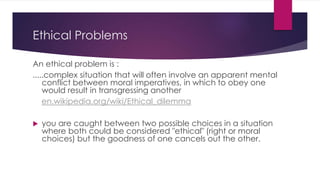
Ethical Problems
An ethical problem is :
.....complex situation that will often involve an apparent mental
conflict between moral imperatives, in which to obey one
would result in transgressing another
en.wikipedia.org/wiki/Ethical_dilemma
 you are caught between two possible choices in a situation
where both could be considered "ethical" (right or moral
choices) but the goodness of one cancels out the other.
Example 1: Business is business...?
You are a school principal in a secondary school in Warszaw and
your spouse is a manager at T-mobile.
Fearful of staff cutbacks, you start up a jewelry sales business for
the evenings and are surprised when it quickly starts to make a
profit. You know that you can double your regular salary if you
recruit more sales staff. Some of your own teaching staff might
like to join you.
You:
 recruit any teachers who would be good at sales
 recruit only teachers who need the money
 recruit staff only from your spouse's office
 avoid recruiting any staff to avoid conflict
Example 2: Making a better deal
You are on the District School Board and also own a small computer store. The
Board issued a Request for Proposals for a large number of PC's to two big
suppliers. After listening to their competing proposals you believe you could
offer a better deal yourself.
You:
 offer a better deal to the Board
 express the opinion that both proposals are high
 say nothing because it is a conflict of interest
 absent yourself from all discussion on the deal
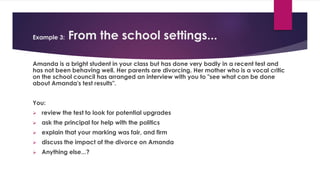
Example 3: From the school settings...
Amanda is a bright student in your class but has done very badly in a recent test and
has not been behaving well. Her parents are divorcing. Her mother who is a vocal critic
on the school council has arranged an interview with you to "see what can be done
about Amanda's test results".
You:
 review the test to look for potential upgrades
 ask the principal for help with the politics
 explain that your marking was fair, and firm
 discuss the impact of the divorce on Amanda
 Anything else...?
Some examples of the most frequent
ethical dilemmas among counselling:
 -The client asked me not to tell about his theft in the
supermarket to his parents...
 - I know that my client started „to taste drugs“ .Feel
embaressed to contact his parents...
 - I was dealing with the case of a drug abuse (the young boy
came voluntarily),however, the problem was to receive his
approval on contacting his parents, or doctor, what he
strongly rejected...
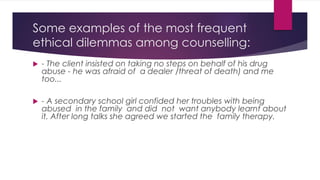
Some examples of the most frequent
ethical dilemmas among counselling:
 - The client insisted on taking no steps on behalf of his drug
abuse - he was afraid of a dealer /threat of death) and me
too...
 - A secondary school girl confided her troubles with being
abused in the family and did not want anybody learnt about
it. After long talks she agreed we started the family therapy.
D. Characteristics of
effective Counselors
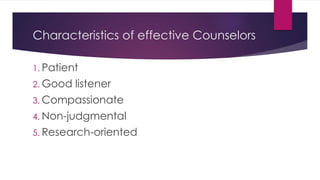
Characteristics of effective Counselors
1. Patient
2. Good listener
3. Compassionate
4. Non-judgmental
5. Research-oriented
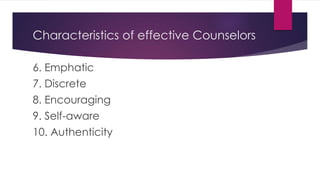
6. Emphatic
7. Discrete
8. Encouraging
9. Self-aware
10. Authenticity
Characteristics of effective Counselors
D. Counselor’s Attitude
Characteristics
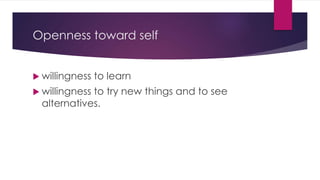
Openness toward self
 willingness to learn
 willingness to try new things and to see
alternatives.
Openness toward clients
 viewing then as individuals seeking
assistance,
 as complex individuals who are not helpless,
 as partners in the process.
Openness toward colleagues
 viewing them as colleagues, not
competitors, with experiences and ideas
that are valuable.
Openness toward supervisors
 viewing them as colleagues with unique and
relevant experiences.
Openness toward counseling
 the counseling process is often a
developing, evolving process wherein the
client’s skills and resources are developed.
 The counselor does not solve the problem,
but offers alternatives and
teaches/facilitates the client’s problem-
solving process.
CODE OF ETHICS
Why it is important to have a specific
Code of Ethics for a counsellor ?
The challenge of working ethically means that practitioners will
inevitably encounter situations where there are competing
obligations. In such situations it is tempting to retreat from all
ethical analysis in order to escape a sense of what may appear
to be unresolvable ethical tension. In these circumstances the
professionals can adhere to the assistance of variety of ethical
factors that may need to be taken into consideration and to
alternative ways of approaching ethics that may prove more
useful.
At any case, each counsellor should respect, (except of
relevant laws), the ethical standards developed and accepted
by particup national Counselling Association .

The code of ethics for counselors

  • 1.
    The Code ofEthics for Counselors REPORT BY: MS. LOVELY JOY B. BUSTOS
  • 2.
  • 3.
    1. KNOWLEDGE Guidance counsellorsshould seek to possess and integrate the following competencies in knowledge of: 1.1 Major theories of counselling and psychotherapy; 1.2 Major theories of the functioning and leadership of experiential groups; 1.3 Life span developmental psychology and its relationship to counselling; 1.4 The main factors underlying personal development; 1.5 Contextual and systemic factors that affect human functioning, including social, biological and family factors;
  • 4.
    1.6 Factors affectingwellbeing and distress; 1.7 The nature of human and cultural diversity with reference to such factors as age, class, race, gender, ethnicity, levels of ability, language, spiritual and religious beliefs, educational achievement and sexuality; 1.8 Current professional developments relevant to practice settings; 1.9 Research underlying effective practice. 1. KNOWLEDGE Guidance counsellors should seek to possess and integrate the following competencies in knowledge of:
  • 5.
    2. THE COUNSELLINGRELATIONSHIP Guidance counsellors should seek to exercise the following competencies when working with client(s): 2.1 Explain the scope of practice and attend to clients’ expectations of counselling including the responsibilities of both the guidance counsellor and client in the counselling relationship; 2.2 Explain confidentiality and its limits and obtain informed consent where required; 2.3 Be able to contract and set boundaries appropriately; 2.4 Develop the ability and the confidence to establish and maintain a collaborative, congruent and effective relationship with the client informed by a theoretical framework;
  • 6.
    2. THE COUNSELLINGRELATIONSHIP Guidance counsellors should seek to exercise the following competencies when working with client(s): 2.5 Demonstrate core conditions of the counselling relationship (empathy, genuineness and unconditional positive regard) 2.6 Employ an eclectic and balanced approach to assisting clients by attending to sensations, feelings, thoughts and behavior; 2.7 Demonstrate a range of individual and group counselling and communication skills such as active listening, clarifying, focusing, paraphrasing, questioning, probing, reflecting feelings, and goal setting; 2.8 Pay attention to the significance of non-verbal communication and respond appropriately;
  • 7.
    2. THE COUNSELLINGRELATIONSHIP Guidance counsellors should seek to exercise the following competencies when working with client(s): 2.10 Have the confidence to challenge clients when it is appropriate to do so, and to be challenged in turn; 2.11 Recognize and manage conflict in the client counsellor relationship; 2.12 Monitor the quality of the client-counsellor relationship on an ongoing basis; 2.13 Be able to provide clients with accessible explanations about their approach and techniques;
  • 8.
    2. THE COUNSELLINGRELATIONSHIP Guidance counsellors should seek to exercise the following competencies when working with client(s): 2.14 Demonstrate an ability to appropriately support clients on a range of issues such as bereavement, bullying, health issues, relationship issues, suicide and self-harm, transitional difficulties, stress, personal/sexual identity and peer pressure; 2.15 Facilitate clients in identifying options, making decisions, resolving difficulties and making a personal life plan; 2.16 Identify and respond to clients’ vulnerabilities, strengths, resilience and resources;
  • 9.
    2. THE COUNSELLINGRELATIONSHIP Guidance counsellors should seek to exercise the following competencies when working with client(s): 2.17 Demonstrate an awareness of and sensitivity to the unique familial, social, cultural, and economic circumstances of clients and their racial/ethnic, gender, age, physical, and learning differences; 2.18 Be aware when losing grounding and take appropriate action (which may include re-grounding, seeking supervision, or referring the client to other professionals); 2.19 Recognize when to conclude counselling and facilitate effective closure process.
  • 10.
    3. COUNSELLING SKILLS Guidancecounsellors should seek to exercise the following competencies in the process of working with client(s): 3.1 Employ a mode of counselling, with both individuals and groups that is based on a framework of counselling theory and lifespan developmental psychology; 3.2 Work within their level of skill and knowledge in addressing the concerns of clients; 3.3 Be able to prioritize issues, structure and summarize a session, and review the process of counselling periodically with the client; 3.4 Monitor progress toward goals; 3.5 Assist clients in developing a sense of awareness and self- worth;
  • 11.
    3. COUNSELLING SKILLS Guidancecounsellors should seek to exercise the following competencies in the process of working with client(s): 3.6 Develop an ability to assist individuals and groups to deal with conflict; 3.7 Take into consideration culturally relevant resources for use with clients. 3.8 Identify community resources relevant to client needs. 3.9 Be able to remain grounded in the presence of client distress (including grief, fear, shame and anger); 3.10 Evaluate overall outcomes and the practitioner’s role in the process.
  • 12.
    4. PROFESSIONAL ANDETHICAL ATTITUDES AND PRACTICE Guidance counsellors should seek to exercise the following competencies in professional practice: 4.1 Recognize the professional responsibility of the guidance counsellor to engage with ongoing supervision; 4.2 Demonstrate evidence of evaluating and enhancing their counselling practice by engaging in ongoing supervision, proportional to the counselling workload; 4.3 Develop and implement methods to assess the overall effectiveness of their counselling role; 4.4 Be open to ongoing reflection and dialogue on their own life narrative and its impact on the counselling relationship and have dealt with, and continue to deal with on an ongoing basis, major unresolved issues in their own lives through appropriate means.
  • 13.
    4. PROFESSIONAL ANDETHICAL ATTITUDES AND PRACTICE Guidance counsellors should seek to exercise the following competencies in professional practice: 4.5 Take note of the philosophy/mission of the institution where they are working and develop a professional philosophy consistent with this setting; 4.6 Demonstrate knowledge of the professional standards, policies, and practices which govern practice in their work setting; 4.7 Engage in appropriate continuing professional development on an ongoing basis; 4.8 Recognize their own personal and professional limitations and act appropriately to seek supervision or professional support;
  • 14.
    4. PROFESSIONAL ANDETHICAL ATTITUDES AND PRACTICE Guidance counsellors should seek to exercise the following competencies in professional practice: 4.12 Establish secure, effective and ethical systems for maintaining the confidentiality of client records; 4.13 Establish procedures to deal effectively with client crisis and emergency situations; 4.14 Resolve ethical dilemmas in a manner consistent with professional standards; 4.15 Comply with any legal requirements governing the practice of counselling.
  • 15.
    B. Qualifications and Functionsof the Guidance Counselor
  • 16.
    Qualifications of theGuidance Counselor 1. Maintain proper certification and license as required by the Department of Public Instruction. 2. Possess the ability to work with students, parents, faculty, administrators, and the community. 3. Demonstrate a thorough understanding of the developmental guidance process and career development theory. 4. Possess the ability to generate, analyze, and synthesize data about the behavior, progress, and needs of students individually and with groups.
  • 17.
    The guidance counselorshall: (Function) 1. Interpret student information to students, parents/guardians, and teachers. 2. Arrange for and coordinate visits from outside speakers; 3. Maintain a working relationship with personnel of other agencies providing student services such as social workers and parole and probation officers; 4. Maintain a daily log of daily activities and student conferences;
  • 18.
    5. Answer mail,complete surveys, request college catalogs and occupational information, order test materials, and handle appropriate phone calls, 6. Provide information to parents through the news media and mailings; 7. Make presentations in orientation/registration programs prior to student registration; 8. Administer and/or interpret tests, surveys, and inventories that deal with high school student achievement, aptitudes, and vocational interests; The guidance counselor shall: (Function)
  • 19.
    9. Work cooperativelywith other staff to develop and implement a K-12 developmental guidance program; 10. Participate in the development of the district guidance and counseling plan; 11. Coordinate with administration the completion of reports on a timely basis, ie: dropout, children-at-risk, etc.; 12. Prepare and administer the high school guidance budget; The guidance counselor shall: (Function)
  • 20.
    C. Ethical Issuesin Counseling
  • 21.
    Ethical Problems An ethicalproblem is : .....complex situation that will often involve an apparent mental conflict between moral imperatives, in which to obey one would result in transgressing another en.wikipedia.org/wiki/Ethical_dilemma  you are caught between two possible choices in a situation where both could be considered "ethical" (right or moral choices) but the goodness of one cancels out the other.
  • 22.
    Example 1: Businessis business...? You are a school principal in a secondary school in Warszaw and your spouse is a manager at T-mobile. Fearful of staff cutbacks, you start up a jewelry sales business for the evenings and are surprised when it quickly starts to make a profit. You know that you can double your regular salary if you recruit more sales staff. Some of your own teaching staff might like to join you. You:  recruit any teachers who would be good at sales  recruit only teachers who need the money  recruit staff only from your spouse's office  avoid recruiting any staff to avoid conflict
  • 23.
    Example 2: Makinga better deal You are on the District School Board and also own a small computer store. The Board issued a Request for Proposals for a large number of PC's to two big suppliers. After listening to their competing proposals you believe you could offer a better deal yourself. You:  offer a better deal to the Board  express the opinion that both proposals are high  say nothing because it is a conflict of interest  absent yourself from all discussion on the deal
  • 24.
    Example 3: Fromthe school settings... Amanda is a bright student in your class but has done very badly in a recent test and has not been behaving well. Her parents are divorcing. Her mother who is a vocal critic on the school council has arranged an interview with you to "see what can be done about Amanda's test results". You:  review the test to look for potential upgrades  ask the principal for help with the politics  explain that your marking was fair, and firm  discuss the impact of the divorce on Amanda  Anything else...?
  • 25.
    Some examples ofthe most frequent ethical dilemmas among counselling:  -The client asked me not to tell about his theft in the supermarket to his parents...  - I know that my client started „to taste drugs“ .Feel embaressed to contact his parents...  - I was dealing with the case of a drug abuse (the young boy came voluntarily),however, the problem was to receive his approval on contacting his parents, or doctor, what he strongly rejected...
  • 26.
    Some examples ofthe most frequent ethical dilemmas among counselling:  - The client insisted on taking no steps on behalf of his drug abuse - he was afraid of a dealer /threat of death) and me too...  - A secondary school girl confided her troubles with being abused in the family and did not want anybody learnt about it. After long talks she agreed we started the family therapy.
  • 27.
  • 28.
    Characteristics of effectiveCounselors 1. Patient 2. Good listener 3. Compassionate 4. Non-judgmental 5. Research-oriented
  • 29.
    6. Emphatic 7. Discrete 8.Encouraging 9. Self-aware 10. Authenticity Characteristics of effective Counselors
  • 30.
  • 31.
    Openness toward self willingness to learn  willingness to try new things and to see alternatives.
  • 32.
    Openness toward clients viewing then as individuals seeking assistance,  as complex individuals who are not helpless,  as partners in the process.
  • 33.
    Openness toward colleagues viewing them as colleagues, not competitors, with experiences and ideas that are valuable.
  • 34.
    Openness toward supervisors viewing them as colleagues with unique and relevant experiences.
  • 35.
    Openness toward counseling the counseling process is often a developing, evolving process wherein the client’s skills and resources are developed.  The counselor does not solve the problem, but offers alternatives and teaches/facilitates the client’s problem- solving process.
  • 36.
  • 37.
    Why it isimportant to have a specific Code of Ethics for a counsellor ? The challenge of working ethically means that practitioners will inevitably encounter situations where there are competing obligations. In such situations it is tempting to retreat from all ethical analysis in order to escape a sense of what may appear to be unresolvable ethical tension. In these circumstances the professionals can adhere to the assistance of variety of ethical factors that may need to be taken into consideration and to alternative ways of approaching ethics that may prove more useful. At any case, each counsellor should respect, (except of relevant laws), the ethical standards developed and accepted by particup national Counselling Association .