ess
History of Chess
The history of chess spans 1500 years. The
earliest predecessor of the game probably originated
in India, before the 6th century AD. From India the
game spread to Persia, Arab and southern Europe.
In Europe chess evolved roughly its current form in
15th century. In the second half of the 19th century Modern
chess tournament play began. And the first World Chess
Championship was held in 1886.
The 20th century saw great leaps forward in chess
theory and the establishment of the World Chess
Federation (FIDE; from French - Fédération
Internationale des Échecs ).
Its early form in the 6th century was known as
"chaturanga", which translates as four divisions (of the
military): infantry, cavalry, elephantry, and chariotry.
These forms are represented by the pieces that would
evolved into the modern pawn, knight, bishop, and rook
respectively. The game chaturanga was a battle
simulation game which rendered Indian military strategy
of time. Chess was used by Indian tool for military
strategy, mathematics, and gambling.
Objectives of Chess
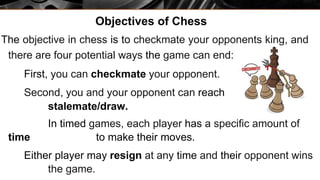
The objective in chess is to checkmate your opponents king, and
there are four potential ways the game can end:
First, you can checkmate your opponent.
Second, you and your opponent can reach
stalemate/draw.
In timed games, each player has a specific amount of
time to make their moves.
Either player may resign at any time and their opponent wins
the game.
Checkmate vs Stalemate
The Rules of
Chess
g Act of moving the pieces
• The movement of pieces is to be done with
one hand.
• When castling, the player should first move the
king with one hand and then move the rook with
the same hand.
A Touch-move rule
In serious play, if a player having the move
touches one of their pieces as if having the
intention of moving it, then the player must move it
if it can be legally moved.
Timing
Tournament games are played under time
constraints, called time controls, using
a game clock.
Recording moves
In formal competition, each player is obliged to
record each move as it is played in a chess
notation in order to settle disputes about illegal
positions, overstepping time control, and
making claims of draws by the fifty-move rule
or repetition of position.
Irregularities
! Illegal move
A player who makes an illegal move must
retract that move and make a legal move.
Illegal position
If it is discovered during the game that the
starting position was incorrect, the game is
restarted.
& Conduct
A Players may not use any notes, outside
sources of information (including computers),
or advice from other people. Players may not
leave the competition area without
permission of the arbiter.
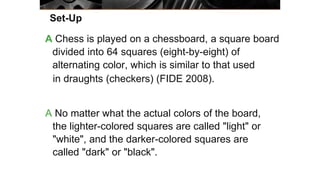
Set-Up
A Chess is played on a chessboard, a square board
divided into 64 squares (eight-by-eight) of
alternating color, which is similar to that used
in draughts (checkers) (FIDE 2008).
A No matter what the actual colors of the board,
the lighter-colored squares are called "light" or
"white", and the darker-colored squares are
called "dark" or "black".
Sixteen "white" and sixteen "black" pieces are
placed on the board at the beginning of the
game. Horizontal rows are
called ranks and vertical rows are
- _ ,, _ _. .£!1-----
Rook
Piece Queen Pawn
Number 1 1 2 2 2 8
Symbols
J.
.
Chess Set-Up
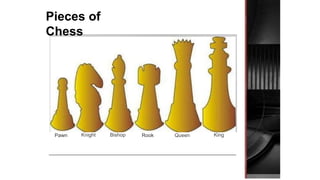
Pieces of
Chess
Pawn Knight Bishop Rook Queen King
I :
....
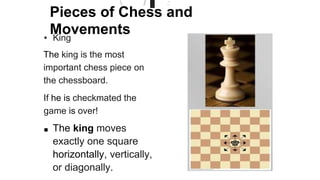
Pieces of Chess and
Movements
• King
The king is the most
important chess piece on
the chessboard.
If he is checkmated the
game is over!
■ The king moves
exactly one square
horizontally, vertically,
or diagonally.
• Castling consists of moving the
king two squares towards a rook,
then placing the rook on the other
side of the king, adjacent to it.
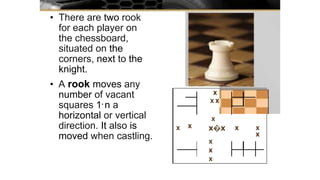
• There are two rook
for each player on
the chessboard,
situated on the
corners, next to the
knight.
• A rook moves any
number of vacant
squares 1• n a
horizontal or vertical
direction. It also is
moved when castling.
X
X X
X
X X x�x X X
X
X
X
X
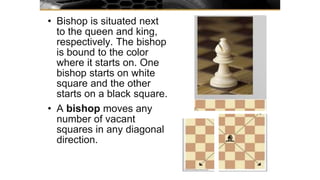
• Bishop is situated next
to the queen and king,
respectively. The bishop
is bound to the color
where it starts on. One
bishop starts on white
square and the other
starts on a black square.
• A bishop moves any
number of vacant
squares in any diagonal
direction.
' 1 '
.
I
 ...
I :..
.
• The queen is
considered the most
powerful chess piece
on the chessboard,
she is placed next to
the king on her own
color.
• The queen moves any
number of vacant
squares 1• n a
horizontal, vertical, or
diagonal direction
• The knight is situated
between the bishop
and the rook. These
chess piece have the
unique trait of being
able to 'leap' over other
chess pieces. They
move "L" shape.
• A knight moves to the
nearest square not on
the same rank, file, or
.
.
.
.
.
• •
• "
'-►
I
•
,
• A'!,,.
,a
••
•
;
•a
•"
• •
' ll
•
'' h
..
..
.
• Each player has eight pawns, providing the first line of
defense for their king.
• In their first move, each pawn has the option to move
one or two spaces. After this move they can only move
one space forward. To capture, the pawn moves
diagonally one space.
• Pawn can never move backwards.
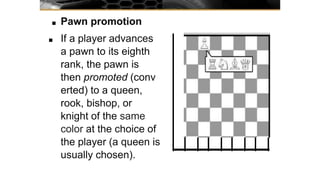
■ Pawn promotion
■ If a player advances
a pawn to its eighth
rank, the pawn is
then promoted (conv
erted) to a queen,
rook, bishop, or
knight of the same
color at the choice of
the player (a queen is
usually chosen).
Check
A king is in check when it is under attack
by at least one enemy piece. A piece
unable to move because it would place its
own king in check (it
is pinned against its own king) may still
deliver check to •
,j.j.j.
.t_
•
A player may not make any move
which places or leaves his king in
check. The possible ways to get out
of check are:
•Move the king to a square where it
is not threatened.
•Capture the threatening piece
(possibly with the king).
•Block the check by placing a piece
between the king and the opponent's
threatening piece
Famous Chess
Players
• Paul Morphy
■ USA (1837-1884)
• Many have claimed that Paul Morphy was the greatest chess player in history, and those claims
could have been proven true had he actually pursued a career in chess. After teaching himself
the ga1ne as a child by watching family members play, he was considered one of the best
players in New Orleans by age 9.
• Mikhail Botvinnik
• Russia(1911-1995)
• A lifelong Communist,
Mikhail Botvinnik held the
World Chan1pionship on and
off for 15 years, from 1948 to
1963 when he was eventually
defeated. Not only a great
player, he made significant
contributions to developing
the World Chess
Champions11ip after WW2.
• Bobby Fischer USA (1943-2008)
• Another player who has claims
to the greatest of all tin1e, Bobby
Fischer's worst opponent was
usually himself. Beginning at age
14, Fischer won 8 US
Championships, including the
1963-64 Toirrna1nent 11-0, tl1e
only perfect score in its history.
By 15, be was the youngest ever
Grandmaster (GM) and the
yo·ungest ever candidate for the
World Championship.
The
End!
Thank You!
©
listverse.com/2009/09/06/top-10-greatest-chess-players-in
history
http://en.wikipedia.org/wiki/Rules_of_chess#Cornpetition_rule
s

Chess

  • 1.
  • 2.
    History of Chess Thehistory of chess spans 1500 years. The earliest predecessor of the game probably originated in India, before the 6th century AD. From India the game spread to Persia, Arab and southern Europe.
  • 3.
    In Europe chessevolved roughly its current form in 15th century. In the second half of the 19th century Modern chess tournament play began. And the first World Chess Championship was held in 1886. The 20th century saw great leaps forward in chess theory and the establishment of the World Chess Federation (FIDE; from French - Fédération Internationale des Échecs ).
  • 4.
    Its early formin the 6th century was known as "chaturanga", which translates as four divisions (of the military): infantry, cavalry, elephantry, and chariotry. These forms are represented by the pieces that would evolved into the modern pawn, knight, bishop, and rook respectively. The game chaturanga was a battle simulation game which rendered Indian military strategy of time. Chess was used by Indian tool for military strategy, mathematics, and gambling.
  • 6.
    Objectives of Chess Theobjective in chess is to checkmate your opponents king, and there are four potential ways the game can end: First, you can checkmate your opponent. Second, you and your opponent can reach stalemate/draw. In timed games, each player has a specific amount of time to make their moves. Either player may resign at any time and their opponent wins the game.
  • 7.
  • 8.
    The Rules of Chess gAct of moving the pieces • The movement of pieces is to be done with one hand. • When castling, the player should first move the king with one hand and then move the rook with the same hand. A Touch-move rule In serious play, if a player having the move touches one of their pieces as if having the intention of moving it, then the player must move it if it can be legally moved.
  • 9.
    Timing Tournament games areplayed under time constraints, called time controls, using a game clock. Recording moves In formal competition, each player is obliged to record each move as it is played in a chess notation in order to settle disputes about illegal positions, overstepping time control, and making claims of draws by the fifty-move rule or repetition of position.
  • 10.
    Irregularities ! Illegal move Aplayer who makes an illegal move must retract that move and make a legal move. Illegal position If it is discovered during the game that the starting position was incorrect, the game is restarted.
  • 11.
    & Conduct A Playersmay not use any notes, outside sources of information (including computers), or advice from other people. Players may not leave the competition area without permission of the arbiter.
  • 12.
    Set-Up A Chess isplayed on a chessboard, a square board divided into 64 squares (eight-by-eight) of alternating color, which is similar to that used in draughts (checkers) (FIDE 2008). A No matter what the actual colors of the board, the lighter-colored squares are called "light" or "white", and the darker-colored squares are called "dark" or "black".
  • 13.
    Sixteen "white" andsixteen "black" pieces are placed on the board at the beginning of the game. Horizontal rows are called ranks and vertical rows are - _ ,, _ _. .£!1----- Rook Piece Queen Pawn Number 1 1 2 2 2 8 Symbols J. .
  • 14.
  • 15.
    Pieces of Chess Pawn KnightBishop Rook Queen King
  • 16.
    I : .... Pieces ofChess and Movements • King The king is the most important chess piece on the chessboard. If he is checkmated the game is over! ■ The king moves exactly one square horizontally, vertically, or diagonally.
  • 17.
    • Castling consistsof moving the king two squares towards a rook, then placing the rook on the other side of the king, adjacent to it.
  • 18.
    • There aretwo rook for each player on the chessboard, situated on the corners, next to the knight. • A rook moves any number of vacant squares 1• n a horizontal or vertical direction. It also is moved when castling. X X X X X X x�x X X X X X X
  • 19.
    • Bishop issituated next to the queen and king, respectively. The bishop is bound to the color where it starts on. One bishop starts on white square and the other starts on a black square. • A bishop moves any number of vacant squares in any diagonal direction.
  • 20.
    ' 1 ' . I ... I :.. . • The queen is considered the most powerful chess piece on the chessboard, she is placed next to the king on her own color. • The queen moves any number of vacant squares 1• n a horizontal, vertical, or diagonal direction
  • 21.
    • The knightis situated between the bishop and the rook. These chess piece have the unique trait of being able to 'leap' over other chess pieces. They move "L" shape. • A knight moves to the nearest square not on the same rank, file, or . . . . . • • • " '-►
  • 22.
    I • , • A'!,,. ,a •• • ; •a •" • • 'll • '' h .. .. . • Each player has eight pawns, providing the first line of defense for their king. • In their first move, each pawn has the option to move one or two spaces. After this move they can only move one space forward. To capture, the pawn moves diagonally one space. • Pawn can never move backwards.
  • 23.
    ■ Pawn promotion ■If a player advances a pawn to its eighth rank, the pawn is then promoted (conv erted) to a queen, rook, bishop, or knight of the same color at the choice of the player (a queen is usually chosen).
  • 24.
    Check A king isin check when it is under attack by at least one enemy piece. A piece unable to move because it would place its own king in check (it is pinned against its own king) may still deliver check to • ,j.j.j. .t_ •
  • 25.
    A player maynot make any move which places or leaves his king in check. The possible ways to get out of check are: •Move the king to a square where it is not threatened. •Capture the threatening piece (possibly with the king). •Block the check by placing a piece between the king and the opponent's threatening piece
  • 26.
    Famous Chess Players • PaulMorphy ■ USA (1837-1884) • Many have claimed that Paul Morphy was the greatest chess player in history, and those claims could have been proven true had he actually pursued a career in chess. After teaching himself the ga1ne as a child by watching family members play, he was considered one of the best players in New Orleans by age 9.
  • 27.
    • Mikhail Botvinnik •Russia(1911-1995) • A lifelong Communist, Mikhail Botvinnik held the World Chan1pionship on and off for 15 years, from 1948 to 1963 when he was eventually defeated. Not only a great player, he made significant contributions to developing the World Chess Champions11ip after WW2.
  • 28.
    • Bobby FischerUSA (1943-2008) • Another player who has claims to the greatest of all tin1e, Bobby Fischer's worst opponent was usually himself. Beginning at age 14, Fischer won 8 US Championships, including the 1963-64 Toirrna1nent 11-0, tl1e only perfect score in its history. By 15, be was the youngest ever Grandmaster (GM) and the yo·ungest ever candidate for the World Championship.
  • 29.