CHAPTER 15
Allocation of
Support Department Costs,
Common Costs,
and Revenues
15-2
To accompany Cost Accounting 12e, by Horngren/Datar/Foster. Copyright © 2006 by Pearson Education. All rights reserved.
Allocating Costs of a Supporting
Department to Operating Departments
 Supporting (Service) Department – provides
the services that assist other internal
departments in the company
 Operating (Production) Department – directly
adds value to a product or service
15-3
To accompany Cost Accounting 12e, by Horngren/Datar/Foster. Copyright © 2006 by Pearson Education. All rights reserved.
Methods to Allocate
Support Department Costs
 Single-Rate Method – allocates costs in each
cost pool (service department) to cost objects
(production departments) using the same rate
per unit of a single allocation base
 No distinction is made between fixed and
variable costs in this method
15-4
To accompany Cost Accounting 12e, by Horngren/Datar/Foster. Copyright © 2006 by Pearson Education. All rights reserved.
Methods to Allocate
Support Department Costs
 Dual-Rate Method – segregates costs within
each cost pool into two segments: a variable-
cost pool and a fixed-cost pool.
 Each pool uses a different cost-allocation
base
15-5
To accompany Cost Accounting 12e, by Horngren/Datar/Foster. Copyright © 2006 by Pearson Education. All rights reserved.
Allocation Method Tradeoffs
 Single-rate method is simple to implement,
but treats fixed costs in a manner similar to
variable costs
 Dual-rate method treats fixed and variable
costs more realistically, but is more complex
to implement
15-6
To accompany Cost Accounting 12e, by Horngren/Datar/Foster. Copyright © 2006 by Pearson Education. All rights reserved.
Allocation Bases
 Under either method, allocation of support costs
can be based on one of the three following
scenarios:
1. Budgeted overhead rate and budgeted hours
2. Budgeted overhead rate and actual hours
3. Actual overhead rate and actual hours
 Choosing between actual and budgeted rates:
budgeted is known at the beginning of the period,
while actual will not be known with certainty until
the end of the period
15-7
To accompany Cost Accounting 12e, by Horngren/Datar/Foster. Copyright © 2006 by Pearson Education. All rights reserved.
Methods of Allocating Support Costs
to Production Departments
1. Direct
2. Step-Down
3. Reciprocal
15-8
To accompany Cost Accounting 12e, by Horngren/Datar/Foster. Copyright © 2006 by Pearson Education. All rights reserved.
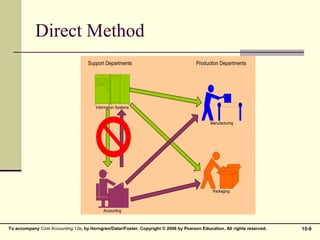
Direct Method
 Allocates support costs only to Operating
Departments
 No interaction between Support Departments
prior to allocation
15-9
To accompany Cost Accounting 12e, by Horngren/Datar/Foster. Copyright © 2006 by Pearson Education. All rights reserved.
Direct Method
Manufacturing
Information Systems
Accounting
Packaging
Support Departments Production Departments
15-10
To accompany Cost Accounting 12e, by Horngren/Datar/Foster. Copyright © 2006 by Pearson Education. All rights reserved.
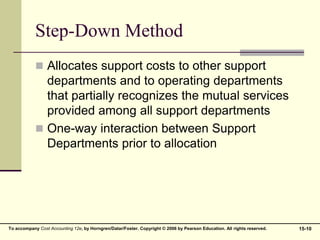
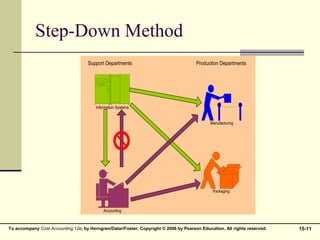
Step-Down Method
 Allocates support costs to other support
departments and to operating departments
that partially recognizes the mutual services
provided among all support departments
 One-way interaction between Support
Departments prior to allocation
15-11
To accompany Cost Accounting 12e, by Horngren/Datar/Foster. Copyright © 2006 by Pearson Education. All rights reserved.
Step-Down Method
Manufacturing
Information Systems
Accounting
Packaging
Support Departments Production Departments
15-12
To accompany Cost Accounting 12e, by Horngren/Datar/Foster. Copyright © 2006 by Pearson Education. All rights reserved.
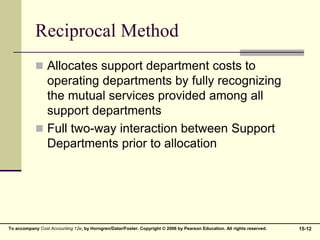
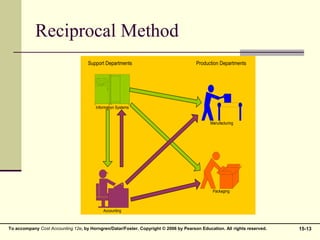
Reciprocal Method
 Allocates support department costs to
operating departments by fully recognizing
the mutual services provided among all
support departments
 Full two-way interaction between Support
Departments prior to allocation
15-13
To accompany Cost Accounting 12e, by Horngren/Datar/Foster. Copyright © 2006 by Pearson Education. All rights reserved.
Reciprocal Method
Manufacturing
Information Systems
Accounting
Packaging
Support Departments Production Departments
15-14
To accompany Cost Accounting 12e, by Horngren/Datar/Foster. Copyright © 2006 by Pearson Education. All rights reserved.
Choosing Between Methods
 Reciprocal is the most precise
 Direct and Step-Down are simple to compute
and understand
 Direct Method is widely used
15-15
To accompany Cost Accounting 12e, by Horngren/Datar/Foster. Copyright © 2006 by Pearson Education. All rights reserved.
Allocating Common Costs
 Common Cost – the cost of operating a
facility, activity, or like cost object that is
shared by two or more users at a lower cost
than the individual cost of the activity to each
user
15-16
To accompany Cost Accounting 12e, by Horngren/Datar/Foster. Copyright © 2006 by Pearson Education. All rights reserved.
Methods of Allocating
Common Costs
 Stand-Alone Cost-Allocation Method – uses
information pertaining to each user of a cost
object as a separate entity to determine the
cost-allocation weights
 Individual costs are added together and
allocation percentages are calculated from
the whole, and applied to the common cost
15-17
To accompany Cost Accounting 12e, by Horngren/Datar/Foster. Copyright © 2006 by Pearson Education. All rights reserved.
Methods of Allocating
Common Costs
 Incremental Cost-Allocation Method ranks the individual users of
a cost object in the order of users most responsible for a
common cost and then uses this ranking to allocate the cost
among the users
 The first ranked user is the Primary User and is allocated
costs up to the costs of the primary user as a stand-alone
user (typically gets the highest allocation of the common
costs)
 The second ranked user is the First Incremental User and is
allocated the additional cost that arises from two users rather
than one
 Subsequent users handled in the same manner as the
second ranked user
15-18
To accompany Cost Accounting 12e, by Horngren/Datar/Foster. Copyright © 2006 by Pearson Education. All rights reserved.
Cost Allocations and Contracting
 The US government reimburses most
contractors in either of two main ways:
1. The contractor is paid a set price without
analysis of actual contract cost data
2. The contractor is paid after an analysis of
actual contract cost data. In some cases,
the contract will state that the reimbursement
amount is based on actual allowable costs
plus a fixed fee (cost-plus contract)
15-19
To accompany Cost Accounting 12e, by Horngren/Datar/Foster. Copyright © 2006 by Pearson Education. All rights reserved.
Revenue Allocation and
Bundled Products
 Revenue Allocation occurs when revenues are
related to a particular revenue object but cannot be
traced to it in an economically feasible manner
 Revenue Object – anything for which a separate
measurement of revenue is desired
 Bundled Product – a package of two or more
products or services that are sold for single price, but
individual components of the bundle also may be sold
as separate items at their own “stand-alone” prices
15-20
To accompany Cost Accounting 12e, by Horngren/Datar/Foster. Copyright © 2006 by Pearson Education. All rights reserved.
Methods to Allocate Revenue to
Bundled Products
 Stand-Alone (separate) Revenue Allocation
Method uses product-specific information on
the products in the bundle as weights for
allocating the bundled revenues to the
individual products. Three types of weights
may be used:
1. Selling Prices
2. Unit Costs
3. Physical Units
15-21
To accompany Cost Accounting 12e, by Horngren/Datar/Foster. Copyright © 2006 by Pearson Education. All rights reserved.
Methods to Allocate Revenue to
Bundled Products
 Incremental Revenue-Allocation Method ranks
individual products in a bundle according to criteria
determined by management and then uses this
ranking to allocate bundled revenues to individual
products (similar to earlier discussed Incremental
Cost-Allocation Method)
 The first-ranked product is the primary product
 The second-ranked product is the first incremental
product
 The third-ranked product is the second incremental
product, etc.

cost12eppt_15.ppt

  • 1.
    CHAPTER 15 Allocation of SupportDepartment Costs, Common Costs, and Revenues
  • 2.
    15-2 To accompany CostAccounting 12e, by Horngren/Datar/Foster. Copyright © 2006 by Pearson Education. All rights reserved. Allocating Costs of a Supporting Department to Operating Departments  Supporting (Service) Department – provides the services that assist other internal departments in the company  Operating (Production) Department – directly adds value to a product or service
  • 3.
    15-3 To accompany CostAccounting 12e, by Horngren/Datar/Foster. Copyright © 2006 by Pearson Education. All rights reserved. Methods to Allocate Support Department Costs  Single-Rate Method – allocates costs in each cost pool (service department) to cost objects (production departments) using the same rate per unit of a single allocation base  No distinction is made between fixed and variable costs in this method
  • 4.
    15-4 To accompany CostAccounting 12e, by Horngren/Datar/Foster. Copyright © 2006 by Pearson Education. All rights reserved. Methods to Allocate Support Department Costs  Dual-Rate Method – segregates costs within each cost pool into two segments: a variable- cost pool and a fixed-cost pool.  Each pool uses a different cost-allocation base
  • 5.
    15-5 To accompany CostAccounting 12e, by Horngren/Datar/Foster. Copyright © 2006 by Pearson Education. All rights reserved. Allocation Method Tradeoffs  Single-rate method is simple to implement, but treats fixed costs in a manner similar to variable costs  Dual-rate method treats fixed and variable costs more realistically, but is more complex to implement
  • 6.
    15-6 To accompany CostAccounting 12e, by Horngren/Datar/Foster. Copyright © 2006 by Pearson Education. All rights reserved. Allocation Bases  Under either method, allocation of support costs can be based on one of the three following scenarios: 1. Budgeted overhead rate and budgeted hours 2. Budgeted overhead rate and actual hours 3. Actual overhead rate and actual hours  Choosing between actual and budgeted rates: budgeted is known at the beginning of the period, while actual will not be known with certainty until the end of the period
  • 7.
    15-7 To accompany CostAccounting 12e, by Horngren/Datar/Foster. Copyright © 2006 by Pearson Education. All rights reserved. Methods of Allocating Support Costs to Production Departments 1. Direct 2. Step-Down 3. Reciprocal
  • 8.
    15-8 To accompany CostAccounting 12e, by Horngren/Datar/Foster. Copyright © 2006 by Pearson Education. All rights reserved. Direct Method  Allocates support costs only to Operating Departments  No interaction between Support Departments prior to allocation
  • 9.
    15-9 To accompany CostAccounting 12e, by Horngren/Datar/Foster. Copyright © 2006 by Pearson Education. All rights reserved. Direct Method Manufacturing Information Systems Accounting Packaging Support Departments Production Departments
  • 10.
    15-10 To accompany CostAccounting 12e, by Horngren/Datar/Foster. Copyright © 2006 by Pearson Education. All rights reserved. Step-Down Method  Allocates support costs to other support departments and to operating departments that partially recognizes the mutual services provided among all support departments  One-way interaction between Support Departments prior to allocation
  • 11.
    15-11 To accompany CostAccounting 12e, by Horngren/Datar/Foster. Copyright © 2006 by Pearson Education. All rights reserved. Step-Down Method Manufacturing Information Systems Accounting Packaging Support Departments Production Departments
  • 12.
    15-12 To accompany CostAccounting 12e, by Horngren/Datar/Foster. Copyright © 2006 by Pearson Education. All rights reserved. Reciprocal Method  Allocates support department costs to operating departments by fully recognizing the mutual services provided among all support departments  Full two-way interaction between Support Departments prior to allocation
  • 13.
    15-13 To accompany CostAccounting 12e, by Horngren/Datar/Foster. Copyright © 2006 by Pearson Education. All rights reserved. Reciprocal Method Manufacturing Information Systems Accounting Packaging Support Departments Production Departments
  • 14.
    15-14 To accompany CostAccounting 12e, by Horngren/Datar/Foster. Copyright © 2006 by Pearson Education. All rights reserved. Choosing Between Methods  Reciprocal is the most precise  Direct and Step-Down are simple to compute and understand  Direct Method is widely used
  • 15.
    15-15 To accompany CostAccounting 12e, by Horngren/Datar/Foster. Copyright © 2006 by Pearson Education. All rights reserved. Allocating Common Costs  Common Cost – the cost of operating a facility, activity, or like cost object that is shared by two or more users at a lower cost than the individual cost of the activity to each user
  • 16.
    15-16 To accompany CostAccounting 12e, by Horngren/Datar/Foster. Copyright © 2006 by Pearson Education. All rights reserved. Methods of Allocating Common Costs  Stand-Alone Cost-Allocation Method – uses information pertaining to each user of a cost object as a separate entity to determine the cost-allocation weights  Individual costs are added together and allocation percentages are calculated from the whole, and applied to the common cost
  • 17.
    15-17 To accompany CostAccounting 12e, by Horngren/Datar/Foster. Copyright © 2006 by Pearson Education. All rights reserved. Methods of Allocating Common Costs  Incremental Cost-Allocation Method ranks the individual users of a cost object in the order of users most responsible for a common cost and then uses this ranking to allocate the cost among the users  The first ranked user is the Primary User and is allocated costs up to the costs of the primary user as a stand-alone user (typically gets the highest allocation of the common costs)  The second ranked user is the First Incremental User and is allocated the additional cost that arises from two users rather than one  Subsequent users handled in the same manner as the second ranked user
  • 18.
    15-18 To accompany CostAccounting 12e, by Horngren/Datar/Foster. Copyright © 2006 by Pearson Education. All rights reserved. Cost Allocations and Contracting  The US government reimburses most contractors in either of two main ways: 1. The contractor is paid a set price without analysis of actual contract cost data 2. The contractor is paid after an analysis of actual contract cost data. In some cases, the contract will state that the reimbursement amount is based on actual allowable costs plus a fixed fee (cost-plus contract)
  • 19.
    15-19 To accompany CostAccounting 12e, by Horngren/Datar/Foster. Copyright © 2006 by Pearson Education. All rights reserved. Revenue Allocation and Bundled Products  Revenue Allocation occurs when revenues are related to a particular revenue object but cannot be traced to it in an economically feasible manner  Revenue Object – anything for which a separate measurement of revenue is desired  Bundled Product – a package of two or more products or services that are sold for single price, but individual components of the bundle also may be sold as separate items at their own “stand-alone” prices
  • 20.
    15-20 To accompany CostAccounting 12e, by Horngren/Datar/Foster. Copyright © 2006 by Pearson Education. All rights reserved. Methods to Allocate Revenue to Bundled Products  Stand-Alone (separate) Revenue Allocation Method uses product-specific information on the products in the bundle as weights for allocating the bundled revenues to the individual products. Three types of weights may be used: 1. Selling Prices 2. Unit Costs 3. Physical Units
  • 21.
    15-21 To accompany CostAccounting 12e, by Horngren/Datar/Foster. Copyright © 2006 by Pearson Education. All rights reserved. Methods to Allocate Revenue to Bundled Products  Incremental Revenue-Allocation Method ranks individual products in a bundle according to criteria determined by management and then uses this ranking to allocate bundled revenues to individual products (similar to earlier discussed Incremental Cost-Allocation Method)  The first-ranked product is the primary product  The second-ranked product is the first incremental product  The third-ranked product is the second incremental product, etc.