Cost Reduction
Current and Future Economic stability is dependent on primary drivers such as
ROC(return on capital employed), operating margin, Net asset Turnover to focus on
revenue management, cost management, fixed asset management and working capital
management.
To align with the objective of WMS(World class Manufacturing System) in India region
with strategy as low cost producer and developing initiative as control on cash flows.
Various projects being taken for reduction in manufacturing overheads, cost reduction in
areas of indirect expenses, inventory reduction etc.
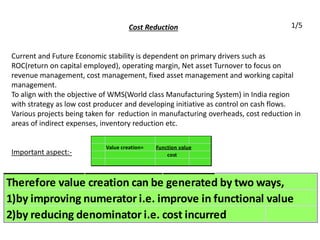
Important aspect:-
Value creation= Function value
cost
Therefore value creation can be generated by two ways,
1)by improving numerator i.e. improve in functional value
2)by reducing denominator i.e. cost incurred
1/5
As an illustration let us take a real life example stating: To reduce indirect expenses in Mumbai
unit by 18% from $ 4,687,343.07 to $ 3,843,621.31 and by sustenance of functional value &
improved Value creation.
exhibit1
Following steps will take us to solution as way of statistical process systematically.
Draw pareto also known as 80:20 rule of these expenses so as to get high consuming particulars
with selected area.
Particulars
Machine Shop
Operations
Assembly area
Operations
Tools mfg expense $2,434,461.60 $928,368.27
Machine maintenance $610,885.20 $224,280.53
Other operating supplies 332591.4667 $60,880.93
Shipping and Packing $6,320 $75,520.53
Non-capitalised equipments 0 $14,034.53
Total $3,384,258.27 $1,303,084.80
Total indirect expenses $4,687,343.07
Target reduction 18% $3,843,621.31
Expected savings $843,721.75
Expected savings K$ $843.72
2/5
Exhibit2
Readers can easily select Tools mfg expenses as high contributing in the exhibit2.
Next step will be to focus on targeted particular i.e. “Tools mfg expenses” and drill down
further to get in-depth analysis of cost expenses.
Readers can collect the list of all expenses which has incurred against high consuming
particular items and prepare again pareto chart. This will be instrumental in addressing high
pots for further action plan in reducing cost.
Further will have to analyze at micro level on the each and individual particulars contributing
to the expenses, so far we have identified the items list contributing for the highest amount
of cost consumption. Now, having the list of contributing tools for high consumption and
high cost we shall be dealing with next step i.e. root cause for each contributing tools.
0
10
20
30
40
50
60
70
80
90
100
0
500000
1000000
1500000
2000000
2500000
3000000
3500000
4000000
Total expenses
Pareto chart of
Indirect
expenses in $ 3/5
Next step to analyze each high contributing type of tools with help of FTA i.e. fault tree
analysis as per following exhibits No. 3,4,5,6.
4/5
Exhibit 3 Exhibit 4
Exhibit 5 Exhibit 6
After solving FTA we will derive with action items as per exhibit No.7.
Final stage will be to execute the freeze action item and then monitoring for success and
sustenance. Extensive prove out and end stakeholder involvement is must.
Conclusion: Monitoring the data for twelve months has demonstrated improvement in the
indirect cost in tool mfg expenses from $ 4,687,343.07 to $ 3,843,621.31 improvement by
18%, this was instrumental in improved PBIT.
5/5
Exhibit 7

Cost reduction real example.pdf

  • 1.
    Cost Reduction Current andFuture Economic stability is dependent on primary drivers such as ROC(return on capital employed), operating margin, Net asset Turnover to focus on revenue management, cost management, fixed asset management and working capital management. To align with the objective of WMS(World class Manufacturing System) in India region with strategy as low cost producer and developing initiative as control on cash flows. Various projects being taken for reduction in manufacturing overheads, cost reduction in areas of indirect expenses, inventory reduction etc. Important aspect:- Value creation= Function value cost Therefore value creation can be generated by two ways, 1)by improving numerator i.e. improve in functional value 2)by reducing denominator i.e. cost incurred 1/5
  • 2.
    As an illustrationlet us take a real life example stating: To reduce indirect expenses in Mumbai unit by 18% from $ 4,687,343.07 to $ 3,843,621.31 and by sustenance of functional value & improved Value creation. exhibit1 Following steps will take us to solution as way of statistical process systematically. Draw pareto also known as 80:20 rule of these expenses so as to get high consuming particulars with selected area. Particulars Machine Shop Operations Assembly area Operations Tools mfg expense $2,434,461.60 $928,368.27 Machine maintenance $610,885.20 $224,280.53 Other operating supplies 332591.4667 $60,880.93 Shipping and Packing $6,320 $75,520.53 Non-capitalised equipments 0 $14,034.53 Total $3,384,258.27 $1,303,084.80 Total indirect expenses $4,687,343.07 Target reduction 18% $3,843,621.31 Expected savings $843,721.75 Expected savings K$ $843.72 2/5
  • 3.
    Exhibit2 Readers can easilyselect Tools mfg expenses as high contributing in the exhibit2. Next step will be to focus on targeted particular i.e. “Tools mfg expenses” and drill down further to get in-depth analysis of cost expenses. Readers can collect the list of all expenses which has incurred against high consuming particular items and prepare again pareto chart. This will be instrumental in addressing high pots for further action plan in reducing cost. Further will have to analyze at micro level on the each and individual particulars contributing to the expenses, so far we have identified the items list contributing for the highest amount of cost consumption. Now, having the list of contributing tools for high consumption and high cost we shall be dealing with next step i.e. root cause for each contributing tools. 0 10 20 30 40 50 60 70 80 90 100 0 500000 1000000 1500000 2000000 2500000 3000000 3500000 4000000 Total expenses Pareto chart of Indirect expenses in $ 3/5
  • 4.
    Next step toanalyze each high contributing type of tools with help of FTA i.e. fault tree analysis as per following exhibits No. 3,4,5,6. 4/5 Exhibit 3 Exhibit 4 Exhibit 5 Exhibit 6
  • 5.
    After solving FTAwe will derive with action items as per exhibit No.7. Final stage will be to execute the freeze action item and then monitoring for success and sustenance. Extensive prove out and end stakeholder involvement is must. Conclusion: Monitoring the data for twelve months has demonstrated improvement in the indirect cost in tool mfg expenses from $ 4,687,343.07 to $ 3,843,621.31 improvement by 18%, this was instrumental in improved PBIT. 5/5 Exhibit 7