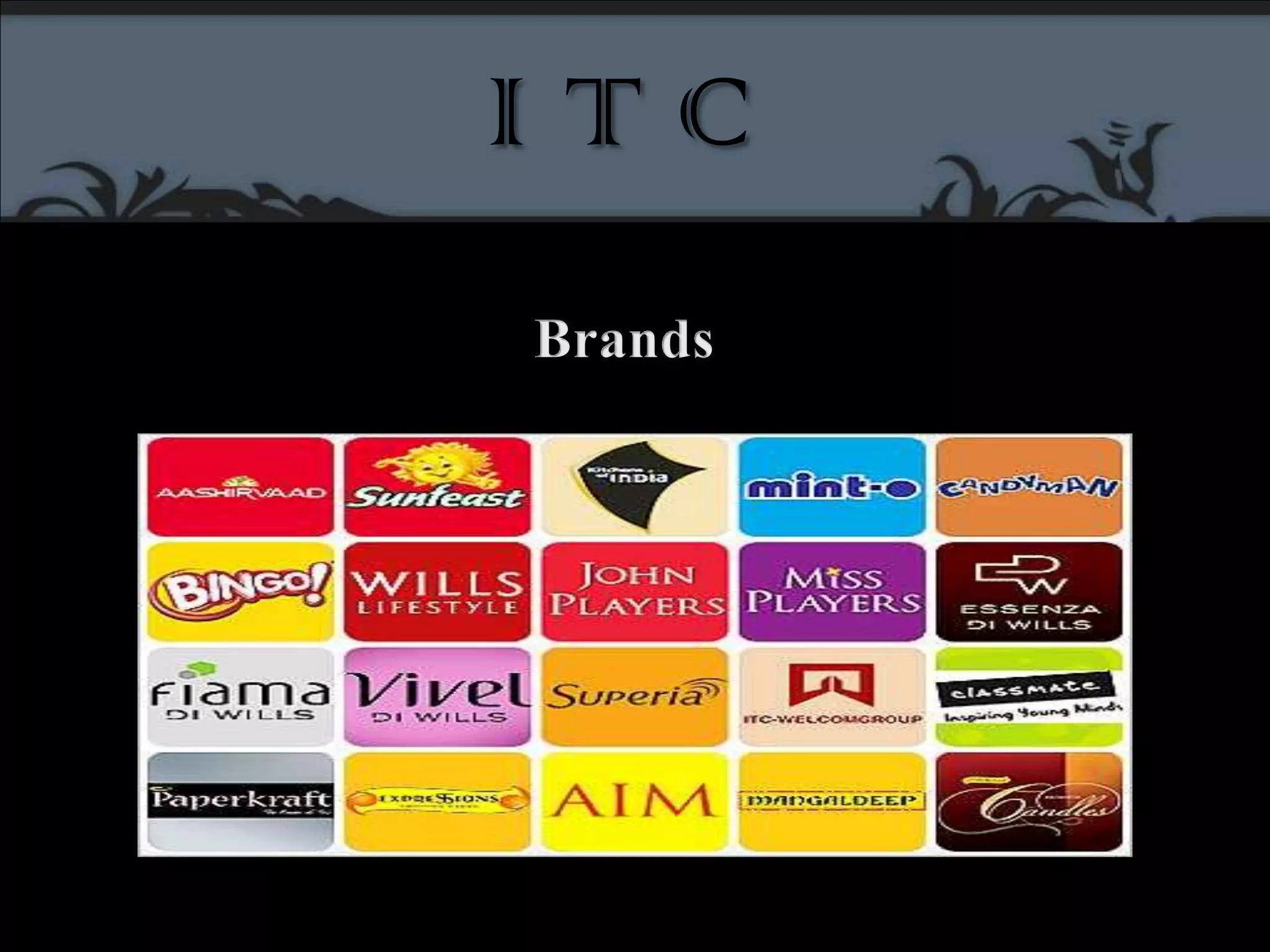

ITCBrands
ITC
FOCUSComputation ofCost of Capitalof ITC Ltd.
Data AnalystsDivanshu Kapoor (91017)	                                                      Radhika Gupta (91041)MadhusudhanPartani (91029)Anika Gupta (91005) 	                                                  Manish TN Singh (91053)
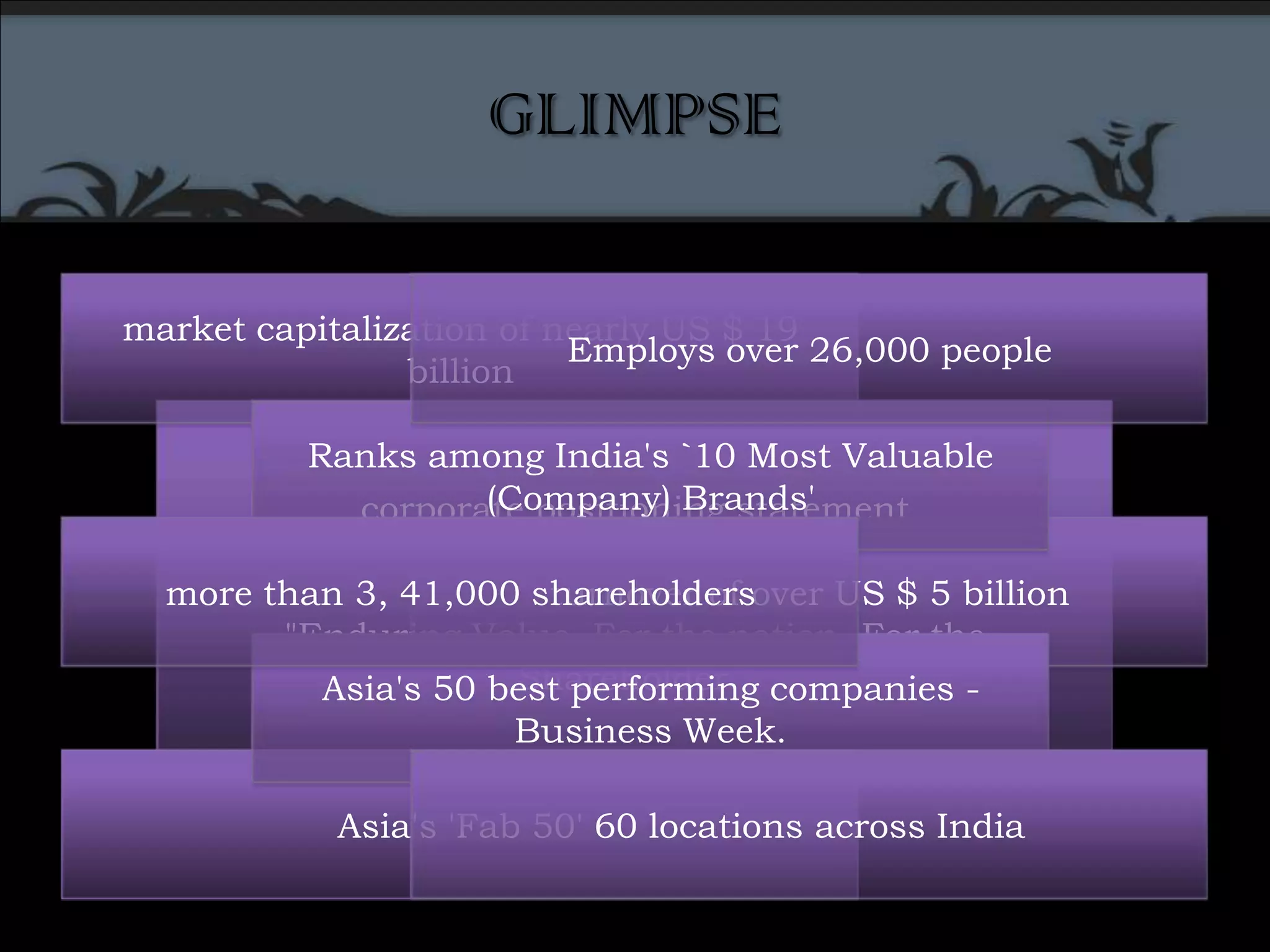
GLIMPSEmarket capitalization of nearly US $ 19 billionEmploys over 26,000 people corporate positioning statement"Enduring Value. For the nation. For the Shareholder."Ranks among India's `10 Most Valuable (Company) Brands'turnover of over US $ 5 billionmore than 3, 41,000 shareholdersAsia's 50 best performing companies -Business Week.Asia's 'Fab 50'60 locations across India
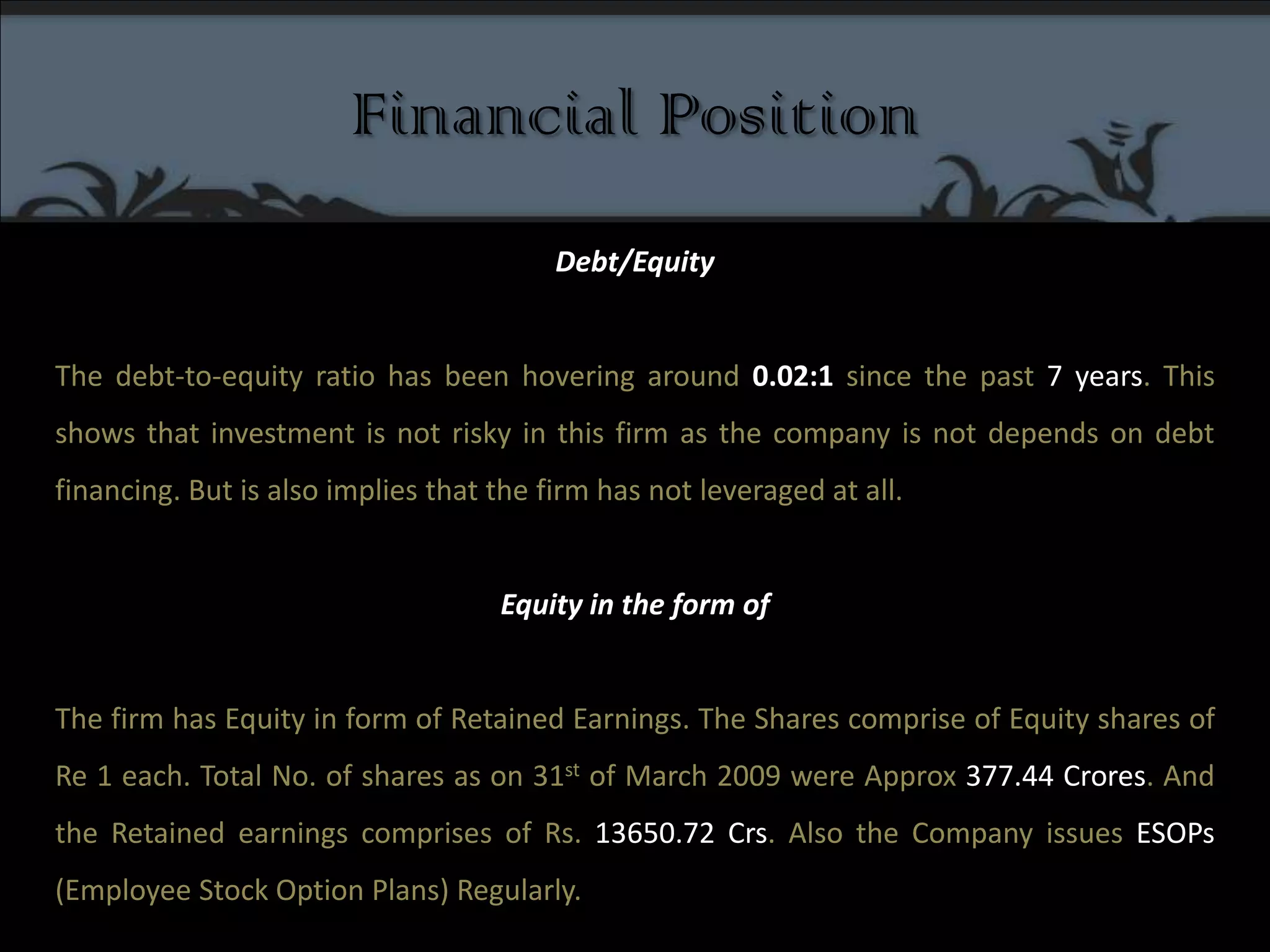
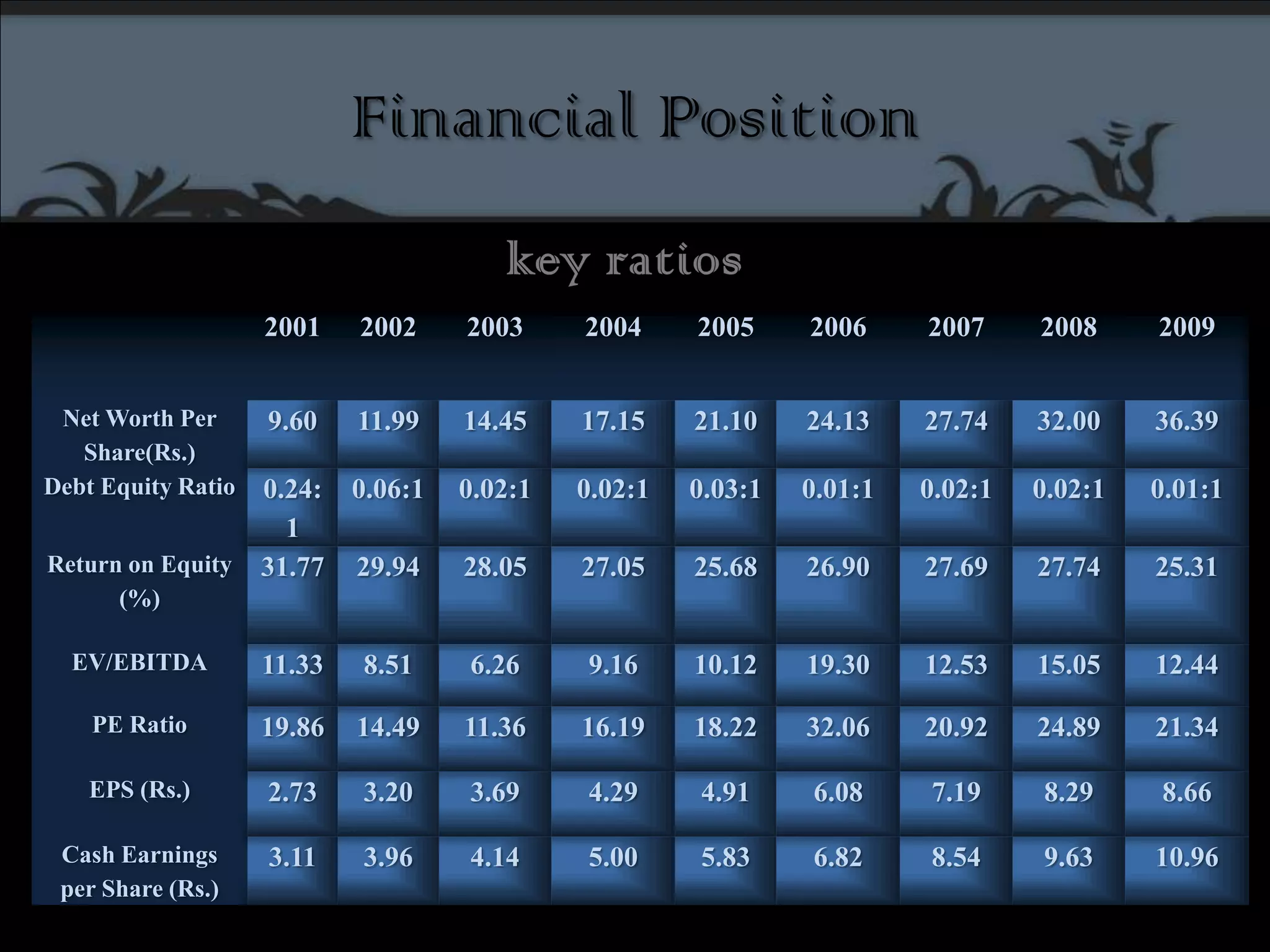
Financial PositionDebt/Equity The debt-to-equity ratio has been hovering around 0.02:1 since the past 7 years. This shows that investment is not risky in this firm as the company is not depends on debt financing. But is also implies that the firm has not leveraged at all. Equity in the form of The firm has Equity in form of Retained Earnings. The Shares comprise of Equity shares of Re 1 each. Total No. of shares as on 31st of March 2009 were Approx 377.44 Crores. And the Retained earnings comprises of Rs. 13650.72 Crs. Also the Company issues ESOPs (Employee Stock Option Plans) Regularly. 
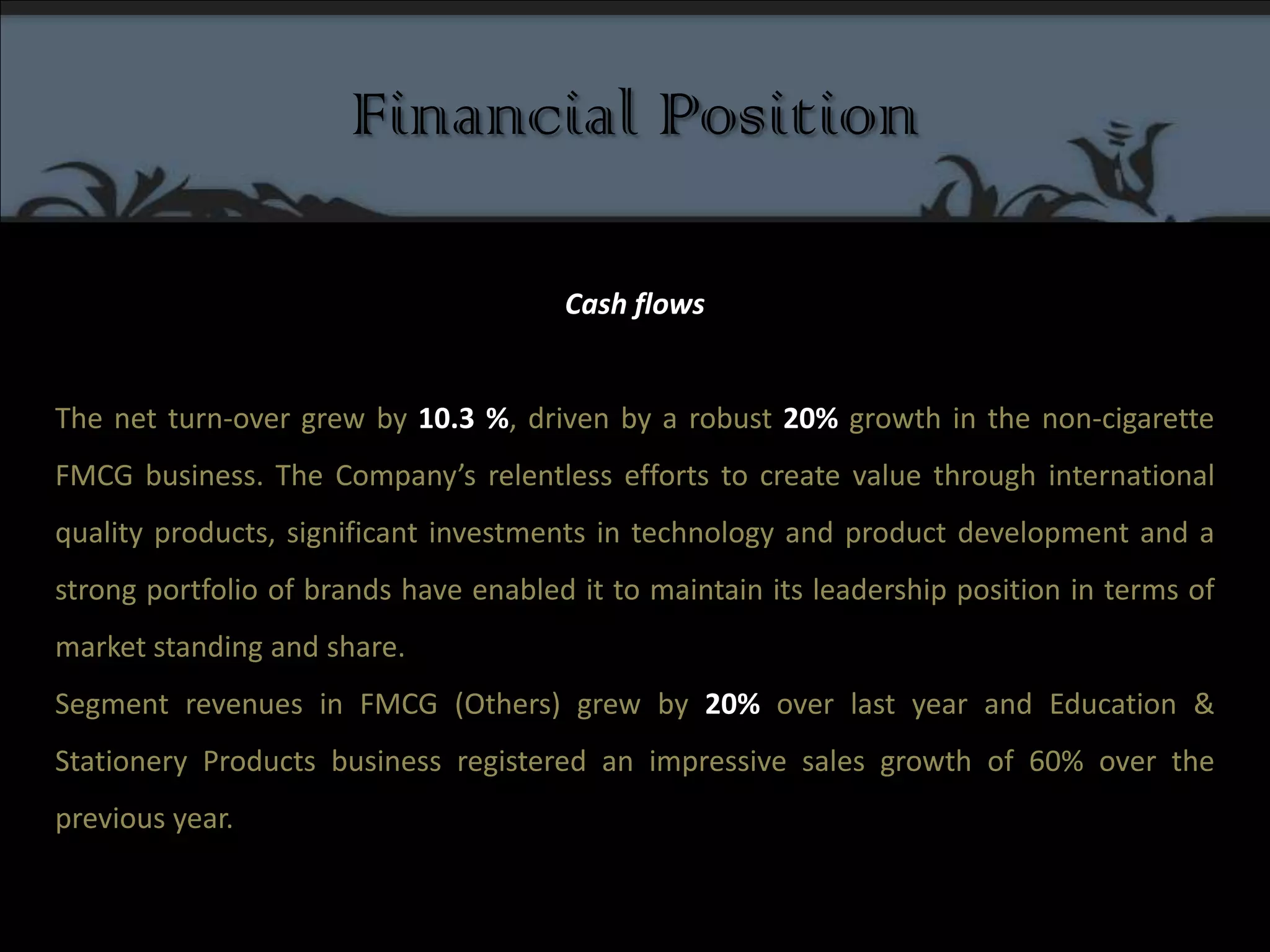
Financial PositionCash flows The net turn-over grew by 10.3 %, driven by a robust 20% growth in the non-cigarette FMCG business. The Company’s relentless efforts to create value through international quality products, significant investments in technology and product development and a strong portfolio of brands have enabled it to maintain its leadership position in terms of market standing and share.Segment revenues in FMCG (Others) grew by 20% over last year and Education & Stationery Products business registered an impressive sales growth of 60% over the previous year.
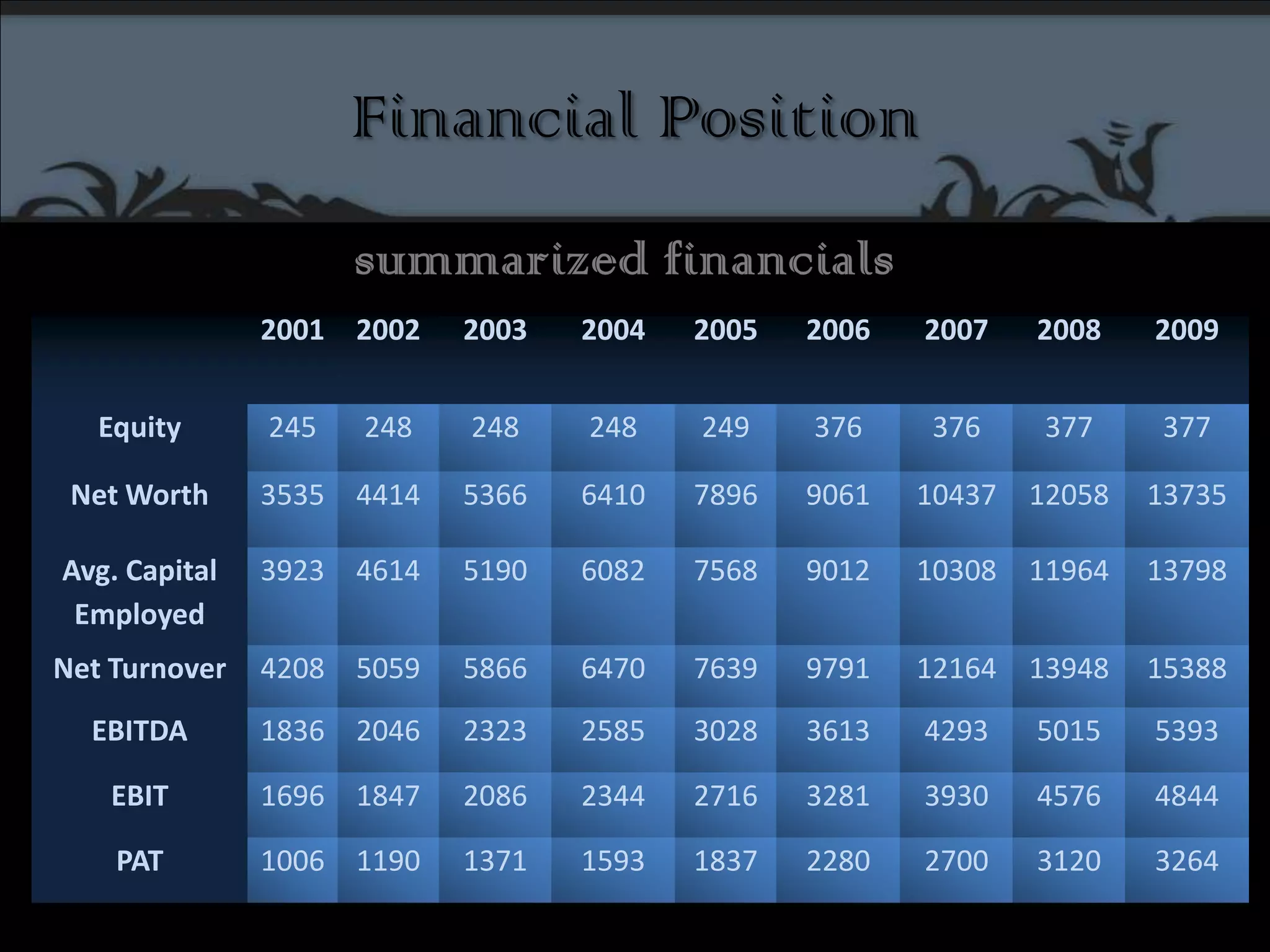
Financial Positionsummarized financials
Financial Positionkey ratios
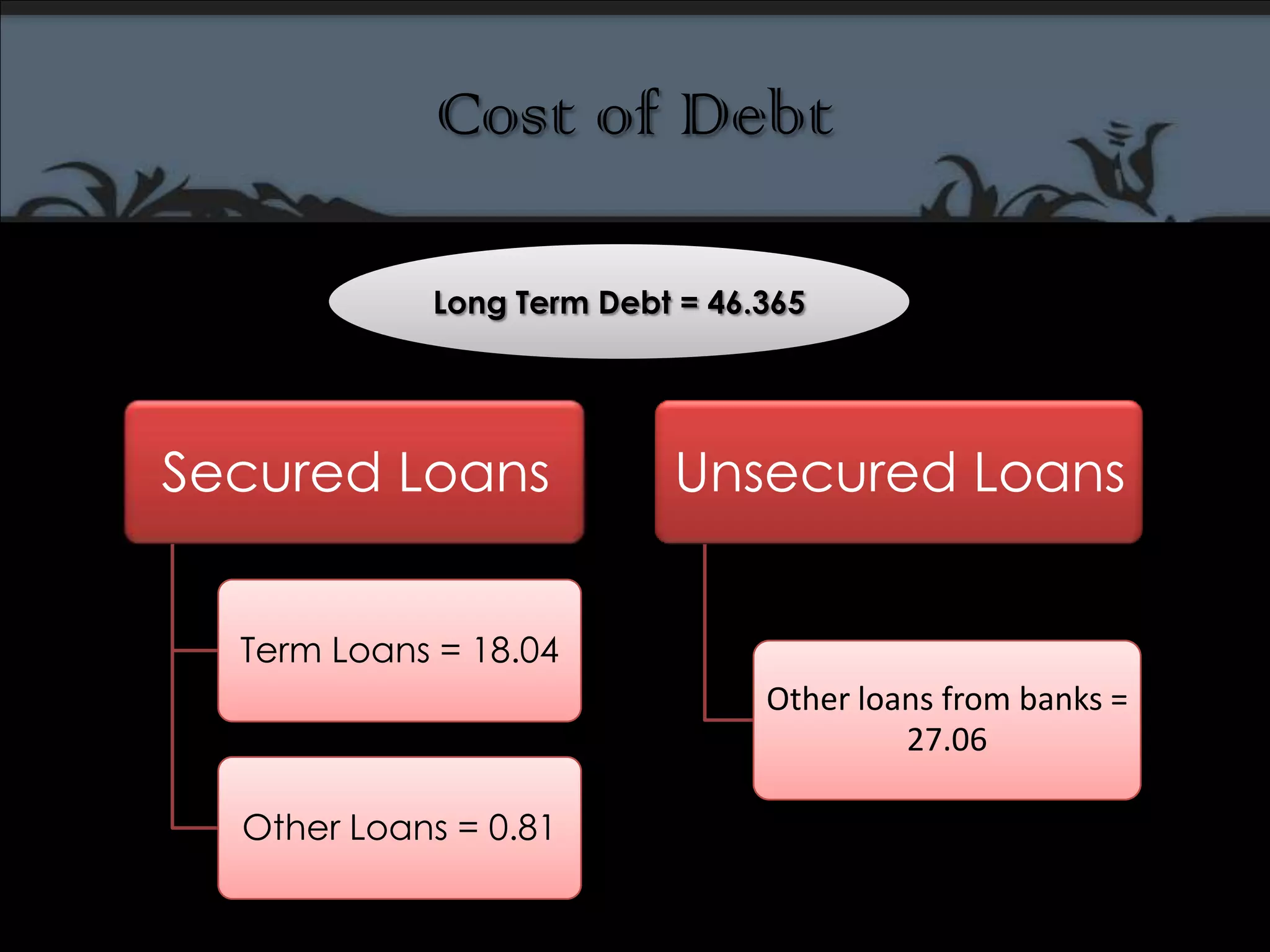
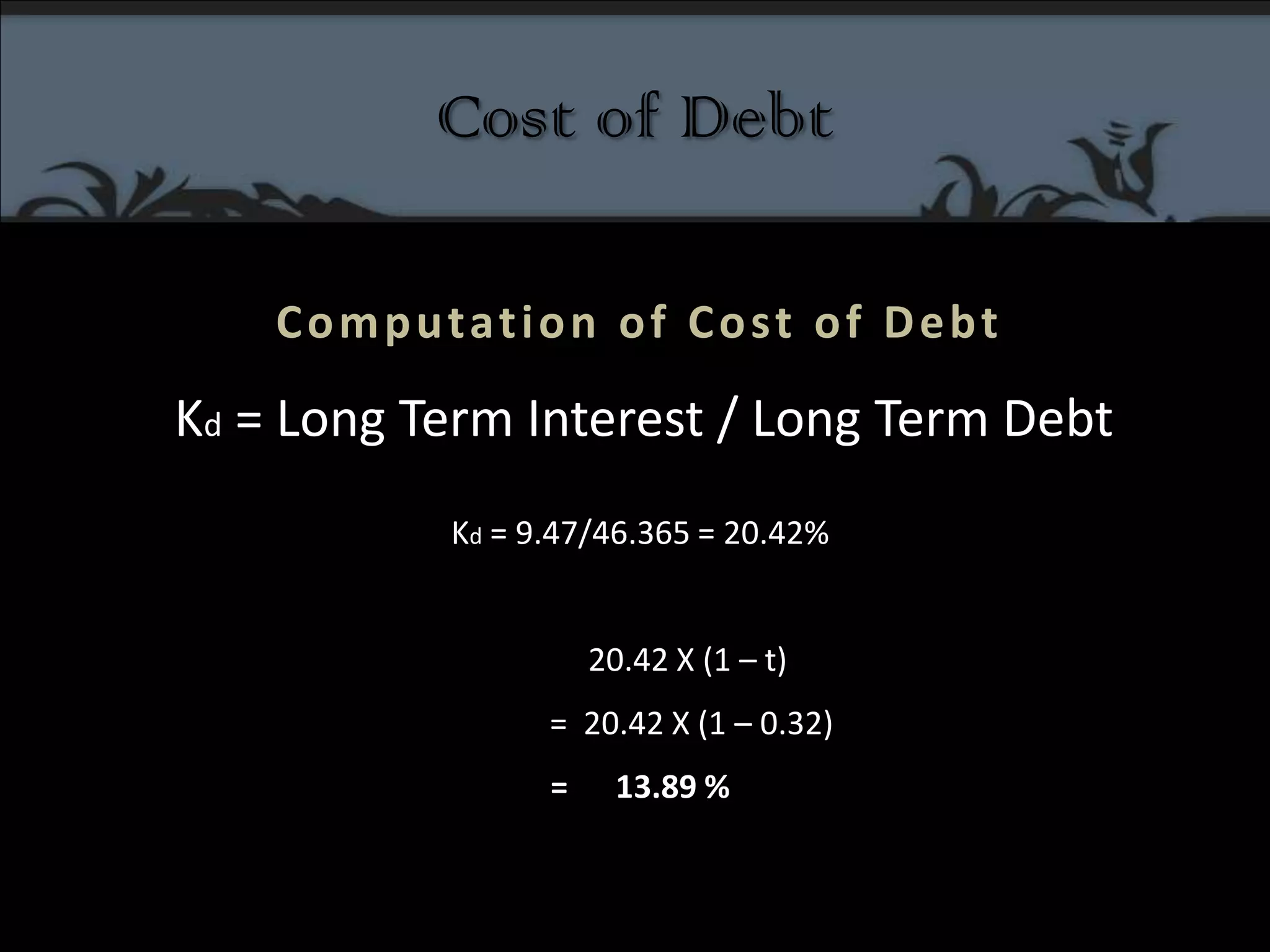
Cost of DebtLong Term Debt = 46.365
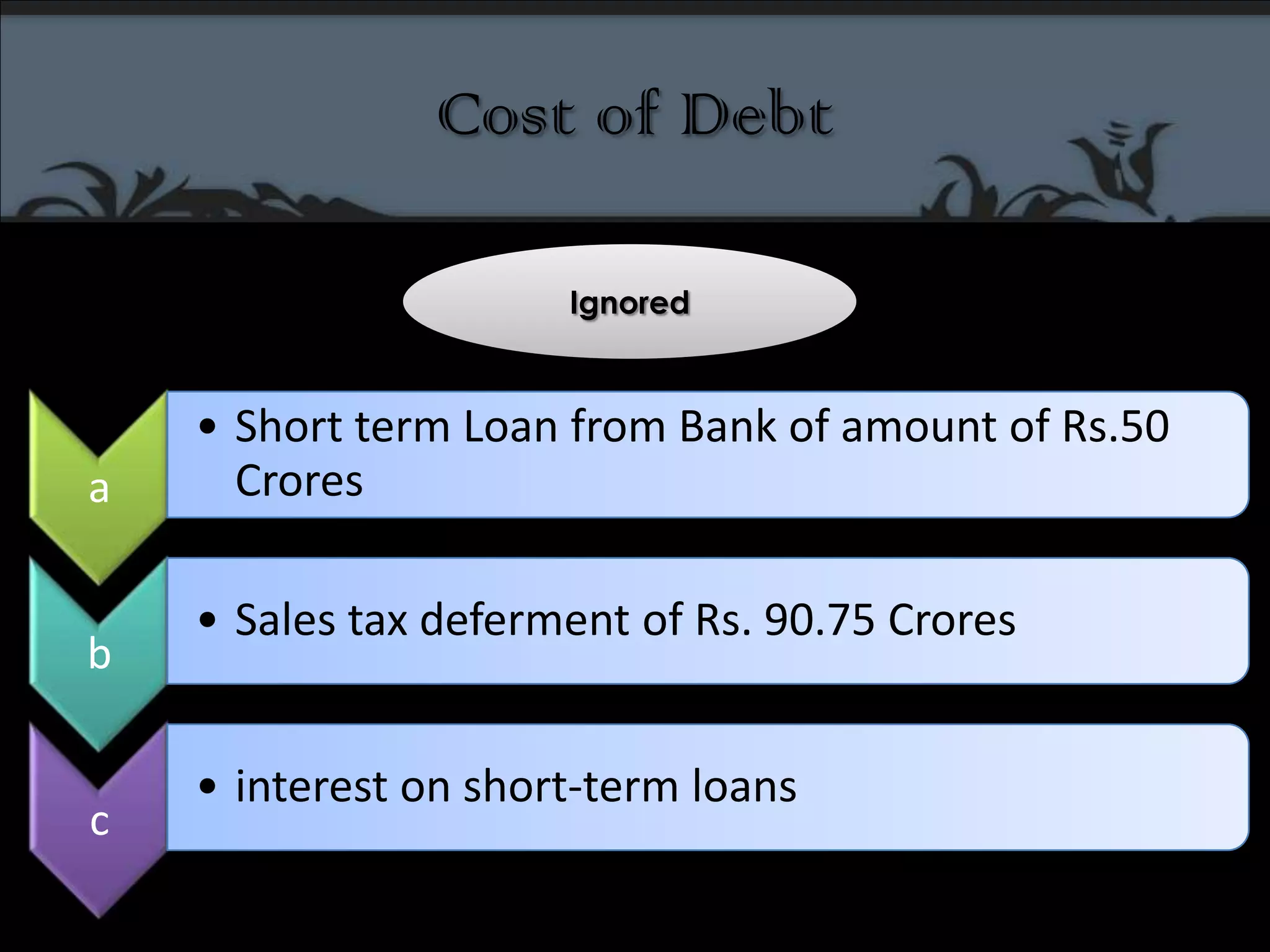
Cost of DebtIgnored
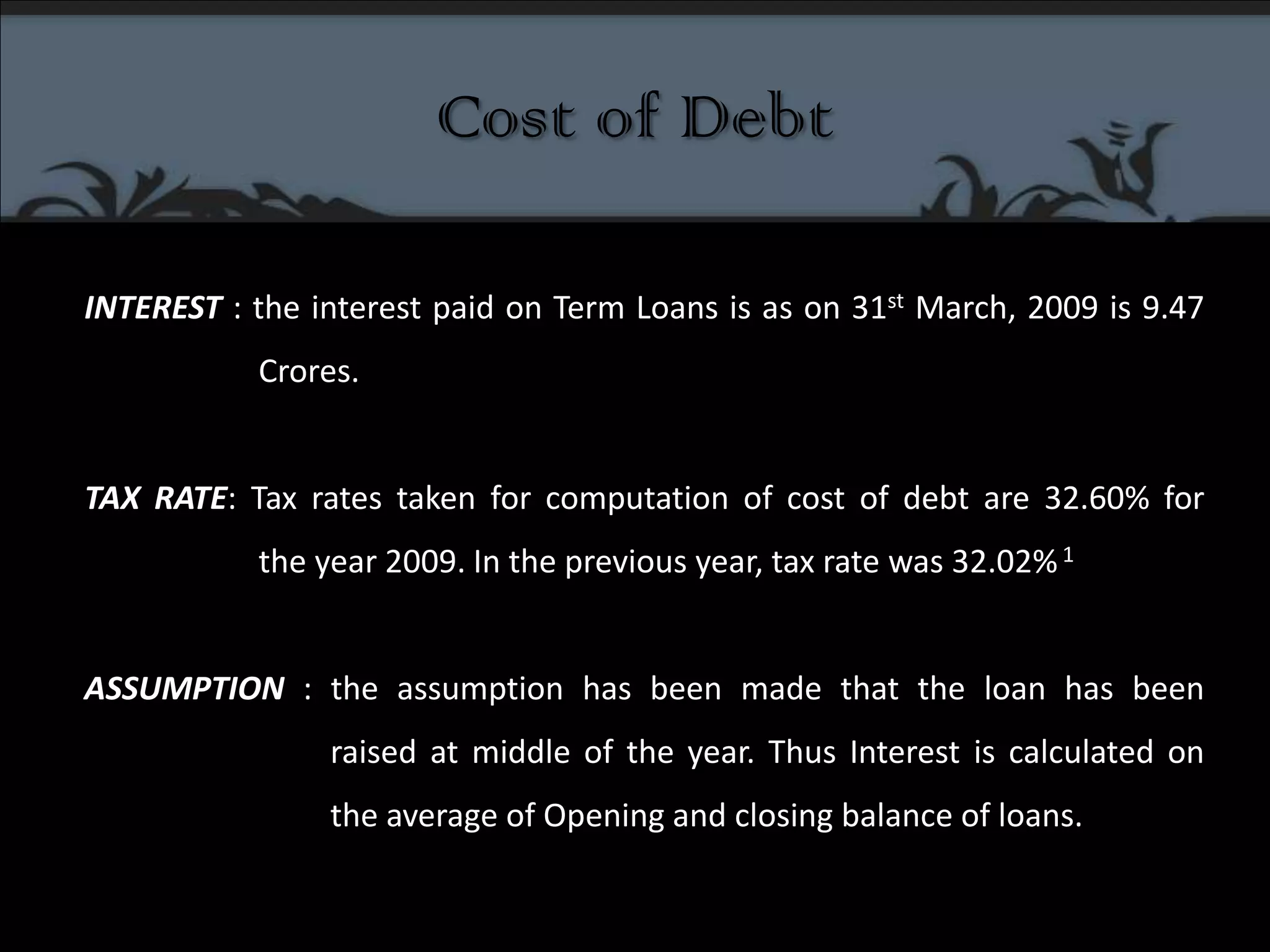
Cost of DebtINTEREST : the interest paid on Term Loans is as on 31st March, 2009 is 9.47 	       Crores.TAX RATE: Tax rates taken for computation of cost of debt are 32.60% for 	       the year 2009. In the previous year, tax rate was 32.02% 1ASSUMPTION : the assumption has been made that the loan has been  	             	raised at middle of the year. Thus Interest is calculated on 		the average of Opening and closing balance of loans.
Cost of DebtComputation of Cost of Debt Kd = Long Term Interest / Long Term DebtKd = 9.47/46.365 = 20.42%            20.42 X (1 – t)              =  20.42 X (1 – 0.32)=      13.89 % 
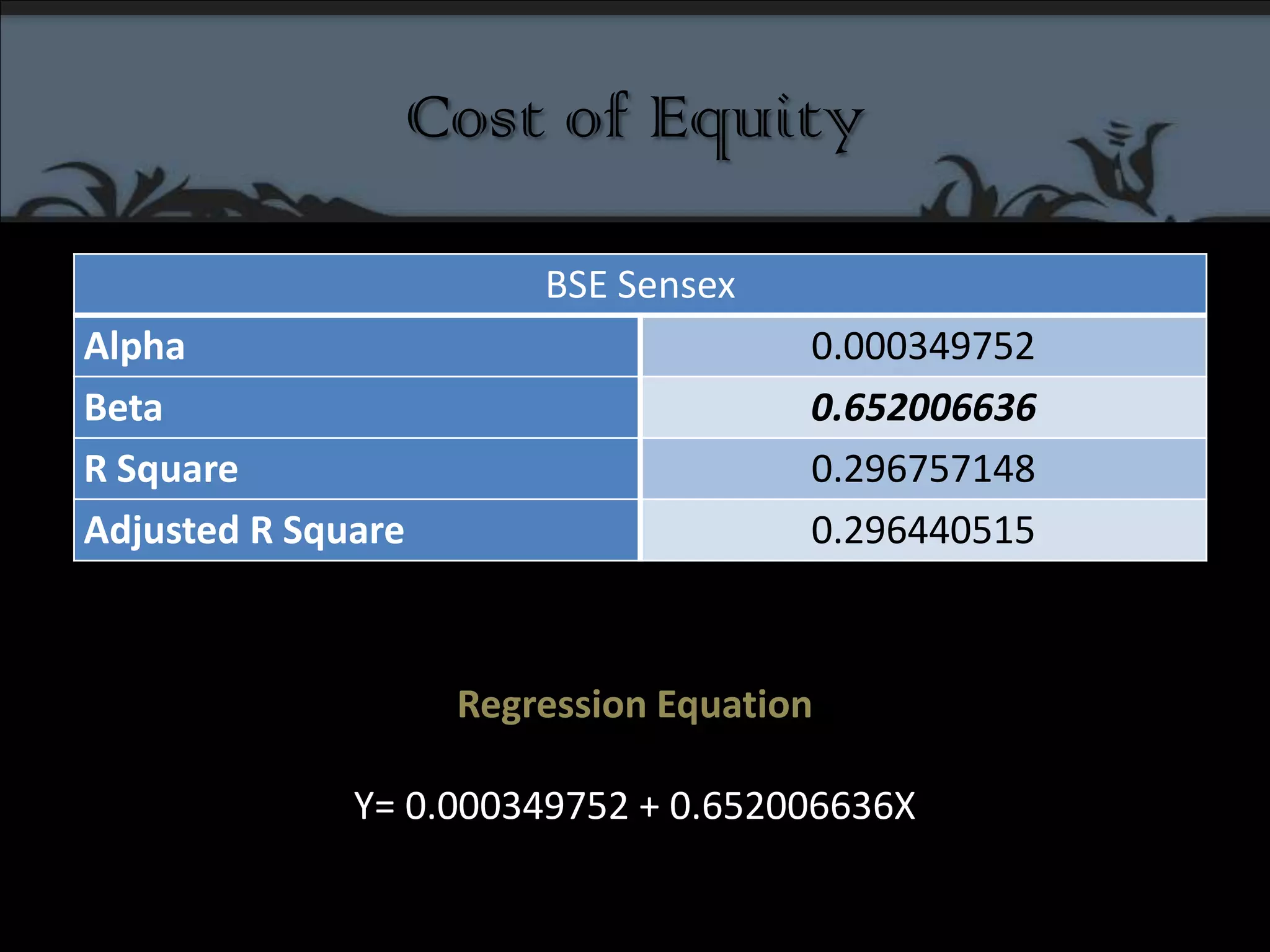
Cost of EquityRegression Equation Y= 0.000349752 + 0.652006636X
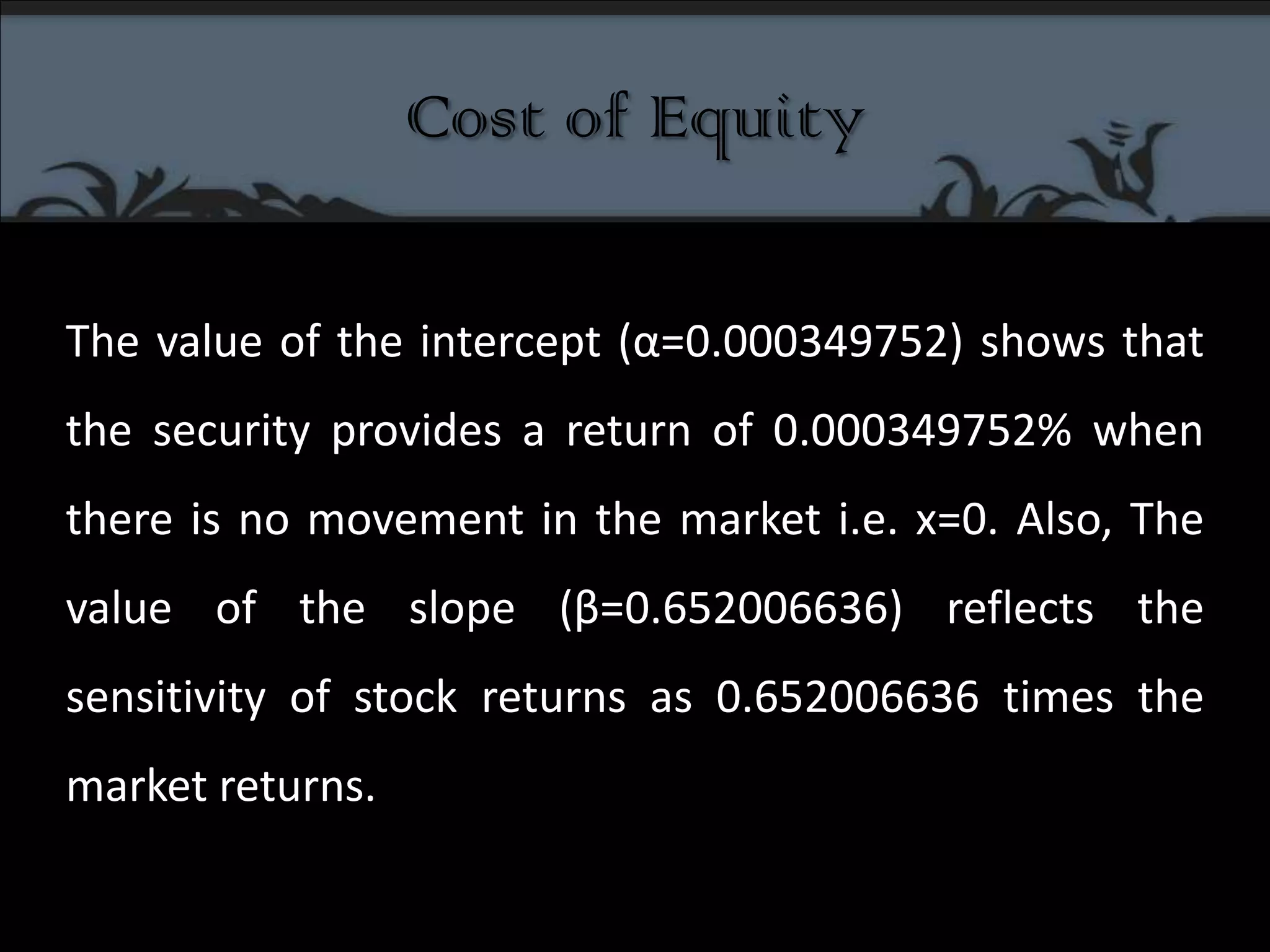
Cost of EquityThe value of the intercept (α=0.000349752) shows that the security provides a return of 0.000349752% when there is no movement in the market i.e. x=0. Also, The value of the slope (β=0.652006636) reflects the sensitivity of stock returns as 0.652006636 times the market returns.
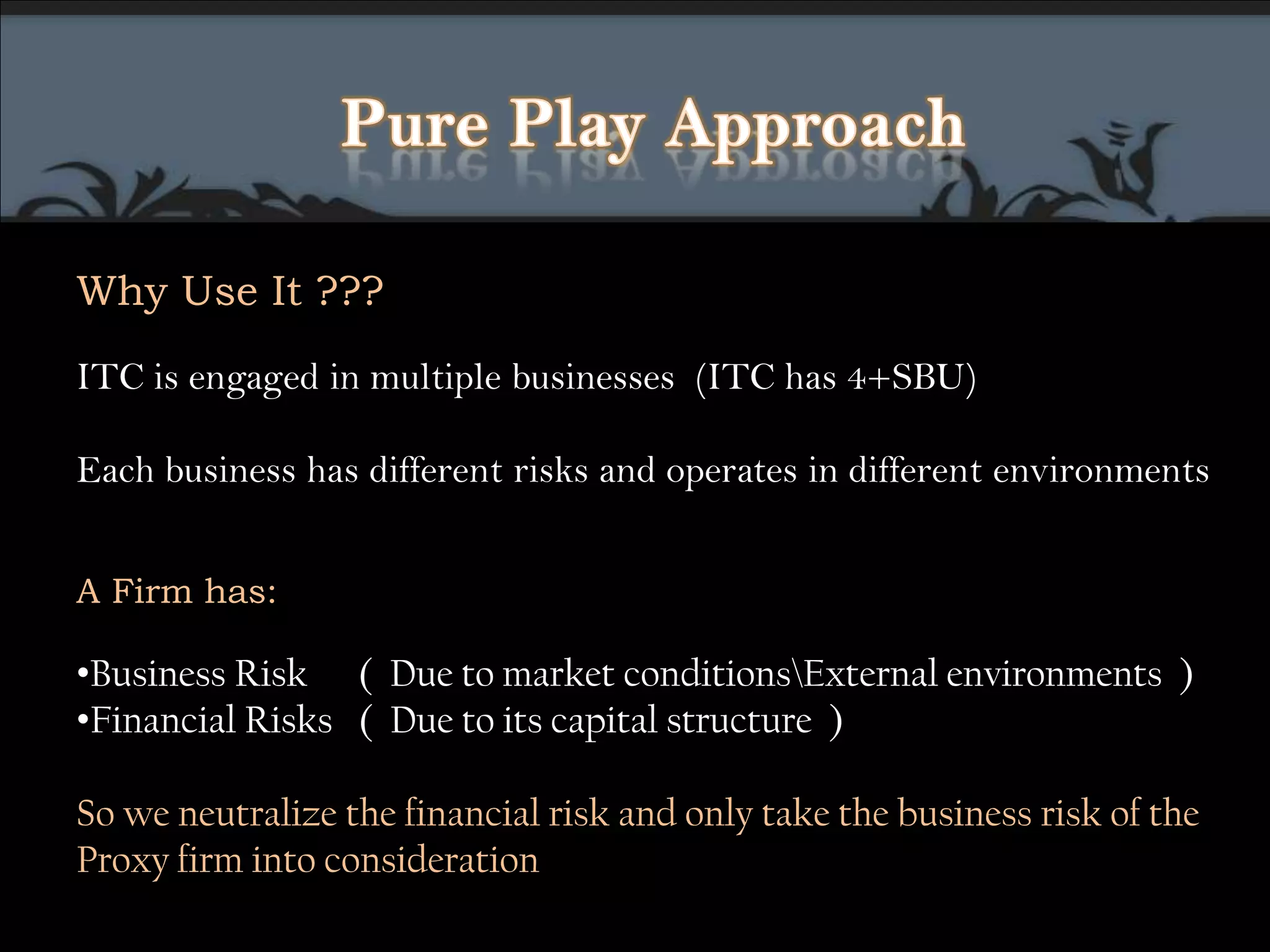
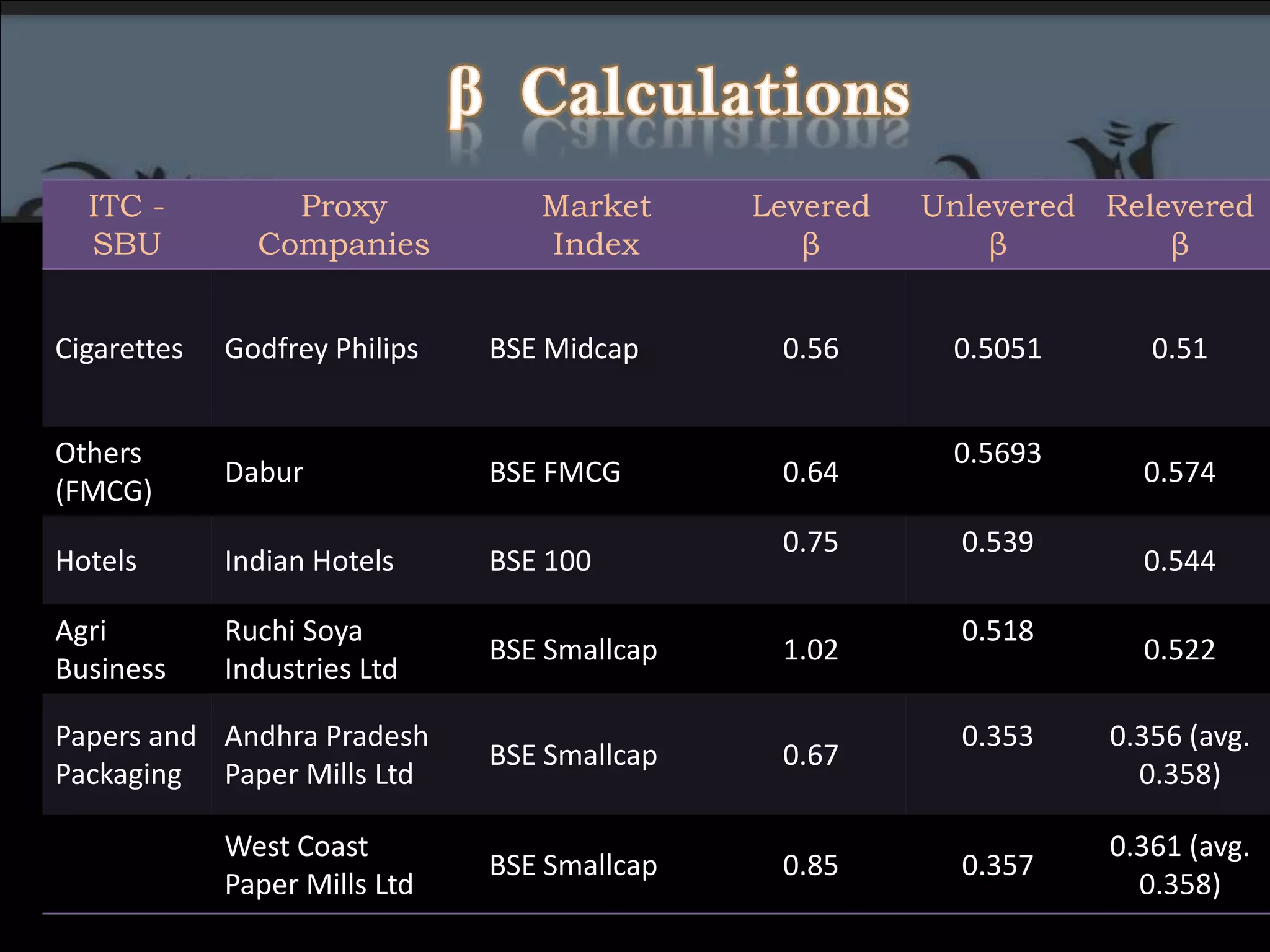
Pure Play ApproachWhy Use It ???ITCis engaged in multiple businesses  (ITC has 4+SBU)Each business has different risks and operates in different environments A Firm has: Business Risk    (  Due to market conditions\External environments  )
Financial Risks   (  Due to its capital structure  )So we neutralize the financial risk and only take the business risk of the Proxy firm into consideration
β Calculations
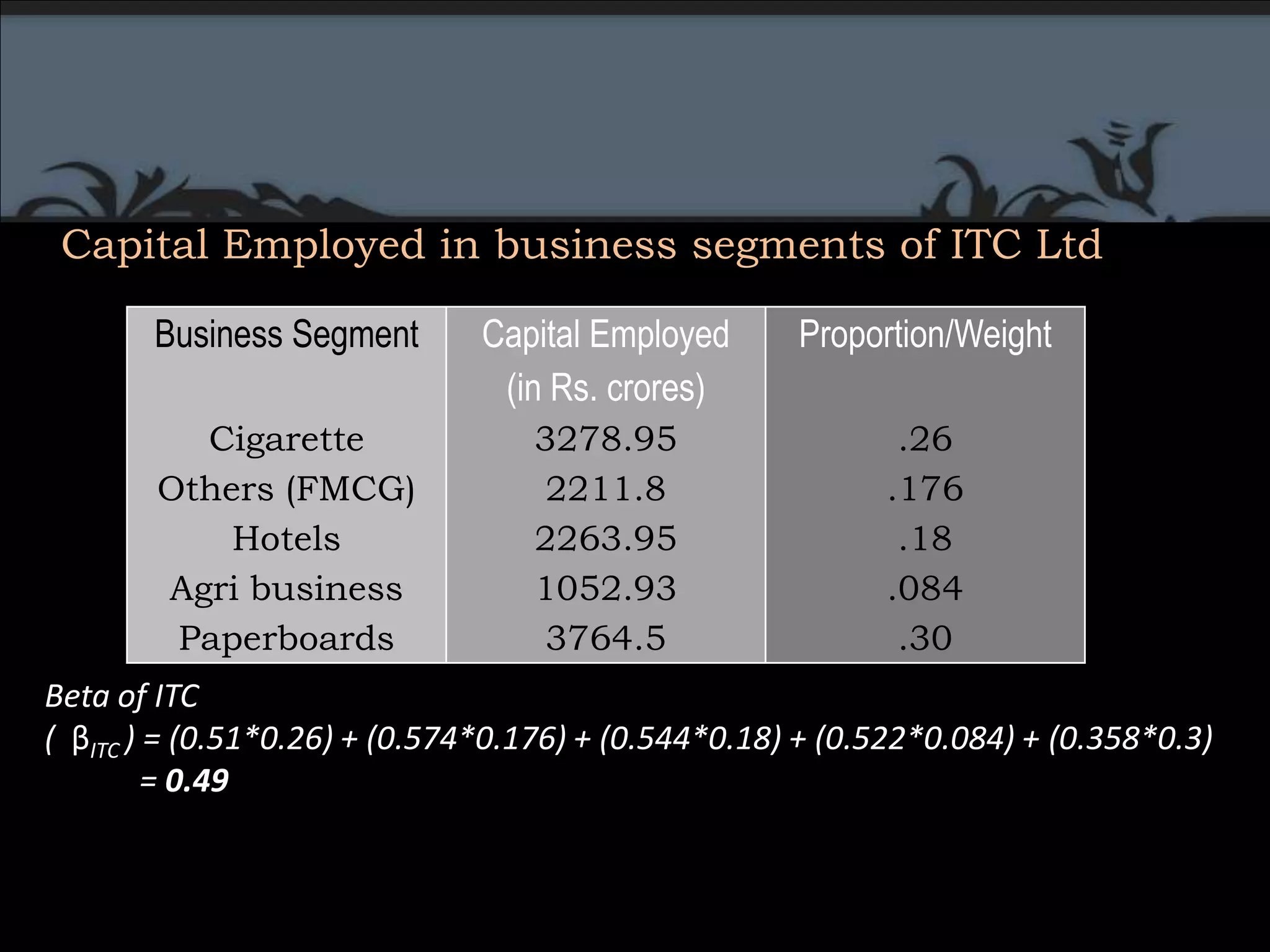
Capital Employed in business segments of ITC LtdBeta of ITC (  βITC) = (0.51*0.26) + (0.574*0.176) + (0.544*0.18) + (0.522*0.084) +(0.358*0.3)= 0.49
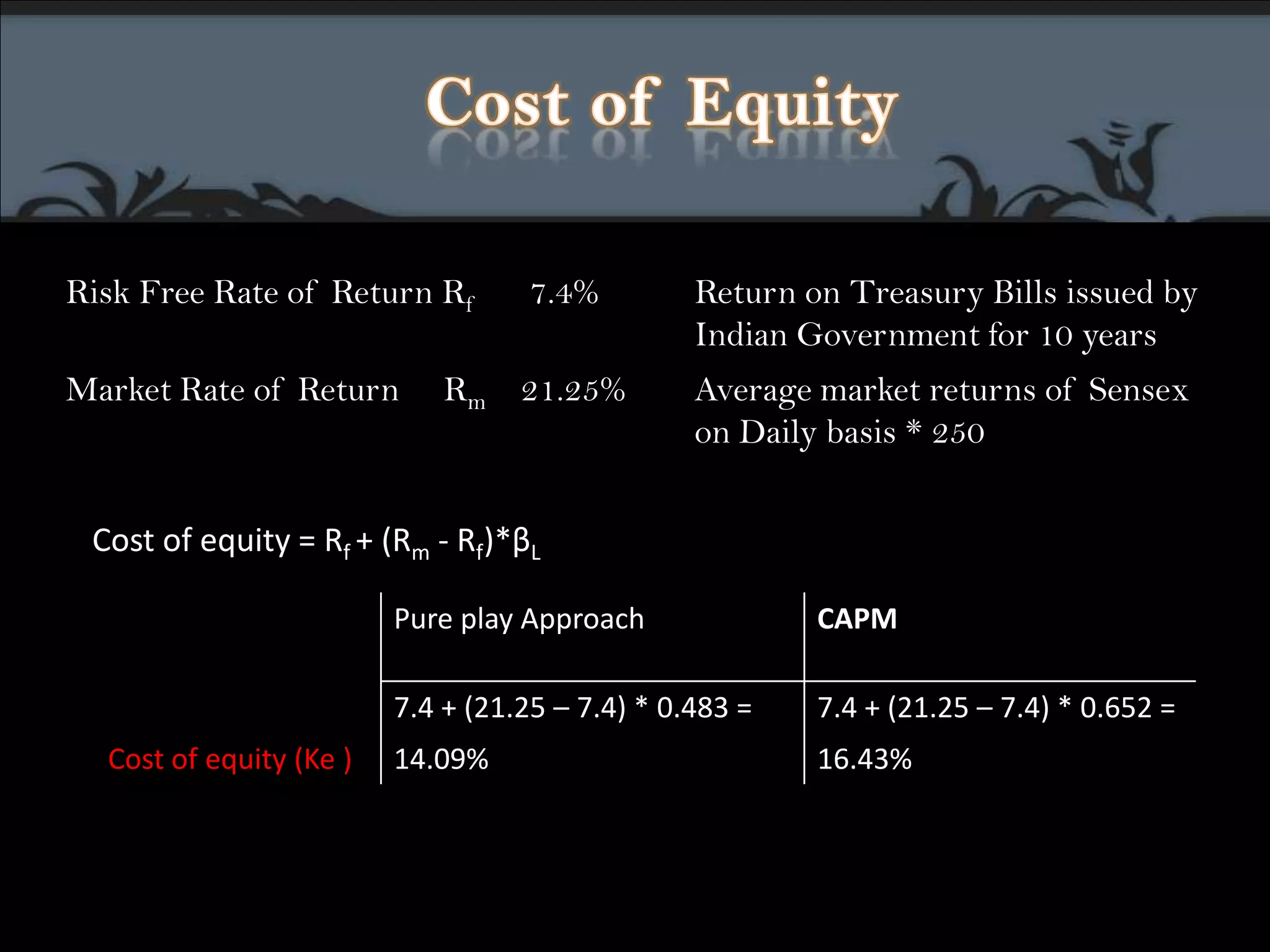
				Cost of Equity	Cost of equity = Rf+ (Rm - Rf)*βL
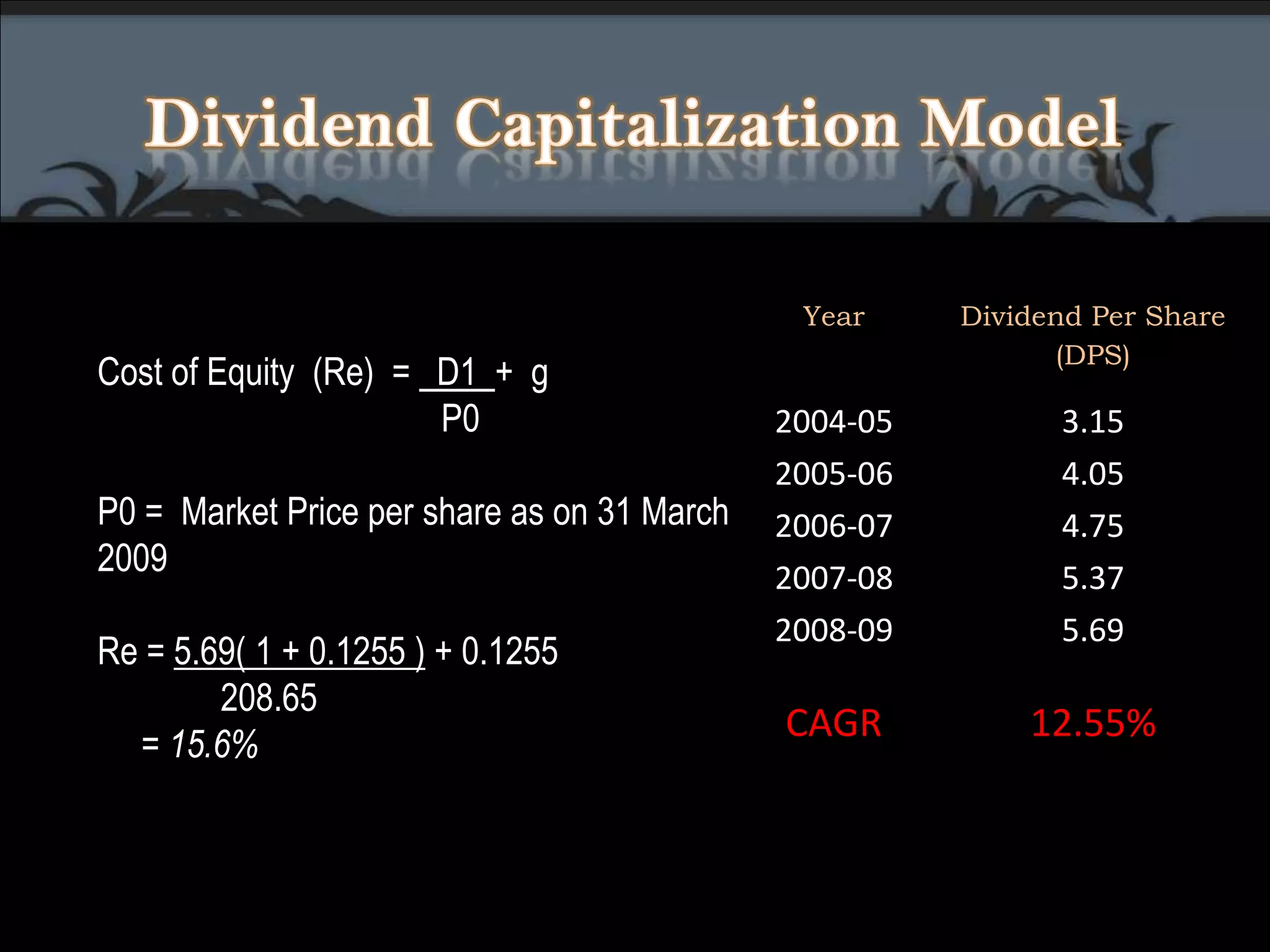
   Dividend Capitalization ModelCost of Equity  (Re)  =   D1  +  g                                       P0P0 =  Market Price per share as on 31 March 2009Re = 5.69( 1 + 0.1255 ) + 0.1255              208.65     = 15.6%
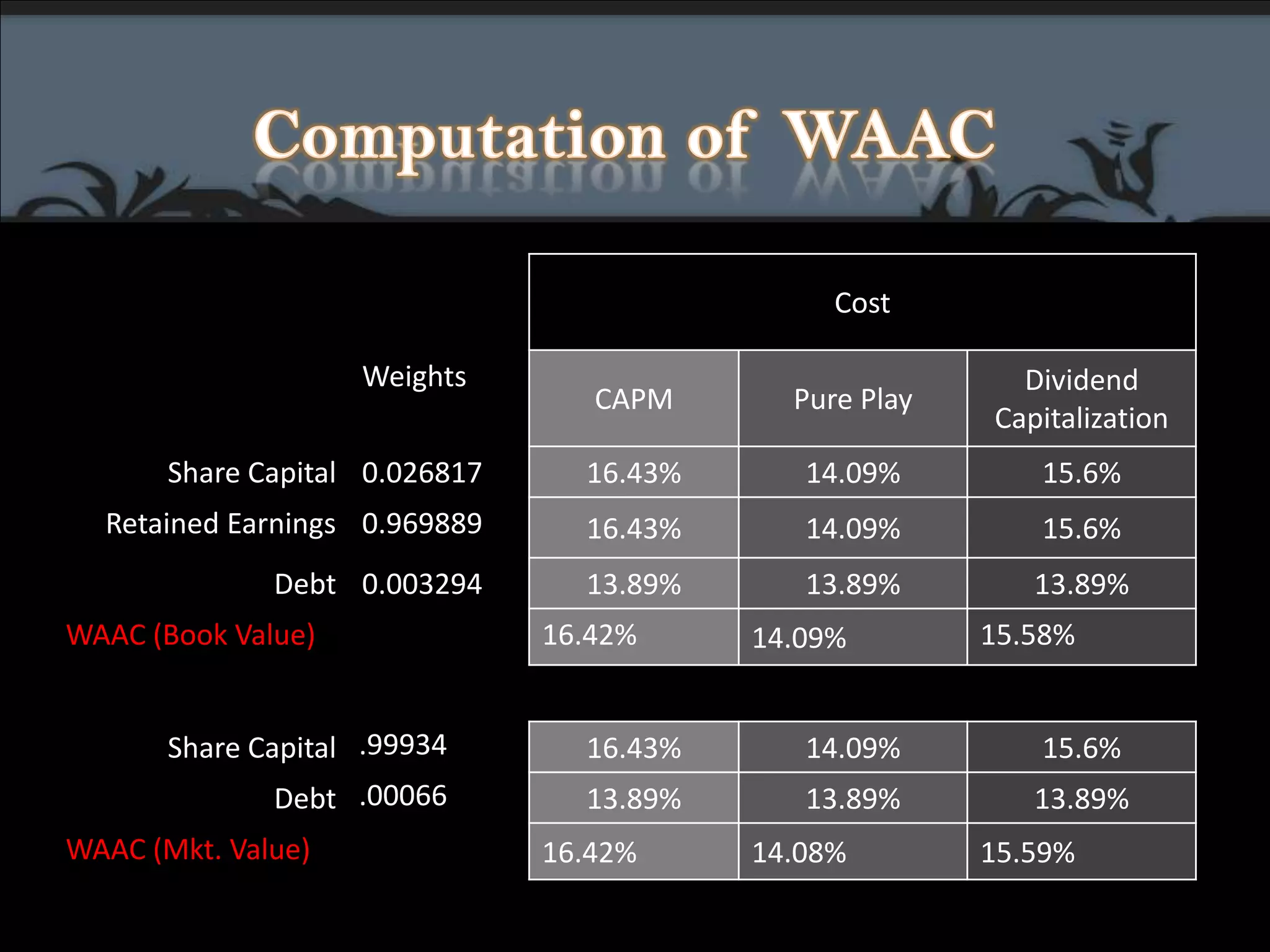
Computation of WAAC
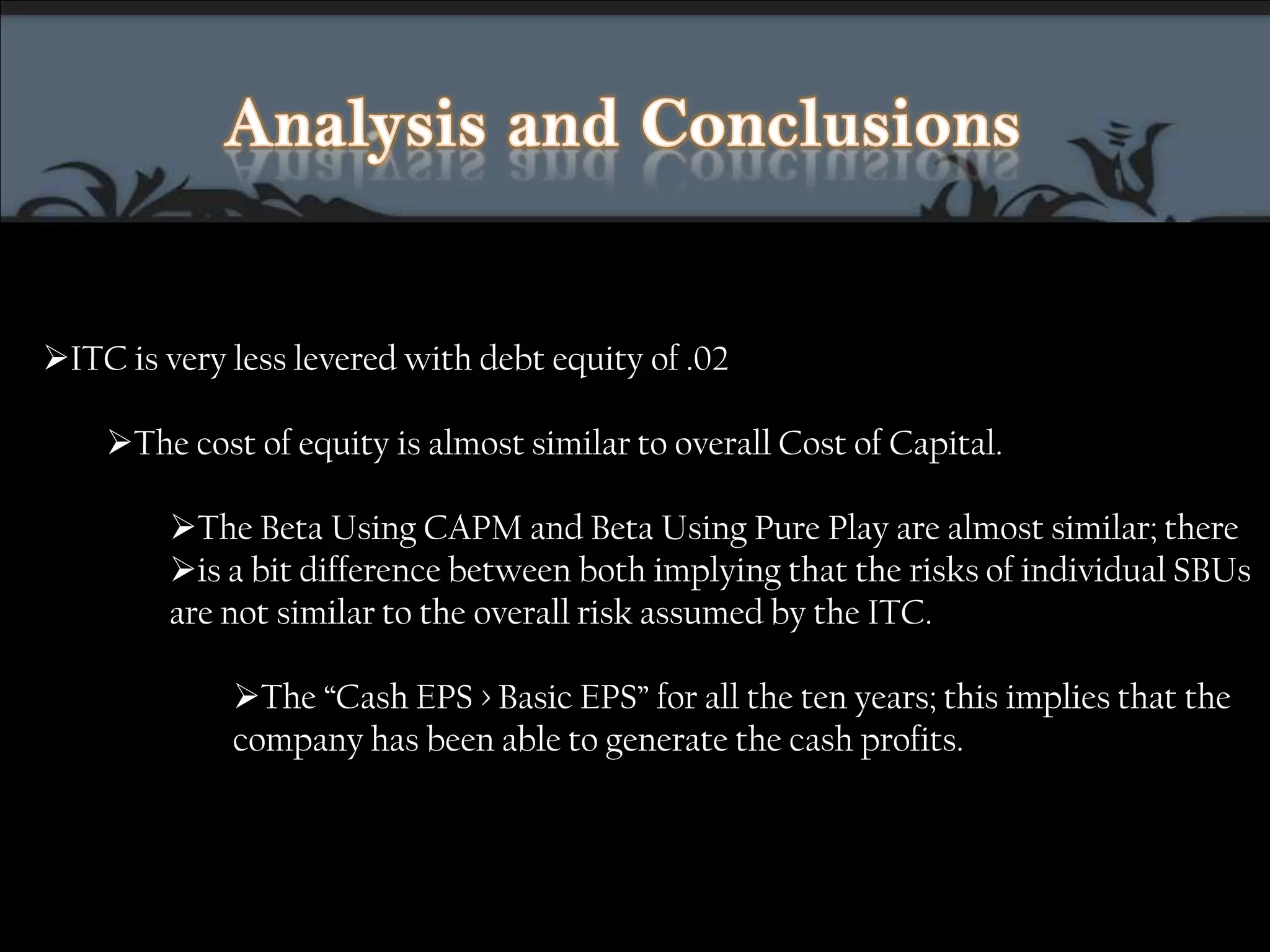
Analysis and ConclusionsITC is very less levered with debt equity of .02
The cost of equity is almost similar to overall Cost of Capital.

Cost of Capital ITC

  • 1.
  • 2.
  • 3.
    FOCUSComputation ofCost ofCapitalof ITC Ltd.
  • 4.
    Data AnalystsDivanshu Kapoor(91017) Radhika Gupta (91041)MadhusudhanPartani (91029)Anika Gupta (91005) Manish TN Singh (91053)
  • 5.
    GLIMPSEmarket capitalization ofnearly US $ 19 billionEmploys over 26,000 people corporate positioning statement"Enduring Value. For the nation. For the Shareholder."Ranks among India's `10 Most Valuable (Company) Brands'turnover of over US $ 5 billionmore than 3, 41,000 shareholdersAsia's 50 best performing companies -Business Week.Asia's 'Fab 50'60 locations across India
  • 6.
    Financial PositionDebt/Equity The debt-to-equityratio has been hovering around 0.02:1 since the past 7 years. This shows that investment is not risky in this firm as the company is not depends on debt financing. But is also implies that the firm has not leveraged at all. Equity in the form of The firm has Equity in form of Retained Earnings. The Shares comprise of Equity shares of Re 1 each. Total No. of shares as on 31st of March 2009 were Approx 377.44 Crores. And the Retained earnings comprises of Rs. 13650.72 Crs. Also the Company issues ESOPs (Employee Stock Option Plans) Regularly. 
  • 7.
    Financial PositionCash flows Thenet turn-over grew by 10.3 %, driven by a robust 20% growth in the non-cigarette FMCG business. The Company’s relentless efforts to create value through international quality products, significant investments in technology and product development and a strong portfolio of brands have enabled it to maintain its leadership position in terms of market standing and share.Segment revenues in FMCG (Others) grew by 20% over last year and Education & Stationery Products business registered an impressive sales growth of 60% over the previous year.
  • 8.
  • 9.
  • 10.
    Cost of DebtLongTerm Debt = 46.365
  • 11.
  • 12.
    Cost of DebtINTEREST: the interest paid on Term Loans is as on 31st March, 2009 is 9.47 Crores.TAX RATE: Tax rates taken for computation of cost of debt are 32.60% for the year 2009. In the previous year, tax rate was 32.02% 1ASSUMPTION : the assumption has been made that the loan has been raised at middle of the year. Thus Interest is calculated on the average of Opening and closing balance of loans.
  • 13.
    Cost of DebtComputationof Cost of Debt Kd = Long Term Interest / Long Term DebtKd = 9.47/46.365 = 20.42% 20.42 X (1 – t) = 20.42 X (1 – 0.32)= 13.89 % 
  • 14.
    Cost of EquityRegressionEquation Y= 0.000349752 + 0.652006636X
  • 15.
    Cost of EquityThevalue of the intercept (α=0.000349752) shows that the security provides a return of 0.000349752% when there is no movement in the market i.e. x=0. Also, The value of the slope (β=0.652006636) reflects the sensitivity of stock returns as 0.652006636 times the market returns.
  • 16.
    Pure Play ApproachWhyUse It ???ITCis engaged in multiple businesses (ITC has 4+SBU)Each business has different risks and operates in different environments A Firm has: Business Risk ( Due to market conditions\External environments )
  • 17.
    Financial Risks ( Due to its capital structure )So we neutralize the financial risk and only take the business risk of the Proxy firm into consideration
  • 18.
  • 19.
    Capital Employed inbusiness segments of ITC LtdBeta of ITC ( βITC) = (0.51*0.26) + (0.574*0.176) + (0.544*0.18) + (0.522*0.084) +(0.358*0.3)= 0.49
  • 20.
    Cost of Equity Costof equity = Rf+ (Rm - Rf)*βL
  • 21.
    Dividend Capitalization ModelCost of Equity (Re) = D1 + g P0P0 = Market Price per share as on 31 March 2009Re = 5.69( 1 + 0.1255 ) + 0.1255 208.65 = 15.6%
  • 22.
  • 23.
    Analysis and ConclusionsITCis very less levered with debt equity of .02
  • 24.
    The cost ofequity is almost similar to overall Cost of Capital.
  • 25.
    The Beta UsingCAPM and Beta Using Pure Play are almost similar; there
  • 26.
    is a bitdifference between both implying that the risks of individual SBUs are not similar to the overall risk assumed by the ITC.
  • 27.
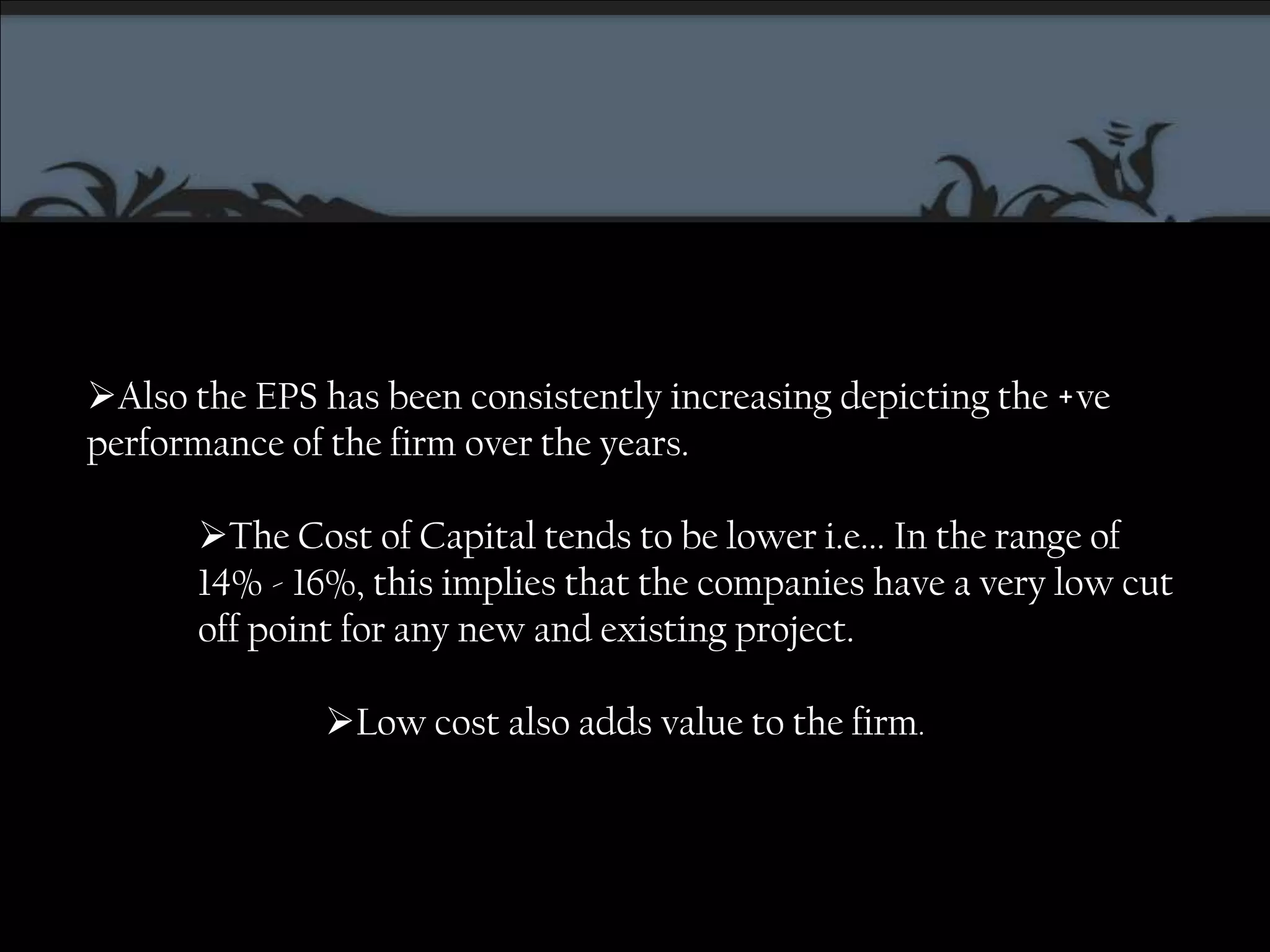
    The “Cash EPS> Basic EPS” for all the ten years; this implies that the company has been able to generate the cash profits.Also the EPS has been consistently increasing depicting the +ve performance of the firm over the years.
  • 28.
    The Cost ofCapital tends to be lower i.e... In the range of 14% - 16%, this implies that the companies have a very low cut off point for any new and existing project.
  • 29.
    Low cost alsoadds value to the firm. THANKYOU !!!!!!!

Editor's Notes

  • #18 NOTE: Mention about the comparision of Proxy companies & the market indexes usedTax rate for pure play firms  33.99% (as per the Income Tax Act, 1961)Tax rate for ITC  32%Assumptions madeCapital employed in each business segment of ITC Ltd. = Segment Assets – Segment Liabilities. At the time of relevering beta (β) of each pure play firm to reflect the financial risk of ITC Ltd., the Debt-Equity ratio of entire ITC Ltd is used.
  • #22 NOTE: The Market value is considered based on Share price as on 31st March 2009 i.e. Market Capitalization.