A PROJECT REPORT
ON

ITC Limited
One of India’s Most Admired and Valuable Companies
INTRODUCTION
Itc limited is a public conglomerate company head quartered in Kolkata .The Company is
currently headed by YogeshChanderDeveshwar. It employs over 26,000 people at more
than 60 location.
Rated by BCG amongst Top 10 consumer goods companies in the world in terms of total
shareholder returns (TSR) Suring 2005-2009.
Oneoftheforemostintheprivatesectorintermsof:
–Sustainedvaluecreation(BT-SternStewartsurvey)
–Operatingprofits
–CashProfits
Itc
is
the
onlyIndianFMCGCompanytofeatureinForbes
2000
List,
Acomprehensiverankingofworld’sbiggestcompaniesmeasuredbyacompositeofsales,profits,ass
ets&marketvalue.
ITC’s rankingamongst all listed private sector cos.
 PBT: No. 6
 PAT: No. 5
 Market Capitalization: No. 3

ITC Performance Track Record
In Rs crs.
1995-96
Net Revenue
2,536
PBDIT
584
PBIT
536
PBT
452
PAT
261
Capital Employed
1,886
ROCE %
28.4
Market Capitalization
5,571
Total Shareholder Returns %
Sensex (CAGR 95-96 to 12-13): 10.7%

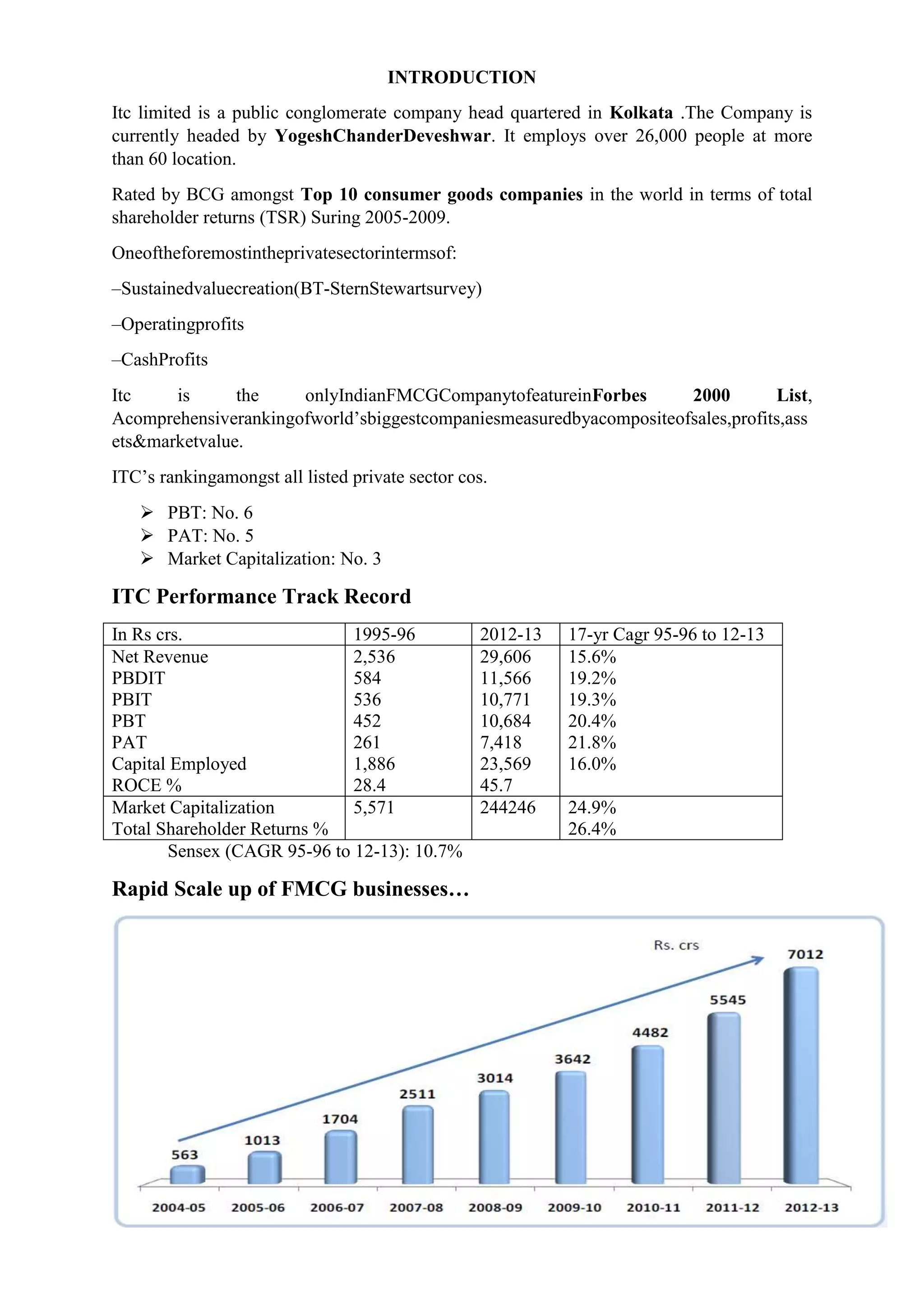
Rapid Scale up of FMCG businesses…

2012-13
29,606
11,566
10,771
10,684
7,418
23,569
45.7
244246

17-yr Cagr 95-96 to 12-13
15.6%
19.2%
19.3%
20.4%
21.8%
16.0%
24.9%
26.4%
ITC’s Vision
Makeasignificantandgrowingcontributiontowards:
 Mitigating societal challenges
 Enhancing shareholder rewards
By:
Creating multiple drivers of growth while sustaining leadership in tobacco and
Focusing on triple bottom line performance
Enlargecontributiontothenations
Financial capital
Environmental capital
Social capital

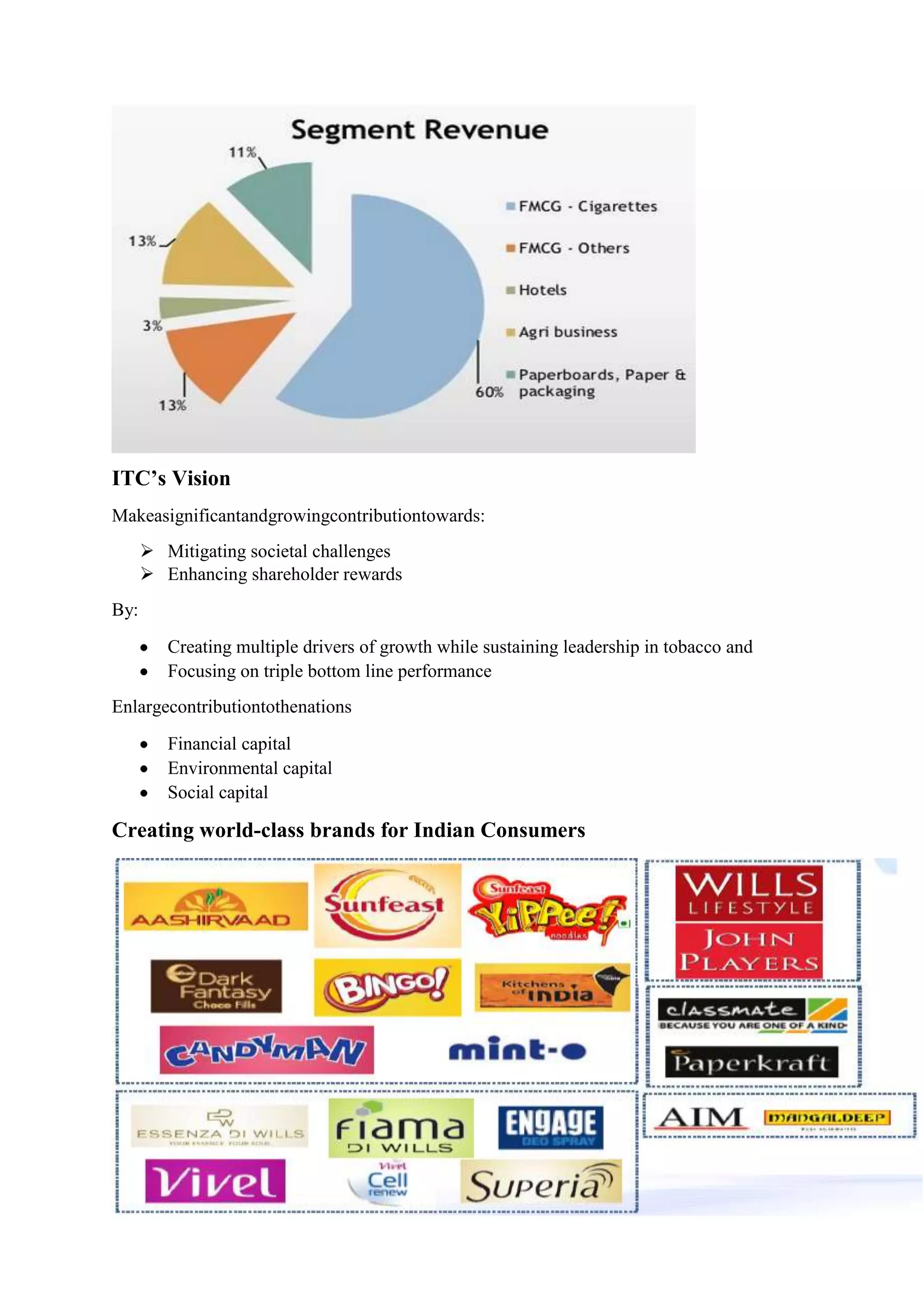
Creating world-class brands for Indian Consumers
Financial Statement Analysis
Financial analysis is the process of identifying the financial strengths and weaknesses of the
firm by property establishing relationships between the item of the balance sheet and the
profit and loss account.

Users of Financial Analysis

Trade creditors
Lenders
Investors
Management

Financial Ratio Analysis
A Liquidity Ratioprovides information on a company's ability to meet its short−term,
immediate obligations.
A Profitability Ratioprovides information on the amount of income from each dollar
ofsales.
An Activity Ratiorelates information on a company's ability to manage its resources
(that is, its assets) efficiently.
A Financial Leverage Ratioprovides information on the degree of a company's
fixedfinancing obligations and its ability to satisfy these financing obligations.
A Market Ratio describes the company's financial condition in terms of amounts
pershare of stock.

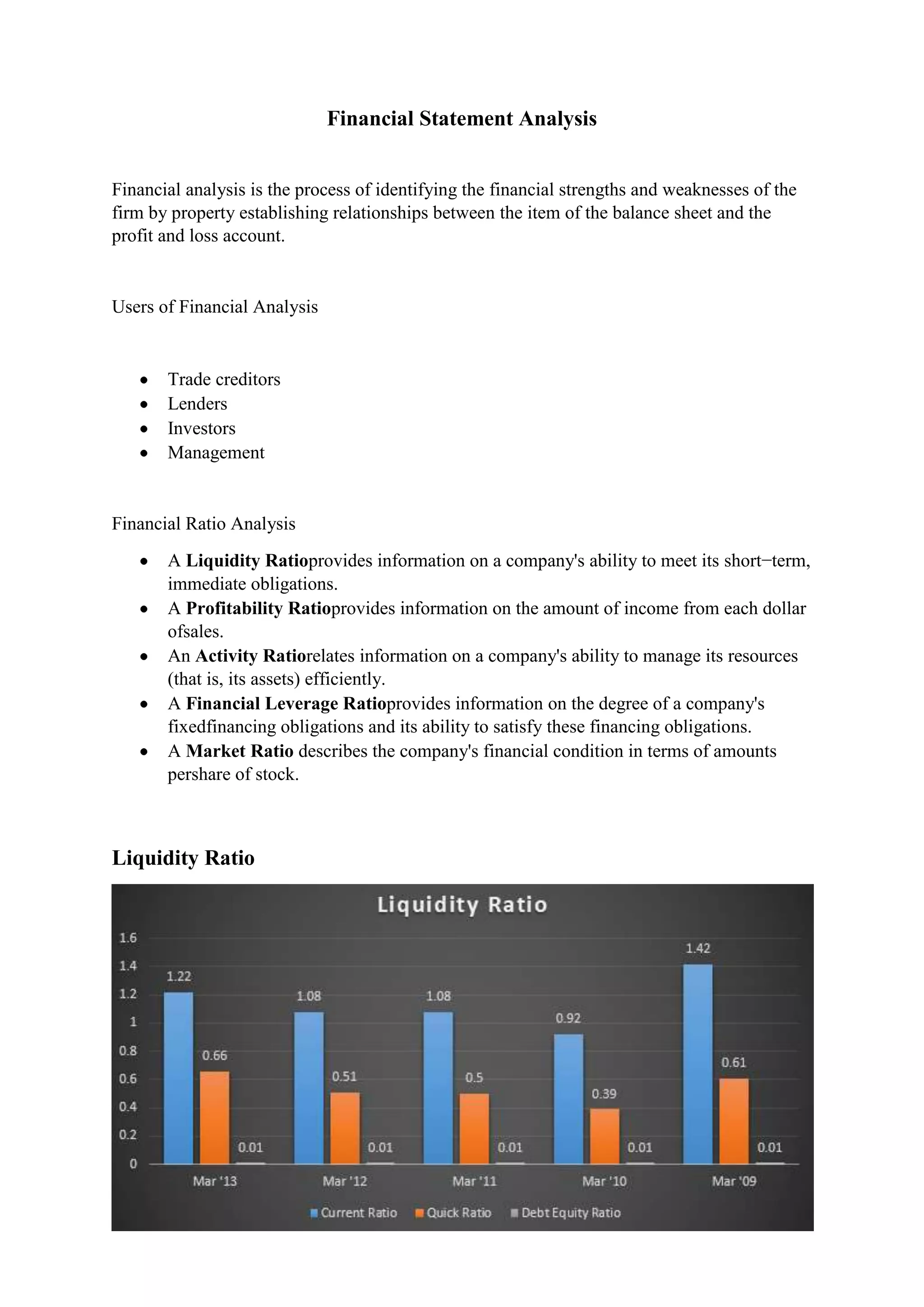
Liquidity Ratio
Itc have high liquidity ratios, the higher the margin of safety that the company possess to
meet its current liabilities. Liquidity ratios greater than 1 indicate that the company is in good
financial health and it is less likely fall into financial difficulties. Seen in all the years above
2013, 2012, 2011.
Current ratio indicates Itc's ability to meet short-term debt obligations. The current ratio
measures whether or not a firm has enough resources to pay its debts over the next 12 month.

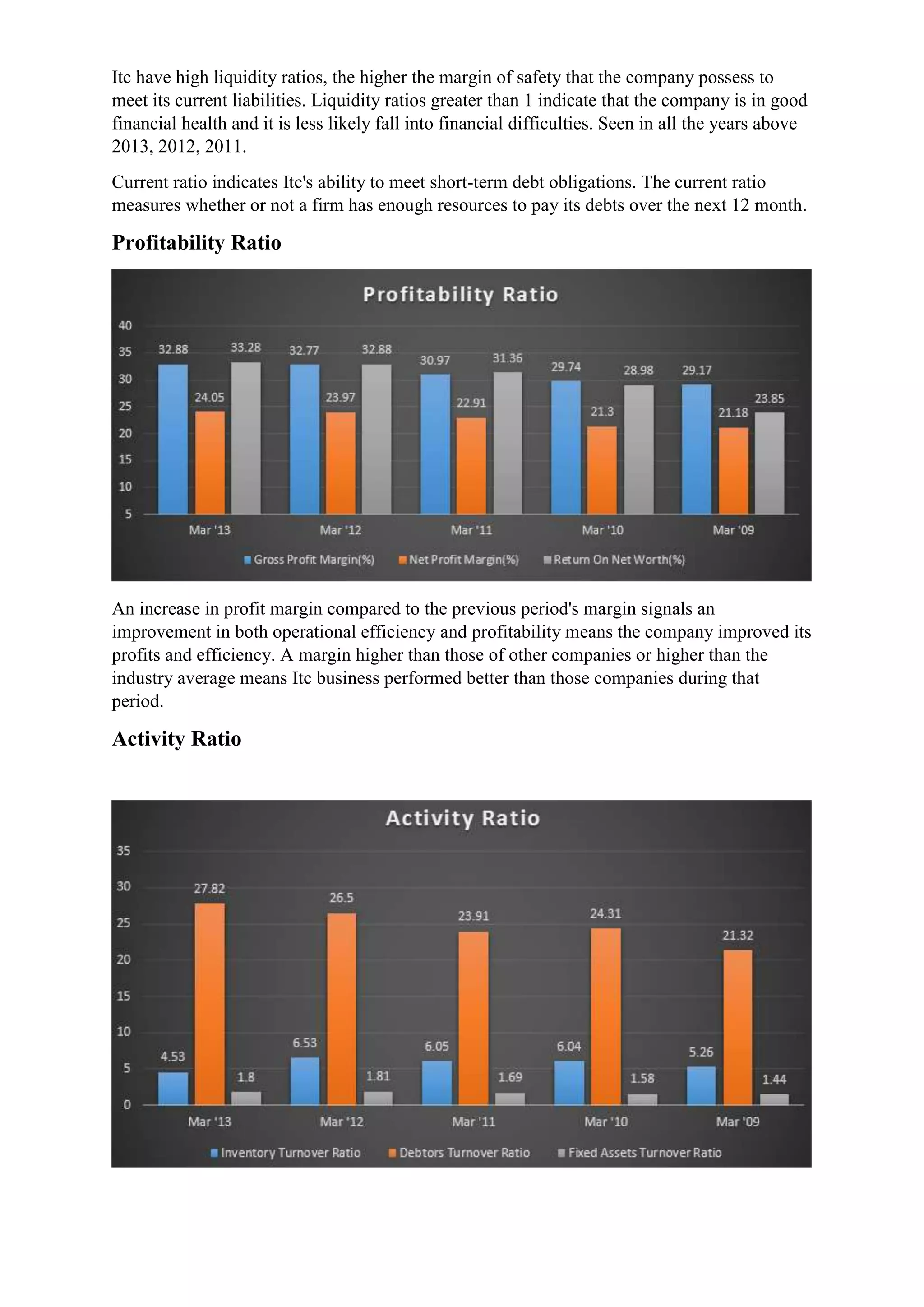
Profitability Ratio

An increase in profit margin compared to the previous period's margin signals an
improvement in both operational efficiency and profitability means the company improved its
profits and efficiency. A margin higher than those of other companies or higher than the
industry average means Itc business performed better than those companies during that
period.

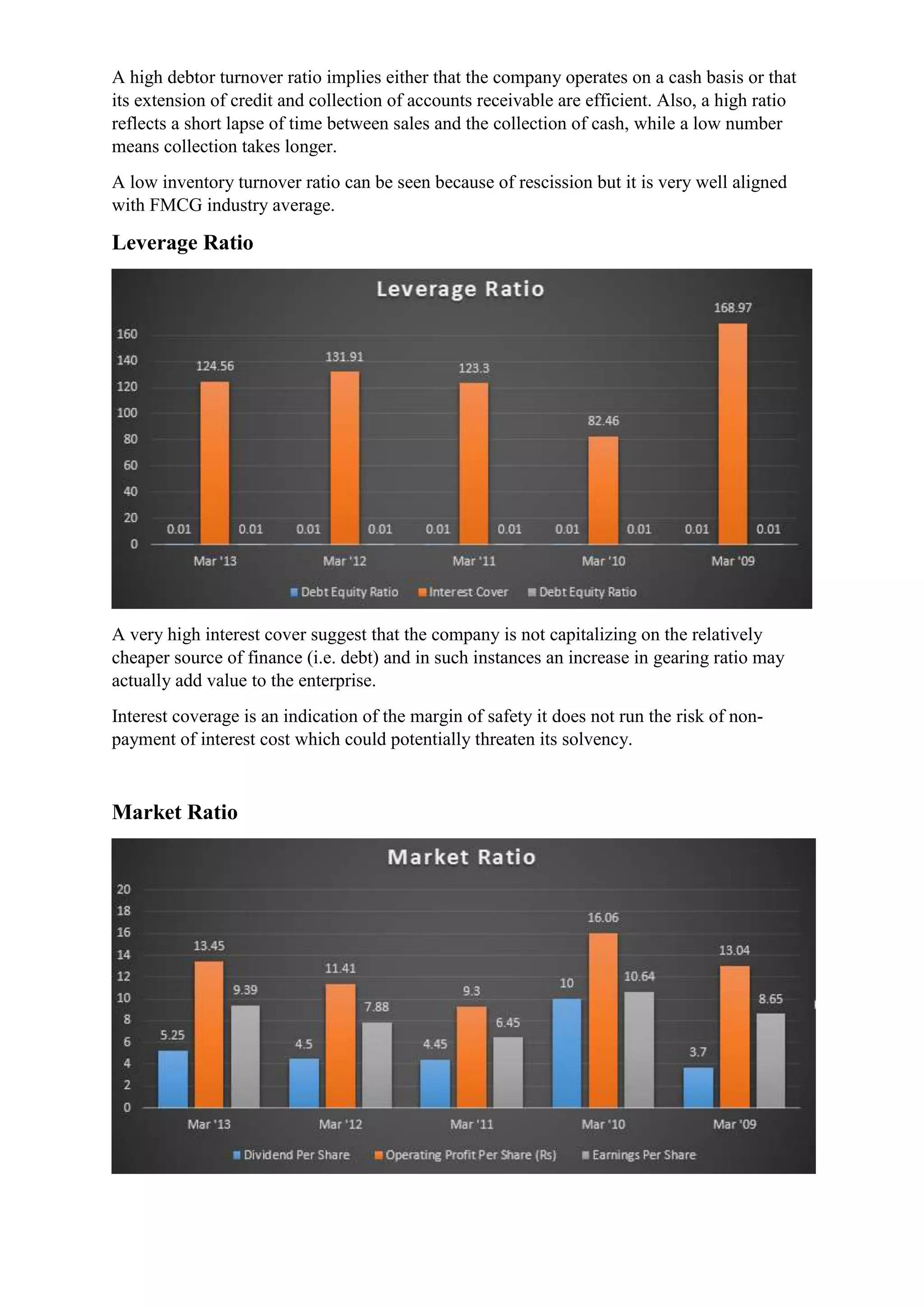
Activity Ratio
A high debtor turnover ratio implies either that the company operates on a cash basis or that
its extension of credit and collection of accounts receivable are efficient. Also, a high ratio
reflects a short lapse of time between sales and the collection of cash, while a low number
means collection takes longer.
A low inventory turnover ratio can be seen because of rescission but it is very well aligned
with FMCG industry average.

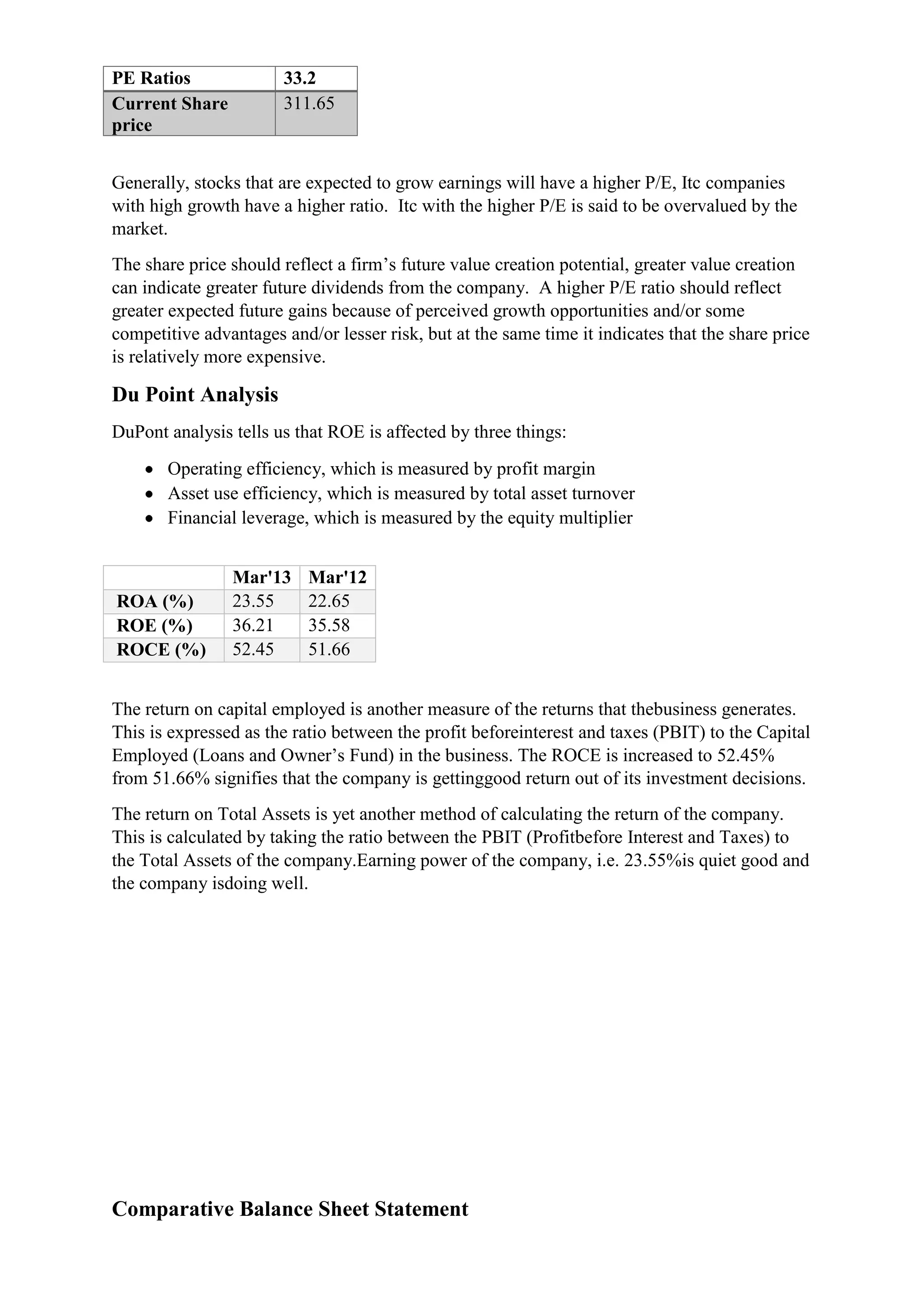
Leverage Ratio

A very high interest cover suggest that the company is not capitalizing on the relatively
cheaper source of finance (i.e. debt) and in such instances an increase in gearing ratio may
actually add value to the enterprise.
Interest coverage is an indication of the margin of safety it does not run the risk of nonpayment of interest cost which could potentially threaten its solvency.

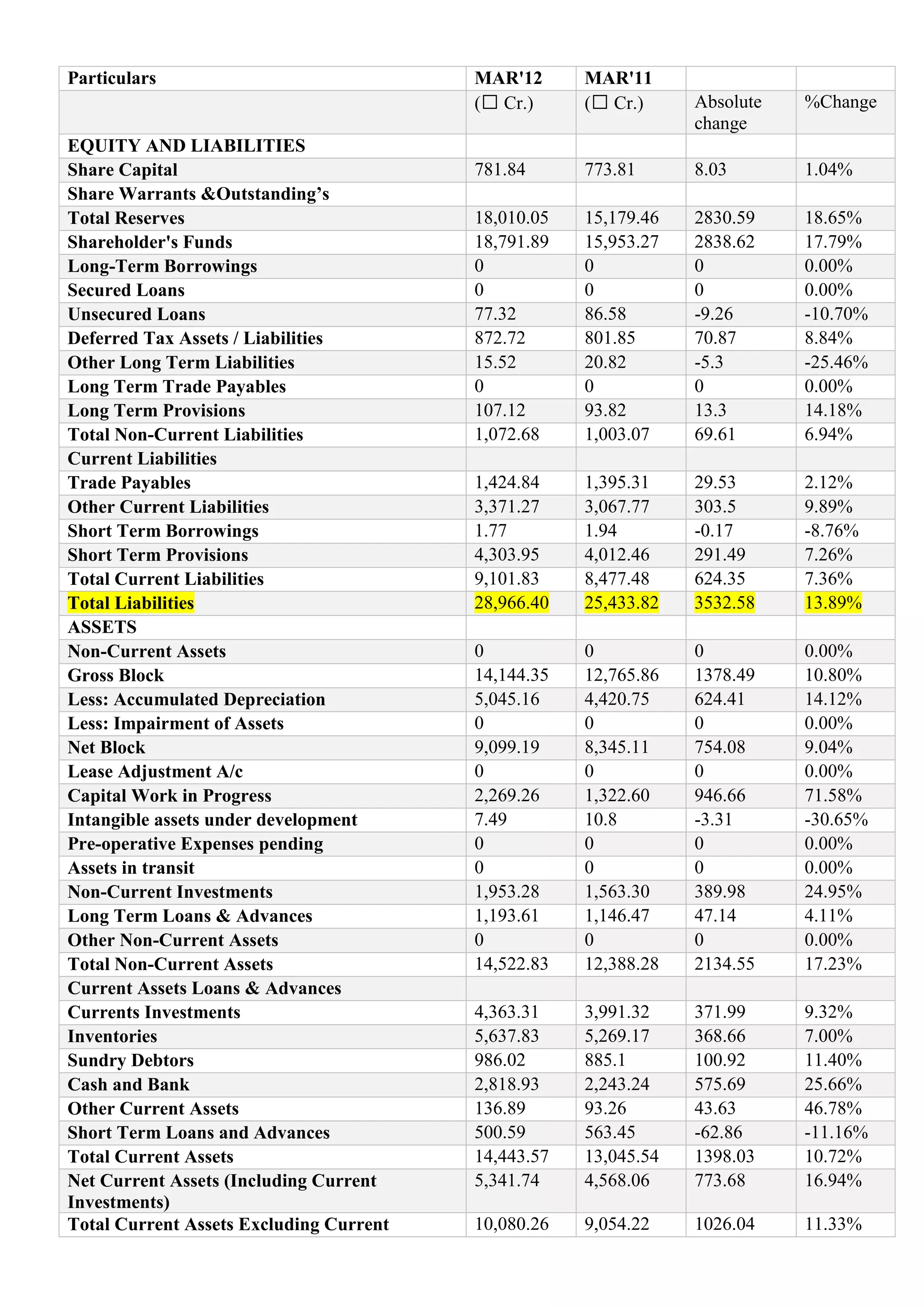
Market Ratio
PE Ratios
Current Share
price

33.2
311.65

Generally, stocks that are expected to grow earnings will have a higher P/E, Itc companies
with high growth have a higher ratio. Itc with the higher P/E is said to be overvalued by the
market.
The share price should reflect a firm’s future value creation potential, greater value creation
can indicate greater future dividends from the company. A higher P/E ratio should reflect
greater expected future gains because of perceived growth opportunities and/or some
competitive advantages and/or lesser risk, but at the same time it indicates that the share price
is relatively more expensive.

Du Point Analysis
DuPont analysis tells us that ROE is affected by three things:
Operating efficiency, which is measured by profit margin
Asset use efficiency, which is measured by total asset turnover
Financial leverage, which is measured by the equity multiplier

ROA (%)
ROE (%)
ROCE (%)

Mar'13
23.55
36.21
52.45

Mar'12
22.65
35.58
51.66

The return on capital employed is another measure of the returns that thebusiness generates.
This is expressed as the ratio between the profit beforeinterest and taxes (PBIT) to the Capital
Employed (Loans and Owner’s Fund) in the business. The ROCE is increased to 52.45%
from 51.66% signifies that the company is gettinggood return out of its investment decisions.
The return on Total Assets is yet another method of calculating the return of the company.
This is calculated by taking the ratio between the PBIT (Profitbefore Interest and Taxes) to
the Total Assets of the company.Earning power of the company, i.e. 23.55%is quiet good and
the company isdoing well.

Comparative Balance Sheet Statement
Particulars

EQUITY AND LIABILITIES
Share Capital
Share Warrants &Outstanding’s
Total Reserves
Shareholder's Funds
Long-Term Borrowings
Secured Loans
Unsecured Loans
Deferred Tax Assets / Liabilities
Other Long Term Liabilities
Long Term Trade Payables
Long Term Provisions
Total Non-Current Liabilities
Current Liabilities
Trade Payables
Other Current Liabilities
Short Term Borrowings
Short Term Provisions
Total Current Liabilities
Total Liabilities
ASSETS
Non-Current Assets
Gross Block
Less: Accumulated Depreciation
Less: Impairment of Assets
Net Block
Lease Adjustment A/c
Capital Work in Progress
Intangible assets under development
Pre-operative Expenses pending
Assets in transit
Non-Current Investments
Long Term Loans & Advances
Other Non-Current Assets
Total Non-Current Assets
Current Assets Loans & Advances
Currents Investments
Inventories
Sundry Debtors
Cash and Bank
Other Current Assets
Short Term Loans and Advances
Total Current Assets
Net Current Assets (Including Current
Investments)
Total Current Assets Excluding Current

MAR'12
(₹ Cr.)

MAR'11
(₹ Cr.)

781.84

Absolute
change

%Change

773.81

8.03

1.04%

18,010.05
18,791.89
0
0
77.32
872.72
15.52
0
107.12
1,072.68

15,179.46
15,953.27
0
0
86.58
801.85
20.82
0
93.82
1,003.07

2830.59
2838.62
0
0
-9.26
70.87
-5.3
0
13.3
69.61

18.65%
17.79%
0.00%
0.00%
-10.70%
8.84%
-25.46%
0.00%
14.18%
6.94%

1,424.84
3,371.27
1.77
4,303.95
9,101.83
28,966.40

1,395.31
3,067.77
1.94
4,012.46
8,477.48
25,433.82

29.53
303.5
-0.17
291.49
624.35
3532.58

2.12%
9.89%
-8.76%
7.26%
7.36%
13.89%

0
14,144.35
5,045.16
0
9,099.19
0
2,269.26
7.49
0
0
1,953.28
1,193.61
0
14,522.83

0
12,765.86
4,420.75
0
8,345.11
0
1,322.60
10.8
0
0
1,563.30
1,146.47
0
12,388.28

0
1378.49
624.41
0
754.08
0
946.66
-3.31
0
0
389.98
47.14
0
2134.55

0.00%
10.80%
14.12%
0.00%
9.04%
0.00%
71.58%
-30.65%
0.00%
0.00%
24.95%
4.11%
0.00%
17.23%

4,363.31
5,637.83
986.02
2,818.93
136.89
500.59
14,443.57
5,341.74

3,991.32
5,269.17
885.1
2,243.24
93.26
563.45
13,045.54
4,568.06

371.99
368.66
100.92
575.69
43.63
-62.86
1398.03
773.68

9.32%
7.00%
11.40%
25.66%
46.78%
-11.16%
10.72%
16.94%

10,080.26

9,054.22

1026.04

11.33%
Investments
Miscellaneous Expenses not written off
Total Assets
Contingent Liabilities
Total Debt
Book Value (in ₹)
Adjusted Book Value (in ₹)

0
28,966.40
287.08
89.12
23.97
23.97

0
25,433.82
255.17
99.2
20.55
20.55

0
3532.58
31.91
-10.08
3.42
3.42

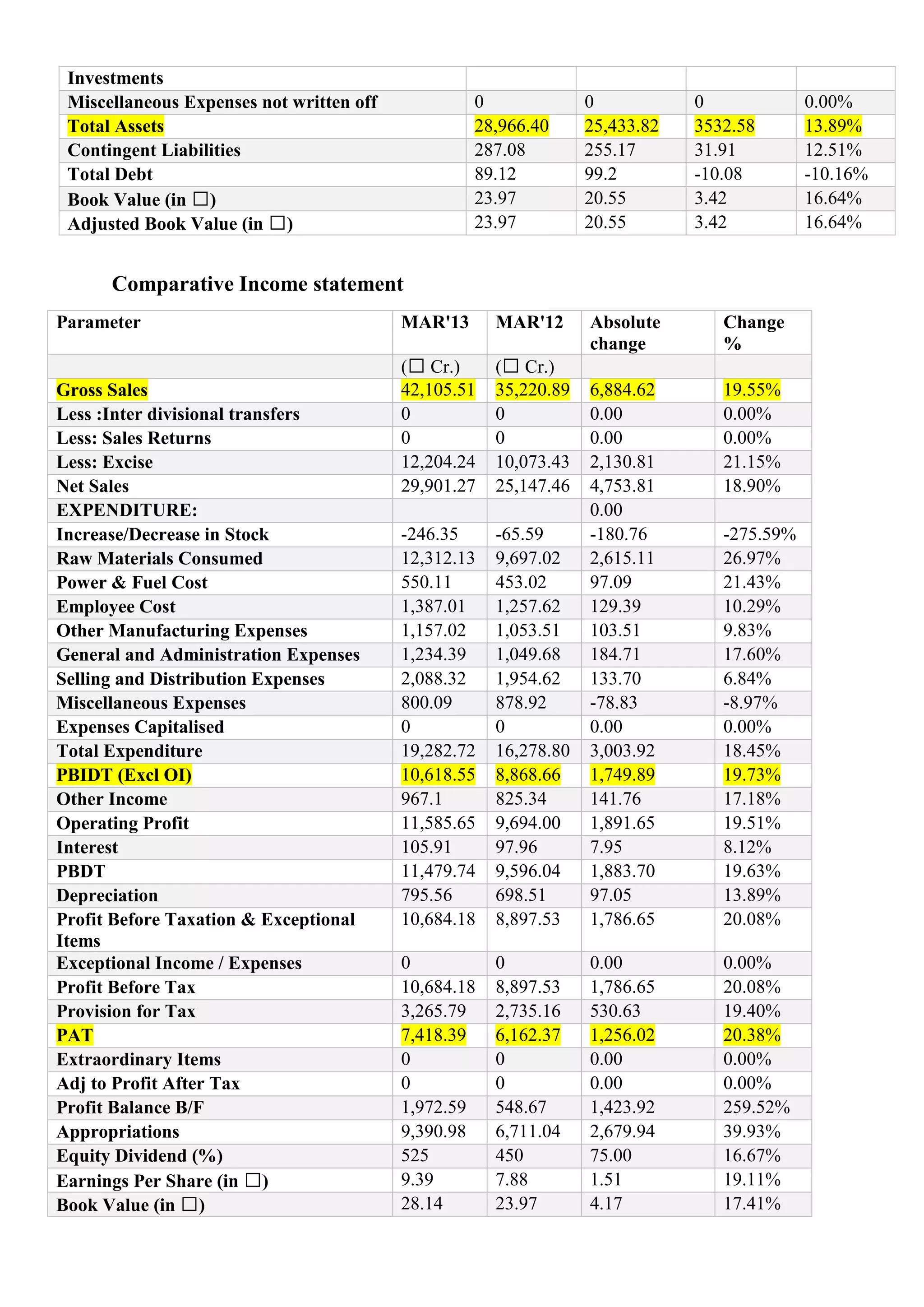
Comparative Income statement
Parameter

Gross Sales
Less :Inter divisional transfers
Less: Sales Returns
Less: Excise
Net Sales
EXPENDITURE:
Increase/Decrease in Stock
Raw Materials Consumed
Power & Fuel Cost
Employee Cost
Other Manufacturing Expenses
General and Administration Expenses
Selling and Distribution Expenses
Miscellaneous Expenses
Expenses Capitalised
Total Expenditure
PBIDT (Excl OI)
Other Income
Operating Profit
Interest
PBDT
Depreciation
Profit Before Taxation & Exceptional
Items
Exceptional Income / Expenses
Profit Before Tax
Provision for Tax
PAT
Extraordinary Items
Adj to Profit After Tax
Profit Balance B/F
Appropriations
Equity Dividend (%)
Earnings Per Share (in ₹)
Book Value (in ₹)

MAR'13

MAR'12

Absolute
change

Change
%

(₹ Cr.)
42,105.51
0
0
12,204.24
29,901.27

(₹ Cr.)
35,220.89
0
0
10,073.43
25,147.46

19.55%
0.00%
0.00%
21.15%
18.90%

-65.59
9,697.02
453.02
1,257.62
1,053.51
1,049.68
1,954.62
878.92
0
16,278.80
8,868.66
825.34
9,694.00
97.96
9,596.04
698.51
8,897.53

6,884.62
0.00
0.00
2,130.81
4,753.81
0.00
-180.76
2,615.11
97.09
129.39
103.51
184.71
133.70
-78.83
0.00
3,003.92
1,749.89
141.76
1,891.65
7.95
1,883.70
97.05
1,786.65

-246.35
12,312.13
550.11
1,387.01
1,157.02
1,234.39
2,088.32
800.09
0
19,282.72
10,618.55
967.1
11,585.65
105.91
11,479.74
795.56
10,684.18
0
10,684.18
3,265.79
7,418.39
0
0
1,972.59
9,390.98
525
9.39
28.14

0
8,897.53
2,735.16
6,162.37
0
0
548.67
6,711.04
450
7.88
23.97

0.00
1,786.65
530.63
1,256.02
0.00
0.00
1,423.92
2,679.94
75.00
1.51
4.17

0.00%
20.08%
19.40%
20.38%
0.00%
0.00%
259.52%
39.93%
16.67%
19.11%
17.41%

-275.59%
26.97%
21.43%
10.29%
9.83%
17.60%
6.84%
-8.97%
0.00%
18.45%
19.73%
17.18%
19.51%
8.12%
19.63%
13.89%
20.08%

0.00%
13.89%
12.51%
-10.16%
16.64%
16.64%
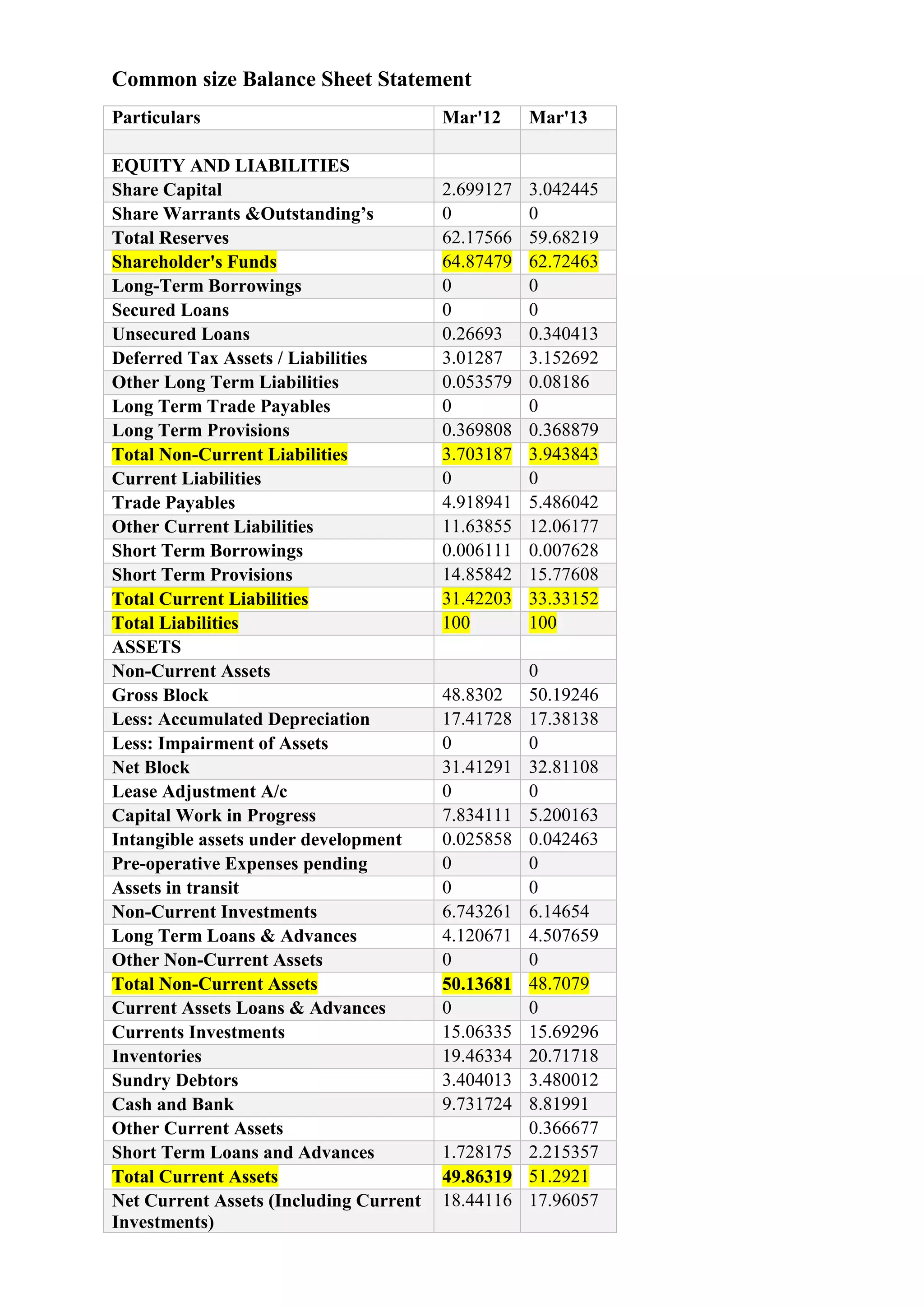
Common size Balance Sheet Statement
Particulars
EQUITY AND LIABILITIES
Share Capital
Share Warrants &Outstanding’s
Total Reserves
Shareholder's Funds
Long-Term Borrowings
Secured Loans
Unsecured Loans
Deferred Tax Assets / Liabilities
Other Long Term Liabilities
Long Term Trade Payables
Long Term Provisions
Total Non-Current Liabilities
Current Liabilities
Trade Payables
Other Current Liabilities
Short Term Borrowings
Short Term Provisions
Total Current Liabilities
Total Liabilities
ASSETS
Non-Current Assets
Gross Block
Less: Accumulated Depreciation
Less: Impairment of Assets
Net Block
Lease Adjustment A/c
Capital Work in Progress
Intangible assets under development
Pre-operative Expenses pending
Assets in transit
Non-Current Investments
Long Term Loans & Advances
Other Non-Current Assets
Total Non-Current Assets
Current Assets Loans & Advances
Currents Investments
Inventories
Sundry Debtors
Cash and Bank
Other Current Assets
Short Term Loans and Advances
Total Current Assets
Net Current Assets (Including Current
Investments)

Mar'12

Mar'13

2.699127
0
62.17566
64.87479
0
0
0.26693
3.01287
0.053579
0
0.369808
3.703187
0
4.918941
11.63855
0.006111
14.85842
31.42203
100

3.042445
0
59.68219
62.72463
0
0
0.340413
3.152692
0.08186
0
0.368879
3.943843
0
5.486042
12.06177
0.007628
15.77608
33.33152
100

48.8302
17.41728
0
31.41291
0
7.834111
0.025858
0
0
6.743261
4.120671
0
50.13681
0
15.06335
19.46334
3.404013
9.731724
1.728175
49.86319
18.44116

0
50.19246
17.38138
0
32.81108
0
5.200163
0.042463
0
0
6.14654
4.507659
0
48.7079
0
15.69296
20.71718
3.480012
8.81991
0.366677
2.215357
51.2921
17.96057
Total Current Assets Excluding
Current Investments
Miscellaneous Expenses not written off
Total Assets
Contingent Liabilities
Total Debt
Book Value (in ₹)
Adjusted Book Value (in ₹)

34.79984 35.59914
0
100

0
100

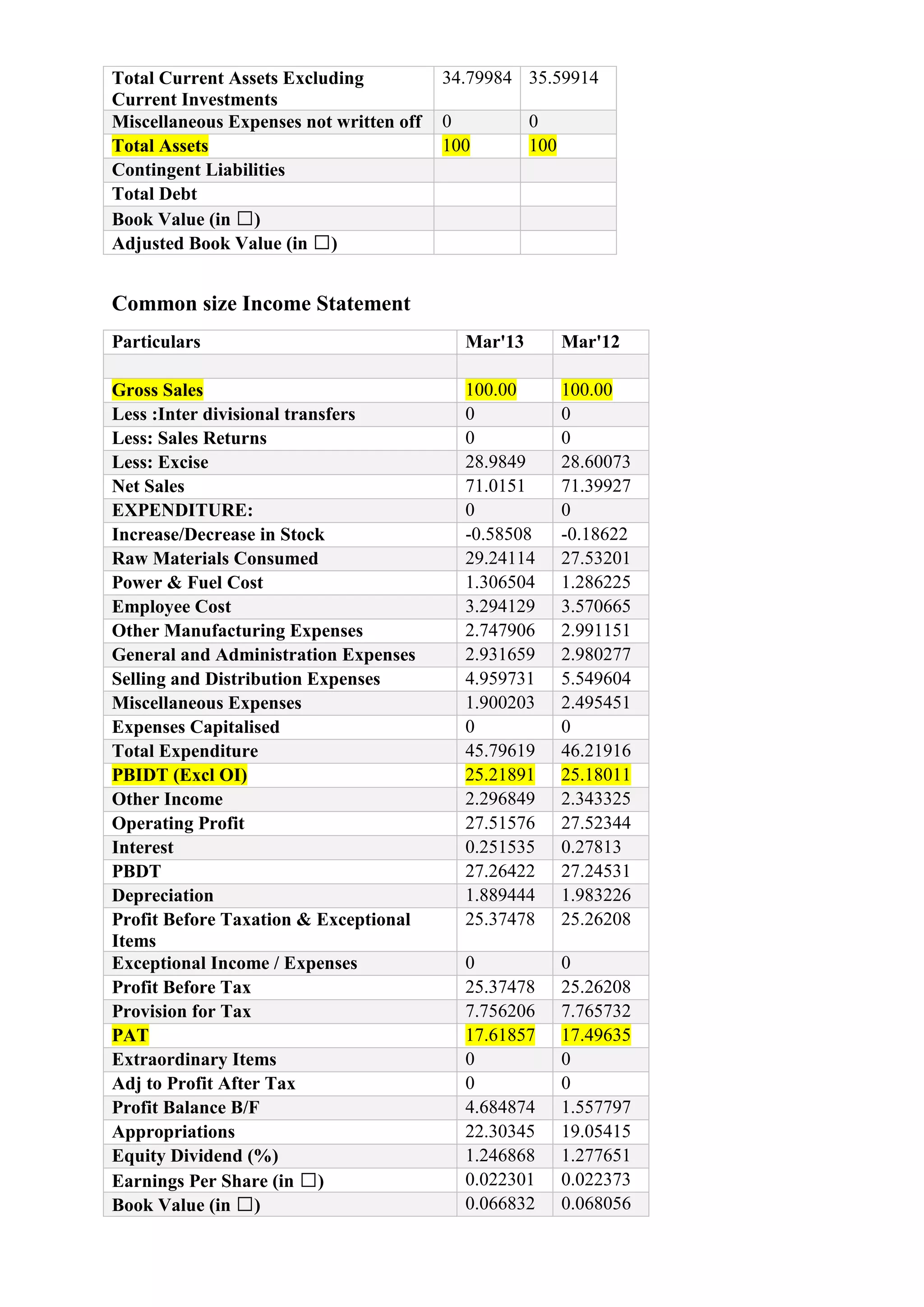
Common size Income Statement
Particulars

Mar'13

Mar'12

Gross Sales
Less :Inter divisional transfers
Less: Sales Returns
Less: Excise
Net Sales
EXPENDITURE:
Increase/Decrease in Stock
Raw Materials Consumed
Power & Fuel Cost
Employee Cost
Other Manufacturing Expenses
General and Administration Expenses
Selling and Distribution Expenses
Miscellaneous Expenses
Expenses Capitalised
Total Expenditure
PBIDT (Excl OI)
Other Income
Operating Profit
Interest
PBDT
Depreciation
Profit Before Taxation & Exceptional
Items
Exceptional Income / Expenses
Profit Before Tax
Provision for Tax
PAT
Extraordinary Items
Adj to Profit After Tax
Profit Balance B/F
Appropriations
Equity Dividend (%)
Earnings Per Share (in ₹)
Book Value (in ₹)

100.00
0
0
28.9849
71.0151
0
-0.58508
29.24114
1.306504
3.294129
2.747906
2.931659
4.959731
1.900203
0
45.79619
25.21891
2.296849
27.51576
0.251535
27.26422
1.889444
25.37478

100.00
0
0
28.60073
71.39927
0
-0.18622
27.53201
1.286225
3.570665
2.991151
2.980277
5.549604
2.495451
0
46.21916
25.18011
2.343325
27.52344
0.27813
27.24531
1.983226
25.26208

0
25.37478
7.756206
17.61857
0
0
4.684874
22.30345
1.246868
0.022301
0.066832

0
25.26208
7.765732
17.49635
0
0
1.557797
19.05415
1.277651
0.022373
0.068056
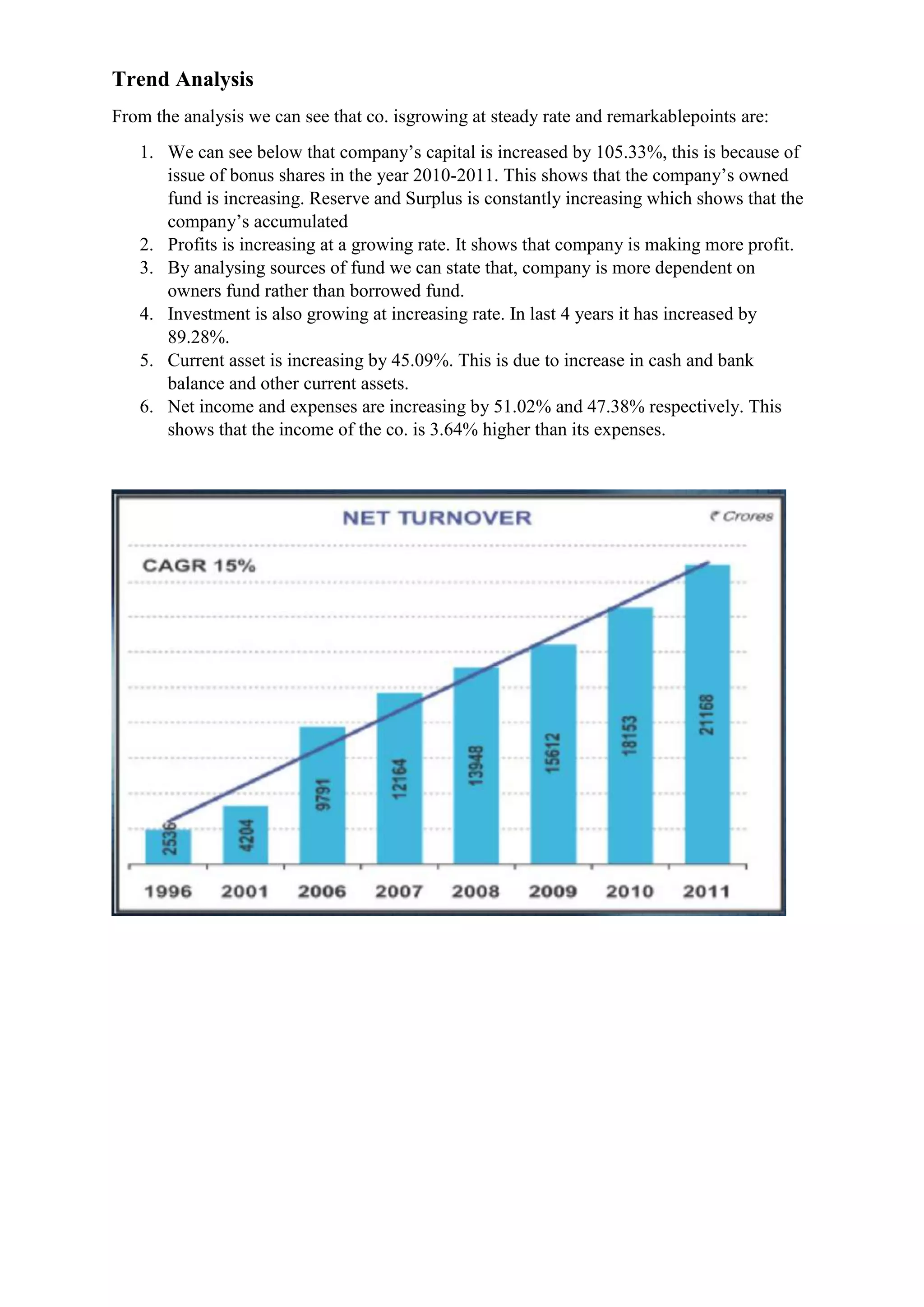
Trend Analysis
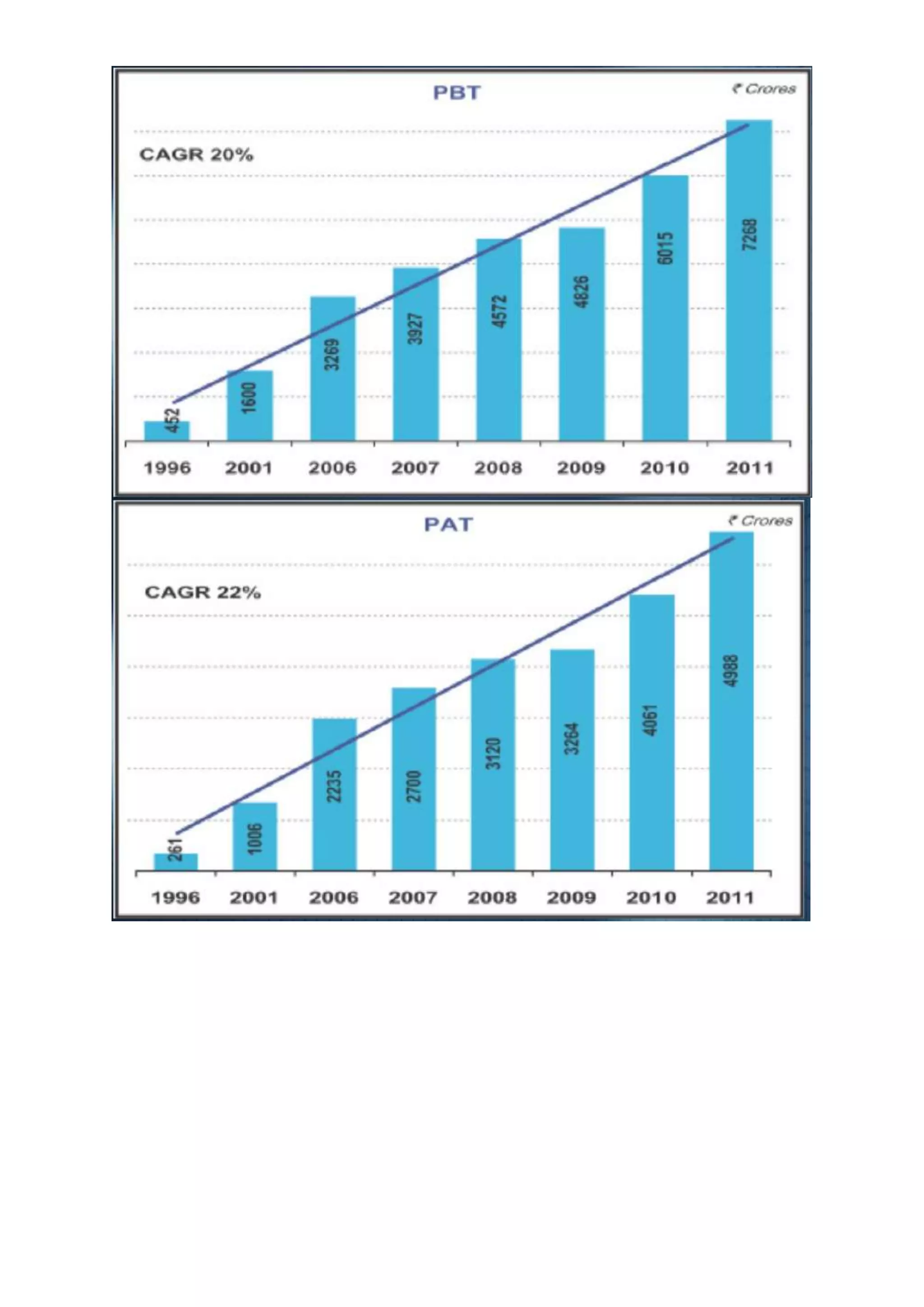
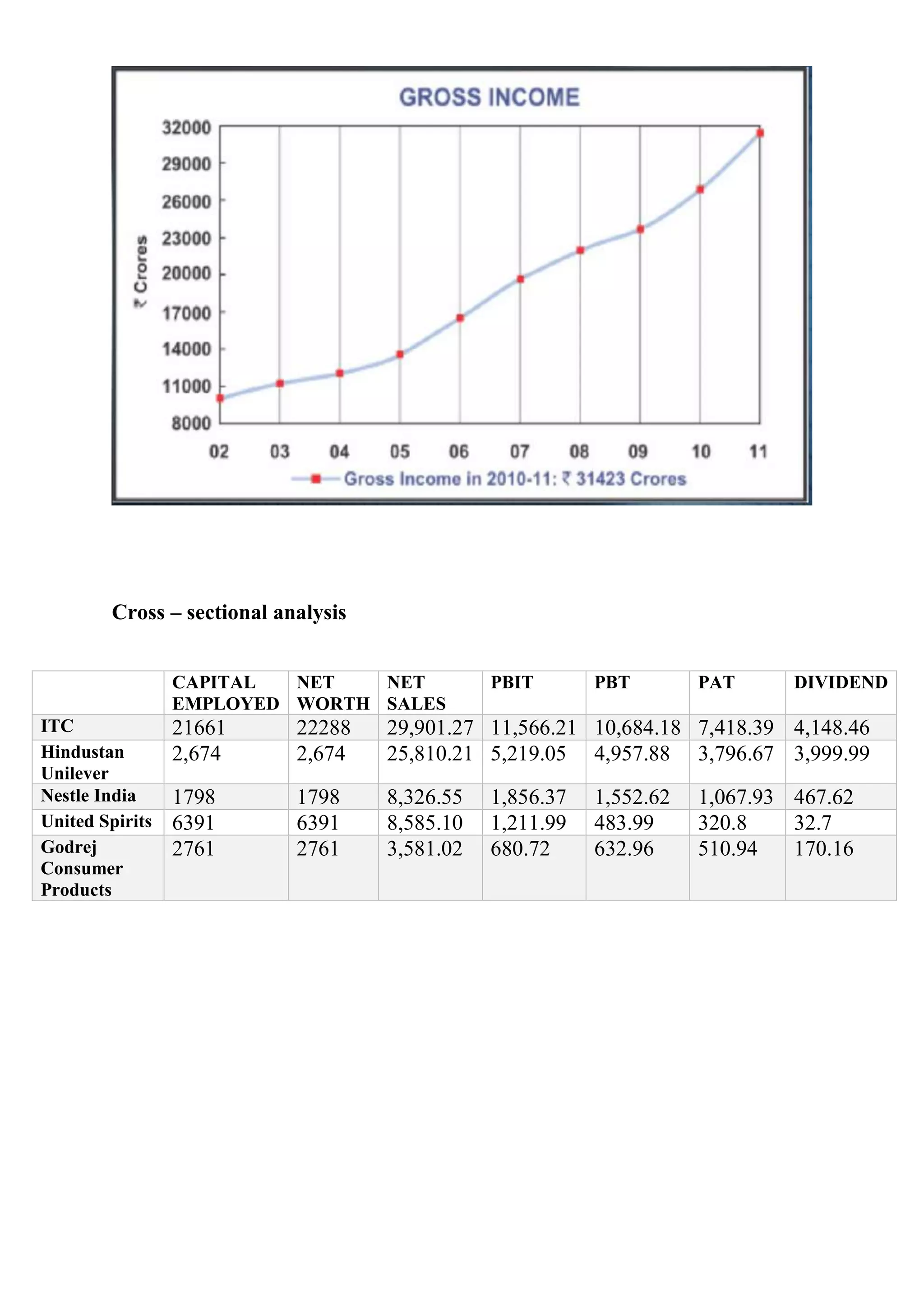
From the analysis we can see that co. isgrowing at steady rate and remarkablepoints are:
1. We can see below that company’s capital is increased by 105.33%, this is because of
issue of bonus shares in the year 2010-2011. This shows that the company’s owned
fund is increasing. Reserve and Surplus is constantly increasing which shows that the
company’s accumulated
2. Profits is increasing at a growing rate. It shows that company is making more profit.
3. By analysing sources of fund we can state that, company is more dependent on
owners fund rather than borrowed fund.
4. Investment is also growing at increasing rate. In last 4 years it has increased by
89.28%.
5. Current asset is increasing by 45.09%. This is due to increase in cash and bank
balance and other current assets.
6. Net income and expenses are increasing by 51.02% and 47.38% respectively. This
shows that the income of the co. is 3.64% higher than its expenses.
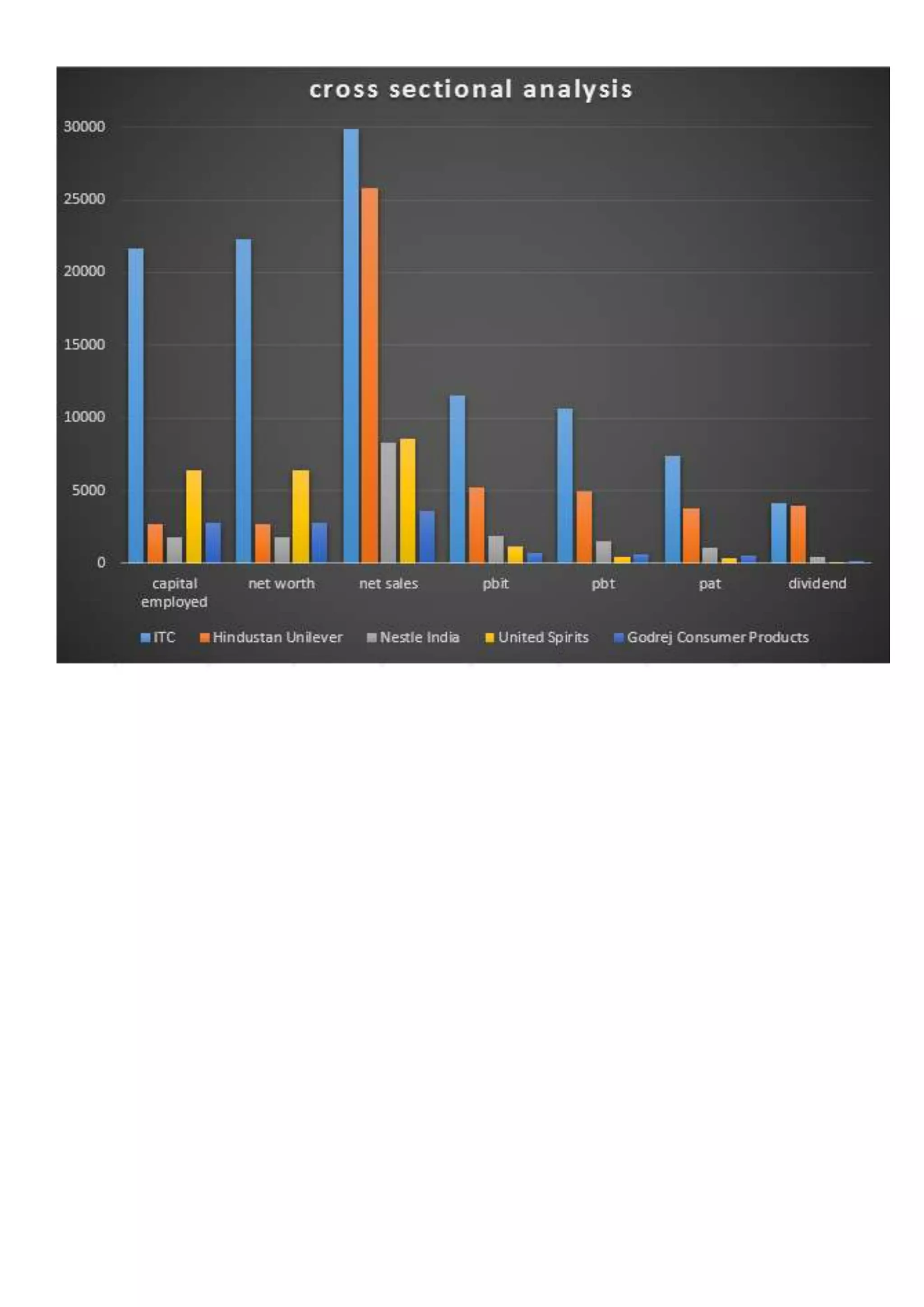
Cross – sectional analysis
CAPITAL
NET
NET
EMPLOYED WORTH SALES
ITC
Hindustan
Unilever
Nestle India
United Spirits
Godrej
Consumer
Products

PBIT

PBT

PAT

DIVIDEND

21661
2,674

22288
2,674

29,901.27 11,566.21 10,684.18 7,418.39 4,148.46
25,810.21 5,219.05 4,957.88 3,796.67 3,999.99

1798
6391
2761

1798
6391
2761

8,326.55
8,585.10
3,581.02

1,856.37
1,211.99
680.72

1,552.62
483.99
632.96

1,067.93 467.62
320.8
32.7
510.94
170.16
Itc financial statement analysis

Itc financial statement analysis

  • 1.
    A PROJECT REPORT ON ITCLimited One of India’s Most Admired and Valuable Companies
  • 2.
    INTRODUCTION Itc limited isa public conglomerate company head quartered in Kolkata .The Company is currently headed by YogeshChanderDeveshwar. It employs over 26,000 people at more than 60 location. Rated by BCG amongst Top 10 consumer goods companies in the world in terms of total shareholder returns (TSR) Suring 2005-2009. Oneoftheforemostintheprivatesectorintermsof: –Sustainedvaluecreation(BT-SternStewartsurvey) –Operatingprofits –CashProfits Itc is the onlyIndianFMCGCompanytofeatureinForbes 2000 List, Acomprehensiverankingofworld’sbiggestcompaniesmeasuredbyacompositeofsales,profits,ass ets&marketvalue. ITC’s rankingamongst all listed private sector cos.  PBT: No. 6  PAT: No. 5  Market Capitalization: No. 3 ITC Performance Track Record In Rs crs. 1995-96 Net Revenue 2,536 PBDIT 584 PBIT 536 PBT 452 PAT 261 Capital Employed 1,886 ROCE % 28.4 Market Capitalization 5,571 Total Shareholder Returns % Sensex (CAGR 95-96 to 12-13): 10.7% Rapid Scale up of FMCG businesses… 2012-13 29,606 11,566 10,771 10,684 7,418 23,569 45.7 244246 17-yr Cagr 95-96 to 12-13 15.6% 19.2% 19.3% 20.4% 21.8% 16.0% 24.9% 26.4%
  • 3.
    ITC’s Vision Makeasignificantandgrowingcontributiontowards:  Mitigatingsocietal challenges  Enhancing shareholder rewards By: Creating multiple drivers of growth while sustaining leadership in tobacco and Focusing on triple bottom line performance Enlargecontributiontothenations Financial capital Environmental capital Social capital Creating world-class brands for Indian Consumers
  • 4.
    Financial Statement Analysis Financialanalysis is the process of identifying the financial strengths and weaknesses of the firm by property establishing relationships between the item of the balance sheet and the profit and loss account. Users of Financial Analysis Trade creditors Lenders Investors Management Financial Ratio Analysis A Liquidity Ratioprovides information on a company's ability to meet its short−term, immediate obligations. A Profitability Ratioprovides information on the amount of income from each dollar ofsales. An Activity Ratiorelates information on a company's ability to manage its resources (that is, its assets) efficiently. A Financial Leverage Ratioprovides information on the degree of a company's fixedfinancing obligations and its ability to satisfy these financing obligations. A Market Ratio describes the company's financial condition in terms of amounts pershare of stock. Liquidity Ratio
  • 5.
    Itc have highliquidity ratios, the higher the margin of safety that the company possess to meet its current liabilities. Liquidity ratios greater than 1 indicate that the company is in good financial health and it is less likely fall into financial difficulties. Seen in all the years above 2013, 2012, 2011. Current ratio indicates Itc's ability to meet short-term debt obligations. The current ratio measures whether or not a firm has enough resources to pay its debts over the next 12 month. Profitability Ratio An increase in profit margin compared to the previous period's margin signals an improvement in both operational efficiency and profitability means the company improved its profits and efficiency. A margin higher than those of other companies or higher than the industry average means Itc business performed better than those companies during that period. Activity Ratio
  • 6.
    A high debtorturnover ratio implies either that the company operates on a cash basis or that its extension of credit and collection of accounts receivable are efficient. Also, a high ratio reflects a short lapse of time between sales and the collection of cash, while a low number means collection takes longer. A low inventory turnover ratio can be seen because of rescission but it is very well aligned with FMCG industry average. Leverage Ratio A very high interest cover suggest that the company is not capitalizing on the relatively cheaper source of finance (i.e. debt) and in such instances an increase in gearing ratio may actually add value to the enterprise. Interest coverage is an indication of the margin of safety it does not run the risk of nonpayment of interest cost which could potentially threaten its solvency. Market Ratio
  • 7.
    PE Ratios Current Share price 33.2 311.65 Generally,stocks that are expected to grow earnings will have a higher P/E, Itc companies with high growth have a higher ratio. Itc with the higher P/E is said to be overvalued by the market. The share price should reflect a firm’s future value creation potential, greater value creation can indicate greater future dividends from the company. A higher P/E ratio should reflect greater expected future gains because of perceived growth opportunities and/or some competitive advantages and/or lesser risk, but at the same time it indicates that the share price is relatively more expensive. Du Point Analysis DuPont analysis tells us that ROE is affected by three things: Operating efficiency, which is measured by profit margin Asset use efficiency, which is measured by total asset turnover Financial leverage, which is measured by the equity multiplier ROA (%) ROE (%) ROCE (%) Mar'13 23.55 36.21 52.45 Mar'12 22.65 35.58 51.66 The return on capital employed is another measure of the returns that thebusiness generates. This is expressed as the ratio between the profit beforeinterest and taxes (PBIT) to the Capital Employed (Loans and Owner’s Fund) in the business. The ROCE is increased to 52.45% from 51.66% signifies that the company is gettinggood return out of its investment decisions. The return on Total Assets is yet another method of calculating the return of the company. This is calculated by taking the ratio between the PBIT (Profitbefore Interest and Taxes) to the Total Assets of the company.Earning power of the company, i.e. 23.55%is quiet good and the company isdoing well. Comparative Balance Sheet Statement
  • 8.
    Particulars EQUITY AND LIABILITIES ShareCapital Share Warrants &Outstanding’s Total Reserves Shareholder's Funds Long-Term Borrowings Secured Loans Unsecured Loans Deferred Tax Assets / Liabilities Other Long Term Liabilities Long Term Trade Payables Long Term Provisions Total Non-Current Liabilities Current Liabilities Trade Payables Other Current Liabilities Short Term Borrowings Short Term Provisions Total Current Liabilities Total Liabilities ASSETS Non-Current Assets Gross Block Less: Accumulated Depreciation Less: Impairment of Assets Net Block Lease Adjustment A/c Capital Work in Progress Intangible assets under development Pre-operative Expenses pending Assets in transit Non-Current Investments Long Term Loans & Advances Other Non-Current Assets Total Non-Current Assets Current Assets Loans & Advances Currents Investments Inventories Sundry Debtors Cash and Bank Other Current Assets Short Term Loans and Advances Total Current Assets Net Current Assets (Including Current Investments) Total Current Assets Excluding Current MAR'12 (₹ Cr.) MAR'11 (₹ Cr.) 781.84 Absolute change %Change 773.81 8.03 1.04% 18,010.05 18,791.89 0 0 77.32 872.72 15.52 0 107.12 1,072.68 15,179.46 15,953.27 0 0 86.58 801.85 20.82 0 93.82 1,003.07 2830.59 2838.62 0 0 -9.26 70.87 -5.3 0 13.3 69.61 18.65% 17.79% 0.00% 0.00% -10.70% 8.84% -25.46% 0.00% 14.18% 6.94% 1,424.84 3,371.27 1.77 4,303.95 9,101.83 28,966.40 1,395.31 3,067.77 1.94 4,012.46 8,477.48 25,433.82 29.53 303.5 -0.17 291.49 624.35 3532.58 2.12% 9.89% -8.76% 7.26% 7.36% 13.89% 0 14,144.35 5,045.16 0 9,099.19 0 2,269.26 7.49 0 0 1,953.28 1,193.61 0 14,522.83 0 12,765.86 4,420.75 0 8,345.11 0 1,322.60 10.8 0 0 1,563.30 1,146.47 0 12,388.28 0 1378.49 624.41 0 754.08 0 946.66 -3.31 0 0 389.98 47.14 0 2134.55 0.00% 10.80% 14.12% 0.00% 9.04% 0.00% 71.58% -30.65% 0.00% 0.00% 24.95% 4.11% 0.00% 17.23% 4,363.31 5,637.83 986.02 2,818.93 136.89 500.59 14,443.57 5,341.74 3,991.32 5,269.17 885.1 2,243.24 93.26 563.45 13,045.54 4,568.06 371.99 368.66 100.92 575.69 43.63 -62.86 1398.03 773.68 9.32% 7.00% 11.40% 25.66% 46.78% -11.16% 10.72% 16.94% 10,080.26 9,054.22 1026.04 11.33%
  • 9.
    Investments Miscellaneous Expenses notwritten off Total Assets Contingent Liabilities Total Debt Book Value (in ₹) Adjusted Book Value (in ₹) 0 28,966.40 287.08 89.12 23.97 23.97 0 25,433.82 255.17 99.2 20.55 20.55 0 3532.58 31.91 -10.08 3.42 3.42 Comparative Income statement Parameter Gross Sales Less :Inter divisional transfers Less: Sales Returns Less: Excise Net Sales EXPENDITURE: Increase/Decrease in Stock Raw Materials Consumed Power & Fuel Cost Employee Cost Other Manufacturing Expenses General and Administration Expenses Selling and Distribution Expenses Miscellaneous Expenses Expenses Capitalised Total Expenditure PBIDT (Excl OI) Other Income Operating Profit Interest PBDT Depreciation Profit Before Taxation & Exceptional Items Exceptional Income / Expenses Profit Before Tax Provision for Tax PAT Extraordinary Items Adj to Profit After Tax Profit Balance B/F Appropriations Equity Dividend (%) Earnings Per Share (in ₹) Book Value (in ₹) MAR'13 MAR'12 Absolute change Change % (₹ Cr.) 42,105.51 0 0 12,204.24 29,901.27 (₹ Cr.) 35,220.89 0 0 10,073.43 25,147.46 19.55% 0.00% 0.00% 21.15% 18.90% -65.59 9,697.02 453.02 1,257.62 1,053.51 1,049.68 1,954.62 878.92 0 16,278.80 8,868.66 825.34 9,694.00 97.96 9,596.04 698.51 8,897.53 6,884.62 0.00 0.00 2,130.81 4,753.81 0.00 -180.76 2,615.11 97.09 129.39 103.51 184.71 133.70 -78.83 0.00 3,003.92 1,749.89 141.76 1,891.65 7.95 1,883.70 97.05 1,786.65 -246.35 12,312.13 550.11 1,387.01 1,157.02 1,234.39 2,088.32 800.09 0 19,282.72 10,618.55 967.1 11,585.65 105.91 11,479.74 795.56 10,684.18 0 10,684.18 3,265.79 7,418.39 0 0 1,972.59 9,390.98 525 9.39 28.14 0 8,897.53 2,735.16 6,162.37 0 0 548.67 6,711.04 450 7.88 23.97 0.00 1,786.65 530.63 1,256.02 0.00 0.00 1,423.92 2,679.94 75.00 1.51 4.17 0.00% 20.08% 19.40% 20.38% 0.00% 0.00% 259.52% 39.93% 16.67% 19.11% 17.41% -275.59% 26.97% 21.43% 10.29% 9.83% 17.60% 6.84% -8.97% 0.00% 18.45% 19.73% 17.18% 19.51% 8.12% 19.63% 13.89% 20.08% 0.00% 13.89% 12.51% -10.16% 16.64% 16.64%
  • 10.
    Common size BalanceSheet Statement Particulars EQUITY AND LIABILITIES Share Capital Share Warrants &Outstanding’s Total Reserves Shareholder's Funds Long-Term Borrowings Secured Loans Unsecured Loans Deferred Tax Assets / Liabilities Other Long Term Liabilities Long Term Trade Payables Long Term Provisions Total Non-Current Liabilities Current Liabilities Trade Payables Other Current Liabilities Short Term Borrowings Short Term Provisions Total Current Liabilities Total Liabilities ASSETS Non-Current Assets Gross Block Less: Accumulated Depreciation Less: Impairment of Assets Net Block Lease Adjustment A/c Capital Work in Progress Intangible assets under development Pre-operative Expenses pending Assets in transit Non-Current Investments Long Term Loans & Advances Other Non-Current Assets Total Non-Current Assets Current Assets Loans & Advances Currents Investments Inventories Sundry Debtors Cash and Bank Other Current Assets Short Term Loans and Advances Total Current Assets Net Current Assets (Including Current Investments) Mar'12 Mar'13 2.699127 0 62.17566 64.87479 0 0 0.26693 3.01287 0.053579 0 0.369808 3.703187 0 4.918941 11.63855 0.006111 14.85842 31.42203 100 3.042445 0 59.68219 62.72463 0 0 0.340413 3.152692 0.08186 0 0.368879 3.943843 0 5.486042 12.06177 0.007628 15.77608 33.33152 100 48.8302 17.41728 0 31.41291 0 7.834111 0.025858 0 0 6.743261 4.120671 0 50.13681 0 15.06335 19.46334 3.404013 9.731724 1.728175 49.86319 18.44116 0 50.19246 17.38138 0 32.81108 0 5.200163 0.042463 0 0 6.14654 4.507659 0 48.7079 0 15.69296 20.71718 3.480012 8.81991 0.366677 2.215357 51.2921 17.96057
  • 11.
    Total Current AssetsExcluding Current Investments Miscellaneous Expenses not written off Total Assets Contingent Liabilities Total Debt Book Value (in ₹) Adjusted Book Value (in ₹) 34.79984 35.59914 0 100 0 100 Common size Income Statement Particulars Mar'13 Mar'12 Gross Sales Less :Inter divisional transfers Less: Sales Returns Less: Excise Net Sales EXPENDITURE: Increase/Decrease in Stock Raw Materials Consumed Power & Fuel Cost Employee Cost Other Manufacturing Expenses General and Administration Expenses Selling and Distribution Expenses Miscellaneous Expenses Expenses Capitalised Total Expenditure PBIDT (Excl OI) Other Income Operating Profit Interest PBDT Depreciation Profit Before Taxation & Exceptional Items Exceptional Income / Expenses Profit Before Tax Provision for Tax PAT Extraordinary Items Adj to Profit After Tax Profit Balance B/F Appropriations Equity Dividend (%) Earnings Per Share (in ₹) Book Value (in ₹) 100.00 0 0 28.9849 71.0151 0 -0.58508 29.24114 1.306504 3.294129 2.747906 2.931659 4.959731 1.900203 0 45.79619 25.21891 2.296849 27.51576 0.251535 27.26422 1.889444 25.37478 100.00 0 0 28.60073 71.39927 0 -0.18622 27.53201 1.286225 3.570665 2.991151 2.980277 5.549604 2.495451 0 46.21916 25.18011 2.343325 27.52344 0.27813 27.24531 1.983226 25.26208 0 25.37478 7.756206 17.61857 0 0 4.684874 22.30345 1.246868 0.022301 0.066832 0 25.26208 7.765732 17.49635 0 0 1.557797 19.05415 1.277651 0.022373 0.068056
  • 12.
    Trend Analysis From theanalysis we can see that co. isgrowing at steady rate and remarkablepoints are: 1. We can see below that company’s capital is increased by 105.33%, this is because of issue of bonus shares in the year 2010-2011. This shows that the company’s owned fund is increasing. Reserve and Surplus is constantly increasing which shows that the company’s accumulated 2. Profits is increasing at a growing rate. It shows that company is making more profit. 3. By analysing sources of fund we can state that, company is more dependent on owners fund rather than borrowed fund. 4. Investment is also growing at increasing rate. In last 4 years it has increased by 89.28%. 5. Current asset is increasing by 45.09%. This is due to increase in cash and bank balance and other current assets. 6. Net income and expenses are increasing by 51.02% and 47.38% respectively. This shows that the income of the co. is 3.64% higher than its expenses.
  • 14.
    Cross – sectionalanalysis CAPITAL NET NET EMPLOYED WORTH SALES ITC Hindustan Unilever Nestle India United Spirits Godrej Consumer Products PBIT PBT PAT DIVIDEND 21661 2,674 22288 2,674 29,901.27 11,566.21 10,684.18 7,418.39 4,148.46 25,810.21 5,219.05 4,957.88 3,796.67 3,999.99 1798 6391 2761 1798 6391 2761 8,326.55 8,585.10 3,581.02 1,856.37 1,211.99 680.72 1,552.62 483.99 632.96 1,067.93 467.62 320.8 32.7 510.94 170.16