






What people SayThe happiest collectors are those that motivated by the fun and enjoyment they derive from collecting. Like a picture, a painting speaks a thousand words and makes billions for the investor."You can't avoid the art market these days if you're a sensible investor," said Mehul Patel, a 27-year-old Indian tech entrepreneur based in Singapore"Today, people aren't buying art out of conviction or pleasure, but because they see money in it," says DadibaPundole, a gallery ownerSo what do You Say ?
AlternativeArt as an Investment Option
MembersMadhu91029Shivi91051Radhika91041Sweta91059Group 2
Flow of Presentation…Facts & ActsArt IndustryWhy Invest in ArtCosts in Art InvestmentRisks in Art InvestmentParticipantsArt Valuation and AppraisalArt Indices and FundsTaxes and InsuranceTips for Art Investment
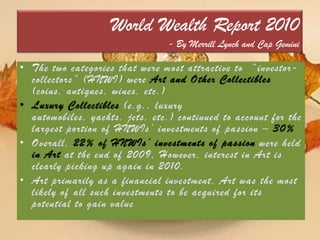
World Wealth Report 2010- By Merrill Lynch and Cap GeminiThe two categories that were most attractive to  “investor-collectors” (HNWI) were Art and Other Collectibles (coins, antiques, wines, etc.)Luxury Collectibles (e.g., luxury automobiles, yachts, jets, etc.) continued to account for the largest portion of HNWIs’ investments of passion – 30%Overall,22% of HNWIs’ investments of passion were held in Artat the end of 2009, However, interest in Art is clearly picking up again in 2010. Art primarily as a financial investment, Art was the most likely of all such investments to be acquired for its potential to gain value
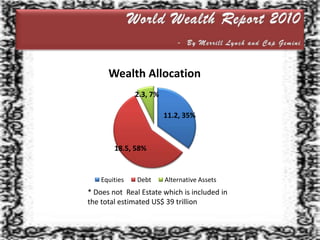
World Wealth Report 2010-By Merrill Lynch and Cap Gemini* Does not  Real Estate which is included in the total estimated US$ 39 trillion
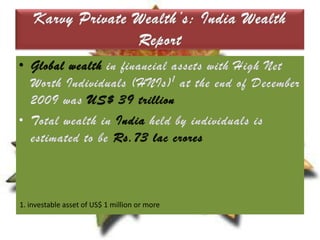
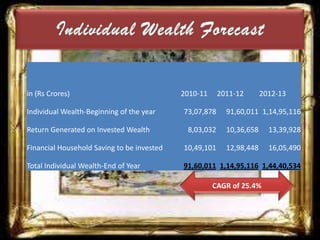
Karvy Private Wealth’s: India Wealth ReportGlobal wealth in financial assets with High Net Worth Individuals (HNIs)1 at the end of December 2009 was US$ 39 trillionTotal wealth in India held by individuals is estimated to be Rs.73lac crores1. investable asset of US$ 1 million or more
CAGR of 25.4%Individual Wealth Forecast
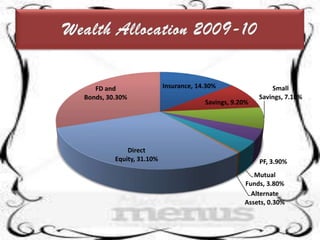
Wealth Allocation 2009-10
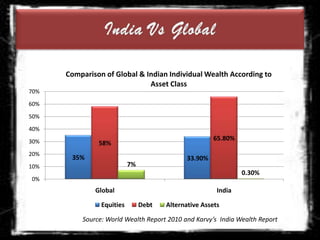
India Vs GlobalSource: World Wealth Report 2010 and Karvy’s  India Wealth Report
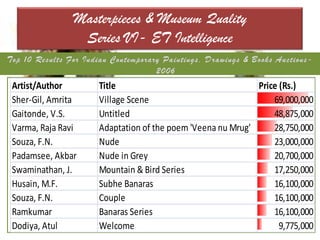
Masterpieces & Museum QualitySeries VI- ET IntelligenceTop 10 Results For Indian Contemporary Paintings, Drawings & Books Auctions-2006
The Antiquities And Art Treasures Act, 1972Sec 2(1) ‘Antiquities’ - which have been in existence for not less than 100 years Viz.,Sculptures in stone, terracotta, metals, ivory.Painting in paper, wood, cloth, skin etcManuscripts Sec 2(2)“Art treasure” means any human work of art, not being an antiquity, declared by the Central Government by notification in the Official Gazette, to be an art treasure for the purposes of this Act having regard to its artistic or aesthetic value: Provided that no declaration under this clause shall be made in respect of any such work of art so long as the author thereof is alive
Sec 3: It is unlawful for any person, other than the Central Government or any authority authorized by Central Government to export antiquity or art treasure.Sec 5: Antiquities to be sold only under a licence.Sec 14: Any person who owns controls or is in possession of any antiquity shall register the same before the registering officer and should obtain a certificate.Sec 25 : If any person exports or attempts to export any antiquity or art treasure is liable for punishment for a term not less than 3 months which may extend to 3 years and with fine.
Art IndustryThe global art market is estimated at $23.5 billion, and more than half of it is in the US, considered the most-developed art market. The Indian art industry is estimated at about Rs 250 crore, and is expected to grow at 35per cent a year. Price increases of between two times and eight times in just the last three years for the works of artists like M.F. Husain, V.S. Gaitonde, SatishGujral and Tyeb Mehta .Today, people aren't buying art out of conviction or pleasure, but because they see money in it.
Indian ArtWith a 5000-year-old culture, Indian Art is rich in its tapestry of ancient heritage, medieval times, Mughal rule, British rule, Progressive art and now contemporary artIndian artists relied heavily on religious scriptures to draw inspirationWater colors, charcoal, vegetable dyes were popular methods of paintingStone and marble were also used to create art. One of the many purposes of art was to spread the word around about the king and glorify his deeds
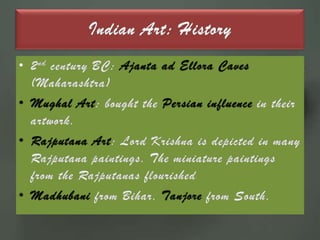
Indian Art: History2nd century BC: Ajanta ad Ellora Caves (Maharashtra) Mughal Art: bought the Persian influence in their artwork.Rajputana Art: Lord Krishna is depicted in many Rajputana paintings. The miniature paintings from the Rajputanas flourishedMadhubani from Bihar, Tanjore from South,
Indian ArtModern Indian Art: Rabindranath Tagore, MF Hussain Raja Ravi Verma.Theme changed to Nature, portraits, were some of the themes artist chose. As artists started to express themselves, art galleries were needed to display their works. Art galleries appeared in Delhi and Mumbai only in the post sixties. The face of Indian Art was changing with times. The uniqueness of Indian Art still lies in its rich cultural heritage.
Why Art?To diversify your investment portfolio. High volatility of equity marketsArt has attracted a lot of attention after the year 2000.Indian art is growing tremendously and breaking new trends of unprecedented appreciation due to excess liquidity in the economyIt's not as volatile as stocks, gold and property, and is not affected as much by economic downturns — and, it provides the investor an aesthetic benefit, as well.
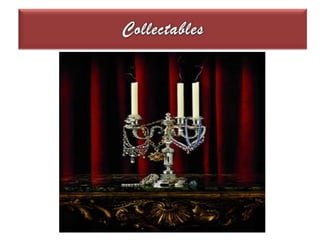
Collectables
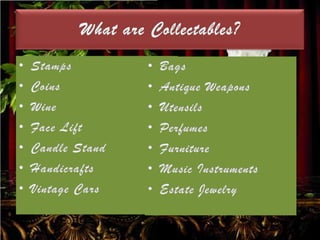
What are Collectables?StampsCoinsWineFace LiftCandle StandHandicraftsVintage CarsBags
Antique Weapons
Utensils
Perfumes
Furniture
Music Instruments
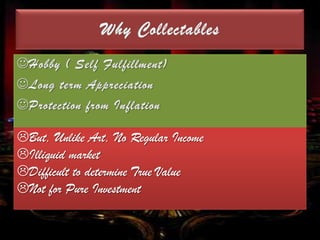
Estate JewelryWhy CollectablesHobby ( Self Fulfillment)
Long term Appreciation
Protection from Inflation
But, Unlike Art, No Regular Income
Illiquid market
Difficult to determine True Value
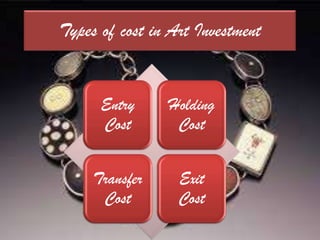
Not for Pure InvestmentTypes of cost in Art Investment
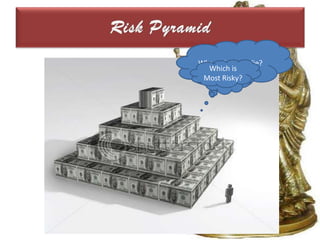
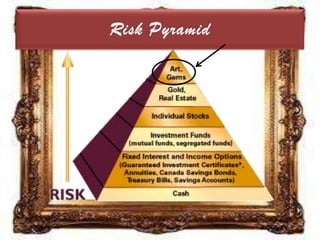
Risk PyramidWhere does Art lie?Which is Most Risky?Which is Safest?
Risk Pyramid
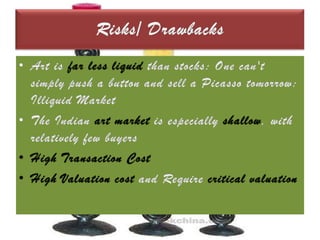
Risks/ DrawbacksArt is far less liquid than stocks: One can't simply push a button and sell a Picasso tomorrow: Illiquid MarketThe Indian art market is especially shallow, with relatively few buyersHigh Transaction CostHigh Valuation cost and Require critical valuation
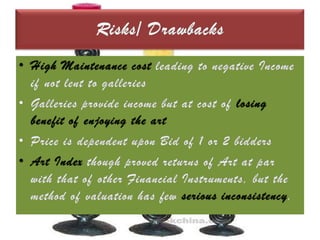
Risks/ DrawbacksHigh Maintenance cost leading to negative Income if not lent to galleriesGalleries provide income but at cost of losing benefit of enjoying the artPrice is dependent upon Bid of 1 or 2 biddersArt Index though proved returns of Art at par with that of other Financial Instruments, but the method of valuation has few serious inconsistency.
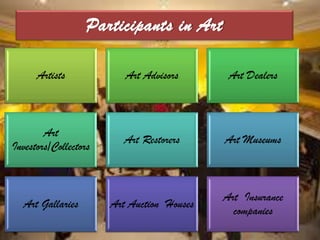
Participants in Art
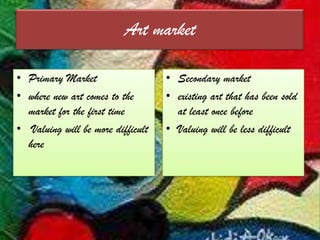
Art marketPrimary Marketwhere new art comes to the market for the first timeValuing will be more difficult hereSecondary marketexisting art that has been sold at least once beforeValuing will be less difficult
Art ValuationArt valuation, an art-specific subset of financial valuation, is the process of estimating the potential market value of works of artand as such is a financial rather than an aesthetic concern. Art valuation involves comparing data from multiple sources such as art auction houses, private and corporate collectors, curators, and specialized analysts to arrive at a value.
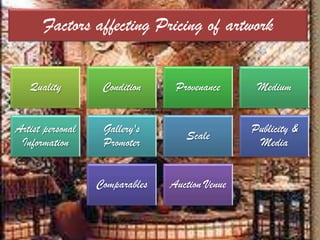
Factors affecting Pricing of artwork
You purchase a work of fine art from a gallery The owner assured you that the price you paid was based on an appraisal provided by the manager of the gallery. You go home feeling comfortable that the price you paid was accurate since it was based on the appraisal provided by the gallery. Is this comfort justified?
AppraisalA proper appraisal of artwork means: A signed written report
Regarding a clearly identified piece of art,
Prepared by a person with the necessary training and experience
Who is impartial and disinterested,
Stating an opinion as to the market value as of a given date, and
Setting forth the facts and analysis supporting the opinionPurpose of AppraisalTo determine a purchase or sales price
For tax purposes(charitable deduction, gift tax)
For insurance purposes(premiums are usually set and claims paid based on replacement value)
To obtain a loan secured by artwork
To satisfy the curiosity of the ownerDifficulties in Appraising ArtworkOriginal artwork is one of the most difficult things to value
Value depends on external factors that are difficult to quantify.
Appraisals are only as good as the time period in which they are presented
No cash flows  as in other asset classesBasic Appraisal Methods
Market Comparison Approach
Cost Approach  Not applicable to all artworks like in painting.
Applicable where say the value of an artwork made of precious metals or gems depends largely on the raw materials or in the case of decorative arts where the cost of manufacturer is the main factor in determining its valueIncome ApproachWhere the artwork produces income, such as artwork in the stock of someone in the business of renting out artwork or a master image used to produce signed and numbered prints or commercial products such as posters and t-shirts.
Under this method the stream of income is capitalized and used as the basis for estimating value.Intuitive ApproachThis approach is not officially recognized by any of the major appraisal organizations or the IRS, but  it is commonly used in the art world.
Replacement Value Approach
Art IndexEquity: NIFTY/SENSEX/OthersReal Estate : RESSEXInflation: CPICommodity Price IndexesDiamond : IDEX Diamond Price Index Why is an Index reqd?
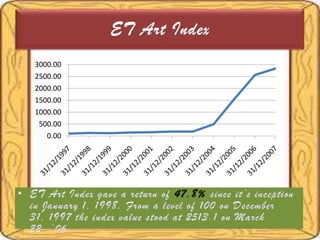
ET Art IndexET and Osian’s– Connoisseurs of Artworld’s premier Archive on the Indian contemporary fine and popular artsFor the fund managers and insurance companies, but also for investors (HNIs)Uses the transactions of artworks belonging to India’s leading 51 contemporary artistsM.F. Husain, F.N..Souza, Tyeb Mehta, Akbar Padamsee, GaneshPyne, J. Swaminathan, J. Sultan Ali, 3 Tagorestransaction value of these 51 artists comprise 88% of the total organized Indian art marketCalculated on the basis of the average Square Inch Rate (S.I.R) of worksThe Liquidity and Historical Significance weights have been considered so as to arrive at the final index value
ET Art IndexET Art Index gave a return of 47.8% since it’s inception in January 1, 1998. From a level of 100 on December 31, 1997 the index value stood at 2513.1 on March 22, ‘06
ET Art IndexET Art Index gave a return of 47.8% since it’s inception inJanuary 1, 1998. From a level of 100 on December 31, 1997 the index value stood at 2513.1 on March 22, ‘06
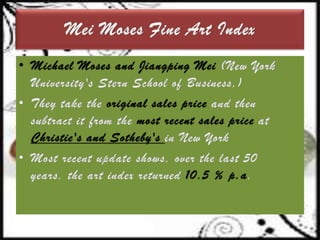
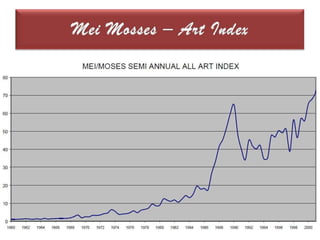
Mei Moses Fine Art IndexMichael Moses and Jiangping Mei (New York University's Stern School of Business,)They take the original sales price and then subtract it from the most recent sales price at Christie's and Sotheby's in New YorkMost recent update shows, over the last 50 years, the art index returned 10.5 % p.a.
Mei Mosses – Art Index
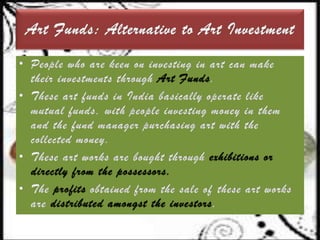
Art Funds: Alternative to Art InvestmentPeople who are keen on investing in art can make their investments through Art Funds.These art funds in India basically operate like mutual funds, with people investing money in them and the fund manager purchasing art with the collected money. These art works are bought through exhibitions or directly from the possessors. The profits obtained from the sale of these art works are distributed amongst the investors.
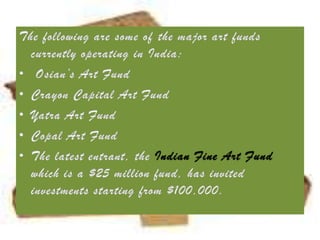
The following are some of the major art funds currently operating in India: Osian’s Art FundCrayon Capital Art FundYatra Art FundCopal Art FundThe latest entrant, the Indian Fine Art Fund which is a $25 million fund, has invited investments starting from $100,000.
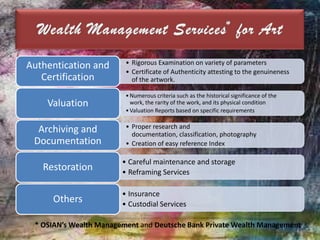
Wealth Management Services* for Art* OSIAN’s Wealth Management and Deutsche Bank Private Wealth Management
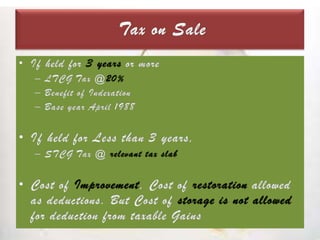
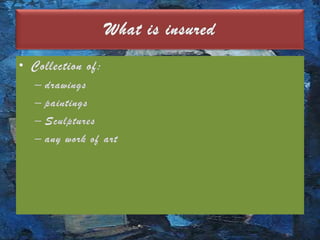
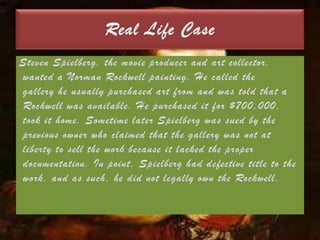
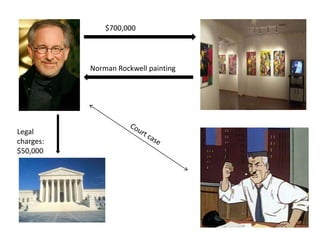
TaxAt what stages Tax is attracted?

Arts as Alternative Investment

  • 1.
    What people SayThehappiest collectors are those that motivated by the fun and enjoyment they derive from collecting. Like a picture, a painting speaks a thousand words and makes billions for the investor."You can't avoid the art market these days if you're a sensible investor," said Mehul Patel, a 27-year-old Indian tech entrepreneur based in Singapore"Today, people aren't buying art out of conviction or pleasure, but because they see money in it," says DadibaPundole, a gallery ownerSo what do You Say ?
  • 2.
    AlternativeArt as anInvestment Option
  • 3.
  • 4.
    Flow of Presentation…Facts& ActsArt IndustryWhy Invest in ArtCosts in Art InvestmentRisks in Art InvestmentParticipantsArt Valuation and AppraisalArt Indices and FundsTaxes and InsuranceTips for Art Investment
  • 5.
    World Wealth Report2010- By Merrill Lynch and Cap GeminiThe two categories that were most attractive to “investor-collectors” (HNWI) were Art and Other Collectibles (coins, antiques, wines, etc.)Luxury Collectibles (e.g., luxury automobiles, yachts, jets, etc.) continued to account for the largest portion of HNWIs’ investments of passion – 30%Overall,22% of HNWIs’ investments of passion were held in Artat the end of 2009, However, interest in Art is clearly picking up again in 2010. Art primarily as a financial investment, Art was the most likely of all such investments to be acquired for its potential to gain value
  • 6.
    World Wealth Report2010-By Merrill Lynch and Cap Gemini* Does not Real Estate which is included in the total estimated US$ 39 trillion
  • 7.
    Karvy Private Wealth’s:India Wealth ReportGlobal wealth in financial assets with High Net Worth Individuals (HNIs)1 at the end of December 2009 was US$ 39 trillionTotal wealth in India held by individuals is estimated to be Rs.73lac crores1. investable asset of US$ 1 million or more
  • 8.
  • 9.
  • 10.
    India Vs GlobalSource:World Wealth Report 2010 and Karvy’s India Wealth Report
  • 11.
    Masterpieces & MuseumQualitySeries VI- ET IntelligenceTop 10 Results For Indian Contemporary Paintings, Drawings & Books Auctions-2006
  • 12.
    The Antiquities AndArt Treasures Act, 1972Sec 2(1) ‘Antiquities’ - which have been in existence for not less than 100 years Viz.,Sculptures in stone, terracotta, metals, ivory.Painting in paper, wood, cloth, skin etcManuscripts Sec 2(2)“Art treasure” means any human work of art, not being an antiquity, declared by the Central Government by notification in the Official Gazette, to be an art treasure for the purposes of this Act having regard to its artistic or aesthetic value: Provided that no declaration under this clause shall be made in respect of any such work of art so long as the author thereof is alive
  • 13.
    Sec 3: Itis unlawful for any person, other than the Central Government or any authority authorized by Central Government to export antiquity or art treasure.Sec 5: Antiquities to be sold only under a licence.Sec 14: Any person who owns controls or is in possession of any antiquity shall register the same before the registering officer and should obtain a certificate.Sec 25 : If any person exports or attempts to export any antiquity or art treasure is liable for punishment for a term not less than 3 months which may extend to 3 years and with fine.
  • 14.
    Art IndustryThe globalart market is estimated at $23.5 billion, and more than half of it is in the US, considered the most-developed art market. The Indian art industry is estimated at about Rs 250 crore, and is expected to grow at 35per cent a year. Price increases of between two times and eight times in just the last three years for the works of artists like M.F. Husain, V.S. Gaitonde, SatishGujral and Tyeb Mehta .Today, people aren't buying art out of conviction or pleasure, but because they see money in it.
  • 15.
    Indian ArtWith a5000-year-old culture, Indian Art is rich in its tapestry of ancient heritage, medieval times, Mughal rule, British rule, Progressive art and now contemporary artIndian artists relied heavily on religious scriptures to draw inspirationWater colors, charcoal, vegetable dyes were popular methods of paintingStone and marble were also used to create art. One of the many purposes of art was to spread the word around about the king and glorify his deeds
  • 16.
    Indian Art: History2ndcentury BC: Ajanta ad Ellora Caves (Maharashtra) Mughal Art: bought the Persian influence in their artwork.Rajputana Art: Lord Krishna is depicted in many Rajputana paintings. The miniature paintings from the Rajputanas flourishedMadhubani from Bihar, Tanjore from South,
  • 17.
    Indian ArtModern IndianArt: Rabindranath Tagore, MF Hussain Raja Ravi Verma.Theme changed to Nature, portraits, were some of the themes artist chose. As artists started to express themselves, art galleries were needed to display their works. Art galleries appeared in Delhi and Mumbai only in the post sixties. The face of Indian Art was changing with times. The uniqueness of Indian Art still lies in its rich cultural heritage.
  • 18.
    Why Art?To diversifyyour investment portfolio. High volatility of equity marketsArt has attracted a lot of attention after the year 2000.Indian art is growing tremendously and breaking new trends of unprecedented appreciation due to excess liquidity in the economyIt's not as volatile as stocks, gold and property, and is not affected as much by economic downturns — and, it provides the investor an aesthetic benefit, as well.
  • 19.
  • 20.
    What are Collectables?StampsCoinsWineFaceLiftCandle StandHandicraftsVintage CarsBags
  • 21.
  • 22.
  • 23.
  • 24.
  • 25.
  • 26.
  • 27.
  • 28.
  • 29.
    But, Unlike Art,No Regular Income
  • 30.
  • 31.
  • 32.
    Not for PureInvestmentTypes of cost in Art Investment
  • 33.
    Risk PyramidWhere doesArt lie?Which is Most Risky?Which is Safest?
  • 34.
  • 35.
    Risks/ DrawbacksArt isfar less liquid than stocks: One can't simply push a button and sell a Picasso tomorrow: Illiquid MarketThe Indian art market is especially shallow, with relatively few buyersHigh Transaction CostHigh Valuation cost and Require critical valuation
  • 36.
    Risks/ DrawbacksHigh Maintenancecost leading to negative Income if not lent to galleriesGalleries provide income but at cost of losing benefit of enjoying the artPrice is dependent upon Bid of 1 or 2 biddersArt Index though proved returns of Art at par with that of other Financial Instruments, but the method of valuation has few serious inconsistency.
  • 37.
  • 39.
    Art marketPrimary Marketwherenew art comes to the market for the first timeValuing will be more difficult hereSecondary marketexisting art that has been sold at least once beforeValuing will be less difficult
  • 40.
    Art ValuationArt valuation,an art-specific subset of financial valuation, is the process of estimating the potential market value of works of artand as such is a financial rather than an aesthetic concern. Art valuation involves comparing data from multiple sources such as art auction houses, private and corporate collectors, curators, and specialized analysts to arrive at a value.
  • 41.
  • 42.
    You purchase awork of fine art from a gallery The owner assured you that the price you paid was based on an appraisal provided by the manager of the gallery. You go home feeling comfortable that the price you paid was accurate since it was based on the appraisal provided by the gallery. Is this comfort justified?
  • 43.
    AppraisalA proper appraisalof artwork means: A signed written report
  • 44.
    Regarding a clearlyidentified piece of art,
  • 45.
    Prepared by aperson with the necessary training and experience
  • 46.
    Who is impartialand disinterested,
  • 47.
    Stating an opinionas to the market value as of a given date, and
  • 48.
    Setting forth thefacts and analysis supporting the opinionPurpose of AppraisalTo determine a purchase or sales price
  • 49.
    For tax purposes(charitablededuction, gift tax)
  • 50.
    For insurance purposes(premiumsare usually set and claims paid based on replacement value)
  • 51.
    To obtain aloan secured by artwork
  • 52.
    To satisfy thecuriosity of the ownerDifficulties in Appraising ArtworkOriginal artwork is one of the most difficult things to value
  • 53.
    Value depends onexternal factors that are difficult to quantify.
  • 54.
    Appraisals are onlyas good as the time period in which they are presented
  • 55.
    No cash flows as in other asset classesBasic Appraisal Methods
  • 56.
  • 57.
    Cost Approach Not applicable to all artworks like in painting.
  • 58.
    Applicable where saythe value of an artwork made of precious metals or gems depends largely on the raw materials or in the case of decorative arts where the cost of manufacturer is the main factor in determining its valueIncome ApproachWhere the artwork produces income, such as artwork in the stock of someone in the business of renting out artwork or a master image used to produce signed and numbered prints or commercial products such as posters and t-shirts.
  • 59.
    Under this methodthe stream of income is capitalized and used as the basis for estimating value.Intuitive ApproachThis approach is not officially recognized by any of the major appraisal organizations or the IRS, but it is commonly used in the art world.
  • 60.
  • 61.
    Art IndexEquity: NIFTY/SENSEX/OthersRealEstate : RESSEXInflation: CPICommodity Price IndexesDiamond : IDEX Diamond Price Index Why is an Index reqd?
  • 62.
    ET Art IndexETand Osian’s– Connoisseurs of Artworld’s premier Archive on the Indian contemporary fine and popular artsFor the fund managers and insurance companies, but also for investors (HNIs)Uses the transactions of artworks belonging to India’s leading 51 contemporary artistsM.F. Husain, F.N..Souza, Tyeb Mehta, Akbar Padamsee, GaneshPyne, J. Swaminathan, J. Sultan Ali, 3 Tagorestransaction value of these 51 artists comprise 88% of the total organized Indian art marketCalculated on the basis of the average Square Inch Rate (S.I.R) of worksThe Liquidity and Historical Significance weights have been considered so as to arrive at the final index value
  • 63.
    ET Art IndexETArt Index gave a return of 47.8% since it’s inception in January 1, 1998. From a level of 100 on December 31, 1997 the index value stood at 2513.1 on March 22, ‘06
  • 64.
    ET Art IndexETArt Index gave a return of 47.8% since it’s inception inJanuary 1, 1998. From a level of 100 on December 31, 1997 the index value stood at 2513.1 on March 22, ‘06
  • 65.
    Mei Moses FineArt IndexMichael Moses and Jiangping Mei (New York University's Stern School of Business,)They take the original sales price and then subtract it from the most recent sales price at Christie's and Sotheby's in New YorkMost recent update shows, over the last 50 years, the art index returned 10.5 % p.a.
  • 66.
  • 67.
    Art Funds: Alternativeto Art InvestmentPeople who are keen on investing in art can make their investments through Art Funds.These art funds in India basically operate like mutual funds, with people investing money in them and the fund manager purchasing art with the collected money. These art works are bought through exhibitions or directly from the possessors. The profits obtained from the sale of these art works are distributed amongst the investors.
  • 68.
    The following aresome of the major art funds currently operating in India: Osian’s Art FundCrayon Capital Art FundYatra Art FundCopal Art FundThe latest entrant, the Indian Fine Art Fund which is a $25 million fund, has invited investments starting from $100,000.
  • 69.
    Wealth Management Services*for Art* OSIAN’s Wealth Management and Deutsche Bank Private Wealth Management
  • 70.
    TaxAt what stagesTax is attracted?