
12/20/2010


ADIDAS                BRAND STUDY


   Submitted To:                              Submitted By:
   Prof Freda J Swaminathan
   Prof. Jayshree Sundar                Shivi Aggarwal ( 91051)
                                    Madhusudan Partani ( 90129)
   Faculty
                                                      FMG-18A
   Strategic Brand Management
                                     FORE School of Management,
   FORE School of Management,
                                                      New Delhi
   New Delhi
Brand Study

Introduction
The idea was as simple as it was brilliant. Adi Dassler’s aim was to provide every athlete with the
best possible equipment. It all began in 1920, when Adi Dassler made his first shoes using the few
materials available after the First World War. Today, the Adidas product range extends from
footwear and apparel to accessories for all kinds of different sports.


The Journey
Adidas as earlier mentioned started its operation in 1920 as a small workshop. But its transformation
into a large corporation and become one of the top global brands has a story within.

In 1949 Adi Dassler first registered Adidas in the commercial register (Handelsregister) in Fürth (near
Herzogenaurach). The official name of the company back then was “Adolf Dassler Adidas
Sportschuhfabrik”. And then the enterprise was transformed into a corporation
(“Aktiengesellschaft”) in 1989.

In 1997, Adidas acquired the Salomon group, and the company’s name changed to Adidas-Salomon
AG. The Salomon group also included the TaylorMade golf brand. In October 2005, the Salomon
business segment, including the related subsidiaries was sold to the Finnish Amer Sports
Corporation. The company changed its legal name to “Adidas AG”. And then On January 31, 2006,
Adidas-Salomon AG acquired Reebok International Ltd. By combining two of the most respected and
well-known brands in the worldwide sporting goods industry, the new Group benefits from a more
competitive worldwide platform, well-defined and complementary brand identities, a wider range of
products, and a stronger presence across teams, athletes, events and leagues. And in June 2006, the
company’s name is changed to Adidas AG.


Since the very beginning of Adidas, the corporation, the employees and the organization followed
the three guiding principle of “To produce the best shoe to serve the needs of the Sport; TO Protect
the athlete from Injury, and to make the product durable” These principles were followed by the
founder Adolf Dassler (the Man who gave Adidas its name) . From the very beginning, a passionate
athlete himself, from the very beginning Adi Dassler was in close contact with sports participants and
was always present in person at important sports events. Parallel to the rapid developments in
sport, Adi Dassler strove to specialize and optimize his products. Adi Dassler was the first
entrepreneur to use sports promotion in order to make the public aware of his innovations. He
started using well-known athletes as advertising for his products. And then Aggressive publicity
became one of the cornerstones of his corporate policy.


Strategic Brand Management                                                                     Page 1
Brand Study

Brand Portfolio
Adidas( name derived from Adi Das The name of its Founder) has three major brands namely Adidas,
TaylorMade and Reebok.

Adidas
Adidas has two sub brands under it namely Sports performance and Originals.


                           The guiding principle of the Adidas Sport Performance Division is to
                           equip all athletes to achieve their “impossible”. Adidas Sport
                           Performance brings its passion for great products to athletes
                           in all sports and mainly focuses on four key categories globally: football,
                           running, training and basketball. It has various product categories
                           ranging from Sport, to body care to Eye care.

                           The Sport Style Division is the home of Originals, defined as authentic
                          sportswear, the Fashion Group, which is the future of sportswear, and
                          Style Essentials, the fresh sport-inspired label made accessible for style-
                          adopting youth. Together they offer consumers products from street
                          fashion to high fashion, all uniquely inspired and linked to sport.

                           Inspired by its roots in sport and women’s fitness, Reebok is
                           a global brand that is committed to developing innovative products
                           which will allow Reebok to own Women’s Fitness, challenge the
                           Men’s Sport category and revive its Classics heritage. It has brands like
                           Reebok-CCM Hockey and Rockport under this Brand.

                           TaylorMade is a leader in the industry and the number one metal wood
                           supplier. It focuses on consumers who seek the most innovative,
                           performance-enhancing       golf     equipment     available,   including
                           technologically superior drivers, fairway woods, irons, putters and balls.
                           The brands like Adidas Golf and Ashworth popular brands in Golf are
                           part of this Brand.


Strategic Brand Management                                                                    Page 2
Brand Study

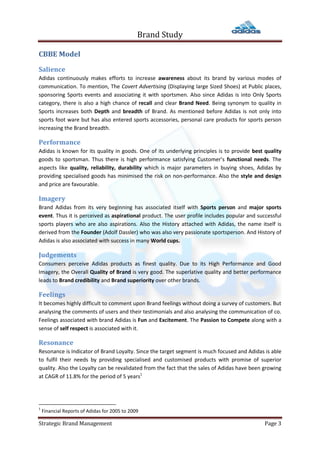
CBBE Model

Salience
Adidas continuously makes efforts to increase awareness about its brand by various modes of
communication. To mention, The Covert Advertising (Displaying large Sized Shoes) at Public places,
sponsoring Sports events and associating it with sportsmen. Also since Adidas is into Only Sports
category, there is also a high chance of recall and clear Brand Need. Being synonym to quality in
Sports increases both Depth and breadth of Brand. As mentioned before Adidas is not only into
sports foot ware but has also entered sports accessories, personal care products for sports person
increasing the Brand breadth.

Performance
Adidas is known for its quality in goods. One of its underlying principles is to provide best quality
goods to sportsman. Thus there is high performance satisfying Customer’s functional needs. The
aspects like quality, reliability, durability which is major parameters in buying shoes, Adidas by
providing specialised goods has minimised the risk on non-performance. Also the style and design
and price are favourable.

Imagery
Brand Adidas from its very beginning has associated itself with Sports person and major sports
event. Thus it is perceived as aspirational product. The user profile includes popular and successful
sports players who are also aspirations. Also the History attached with Adidas, the name itself is
derived from the Founder (Adolf Dassler) who was also very passionate sportsperson. And History of
Adidas is also associated with success in many World cups.

Judgements
Consumers perceive Adidas products as finest quality. Due to its High Performance and Good
Imagery, the Overall Quality of Brand is very good. The superlative quality and better performance
leads to Brand credibility and Brand superiority over other brands.

Feelings
It becomes highly difficult to comment upon Brand feelings without doing a survey of customers. But
analysing the comments of users and their testimonials and also analysing the communication of co.
Feelings associated with brand Adidas is Fun and Excitement. The Passion to Compete along with a
sense of self respect is associated with it.

Resonance
Resonance is Indicator of Brand Loyalty. Since the target segment is much focused and Adidas is able
to fulfil their needs by providing specialised and customised products with promise of superior
quality. Also the Loyalty can be revalidated from the fact that the sales of Adidas have been growing
at CAGR of 11.8% for the period of 5 years1


1
    Financial Reports of Adidas for 2005 to 2009

Strategic Brand Management                                                                    Page 3
Brand Study


Picture 1 CBBE Model- Adidas


Target Market
From the website and various campaigns led by Adidas for its various brands as above mentioned,
the primary target market has been sports person. Over the years the target customer for Adidas
was Sportsperson both men and women. It has aimed and is successful in providing not only shoes
but every equipment, accessory and also cares items. It has entered into a foray of Electronic
Communications by launching mCoach a Mobile with Training and guide. But all the products the
Adidas deals into target the sportsperson and all its products have a sporty look.


Brand Identity

Name
Adidas is derived from the Initials of its Founder Adolf (Adi) Dassler. But now the name has become
synonym to sports need for Sportsmen. Also the name is easy to pronounce, easy recall ability and
not confused with any other brand.


Strategic Brand Management                                                                  Page 4
Brand Study


Logo
                                               The Logo is bright, Sporty and easy to recognise. It has few
                                               distinct features making it easily distinguishable with other
                                               brands like three line breaks. Also Name is written in small
                                               caps.

Slogan
The Slogan of Adidas “Impossible Nothing” though it has just two words, but it says a lot; It
stimulates the sportiness and enthusiasm in minds of consumer. The slogan is very apt with the
product it is into and the message and perception it wants to make.

Brand Positioning
Adidas tries to position itself as Sporty brand by associating itself with Major Sports events,
Aspirational and successful sportspersons, and also by creating commercials full of energy. The
slogan as mentioned above is also very sporty. The primary positioning which Adidas wants to make
is of Super quality sports good for Sporty persons.


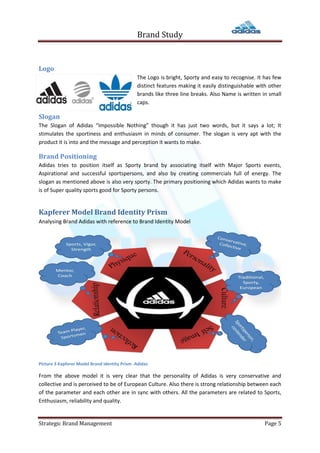
Kapferer Model Brand Identity Prism
Analysing Brand Adidas with reference to Brand Identity Model


Picture 3 Kapferer Model Brand Identity Prism -Adidas

From the above model it is very clear that the personality of Adidas is very conservative and
collective and is perceived to be of European Culture. Also there is strong relationship between each
of the parameter and each other are in sync with others. All the parameters are related to Sports,
Enthusiasm, reliability and quality.


Strategic Brand Management                                                                          Page 5
Brand Study

Position Re-Shuffle
Adidas over the years has constantly positioned itself as brand for Hard core Sports person. All of its
communication campaigns feature Healthy sporty men and women and majorly sportspersons. And
this has been a success mantra for adidas. Since its founder Mr.Dassler has the principle of providing
the best quality goods to sportsmen and also the same is the company’s objectives, thus targeting
sportsperson or aspiring sportsperson is very much relevant.

Adidas has gained core competency in sports Goods by means of remaining in constant touch with
sportspersons and identifying their needs. This competency has given a competitive advantage to
Adidas over its competitor. The expertise of sports knowledge has helped Adidas in acquiring related
brands like TaylorMade and Reebok. Also it has entered into other sports equipments and Sports
merchandise.

But One Critical observation is, after acquiring Reebok and Taylor made, they are retained as
separate brands targeting different customers like Reebok for Women; this creates confusion in
minds of customer and also by this way Adidas is not leveraging its Brand value. Thus it would be
better if Reebok and Taylor made though will remain as brand but will become part of Adidas like
Adidas Sports and Adidas Originals.


Brand Extension Strategies

Given the origins of Adidas, it is understandable why the brand was focused purely on sports
performance and technology for most of its existence. However, the Adidas Style brand extension,
which targets a broader audience with casual street wear, is responsible for 20% of total brand sales.
The untouched target group propelled Adidas through the roof in the 1980s was that of Hip-Hop
musicians and break dancers!

That's 20% of total sales that may not have existed if Adidas didn't think to market to a new
audience and decided to stick with sports.

Reorganization of Group Provides Solid Platform For Growth
In 2009, the adidas Group took the strategic decision to move from a vertically integrated brand
structure into a functional multi-brand structure for the adidas and Reebok brands. This led to the
creation of a Global Sales function responsible for the commercial activities and a Global Brands
function responsible for the marketing activities of both brands. In addition, the Global Sales
organization was split into Wholesale and Retail, to cater more appropriately to the different needs
of these two distinctive business models. This new structure follows two important principles: to
foster further alignment and strengthen brand management to drive long-term sustainable growth,
while at the same time ensuring coordinated and best practice execution in the marketplace.


Diverse Brand Portfolio

Consumers want choice. To maximize our consumer reach, it has embraced a multi-brand strategy.
This approach allows it to tackle opportunities from several perspectives, as both a mass and a niche

Strategic Brand Management                                                                     Page 6
Brand Study

player, providing distinct and relevant products to a wide spectrum of consumers. In this way, each
brand is able to keep a unique identity and focus on its core competencies, while simultaneously
providing the Group with a broad product offering, increasing its leverage in the marketplace. It also
allows adidas to address multiple consumer needs, tackle market opportunities from various angles
as well as be less affected by one-dimensional market risks. Currently, the brand focuses on 5 global
priorities:

Football: expanding market leadership
Running: building credibility with high-performance athletes
Training: creating new consumer experiences
Basketball: increasing global footprint
Outdoor: the athletic brand in the outdoors


Investments Focused on Highest Potential Markets and Channels
As a Group, it targets leading market positions in all markets where it competes. However, with
almost 180 subsidiaries worldwide, it has prioritized our investments based on those markets which
offer the best medium- to long-term growth and profitability opportunities. Therefore, to fully
exploit market opportunities, it tailors the distribution strategy to present brands to the consumer in
the most impactful way.


Brand’s Broad and Unique Product Portfolio
It spans from apparel and footwear for professional athletes to premium fashion. It allows adidas to
address multiple consumer needs, exploit market opportunities from various angles as well as be
less affected by one-dimensional market risks. Adidas’ commitment to product innovation and its
rich heritage differentiates the brand from competitors and provides a solid platform for future
growth. That means adidas intends to inspire, support and equip all athletes in the best possible way
to help them achieve their optimal performance.


Strategic Brand Management                                                                     Page 7
Brand Study

Recommendations

Brand Consolidation
As already mentioned, adidas has four sub brands ( as mentioned above) of these two are sub
brands of Adidas and two are positioned as separate brands. Instead of this it will be beneficial if all
brands are made as sub brands of adidas. By this none of the brand will lose their positioning and a
clear corporate brand structure will be made.

Reshuffle Portfolio
At present adidas has a very wide range of products lengthening and widening its product mix.
Different Shoes of different variety and different features for each sport namely Cricket, Hockey, and
Football etc... Also Different apparels, merchandise and Sports equipments. Thus it is per se
necessary to re shuffle the product basket. A Concentrated approach will be advisable.

Focus on Emerging markets like India
According to Venn research Inc., The Indian sports equipment market had total revenue of $2,069.1
million in 2009, representing a com-pound annual growth rate (CAGR) of 7.1% for the period
spanning 2005-2009. Thus there is huge scope and opportunity for Brand like Adidas to increase its
presence in emerging countries.

Creating a Flexible Supply Chain
Speed and agility is the key to outpacing the competition. It is committed to meeting the full range
of customer and consumer needs by ensuring product availability in the correct size and colour,
providing game-changing technical innovations and also the latest high-end fashion product to the
highest quality standards.


Strategic Brand Management                                                                      Page 8

Adidas Brand Study

  • 1.
    12/20/2010 ADIDAS BRAND STUDY Submitted To: Submitted By: Prof Freda J Swaminathan Prof. Jayshree Sundar Shivi Aggarwal ( 91051) Madhusudan Partani ( 90129) Faculty FMG-18A Strategic Brand Management FORE School of Management, FORE School of Management, New Delhi New Delhi
  • 2.
    Brand Study Introduction The ideawas as simple as it was brilliant. Adi Dassler’s aim was to provide every athlete with the best possible equipment. It all began in 1920, when Adi Dassler made his first shoes using the few materials available after the First World War. Today, the Adidas product range extends from footwear and apparel to accessories for all kinds of different sports. The Journey Adidas as earlier mentioned started its operation in 1920 as a small workshop. But its transformation into a large corporation and become one of the top global brands has a story within. In 1949 Adi Dassler first registered Adidas in the commercial register (Handelsregister) in Fürth (near Herzogenaurach). The official name of the company back then was “Adolf Dassler Adidas Sportschuhfabrik”. And then the enterprise was transformed into a corporation (“Aktiengesellschaft”) in 1989. In 1997, Adidas acquired the Salomon group, and the company’s name changed to Adidas-Salomon AG. The Salomon group also included the TaylorMade golf brand. In October 2005, the Salomon business segment, including the related subsidiaries was sold to the Finnish Amer Sports Corporation. The company changed its legal name to “Adidas AG”. And then On January 31, 2006, Adidas-Salomon AG acquired Reebok International Ltd. By combining two of the most respected and well-known brands in the worldwide sporting goods industry, the new Group benefits from a more competitive worldwide platform, well-defined and complementary brand identities, a wider range of products, and a stronger presence across teams, athletes, events and leagues. And in June 2006, the company’s name is changed to Adidas AG. Since the very beginning of Adidas, the corporation, the employees and the organization followed the three guiding principle of “To produce the best shoe to serve the needs of the Sport; TO Protect the athlete from Injury, and to make the product durable” These principles were followed by the founder Adolf Dassler (the Man who gave Adidas its name) . From the very beginning, a passionate athlete himself, from the very beginning Adi Dassler was in close contact with sports participants and was always present in person at important sports events. Parallel to the rapid developments in sport, Adi Dassler strove to specialize and optimize his products. Adi Dassler was the first entrepreneur to use sports promotion in order to make the public aware of his innovations. He started using well-known athletes as advertising for his products. And then Aggressive publicity became one of the cornerstones of his corporate policy. Strategic Brand Management Page 1
  • 3.
    Brand Study Brand Portfolio Adidas(name derived from Adi Das The name of its Founder) has three major brands namely Adidas, TaylorMade and Reebok. Adidas Adidas has two sub brands under it namely Sports performance and Originals. The guiding principle of the Adidas Sport Performance Division is to equip all athletes to achieve their “impossible”. Adidas Sport Performance brings its passion for great products to athletes in all sports and mainly focuses on four key categories globally: football, running, training and basketball. It has various product categories ranging from Sport, to body care to Eye care. The Sport Style Division is the home of Originals, defined as authentic sportswear, the Fashion Group, which is the future of sportswear, and Style Essentials, the fresh sport-inspired label made accessible for style- adopting youth. Together they offer consumers products from street fashion to high fashion, all uniquely inspired and linked to sport. Inspired by its roots in sport and women’s fitness, Reebok is a global brand that is committed to developing innovative products which will allow Reebok to own Women’s Fitness, challenge the Men’s Sport category and revive its Classics heritage. It has brands like Reebok-CCM Hockey and Rockport under this Brand. TaylorMade is a leader in the industry and the number one metal wood supplier. It focuses on consumers who seek the most innovative, performance-enhancing golf equipment available, including technologically superior drivers, fairway woods, irons, putters and balls. The brands like Adidas Golf and Ashworth popular brands in Golf are part of this Brand. Strategic Brand Management Page 2
  • 4.
    Brand Study CBBE Model Salience Adidascontinuously makes efforts to increase awareness about its brand by various modes of communication. To mention, The Covert Advertising (Displaying large Sized Shoes) at Public places, sponsoring Sports events and associating it with sportsmen. Also since Adidas is into Only Sports category, there is also a high chance of recall and clear Brand Need. Being synonym to quality in Sports increases both Depth and breadth of Brand. As mentioned before Adidas is not only into sports foot ware but has also entered sports accessories, personal care products for sports person increasing the Brand breadth. Performance Adidas is known for its quality in goods. One of its underlying principles is to provide best quality goods to sportsman. Thus there is high performance satisfying Customer’s functional needs. The aspects like quality, reliability, durability which is major parameters in buying shoes, Adidas by providing specialised goods has minimised the risk on non-performance. Also the style and design and price are favourable. Imagery Brand Adidas from its very beginning has associated itself with Sports person and major sports event. Thus it is perceived as aspirational product. The user profile includes popular and successful sports players who are also aspirations. Also the History attached with Adidas, the name itself is derived from the Founder (Adolf Dassler) who was also very passionate sportsperson. And History of Adidas is also associated with success in many World cups. Judgements Consumers perceive Adidas products as finest quality. Due to its High Performance and Good Imagery, the Overall Quality of Brand is very good. The superlative quality and better performance leads to Brand credibility and Brand superiority over other brands. Feelings It becomes highly difficult to comment upon Brand feelings without doing a survey of customers. But analysing the comments of users and their testimonials and also analysing the communication of co. Feelings associated with brand Adidas is Fun and Excitement. The Passion to Compete along with a sense of self respect is associated with it. Resonance Resonance is Indicator of Brand Loyalty. Since the target segment is much focused and Adidas is able to fulfil their needs by providing specialised and customised products with promise of superior quality. Also the Loyalty can be revalidated from the fact that the sales of Adidas have been growing at CAGR of 11.8% for the period of 5 years1 1 Financial Reports of Adidas for 2005 to 2009 Strategic Brand Management Page 3
  • 5.
    Brand Study Picture 1CBBE Model- Adidas Target Market From the website and various campaigns led by Adidas for its various brands as above mentioned, the primary target market has been sports person. Over the years the target customer for Adidas was Sportsperson both men and women. It has aimed and is successful in providing not only shoes but every equipment, accessory and also cares items. It has entered into a foray of Electronic Communications by launching mCoach a Mobile with Training and guide. But all the products the Adidas deals into target the sportsperson and all its products have a sporty look. Brand Identity Name Adidas is derived from the Initials of its Founder Adolf (Adi) Dassler. But now the name has become synonym to sports need for Sportsmen. Also the name is easy to pronounce, easy recall ability and not confused with any other brand. Strategic Brand Management Page 4
  • 6.
    Brand Study Logo The Logo is bright, Sporty and easy to recognise. It has few distinct features making it easily distinguishable with other brands like three line breaks. Also Name is written in small caps. Slogan The Slogan of Adidas “Impossible Nothing” though it has just two words, but it says a lot; It stimulates the sportiness and enthusiasm in minds of consumer. The slogan is very apt with the product it is into and the message and perception it wants to make. Brand Positioning Adidas tries to position itself as Sporty brand by associating itself with Major Sports events, Aspirational and successful sportspersons, and also by creating commercials full of energy. The slogan as mentioned above is also very sporty. The primary positioning which Adidas wants to make is of Super quality sports good for Sporty persons. Kapferer Model Brand Identity Prism Analysing Brand Adidas with reference to Brand Identity Model Picture 3 Kapferer Model Brand Identity Prism -Adidas From the above model it is very clear that the personality of Adidas is very conservative and collective and is perceived to be of European Culture. Also there is strong relationship between each of the parameter and each other are in sync with others. All the parameters are related to Sports, Enthusiasm, reliability and quality. Strategic Brand Management Page 5
  • 7.
    Brand Study Position Re-Shuffle Adidasover the years has constantly positioned itself as brand for Hard core Sports person. All of its communication campaigns feature Healthy sporty men and women and majorly sportspersons. And this has been a success mantra for adidas. Since its founder Mr.Dassler has the principle of providing the best quality goods to sportsmen and also the same is the company’s objectives, thus targeting sportsperson or aspiring sportsperson is very much relevant. Adidas has gained core competency in sports Goods by means of remaining in constant touch with sportspersons and identifying their needs. This competency has given a competitive advantage to Adidas over its competitor. The expertise of sports knowledge has helped Adidas in acquiring related brands like TaylorMade and Reebok. Also it has entered into other sports equipments and Sports merchandise. But One Critical observation is, after acquiring Reebok and Taylor made, they are retained as separate brands targeting different customers like Reebok for Women; this creates confusion in minds of customer and also by this way Adidas is not leveraging its Brand value. Thus it would be better if Reebok and Taylor made though will remain as brand but will become part of Adidas like Adidas Sports and Adidas Originals. Brand Extension Strategies Given the origins of Adidas, it is understandable why the brand was focused purely on sports performance and technology for most of its existence. However, the Adidas Style brand extension, which targets a broader audience with casual street wear, is responsible for 20% of total brand sales. The untouched target group propelled Adidas through the roof in the 1980s was that of Hip-Hop musicians and break dancers! That's 20% of total sales that may not have existed if Adidas didn't think to market to a new audience and decided to stick with sports. Reorganization of Group Provides Solid Platform For Growth In 2009, the adidas Group took the strategic decision to move from a vertically integrated brand structure into a functional multi-brand structure for the adidas and Reebok brands. This led to the creation of a Global Sales function responsible for the commercial activities and a Global Brands function responsible for the marketing activities of both brands. In addition, the Global Sales organization was split into Wholesale and Retail, to cater more appropriately to the different needs of these two distinctive business models. This new structure follows two important principles: to foster further alignment and strengthen brand management to drive long-term sustainable growth, while at the same time ensuring coordinated and best practice execution in the marketplace. Diverse Brand Portfolio Consumers want choice. To maximize our consumer reach, it has embraced a multi-brand strategy. This approach allows it to tackle opportunities from several perspectives, as both a mass and a niche Strategic Brand Management Page 6
  • 8.
    Brand Study player, providingdistinct and relevant products to a wide spectrum of consumers. In this way, each brand is able to keep a unique identity and focus on its core competencies, while simultaneously providing the Group with a broad product offering, increasing its leverage in the marketplace. It also allows adidas to address multiple consumer needs, tackle market opportunities from various angles as well as be less affected by one-dimensional market risks. Currently, the brand focuses on 5 global priorities: Football: expanding market leadership Running: building credibility with high-performance athletes Training: creating new consumer experiences Basketball: increasing global footprint Outdoor: the athletic brand in the outdoors Investments Focused on Highest Potential Markets and Channels As a Group, it targets leading market positions in all markets where it competes. However, with almost 180 subsidiaries worldwide, it has prioritized our investments based on those markets which offer the best medium- to long-term growth and profitability opportunities. Therefore, to fully exploit market opportunities, it tailors the distribution strategy to present brands to the consumer in the most impactful way. Brand’s Broad and Unique Product Portfolio It spans from apparel and footwear for professional athletes to premium fashion. It allows adidas to address multiple consumer needs, exploit market opportunities from various angles as well as be less affected by one-dimensional market risks. Adidas’ commitment to product innovation and its rich heritage differentiates the brand from competitors and provides a solid platform for future growth. That means adidas intends to inspire, support and equip all athletes in the best possible way to help them achieve their optimal performance. Strategic Brand Management Page 7
  • 9.
    Brand Study Recommendations Brand Consolidation Asalready mentioned, adidas has four sub brands ( as mentioned above) of these two are sub brands of Adidas and two are positioned as separate brands. Instead of this it will be beneficial if all brands are made as sub brands of adidas. By this none of the brand will lose their positioning and a clear corporate brand structure will be made. Reshuffle Portfolio At present adidas has a very wide range of products lengthening and widening its product mix. Different Shoes of different variety and different features for each sport namely Cricket, Hockey, and Football etc... Also Different apparels, merchandise and Sports equipments. Thus it is per se necessary to re shuffle the product basket. A Concentrated approach will be advisable. Focus on Emerging markets like India According to Venn research Inc., The Indian sports equipment market had total revenue of $2,069.1 million in 2009, representing a com-pound annual growth rate (CAGR) of 7.1% for the period spanning 2005-2009. Thus there is huge scope and opportunity for Brand like Adidas to increase its presence in emerging countries. Creating a Flexible Supply Chain Speed and agility is the key to outpacing the competition. It is committed to meeting the full range of customer and consumer needs by ensuring product availability in the correct size and colour, providing game-changing technical innovations and also the latest high-end fashion product to the highest quality standards. Strategic Brand Management Page 8