Ethical Decision Making
in a Political
Environment
The Nature of Decisions
▪ Decision making: product of complex social
process generally extending over a long
period of time
▫ Increasing potential gains
▫ Monitoring ongoing decisional process
▫ Reducing resource expenditure,
uncertainty or risk
Approaches to Decision Making:
Concepts and Controversies
▪ Rational approach
▫ Works to achieve conscious goals
▫ Efficiency
▫ Cost-benefit analysis/cost-benefit
ratios
▫ Value-neutral
▫ Procedural criteria
Approaches to Decision Making:
Concepts and Controversies
▪ Critiques of rational model
▫ Only applicable to low-level decisions
▫ Many impediments to rationality
▫ Competition for resources
▫ Must deal with different aspects of same
problem
▫ Not usually applicable to government
decision-making processes
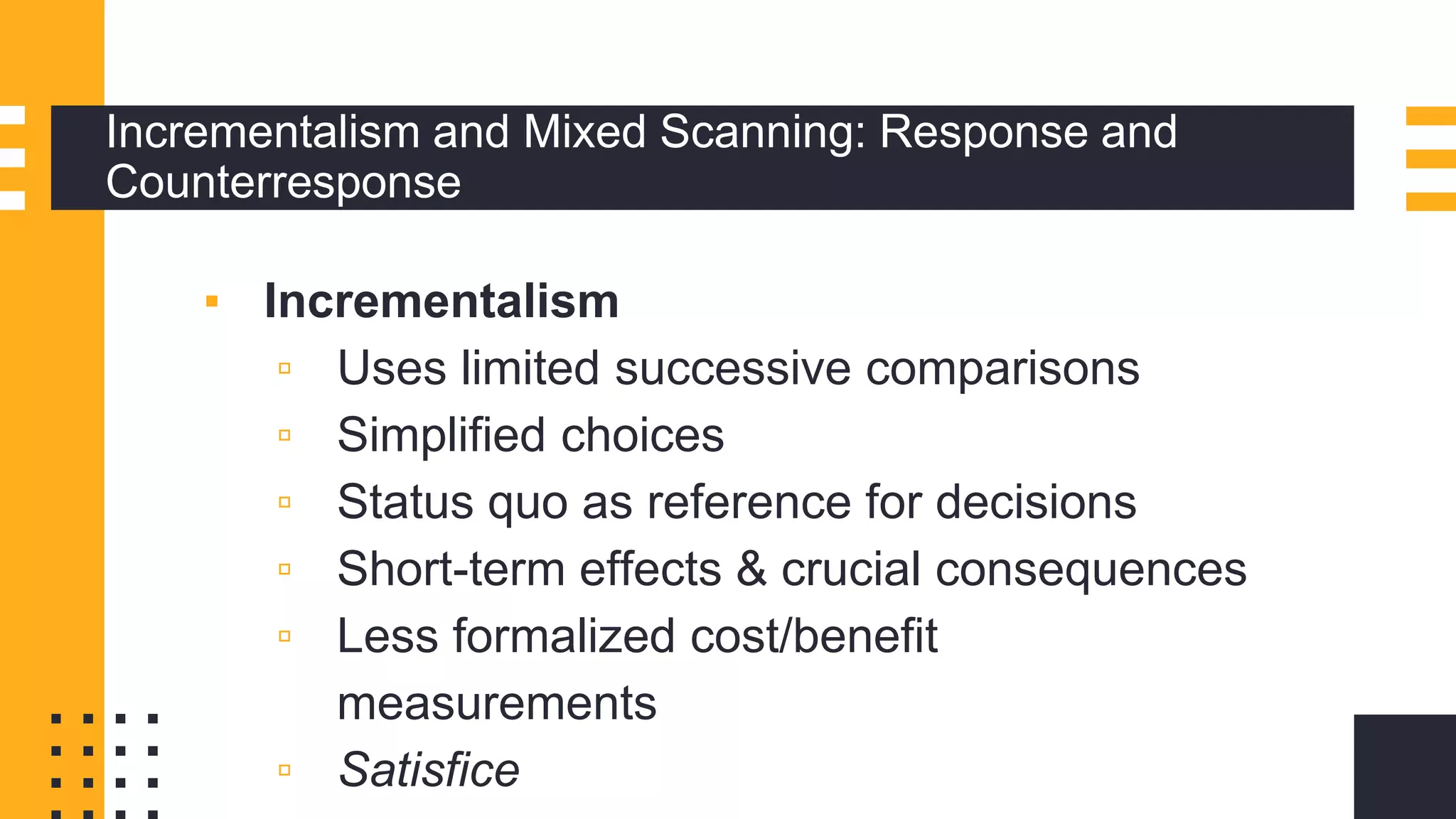
Incrementalism and Mixed Scanning: Response and
Counterresponse
▪ Incrementalism
▫ Uses limited successive comparisons
▫ Simplified choices
▫ Status quo as reference for decisions
▫ Short-term effects & crucial consequences
▫ Less formalized cost/benefit
measurements
▫ Satisfice
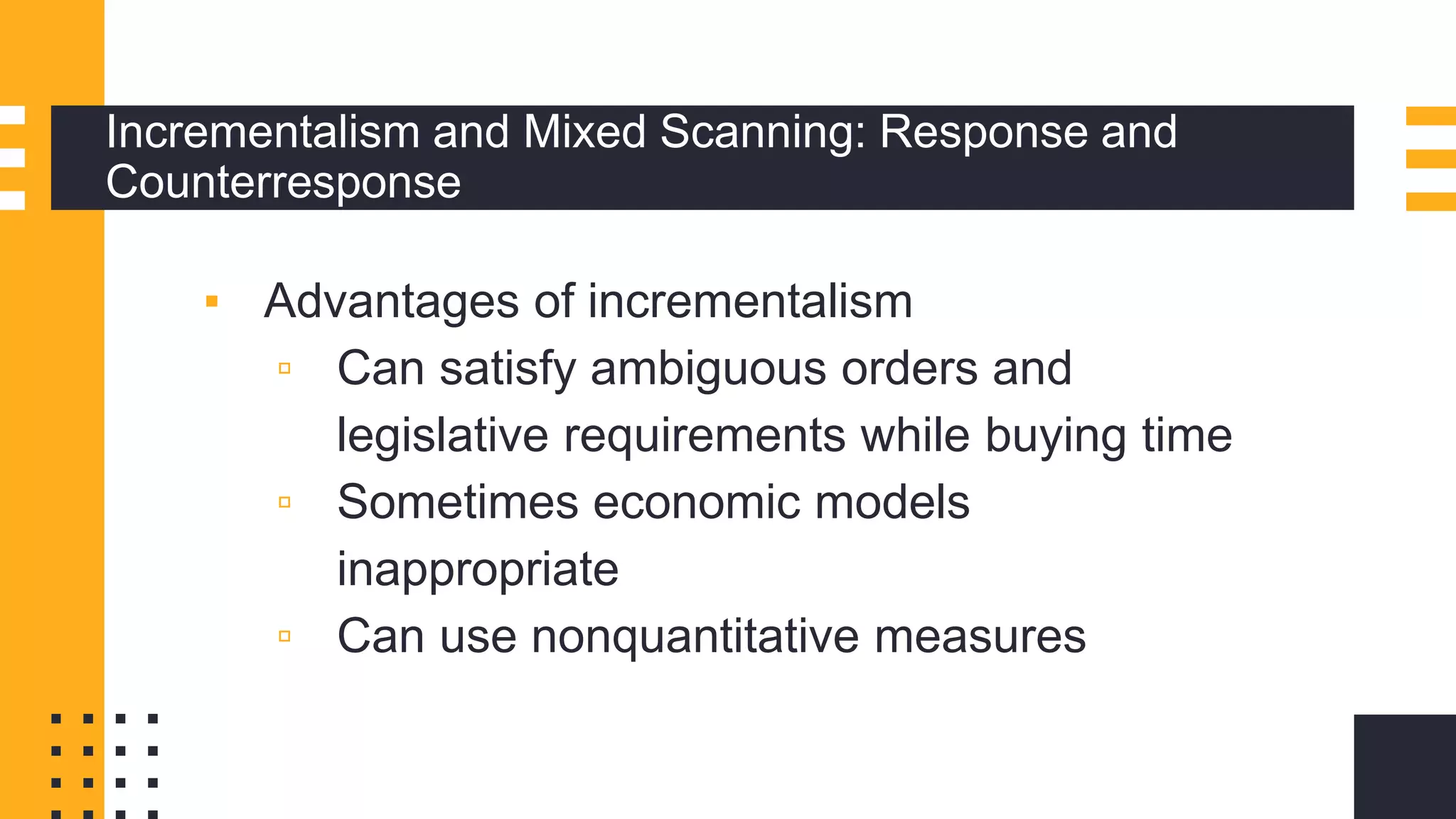
Incrementalism and Mixed Scanning: Response and
Counterresponse
▪ Advantages of incrementalism
▫ Can satisfy ambiguous orders and
legislative requirements while buying time
▫ Sometimes economic models
inappropriate
▫ Can use nonquantitative measures
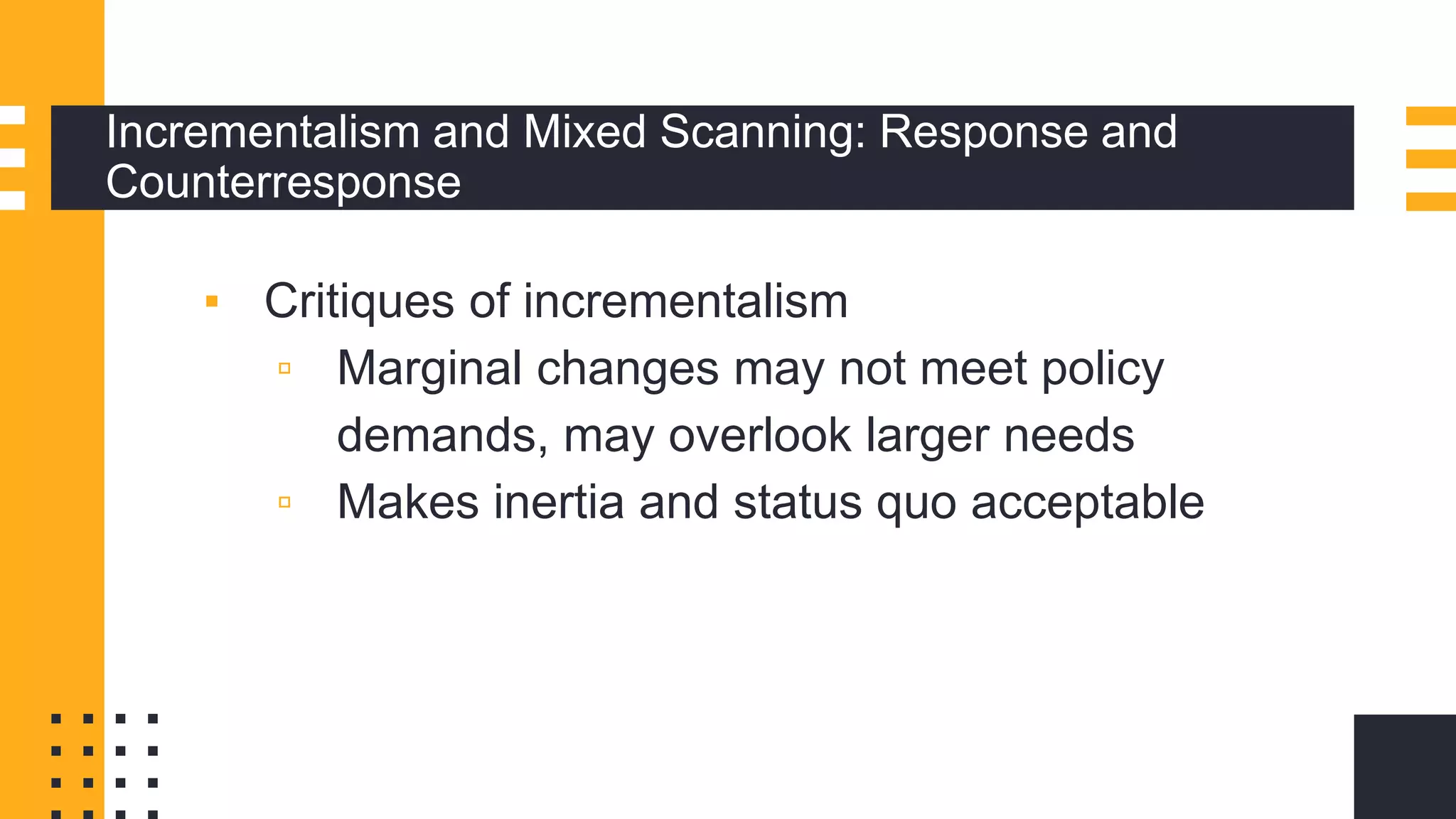
Incrementalism and Mixed Scanning: Response and
Counterresponse
▪ Critiques of incrementalism
▫ Marginal changes may not meet policy
demands, may overlook larger needs
▫ Makes inertia and status quo acceptable
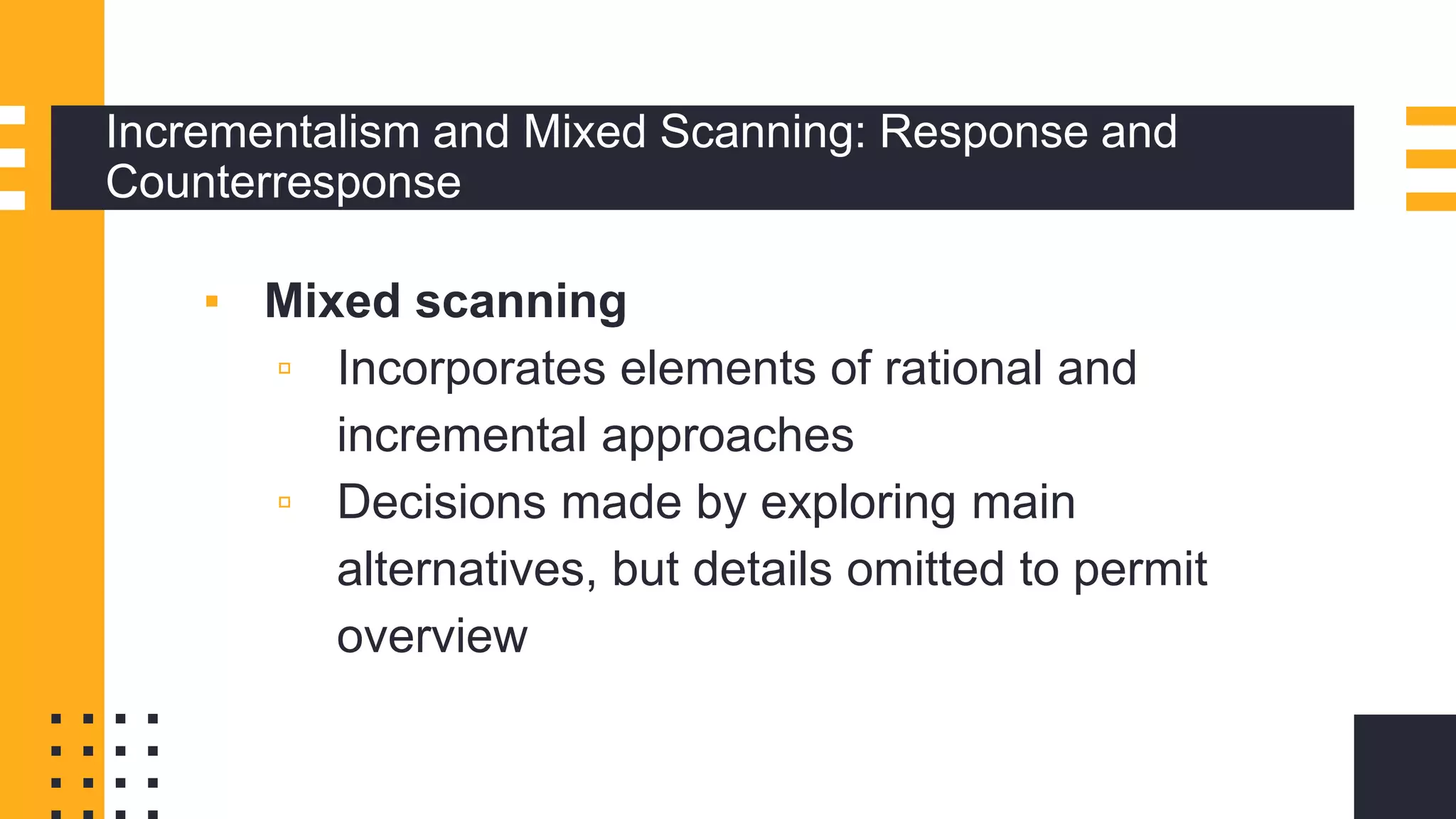
Incrementalism and Mixed Scanning: Response and
Counterresponse
▪ Mixed scanning
▫ Incorporates elements of rational and
incremental approaches
▫ Decisions made by exploring main
alternatives, but details omitted to permit
overview
Decisions in the Balance:
The Environment of Choice
Decision-maker considerations
Kinds/quantity of resources to be used
Benefits vs. probable costs
How are benefits and costs measured?
Substantive grounds
Political grounds
Organizational grounds
Which factor predominates?
Decisions in the Balance:
The Environment of Choice
▪ Different grounds predominate for different
decision makers
▫ Specialists (area of expertise)
▫ Generalists (political factors)
▪ Time factors
Information Quality and
Decision Analysis
Quantity and quality of information
Decision analysis techniques
Experimental method
Technology
Human judgment and experience
Limitations
Imperfect information
Costs of obtaining
Biases
Deliberately distorted information
Information Quality and
Decision Analysis
▪ Other issues facing decision makers
▫ Influence by previous decisions, current
policy
▫ Unanticipated consequences
▫ Groupthink
▫ Sunk costs
▪ Bounded rationality framework
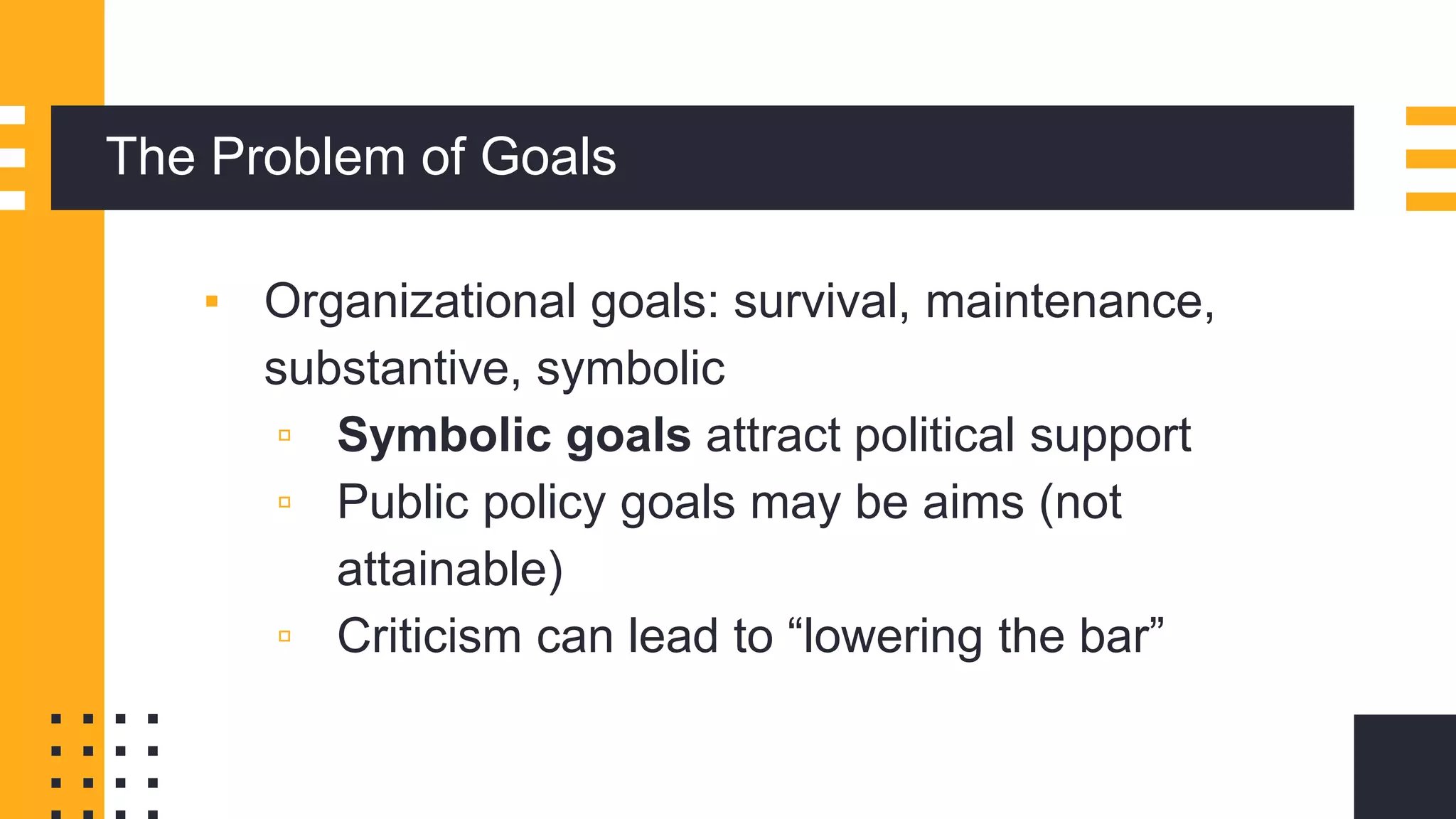
The Problem of Goals
▪ Organizational goals: survival, maintenance,
substantive, symbolic
▫ Symbolic goals attract political support
▫ Public policy goals may be aims (not
attainable)
▫ Criticism can lead to “lowering the bar”
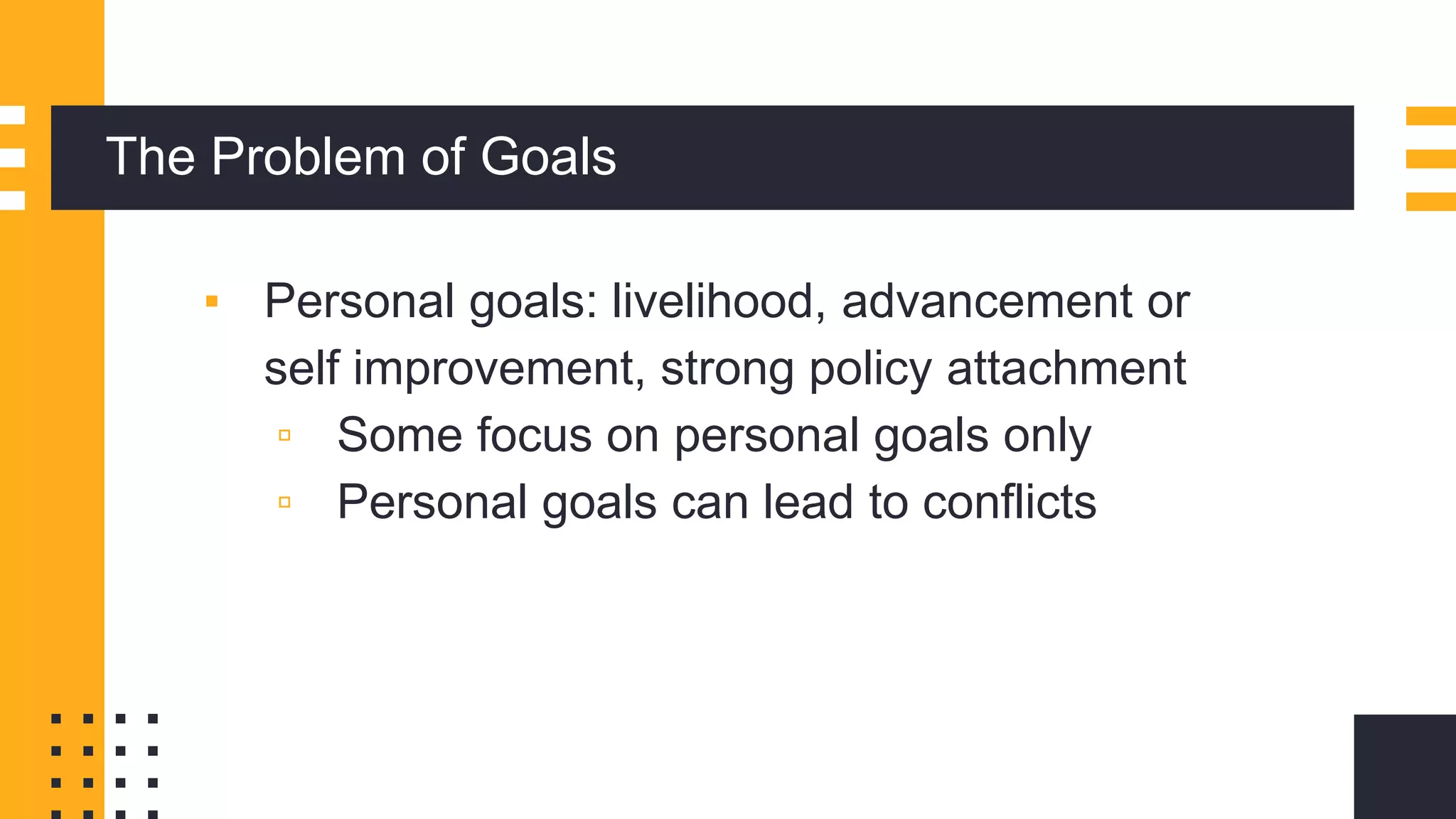
The Problem of Goals
▪ Personal goals: livelihood, advancement or
self improvement, strong policy attachment
▫ Some focus on personal goals only
▫ Personal goals can lead to conflicts
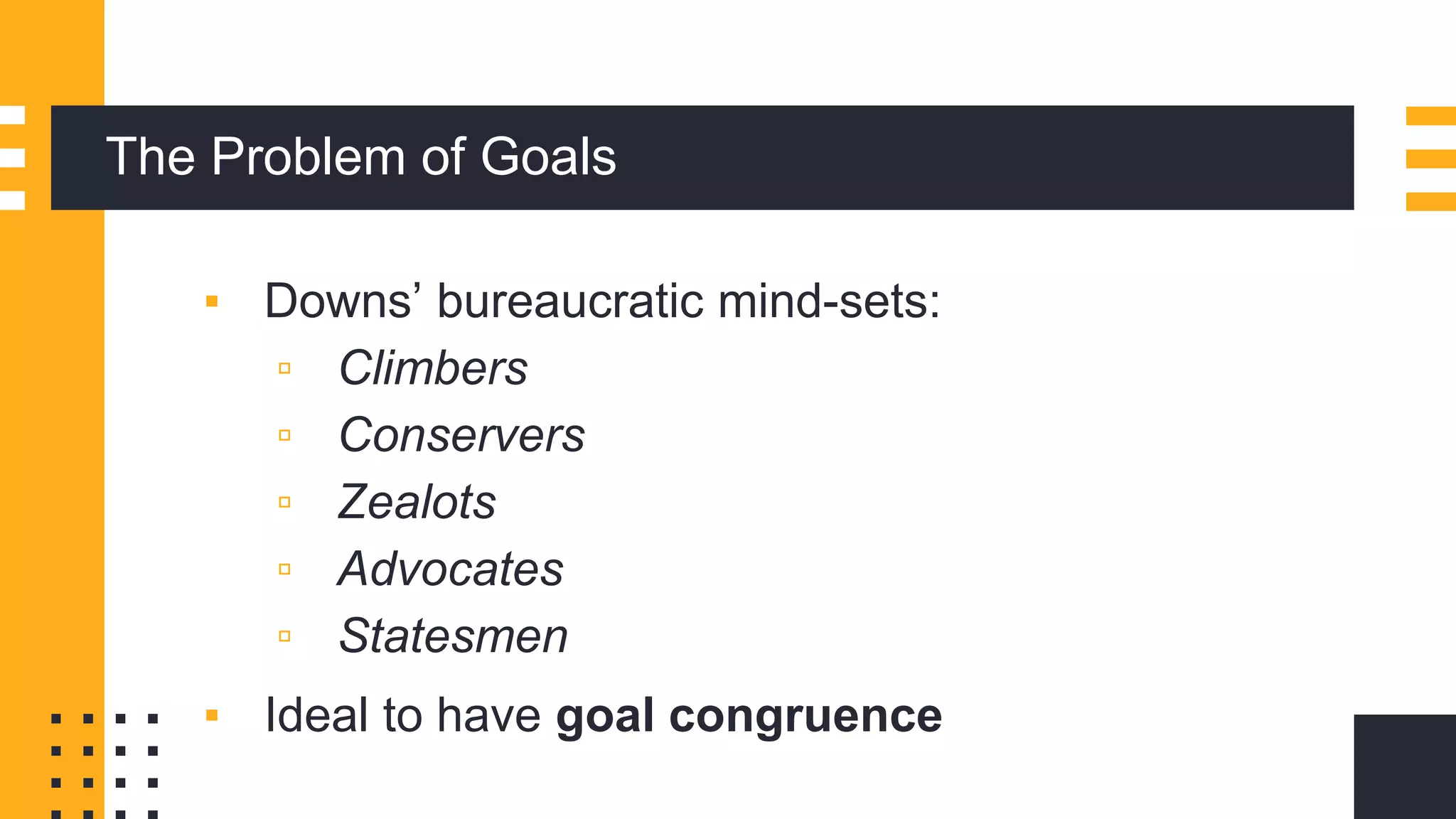
The Problem of Goals
▪ Downs’ bureaucratic mind-sets:
▫ Climbers
▫ Conservers
▫ Zealots
▫ Advocates
▫ Statesmen
▪ Ideal to have goal congruence
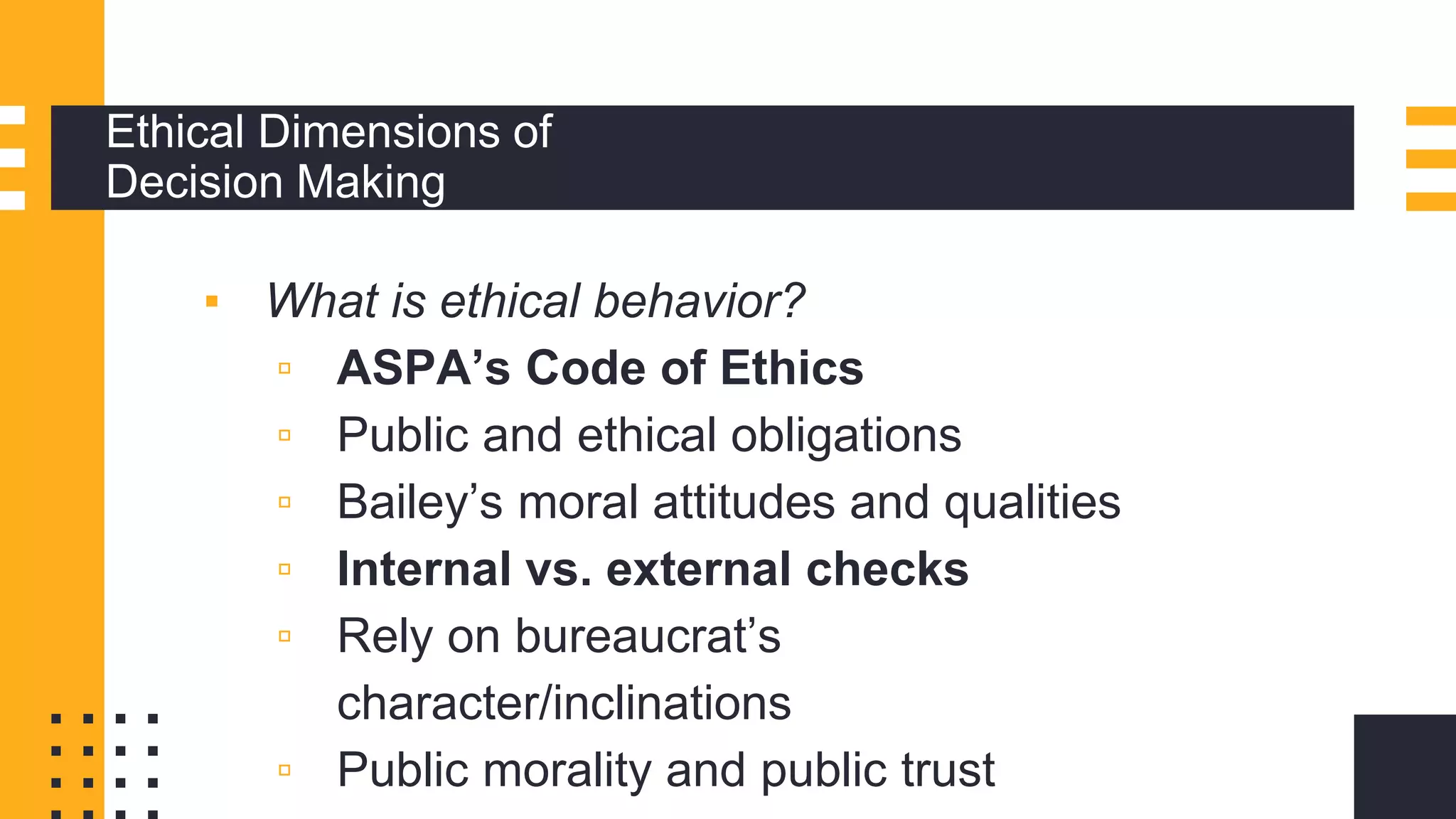
Ethical Dimensions of
Decision Making
▪ What is ethical behavior?
▫ ASPA’s Code of Ethics
▫ Public and ethical obligations
▫ Bailey’s moral attitudes and qualities
▫ Internal vs. external checks
▫ Rely on bureaucrat’s
character/inclinations
▫ Public morality and public trust
The Ethical Setting:
New Emphasis on an Old Challenge
Challenge in defining, establishing and maintaining
high level of ethical behavior in government officials
Ethical behaviors
Professional conduct
Personal honesty
Concern for serving public
Respecting law and democratic beliefs
The Ethical Setting:
New Emphasis on an Old Challenge
Implementation:
Formal adoption of ethics code
Professional association codes
Financial disclosure requirements
Honoraria restrictions
Professional activity restrictions
In-house ethics training
Moral leadership
Political Rationality:
A Contradiction in Terms?
▪ Can politics and rationality coexist?
▪ Political rationality
▫ Political costs, benefits, consequences
▫ Choice of criteria significant
Organized Anarchies and Uncertainty
▪ Organized anarchies
▫ Garbage can theory
▫ Decision making characterized by
pervasive ambiguity and unpredictable
behavior
▫ Choices often product of chance (not
rationality)

Puad 5340 d 01 module 4 lecture

  • 1.
    Ethical Decision Making ina Political Environment
  • 2.
    The Nature ofDecisions ▪ Decision making: product of complex social process generally extending over a long period of time ▫ Increasing potential gains ▫ Monitoring ongoing decisional process ▫ Reducing resource expenditure, uncertainty or risk
  • 3.
    Approaches to DecisionMaking: Concepts and Controversies ▪ Rational approach ▫ Works to achieve conscious goals ▫ Efficiency ▫ Cost-benefit analysis/cost-benefit ratios ▫ Value-neutral ▫ Procedural criteria
  • 4.
    Approaches to DecisionMaking: Concepts and Controversies ▪ Critiques of rational model ▫ Only applicable to low-level decisions ▫ Many impediments to rationality ▫ Competition for resources ▫ Must deal with different aspects of same problem ▫ Not usually applicable to government decision-making processes
  • 5.
    Incrementalism and MixedScanning: Response and Counterresponse ▪ Incrementalism ▫ Uses limited successive comparisons ▫ Simplified choices ▫ Status quo as reference for decisions ▫ Short-term effects & crucial consequences ▫ Less formalized cost/benefit measurements ▫ Satisfice
  • 6.
    Incrementalism and MixedScanning: Response and Counterresponse ▪ Advantages of incrementalism ▫ Can satisfy ambiguous orders and legislative requirements while buying time ▫ Sometimes economic models inappropriate ▫ Can use nonquantitative measures
  • 7.
    Incrementalism and MixedScanning: Response and Counterresponse ▪ Critiques of incrementalism ▫ Marginal changes may not meet policy demands, may overlook larger needs ▫ Makes inertia and status quo acceptable
  • 8.
    Incrementalism and MixedScanning: Response and Counterresponse ▪ Mixed scanning ▫ Incorporates elements of rational and incremental approaches ▫ Decisions made by exploring main alternatives, but details omitted to permit overview
  • 9.
    Decisions in theBalance: The Environment of Choice Decision-maker considerations Kinds/quantity of resources to be used Benefits vs. probable costs How are benefits and costs measured? Substantive grounds Political grounds Organizational grounds Which factor predominates?
  • 10.
    Decisions in theBalance: The Environment of Choice ▪ Different grounds predominate for different decision makers ▫ Specialists (area of expertise) ▫ Generalists (political factors) ▪ Time factors
  • 11.
    Information Quality and DecisionAnalysis Quantity and quality of information Decision analysis techniques Experimental method Technology Human judgment and experience Limitations Imperfect information Costs of obtaining Biases Deliberately distorted information
  • 12.
    Information Quality and DecisionAnalysis ▪ Other issues facing decision makers ▫ Influence by previous decisions, current policy ▫ Unanticipated consequences ▫ Groupthink ▫ Sunk costs ▪ Bounded rationality framework
  • 13.
    The Problem ofGoals ▪ Organizational goals: survival, maintenance, substantive, symbolic ▫ Symbolic goals attract political support ▫ Public policy goals may be aims (not attainable) ▫ Criticism can lead to “lowering the bar”
  • 14.
    The Problem ofGoals ▪ Personal goals: livelihood, advancement or self improvement, strong policy attachment ▫ Some focus on personal goals only ▫ Personal goals can lead to conflicts
  • 15.
    The Problem ofGoals ▪ Downs’ bureaucratic mind-sets: ▫ Climbers ▫ Conservers ▫ Zealots ▫ Advocates ▫ Statesmen ▪ Ideal to have goal congruence
  • 16.
    Ethical Dimensions of DecisionMaking ▪ What is ethical behavior? ▫ ASPA’s Code of Ethics ▫ Public and ethical obligations ▫ Bailey’s moral attitudes and qualities ▫ Internal vs. external checks ▫ Rely on bureaucrat’s character/inclinations ▫ Public morality and public trust
  • 17.
    The Ethical Setting: NewEmphasis on an Old Challenge Challenge in defining, establishing and maintaining high level of ethical behavior in government officials Ethical behaviors Professional conduct Personal honesty Concern for serving public Respecting law and democratic beliefs
  • 18.
    The Ethical Setting: NewEmphasis on an Old Challenge Implementation: Formal adoption of ethics code Professional association codes Financial disclosure requirements Honoraria restrictions Professional activity restrictions In-house ethics training Moral leadership
  • 19.
    Political Rationality: A Contradictionin Terms? ▪ Can politics and rationality coexist? ▪ Political rationality ▫ Political costs, benefits, consequences ▫ Choice of criteria significant
  • 20.
    Organized Anarchies andUncertainty ▪ Organized anarchies ▫ Garbage can theory ▫ Decision making characterized by pervasive ambiguity and unpredictable behavior ▫ Choices often product of chance (not rationality)