Probation
Supervision
Chapter 5
The Dual Functions of Probation
 Investigation
 Presentence Investigation (PSI)
 Summary of offenders background
 Probation supervision policies & practices:
 Establish relationship, define roles
 Establish supervision goals
 Termination
The Dual Functions of Probation
 Investigation
 Work with teachers, officials, psychologists, judge
to provide information to assist the judge in a
proper sentence for the offender
 Supervision
 Series of tasks loosely connected to possible
rehabilitation
 Rewards of this work are inconsistent and
intangible
Discussion Question
Do you believe that probation officers have too
much power when it comes to their role in
investigative authority, especially the
presentence investigation report?
The Investigative Function
 PSI—most important role in the sentencing
process
 Purpose
 Sentencing
 Rehabilitation
 Risk management
 Plea bargaining
The Investigative Function
 PSI
 Contents
 Objectivity
 Reliable
 Victim impact statement
The Investigative Function
 PSI
 Recommendations
 Controversial
 Not all have sentencing recommendations
 Agreement with actual sentence
 Plea-bargaining
The Investigative Function
 PSI
 Disclosure
 In many states defendants do not receive a copy
 Williams v. New York (1949)
 Cleansing
 Confidential comments from private citizen
 Clinical statements or evaluations that might be
damaging
The Investigative Function
 PSI
 Private PSIs
 Client-specific planning
 Advocate for the defendant
 Controversial
 Unfair advantage for middle/upper class
 Liability for accuracy and relevance of information they
provide the court
Discussion Question
Imagine you are a judge who has the responsibility of sentencing
an offender who has just pled guilty to a burglary and
possession of cocaine. The sentence has to be determined.
The defense attorney is asking for probation with a condition
of residential drug treatment. The prosecutor is demanding
that the offender serve five years in prison. The probation
officer who has completed the presentence investigation
report is also recommending prison time, but wants 3 years
instead of 5. What would you look for specifically in the PSI to
make your determination of the sentence? What other
factors would you consider in your sentencing decision?
The Supervisory Function
 The Officer—enforce the law and help the
offender
 Conflict—power and authority
 Motivational interviewing
 Behavior change
 Identify tools for handling resistance
 Keep officer from doing all the work
 Responsibility of behavior change on the officer
The Supervisory Function
 The Offender
 Response—depends on his/her perception of
the officer’s power
 Commonly resent their status
The Supervisory Function
 The Bureaucracy
 Formal constraints—legal conditions of probation
 Standard conditions—imposed on all
probationers
 Punitive conditions—fines, community service,
form of restitution
 Treatment conditions—alcohol/substance help
The Effectiveness of Supervision
 Recidivism
 Case Management Systems
 Statistical risk assessment
 Systematic needs assessment
 Contact supervision standards
 Case planning
 Workload accounting
The Effectiveness of Supervision
 Evidence-Based Supervision
 Focus program on high-risk probationers
 Greater levels of supervision to higher-risk clients
 Treatment programs designed around higher-risk
clients
 Make referrals to treatment programs
The Effectiveness of Supervision
 Specialized Supervision Programs
 Sex offenders
 Drug offenders
 Mentally ill offenders
 Techniques for drug surveillance and treatment
 Urinalysis
 Antabuse
 Methadone
The Effectiveness of Supervision
 Performance-Based Supervision
 Focus on results in setting priorities and
selecting activities
 Public safety
 Broken windows
probation
The Effectiveness of Supervision
 Is Probation Effective Regardless?
 Comparison of probation strategies reveal little
differences
 What if methods matter little but probation
works?
 Recent study
 Reduction in criminality following probation
sentence
Discussion Question
Do you think drug abuse is a medical problem or
a criminal justice problem?
How we should deal with the issue of drugs at
the:
a) local level
b) state level
c) federal level?
Revocation and Termination
of Probation
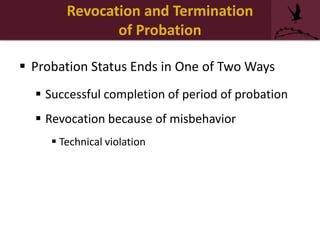
 Probation Status Ends in One of Two Ways
 Successful completion of period of probation
 Revocation because of misbehavior
 Technical violation
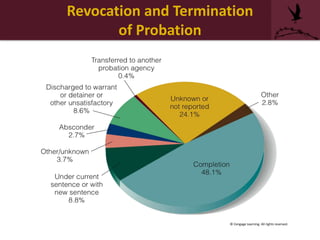
Revocation and Termination
of Probation
© Cengage Learning. All rights reserved.
Revocation and Termination
of Probation
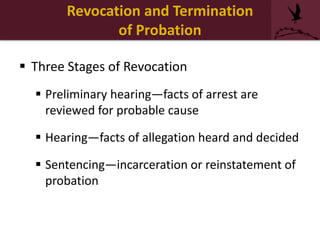
 Three Stages of Revocation
 Preliminary hearing—facts of arrest are
reviewed for probable cause
 Hearing—facts of allegation heard and decided
 Sentencing—incarceration or reinstatement of
probation
Probation in the Coming Decade
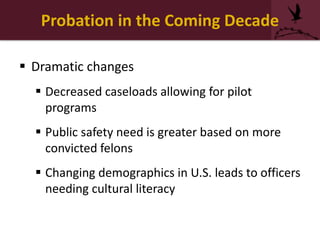
 Dramatic changes
 Decreased caseloads allowing for pilot
programs
 Public safety need is greater based on more
convicted felons
 Changing demographics in U.S. leads to officers
needing cultural literacy
Probation in the Coming Decade
 Dramatic changes
 Monitoring tools for probation officers
increase:
 Ankle bracelet, GPS
 Alcohol consumption monitors
 Mobile automated fingerprinting systems
 Videoconferencing

Corrections chapter 5 ppt

  • 1.
  • 2.
    The Dual Functionsof Probation  Investigation  Presentence Investigation (PSI)  Summary of offenders background  Probation supervision policies & practices:  Establish relationship, define roles  Establish supervision goals  Termination
  • 3.
    The Dual Functionsof Probation  Investigation  Work with teachers, officials, psychologists, judge to provide information to assist the judge in a proper sentence for the offender  Supervision  Series of tasks loosely connected to possible rehabilitation  Rewards of this work are inconsistent and intangible
  • 4.
    Discussion Question Do youbelieve that probation officers have too much power when it comes to their role in investigative authority, especially the presentence investigation report?
  • 5.
    The Investigative Function PSI—most important role in the sentencing process  Purpose  Sentencing  Rehabilitation  Risk management  Plea bargaining
  • 6.
    The Investigative Function PSI  Contents  Objectivity  Reliable  Victim impact statement
  • 7.
    The Investigative Function PSI  Recommendations  Controversial  Not all have sentencing recommendations  Agreement with actual sentence  Plea-bargaining
  • 8.
    The Investigative Function PSI  Disclosure  In many states defendants do not receive a copy  Williams v. New York (1949)  Cleansing  Confidential comments from private citizen  Clinical statements or evaluations that might be damaging
  • 9.
    The Investigative Function PSI  Private PSIs  Client-specific planning  Advocate for the defendant  Controversial  Unfair advantage for middle/upper class  Liability for accuracy and relevance of information they provide the court
  • 10.
    Discussion Question Imagine youare a judge who has the responsibility of sentencing an offender who has just pled guilty to a burglary and possession of cocaine. The sentence has to be determined. The defense attorney is asking for probation with a condition of residential drug treatment. The prosecutor is demanding that the offender serve five years in prison. The probation officer who has completed the presentence investigation report is also recommending prison time, but wants 3 years instead of 5. What would you look for specifically in the PSI to make your determination of the sentence? What other factors would you consider in your sentencing decision?
  • 11.
    The Supervisory Function The Officer—enforce the law and help the offender  Conflict—power and authority  Motivational interviewing  Behavior change  Identify tools for handling resistance  Keep officer from doing all the work  Responsibility of behavior change on the officer
  • 12.
    The Supervisory Function The Offender  Response—depends on his/her perception of the officer’s power  Commonly resent their status
  • 13.
    The Supervisory Function The Bureaucracy  Formal constraints—legal conditions of probation  Standard conditions—imposed on all probationers  Punitive conditions—fines, community service, form of restitution  Treatment conditions—alcohol/substance help
  • 14.
    The Effectiveness ofSupervision  Recidivism  Case Management Systems  Statistical risk assessment  Systematic needs assessment  Contact supervision standards  Case planning  Workload accounting
  • 15.
    The Effectiveness ofSupervision  Evidence-Based Supervision  Focus program on high-risk probationers  Greater levels of supervision to higher-risk clients  Treatment programs designed around higher-risk clients  Make referrals to treatment programs
  • 16.
    The Effectiveness ofSupervision  Specialized Supervision Programs  Sex offenders  Drug offenders  Mentally ill offenders  Techniques for drug surveillance and treatment  Urinalysis  Antabuse  Methadone
  • 17.
    The Effectiveness ofSupervision  Performance-Based Supervision  Focus on results in setting priorities and selecting activities  Public safety  Broken windows probation
  • 18.
    The Effectiveness ofSupervision  Is Probation Effective Regardless?  Comparison of probation strategies reveal little differences  What if methods matter little but probation works?  Recent study  Reduction in criminality following probation sentence
  • 19.
    Discussion Question Do youthink drug abuse is a medical problem or a criminal justice problem? How we should deal with the issue of drugs at the: a) local level b) state level c) federal level?
  • 20.
    Revocation and Termination ofProbation  Probation Status Ends in One of Two Ways  Successful completion of period of probation  Revocation because of misbehavior  Technical violation
  • 21.
    Revocation and Termination ofProbation © Cengage Learning. All rights reserved.
  • 22.
    Revocation and Termination ofProbation  Three Stages of Revocation  Preliminary hearing—facts of arrest are reviewed for probable cause  Hearing—facts of allegation heard and decided  Sentencing—incarceration or reinstatement of probation
  • 23.
    Probation in theComing Decade  Dramatic changes  Decreased caseloads allowing for pilot programs  Public safety need is greater based on more convicted felons  Changing demographics in U.S. leads to officers needing cultural literacy
  • 24.
    Probation in theComing Decade  Dramatic changes  Monitoring tools for probation officers increase:  Ankle bracelet, GPS  Alcohol consumption monitors  Mobile automated fingerprinting systems  Videoconferencing

Editor's Notes

  • #22 Source: Bureau of Justice Statistics, Probation and Parole in the United States, 2008, Statistical Tables, December 2009. Appendix Table 4—Adults Exiting Probation, by type of exit.