Crime and
Criminal Law
CHAPTER 5
Crime and Criminal Law
 Criminal law (substantive law)
 Law of crimes
 Defined by statute
 Prescriptions
 Proscriptions
 Code of conduct all are expected to follow
 Enforced by state
 Primary purpose is protecting public from harm by
punishing harmful acts that have occurred and
forbidding conduct that may lead to it
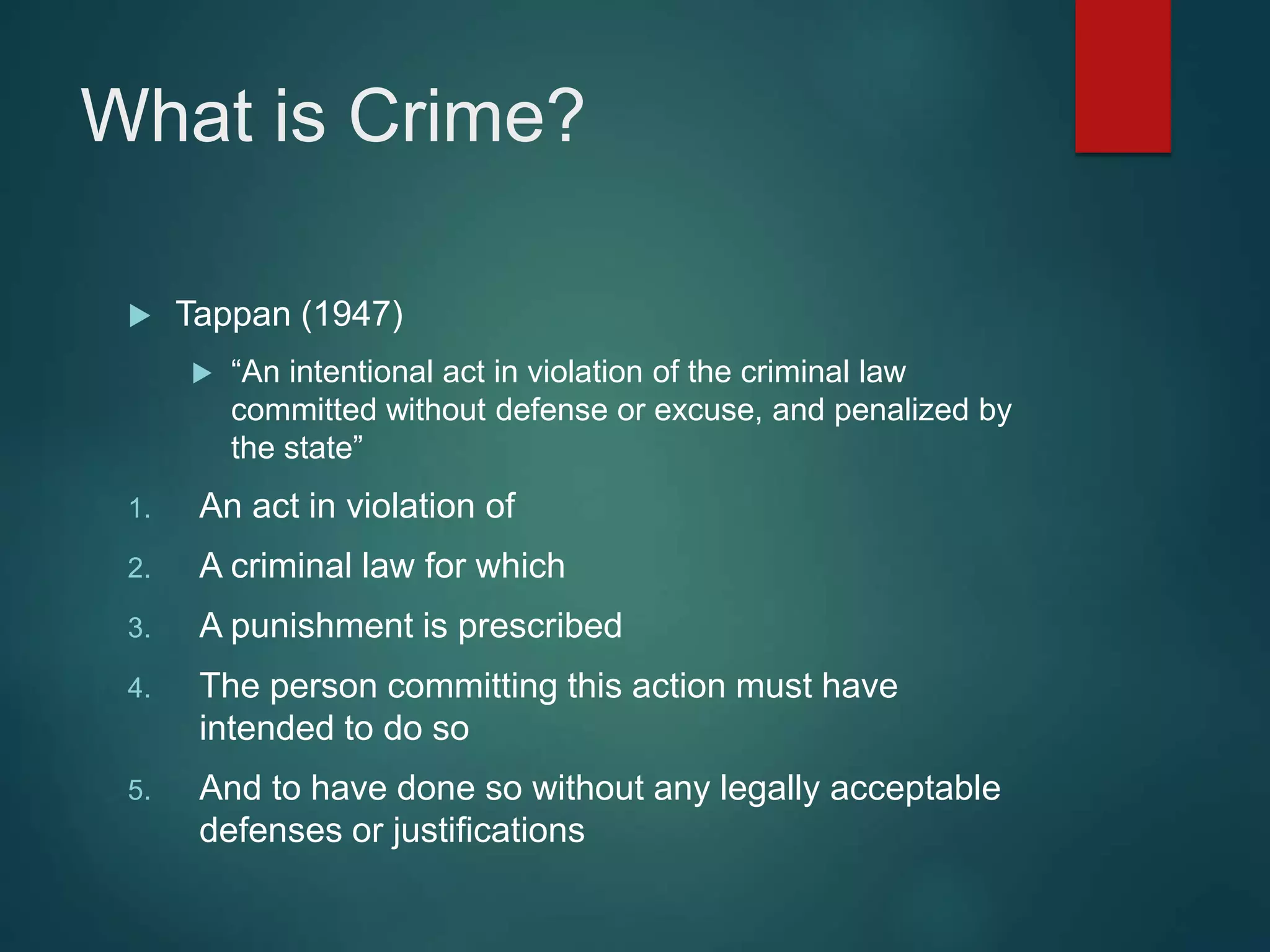
What is Crime?
 Tappan (1947)
 “An intentional act in violation of the criminal law
committed without defense or excuse, and penalized by
the state”
1. An act in violation of
2. A criminal law for which
3. A punishment is prescribed
4. The person committing this action must have
intended to do so
5. And to have done so without any legally acceptable
defenses or justifications
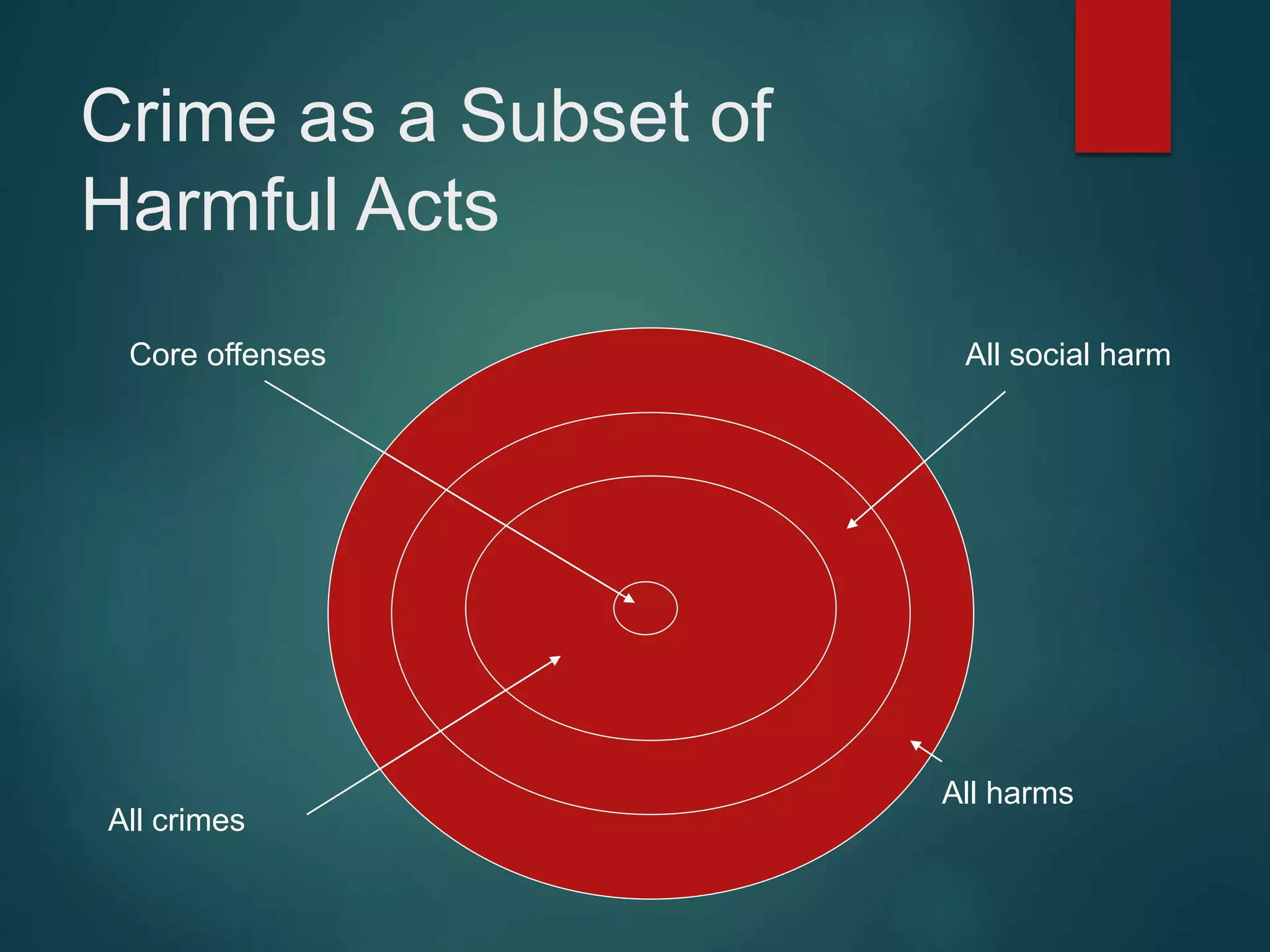
Crime as a Subset of
Harmful Acts
Core offenses
All crimes
All social harm
All harms
Sources of Criminal Law
 State and federal constitutions
 State and federal statutes
 New crimes added as circumstances warrant
 Common law
 Codified in most states by mid-1800s
 Federal law is growing source of criminal law
 Statutes define elements (various parts) of a crime
more specifically than common law
Limitations on Criminal Law
 State cannot criminalize any conduct it chooses
 Substantive due process
 There are limits to what conduct the law may seek to
prohibit
 Forbids passage of laws that infringe on rights of
individuals
 Free speech
 Assembly
 Is underlying theory for privacy rights
Limitations on Criminal Law
 Overbreadth doctrine
 Laws unconstitutional when they fail to narrowly define
specific behavior to be restricted
 Void for vagueness
 Laws unconstitutional when they fail to clearly define
prohibited act and punishment in advance
 Fair notice
 Letting people know what is and is not permitted
Limitations on Criminal Law
 Must not restrict due process
 Must be enforced fairly and non-arbitrarily
 Must not restrict equal protection
 Laws cannot restrict rights of members of suspect
classifications
 Cruel and unusual punishment
 Punishments must be proportional to the crime
 Jurisdictions not required to punish in same manner
Limitations on Criminal Law
 Ex post facto laws
 Cannot be penalized for behavior that was not illegal at
time they acted
 Penalties cannot be increased after crime has been
committed
 Do apply retroactively if they are beneficial
 Bills of attainder
 Cannot have laws that impose punishment without trial
Elements of Criminal
Offenses
 Elements that must be present for criminal liability to
attach:
 Actus reus
 Mens rea
 Concurrence
 Causation
 Harm
 All make up corpus delecti
Actus Reus (Criminal Act)
 The guilty act
 Three forms
 Voluntarily bodily movements
 An omission in the face of a duty to act
 Failure to perform legal duty
 Failure to prevent harm when special relationship exists
 Possession
 If person has some knowledge that his or her possession is
illegal
Mens Rea (Criminal Intent)
 Guilty mind
 Inferred from circumstances surrounding criminal act
 Motive and intent not same thing
 Intent
 Mental purpose or desire to commit certain act
 Motive
 Refers to cause or reason why act was committed
Mens Rea (Criminal Intent)
 Model penal code sets forth four levels:
 Purposeful
 Knowing
 Reckless
 Negligent
 Doctrine of transferred intent
Concurrence
 Union of criminal act and criminal intent
 Intent must set act in motion
 Those not generated by intent do not constitute criminal
conduct
Causation
 Criminal act is the act that is the cause of the harm
 Two types:
 Factual cause
 “But for” actor’s conduct, harm would not have occurred
 Legal cause
 Also known as proximate cause
 Consequences of act not reasonably foreseeable to actor
(intervening causes) relieve actor of some degree of
criminal liability
Harm
 The result of the act
 Injury to another or to society
 There can be no liability without harm
 Occurs in all crimes
 Can be focused on harm only to actor
 May be physical or mental
Liability Without Fault
 Strict liability
 Imposes accountability without proof of criminal intent in
situation where society deems it fair to do so
 Statutory rape
 Vicarious liability
 Imputation of accountability from one person to another
 Based on relationship of individual to person committing
illegal act
 Only in civil law
Inchoate Crimes
 Crimes that occur in preparation for an offense
 Basically incomplete crimes
 Inchoate
 “To begin” or “to partially put into operation”
 Three types
 Attempt
 Solicitation
 Conspiracy
Parties to Crime
 Doctrine of complicity
 More than one person may be held liable for criminal
activity
 Requires all criminal elements be present
 Common law recognizes four parties:
 Principles in the first degree
 Principles in the second degree
 Accessories before the fact
 Accessories after the fact
Defenses to Criminal
Liability
 Defense
 Response made by defendant that allows them to avoid
criminal liability
 Alibi
 Form of defense where defendant asserts they are not
the person who committed the act charged
 Affirmative defenses
 Defendant admits they committed the act but denies
criminal liability
 When defense is used burden of production shifts to
defense (preponderance of evidence)
Justification Defenses
 Ones in which defendant admits they are responsible
for act but claims that under the circumstances, the act
was not criminal
 Three types:
 Self-defense
 Consent
 Execution of public duties
Justification Defenses:
Self-Defense
 Use of force to repel imminent, unprovoked attack in
which person reasonably believed he or she was about
to be seriously injured
 May only use as much force as is necessary
 Retreat doctrine
 Person must retreat rather than use deadly force if doing
so is possible
 Castle doctrine
 Persons attacked in their home need not retreat
 Can also apply to defense of others and property
Justification Defenses: Consent
and Execution of Public Duties
 Consent
 Persons may consent to suffer what otherwise would be
an objectionable injury
 Must be voluntary, knowing, and intelligent
 Execution of public duties
 Agents of state permitted to use reasonable force in the
lawful execution of their duties
 Tennessee v. Garner (1984)
Excuse Defenses
 Ones in which defendant admits what he or she did
was wrong but claims that under circumstances he or
she is not responsible for improper conduct
 Four types:
 Duress
 Intoxication
 Age
 Insanity
Excuse Defenses: Duress
 Situations involving threat of serious, imminent harm to
oneself, where act is less serious than threatened
harm
 Those forced to commit crime in such circumstances
do not act voluntarily
 Eliminates actus reus
 Eliminates mens rea
Excuse Defenses:
Intoxication and Age
 Intoxication
 Voluntary
 Never leads to acquittal
 May only mitigate
 Involuntary
 May work as defense as person is not responsible for their
actions
 Age
 Persons below certain age lack capability to form mens
rea
 Various jurisdictions define age parameters
Excuse Defenses: Insanity
 Legal term to describe mental illness
 Mental illness and legal insanity are not same thing
 Impairs mens rea
 Probably most controversial of all defenses
 Rex v. Hadfield (1800)
 First successful case using defense
 Rex v. M’Naghten (1843)
 Cemented modern insanity defense
Excuse Defenses: Tests for
Insanity
 M’Naghten rule-right-wrong test
 Durham rule-product test
 Irresistible impulse test
 Substantial capacity test
 GBMI
Procedural Defenses:
Entrapment
 One of number of procedural defenses
 Increasingly being raised by those caught in drug
stings and Internet sexual enticement stings
 Sherman v. U.S. (1958)
 Court laid out two scenarios in which it occurs:
 Crime is result of creative activity of law enforcement
 Prosecutor cannot prove beyond reasonable doubt that
defendant was “independently predisposed” to commit the
crime
Categories of Crime
 Crimes against the person
 Crimes against property
 Crimes against public order and morality
Categories of Crime: Crimes
Against the Person
 Include:
 Murder
 Forcible rape
 Aggravated assault
 Robbery
Murder
 FBI definition
 Murder is willful (non-negligent) killing of one human
being by another
 Common law definition
 The killing of another with malice aforethought
 Model Penal Code
 Distinguishes between lawful and unlawful killings
 Unlawful killings are criminal homicides
 Three forms
Murder
 Today, murder defined by Model Penal Code as a
killing that occurs:
 Purposefully
 Knowingly, or
 Recklessly
 Murder graded into
 First degree
 Second degree
 States and courts differ on how to consider first degree
murders
Manslaughter
 Voluntary
 An intentional killing that occurs:
 Under mistaken belief self-defense is needed, or
 In response to adequate provocation while in sudden heat
of passion
 Existence of adequate provocation does not eliminate criminal
liability, only reduces charge and associate punishment
 Involuntary
 Unintentional killing that occurs as result of reckless act
Negligent Homicide
 Unintentional killing in which defendant should have
known they were creating substantial risk of death by
their conduct
 Such conduct deviated from ordinary level of care
owed to others
Felony Murder Rule
 Ranked as first-degree murder in some states
 Second degree in others
 Individual is held liable for unintended killing that
occurs during the commission of a dangerous felony
 No requirement of intent to either kill or inflict serious
harm
Forcible Rape
 FBI definition
 “Carnal knowledge of a female forcibly and against her
will”
 Common law definition
 “Carnal knowledge by a man of a woman who is not his
wife, forcibly and without consent”
 Definitions created several loopholes
 Modern day statutes have among other things:
 Removed gender specific language
 Adopted marital rape exceptions
 Child sexual assault
Aggravated Assault
 FBI definition
 “Unlawful attack by one person upon another for purpose
of inflicting severe or aggravated bodily injury”
 Involves use of weapons
 Common law definition
 Assault: attempt or threat to inflict immediate harm
 Battery: unjustified, offensive physical contact
 Modern statutes have merged assault with battery to
fall under same name
Robbery
 FBI definition
 Taking or attempted taking of anything of value from
care, custody, and control of person or persons by force
or threat of force or violence and/or putting victim in fear
 Often classified as violent crime
 Extortion
 Taking of property accomplished by threat of future harm
to person, property, or reputation
Categories of Crime: Crimes
against Property
 Include:
 Arson
 Burglary
 Larceny/Theft
Arson
 FBI definition
 Any willful or malicious burning or attempting to burn, with or
without intent to defraud, a dwelling house, public building,
motor vehicle or aircraft, personal property of another, etc.
 First degree
 Burning of an occupied structure
 Second degree
 Burning of an unoccupied structure
 Third degree
 Burning of personal property
 There must exist an intent to burn
Burglary
 FBI definition
 Unlawful entry of structure to commit felony or theft
 Seventeenth century
 Breaking and entering of dwelling of another at night with
intention of committing felony inside dwelling
 Today burglary can occur during the day
 Not entry alone
 Must be unlawful entry accompanied by intent to commit
another crime inside
Larceny/Theft
 FBI definition
 Unlawful taking, leading, or riding away from the
possession or constructive possession of another
 Graded depending on method of taking and the value
of property taken
 Grand theft versus petty theft (felony and misdemeanor)
 Crimes against property (theft) more common than
crimes against person
Categories of Crime: Crimes
against Public Order
 Those in which injury is to the peace and order of
society
 Disorderly conduct
 Unlawful assembly
 Vagrancy
Categories of Crime: Crimes
against Morality
 Those in which the moral health of society is injured
 Adultery
 Prostitution
 Obscenity

Chapter 5 power point

  • 1.
  • 2.
    Crime and CriminalLaw  Criminal law (substantive law)  Law of crimes  Defined by statute  Prescriptions  Proscriptions  Code of conduct all are expected to follow  Enforced by state  Primary purpose is protecting public from harm by punishing harmful acts that have occurred and forbidding conduct that may lead to it
  • 3.
    What is Crime? Tappan (1947)  “An intentional act in violation of the criminal law committed without defense or excuse, and penalized by the state” 1. An act in violation of 2. A criminal law for which 3. A punishment is prescribed 4. The person committing this action must have intended to do so 5. And to have done so without any legally acceptable defenses or justifications
  • 4.
    Crime as aSubset of Harmful Acts Core offenses All crimes All social harm All harms
  • 5.
    Sources of CriminalLaw  State and federal constitutions  State and federal statutes  New crimes added as circumstances warrant  Common law  Codified in most states by mid-1800s  Federal law is growing source of criminal law  Statutes define elements (various parts) of a crime more specifically than common law
  • 6.
    Limitations on CriminalLaw  State cannot criminalize any conduct it chooses  Substantive due process  There are limits to what conduct the law may seek to prohibit  Forbids passage of laws that infringe on rights of individuals  Free speech  Assembly  Is underlying theory for privacy rights
  • 7.
    Limitations on CriminalLaw  Overbreadth doctrine  Laws unconstitutional when they fail to narrowly define specific behavior to be restricted  Void for vagueness  Laws unconstitutional when they fail to clearly define prohibited act and punishment in advance  Fair notice  Letting people know what is and is not permitted
  • 8.
    Limitations on CriminalLaw  Must not restrict due process  Must be enforced fairly and non-arbitrarily  Must not restrict equal protection  Laws cannot restrict rights of members of suspect classifications  Cruel and unusual punishment  Punishments must be proportional to the crime  Jurisdictions not required to punish in same manner
  • 9.
    Limitations on CriminalLaw  Ex post facto laws  Cannot be penalized for behavior that was not illegal at time they acted  Penalties cannot be increased after crime has been committed  Do apply retroactively if they are beneficial  Bills of attainder  Cannot have laws that impose punishment without trial
  • 10.
    Elements of Criminal Offenses Elements that must be present for criminal liability to attach:  Actus reus  Mens rea  Concurrence  Causation  Harm  All make up corpus delecti
  • 11.
    Actus Reus (CriminalAct)  The guilty act  Three forms  Voluntarily bodily movements  An omission in the face of a duty to act  Failure to perform legal duty  Failure to prevent harm when special relationship exists  Possession  If person has some knowledge that his or her possession is illegal
  • 12.
    Mens Rea (CriminalIntent)  Guilty mind  Inferred from circumstances surrounding criminal act  Motive and intent not same thing  Intent  Mental purpose or desire to commit certain act  Motive  Refers to cause or reason why act was committed
  • 13.
    Mens Rea (CriminalIntent)  Model penal code sets forth four levels:  Purposeful  Knowing  Reckless  Negligent  Doctrine of transferred intent
  • 14.
    Concurrence  Union ofcriminal act and criminal intent  Intent must set act in motion  Those not generated by intent do not constitute criminal conduct
  • 15.
    Causation  Criminal actis the act that is the cause of the harm  Two types:  Factual cause  “But for” actor’s conduct, harm would not have occurred  Legal cause  Also known as proximate cause  Consequences of act not reasonably foreseeable to actor (intervening causes) relieve actor of some degree of criminal liability
  • 16.
    Harm  The resultof the act  Injury to another or to society  There can be no liability without harm  Occurs in all crimes  Can be focused on harm only to actor  May be physical or mental
  • 17.
    Liability Without Fault Strict liability  Imposes accountability without proof of criminal intent in situation where society deems it fair to do so  Statutory rape  Vicarious liability  Imputation of accountability from one person to another  Based on relationship of individual to person committing illegal act  Only in civil law
  • 18.
    Inchoate Crimes  Crimesthat occur in preparation for an offense  Basically incomplete crimes  Inchoate  “To begin” or “to partially put into operation”  Three types  Attempt  Solicitation  Conspiracy
  • 19.
    Parties to Crime Doctrine of complicity  More than one person may be held liable for criminal activity  Requires all criminal elements be present  Common law recognizes four parties:  Principles in the first degree  Principles in the second degree  Accessories before the fact  Accessories after the fact
  • 20.
    Defenses to Criminal Liability Defense  Response made by defendant that allows them to avoid criminal liability  Alibi  Form of defense where defendant asserts they are not the person who committed the act charged  Affirmative defenses  Defendant admits they committed the act but denies criminal liability  When defense is used burden of production shifts to defense (preponderance of evidence)
  • 21.
    Justification Defenses  Onesin which defendant admits they are responsible for act but claims that under the circumstances, the act was not criminal  Three types:  Self-defense  Consent  Execution of public duties
  • 22.
    Justification Defenses: Self-Defense  Useof force to repel imminent, unprovoked attack in which person reasonably believed he or she was about to be seriously injured  May only use as much force as is necessary  Retreat doctrine  Person must retreat rather than use deadly force if doing so is possible  Castle doctrine  Persons attacked in their home need not retreat  Can also apply to defense of others and property
  • 23.
    Justification Defenses: Consent andExecution of Public Duties  Consent  Persons may consent to suffer what otherwise would be an objectionable injury  Must be voluntary, knowing, and intelligent  Execution of public duties  Agents of state permitted to use reasonable force in the lawful execution of their duties  Tennessee v. Garner (1984)
  • 24.
    Excuse Defenses  Onesin which defendant admits what he or she did was wrong but claims that under circumstances he or she is not responsible for improper conduct  Four types:  Duress  Intoxication  Age  Insanity
  • 25.
    Excuse Defenses: Duress Situations involving threat of serious, imminent harm to oneself, where act is less serious than threatened harm  Those forced to commit crime in such circumstances do not act voluntarily  Eliminates actus reus  Eliminates mens rea
  • 26.
    Excuse Defenses: Intoxication andAge  Intoxication  Voluntary  Never leads to acquittal  May only mitigate  Involuntary  May work as defense as person is not responsible for their actions  Age  Persons below certain age lack capability to form mens rea  Various jurisdictions define age parameters
  • 27.
    Excuse Defenses: Insanity Legal term to describe mental illness  Mental illness and legal insanity are not same thing  Impairs mens rea  Probably most controversial of all defenses  Rex v. Hadfield (1800)  First successful case using defense  Rex v. M’Naghten (1843)  Cemented modern insanity defense
  • 28.
    Excuse Defenses: Testsfor Insanity  M’Naghten rule-right-wrong test  Durham rule-product test  Irresistible impulse test  Substantial capacity test  GBMI
  • 29.
    Procedural Defenses: Entrapment  Oneof number of procedural defenses  Increasingly being raised by those caught in drug stings and Internet sexual enticement stings  Sherman v. U.S. (1958)  Court laid out two scenarios in which it occurs:  Crime is result of creative activity of law enforcement  Prosecutor cannot prove beyond reasonable doubt that defendant was “independently predisposed” to commit the crime
  • 30.
    Categories of Crime Crimes against the person  Crimes against property  Crimes against public order and morality
  • 31.
    Categories of Crime:Crimes Against the Person  Include:  Murder  Forcible rape  Aggravated assault  Robbery
  • 32.
    Murder  FBI definition Murder is willful (non-negligent) killing of one human being by another  Common law definition  The killing of another with malice aforethought  Model Penal Code  Distinguishes between lawful and unlawful killings  Unlawful killings are criminal homicides  Three forms
  • 33.
    Murder  Today, murderdefined by Model Penal Code as a killing that occurs:  Purposefully  Knowingly, or  Recklessly  Murder graded into  First degree  Second degree  States and courts differ on how to consider first degree murders
  • 34.
    Manslaughter  Voluntary  Anintentional killing that occurs:  Under mistaken belief self-defense is needed, or  In response to adequate provocation while in sudden heat of passion  Existence of adequate provocation does not eliminate criminal liability, only reduces charge and associate punishment  Involuntary  Unintentional killing that occurs as result of reckless act
  • 35.
    Negligent Homicide  Unintentionalkilling in which defendant should have known they were creating substantial risk of death by their conduct  Such conduct deviated from ordinary level of care owed to others
  • 36.
    Felony Murder Rule Ranked as first-degree murder in some states  Second degree in others  Individual is held liable for unintended killing that occurs during the commission of a dangerous felony  No requirement of intent to either kill or inflict serious harm
  • 37.
    Forcible Rape  FBIdefinition  “Carnal knowledge of a female forcibly and against her will”  Common law definition  “Carnal knowledge by a man of a woman who is not his wife, forcibly and without consent”  Definitions created several loopholes  Modern day statutes have among other things:  Removed gender specific language  Adopted marital rape exceptions  Child sexual assault
  • 38.
    Aggravated Assault  FBIdefinition  “Unlawful attack by one person upon another for purpose of inflicting severe or aggravated bodily injury”  Involves use of weapons  Common law definition  Assault: attempt or threat to inflict immediate harm  Battery: unjustified, offensive physical contact  Modern statutes have merged assault with battery to fall under same name
  • 39.
    Robbery  FBI definition Taking or attempted taking of anything of value from care, custody, and control of person or persons by force or threat of force or violence and/or putting victim in fear  Often classified as violent crime  Extortion  Taking of property accomplished by threat of future harm to person, property, or reputation
  • 40.
    Categories of Crime:Crimes against Property  Include:  Arson  Burglary  Larceny/Theft
  • 41.
    Arson  FBI definition Any willful or malicious burning or attempting to burn, with or without intent to defraud, a dwelling house, public building, motor vehicle or aircraft, personal property of another, etc.  First degree  Burning of an occupied structure  Second degree  Burning of an unoccupied structure  Third degree  Burning of personal property  There must exist an intent to burn
  • 42.
    Burglary  FBI definition Unlawful entry of structure to commit felony or theft  Seventeenth century  Breaking and entering of dwelling of another at night with intention of committing felony inside dwelling  Today burglary can occur during the day  Not entry alone  Must be unlawful entry accompanied by intent to commit another crime inside
  • 43.
    Larceny/Theft  FBI definition Unlawful taking, leading, or riding away from the possession or constructive possession of another  Graded depending on method of taking and the value of property taken  Grand theft versus petty theft (felony and misdemeanor)  Crimes against property (theft) more common than crimes against person
  • 44.
    Categories of Crime:Crimes against Public Order  Those in which injury is to the peace and order of society  Disorderly conduct  Unlawful assembly  Vagrancy
  • 45.
    Categories of Crime:Crimes against Morality  Those in which the moral health of society is injured  Adultery  Prostitution  Obscenity