Juvenile
Justice
Chapter 8
What Is Juvenile
Delinquency?
– Falls under umbrella of civil law
– Delinquent
– Latin for “to leave undone”
– Reflects rehabilitative nature
– Juveniles historically subject to laws that make some actions
illegal for them that are legal for adults
– Status offenses
– Constitute largest proportion of juvenile offenses
– CHINS
– PINS
The Extent of Delinquency
– Public image fueled by sensationalized media accounts of
atypical cases
– Juveniles commit disproportionate percentage of FBI’s UCR
Part I index crimes
– Youths under 18 accounted for 16 percent of Part I index
crimes in 2009
– Youth only comprised about 6 percent of American population
– Individuals who do not engage in some form of antisocial
behavior are statistically abnormal
New York Academy of
Sciences Conference (2003)
– Key messages:
– Much of behavior characterizing adolescence is rooted in
biology intermingling with environmental influences to cause
teens to conflict with parents, take more risks, and experience
wide mood swings in emotion
– Lack of synchrony between physically mature body and still
maturing nervous system may explain behaviors
– Adolescent sensitivities to rewards appear to be different than
in adults, prompting them to seek higher levels of novelty and
stimulation to achieve same feeling of pleasure
Developmental Factors and
Juvenile Delinquency
– Puberty marks onset of transition from childhood to adulthood
– Neurotransmitters increase during this period
– Inhibitory transmitters decrease
– Brain undergoes period of physical reorganization
– Adolescent brain is immature
– In context of justice philosophy, best treatment is simply growing
older
– Adolescent limited offenders versus life-course persistent offenders
– Reaffirmed by cohort studies
History and Philosophy of
Juvenile Justice
– Historically, youth considered to be property
– Idea of not assigning culpability to young children is relatively new
– Age seven under common law
– Jurisdictions vary
– Early Rome
– Children considered property of father
– Patria potestas
– Fourth century Rome
– Father’s power limited
– Paterna pietas
History and Philosophy of
Juvenile Justice
– Middle Ages
– Gradual lessening of brutal nature of treatment
– Children under seven not responsible
– Special status for children between seven and fourteen
– Fourteen cut-off age for adulthood (marriable)
Institutional Control
– Thirteenth century
– Courts adopted parens patriae
– Gave king right to intercede
– State, not parents, had authority over children
– Binding out
– Vagrancy and laziness laws
– Bridewells
Childhood in the United
States
– Delinquent British youth sent to colonies as indentured
servants
– Usually four-year sentences
– Considered legal property of “owners”
– Juveniles arrested were placed in jails and prisons
– Economic downturn in 1800 in United States limited
opportunities
– Caused vagrancy and begging to increase
Childhood in the United
States
– Society for the Prevention of Pauperism
– Known later as Society for the Reformation of Juvenile Delinquents
(SRJD)
– Primary causes of criminal behavior were economic
– Give children food, shelter, and vocational training
– New York House of Refuge in 1825
– Children assigned remained until determined to be reformed
– Criteria for admission often arbitrary
– Parents could place children there for such offenses as being idle
and disorderly
Childhood in the United
States
– Ex Parte Crouse (1838)
– Parental rights superseded by best interest of child doctrine
– Purpose of House of Refuge was to train and care for
children
– Acted like Bridewells
– Indeterminate nature of children’s residence allowed
institutions great deal of latitude in their treatment
The Child Savers
– Middle-class discontent with government corruption and
inefficiency
– Progressives
– Sought for professionalization of public service
– Began “ideological attack” on houses of refuge
– Believed juveniles could be molded into better citizens
– Placed children in farms in western United States
– Motives may have been less than altruistic
– Many believed poor to be innately criminal
– Poverty a sign of personal defects
The Beginning of the Juvenile
Courts
– Cook County, Illinois (1899)
– Every state had a juvenile court by 1945
– Used civil law standards
– Preponderance of the evidence
– Judges given wide latitude
– Different terms used than in adult system
– Reflect rehabilitative nature of system
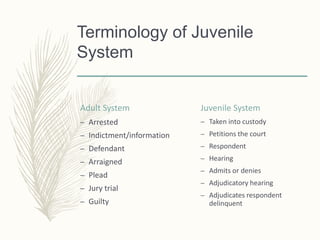
Terminology of Juvenile
System
Adult System
– Arrested
– Indictment/information
– Defendant
– Arraigned
– Plead
– Jury trial
– Guilty
Juvenile System
– Taken into custody
– Petitions the court
– Respondent
– Hearing
– Admits or denies
– Adjudicatory hearing
– Adjudicates respondent
delinquent
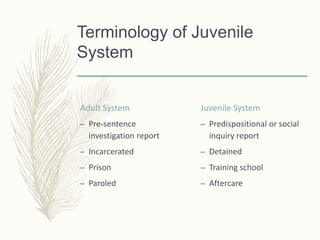
Terminology of Juvenile
System
Adult System
– Pre-sentence
investigation report
– Incarcerated
– Prison
– Paroled
Juvenile System
– Predispositional or social
inquiry report
– Detained
– Training school
– Aftercare
Juvenile Waiver to Criminal
Court
– Under certain circumstances, juveniles can be transferred
to adult court
– Lose status as minors
– Are legally culpable for alleged crime
– Age criterion varies from state to state
– About 1.5 percent of juvenile cases are waived
– Three primary ways
Juvenile Waiver to Criminal
Court
– Judicial waiver
– Judges given discretion after “full inquiry”
– Forty-eight states allow for this type
– Some have mandatory waiver but judges must determine if criteria is
met
– Some also have presumptive waiver
– Prosecutorial discretion/direct file
– Allows prosecutors to file some cases in either juvenile or adult
court
– Fourteen states and District of Columbia allow for this type
Juvenile Waiver to Criminal
Court
– Statutory exclusion/legislative waiver
– State legislatures statutorily exclude certain offenses (most
serious) from juvenile courts for those over certain age
– Vary from state to state
– Thirty-one states allow for this type
– Presumed social benefits have not materialized
– Does not guarantee more punitive disposition
Extending Due Process to
Juveniles
– Critics argued parens patriae doctrine allowed too much
latitude for courts to restrict rights of juveniles
– Argued similarities to adult correctional practices made it
more punitive
– Juveniles should be afforded same due process protections as
adults
– Courts maintained hands-off policy with regard to juveniles
until 1948
Extending Due Process to
Juveniles
– Haley v. Ohio (1948)
– Fourteenth Amendment prohibits police from violating due
process clause in obtaining confessions from juveniles
– Illegal confessions are inadmissible in court
– Kent v. United States (1966)
– Waiver decision is a critically important stage
– Juveniles have constitutional rights
Extending Due Process to
Juveniles
– In re Gault (1967)
– Established five basic due process rights for adjudication
hearings:
1. Proper notification of charges
2. Legal counsel
3. Confront witnesses
4. Privilege against self-incrimination
5. Appellate review
Extending Due Process to
Juveniles
– In re Winship (1970)
– Beyond reasonable doubt standard necessary when
incarceration is a possibility
– McKeiver v. Pennsylvania (1971)
– Juveniles do not have the right to a trial
– Breed v. Jones (1975)
– Double jeopardy applies between juvenile and adult courts
Extending Due Process to
Juveniles
– Schall v. Martin (1984)
– Preventive detention is constitutional
– Graham v. Florida (2010)
– Imposition of life sentences without possibility of parole for
juvenile is unconstitutional unless given for sentence of murder
– Miller v. Alabama (2012)
– Mandatory life without parole for juveniles violates Eighth
Amendment’s prohibition on cruel and unusual punishment
The Juvenile Death Penalty
– Greatest moral issue associated with juvenile justice
– Between 1973-2003, twenty-two juvenile offenders
executed in United States
– Thirteen of those in Texas
– Issue has gone before Supreme Court on four occasions
– Eddings v. Oklahoma (1982)
– Court must consider all mitigating factors in deciding whether
to impose the death sentence
The Juvenile Death Penalty
– Thompson v. Oklahoma (1988)
– Court drew the line for death penalty at age sixteen
– Stanford v. Kentucky (1989)
– Constitutionally permissible to execute juveniles who committed
their crimes at age sixteen or seventeen
– Reaffirmed minimum age set in Thompson
– Roper v. Simmons (2005)
– Court drew new line at age eighteen
– Violation of Eighth Amendment’s prohibition on cruel and unusual
punishment
Eroding the Distinction between
Adult and Juvenile Court Systems
– Preceding cases created procedures that mirrored those of
adult courts
– Juveniles have given up some benefits to gain others
– Interesting example is application of Megan’s Law provisions to
juveniles
– Megan’s Law
– Requires adjudicated delinquent sex offenders as well as
convicted adult sex offenders to register with law enforcement
agencies for rest of their lives
Restorative Justice
– One major innovation in juvenile justice was based off of a
Office of Juvenile Justice and Delinquency Prevention
(OJJDP) grant
– Called for strategic development of juvenile justice policies and
models based on philosophy of juvenile crime as a social
problem
– Result was restorative justice in juvenile corrections
Restorative Justice
– Restorative justice defined
– Compromise between hard punishment and soft
rehabilitation
– Holds offenders accountable while healing harm done to
victim and community
– Often involves face-to-face contact between victim and
criminal
– All previous models were “offender driven”
Restorative Justice
– Balanced approach focuses on three equally important
components for sanctioning of juveniles:
1. Hold juveniles accountable
2. Protect the community
3. Competency development programs
– VORPS
– Very successful
– 97 percent satisfaction among victims
Restorative Justice
– OJJDP has embraced balanced approach to restorative
justice
– Not meant to replace traditional methods of dealing with
delinquents and criminals
– How well does it work?
– Depends on what we want to accomplish

Chapter 8 power point

  • 1.
  • 2.
    What Is Juvenile Delinquency? –Falls under umbrella of civil law – Delinquent – Latin for “to leave undone” – Reflects rehabilitative nature – Juveniles historically subject to laws that make some actions illegal for them that are legal for adults – Status offenses – Constitute largest proportion of juvenile offenses – CHINS – PINS
  • 3.
    The Extent ofDelinquency – Public image fueled by sensationalized media accounts of atypical cases – Juveniles commit disproportionate percentage of FBI’s UCR Part I index crimes – Youths under 18 accounted for 16 percent of Part I index crimes in 2009 – Youth only comprised about 6 percent of American population – Individuals who do not engage in some form of antisocial behavior are statistically abnormal
  • 4.
    New York Academyof Sciences Conference (2003) – Key messages: – Much of behavior characterizing adolescence is rooted in biology intermingling with environmental influences to cause teens to conflict with parents, take more risks, and experience wide mood swings in emotion – Lack of synchrony between physically mature body and still maturing nervous system may explain behaviors – Adolescent sensitivities to rewards appear to be different than in adults, prompting them to seek higher levels of novelty and stimulation to achieve same feeling of pleasure
  • 5.
    Developmental Factors and JuvenileDelinquency – Puberty marks onset of transition from childhood to adulthood – Neurotransmitters increase during this period – Inhibitory transmitters decrease – Brain undergoes period of physical reorganization – Adolescent brain is immature – In context of justice philosophy, best treatment is simply growing older – Adolescent limited offenders versus life-course persistent offenders – Reaffirmed by cohort studies
  • 6.
    History and Philosophyof Juvenile Justice – Historically, youth considered to be property – Idea of not assigning culpability to young children is relatively new – Age seven under common law – Jurisdictions vary – Early Rome – Children considered property of father – Patria potestas – Fourth century Rome – Father’s power limited – Paterna pietas
  • 7.
    History and Philosophyof Juvenile Justice – Middle Ages – Gradual lessening of brutal nature of treatment – Children under seven not responsible – Special status for children between seven and fourteen – Fourteen cut-off age for adulthood (marriable)
  • 8.
    Institutional Control – Thirteenthcentury – Courts adopted parens patriae – Gave king right to intercede – State, not parents, had authority over children – Binding out – Vagrancy and laziness laws – Bridewells
  • 9.
    Childhood in theUnited States – Delinquent British youth sent to colonies as indentured servants – Usually four-year sentences – Considered legal property of “owners” – Juveniles arrested were placed in jails and prisons – Economic downturn in 1800 in United States limited opportunities – Caused vagrancy and begging to increase
  • 10.
    Childhood in theUnited States – Society for the Prevention of Pauperism – Known later as Society for the Reformation of Juvenile Delinquents (SRJD) – Primary causes of criminal behavior were economic – Give children food, shelter, and vocational training – New York House of Refuge in 1825 – Children assigned remained until determined to be reformed – Criteria for admission often arbitrary – Parents could place children there for such offenses as being idle and disorderly
  • 11.
    Childhood in theUnited States – Ex Parte Crouse (1838) – Parental rights superseded by best interest of child doctrine – Purpose of House of Refuge was to train and care for children – Acted like Bridewells – Indeterminate nature of children’s residence allowed institutions great deal of latitude in their treatment
  • 12.
    The Child Savers –Middle-class discontent with government corruption and inefficiency – Progressives – Sought for professionalization of public service – Began “ideological attack” on houses of refuge – Believed juveniles could be molded into better citizens – Placed children in farms in western United States – Motives may have been less than altruistic – Many believed poor to be innately criminal – Poverty a sign of personal defects
  • 13.
    The Beginning ofthe Juvenile Courts – Cook County, Illinois (1899) – Every state had a juvenile court by 1945 – Used civil law standards – Preponderance of the evidence – Judges given wide latitude – Different terms used than in adult system – Reflect rehabilitative nature of system
  • 14.
    Terminology of Juvenile System AdultSystem – Arrested – Indictment/information – Defendant – Arraigned – Plead – Jury trial – Guilty Juvenile System – Taken into custody – Petitions the court – Respondent – Hearing – Admits or denies – Adjudicatory hearing – Adjudicates respondent delinquent
  • 15.
    Terminology of Juvenile System AdultSystem – Pre-sentence investigation report – Incarcerated – Prison – Paroled Juvenile System – Predispositional or social inquiry report – Detained – Training school – Aftercare
  • 16.
    Juvenile Waiver toCriminal Court – Under certain circumstances, juveniles can be transferred to adult court – Lose status as minors – Are legally culpable for alleged crime – Age criterion varies from state to state – About 1.5 percent of juvenile cases are waived – Three primary ways
  • 17.
    Juvenile Waiver toCriminal Court – Judicial waiver – Judges given discretion after “full inquiry” – Forty-eight states allow for this type – Some have mandatory waiver but judges must determine if criteria is met – Some also have presumptive waiver – Prosecutorial discretion/direct file – Allows prosecutors to file some cases in either juvenile or adult court – Fourteen states and District of Columbia allow for this type
  • 18.
    Juvenile Waiver toCriminal Court – Statutory exclusion/legislative waiver – State legislatures statutorily exclude certain offenses (most serious) from juvenile courts for those over certain age – Vary from state to state – Thirty-one states allow for this type – Presumed social benefits have not materialized – Does not guarantee more punitive disposition
  • 19.
    Extending Due Processto Juveniles – Critics argued parens patriae doctrine allowed too much latitude for courts to restrict rights of juveniles – Argued similarities to adult correctional practices made it more punitive – Juveniles should be afforded same due process protections as adults – Courts maintained hands-off policy with regard to juveniles until 1948
  • 20.
    Extending Due Processto Juveniles – Haley v. Ohio (1948) – Fourteenth Amendment prohibits police from violating due process clause in obtaining confessions from juveniles – Illegal confessions are inadmissible in court – Kent v. United States (1966) – Waiver decision is a critically important stage – Juveniles have constitutional rights
  • 21.
    Extending Due Processto Juveniles – In re Gault (1967) – Established five basic due process rights for adjudication hearings: 1. Proper notification of charges 2. Legal counsel 3. Confront witnesses 4. Privilege against self-incrimination 5. Appellate review
  • 22.
    Extending Due Processto Juveniles – In re Winship (1970) – Beyond reasonable doubt standard necessary when incarceration is a possibility – McKeiver v. Pennsylvania (1971) – Juveniles do not have the right to a trial – Breed v. Jones (1975) – Double jeopardy applies between juvenile and adult courts
  • 23.
    Extending Due Processto Juveniles – Schall v. Martin (1984) – Preventive detention is constitutional – Graham v. Florida (2010) – Imposition of life sentences without possibility of parole for juvenile is unconstitutional unless given for sentence of murder – Miller v. Alabama (2012) – Mandatory life without parole for juveniles violates Eighth Amendment’s prohibition on cruel and unusual punishment
  • 24.
    The Juvenile DeathPenalty – Greatest moral issue associated with juvenile justice – Between 1973-2003, twenty-two juvenile offenders executed in United States – Thirteen of those in Texas – Issue has gone before Supreme Court on four occasions – Eddings v. Oklahoma (1982) – Court must consider all mitigating factors in deciding whether to impose the death sentence
  • 25.
    The Juvenile DeathPenalty – Thompson v. Oklahoma (1988) – Court drew the line for death penalty at age sixteen – Stanford v. Kentucky (1989) – Constitutionally permissible to execute juveniles who committed their crimes at age sixteen or seventeen – Reaffirmed minimum age set in Thompson – Roper v. Simmons (2005) – Court drew new line at age eighteen – Violation of Eighth Amendment’s prohibition on cruel and unusual punishment
  • 26.
    Eroding the Distinctionbetween Adult and Juvenile Court Systems – Preceding cases created procedures that mirrored those of adult courts – Juveniles have given up some benefits to gain others – Interesting example is application of Megan’s Law provisions to juveniles – Megan’s Law – Requires adjudicated delinquent sex offenders as well as convicted adult sex offenders to register with law enforcement agencies for rest of their lives
  • 27.
    Restorative Justice – Onemajor innovation in juvenile justice was based off of a Office of Juvenile Justice and Delinquency Prevention (OJJDP) grant – Called for strategic development of juvenile justice policies and models based on philosophy of juvenile crime as a social problem – Result was restorative justice in juvenile corrections
  • 28.
    Restorative Justice – Restorativejustice defined – Compromise between hard punishment and soft rehabilitation – Holds offenders accountable while healing harm done to victim and community – Often involves face-to-face contact between victim and criminal – All previous models were “offender driven”
  • 29.
    Restorative Justice – Balancedapproach focuses on three equally important components for sanctioning of juveniles: 1. Hold juveniles accountable 2. Protect the community 3. Competency development programs – VORPS – Very successful – 97 percent satisfaction among victims
  • 30.
    Restorative Justice – OJJDPhas embraced balanced approach to restorative justice – Not meant to replace traditional methods of dealing with delinquents and criminals – How well does it work? – Depends on what we want to accomplish