Prisons
Chapter 6
Links to the Past
 The Big House
 1940s-50s, average population 2,500 inmates per
institution
 Mostly white inmates, few treatment
programs, custody as primary goal
 1960s-70s
 Correctional institutions
 Rehabilitation model, treatment programs with
counselors and teachers
The Goals of Incarceration
 Crime Control
 Incarceration
 Diverse prison population
 Drug-related and violent criminals
The Goals of Incarceration
 Custodial Model
 Incapacitation
 Deterrence
 Retribution
 Rehabilitation Model
 Treatment
 Reintegration Model
 Community supervision
Discussion Question
Discuss if all three models of incarceration can
be implemented at once. Why or why not?
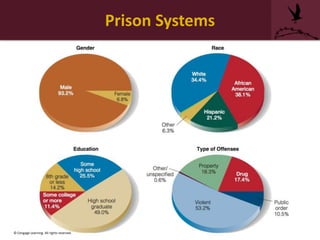
Prison Systems
 All 50 states and federal government operate
prisons
 1,292 confinement facilities
 92% under state authority
 283 private facilities
 Largest number in the South 47%
 20% in Midwest
 18.5% West
 14.5% North
Discussion Question
What if your home state decided to release 50%
of its inmates early of their scheduled
release, over a 16 month cycle, due to
overcrowding and budget problems. The first
inmates released early would be first time
drug offenders, followed by non-violent
offenders and repeat non-violent/drug
offenders? Would you support or oppose this
move? Why?
Prison Systems
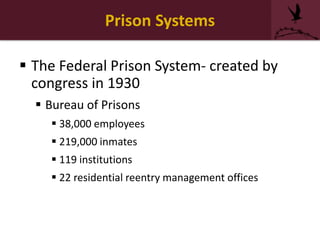
 The Federal Prison System- created by
congress in 1930
 Bureau of Prisons
 38,000 employees
 219,000 inmates
 119 institutions
 22 residential reentry management offices
Prison Systems
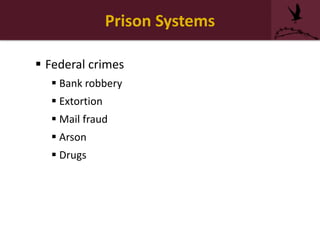
 Federal crimes
 Bank robbery
 Extortion
 Mail fraud
 Arson
 Drugs
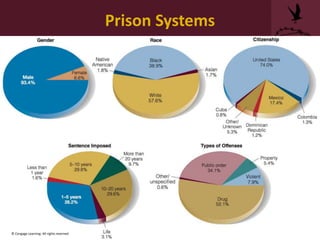
Prison Systems
© Cengage Learning. All rights reserved.
Prison Systems
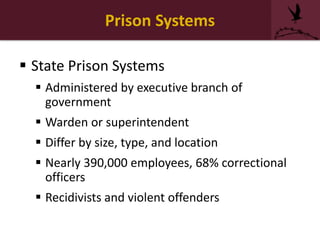
 State Prison Systems
 Administered by executive branch of
government
 Warden or superintendent
 Differ by size, type, and location
 Nearly 390,000 employees, 68% correctional
officers
 Recidivists and violent offenders
Prison Systems
© Cengage Learning. All rights reserved.
The Design and Classification
of Prisons
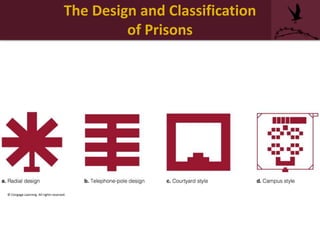
 Today’s Designs
 The radial design—East State Penitentiary
 The telephone pole design
 The courtyard style
 The campus style
The Design and Classification
of Prisons
© Cengage Learning. All rights reserved.
The Design and Classification
of Prisons
 The Location of Prisons
 Rural areas
 Isolate offenders
 Farms
 Cheap land
 NIMBY
 Economic impact
Discussion Question
Regardless of race, what are some obvious
issues which arise when rural prison guards
are responsible for urban prison inmates?
The Design and Classification
of Prisons
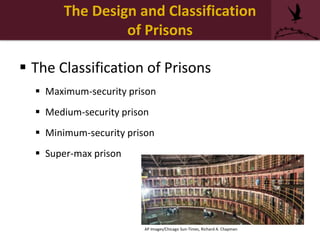
 The Classification of Prisons
 Maximum-security prison
 Medium-security prison
 Minimum-security prison
 Super-max prison
AP Images/Chicago Sun-Times, Richard A. Chapman
The Design and Classification
of Prisons
 Private Prisons
 Expanded in recent decades
 Big business
 Controversial
 Philosophical questions
Incarceration Trends
© Cengage Learning. All rights reserved.
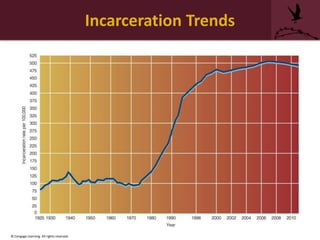
Incarceration Trends
 Explaining Prison Population Trends
 Increased arrests and more likely incarceration
 Tougher sentencing
 Prison construction
 The war on drugs
 State and local politics
Incarceration Trends
 Public Policy Trends
 Incarceration of more offenders for longer
periods of time
 Increased law enforcement and prosecution
spending
 Mandatory-sentencing laws
 Truth-in-sentencing requirements
 Enhanced drug law enforcement
 Tough parole policies
Incarceration Trends
 Dealing with Crowded Prisons
 Null strategy- doing nothing
 Construction strategy- building more prisons to
meet the demands of prison space
 Reserve prison space for violent offenders
 Intermediate sanctions
 “Backdoor strategies”
 Parole
 Work release
 Good time
Discussion Question
Discuss which strategy would be most effective
for dealing with overcrowding in prisons?
Why?
Does Incarceration Pay?
 Opponents
 Incarceration not warranted
 Unintended consequences
 Supporters
 Reduced crime rate
 Most inmates commit serious crimes

Corrections chapter 6 ppt

  • 1.
  • 2.
    Links to thePast  The Big House  1940s-50s, average population 2,500 inmates per institution  Mostly white inmates, few treatment programs, custody as primary goal  1960s-70s  Correctional institutions  Rehabilitation model, treatment programs with counselors and teachers
  • 3.
    The Goals ofIncarceration  Crime Control  Incarceration  Diverse prison population  Drug-related and violent criminals
  • 4.
    The Goals ofIncarceration  Custodial Model  Incapacitation  Deterrence  Retribution  Rehabilitation Model  Treatment  Reintegration Model  Community supervision
  • 5.
    Discussion Question Discuss ifall three models of incarceration can be implemented at once. Why or why not?
  • 6.
    Prison Systems  All50 states and federal government operate prisons  1,292 confinement facilities  92% under state authority  283 private facilities  Largest number in the South 47%  20% in Midwest  18.5% West  14.5% North
  • 7.
    Discussion Question What ifyour home state decided to release 50% of its inmates early of their scheduled release, over a 16 month cycle, due to overcrowding and budget problems. The first inmates released early would be first time drug offenders, followed by non-violent offenders and repeat non-violent/drug offenders? Would you support or oppose this move? Why?
  • 8.
    Prison Systems  TheFederal Prison System- created by congress in 1930  Bureau of Prisons  38,000 employees  219,000 inmates  119 institutions  22 residential reentry management offices
  • 9.
    Prison Systems  Federalcrimes  Bank robbery  Extortion  Mail fraud  Arson  Drugs
  • 10.
    Prison Systems © CengageLearning. All rights reserved.
  • 11.
    Prison Systems  StatePrison Systems  Administered by executive branch of government  Warden or superintendent  Differ by size, type, and location  Nearly 390,000 employees, 68% correctional officers  Recidivists and violent offenders
  • 12.
    Prison Systems © CengageLearning. All rights reserved.
  • 13.
    The Design andClassification of Prisons  Today’s Designs  The radial design—East State Penitentiary  The telephone pole design  The courtyard style  The campus style
  • 14.
    The Design andClassification of Prisons © Cengage Learning. All rights reserved.
  • 15.
    The Design andClassification of Prisons  The Location of Prisons  Rural areas  Isolate offenders  Farms  Cheap land  NIMBY  Economic impact
  • 16.
    Discussion Question Regardless ofrace, what are some obvious issues which arise when rural prison guards are responsible for urban prison inmates?
  • 17.
    The Design andClassification of Prisons  The Classification of Prisons  Maximum-security prison  Medium-security prison  Minimum-security prison  Super-max prison AP Images/Chicago Sun-Times, Richard A. Chapman
  • 18.
    The Design andClassification of Prisons  Private Prisons  Expanded in recent decades  Big business  Controversial  Philosophical questions
  • 19.
    Incarceration Trends © CengageLearning. All rights reserved.
  • 20.
    Incarceration Trends  ExplainingPrison Population Trends  Increased arrests and more likely incarceration  Tougher sentencing  Prison construction  The war on drugs  State and local politics
  • 21.
    Incarceration Trends  PublicPolicy Trends  Incarceration of more offenders for longer periods of time  Increased law enforcement and prosecution spending  Mandatory-sentencing laws  Truth-in-sentencing requirements  Enhanced drug law enforcement  Tough parole policies
  • 22.
    Incarceration Trends  Dealingwith Crowded Prisons  Null strategy- doing nothing  Construction strategy- building more prisons to meet the demands of prison space  Reserve prison space for violent offenders  Intermediate sanctions  “Backdoor strategies”  Parole  Work release  Good time
  • 23.
    Discussion Question Discuss whichstrategy would be most effective for dealing with overcrowding in prisons? Why?
  • 24.
    Does Incarceration Pay? Opponents  Incarceration not warranted  Unintended consequences  Supporters  Reduced crime rate  Most inmates commit serious crimes

Editor's Notes

  • #11 Sources: Federal Bureau of Prisons, State of the Bureau, 2010 (Washington, DC: U.S. Government Printing Office, 2010), 3; E. Ann Carson and William J. Sabol, Prisoners in 2011 (Washington, DC: U.S. Government Printing Office, 2012), 29.
  • #13 Sources: E. Ann Carson and William J. Sabol, Prisoners in 2011 (Washington, DC: U.S. Government Printing Office, 2012); Caroline Wolf Harlow, Education and Correctional Populations (Washington, DC: U.S. Government Printing Office, 2003).
  • #20 Sources: Kathleen Maguire, ed., Sourcebook of Criminal Justice Statistics Online, Table 6.29.2010, www.albany.edu/sourcebook, January 18, 2013; E. Ann Carson and William J. Sabol, Prisoners in 2011 (Washington, DC: U.S. Government Printing Office, 2010), 6.