Law, Social
Change, and the
Class Struggle
Chapter 11
What is Social Change?
• Defined
• Some may seem trivial
 Can still generate own momentum
• Was time in history when hardly any occurred
 Small and isolated cultures
• Those who most stoutly resist are ones who gain most
from status quo
• Tensions can occur when change is induced
 Most work themselves out without conflict
The Law as a Cause of Social
Change
• Historically only had minor role
 Has hugely increased over past two centuries
• Law is mostly reactive
• Tendency to view law as barrier to change
 Consists of things resistant to change
• Disraeli (Ashford, 1990)
 French (1789) and Russian (1917) revolutions versus English
(1688) and American (1776) revolutions
The Law as a Cause of Social
Change
• Law can be independent source of change
• Two views:
 Conservative
 Active use of law to generate social change is wrong
 Law must be natural extension of social custom
 Other view:
 Too many customs in United States for law to be based on only one
 Law instead based on general, abstract, universalistic principle of
justice
Social Movements, the Law,
and Social Change
• Reciprocal relationship between law and social change
 Sometimes social conditions give rise to changes in law,
sometimes it is the reverse
• Law is not isolated phenomenon
• Role of law most often facilitative
• When enough people involved in process, it is called a
social movement
Social Movements, the Law,
and Social Change
• Social movement defined
 Charles Tilly (1984)
• Law provides important terrain to exploit when pursuing
goals
• Politics of social movements depend on democracy
• Before judiciary interpreted Constitution
 Social movements unlikely to go anywhere without violence
Social Movements, the Law,
and Social Change
• Contagion effect can occur
 Defined
• Ebb and flow depending on historical period
 Some more “contagious” than others
• Examples of social movements:
 Worker’s rights
 Rights of gays and lesbians
 Abortion rights
 Women’s rights
 Minority and racial/ethnic rights
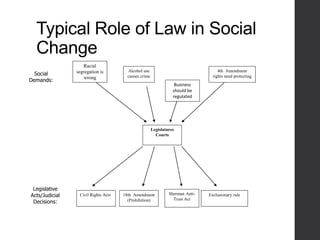
Typical Role of Law in Social
Change
Alcohol use
causes crime
4th Amendment
rights need protecting
Legislatures
Courts
Civil Rights Acts 18th Amendment
(Prohibition)
Exclusionary rule
Racial
segregation is
wrong
Business
should be
regulated
Sherman Anti-
Trust Act
Social
Demands:
Legislative
Acts/Judicial
Decisions:
British Law and the American
Revolution
• Were it not for number of British legal decisions, colonists
may have been loyal
• British laws after French and Indian Ears designed to force
colonists to pay share of war expense
 Mutiny Act of 1765
 Sugar Act of 1774
 Stamp Act of 1765
 Proclamation Act of 1763
• Colonists used British law to oppose acts
British Law and the American
Revolution
• Judicial rulings may have contributed
 Somerset v. Stewart (1772)
 Joseph Knight v. Wedderburn (1778)
• Americans considered Revolution to be legal declaration of
divorce
 Based on British constitution
 Believed King George had overstepped authority
 Placed himself above law
Law and Social Engineering in
the Former USSR
• Pre-USSR law suppressed social change and retarded
social progress
• USSR used law to force social change
• Have been five Soviet constitutions since 1918
 Have been longer and more detailed
 Changing sometimes as frequently as once a day
 All guaranteed certain rights
 All set forth certain obligations
Law and Social Engineering in
the Former USSR
• Russian experience shows written constitutions not
guarantee of political freedom
• Officially, legal system conducted in conformity to Weber’s
formal rationality
 In reality conformed to substantive irrationality
 Substance provided by Marxist ideology
 Legal decisions made on ad hoc basis
 Use of vague concepts allowed for ex post facto laws to be passed
Law and Social Engineering in
the Former USSR
• Soviets viewed law as force for social change
 Mold attitudes and behaviors in any way government deemed
appropriate
 Ultimate goal was dictatorship of proletariat
• During early days Western concepts of law thrown out
 Favored Soviet legalism
 Soviet flip-flop on “bourgeois family”
Law and Social Engineering in
the Former USSR
• Party passed legislation to destroy the family
 Had devastating consequences
 Results
• Soviets quickly reversed when damage was assessed
 Experience points to both power of law to induce social change
and to its limits
• Law coupled with police tactics can result in social change
• Law based on custom is more efficient
The U.S. Supreme Court and
Social Change
• Ultimate source of law in America is Constitution
 Supreme Court is ultimate legal authority
• Supreme Court is source of change
 Much of their record supports both consensus and conflict
theories of law
• How have these used this power?
 Rosenberg’s (1991) two views of USSC’s ability to induce social
change
 Dynamic view
 Constrained view
The Supreme Court’s Power:
Dynamic View
• Court can be more effective than other government
institutions in bringing about social change
 Free of election concerns
 Can act in face of public opposition
The Supreme Court’s Power:
Constrained View
• Court can rarely produce significant social change due to
three constraints
 Bounded nature of constitutional rights
 Lacks necessary independence from other branches of
government
 Lacks tools to develop policies and implement decisions
The Supreme Court’s Power:
Constrained View
• Does not mean courts do not matter
 Social policy and political events are more salient
 Courts have indirect effect on change
• USSC has created little social change unless all three
forms of opposition have been absent
• Dynamism can exist when coupled with USSC’s main
resource:
 Legitimacy
The Legitimacy Basis of the
Court’s Power
• Constrained by lack of power of purse and sword
 Court must rely more on power of legitimacy
• Legitimacy defined
 Authority
• Weber’s (1968) three types of authority
1. Traditional
2. Charismatic
3. Rational-legal
• Supreme Court enjoys all of these
The Legitimacy Basis of the Court’s
Power: Traditional Authority
• Court is almost as old as Republic itself
 Hard to imagine being without it
• Tradition has powerful hold on psychology of people
 Often invested with kind of quasi-divine inspiration
 Rarely any questioning of this type of authority
 Always been there
• May be maintained even in face of criticism if buttressed by
charismatic authority
The Legitimacy Basis of the Court’s
Power: Charismatic Authority
• Defined
• Rests on some extent to use of quasi-religious myths and
symbols
 Designed to arouse feelings of worship and reverence
• Court’s actions and refusals support impression of
“otherworldliness”
The Legitimacy Basis of the Court’s
Power: Rational-Legal Authority
• Derived from rules rationally and legally enacted
• Court provided for in Article III of Constitution
 How far was power originally intended is matter of contention
• Framers intent on issue of judicial review
 Marbury v. Madison (1803)
 Intended or overstepping?
The Legitimacy Basis of the
Court’s Power
• Rosenberg (1991)
 Court could not have as much power without cooperation from
other branches
 Cooperation forthcoming due to view of Court as more useful
rather than a nuisance
 Do not worry about reelection like legislators
• Some see role as major threat to validity of American
political system
Justice Anthony Kennedy: The Most
Powerful Man in the United States?
• Recent Court decisions lend more support to dynamic
model
• Kennedy has been dubbed “most powerful man in America”
 Is only political centrist on Court
 Provides so-called swing vote on divisive social issues
• Despite arguments to contrary, Court is highly politicized
institution
Justice Anthony Kennedy: The Most
Powerful Man in the United States?
• Prior to February 2016 (death of Justice Antonin Scalia),
the Court had:
 Four solid liberals
 Four solid conservatives
• Some exceptions apply
• Votes simply canceled each other out
 Makes Kennedy’s vote only one that really matters
• His one vote has more input than all the 435
representatives and 100 senators at federal level combined
 As well as all state and local legislators combined
Interpreting the Constitution: Strict
Construction or Living Document?
• Conservative presidents tend to nominate those who
believe Court’s task is to take Constitution as it finds it
• Strict constructionism
 Asserts judges must not place in own interpretations under any
circumstances
• Constitutional fundamentalists
• Would have very little role in social change
 Captives of eighteenth-century thinking
Interpreting the Constitution: Strict
Construction or Living Document?
• Strict constructionists would point out that important equity
issues are proper domains of Congress
 Not Supreme Court
• Congress can amend Constitution
 Until they do, Court is bound to find only that which is there
 Slavery and changes by legislative branch, not Court
Interpreting the Constitution: Strict
Construction or Living Document?
• Judicial activism
 Defined
• Active justices have found ideas in the penumbras of the
Constitution
 Framers never conceived
• Modern critics call this judicial governance
 Clear violation of separation of powers
• United States v. Windsor (2012)
Interpreting the Constitution: Strict
Construction or Living Document?
• Judicial activism often viewed as synonymous with view
that Constitution is “living, breathing document”
 Lex non scripta
 Flexible documents and traditions added over centuries
• Purposefully written in generalities
 In need of interpretation by others in different times
 Confronted with issues Framers could not envision
The Supreme Court and the
Class Struggle
• Extreme concentration of wealth leads to de facto
plutocracy
 Functions beneath “official” government
 Defiles very ideas of justice and democracy
• Democratic governments have responded to demands for
social change in three ways
• Equity efforts resisted everywhere by wealthy classes and
their political parties
 United States most successful
 Supreme Court has guarded interests
The Supreme Court and the
Class Struggle
• Many think justices are servants to Constitution
 If so, ideological composition of Court should not matter
 Reality
• Founding fathers believed human nature is not to be
trusted
 Democracy not to be trusted unless limited by boundaries
• U.S. Constitution is economic document that favors
moneyed business class
The Fourteenth Amendment
and Business Interests
• Constitution has always been bastion for upper class
 Fletcher v. Peck (1810)
• Fourteenth Amendment
 Passed in 1868
 Created to protect most deprived members of society
• USSC used it to protect rich business interests against
working-class interests
 Santa Clara Co. v. Southern Pacific R.R. Co. (1886)
The Fourteenth Amendment
and Business Interests
• After precedent set, business interests could seek judicial
injunctions against strikes with relative ease
• Courts able to use by defining
 Person very broadly as any body of people
 Property to include business profits
• Courts opened floodgates to tide of judicial attacks on state
laws
The Fourteenth Amendment
and Business Interests
• Sherman Anti-Trust Act (1890)
 Designed to place controls on business
 Used by Court as hammer against working class
 United States v. E.C. Knight (1895)
 In re Debs (1895)
 Loewe v. Lawlor (1908)
• Late nineteenth and early twentieth centuries
 Court legitimized “law of the jungle”
 Lochner v. New York (1905)
 Hammer v. Dagenhart (1918)
 Adkins v. Children’s Hospital (1923)
The Fourteenth Amendment
and Business Interests
• Similar case outcomes throughout 1930s and after
 Schechter Poultry Corp v. United States (1935)
 Louisville Bank v. Radford (1935)
 United States v. Butler (1936)
• Spurred congressional action to suppress Court
 Norris-La Guardia Act (1932)
 National Labor Relations (Wagner) Act (1935)
The Fourteenth Amendment
and Business Interests
• Allied Structural Steel v. Spannous (1978)
• National Labor Relations Board v. Bildisco (1983)
• Pollock v. Farmer’s Loan and Trust Company (1895)
Social Justice, Equality and
Freedom: A Debate
• Concept of equality has many positive connotations carried
over from great struggles of past for legal and political
equality
• United States has reached point where all individuals,
classes, and races are guaranteed equality before law
 Some want to go beyond and demand “social justice”
• Voltaire
 Legal and political equality are natural equalities
The Argument for Social Justice
• Ideal demands embrace of equality of “goods and power”
regardless of so-called talent and effort
• John Rawls
 Talent and effort part of “superior character”
 Did not believe anyone should benefit from it
 Can neither blame nor praise people for what they can or cannot
accomplish
 Given genes and environment that influence developmental
trajectories
The Argument for Social Justice
• Karl Marx
 People should not benefit from superior abilities
 Capitalist meritocracy unfair
 Distributive justice provides “superior” people with more
 Natural superiority they did nothing to deserve
 Natural talents and benefits derived from them belongs to
society, not person who is lucky to have them
 Principle of social justice assets
The Argument for Social Justice
• Argued all Marxist societies have failed
 None were true Marxist societies
• Rawl’s “original position”
 Those charged with developing social system do so under “veil
of ignorance”
 Individuals accept principle of equality as prime facie obligation
 Theory separates distributive justice from capitalist notion of
desert
 Inequality acceptable if it is to advantage worst off individuals
 Difference principle
The Argument against “Social
Justice”
• Not that we value inequality; rather, income inequality is
natural outcome of free individuals in spontaneous
competitive system
 Any attempt to interfere is major threat to freedom
• Fairness appeals to moral sentiments
 Process by which we expect to “make things right”
 Sympathy does not tell us how one’s position in life coheres with
this moral issue
The Argument against “Social
Justice”
• Fairness saturated with contradictory notions
 Viewed as equal opportunity process
 Process can be guarded by law
 Unequal outcomes fair if process is fair
• With rules and standards of judgment held constant, only
things that vary are qualities that individuals bring
The Supreme Court and the
Class Struggle
• Society concerned with justice
 Must do what it can for those plagued by misfortunes
• Society concerned with liberty
 Knows nature does not produce state of equality
• Quest for “social justice” is dangerous utopian dream
leading to totalitarianism
 Anyone who doubts this knows nothing of human nature
The Supreme Court’s Role in
Inducing Social Change
• Social change has been hallmark of American society since
its beginning
• Law has played active role in molding it
• Supreme Court continually expanded power of federal
government relative to that of individual states
 Has served as nation builder
Bringing the Country Together
through Case Law
• Supreme Court has expanded role and have done much to
mold common national identity
• Supreme Court used Supremacy Clause
 Article VI of Constitution
• Fletcher v. Peck (1810)
 Court set stage for jurisdiction over state legislatures
Bringing the Country Together
through Case Law
• Martin v. Hunter’s Lessee (1813)
• Marshall Court: Molding national identity
 McCulloch v. Maryland (1819)
 Gibbons v. Ogden (1824)
• Combined impact of previous cases did much to integrate
and unite the states
 Generated feelings of being citizens of the United States as well
as their individual states
Bringing the Country Together
through Case Law
• Tide of disunity generated by existence of slavery opposed
tide of national unity
• Taney Court: states’ rights take precedent
 Scott v. Sandford (1857)
 West Coast Hotel Co. v. Parrish (1937)
The Activism of the Warren and
Burger Courts
• Court became major catalyst for change under Chief
Justice Earl Warren (1953-1969)
 Brown v. Board of Education of Topeka (1954)
 One of the most famous of all Supreme Court cases
 Plessy v. Ferguson (1896)
 Engel v. Vitale (1962)
 Roe v. Wade (1973)
• These decisions have become institutionalized and
accepted
 Especially among younger generations

Chapter 11 power point

  • 1.
    Law, Social Change, andthe Class Struggle Chapter 11
  • 2.
    What is SocialChange? • Defined • Some may seem trivial  Can still generate own momentum • Was time in history when hardly any occurred  Small and isolated cultures • Those who most stoutly resist are ones who gain most from status quo • Tensions can occur when change is induced  Most work themselves out without conflict
  • 3.
    The Law asa Cause of Social Change • Historically only had minor role  Has hugely increased over past two centuries • Law is mostly reactive • Tendency to view law as barrier to change  Consists of things resistant to change • Disraeli (Ashford, 1990)  French (1789) and Russian (1917) revolutions versus English (1688) and American (1776) revolutions
  • 4.
    The Law asa Cause of Social Change • Law can be independent source of change • Two views:  Conservative  Active use of law to generate social change is wrong  Law must be natural extension of social custom  Other view:  Too many customs in United States for law to be based on only one  Law instead based on general, abstract, universalistic principle of justice
  • 5.
    Social Movements, theLaw, and Social Change • Reciprocal relationship between law and social change  Sometimes social conditions give rise to changes in law, sometimes it is the reverse • Law is not isolated phenomenon • Role of law most often facilitative • When enough people involved in process, it is called a social movement
  • 6.
    Social Movements, theLaw, and Social Change • Social movement defined  Charles Tilly (1984) • Law provides important terrain to exploit when pursuing goals • Politics of social movements depend on democracy • Before judiciary interpreted Constitution  Social movements unlikely to go anywhere without violence
  • 7.
    Social Movements, theLaw, and Social Change • Contagion effect can occur  Defined • Ebb and flow depending on historical period  Some more “contagious” than others • Examples of social movements:  Worker’s rights  Rights of gays and lesbians  Abortion rights  Women’s rights  Minority and racial/ethnic rights
  • 8.
    Typical Role ofLaw in Social Change Alcohol use causes crime 4th Amendment rights need protecting Legislatures Courts Civil Rights Acts 18th Amendment (Prohibition) Exclusionary rule Racial segregation is wrong Business should be regulated Sherman Anti- Trust Act Social Demands: Legislative Acts/Judicial Decisions:
  • 9.
    British Law andthe American Revolution • Were it not for number of British legal decisions, colonists may have been loyal • British laws after French and Indian Ears designed to force colonists to pay share of war expense  Mutiny Act of 1765  Sugar Act of 1774  Stamp Act of 1765  Proclamation Act of 1763 • Colonists used British law to oppose acts
  • 10.
    British Law andthe American Revolution • Judicial rulings may have contributed  Somerset v. Stewart (1772)  Joseph Knight v. Wedderburn (1778) • Americans considered Revolution to be legal declaration of divorce  Based on British constitution  Believed King George had overstepped authority  Placed himself above law
  • 11.
    Law and SocialEngineering in the Former USSR • Pre-USSR law suppressed social change and retarded social progress • USSR used law to force social change • Have been five Soviet constitutions since 1918  Have been longer and more detailed  Changing sometimes as frequently as once a day  All guaranteed certain rights  All set forth certain obligations
  • 12.
    Law and SocialEngineering in the Former USSR • Russian experience shows written constitutions not guarantee of political freedom • Officially, legal system conducted in conformity to Weber’s formal rationality  In reality conformed to substantive irrationality  Substance provided by Marxist ideology  Legal decisions made on ad hoc basis  Use of vague concepts allowed for ex post facto laws to be passed
  • 13.
    Law and SocialEngineering in the Former USSR • Soviets viewed law as force for social change  Mold attitudes and behaviors in any way government deemed appropriate  Ultimate goal was dictatorship of proletariat • During early days Western concepts of law thrown out  Favored Soviet legalism  Soviet flip-flop on “bourgeois family”
  • 14.
    Law and SocialEngineering in the Former USSR • Party passed legislation to destroy the family  Had devastating consequences  Results • Soviets quickly reversed when damage was assessed  Experience points to both power of law to induce social change and to its limits • Law coupled with police tactics can result in social change • Law based on custom is more efficient
  • 15.
    The U.S. SupremeCourt and Social Change • Ultimate source of law in America is Constitution  Supreme Court is ultimate legal authority • Supreme Court is source of change  Much of their record supports both consensus and conflict theories of law • How have these used this power?  Rosenberg’s (1991) two views of USSC’s ability to induce social change  Dynamic view  Constrained view
  • 16.
    The Supreme Court’sPower: Dynamic View • Court can be more effective than other government institutions in bringing about social change  Free of election concerns  Can act in face of public opposition
  • 17.
    The Supreme Court’sPower: Constrained View • Court can rarely produce significant social change due to three constraints  Bounded nature of constitutional rights  Lacks necessary independence from other branches of government  Lacks tools to develop policies and implement decisions
  • 18.
    The Supreme Court’sPower: Constrained View • Does not mean courts do not matter  Social policy and political events are more salient  Courts have indirect effect on change • USSC has created little social change unless all three forms of opposition have been absent • Dynamism can exist when coupled with USSC’s main resource:  Legitimacy
  • 19.
    The Legitimacy Basisof the Court’s Power • Constrained by lack of power of purse and sword  Court must rely more on power of legitimacy • Legitimacy defined  Authority • Weber’s (1968) three types of authority 1. Traditional 2. Charismatic 3. Rational-legal • Supreme Court enjoys all of these
  • 20.
    The Legitimacy Basisof the Court’s Power: Traditional Authority • Court is almost as old as Republic itself  Hard to imagine being without it • Tradition has powerful hold on psychology of people  Often invested with kind of quasi-divine inspiration  Rarely any questioning of this type of authority  Always been there • May be maintained even in face of criticism if buttressed by charismatic authority
  • 21.
    The Legitimacy Basisof the Court’s Power: Charismatic Authority • Defined • Rests on some extent to use of quasi-religious myths and symbols  Designed to arouse feelings of worship and reverence • Court’s actions and refusals support impression of “otherworldliness”
  • 22.
    The Legitimacy Basisof the Court’s Power: Rational-Legal Authority • Derived from rules rationally and legally enacted • Court provided for in Article III of Constitution  How far was power originally intended is matter of contention • Framers intent on issue of judicial review  Marbury v. Madison (1803)  Intended or overstepping?
  • 23.
    The Legitimacy Basisof the Court’s Power • Rosenberg (1991)  Court could not have as much power without cooperation from other branches  Cooperation forthcoming due to view of Court as more useful rather than a nuisance  Do not worry about reelection like legislators • Some see role as major threat to validity of American political system
  • 24.
    Justice Anthony Kennedy:The Most Powerful Man in the United States? • Recent Court decisions lend more support to dynamic model • Kennedy has been dubbed “most powerful man in America”  Is only political centrist on Court  Provides so-called swing vote on divisive social issues • Despite arguments to contrary, Court is highly politicized institution
  • 25.
    Justice Anthony Kennedy:The Most Powerful Man in the United States? • Prior to February 2016 (death of Justice Antonin Scalia), the Court had:  Four solid liberals  Four solid conservatives • Some exceptions apply • Votes simply canceled each other out  Makes Kennedy’s vote only one that really matters • His one vote has more input than all the 435 representatives and 100 senators at federal level combined  As well as all state and local legislators combined
  • 26.
    Interpreting the Constitution:Strict Construction or Living Document? • Conservative presidents tend to nominate those who believe Court’s task is to take Constitution as it finds it • Strict constructionism  Asserts judges must not place in own interpretations under any circumstances • Constitutional fundamentalists • Would have very little role in social change  Captives of eighteenth-century thinking
  • 27.
    Interpreting the Constitution:Strict Construction or Living Document? • Strict constructionists would point out that important equity issues are proper domains of Congress  Not Supreme Court • Congress can amend Constitution  Until they do, Court is bound to find only that which is there  Slavery and changes by legislative branch, not Court
  • 28.
    Interpreting the Constitution:Strict Construction or Living Document? • Judicial activism  Defined • Active justices have found ideas in the penumbras of the Constitution  Framers never conceived • Modern critics call this judicial governance  Clear violation of separation of powers • United States v. Windsor (2012)
  • 29.
    Interpreting the Constitution:Strict Construction or Living Document? • Judicial activism often viewed as synonymous with view that Constitution is “living, breathing document”  Lex non scripta  Flexible documents and traditions added over centuries • Purposefully written in generalities  In need of interpretation by others in different times  Confronted with issues Framers could not envision
  • 30.
    The Supreme Courtand the Class Struggle • Extreme concentration of wealth leads to de facto plutocracy  Functions beneath “official” government  Defiles very ideas of justice and democracy • Democratic governments have responded to demands for social change in three ways • Equity efforts resisted everywhere by wealthy classes and their political parties  United States most successful  Supreme Court has guarded interests
  • 31.
    The Supreme Courtand the Class Struggle • Many think justices are servants to Constitution  If so, ideological composition of Court should not matter  Reality • Founding fathers believed human nature is not to be trusted  Democracy not to be trusted unless limited by boundaries • U.S. Constitution is economic document that favors moneyed business class
  • 32.
    The Fourteenth Amendment andBusiness Interests • Constitution has always been bastion for upper class  Fletcher v. Peck (1810) • Fourteenth Amendment  Passed in 1868  Created to protect most deprived members of society • USSC used it to protect rich business interests against working-class interests  Santa Clara Co. v. Southern Pacific R.R. Co. (1886)
  • 33.
    The Fourteenth Amendment andBusiness Interests • After precedent set, business interests could seek judicial injunctions against strikes with relative ease • Courts able to use by defining  Person very broadly as any body of people  Property to include business profits • Courts opened floodgates to tide of judicial attacks on state laws
  • 34.
    The Fourteenth Amendment andBusiness Interests • Sherman Anti-Trust Act (1890)  Designed to place controls on business  Used by Court as hammer against working class  United States v. E.C. Knight (1895)  In re Debs (1895)  Loewe v. Lawlor (1908) • Late nineteenth and early twentieth centuries  Court legitimized “law of the jungle”  Lochner v. New York (1905)  Hammer v. Dagenhart (1918)  Adkins v. Children’s Hospital (1923)
  • 35.
    The Fourteenth Amendment andBusiness Interests • Similar case outcomes throughout 1930s and after  Schechter Poultry Corp v. United States (1935)  Louisville Bank v. Radford (1935)  United States v. Butler (1936) • Spurred congressional action to suppress Court  Norris-La Guardia Act (1932)  National Labor Relations (Wagner) Act (1935)
  • 36.
    The Fourteenth Amendment andBusiness Interests • Allied Structural Steel v. Spannous (1978) • National Labor Relations Board v. Bildisco (1983) • Pollock v. Farmer’s Loan and Trust Company (1895)
  • 37.
    Social Justice, Equalityand Freedom: A Debate • Concept of equality has many positive connotations carried over from great struggles of past for legal and political equality • United States has reached point where all individuals, classes, and races are guaranteed equality before law  Some want to go beyond and demand “social justice” • Voltaire  Legal and political equality are natural equalities
  • 38.
    The Argument forSocial Justice • Ideal demands embrace of equality of “goods and power” regardless of so-called talent and effort • John Rawls  Talent and effort part of “superior character”  Did not believe anyone should benefit from it  Can neither blame nor praise people for what they can or cannot accomplish  Given genes and environment that influence developmental trajectories
  • 39.
    The Argument forSocial Justice • Karl Marx  People should not benefit from superior abilities  Capitalist meritocracy unfair  Distributive justice provides “superior” people with more  Natural superiority they did nothing to deserve  Natural talents and benefits derived from them belongs to society, not person who is lucky to have them  Principle of social justice assets
  • 40.
    The Argument forSocial Justice • Argued all Marxist societies have failed  None were true Marxist societies • Rawl’s “original position”  Those charged with developing social system do so under “veil of ignorance”  Individuals accept principle of equality as prime facie obligation  Theory separates distributive justice from capitalist notion of desert  Inequality acceptable if it is to advantage worst off individuals  Difference principle
  • 41.
    The Argument against“Social Justice” • Not that we value inequality; rather, income inequality is natural outcome of free individuals in spontaneous competitive system  Any attempt to interfere is major threat to freedom • Fairness appeals to moral sentiments  Process by which we expect to “make things right”  Sympathy does not tell us how one’s position in life coheres with this moral issue
  • 42.
    The Argument against“Social Justice” • Fairness saturated with contradictory notions  Viewed as equal opportunity process  Process can be guarded by law  Unequal outcomes fair if process is fair • With rules and standards of judgment held constant, only things that vary are qualities that individuals bring
  • 43.
    The Supreme Courtand the Class Struggle • Society concerned with justice  Must do what it can for those plagued by misfortunes • Society concerned with liberty  Knows nature does not produce state of equality • Quest for “social justice” is dangerous utopian dream leading to totalitarianism  Anyone who doubts this knows nothing of human nature
  • 44.
    The Supreme Court’sRole in Inducing Social Change • Social change has been hallmark of American society since its beginning • Law has played active role in molding it • Supreme Court continually expanded power of federal government relative to that of individual states  Has served as nation builder
  • 45.
    Bringing the CountryTogether through Case Law • Supreme Court has expanded role and have done much to mold common national identity • Supreme Court used Supremacy Clause  Article VI of Constitution • Fletcher v. Peck (1810)  Court set stage for jurisdiction over state legislatures
  • 46.
    Bringing the CountryTogether through Case Law • Martin v. Hunter’s Lessee (1813) • Marshall Court: Molding national identity  McCulloch v. Maryland (1819)  Gibbons v. Ogden (1824) • Combined impact of previous cases did much to integrate and unite the states  Generated feelings of being citizens of the United States as well as their individual states
  • 47.
    Bringing the CountryTogether through Case Law • Tide of disunity generated by existence of slavery opposed tide of national unity • Taney Court: states’ rights take precedent  Scott v. Sandford (1857)  West Coast Hotel Co. v. Parrish (1937)
  • 48.
    The Activism ofthe Warren and Burger Courts • Court became major catalyst for change under Chief Justice Earl Warren (1953-1969)  Brown v. Board of Education of Topeka (1954)  One of the most famous of all Supreme Court cases  Plessy v. Ferguson (1896)  Engel v. Vitale (1962)  Roe v. Wade (1973) • These decisions have become institutionalized and accepted  Especially among younger generations