Special
Populations
Chapter 9
The Challenge of Special
Populations in Corrections
 Elderly Prisoners- minimum 50 years of age
but normally defined as 55 or older
 Geriatric offenders
 Housing- general population with accommodations
 Medical care- often chronic illnesses
 Programs- exercise, rehabilitative, etc.
 Release- government and social service assistance
Discussion Question
Should there be an age limit where prisoners
can be moved to a lower level security prison
or be released? What about terminally ill
prisoners?
5 Factors Affecting Life in Prison
 Increased number of elderly inmates
 Number of inmates with HIV/AIDS
 Mentally ill inmates
 Long-term prisoners
 Correctional policies required to address the
needs of incarcerated sexual minorities
The Challenge of Special
Populations in Corrections
 Prisoners with HIV/AIDS
 Higher rate of infection than general
population
 High-risk behaviors
 IV drug use
 Needle sharing
 Unprotected sex
The Challenge of Special
Populations in Corrections
 Prisoners with HIV/AIDS
 Segregation policies are controversial
 Advocates
 Prison violence decreases
 HIV-infected inmates benefit from removal from the
general population
 Additional health care and programs more available
 Better living accommodations
 More staff support and specialized care
The Challenge of Special
Populations in Corrections
 Prisoners with HIV/AIDS
 Safe environment for staff
 Correctional officers
 Breaking up fights
 Handling physically violent inmates
 Chance of virus transmission are reportedly low
Discussion Question
What if you were a correctional guard in change
of inmates with HIV and AIDS; would you be
comfortable in this position? What
precautions would you take?
The Challenge of Special
Populations in Corrections
 Mentally Ill Prisoners
 Deinstitutionalization increased inmate numbers
 More likely among violent offenders
 Less likely among drug offenders
 Differs by age, race, and gender
 Sexual abuse, homelessness, incarcerated family
member
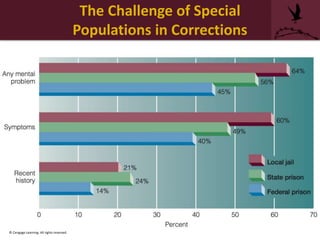
The Challenge of Special
Populations in Corrections
© Cengage Learning. All rights reserved.
The Challenge of Special
Populations in Corrections
 Mentally Ill Prisoners
 Challenges for correctional officials
 More fights
 More rule violations
 Counseling
 Medication
The Challenge of Special
Populations in Corrections
 Psychotherapy
 Treatment of the mind
 Motivated, voluntary and free for patients shows
success
 In prison can be coercive in nature showing lower
success rates
 Psychotropic medications for 10% of prisoners
The Challenge of Special
Populations in Corrections
 Reality therapy
 People’s problems decline when they behave
more responsibly
 Emphasizes personal responsibility for actions and
their consequences
 Confrontation therapy
 Professional group leader encourages group
members to confront one another’s
rationalizations and manipulations which are
common in criminal thoughts and actions
 Face-to-face with crime’s consequences for the
victim and society
The Challenge of Special
Populations in Corrections
 Transactional analysis
 Focuses on the roles that people play with others
 Patterns of interactions with others
 Patterns that indicate personal problems
The Challenge of Special
Populations in Corrections
 Cognitive skill building
 Focuses on the changing the thought patterns that
accompany criminal behavior
 Focuses on changing the thinking and reasoning
patterns that accompany criminal behavior
The Challenge of Special
Populations in Corrections
Discussion Question
Discuss the treatments available to the mentally
ill behind bars. What, if anything, can be done
to lower the cost of treatment while still
providing the necessary care?
The Challenge of Special
Populations in Corrections
 Long-Term Prisoners
 310,000 prisoners serving at least 20 years
 Each life sentence costs taxpayers
approximately $1 million
 “Get tough” sentences mean more non-violent
long term inmates
 Not generally control problems
The Challenge of Special
Populations in Corrections
 Long-Term Prisoners
 Three main principles for managing long-term
inmates
 Maximize opportunities for the inmates to exercise
choice in living conditions
 Create opportunities for meaningful living
 Help the inmates maintain contact with the outside
world
Examples of Programs for
Long-term Inmates
 Thinking for change
 Thinking errors
 Anger Management Phase I and II
 Parenting
 Impact of Crime Phase I and II
 Domestic Violence
 Financial Literacy
 Computer Literacy
Discussion Question
Does it seem plausible that some inmates may
continue to commit criminal acts in prison just
to avoid being released into an unknown and
unfamiliar world?
 Sexual minority inmates
 3.4% identify themselves as gay, lesbian, bisexual
or transgender
 11% are male
 28% are female
 Sexual victimization
 18.5% of gay or lesbian inmates were victims of
sexual abuse
The Challenge of Special
Populations in Corrections
Discussion Question
Discuss the issues associated with guarding
sexual-minorities inmates. Is extra protection
needed? If so, what kind?

Corrections chapter 9 ppt

  • 1.
  • 2.
    The Challenge ofSpecial Populations in Corrections  Elderly Prisoners- minimum 50 years of age but normally defined as 55 or older  Geriatric offenders  Housing- general population with accommodations  Medical care- often chronic illnesses  Programs- exercise, rehabilitative, etc.  Release- government and social service assistance
  • 3.
    Discussion Question Should therebe an age limit where prisoners can be moved to a lower level security prison or be released? What about terminally ill prisoners?
  • 4.
    5 Factors AffectingLife in Prison  Increased number of elderly inmates  Number of inmates with HIV/AIDS  Mentally ill inmates  Long-term prisoners  Correctional policies required to address the needs of incarcerated sexual minorities
  • 5.
    The Challenge ofSpecial Populations in Corrections  Prisoners with HIV/AIDS  Higher rate of infection than general population  High-risk behaviors  IV drug use  Needle sharing  Unprotected sex
  • 6.
    The Challenge ofSpecial Populations in Corrections  Prisoners with HIV/AIDS  Segregation policies are controversial  Advocates  Prison violence decreases  HIV-infected inmates benefit from removal from the general population  Additional health care and programs more available  Better living accommodations  More staff support and specialized care
  • 7.
    The Challenge ofSpecial Populations in Corrections  Prisoners with HIV/AIDS  Safe environment for staff  Correctional officers  Breaking up fights  Handling physically violent inmates  Chance of virus transmission are reportedly low
  • 8.
    Discussion Question What ifyou were a correctional guard in change of inmates with HIV and AIDS; would you be comfortable in this position? What precautions would you take?
  • 9.
    The Challenge ofSpecial Populations in Corrections  Mentally Ill Prisoners  Deinstitutionalization increased inmate numbers  More likely among violent offenders  Less likely among drug offenders  Differs by age, race, and gender  Sexual abuse, homelessness, incarcerated family member
  • 10.
    The Challenge ofSpecial Populations in Corrections © Cengage Learning. All rights reserved.
  • 11.
    The Challenge ofSpecial Populations in Corrections  Mentally Ill Prisoners  Challenges for correctional officials  More fights  More rule violations  Counseling  Medication
  • 12.
    The Challenge ofSpecial Populations in Corrections  Psychotherapy  Treatment of the mind  Motivated, voluntary and free for patients shows success  In prison can be coercive in nature showing lower success rates  Psychotropic medications for 10% of prisoners
  • 13.
    The Challenge ofSpecial Populations in Corrections  Reality therapy  People’s problems decline when they behave more responsibly  Emphasizes personal responsibility for actions and their consequences
  • 14.
     Confrontation therapy Professional group leader encourages group members to confront one another’s rationalizations and manipulations which are common in criminal thoughts and actions  Face-to-face with crime’s consequences for the victim and society The Challenge of Special Populations in Corrections
  • 15.
     Transactional analysis Focuses on the roles that people play with others  Patterns of interactions with others  Patterns that indicate personal problems The Challenge of Special Populations in Corrections
  • 16.
     Cognitive skillbuilding  Focuses on the changing the thought patterns that accompany criminal behavior  Focuses on changing the thinking and reasoning patterns that accompany criminal behavior The Challenge of Special Populations in Corrections
  • 17.
    Discussion Question Discuss thetreatments available to the mentally ill behind bars. What, if anything, can be done to lower the cost of treatment while still providing the necessary care?
  • 18.
    The Challenge ofSpecial Populations in Corrections  Long-Term Prisoners  310,000 prisoners serving at least 20 years  Each life sentence costs taxpayers approximately $1 million  “Get tough” sentences mean more non-violent long term inmates  Not generally control problems
  • 19.
    The Challenge ofSpecial Populations in Corrections  Long-Term Prisoners  Three main principles for managing long-term inmates  Maximize opportunities for the inmates to exercise choice in living conditions  Create opportunities for meaningful living  Help the inmates maintain contact with the outside world
  • 20.
    Examples of Programsfor Long-term Inmates  Thinking for change  Thinking errors  Anger Management Phase I and II  Parenting  Impact of Crime Phase I and II  Domestic Violence  Financial Literacy  Computer Literacy
  • 21.
    Discussion Question Does itseem plausible that some inmates may continue to commit criminal acts in prison just to avoid being released into an unknown and unfamiliar world?
  • 22.
     Sexual minorityinmates  3.4% identify themselves as gay, lesbian, bisexual or transgender  11% are male  28% are female  Sexual victimization  18.5% of gay or lesbian inmates were victims of sexual abuse The Challenge of Special Populations in Corrections
  • 23.
    Discussion Question Discuss theissues associated with guarding sexual-minorities inmates. Is extra protection needed? If so, what kind?

Editor's Notes

  • #11 Source: Bureau of Justice Statistics, Mental Health Problems of Prison and Jail Inmates (Washington, DC: U.S. Government Printing Office, September 2006), 1.