Criminal Procedure
Chapter 6
Criminal Procedure and
Purpose
 Sets forth appropriate behavior for agents of state if they
deprive individual of their liberty
 Derived from due process clause of Fifth and Fourteenth
Amendments
 Tremendously important legal concept
 Procedural law is pendulum between due process and
crime control models
 Procedural law attempts to balance goals of these two
models
Sources of Criminal Procedure
Law
 U.S. Constitution
 Bill of Rights
 Particularly Fourth, Fifth, and Sixth Amendments
 Fourteenth Amendment
 State Constitution
 Federal and state statutes
 Supreme Court decisions
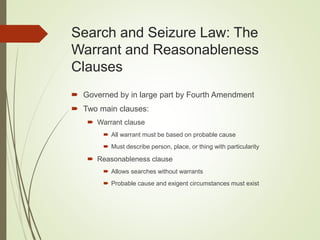
Search and Seizure Law: The
Warrant and Reasonableness
Clauses
 Governed by in large part by Fourth Amendment
 Two main clauses:
 Warrant clause
 All warrant must be based on probable cause
 Must describe person, place, or thing with particularity
 Reasonableness clause
 Allows searches without warrants
 Probable cause and exigent circumstances must exist
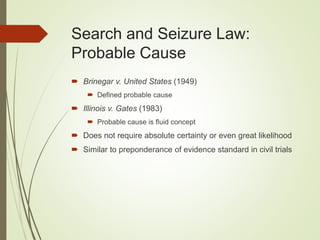
Search and Seizure Law:
Probable Cause
 Brinegar v. United States (1949)
 Defined probable cause
 Illinois v. Gates (1983)
 Probable cause is fluid concept
 Does not require absolute certainty or even great likelihood
 Similar to preponderance of evidence standard in civil trials
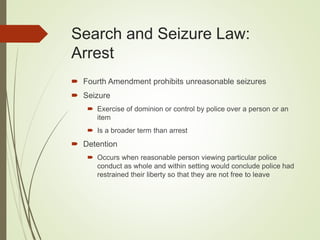
Search and Seizure Law:
Arrest
 Fourth Amendment prohibits unreasonable seizures
 Seizure
 Exercise of dominion or control by police over a person or an
item
 Is a broader term than arrest
 Detention
 Occurs when reasonable person viewing particular police
conduct as whole and within setting would conclude police had
restrained their liberty so that they are not free to leave
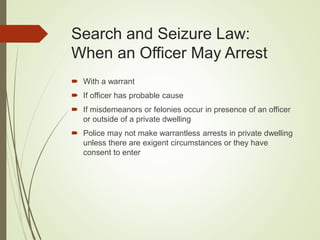
Search and Seizure Law:
When an Officer May Arrest
 With a warrant
 If officer has probable cause
 If misdemeanors or felonies occur in presence of an officer
or outside of a private dwelling
 Police may not make warrantless arrests in private dwelling
unless there are exigent circumstances or they have
consent to enter
Search and Seizure Law:
Manner of Arrest
 May use whatever force is reasonable under circumstances
 Deadly force permitted only when necessary to protect life
 Knock and announce
 Must announce presence and purpose
 Give occupant reasonable time to open door
 Rule may be ignored in certain circumstances
Search and Seizure Law:
Types of Seizures
 May ask questions of anyone in public—not an arrest or
seizure
 Citizens may ignore or walk away—does not constitute
probable cause
 “Seizure tantamount of arrest”
 Requires more than mere suspicion, but not probable cause
 Traffic stops
 Stop and frisks on street
Search and Seizure Law: Stop
and Frisk
 Terry v. Ohio (1968)
 Requires reasonable suspicion based on experience
 Less demanding than probable cause
 Stop
 Must be temporary and no longer than necessary under
circumstances
 Frisk
 If stop does not allay officer fears
 Pat-down of outer clothing
 Officer may not manipulate items felt to discern what they are
Search and Seizure Law:
Vehicle Stops
 Seizure occurs whenever a vehicle is stopped
 Must have at least reasonable suspicion
 Except certain roadblocks
 May ask driver and passengers to exit
 May request documentation such as VIN and ask other
questions
 May seek consent searches
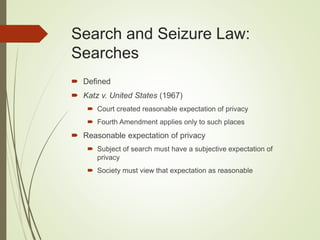
Search and Seizure Law:
Searches
 Defined
 Katz v. United States (1967)
 Court created reasonable expectation of privacy
 Fourth Amendment applies only to such places
 Reasonable expectation of privacy
 Subject of search must have a subjective expectation of
privacy
 Society must view that expectation as reasonable
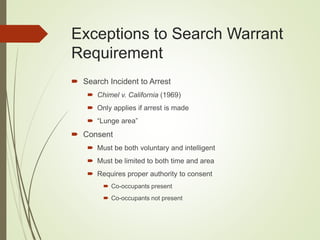
Exceptions to Search Warrant
Requirement
 Search Incident to Arrest
 Chimel v. California (1969)
 Only applies if arrest is made
 “Lunge area”
 Consent
 Must be both voluntary and intelligent
 Must be limited to both time and area
 Requires proper authority to consent
 Co-occupants present
 Co-occupants not present
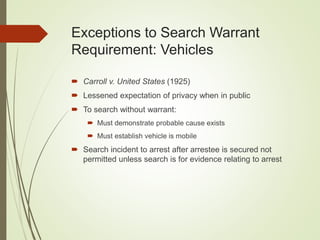
Exceptions to Search Warrant
Requirement: Vehicles
 Carroll v. United States (1925)
 Lessened expectation of privacy when in public
 To search without warrant:
 Must demonstrate probable cause exists
 Must establish vehicle is mobile
 Search incident to arrest after arrestee is secured not
permitted unless search is for evidence relating to arrest
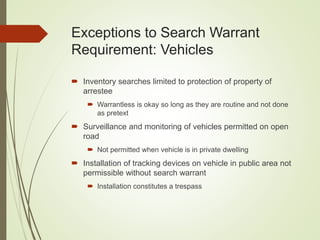
Exceptions to Search Warrant
Requirement: Vehicles
 Inventory searches limited to protection of property of
arrestee
 Warrantless is okay so long as they are routine and not done
as pretext
 Surveillance and monitoring of vehicles permitted on open
road
 Not permitted when vehicle is in private dwelling
 Installation of tracking devices on vehicle in public area not
permissible without search warrant
 Installation constitutes a trespass
Exceptions to Search Warrant
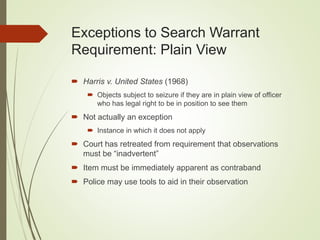
Requirement: Plain View
 Harris v. United States (1968)
 Objects subject to seizure if they are in plain view of officer
who has legal right to be in position to see them
 Not actually an exception
 Instance in which it does not apply
 Court has retreated from requirement that observations
must be “inadvertent”
 Item must be immediately apparent as contraband
 Police may use tools to aid in their observation
Exceptions to Search Warrant
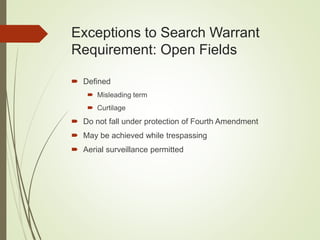
Requirement: Open Fields
 Defined
 Misleading term
 Curtilage
 Do not fall under protection of Fourth Amendment
 May be achieved while trespassing
 Aerial surveillance permitted
Exceptions to Search Warrant
Requirement
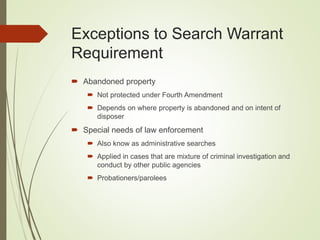
 Abandoned property
 Not protected under Fourth Amendment
 Depends on where property is abandoned and on intent of
disposer
 Special needs of law enforcement
 Also know as administrative searches
 Applied in cases that are mixture of criminal investigation and
conduct by other public agencies
 Probationers/parolees
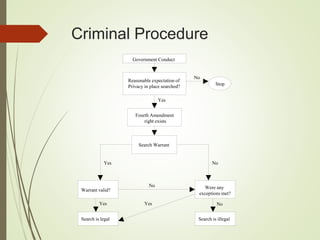
Criminal Procedure
NoYes
No
Yes
NoYes
Reasonable expectation of
Privacy in place searched? Stop
p
Fourth Amendment
right exists
Search Warrant
Government Conduct
Warrant valid?
Were any
exceptions met?
Search is legal Search is illegal
Yes
No
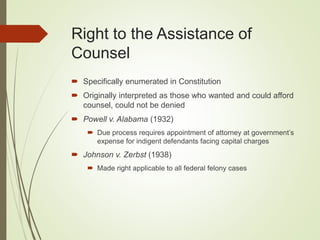
Right to the Assistance of
Counsel
 Specifically enumerated in Constitution
 Originally interpreted as those who wanted and could afford
counsel, could not be denied
 Powell v. Alabama (1932)
 Due process requires appointment of attorney at government’s
expense for indigent defendants facing capital charges
 Johnson v. Zerbst (1938)
 Made right applicable to all federal felony cases
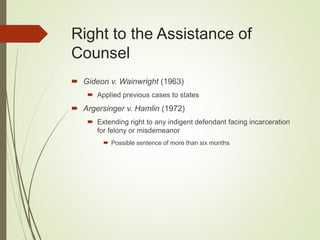
Right to the Assistance of
Counsel
 Gideon v. Wainwright (1963)
 Applied previous cases to states
 Argersinger v. Hamlin (1972)
 Extending right to any indigent defendant facing incarceration
for felony or misdemeanor
 Possible sentence of more than six months
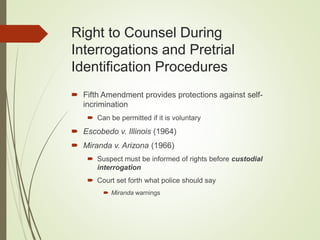
Right to Counsel During
Interrogations and Pretrial
Identification Procedures
 Fifth Amendment provides protections against self-
incrimination
 Can be permitted if it is voluntary
 Escobedo v. Illinois (1964)
 Miranda v. Arizona (1966)
 Suspect must be informed of rights before custodial
interrogation
 Court set forth what police should say
 Miranda warnings
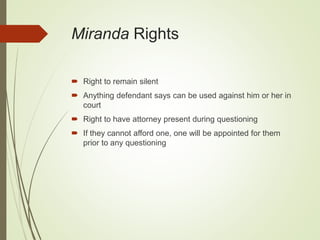
Miranda Rights
 Right to remain silent
 Anything defendant says can be used against him or her in
court
 Right to have attorney present during questioning
 If they cannot afford one, one will be appointed for them
prior to any questioning
When Miranda Applies
 Custody
 When suspect has been subject to formal arrest or equivalent
restraints on freedom of movement
 Free to leave test
 Interrogation
 Police ask questions the answers to which may incriminate
 In circumstances in which police, through actions, create
“functional equivalent” of interrogation
 Engage in activity they “should have known is reasonably likely to
evoke an incriminating response from suspect”
When Miranda is NOT
Required
 Routine traffic stops
 Sobriety check points
 Conversations between two officers in vicinity of suspect
 Voluntary statements without prompting
 Routine questioning of persons at crime scene
 Clarifying questions
 Questions that are part of stop and frisk
 Threat to public safety
Extensions and Application of
Miranda
 After Fifth Amendment evoked:
 Police cannot question more unless suspect initiates
communication
 Suspect cannot be questioned about other crimes unrelated to
current offense
 Police need not let suspect know lawyer is waiting if
acquired by family member
 Police posing as inmate
Extensions and Application of
Miranda
 Requesting lawyer at bail hearing not considered invocation
of right to counsel
 Charges have not been filed yet
 If police obtain voluntary, but unwarned confession, they
can remedy any confusion if they give proper Miranda
warnings and obtain waiver of rights and then re-obtain
confession
 Suspect does not need to know initial confession was
inadmissible
Extensions and Application of
Miranda
 Illegally obtained confession may be admitted at trial to
impeach defendant’s testimony
 Must sole be used to impeach testimony
 Miranda rights may be waived
 Knowingly
 Intelligently
 Voluntarily
Pretrial Identification
Procedures
 Suspect has right to counsel at lineup if it occurs after
criminal charges have been filed
 Constitutes critical stage in prosecution
 Potential for prejudicial error
 No right if lineup takes place prior to charges being filed
The Confrontation of Witnesses
Clause
 Affords defense opportunity to test credibility of hostile
witnesses
 Prevents ex parte evidence
 Pointer v. Texas (1965)
 Made confrontation clause obligatory to states
 Crawford v. Washington (2004)
 Statements of absent witnesses may be admitted only when
witness is unavailable or if defense had prior opportunity to
cross-examine
 Unavailable-Witness demonstrably unable to testify in person
 Does not guarantee right to face-to-face confrontation
The Right to Compulsory
Process Clause
 Defendants have right to compel favorable witnesses to
appear in court to testify on their behalf
 Must show proposed witnesses’ testimony and/or evidence
is relevant and that such testimony would not be cumulative
 Washington v. Texas (1967)
 Made compulsory process applicable to states
 Co-defendant’s testimony not sufficient for use by defense
 Only prosecution
The Exclusionary Rule
 Any evidence obtained by government in violation of Fourth
Amendment guarantee against unreasonable searches and
seizures is not admissible in criminal trial for purposes of
proving guilt
 Judicially created remedy for violations
Advancing Toward the
Exclusionary Rule
 Boyd v. United States (1886)
 Adams v. New York (1904)
 Weeks v. United States (1914)
 Birth of exclusionary rule
 Only applied to federal government
 Led to issue of silver platter doctrine
 Nardone v. United States (1939)
Advancing Toward the
Exclusionary Rule
 Wolf v. Colorado (1949)
 Applied exclusionary rule to states
 Left enforcement up to states
 Mapp v. Ohio (1961)
 Fully applied exclusionary rule to states
 State failed to provide adequate remedies for violations
committed by state police
Curtailing the Exclusionary
Rule
 Court has held rule does not in civil and grand jury
investigation
 Number of lower courts have concluded rule does not apply
to probation and parole revocation hearings
 Illegally obtained evidence can be used in criminal trial for
purposes of impeaching defendant’s testimony
Curtailing the Exclusionary
Rule
 Rakas v. Illinois (1978)
 To claim Fourth Amendment protection, defendant must have
standing
 Person has right to bring legal action by virtue of being
personally harmed
 Independent source exception
 Evidence may be admitted if knowledge of that evidence is
gained from source entirely independent from source tainted
by illegality
Curtailing the Exclusionary
Rule
 Attenuation exception
 Illegally obtained evidence admissible if there is less than clear
causal connection between illegal police action and evidence
 United States v. Leon (1984)
 Good faith exception
 Nix v. Williams (1984)
 Inevitable discovery exception

Chapter 6 power point

  • 1.
  • 2.
    Criminal Procedure and Purpose Sets forth appropriate behavior for agents of state if they deprive individual of their liberty  Derived from due process clause of Fifth and Fourteenth Amendments  Tremendously important legal concept  Procedural law is pendulum between due process and crime control models  Procedural law attempts to balance goals of these two models
  • 3.
    Sources of CriminalProcedure Law  U.S. Constitution  Bill of Rights  Particularly Fourth, Fifth, and Sixth Amendments  Fourteenth Amendment  State Constitution  Federal and state statutes  Supreme Court decisions
  • 4.
    Search and SeizureLaw: The Warrant and Reasonableness Clauses  Governed by in large part by Fourth Amendment  Two main clauses:  Warrant clause  All warrant must be based on probable cause  Must describe person, place, or thing with particularity  Reasonableness clause  Allows searches without warrants  Probable cause and exigent circumstances must exist
  • 5.
    Search and SeizureLaw: Probable Cause  Brinegar v. United States (1949)  Defined probable cause  Illinois v. Gates (1983)  Probable cause is fluid concept  Does not require absolute certainty or even great likelihood  Similar to preponderance of evidence standard in civil trials
  • 6.
    Search and SeizureLaw: Arrest  Fourth Amendment prohibits unreasonable seizures  Seizure  Exercise of dominion or control by police over a person or an item  Is a broader term than arrest  Detention  Occurs when reasonable person viewing particular police conduct as whole and within setting would conclude police had restrained their liberty so that they are not free to leave
  • 7.
    Search and SeizureLaw: When an Officer May Arrest  With a warrant  If officer has probable cause  If misdemeanors or felonies occur in presence of an officer or outside of a private dwelling  Police may not make warrantless arrests in private dwelling unless there are exigent circumstances or they have consent to enter
  • 8.
    Search and SeizureLaw: Manner of Arrest  May use whatever force is reasonable under circumstances  Deadly force permitted only when necessary to protect life  Knock and announce  Must announce presence and purpose  Give occupant reasonable time to open door  Rule may be ignored in certain circumstances
  • 9.
    Search and SeizureLaw: Types of Seizures  May ask questions of anyone in public—not an arrest or seizure  Citizens may ignore or walk away—does not constitute probable cause  “Seizure tantamount of arrest”  Requires more than mere suspicion, but not probable cause  Traffic stops  Stop and frisks on street
  • 10.
    Search and SeizureLaw: Stop and Frisk  Terry v. Ohio (1968)  Requires reasonable suspicion based on experience  Less demanding than probable cause  Stop  Must be temporary and no longer than necessary under circumstances  Frisk  If stop does not allay officer fears  Pat-down of outer clothing  Officer may not manipulate items felt to discern what they are
  • 11.
    Search and SeizureLaw: Vehicle Stops  Seizure occurs whenever a vehicle is stopped  Must have at least reasonable suspicion  Except certain roadblocks  May ask driver and passengers to exit  May request documentation such as VIN and ask other questions  May seek consent searches
  • 12.
    Search and SeizureLaw: Searches  Defined  Katz v. United States (1967)  Court created reasonable expectation of privacy  Fourth Amendment applies only to such places  Reasonable expectation of privacy  Subject of search must have a subjective expectation of privacy  Society must view that expectation as reasonable
  • 13.
    Exceptions to SearchWarrant Requirement  Search Incident to Arrest  Chimel v. California (1969)  Only applies if arrest is made  “Lunge area”  Consent  Must be both voluntary and intelligent  Must be limited to both time and area  Requires proper authority to consent  Co-occupants present  Co-occupants not present
  • 14.
    Exceptions to SearchWarrant Requirement: Vehicles  Carroll v. United States (1925)  Lessened expectation of privacy when in public  To search without warrant:  Must demonstrate probable cause exists  Must establish vehicle is mobile  Search incident to arrest after arrestee is secured not permitted unless search is for evidence relating to arrest
  • 15.
    Exceptions to SearchWarrant Requirement: Vehicles  Inventory searches limited to protection of property of arrestee  Warrantless is okay so long as they are routine and not done as pretext  Surveillance and monitoring of vehicles permitted on open road  Not permitted when vehicle is in private dwelling  Installation of tracking devices on vehicle in public area not permissible without search warrant  Installation constitutes a trespass
  • 16.
    Exceptions to SearchWarrant Requirement: Plain View  Harris v. United States (1968)  Objects subject to seizure if they are in plain view of officer who has legal right to be in position to see them  Not actually an exception  Instance in which it does not apply  Court has retreated from requirement that observations must be “inadvertent”  Item must be immediately apparent as contraband  Police may use tools to aid in their observation
  • 17.
    Exceptions to SearchWarrant Requirement: Open Fields  Defined  Misleading term  Curtilage  Do not fall under protection of Fourth Amendment  May be achieved while trespassing  Aerial surveillance permitted
  • 18.
    Exceptions to SearchWarrant Requirement  Abandoned property  Not protected under Fourth Amendment  Depends on where property is abandoned and on intent of disposer  Special needs of law enforcement  Also know as administrative searches  Applied in cases that are mixture of criminal investigation and conduct by other public agencies  Probationers/parolees
  • 19.
    Criminal Procedure NoYes No Yes NoYes Reasonable expectationof Privacy in place searched? Stop p Fourth Amendment right exists Search Warrant Government Conduct Warrant valid? Were any exceptions met? Search is legal Search is illegal Yes No
  • 20.
    Right to theAssistance of Counsel  Specifically enumerated in Constitution  Originally interpreted as those who wanted and could afford counsel, could not be denied  Powell v. Alabama (1932)  Due process requires appointment of attorney at government’s expense for indigent defendants facing capital charges  Johnson v. Zerbst (1938)  Made right applicable to all federal felony cases
  • 21.
    Right to theAssistance of Counsel  Gideon v. Wainwright (1963)  Applied previous cases to states  Argersinger v. Hamlin (1972)  Extending right to any indigent defendant facing incarceration for felony or misdemeanor  Possible sentence of more than six months
  • 22.
    Right to CounselDuring Interrogations and Pretrial Identification Procedures  Fifth Amendment provides protections against self- incrimination  Can be permitted if it is voluntary  Escobedo v. Illinois (1964)  Miranda v. Arizona (1966)  Suspect must be informed of rights before custodial interrogation  Court set forth what police should say  Miranda warnings
  • 23.
    Miranda Rights  Rightto remain silent  Anything defendant says can be used against him or her in court  Right to have attorney present during questioning  If they cannot afford one, one will be appointed for them prior to any questioning
  • 24.
    When Miranda Applies Custody  When suspect has been subject to formal arrest or equivalent restraints on freedom of movement  Free to leave test  Interrogation  Police ask questions the answers to which may incriminate  In circumstances in which police, through actions, create “functional equivalent” of interrogation  Engage in activity they “should have known is reasonably likely to evoke an incriminating response from suspect”
  • 25.
    When Miranda isNOT Required  Routine traffic stops  Sobriety check points  Conversations between two officers in vicinity of suspect  Voluntary statements without prompting  Routine questioning of persons at crime scene  Clarifying questions  Questions that are part of stop and frisk  Threat to public safety
  • 26.
    Extensions and Applicationof Miranda  After Fifth Amendment evoked:  Police cannot question more unless suspect initiates communication  Suspect cannot be questioned about other crimes unrelated to current offense  Police need not let suspect know lawyer is waiting if acquired by family member  Police posing as inmate
  • 27.
    Extensions and Applicationof Miranda  Requesting lawyer at bail hearing not considered invocation of right to counsel  Charges have not been filed yet  If police obtain voluntary, but unwarned confession, they can remedy any confusion if they give proper Miranda warnings and obtain waiver of rights and then re-obtain confession  Suspect does not need to know initial confession was inadmissible
  • 28.
    Extensions and Applicationof Miranda  Illegally obtained confession may be admitted at trial to impeach defendant’s testimony  Must sole be used to impeach testimony  Miranda rights may be waived  Knowingly  Intelligently  Voluntarily
  • 29.
    Pretrial Identification Procedures  Suspecthas right to counsel at lineup if it occurs after criminal charges have been filed  Constitutes critical stage in prosecution  Potential for prejudicial error  No right if lineup takes place prior to charges being filed
  • 30.
    The Confrontation ofWitnesses Clause  Affords defense opportunity to test credibility of hostile witnesses  Prevents ex parte evidence  Pointer v. Texas (1965)  Made confrontation clause obligatory to states  Crawford v. Washington (2004)  Statements of absent witnesses may be admitted only when witness is unavailable or if defense had prior opportunity to cross-examine  Unavailable-Witness demonstrably unable to testify in person  Does not guarantee right to face-to-face confrontation
  • 31.
    The Right toCompulsory Process Clause  Defendants have right to compel favorable witnesses to appear in court to testify on their behalf  Must show proposed witnesses’ testimony and/or evidence is relevant and that such testimony would not be cumulative  Washington v. Texas (1967)  Made compulsory process applicable to states  Co-defendant’s testimony not sufficient for use by defense  Only prosecution
  • 32.
    The Exclusionary Rule Any evidence obtained by government in violation of Fourth Amendment guarantee against unreasonable searches and seizures is not admissible in criminal trial for purposes of proving guilt  Judicially created remedy for violations
  • 33.
    Advancing Toward the ExclusionaryRule  Boyd v. United States (1886)  Adams v. New York (1904)  Weeks v. United States (1914)  Birth of exclusionary rule  Only applied to federal government  Led to issue of silver platter doctrine  Nardone v. United States (1939)
  • 34.
    Advancing Toward the ExclusionaryRule  Wolf v. Colorado (1949)  Applied exclusionary rule to states  Left enforcement up to states  Mapp v. Ohio (1961)  Fully applied exclusionary rule to states  State failed to provide adequate remedies for violations committed by state police
  • 35.
    Curtailing the Exclusionary Rule Court has held rule does not in civil and grand jury investigation  Number of lower courts have concluded rule does not apply to probation and parole revocation hearings  Illegally obtained evidence can be used in criminal trial for purposes of impeaching defendant’s testimony
  • 36.
    Curtailing the Exclusionary Rule Rakas v. Illinois (1978)  To claim Fourth Amendment protection, defendant must have standing  Person has right to bring legal action by virtue of being personally harmed  Independent source exception  Evidence may be admitted if knowledge of that evidence is gained from source entirely independent from source tainted by illegality
  • 37.
    Curtailing the Exclusionary Rule Attenuation exception  Illegally obtained evidence admissible if there is less than clear causal connection between illegal police action and evidence  United States v. Leon (1984)  Good faith exception  Nix v. Williams (1984)  Inevitable discovery exception