CORPORATE RESTRUCTURING
1
CHAPTER 5
2
Corporate restructuring is any change in a
company’s:
1. Capital structure,
2. Operations, or
3. Ownership that is outside its
ordinary course of business.
Introduction
Introduction(Cont’d…)
3
 Restructuring takes place at different levels. At the level of the whole
economy, it is a long-term response to
 market trends,
 technological change, and
 macroeconomic policies
 At the sector level, restructuring causes change in the production
structure and new arrangements across enterprises.
 At the enterprise level, firms restructure through new business
strategies and internal reorganization in order to adapt to new
market requirements.
Introduction(Cont’d…)
4
 Purpose of Restructuring :-The major purpose
of restructuring can be:
 Expansion
 Contraction
 Buy out
 Corporations can grow and expand by:
 Organic growth
 Mergers and Acquisition
 Consolidation.
 Purchase of another corporation’s assets.
 Purchases of a controlling interest in another corporation.
Merger
5
 A merger is a combination of two corporations in which
only one corporation survives and the merged
corporation goes out of existence.
 In a merger, the acquiring company assumes the assets
and liabilities of the merged company.
 Sometimes the term statutory merger is used to refer to
this type of business transaction.
 It basically means that the merger is being done
consistent with a specific state statute.
Merger Vs. Consolidation
6
 A merger differs from a consolidation, which is a
business combination whereby two or more companies
join to form an entirely new company.
 All of the combining companies are dissolved and only
the new entity continues to operate.
 That is
 In a merger, A + B = A , where company B is merged into company
A.
 In a consolidation, A + B = C, where C is an entirely new company.
Merger
7
 Legal combination of two or
more corporations (A & B)
after which only A corporation
remains. A’s articles of
incorporation are amended to
include articles of merger.
 After merger, A continues as
the surviving corporation with
all of B’s rights and
obligations.
A
A B
B
A
A
Consolidation
8
 Occurs when two or more
corporations (A & B) combine such
that both cease to exist and a new
corporation emerges which has all
the rights and obligations
previously held by A and B.
 C’s articles of consolidation take
the place of the original articles of
A and B.
A
A B
B
C
C
Types of Merger
9
1. Horizontal Merger
2. Vertical Merger
3. Conglomerate Merger
4. Congeneric
5. Reverse Merger
1. Horizontal Merger
10
 Horizontal merger involves combinations of two
firms in the same line of business and operate in the
same industry.
 However, if a horizontal merger causes the
combined firm to experience an increase in market
power that will have anticompetitive effects, the
merger may be opposed on antitrust grounds.
2. Vertical Merger
11
 A vertical merger involves companies at
different stages of production.
 The buyer expands back toward the source of
raw materials or forward in the direction of the
ultimate consumer.
 This merger happens when the merged
companies have buyer – seller relationships.
3. Conglomerate Merger
12
 A conglomerate merger involves companies in unrelated lines
of businesses.
 In pure conglomerate, there are no common factors between
companies in production, marketing, research and
development, and technologies.
 There may, however, some degree of overlapping in one or
more of these common factors. The purpose of merger
remains utilization of financial resources, enlarged debt
capacity, and synergy of managerial functions.
4. Co generic Merger
13
 within the same industries and taking place at the same level of
economic activity
 In co generic merger, the acquirer and the target
companies are related through basic technologies,
production processes or markets.
 The acquired company represents an extension of
product-line, market participants or technologies of
an acquirer.
 These mergers represent an outward movement by acquirer from its
current business scenario to other business activities within
overarching business industry.
5. Reverse Merger
14
 Reverse merger involves the acquisition of public
companies by private company, as it helps the private
company to by-pass lengthy and complex process
required to be followed in case it is interested to go
public.
 Merger of a healthy company with a financially weak
company
Motives for Merger
15
 A preliminary analysis of the motivations behind mergers and
acquisitions reveals that M&A operations are corporate
strategies intended to:
 achieve rapid corporate expansion,
 penetrate new markets,
 rationalize production,
 attain economy of scale and
 Synergies through Consolidation
 Diversification of risk
 replace inefficient managers, among others.
Takeovers
16
 Alternative to merger or consolidation is the
purchase of a controlling interest (e.g.,
51%) of a “target” corporation’s stock
giving the purchaser corporation
controlling interest in the target.
 The aggressor deal entirely with the target’s
shareholders.
Takeovers…Con’d
17
 This term is vague; sometimes it refers only to
hostile transactions, and other times it refers to both
friendly and unfriendly mergers.
 Types of Takeovers:
 Friendly Takeovers
 Hostile Takeovers
 Reverse Takeovers
 Backflip Takeovers
Friendly takeovers
18
 It is an acquisition which is approved by the
management.
 Before a bidder makes an offer for another company, it
usually first informs the company's board of directors.
 In an ideal world, if the board feels that accepting the
offer serves the shareholders better than rejecting it, it
recommends the offer be accepted by the shareholders.
Hostile takeovers
19
A "hostile takeover" allows a bidder to take over a
target company whose management is unwilling to
agree to a merger or takeover.
A takeover is considered "hostile" if the target
company's board rejects the offer, but the bidder
continues to pursue it, or the bidder makes the offer
directly after having announced its firm intention to
make an offer.
Reverse takeovers
20
A "reverse takeover" is a type of takeover where a
private company acquires a public company.
This is usually done at the instigation of the larger,
private company, the purpose being for the
private company to effectively float itself while
avoiding some of the expense and time involved in
a conventional IPO.
Backflip takeovers
21
A "backflip takeover" is any sort of takeover in
which the acquiring company turns itself into a
subsidiary of the purchased company.
This type of takeover can occur when a larger but
less well-known company purchases a struggling
company with a very well-known brand.
Takeovers: Tender Offers
22
 A tender offer is a publicly advertised offer
addressed to all shareholders of the target.
 A tender offer is usually higher than market
value per share but conditioned on the
acquisition of a certain % of shares.
 Can be in exchange for aggressor's stock.
 SEC strictly regulates tender offers.
Defensive Tactics of Takeover
23
Term Definition
Crown Jewel Management makes company less attractive by selling
company’s most valuable asset (crown jewel).
Poison Pill Board of directors gives other shareholders the right to buy
more shares at a discount if once one share owner crosses a
specific ownership threshold(say 20%) of the company's
shares.
Greenmail To regain control, target company may pay higher-than-
market price to repurchase the stock.
Scorched Earth Target company sells off assets or divisions or takes out
loans to make it unattractive to hostile takeover.
White Knight Target corporation solicits merger with 3rd
party which is a
better match. 3rd
party “rescues” the target.
Takeover Tactics
24
 Exchange Tender Offer
 Offering corporation offers target shareholders its own
securities in exchange for target stock.
 Cash Tender Offer
 Cash in exchange for target stock.
 Self-Tender
 Target company offers to buy stock from its own
shareholders to retain control.
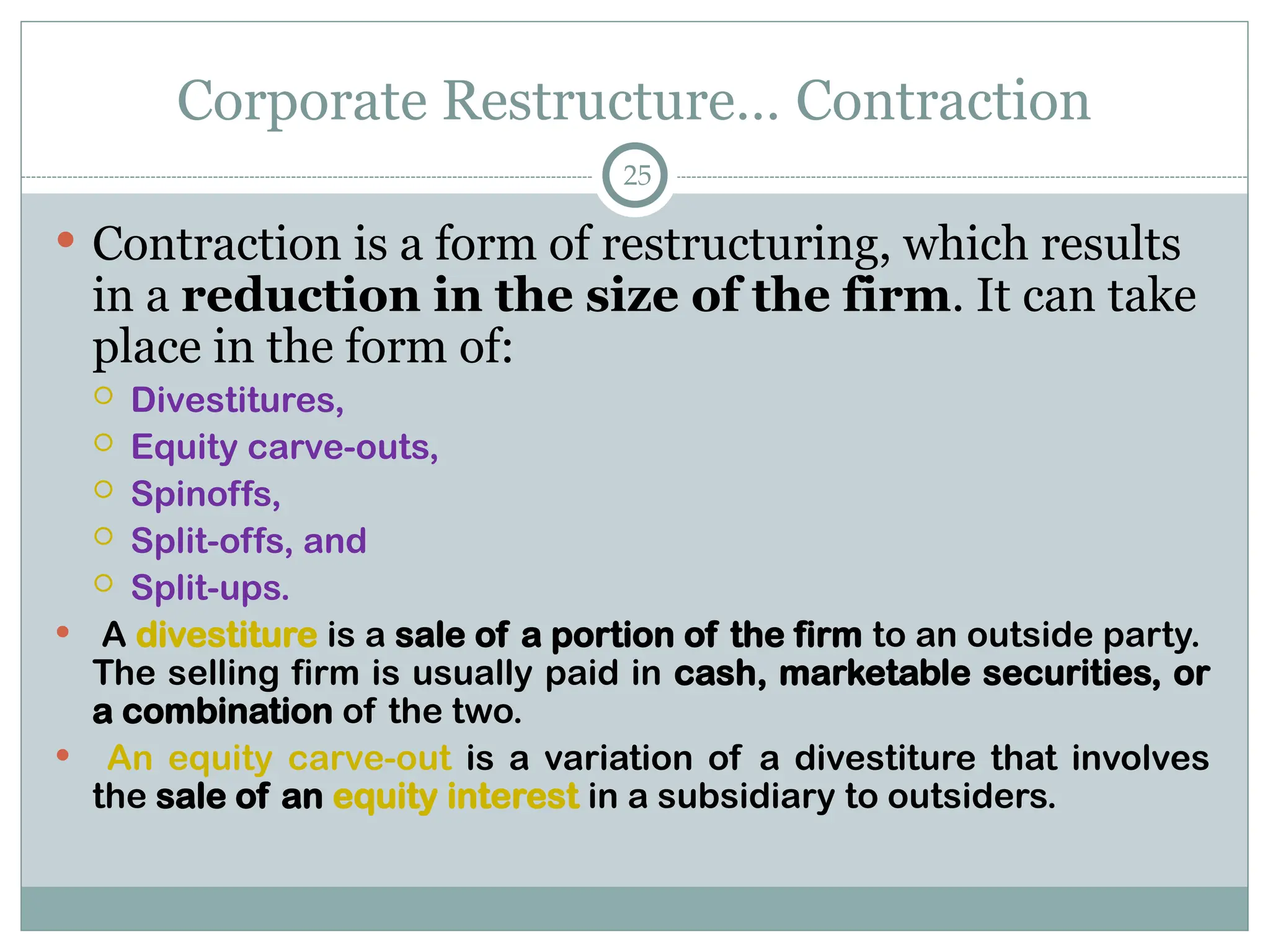
Corporate Restructure… Contraction
25
 Contraction is a form of restructuring, which results
in a reduction in the size of the firm. It can take
place in the form of:
 Divestitures,
 Equity carve-outs,
 Spinoffs,
 Split-offs, and
 Split-ups.
 A divestiture is a sale of a portion of the firm to an outside party.
The selling firm is usually paid in cash, marketable securities, or
a combination of the two.
 An equity carve-out is a variation of a divestiture that involves
the sale of an equity interest in a subsidiary to outsiders.
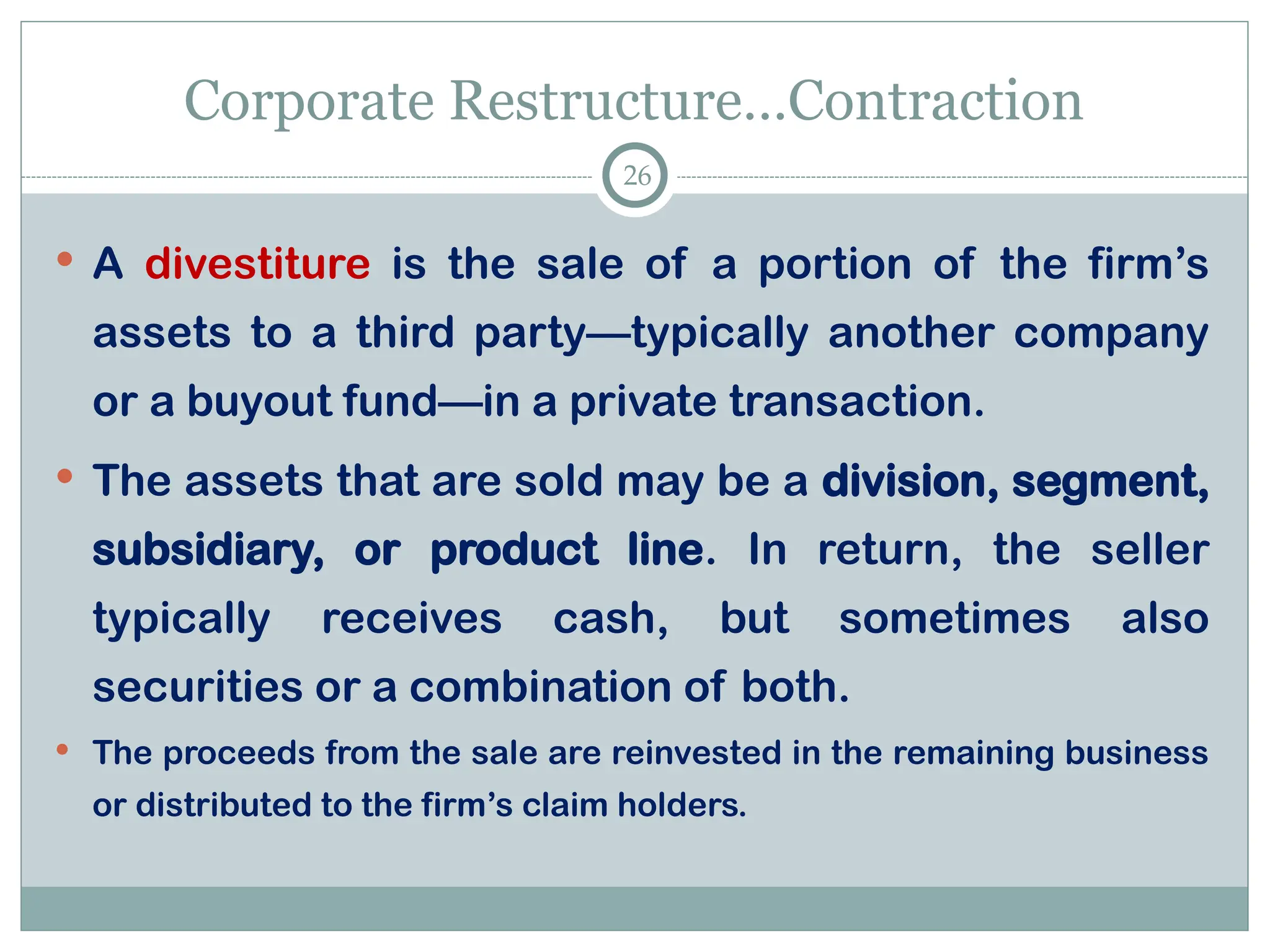
Corporate Restructure…Contraction
26
 A divestiture is the sale of a portion of the firm’s
assets to a third party—typically another company
or a buyout fund—in a private transaction.
 The assets that are sold may be a division, segment,
subsidiary, or product line. In return, the seller
typically receives cash, but sometimes also
securities or a combination of both.
 The proceeds from the sale are reinvested in the remaining business
or distributed to the firm’s claim holders.
Corporate Restructure…contraction
27
 In a spin-off, a public company distributes its
equity ownership in a subsidiary to its
shareholders.
 The distribution is a pro-rata dividend and parents’
shareholders receive subsidiary stock in
proportion to their ownership in the parent firm.
 The spinoff involves a complete separation of the
two firms.
Corporate Restructure…contraction
28
 In a split-up, the entire firm is broken up into a series of
spin-off.
 The end result of this process is that the parent
company no longer exists, leaving only the newly formed
companies.
 The stockholders in the companies may be different
because stockholders exchange their shares in the
parent company for shares in one or more of the units
that are spun off.
Corporate Restructure…contraction
29
 A split-off is similar to a spinoff in that the subsidiary
becomes an independent company with a separate stock
listing.
 The split off, however, involves an exchange offer, where
shareholders are offered to exchange parent company
stock for subsidiary stock.
 Thus, the split off effectively resembles a stock repurchase, where the
parent company buys back its own shares using subsidiary stock as
consideration.
LEVERAGED BUYOUT(LBO)
30
 A LEVERAGED BUYOUT is the process by which
a group (usually a management group) borrows
heavily to take a firm private.
 That is, the shares are repurchased from the
stockholders where the purchase is financed through
heavy debt.
The purpose of LBO
31
The buyout improves operating efficiency through
Reducing inefficient use of Free Cash Flow
Provide additional incentives for management
through higher ownership share and the necessity to
make high debt coverage.
 Increased after tax cash flow due to tax benefits
32
Thank You!!!

Chapter Five corporate restructuring.ppt

  • 1.
  • 2.
    2 Corporate restructuring isany change in a company’s: 1. Capital structure, 2. Operations, or 3. Ownership that is outside its ordinary course of business. Introduction
  • 3.
    Introduction(Cont’d…) 3  Restructuring takesplace at different levels. At the level of the whole economy, it is a long-term response to  market trends,  technological change, and  macroeconomic policies  At the sector level, restructuring causes change in the production structure and new arrangements across enterprises.  At the enterprise level, firms restructure through new business strategies and internal reorganization in order to adapt to new market requirements.
  • 4.
    Introduction(Cont’d…) 4  Purpose ofRestructuring :-The major purpose of restructuring can be:  Expansion  Contraction  Buy out  Corporations can grow and expand by:  Organic growth  Mergers and Acquisition  Consolidation.  Purchase of another corporation’s assets.  Purchases of a controlling interest in another corporation.
  • 5.
    Merger 5  A mergeris a combination of two corporations in which only one corporation survives and the merged corporation goes out of existence.  In a merger, the acquiring company assumes the assets and liabilities of the merged company.  Sometimes the term statutory merger is used to refer to this type of business transaction.  It basically means that the merger is being done consistent with a specific state statute.
  • 6.
    Merger Vs. Consolidation 6 A merger differs from a consolidation, which is a business combination whereby two or more companies join to form an entirely new company.  All of the combining companies are dissolved and only the new entity continues to operate.  That is  In a merger, A + B = A , where company B is merged into company A.  In a consolidation, A + B = C, where C is an entirely new company.
  • 7.
    Merger 7  Legal combinationof two or more corporations (A & B) after which only A corporation remains. A’s articles of incorporation are amended to include articles of merger.  After merger, A continues as the surviving corporation with all of B’s rights and obligations. A A B B A A
  • 8.
    Consolidation 8  Occurs whentwo or more corporations (A & B) combine such that both cease to exist and a new corporation emerges which has all the rights and obligations previously held by A and B.  C’s articles of consolidation take the place of the original articles of A and B. A A B B C C
  • 9.
    Types of Merger 9 1.Horizontal Merger 2. Vertical Merger 3. Conglomerate Merger 4. Congeneric 5. Reverse Merger
  • 10.
    1. Horizontal Merger 10 Horizontal merger involves combinations of two firms in the same line of business and operate in the same industry.  However, if a horizontal merger causes the combined firm to experience an increase in market power that will have anticompetitive effects, the merger may be opposed on antitrust grounds.
  • 11.
    2. Vertical Merger 11 A vertical merger involves companies at different stages of production.  The buyer expands back toward the source of raw materials or forward in the direction of the ultimate consumer.  This merger happens when the merged companies have buyer – seller relationships.
  • 12.
    3. Conglomerate Merger 12 A conglomerate merger involves companies in unrelated lines of businesses.  In pure conglomerate, there are no common factors between companies in production, marketing, research and development, and technologies.  There may, however, some degree of overlapping in one or more of these common factors. The purpose of merger remains utilization of financial resources, enlarged debt capacity, and synergy of managerial functions.
  • 13.
    4. Co genericMerger 13  within the same industries and taking place at the same level of economic activity  In co generic merger, the acquirer and the target companies are related through basic technologies, production processes or markets.  The acquired company represents an extension of product-line, market participants or technologies of an acquirer.  These mergers represent an outward movement by acquirer from its current business scenario to other business activities within overarching business industry.
  • 14.
    5. Reverse Merger 14 Reverse merger involves the acquisition of public companies by private company, as it helps the private company to by-pass lengthy and complex process required to be followed in case it is interested to go public.  Merger of a healthy company with a financially weak company
  • 15.
    Motives for Merger 15 A preliminary analysis of the motivations behind mergers and acquisitions reveals that M&A operations are corporate strategies intended to:  achieve rapid corporate expansion,  penetrate new markets,  rationalize production,  attain economy of scale and  Synergies through Consolidation  Diversification of risk  replace inefficient managers, among others.
  • 16.
    Takeovers 16  Alternative tomerger or consolidation is the purchase of a controlling interest (e.g., 51%) of a “target” corporation’s stock giving the purchaser corporation controlling interest in the target.  The aggressor deal entirely with the target’s shareholders.
  • 17.
    Takeovers…Con’d 17  This termis vague; sometimes it refers only to hostile transactions, and other times it refers to both friendly and unfriendly mergers.  Types of Takeovers:  Friendly Takeovers  Hostile Takeovers  Reverse Takeovers  Backflip Takeovers
  • 18.
    Friendly takeovers 18  Itis an acquisition which is approved by the management.  Before a bidder makes an offer for another company, it usually first informs the company's board of directors.  In an ideal world, if the board feels that accepting the offer serves the shareholders better than rejecting it, it recommends the offer be accepted by the shareholders.
  • 19.
    Hostile takeovers 19 A "hostiletakeover" allows a bidder to take over a target company whose management is unwilling to agree to a merger or takeover. A takeover is considered "hostile" if the target company's board rejects the offer, but the bidder continues to pursue it, or the bidder makes the offer directly after having announced its firm intention to make an offer.
  • 20.
    Reverse takeovers 20 A "reversetakeover" is a type of takeover where a private company acquires a public company. This is usually done at the instigation of the larger, private company, the purpose being for the private company to effectively float itself while avoiding some of the expense and time involved in a conventional IPO.
  • 21.
    Backflip takeovers 21 A "backfliptakeover" is any sort of takeover in which the acquiring company turns itself into a subsidiary of the purchased company. This type of takeover can occur when a larger but less well-known company purchases a struggling company with a very well-known brand.
  • 22.
    Takeovers: Tender Offers 22 A tender offer is a publicly advertised offer addressed to all shareholders of the target.  A tender offer is usually higher than market value per share but conditioned on the acquisition of a certain % of shares.  Can be in exchange for aggressor's stock.  SEC strictly regulates tender offers.
  • 23.
    Defensive Tactics ofTakeover 23 Term Definition Crown Jewel Management makes company less attractive by selling company’s most valuable asset (crown jewel). Poison Pill Board of directors gives other shareholders the right to buy more shares at a discount if once one share owner crosses a specific ownership threshold(say 20%) of the company's shares. Greenmail To regain control, target company may pay higher-than- market price to repurchase the stock. Scorched Earth Target company sells off assets or divisions or takes out loans to make it unattractive to hostile takeover. White Knight Target corporation solicits merger with 3rd party which is a better match. 3rd party “rescues” the target.
  • 24.
    Takeover Tactics 24  ExchangeTender Offer  Offering corporation offers target shareholders its own securities in exchange for target stock.  Cash Tender Offer  Cash in exchange for target stock.  Self-Tender  Target company offers to buy stock from its own shareholders to retain control.
  • 25.
    Corporate Restructure… Contraction 25 Contraction is a form of restructuring, which results in a reduction in the size of the firm. It can take place in the form of:  Divestitures,  Equity carve-outs,  Spinoffs,  Split-offs, and  Split-ups.  A divestiture is a sale of a portion of the firm to an outside party. The selling firm is usually paid in cash, marketable securities, or a combination of the two.  An equity carve-out is a variation of a divestiture that involves the sale of an equity interest in a subsidiary to outsiders.
  • 26.
    Corporate Restructure…Contraction 26  Adivestiture is the sale of a portion of the firm’s assets to a third party—typically another company or a buyout fund—in a private transaction.  The assets that are sold may be a division, segment, subsidiary, or product line. In return, the seller typically receives cash, but sometimes also securities or a combination of both.  The proceeds from the sale are reinvested in the remaining business or distributed to the firm’s claim holders.
  • 27.
    Corporate Restructure…contraction 27  Ina spin-off, a public company distributes its equity ownership in a subsidiary to its shareholders.  The distribution is a pro-rata dividend and parents’ shareholders receive subsidiary stock in proportion to their ownership in the parent firm.  The spinoff involves a complete separation of the two firms.
  • 28.
    Corporate Restructure…contraction 28  Ina split-up, the entire firm is broken up into a series of spin-off.  The end result of this process is that the parent company no longer exists, leaving only the newly formed companies.  The stockholders in the companies may be different because stockholders exchange their shares in the parent company for shares in one or more of the units that are spun off.
  • 29.
    Corporate Restructure…contraction 29  Asplit-off is similar to a spinoff in that the subsidiary becomes an independent company with a separate stock listing.  The split off, however, involves an exchange offer, where shareholders are offered to exchange parent company stock for subsidiary stock.  Thus, the split off effectively resembles a stock repurchase, where the parent company buys back its own shares using subsidiary stock as consideration.
  • 30.
    LEVERAGED BUYOUT(LBO) 30  ALEVERAGED BUYOUT is the process by which a group (usually a management group) borrows heavily to take a firm private.  That is, the shares are repurchased from the stockholders where the purchase is financed through heavy debt.
  • 31.
    The purpose ofLBO 31 The buyout improves operating efficiency through Reducing inefficient use of Free Cash Flow Provide additional incentives for management through higher ownership share and the necessity to make high debt coverage.  Increased after tax cash flow due to tax benefits
  • 32.

Editor's Notes

  • #7 A has all rights, privileges, and powers of itself and B A automatically acquires B’s property and assets A becomes liable for all of B’s debts and obligations A’s articles are deemed amended to include changes that are stated in the articles of merger