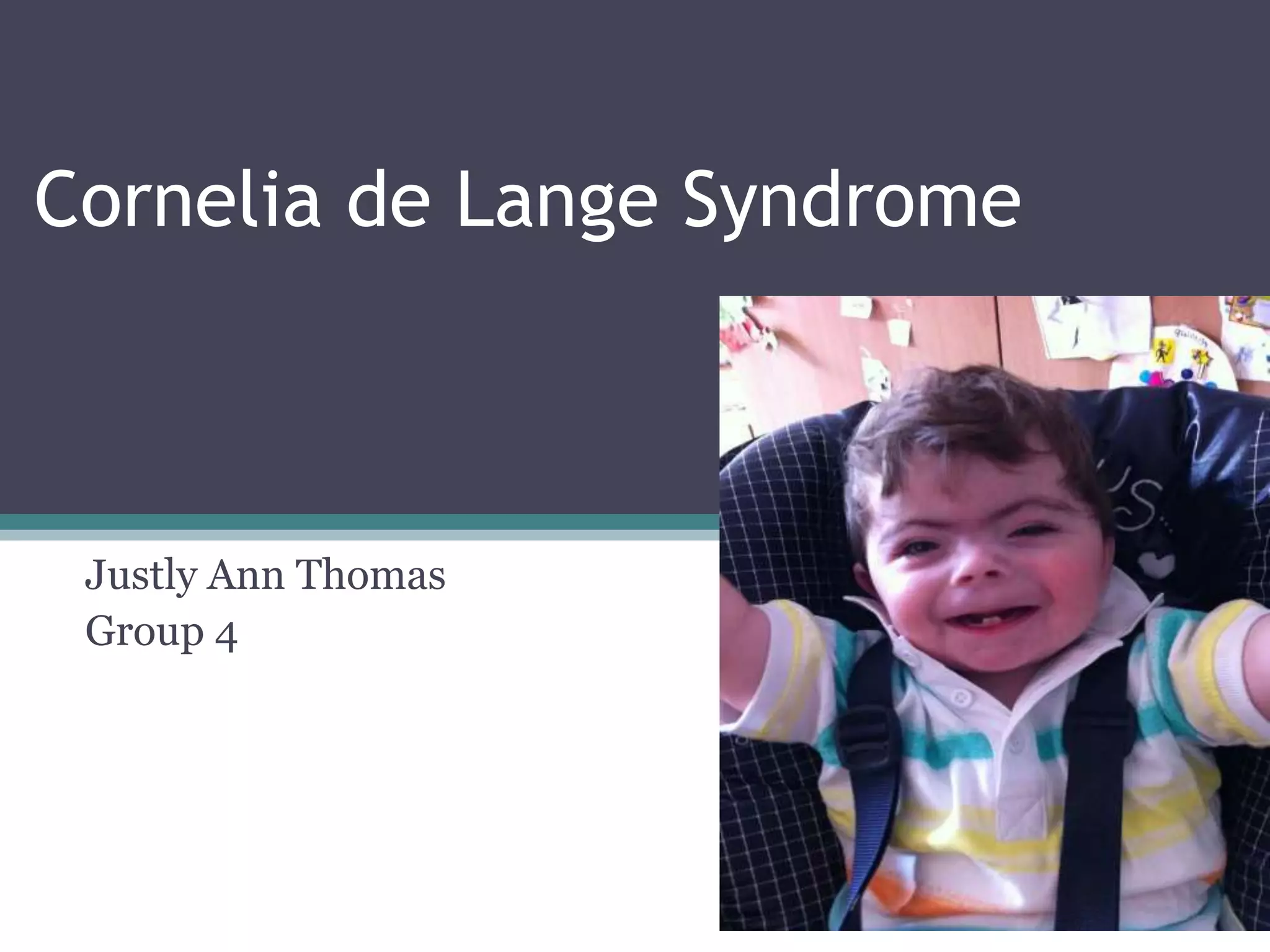
Cornelia de Lange Syndrome
Justly Ann Thomas
Group 4
Introduction
• Cornelia de Lange Syndrome (CdLS) is a GENETIC
DISORDER!
• It is a syndrome of multiple congenital anomalies
characterized by a distinctive facial appearance, prenatal
and postnatal growth deficiency, feeding difficulties,
psychomotor delay, behavioral problems, and associated
malformations that mainly involve the upper
extremities.
• The syndrome is named after Dutch pediatrician
Cornelia Catharina de Lange, who described it in 1933.
• It is often termed Brachmann de Lange syndrome or
Bushy syndrome and is also known as Amsterdam
dwarfism.
Epidemiology
Frequency
• The incidence is 1 case per 10,000-50,000 live births. No
differences based on sex or race have been described.
Mortality/Morbidity
• Gastrointestinal disease complications are one of the most
common causes of death in this syndrome. They include
diaphragmatic hernia in infancy and aspiration pneumonia
and volvulus at an older age.
• A retrospective review of 295 propositi with Cornelia de Lange
syndrome found that respiratory issues (eg, aspiration, reflux,
pneumonia) were the most common causes of death (31%),
followed by gastrointestinal disease, including
obstruction/volvulus (19%), congenital anomalies (15%).
Genetics
• NIPBL (5p13) accounts for the majority of CdLS cases
• SMC1A (Xp11) accounts for less than 5%
• SMC3 (10q25) is involved in rare cases
• All genes involved code for components of the cohesin
complex. Cohesin secures sister chromatids during cell
division
• NIPBL is particularly expressed in the upper extremities
and face, and mutation is associated w/ the classic CdLS
phenotype; SMC1A and SMC3 mutations are associated
w/ less severe CdLS phenotypes
• Due to sporadic mutations in almost all cases :
autosomal dominant
Clinical Features
General
• Microcephaly
• Short stature
• Feeding problems
• Cutis marmorta
Craniofacial
• Short neck
• Low posterior hairline
• Hypertrichosis
• Arched eyebrows,
synophrys
• Low set ears
• Long philthrum, thin
upper lip w/ downturned corners
• Cleft palate
• Widely spaced teeth
• Micrognathia
Extremities
• UEX malformations
• Small hands, feet
• Clinodactyly
• Disproportionately short thumbs, proximally placed
GI
• GERD
• Pyloric stenosis
• Congenital diaphragmatic hernia
Urogenital
• VUR
• Renal dysplasia
• Micropenis/ small labia majora
• Hypospadias
Neurological
• Seizures
• Sleep disturbances
• Myopia
• Hearing loss
Neurobehavioral
• Intellectual disability
• Self injurious behaviour
• ADHD
• Autistic features
Diagnosis
• Presumptive diagnosis can be made clinically,
based on the history and physical exam,
particularly the facial appearance
• Genetic testing can confirm the diagnosis (80%
cases are positive)
• Prenatally – ultrasound at 18 weeks
Imaging Studies
• Radiography may reveal the following:
• Delayed bone age (100%)
• Long-bone abnormalities,
• Hiatal hernia
• Aspiration pneumonia (50%)
• Gastroesophageal reflux (90%)
• Intestinal obstruction, malrotation, volvulus (17%)
• Ultrasonography at diagnosis to assess for kidney and
urinary tract abnormalities
• Echocardiography is indicated for evaluation of
congenital heart disease.
• Radiologic brain findings may include enlarged
ventricles, including thinning or atrophy of white matter,
particularly frontal lobes, with relative sparing of
parietal lobes; brainstem hypoplasia; and cerebellar
vermian hypoplasia or agenesis.
• Other tests - Hearing evaluation is recommended
Scoring System for Severity of CdLS
Parameter 1 point 2 point 3 point
Birth weight Above 2,500 g 2,000–2,500 g Below 2,000 g
Sitting alone < 9 mo 9–20 mo >20 mo
Walking alone < 18 mo 18–42 months >42 mo
Saying first
word
< 24 mo 24–48 mo >48 mo
Upper limb
malformation
No defect
Partial defect (<2
digits)
Severe defect (> 2
digits)
Number of
other major
malformations
0-1 2-3 >3
Hearing loss Absent ... ...
A score of less than 15 points indicates mild involvement, a score of 15-22
points indicates moderate involvement, and a score of more than 22
points indicates severe involvement.
Management
• Often, an interdisciplinary approach is recommended to treat
the issues associated with CdLS. A team for promoting the
child's well-being often includes speech, occupational and
physical therapists, teachers, physicians, and parents.
• Ongoing physical, occupational, and speech therapies
• Surgery to treat skeletal abnormalities, gastrointestinal
problems, congenital heart defects and other health problems
• Medications to prevent or control seizures.
• Research into CdLS ongoing
Cornelia de Lange Syndrome.pptx

Cornelia de Lange Syndrome.pptx

  • 1.
    Cornelia de LangeSyndrome Justly Ann Thomas Group 4
  • 2.
    Introduction • Cornelia deLange Syndrome (CdLS) is a GENETIC DISORDER! • It is a syndrome of multiple congenital anomalies characterized by a distinctive facial appearance, prenatal and postnatal growth deficiency, feeding difficulties, psychomotor delay, behavioral problems, and associated malformations that mainly involve the upper extremities. • The syndrome is named after Dutch pediatrician Cornelia Catharina de Lange, who described it in 1933. • It is often termed Brachmann de Lange syndrome or Bushy syndrome and is also known as Amsterdam dwarfism.
  • 3.
    Epidemiology Frequency • The incidenceis 1 case per 10,000-50,000 live births. No differences based on sex or race have been described. Mortality/Morbidity • Gastrointestinal disease complications are one of the most common causes of death in this syndrome. They include diaphragmatic hernia in infancy and aspiration pneumonia and volvulus at an older age. • A retrospective review of 295 propositi with Cornelia de Lange syndrome found that respiratory issues (eg, aspiration, reflux, pneumonia) were the most common causes of death (31%), followed by gastrointestinal disease, including obstruction/volvulus (19%), congenital anomalies (15%).
  • 4.
    Genetics • NIPBL (5p13)accounts for the majority of CdLS cases • SMC1A (Xp11) accounts for less than 5% • SMC3 (10q25) is involved in rare cases • All genes involved code for components of the cohesin complex. Cohesin secures sister chromatids during cell division • NIPBL is particularly expressed in the upper extremities and face, and mutation is associated w/ the classic CdLS phenotype; SMC1A and SMC3 mutations are associated w/ less severe CdLS phenotypes • Due to sporadic mutations in almost all cases : autosomal dominant
  • 5.
    Clinical Features General • Microcephaly •Short stature • Feeding problems • Cutis marmorta Craniofacial • Short neck • Low posterior hairline • Hypertrichosis • Arched eyebrows, synophrys • Low set ears • Long philthrum, thin upper lip w/ downturned corners • Cleft palate • Widely spaced teeth • Micrognathia
  • 6.
    Extremities • UEX malformations •Small hands, feet • Clinodactyly • Disproportionately short thumbs, proximally placed GI • GERD • Pyloric stenosis • Congenital diaphragmatic hernia Urogenital • VUR • Renal dysplasia • Micropenis/ small labia majora • Hypospadias
  • 7.
    Neurological • Seizures • Sleepdisturbances • Myopia • Hearing loss Neurobehavioral • Intellectual disability • Self injurious behaviour • ADHD • Autistic features
  • 11.
    Diagnosis • Presumptive diagnosiscan be made clinically, based on the history and physical exam, particularly the facial appearance • Genetic testing can confirm the diagnosis (80% cases are positive) • Prenatally – ultrasound at 18 weeks
  • 12.
    Imaging Studies • Radiographymay reveal the following: • Delayed bone age (100%) • Long-bone abnormalities, • Hiatal hernia • Aspiration pneumonia (50%) • Gastroesophageal reflux (90%) • Intestinal obstruction, malrotation, volvulus (17%) • Ultrasonography at diagnosis to assess for kidney and urinary tract abnormalities • Echocardiography is indicated for evaluation of congenital heart disease. • Radiologic brain findings may include enlarged ventricles, including thinning or atrophy of white matter, particularly frontal lobes, with relative sparing of parietal lobes; brainstem hypoplasia; and cerebellar vermian hypoplasia or agenesis. • Other tests - Hearing evaluation is recommended
  • 13.
    Scoring System forSeverity of CdLS Parameter 1 point 2 point 3 point Birth weight Above 2,500 g 2,000–2,500 g Below 2,000 g Sitting alone < 9 mo 9–20 mo >20 mo Walking alone < 18 mo 18–42 months >42 mo Saying first word < 24 mo 24–48 mo >48 mo Upper limb malformation No defect Partial defect (<2 digits) Severe defect (> 2 digits) Number of other major malformations 0-1 2-3 >3 Hearing loss Absent ... ... A score of less than 15 points indicates mild involvement, a score of 15-22 points indicates moderate involvement, and a score of more than 22 points indicates severe involvement.
  • 14.
    Management • Often, aninterdisciplinary approach is recommended to treat the issues associated with CdLS. A team for promoting the child's well-being often includes speech, occupational and physical therapists, teachers, physicians, and parents. • Ongoing physical, occupational, and speech therapies • Surgery to treat skeletal abnormalities, gastrointestinal problems, congenital heart defects and other health problems • Medications to prevent or control seizures. • Research into CdLS ongoing