APPROACH TO A CHILD WITH
DEVELOPMENTAL DELAY
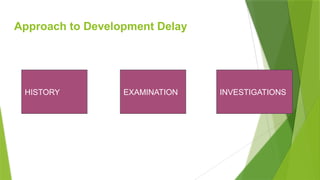
Approach to Development Delay
HISTORY INVESTIGATIONS
EXAMINATION
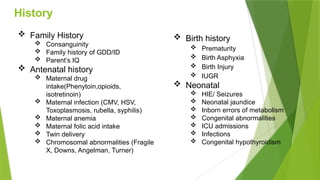
History
 Family History
 Consanguinity
 Family history of GDD/ID
 Parent’s IQ
 Antenatal history
 Maternal drug
intake(Phenytoin,opioids,
isotretinoin)
 Maternal infection (CMV, HSV,
Toxoplasmosis, rubella, syphilis)
 Maternal anemia
 Maternal folic acid intake
 Twin delivery
 Chromosomal abnormalities (Fragile
X, Downs, Angelman, Turner)
 Birth history
 Prematurity
 Birth Asphyxia
 Birth Injury
 IUGR
 Neonatal
 HIE/ Seizures
 Neonatal jaundice
 Inborn errors of metabolism
 Congenital abnormalities
 ICU admissions
 Infections
 Congenital hypothyroidism
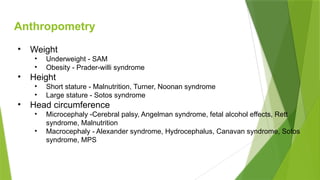
Anthropometry
• Weight
• Underweight - SAM
• Obesity - Prader-willi syndrome
• Height
• Short stature - Malnutrition, Turner, Noonan syndrome
• Large stature - Sotos syndrome
• Head circumference
• Microcephaly -Cerebral palsy, Angelman syndrome, fetal alcohol effects, Rett
syndrome, Malnutrition
• Macrocephaly - Alexander syndrome, Hydrocephalus, Canavan syndrome, Sotos
syndrome, MPS
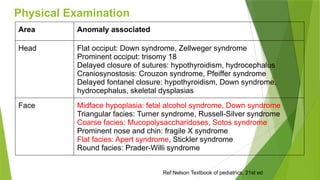
Physical Examination
Area Anomaly associated
Head Flat occiput: Down syndrome, Zellweger syndrome
Prominent occiput: trisomy 18
Delayed closure of sutures: hypothyroidism, hydrocephalus
Craniosynostosis: Crouzon syndrome, Pfeiffer syndrome
Delayed fontanel closure: hypothyroidism, Down syndrome,
hydrocephalus, skeletal dysplasias
Face Midface hypoplasia: fetal alcohol syndrome, Down syndrome
Triangular facies: Turner syndrome, Russell-Silver syndrome
Coarse facies: Mucopolysaccharidoses, Sotos syndrome
Prominent nose and chin: fragile X syndrome
Flat facies: Apert syndrome, Stickler syndrome
Round facies: Prader-Willi syndrome
Ref:Nelson Textbook of pediatrics, 21st ed
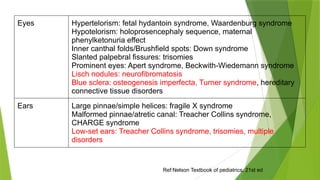
Eyes Hypertelorism: fetal hydantoin syndrome, Waardenburg syndrome
Hypotelorism: holoprosencephaly sequence, maternal
phenylketonuria effect
Inner canthal folds/Brushfield spots: Down syndrome
Slanted palpebral fissures: trisomies
Prominent eyes: Apert syndrome, Beckwith-Wiedemann syndrome
Lisch nodules: neurofibromatosis
Blue sclera: osteogenesis imperfecta, Turner syndrome, hereditary
connective tissue disorders
Ears Large pinnae/simple helices: fragile X syndrome
Malformed pinnae/atretic canal: Treacher Collins syndrome,
CHARGE syndrome
Low-set ears: Treacher Collins syndrome, trisomies, multiple
disorders
Ref:Nelson Textbook of pediatrics, 21st ed
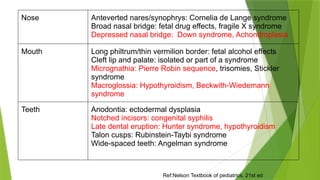
Nose Anteverted nares/synophrys: Cornelia de Lange syndrome
Broad nasal bridge: fetal drug effects, fragile X syndrome
Depressed nasal bridge: Down syndrome, Achondroplasia
Mouth Long philtrum/thin vermilion border: fetal alcohol effects
Cleft lip and palate: isolated or part of a syndrome
Micrognathia: Pierre Robin sequence, trisomies, Stickler
syndrome
Macroglossia: Hypothyroidism, Beckwith-Wiedemann
syndrome
Teeth Anodontia: ectodermal dysplasia
Notched incisors: congenital syphilis
Late dental eruption: Hunter syndrome, hypothyroidism
Talon cusps: Rubinstein-Taybi syndrome
Wide-spaced teeth: Angelman syndrome
Ref:Nelson Textbook of pediatrics, 21st ed
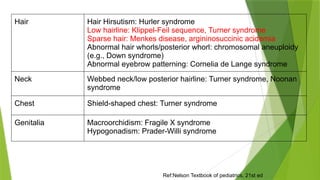
Hair Hair Hirsutism: Hurler syndrome
Low hairline: Klippel-Feil sequence, Turner syndrome
Sparse hair: Menkes disease, argininosuccinic acidemia
Abnormal hair whorls/posterior whorl: chromosomal aneuploidy
(e.g., Down syndrome)
Abnormal eyebrow patterning: Cornelia de Lange syndrome
Neck Webbed neck/low posterior hairline: Turner syndrome, Noonan
syndrome
Chest Shield-shaped chest: Turner syndrome
Genitalia Macroorchidism: Fragile X syndrome
Hypogonadism: Prader-Willi syndrome
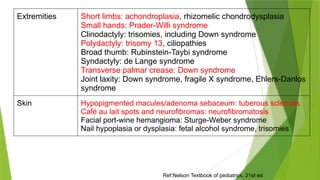
Extremities Short limbs: achondroplasia, rhizomelic chondrodysplasia
Small hands: Prader-Willi syndrome
Clinodactyly: trisomies, including Down syndrome
Polydactyly: trisomy 13, ciliopathies
Broad thumb: Rubinstein-Taybi syndrome
Syndactyly: de Lange syndrome
Transverse palmar crease: Down syndrome
Joint laxity: Down syndrome, fragile X syndrome, Ehlers-Danlos
syndrome
Skin Hypopigmented macules/adenoma sebaceum: tuberous sclerosis
Café au lait spots and neurofibromas: neurofibromatosis
Facial port-wine hemangioma: Sturge-Weber syndrome
Nail hypoplasia or dysplasia: fetal alcohol syndrome, trisomies
Ref:Nelson Textbook of pediatrics, 21st ed
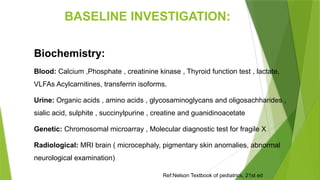
BASELINE INVESTIGATION:
Biochemistry:
Blood: Calcium ,Phosphate , creatinine kinase , Thyroid function test , lactate,
VLFAs Acylcarnitines, transferrin isoforms.
Urine: Organic acids , amino acids , glycosaminoglycans and oligosachharides ,
sialic acid, sulphite , succinylpurine , creatine and guanidinoacetate
Genetic: Chromosomal microarray , Molecular diagnostic test for fragile X
Radiological: MRI brain ( microcephaly, pigmentary skin anomalies, abnormal
neurological examination)
Ref:Nelson Textbook of pediatrics, 21st ed
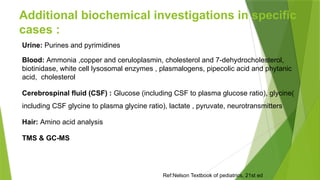
Additional biochemical investigations in specific
cases :
Urine: Purines and pyrimidines
Blood: Ammonia ,copper and ceruloplasmin, cholesterol and 7-dehydrocholesterol,
biotinidase, white cell lysosomal enzymes , plasmalogens, pipecolic acid and phytanic
acid, cholesterol
Cerebrospinal fluid (CSF) : Glucose (including CSF to plasma glucose ratio), glycine(
including CSF glycine to plasma glycine ratio), lactate , pyruvate, neurotransmitters
Hair: Amino acid analysis
TMS & GC-MS
Ref:Nelson Textbook of pediatrics, 21st ed
GENETIC INVESTIGATIONS IN SPECIFIC CASES :
1. Specific genetic test(sanger sequencing and copy number analysis) for suspected
monogenic disorder
2. Next generation sequencing (and copy number analysis) of panel of genes eg
suspected x linked disorder or based on phenotype , eg epilepsy or neuro- imaging
abnormality
3. Chromosomal microarray and /or standard karyotype in cultured skin fibroblasts
 Methylation tests at imprinted chromosomal loci, including methylation – specific
MLPA test for prader Willi and angelman syndromes
4. Whole genome sequencing/Whole Exon Sequencing
Ref:Nelson Textbook of pediatrics, 21st ed
Red flags suggestive of inborn errors of metabolism:
• Family history of IEM or GDD or
unexplained neonatal death
• Consanguinity
• Intrauterine growth retardation
• Failure to thrive
• Growth abnormality
• Recurrent episodes of vomiting ,ataxia ,
seizures ,lethargy , coma
• Regression in developmental milestones
• Behavioural or psychiatric problems
• Movement disorder
• Facial dysmorphism
• Organomegaly, Severe hypotonia
• Sensory defects, especially
progressive for eg cataract,
retinopathy
• Non congenital progressive spine
deformities
• Neuroimaging abnormalities
Ref:Nelson Textbook of pediatrics, 21st ed

approach to developmental delay in children

  • 1.
    APPROACH TO ACHILD WITH DEVELOPMENTAL DELAY
  • 2.
    Approach to DevelopmentDelay HISTORY INVESTIGATIONS EXAMINATION
  • 3.
    History  Family History Consanguinity  Family history of GDD/ID  Parent’s IQ  Antenatal history  Maternal drug intake(Phenytoin,opioids, isotretinoin)  Maternal infection (CMV, HSV, Toxoplasmosis, rubella, syphilis)  Maternal anemia  Maternal folic acid intake  Twin delivery  Chromosomal abnormalities (Fragile X, Downs, Angelman, Turner)  Birth history  Prematurity  Birth Asphyxia  Birth Injury  IUGR  Neonatal  HIE/ Seizures  Neonatal jaundice  Inborn errors of metabolism  Congenital abnormalities  ICU admissions  Infections  Congenital hypothyroidism
  • 4.
    Anthropometry • Weight • Underweight- SAM • Obesity - Prader-willi syndrome • Height • Short stature - Malnutrition, Turner, Noonan syndrome • Large stature - Sotos syndrome • Head circumference • Microcephaly -Cerebral palsy, Angelman syndrome, fetal alcohol effects, Rett syndrome, Malnutrition • Macrocephaly - Alexander syndrome, Hydrocephalus, Canavan syndrome, Sotos syndrome, MPS
  • 5.
    Physical Examination Area Anomalyassociated Head Flat occiput: Down syndrome, Zellweger syndrome Prominent occiput: trisomy 18 Delayed closure of sutures: hypothyroidism, hydrocephalus Craniosynostosis: Crouzon syndrome, Pfeiffer syndrome Delayed fontanel closure: hypothyroidism, Down syndrome, hydrocephalus, skeletal dysplasias Face Midface hypoplasia: fetal alcohol syndrome, Down syndrome Triangular facies: Turner syndrome, Russell-Silver syndrome Coarse facies: Mucopolysaccharidoses, Sotos syndrome Prominent nose and chin: fragile X syndrome Flat facies: Apert syndrome, Stickler syndrome Round facies: Prader-Willi syndrome Ref:Nelson Textbook of pediatrics, 21st ed
  • 6.
    Eyes Hypertelorism: fetalhydantoin syndrome, Waardenburg syndrome Hypotelorism: holoprosencephaly sequence, maternal phenylketonuria effect Inner canthal folds/Brushfield spots: Down syndrome Slanted palpebral fissures: trisomies Prominent eyes: Apert syndrome, Beckwith-Wiedemann syndrome Lisch nodules: neurofibromatosis Blue sclera: osteogenesis imperfecta, Turner syndrome, hereditary connective tissue disorders Ears Large pinnae/simple helices: fragile X syndrome Malformed pinnae/atretic canal: Treacher Collins syndrome, CHARGE syndrome Low-set ears: Treacher Collins syndrome, trisomies, multiple disorders Ref:Nelson Textbook of pediatrics, 21st ed
  • 7.
    Ref:Nelson Textbook ofpediatrics, 21st ed Nose Anteverted nares/synophrys: Cornelia de Lange syndrome Broad nasal bridge: fetal drug effects, fragile X syndrome Depressed nasal bridge: Down syndrome, Achondroplasia Mouth Long philtrum/thin vermilion border: fetal alcohol effects Cleft lip and palate: isolated or part of a syndrome Micrognathia: Pierre Robin sequence, trisomies, Stickler syndrome Macroglossia: Hypothyroidism, Beckwith-Wiedemann syndrome Teeth Anodontia: ectodermal dysplasia Notched incisors: congenital syphilis Late dental eruption: Hunter syndrome, hypothyroidism Talon cusps: Rubinstein-Taybi syndrome Wide-spaced teeth: Angelman syndrome
  • 8.
    Ref:Nelson Textbook ofpediatrics, 21st ed Hair Hair Hirsutism: Hurler syndrome Low hairline: Klippel-Feil sequence, Turner syndrome Sparse hair: Menkes disease, argininosuccinic acidemia Abnormal hair whorls/posterior whorl: chromosomal aneuploidy (e.g., Down syndrome) Abnormal eyebrow patterning: Cornelia de Lange syndrome Neck Webbed neck/low posterior hairline: Turner syndrome, Noonan syndrome Chest Shield-shaped chest: Turner syndrome Genitalia Macroorchidism: Fragile X syndrome Hypogonadism: Prader-Willi syndrome
  • 9.
    Extremities Short limbs:achondroplasia, rhizomelic chondrodysplasia Small hands: Prader-Willi syndrome Clinodactyly: trisomies, including Down syndrome Polydactyly: trisomy 13, ciliopathies Broad thumb: Rubinstein-Taybi syndrome Syndactyly: de Lange syndrome Transverse palmar crease: Down syndrome Joint laxity: Down syndrome, fragile X syndrome, Ehlers-Danlos syndrome Skin Hypopigmented macules/adenoma sebaceum: tuberous sclerosis Café au lait spots and neurofibromas: neurofibromatosis Facial port-wine hemangioma: Sturge-Weber syndrome Nail hypoplasia or dysplasia: fetal alcohol syndrome, trisomies Ref:Nelson Textbook of pediatrics, 21st ed
  • 10.
    BASELINE INVESTIGATION: Biochemistry: Blood: Calcium,Phosphate , creatinine kinase , Thyroid function test , lactate, VLFAs Acylcarnitines, transferrin isoforms. Urine: Organic acids , amino acids , glycosaminoglycans and oligosachharides , sialic acid, sulphite , succinylpurine , creatine and guanidinoacetate Genetic: Chromosomal microarray , Molecular diagnostic test for fragile X Radiological: MRI brain ( microcephaly, pigmentary skin anomalies, abnormal neurological examination) Ref:Nelson Textbook of pediatrics, 21st ed
  • 11.
    Additional biochemical investigationsin specific cases : Urine: Purines and pyrimidines Blood: Ammonia ,copper and ceruloplasmin, cholesterol and 7-dehydrocholesterol, biotinidase, white cell lysosomal enzymes , plasmalogens, pipecolic acid and phytanic acid, cholesterol Cerebrospinal fluid (CSF) : Glucose (including CSF to plasma glucose ratio), glycine( including CSF glycine to plasma glycine ratio), lactate , pyruvate, neurotransmitters Hair: Amino acid analysis TMS & GC-MS Ref:Nelson Textbook of pediatrics, 21st ed
  • 12.
    GENETIC INVESTIGATIONS INSPECIFIC CASES : 1. Specific genetic test(sanger sequencing and copy number analysis) for suspected monogenic disorder 2. Next generation sequencing (and copy number analysis) of panel of genes eg suspected x linked disorder or based on phenotype , eg epilepsy or neuro- imaging abnormality 3. Chromosomal microarray and /or standard karyotype in cultured skin fibroblasts  Methylation tests at imprinted chromosomal loci, including methylation – specific MLPA test for prader Willi and angelman syndromes 4. Whole genome sequencing/Whole Exon Sequencing Ref:Nelson Textbook of pediatrics, 21st ed
  • 13.
    Red flags suggestiveof inborn errors of metabolism: • Family history of IEM or GDD or unexplained neonatal death • Consanguinity • Intrauterine growth retardation • Failure to thrive • Growth abnormality • Recurrent episodes of vomiting ,ataxia , seizures ,lethargy , coma • Regression in developmental milestones • Behavioural or psychiatric problems • Movement disorder • Facial dysmorphism • Organomegaly, Severe hypotonia • Sensory defects, especially progressive for eg cataract, retinopathy • Non congenital progressive spine deformities • Neuroimaging abnormalities Ref:Nelson Textbook of pediatrics, 21st ed