A framework for developing

ePortfolios
 Nick Rate   nick.rate@core-ed.org   http://nickrate.com
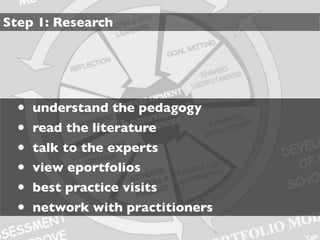
Step 1: Research


  •   understand the pedagogy
  •   read the literature
  •   talk to the experts
  •   view eportfolios
  •   best practice visits
  •   network with practitioners
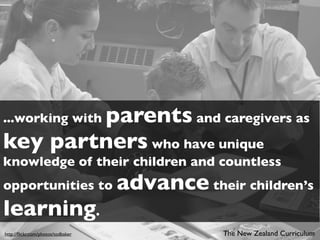
parents and caregivers as
...working with
key partners who have unique
knowledge of their children and countless
opportunities to                   advance their children’s
learning.
http://flickr.com/photos/todbaker               The New Zealand Curriculum
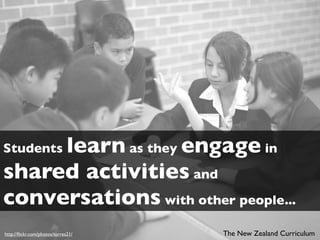
learn as they engage in
Students
shared activities and
conversations with other people...
http://flickr.com/photos/torres21/   The New Zealand Curriculum
...all students should develop strategies
for self-monitoring and
collaborative evaluation of
their performance in relation to suitable
criteria.
http://flickr.com/photos/torres21/   The New Zealand Curriculum
Schools should                       explore not only how
ICT can supplement traditional ways of
teaching but also how it can open up new
and different ways of learning.

http://www.flickr.com/photos/bz3rk/                The New Zealand Curriculum
!"#$%&"'()*+'#*
,))$))-$(&**
"(*.$/*0$121(3*
Developing students’ assessment capabilities

Michael Absolum, Evaluation Associates Ltd, Auckland
Lester Flockton, University of Otago
John Hattie, University of Auckland
Rosemary Hipkins, New Zealand Council for Educational Research
Ian Reid, Learning Media Ltd                           http://assessment.tki.org.nz/
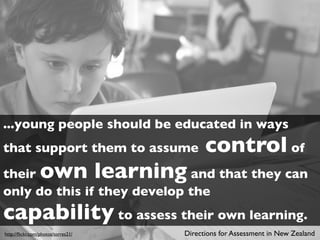
...young people should be educated in ways
that support them to assume               control of
their            own learningand that they can
only do this if they develop the
capability to assess their own learning.
http://flickr.com/photos/torres21/   Directions for Assessment in New Zealand
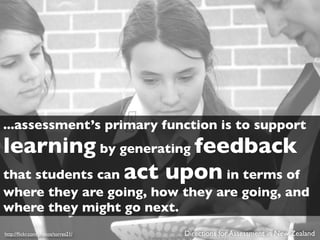
...assessment’s primary function is to support
learning by generating feedback
that students can act upon in terms of
where they are going, how they are going, and
where they might go next.
http://flickr.com/photos/torres21/   Directions for Assessment in New Zealand
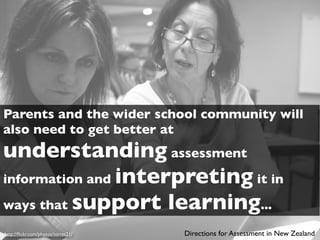
Parents and the wider school community will
also need to get better at
understanding assessment
information and interpreting it in
ways that support learning...

http://flickr.com/photos/torres21/   Directions for Assessment in New Zealand
http://www.cognitioninstitute.org
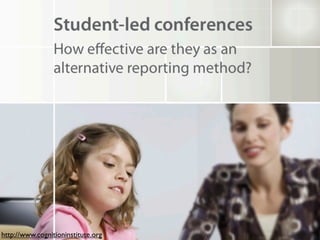
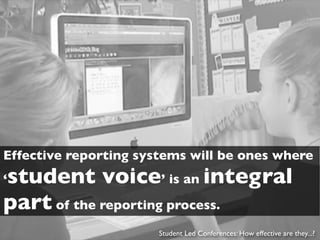
Effective reporting systems will be ones where
student voice’ is an integral
‘
part of the reporting process.
                       Student Led Conferences: How effective are they...?
http://www.nzei.org.nz/
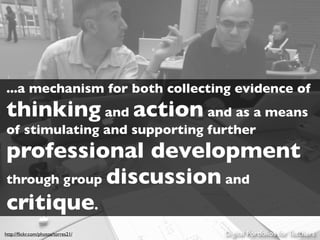
...a mechanism for both collecting evidence of
thinking and action and as a means
of stimulating and supporting further
professional development
through group discussion and
critique.
http://flickr.com/photos/torres21/   Digital Portfolios for Teachers
http://www.teacherscouncil.govt.nz/
Evidence of professional practice that
meets the criteria will need to be
provided to the teachers’ professional
leaders...
                             Registered Teacher Criteria
http://www.educationcounts.govt.nz
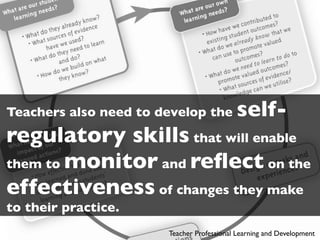
Teachers also need to develop the          self-
regulatory skills that will enable
them to monitor and reflect on the
effectiveness of changes they make
to their practice.
                       Teacher Professional Learning and Development
evidence from research and from
...
their own past practice and that of
colleagues to plan teaching and
learning opportunities...
                            The New Zealand Curriculum
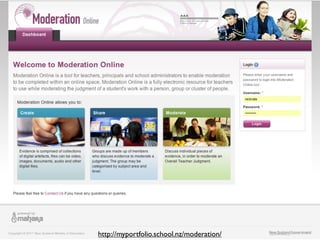
http://myportfolio.school.nz/moderation/
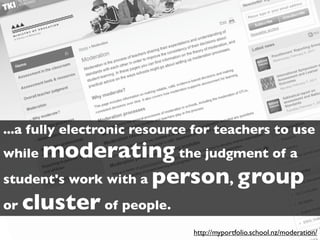
...a fully electronic resource for teachers to use
whilemoderating the judgment of a
student's work with a person, group
or cluster of people.
                              http://myportfolio.school.nz/moderation/
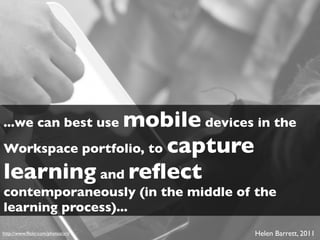
mobile devices in the
...we can best use
Workspace portfolio, to capture
learning and reflect
contemporaneously (in the middle of the
learning process)...
http://www.flickr.com/photos/ari/   Helen Barrett, 2011
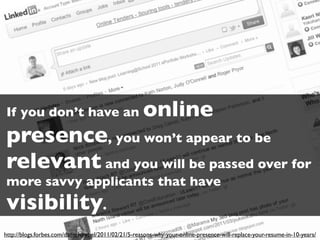
http://blogs.forbes.com/danschawbel/2011/02/21/5-reasons-why-your-online-presence-will-replace-your-resume-in-10-years/
If you don’t have an                                 online
presence, you won’t appear to be
relevant and you will be passed over for
more savvy applicants that have
visibility.
http://blogs.forbes.com/danschawbel/2011/02/21/5-reasons-why-your-online-presence-will-replace-your-resume-in-10-years/
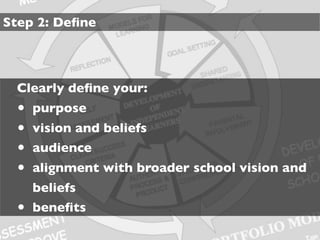
Step 2: Define


 Clearly define your:
 •   purpose
 •   vision and beliefs
 •   audience
 •   alignment with broader school vision and
     beliefs
 •   benefits
“An e-portfolio is an electronic format
for learners to record their work,
their achievements and their
goals, to reflect on their
learning, and to share and be
supported in this.”
                                    Banks, 2004
“...ideas of what an e-portfolio 'is' are
complex and to an extent the
definition and purpose will vary
depending on the perspective from
which a particular person is approaching
the concept...”
http://www.flickr.com/photos/darthdowney/   JISC ePortfolio Infokit
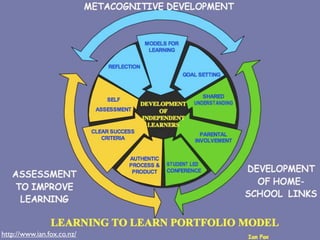
http://www.ian.fox.co.nz/
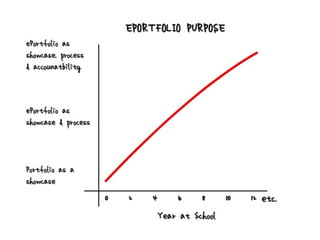
http://edtalks.org/video/eportfolios-just-good-old-fashioned-sharing
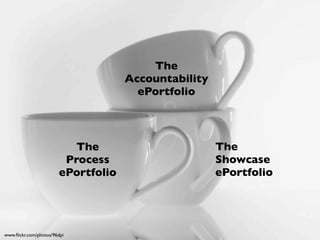
The
                                    Accountability
                                      ePortfolio


                          The                        The
                        Process                      Showcase
                       ePortfolio                    ePortfolio


www.flickr.com/photos/96dpi
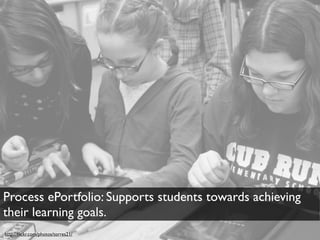
Process ePortfolio: Supports students towards achieving
their learning goals.
 www.flickr.com/photos/viernest
http://flickr.com/photos/torres21/
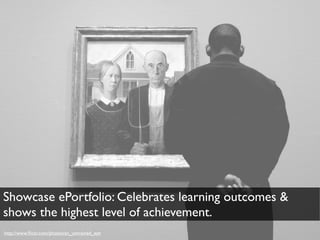
Showcase ePortfolio: Celebrates learning outcomes &
shows the highest level of achievement.
http://www.flickr.com/photos/an_untrained_eye
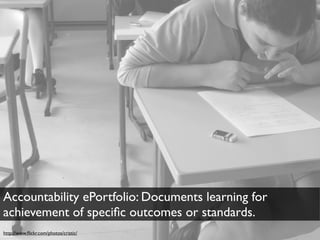
Accountability ePortfolio: Documents learning for
achievement of specific outcomes or standards.
http://www.flickr.com/photos/cristic/
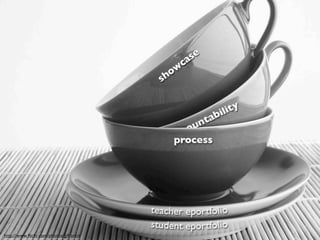
Process                                             Showcase

                                                         se
                                                   w   ca
                                                sho


                                        Accountability
http://www.flickr.com/photos/gifrancis
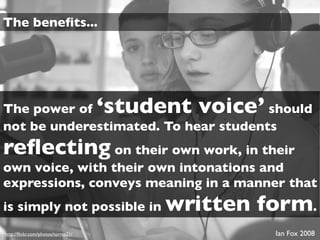
The benefits...


The power of                        ‘student voice’
                                      should
not be underestimated. To hear students
reflecting on their own work, in their
own voice, with their own intonations and
expressions, conveys meaning in a manner that
is simply not possible in                 written form.
http://flickr.com/photos/torres21/                     Ian Fox 2008
...thesocial networking             potential
of the learning landscape and eportfolio-
related tools are features that   facilitate
and enhance the making of
connections and the linking together
of people, ideas, resources and
learning...
                                       Tosh et al., 2006
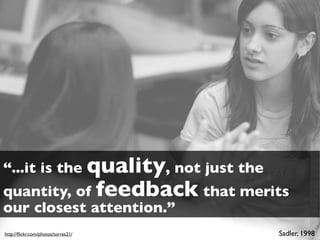
“...it is the quality, not just the
quantity, of feedback that merits
our closest attention.”
http://flickr.com/photos/torres21/     Sadler, 1998
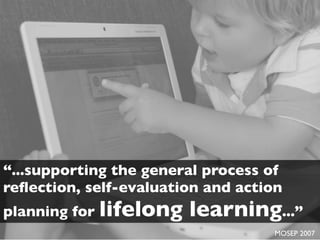
“...supporting the general process of
reflection, self-evaluation and action
planning for lifelong   learning...”
                                    MOSEP 2007
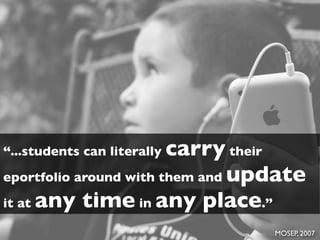
carry their
“...students can literally
eportfolio around with them and update
it at any time in any place.”

                                  MOSEP, 2007
http://edtalks.org/video/eportfolios
Step 3: Consult


  Seek input from all stakeholders:
  •   students
  •   teachers
  •   school leadership
  •   curriculum leaders, HODs
  •   parents
  •   BoT
  •   providers
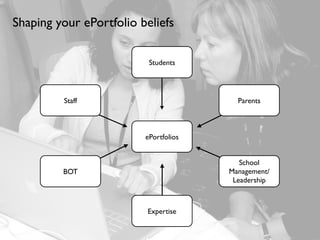
Shaping your ePortfolio beliefs

                          Students


         Staff                           Parents


                         ePortfolios


                                          School
         BOT                           Management/
                                        Leadership


                         Expertise
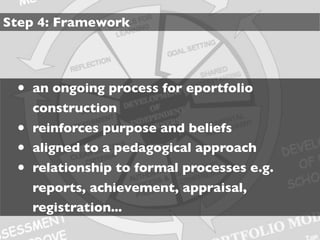
Step 4: Framework


 • an ongoing process for eportfolio
   construction
 • reinforces purpose and beliefs
 • aligned to a pedagogical approach
 • relationship to formal processes e.g.
   reports, achievement, appraisal,
   registration...
“...to define e-Portfolios as a process,
rather than just a product or a
technological system.
                                 Attwell, 2007
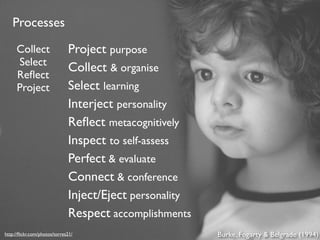
Processes
     Collect                  Project purpose
     Select
                              Collect & organise
     Reflect
     Project                  Select learning
                              Interject personality
                              Reflect metacognitively
                              Inspect to self-assess
                              Perfect & evaluate
                              Connect & conference
                              Inject/Eject personality
                              Respect accomplishments
http://flickr.com/photos/torres21/                        Burke, Fogarty & Belgrade (1994)
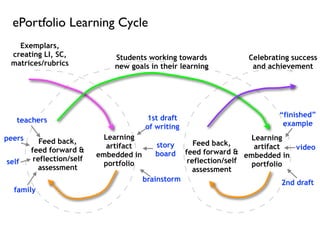
ePortfolio Learning Cycle
   Exemplars,
 creating LI, SC,              Students working towards              Celebrating success
 matrices/rubrics              new goals in their learning            and achievement


                                         1st draft                           “finished”
   teachers                                                                   example
                                         of writing
peers                        Learning                                  Learning
           Feed back,                       story        Feed back,
                              artifact                                  artifact video
        feed forward &                      board     feed forward & embedded in
                           embedded in
self     reflection/self                               reflection/self
                             portfolio                                 portfolio
          assessment                                    assessment
                                         brainstorm                           2nd draft
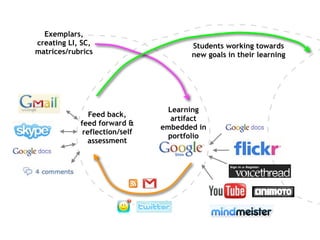
  family
Exemplars,
creating LI, SC,                      Students working towards
matrices/rubrics                      new goals in their learning


                                 Learning
               Feed back,
                                  artifact
            feed forward &
                               embedded in
             reflection/self
                                 portfolio
              assessment
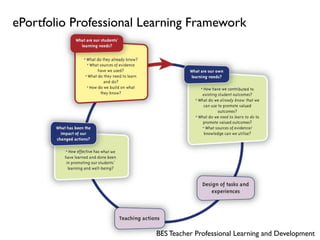
ePortfolio Professional Learning Framework


                         BES Teacher Professional Learning and Development
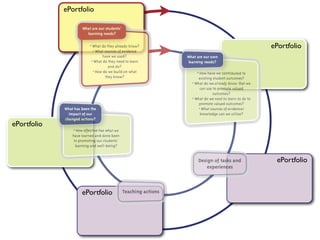
ePortfolio


                                ePortfolio


ePortfolio


                                 ePortfolio


                   ePortfolio
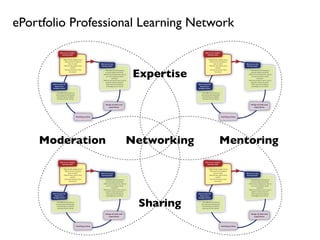
ePortfolio Professional Learning Network


                     Expertise


    Moderation      Networking       Mentoring


                      Sharing
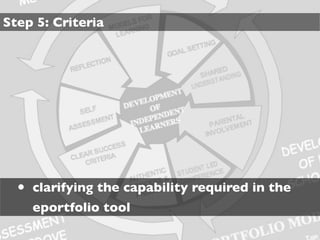
Step 5: Criteria


  • clarifying the capability required in the
    eportfolio tool
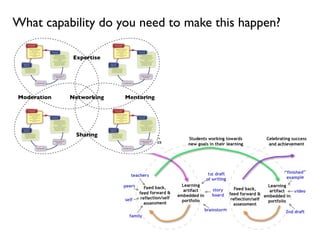
What capability do you need to make this happen?

              Expertise


Moderation   Networking   Mentoring


              Sharing
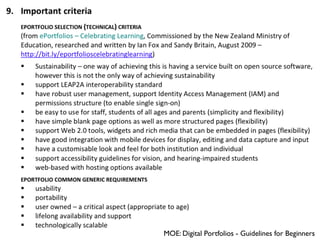
MOE: Digital Portfolios - Guidelines for Beginners
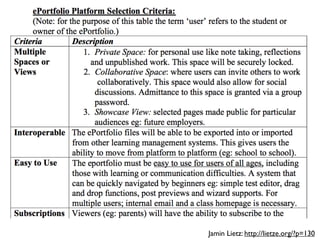
Jamin Lietz: http://lietze.org/?p=130
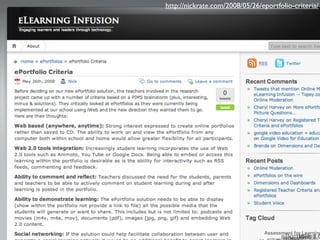
http://nickrate.com/2008/05/26/eportfolio-criteria/
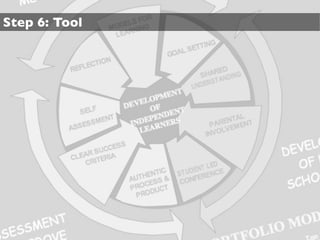
Step 6: Tool
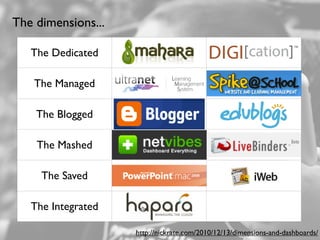
The dimensions...

   The Dedicated

    The Managed

    The Blogged

    The Mashed

     The Saved

   The Integrated

                    http://nickrate.com/2010/12/13/dimensions-and-dashboards/
Step 7: Educate


  Students, teachers, parents, mentors,
  coaches:
  •   pedagogy
  •   giving effective feedback
  •   setting goals
  •   reflecting and self-assessing
  •   technical how to’s
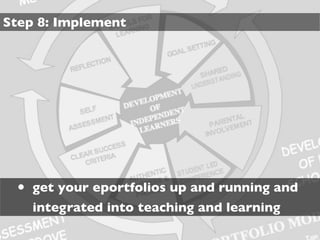
Step 8: Implement


 • get your eportfolios up and running and
    integrated into teaching and learning
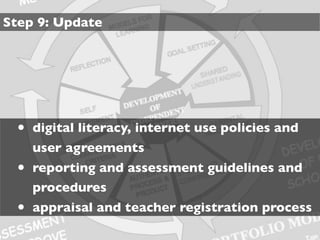
Step 9: Update


 • digital literacy, internet use policies and
    user agreements
 • reporting and assessment guidelines and
    procedures
 • appraisal and teacher registration process
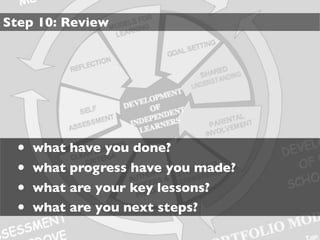
Step 10: Review


 •   what have you done?
 •   what progress have you made?
 •   what are your key lessons?
 •   what are you next steps?
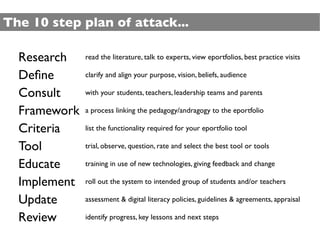
The 10 step plan of attack...

  Research    read the literature, talk to experts, view eportfolios, best practice visits

  Define       clarify and align your purpose, vision, beliefs, audience

  Consult     with your students, teachers, leadership teams and parents

  Framework   a process linking the pedagogy/andragogy to the eportfolio

  Criteria    list the functionality required for your eportfolio tool

  Tool        trial, observe, question, rate and select the best tool or tools

  Educate     training in use of new technologies, giving feedback and change

  Implement   roll out the system to intended group of students and/or teachers

  Update      assessment & digital literacy policies, guidelines & agreements, appraisal

  Review      identify progress, key lessons and next steps
Should an eportfolio include all aspects of a
student’s life and learning?


www.flickr.com/photos/pasq
What happens when a student leaves school?
Transfers? Moves to a new class?


www.flickr.com/photos/bigtallguy
Who owns the eportfolio?


www.flickr.com/photos/sveinhal
Are your eportfolios open to the world?


www.flickr.com/photos/willfuller
Are your parents and teachers ready? Is the
principal?


http://flickr.com/photos/torres21/
Do your current policies cater for eportfolios
and use of Web 2.0 tools?
Will your eportfolios play a role in reporting
achievement against the National Standards?
Is one eportfolio system enough or should you
use a mash-up of tools?


www.flickr.com/photos/diathesis
Is it important for eportfolios in your school to
have a consistent look and feel?


                                     http://www.flickr.com/photos/cobalt/
Should your school expect the teachers to
have a reflective eportfolio just as the students
do?


www.flickr.com/photos/raigverd/
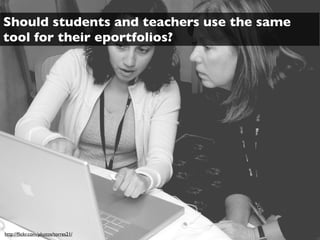
Should students and teachers use the same
tool for their eportfolios?


http://flickr.com/photos/torres21/
Where to next?
 Join the discussions on the MLE Reference Group:
 http://groups.google.com/group/mle-reference-group/
 Read MOE ePortfolio Guidelines: http://goo.gl/dbBR8
 Watch the videos: http://edtalks.org/tag-keyword/eportfolios
 Ian Fox: http://www.foxedu.co.nz
 Helen Barrett: http://electronicportfolios.org/
 Follow Jamin Lietze’s Journey: http://lietze.org/
 Other people to know:
 http://eportfoliosnz.wikispaces.com/ePortfolio+Network
 Twitter: #eportfolios

CORE Education Breakfast Seminar: ePortfolios

  • 1.
    A framework fordeveloping ePortfolios Nick Rate nick.rate@core-ed.org http://nickrate.com
  • 2.
    Step 1: Research • understand the pedagogy • read the literature • talk to the experts • view eportfolios • best practice visits • network with practitioners
  • 4.
    parents and caregiversas ...working with key partners who have unique knowledge of their children and countless opportunities to advance their children’s learning. http://flickr.com/photos/todbaker The New Zealand Curriculum
  • 5.
    learn as theyengage in Students shared activities and conversations with other people... http://flickr.com/photos/torres21/ The New Zealand Curriculum
  • 6.
    ...all students shoulddevelop strategies for self-monitoring and collaborative evaluation of their performance in relation to suitable criteria. http://flickr.com/photos/torres21/ The New Zealand Curriculum
  • 7.
    Schools should explore not only how ICT can supplement traditional ways of teaching but also how it can open up new and different ways of learning. http://www.flickr.com/photos/bz3rk/ The New Zealand Curriculum
  • 8.
    !"#$%&"'()*+'#* ,))$))-$(&** "(*.$/*0$121(3* Developing students’ assessmentcapabilities Michael Absolum, Evaluation Associates Ltd, Auckland Lester Flockton, University of Otago John Hattie, University of Auckland Rosemary Hipkins, New Zealand Council for Educational Research Ian Reid, Learning Media Ltd http://assessment.tki.org.nz/
  • 9.
    ...young people shouldbe educated in ways that support them to assume control of their own learningand that they can only do this if they develop the capability to assess their own learning. http://flickr.com/photos/torres21/ Directions for Assessment in New Zealand
  • 10.
    ...assessment’s primary functionis to support learning by generating feedback that students can act upon in terms of where they are going, how they are going, and where they might go next. http://flickr.com/photos/torres21/ Directions for Assessment in New Zealand
  • 11.
    Parents and thewider school community will also need to get better at understanding assessment information and interpreting it in ways that support learning... http://flickr.com/photos/torres21/ Directions for Assessment in New Zealand
  • 12.
  • 13.
    Effective reporting systemswill be ones where student voice’ is an integral ‘ part of the reporting process. Student Led Conferences: How effective are they...?
  • 14.
  • 15.
    ...a mechanism forboth collecting evidence of thinking and action and as a means of stimulating and supporting further professional development through group discussion and critique. http://flickr.com/photos/torres21/ Digital Portfolios for Teachers
  • 16.
  • 17.
    Evidence of professionalpractice that meets the criteria will need to be provided to the teachers’ professional leaders... Registered Teacher Criteria
  • 18.
  • 19.
    Teachers also needto develop the self- regulatory skills that will enable them to monitor and reflect on the effectiveness of changes they make to their practice. Teacher Professional Learning and Development
  • 20.
    evidence from researchand from ... their own past practice and that of colleagues to plan teaching and learning opportunities... The New Zealand Curriculum
  • 21.
  • 22.
    ...a fully electronicresource for teachers to use whilemoderating the judgment of a student's work with a person, group or cluster of people. http://myportfolio.school.nz/moderation/
  • 24.
    mobile devices inthe ...we can best use Workspace portfolio, to capture learning and reflect contemporaneously (in the middle of the learning process)... http://www.flickr.com/photos/ari/ Helen Barrett, 2011
  • 25.
  • 26.
    If you don’thave an online presence, you won’t appear to be relevant and you will be passed over for more savvy applicants that have visibility. http://blogs.forbes.com/danschawbel/2011/02/21/5-reasons-why-your-online-presence-will-replace-your-resume-in-10-years/
  • 27.
    Step 2: Define Clearly define your: • purpose • vision and beliefs • audience • alignment with broader school vision and beliefs • benefits
  • 28.
    “An e-portfolio isan electronic format for learners to record their work, their achievements and their goals, to reflect on their learning, and to share and be supported in this.” Banks, 2004
  • 29.
    “...ideas of whatan e-portfolio 'is' are complex and to an extent the definition and purpose will vary depending on the perspective from which a particular person is approaching the concept...” http://www.flickr.com/photos/darthdowney/ JISC ePortfolio Infokit
  • 30.
  • 31.
  • 32.
    The Accountability ePortfolio The The Process Showcase ePortfolio ePortfolio www.flickr.com/photos/96dpi
  • 33.
    Process ePortfolio: Supportsstudents towards achieving their learning goals. www.flickr.com/photos/viernest http://flickr.com/photos/torres21/
  • 34.
    Showcase ePortfolio: Celebrateslearning outcomes & shows the highest level of achievement. http://www.flickr.com/photos/an_untrained_eye
  • 35.
    Accountability ePortfolio: Documentslearning for achievement of specific outcomes or standards. http://www.flickr.com/photos/cristic/
  • 36.
    Process Showcase se w ca sho Accountability http://www.flickr.com/photos/gifrancis
  • 38.
    The benefits... The powerof ‘student voice’ should not be underestimated. To hear students reflecting on their own work, in their own voice, with their own intonations and expressions, conveys meaning in a manner that is simply not possible in written form. http://flickr.com/photos/torres21/ Ian Fox 2008
  • 39.
    ...thesocial networking potential of the learning landscape and eportfolio- related tools are features that facilitate and enhance the making of connections and the linking together of people, ideas, resources and learning... Tosh et al., 2006
  • 40.
    “...it is thequality, not just the quantity, of feedback that merits our closest attention.” http://flickr.com/photos/torres21/ Sadler, 1998
  • 41.
    “...supporting the generalprocess of reflection, self-evaluation and action planning for lifelong learning...” MOSEP 2007
  • 42.
    carry their “...students canliterally eportfolio around with them and update it at any time in any place.” MOSEP, 2007
  • 43.
  • 44.
    Step 3: Consult Seek input from all stakeholders: • students • teachers • school leadership • curriculum leaders, HODs • parents • BoT • providers
  • 45.
    Shaping your ePortfoliobeliefs Students Staff Parents ePortfolios School BOT Management/ Leadership Expertise
  • 46.
    Step 4: Framework • an ongoing process for eportfolio construction • reinforces purpose and beliefs • aligned to a pedagogical approach • relationship to formal processes e.g. reports, achievement, appraisal, registration...
  • 47.
    “...to define e-Portfoliosas a process, rather than just a product or a technological system. Attwell, 2007
  • 48.
    Processes Collect Project purpose Select Collect & organise Reflect Project Select learning Interject personality Reflect metacognitively Inspect to self-assess Perfect & evaluate Connect & conference Inject/Eject personality Respect accomplishments http://flickr.com/photos/torres21/ Burke, Fogarty & Belgrade (1994)
  • 49.
    ePortfolio Learning Cycle Exemplars, creating LI, SC, Students working towards Celebrating success matrices/rubrics new goals in their learning and achievement 1st draft “finished” teachers example of writing peers Learning Learning Feed back, story Feed back, artifact artifact video feed forward & board feed forward & embedded in embedded in self reflection/self reflection/self portfolio portfolio assessment assessment brainstorm 2nd draft family
  • 50.
    Exemplars, creating LI, SC, Students working towards matrices/rubrics new goals in their learning Learning Feed back, artifact feed forward & embedded in reflection/self portfolio assessment
  • 51.
    ePortfolio Professional LearningFramework BES Teacher Professional Learning and Development
  • 52.
    ePortfolio ePortfolio ePortfolio ePortfolio ePortfolio
  • 53.
    ePortfolio Professional LearningNetwork Expertise Moderation Networking Mentoring Sharing
  • 54.
    Step 5: Criteria • clarifying the capability required in the eportfolio tool
  • 55.
    What capability doyou need to make this happen? Expertise Moderation Networking Mentoring Sharing
  • 56.
    MOE: Digital Portfolios- Guidelines for Beginners
  • 57.
  • 58.
  • 59.
  • 61.
    The dimensions... The Dedicated The Managed The Blogged The Mashed The Saved The Integrated http://nickrate.com/2010/12/13/dimensions-and-dashboards/
  • 62.
    Step 7: Educate Students, teachers, parents, mentors, coaches: • pedagogy • giving effective feedback • setting goals • reflecting and self-assessing • technical how to’s
  • 63.
    Step 8: Implement • get your eportfolios up and running and integrated into teaching and learning
  • 64.
    Step 9: Update • digital literacy, internet use policies and user agreements • reporting and assessment guidelines and procedures • appraisal and teacher registration process
  • 65.
    Step 10: Review • what have you done? • what progress have you made? • what are your key lessons? • what are you next steps?
  • 66.
    The 10 stepplan of attack... Research read the literature, talk to experts, view eportfolios, best practice visits Define clarify and align your purpose, vision, beliefs, audience Consult with your students, teachers, leadership teams and parents Framework a process linking the pedagogy/andragogy to the eportfolio Criteria list the functionality required for your eportfolio tool Tool trial, observe, question, rate and select the best tool or tools Educate training in use of new technologies, giving feedback and change Implement roll out the system to intended group of students and/or teachers Update assessment & digital literacy policies, guidelines & agreements, appraisal Review identify progress, key lessons and next steps
  • 67.
    Should an eportfolioinclude all aspects of a student’s life and learning? www.flickr.com/photos/pasq
  • 68.
    What happens whena student leaves school? Transfers? Moves to a new class? www.flickr.com/photos/bigtallguy
  • 69.
    Who owns theeportfolio? www.flickr.com/photos/sveinhal
  • 70.
    Are your eportfoliosopen to the world? www.flickr.com/photos/willfuller
  • 71.
    Are your parentsand teachers ready? Is the principal? http://flickr.com/photos/torres21/
  • 72.
    Do your currentpolicies cater for eportfolios and use of Web 2.0 tools?
  • 73.
    Will your eportfoliosplay a role in reporting achievement against the National Standards?
  • 74.
    Is one eportfoliosystem enough or should you use a mash-up of tools? www.flickr.com/photos/diathesis
  • 75.
    Is it importantfor eportfolios in your school to have a consistent look and feel? http://www.flickr.com/photos/cobalt/
  • 76.
    Should your schoolexpect the teachers to have a reflective eportfolio just as the students do? www.flickr.com/photos/raigverd/
  • 77.
    Should students andteachers use the same tool for their eportfolios? http://flickr.com/photos/torres21/
  • 78.
    Where to next? Join the discussions on the MLE Reference Group: http://groups.google.com/group/mle-reference-group/ Read MOE ePortfolio Guidelines: http://goo.gl/dbBR8 Watch the videos: http://edtalks.org/tag-keyword/eportfolios Ian Fox: http://www.foxedu.co.nz Helen Barrett: http://electronicportfolios.org/ Follow Jamin Lietze’s Journey: http://lietze.org/ Other people to know: http://eportfoliosnz.wikispaces.com/ePortfolio+Network Twitter: #eportfolios