









Challenges for the Education/ePortfolioCommunity:Change!Keynote Address, July 7, 2010EIFeL ConferenceDr. Helen Barretthttp://slideshare.net/eportfolios
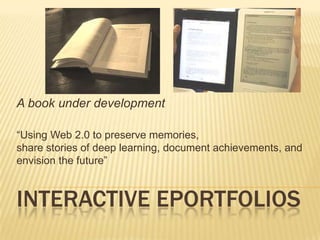
Interactive ePortfoliosA book under development“Using Web 2.0 to preserve memories, share stories of deep learning, document achievements, and envision the future”
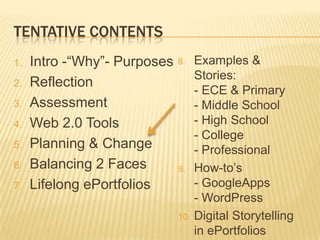
Tentative ContentsIntro -“Why”- PurposesReflection AssessmentWeb 2.0 ToolsPlanning & ChangeBalancing 2 FacesLifelong ePortfoliosExamples & Stories:- ECE & Primary- Middle School- High School- College - ProfessionalHow-to’s- GoogleApps- WordPressDigital Storytelling in ePortfolios
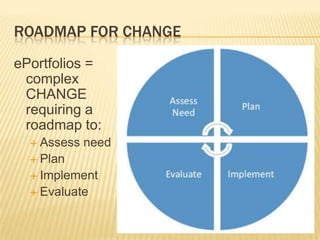
Roadmap for ChangeePortfolios =complexCHANGErequiring a roadmap to:Assess needPlanImplementEvaluate
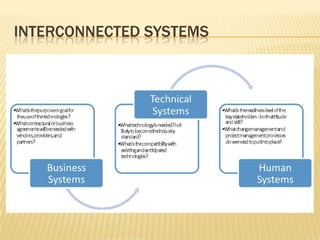
Interconnected Systems
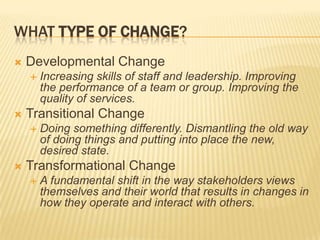
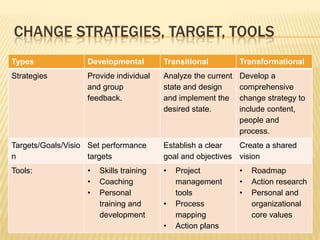
What Type of Change?Developmental Change Increasing skills of staff and leadership. Improving the performance of a team or group. Improving the quality of services.Transitional ChangeDoing something differently. Dismantling the old way of doing things and putting into place the new, desired state. Transformational ChangeA fundamental shift in the way stakeholders views themselves and their world that results in changes in how they operate and interact with others.
Roadmap for Leaders
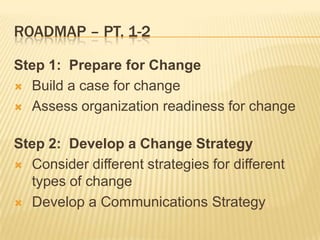
Roadmap – pt. 1-2Step 1:  Prepare for ChangeBuild a case for changeAssess organization readiness for changeStep 2:  Develop a Change StrategyConsider different strategies for different types of change Develop a Communications StrategyChange Strategies, Target, Tools
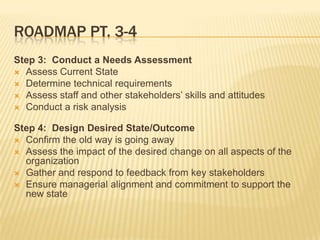
Roadmap pt. 3-4Step 3:  Conduct a Needs AssessmentAssess Current State Determine technical requirementsAssess staff and other stakeholders’ skills and attitudesConduct a risk analysisStep 4:  Design Desired State/OutcomeConfirm the old way is going away Assess the impact of the desired change on all aspects of the organization Gather and respond to feedback from key stakeholdersEnsure managerial alignment and commitment to support the new state
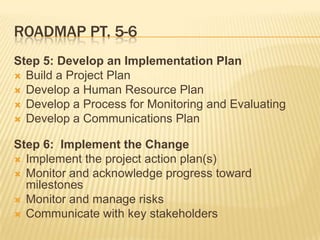
Roadmap Pt. 5-6Step 5: Develop an Implementation PlanBuild a Project PlanDevelop a Human Resource PlanDevelop a Process for Monitoring and EvaluatingDevelop a Communications PlanStep 6:  Implement the ChangeImplement the project action plan(s)Monitor and acknowledge progress toward milestonesMonitor and manage risksCommunicate with key stakeholders
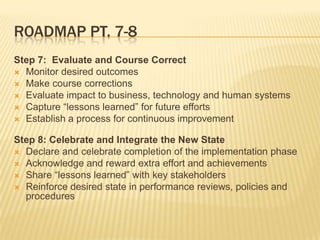
Roadmap pt. 7-8 Step 7:  Evaluate and Course CorrectMonitor desired outcomes Make course correctionsEvaluate impact to business, technology and human systemsCapture “lessons learned” for future effortsEstablish a process for continuous improvementStep 8: Celebrate and Integrate the New State Declare and celebrate completion of the implementation phaseAcknowledge and reward extra effort and achievementsShare “lessons learned” with key stakeholdersReinforce desired state in performance reviews, policies and procedures
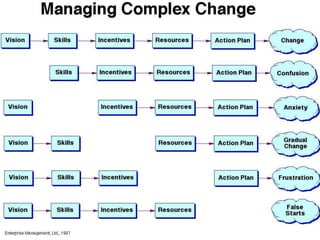
13Managing Complex Change graphic
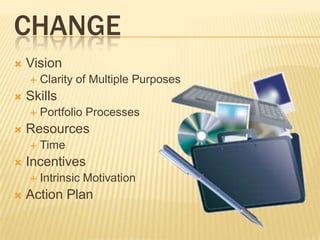
ChangeVisionClarity of Multiple PurposesSkillsPortfolio ProcessesResourcesTimeIncentivesIntrinsic MotivationAction Plan
ConfusionVision
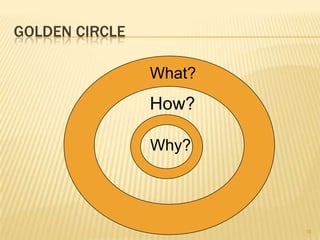
Golden Circle        16What?How?Why?
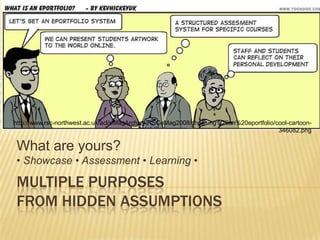
Multiple Purposes from Hidden AssumptionsWhat are yours?• Showcase • Assessment • Learning •http://www.rsc-northwest.ac.uk/acl/eMagArchive/RSCeMag2008/choosing%20an%20eportfolio/cool-cartoon-346082.png
1 paragraph!What is your “elevator Speech” describing your Vision for ePortfolios?
A California School District K-12 VisionElectronic portfolios foster meaningful learning by allowing all students to evaluate their growth over time, to share their achievements and strengths with others, and to improve their own skills through reflection and goal setting.
One NYC school’s VisionAn electronic portfolio will allow students to create a collaborative, portable, personal space that fosters self-reflection, promotes academic accomplishments, and highlights individual growth. Through the integration of technology and the collection of digital artifacts, students will be able to showcase their achievements to peers and educators, while helping envision their future goals.
AnxietySkills
Two Skills across the Lifespan with ePortfolio Development and Social NetworkingTechnology & Reflection
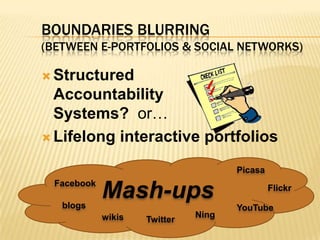
Boundaries Blurring (between e-portfolios & social networks)Structured Accountability Systems?  or…Lifelong interactive portfoliosPicasaMash-upsFacebookFlickrblogsYouTubeNingwikisTwitter
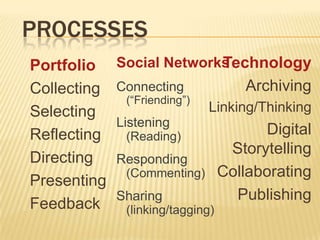
ProcessesTechnologyArchivingLinking/Thinking Digital Storytelling  Collaborating  PublishingPortfolioCollectingSelectingReflectingDirectingPresentingFeedbackSocial NetworksConnecting(“Friending”)Listening(Reading)Responding(Commenting)Sharing(linking/tagging)
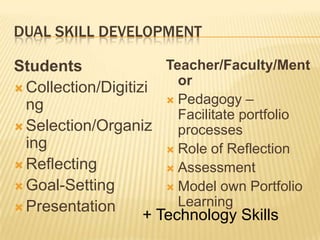
Dual Skill DevelopmentStudentsCollection/ DigitizingSelection/ OrganizingReflectingGoal-SettingPresentationTeacher/Faculty/MentorPedagogy – Facilitate portfolio processesRole of ReflectionAssessmentModel own Portfolio Learning+ Technology Skills
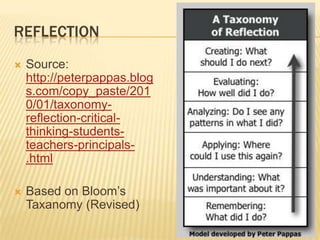
ReflectionSource: http://peterpappas.blogs.com/copy_paste/2010/01/taxonomy-reflection-critical-thinking-students-teachers-principals-.htmlBased on Bloom’s Taxanomy (Revised)
FrustrationResources
Tools, Tools, Tools!RecommendationsCommercial Vendors: keep up with current technology trends – interactivity & mobile!Institutions: Value student learning as much as data collection or accountabilitySchools: Recognize/incorporate students’ out-of-school technology experiences – Don’t block! Educate about Digital Citizenship!Web 2.0 Tool Providers: Don’t pull a “Ning”
GroupsDocsVideoSitesMailCalendarWaveOregon, Colorado, IowaStates Adopt Google Apps for K-12 Schools
Add-ons to Google Apps  by FallAdditional Google Applications soon to be included inside GoogleApps Education domains:
TIMETeachers’ biggest issue:
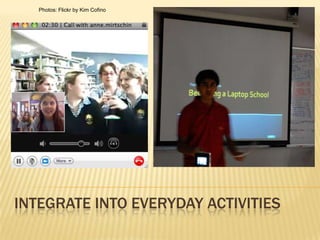
Integrate into everyday ActivitiesPhotos: Flickr by Kim Cofino
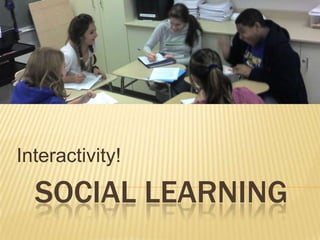
Social LearningInteractivity!
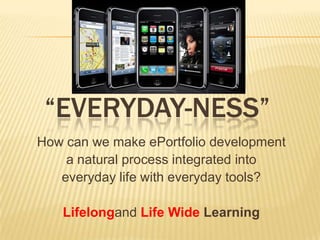
“everyday-ness”How can we make ePortfolio developmenta natural process integrated into everyday life with everyday tools?Lifelong and  Life Wide Learning
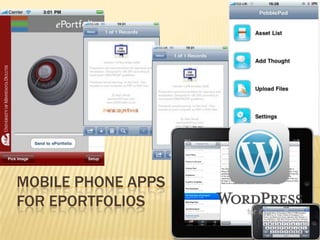
Mobile Phone Apps for ePortfoliosAdd: PebblePad & WordPress Apps
iPad?
XO-3One Laptop per Child Available in 2012 ~$100 Android-based tablet
Gradual ChangeIncentives
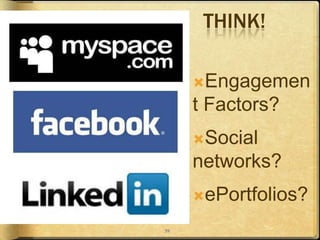
Think!Engagement Factors?Social networks?ePortfolios?39
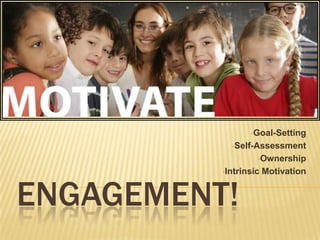
Engagement!Goal-Setting
Self-Assessment
Ownership
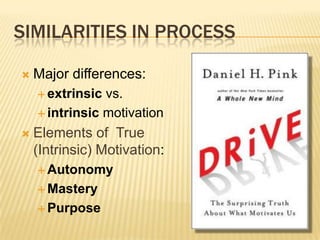
Intrinsic MotivationSimilarities in ProcessMajor differences:extrinsic vs. intrinsic motivation Elements of  True (Intrinsic) Motivation:AutonomyMasteryPurpose
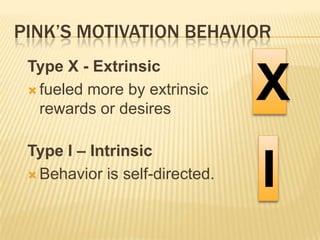
Pink’s Motivation BehaviorX  Type X - Extrinsicfueled more by extrinsic rewards or desiresType I – IntrinsicBehavior is self-directed.I
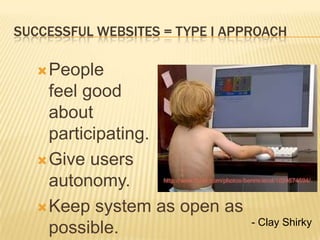
Successful websites = Type I ApproachPeople feel good about participating.Give users autonomy.Keep system as open as possible.- Clay Shirky
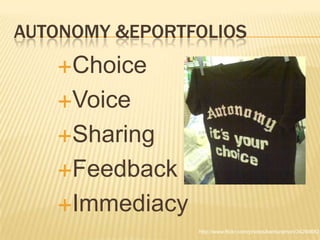
Autonomy & ePortfoliosChoiceVoiceSharing FeedbackImmediacyhttp://www.flickr.com/photos/kenturamon/342946821/
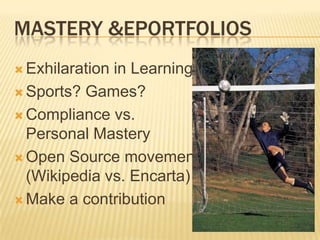
Mastery & ePortfoliosExhilaration in LearningSports? Games?Compliance vs. Personal MasteryOpen Source movement (Wikipedia vs. Encarta) Make a contribution
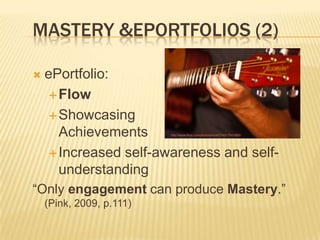
Mastery & ePortfolios (2)ePortfolio:FlowShowcasing AchievementsIncreased self-awareness and self-understanding“Only engagement can produce Mastery.” (Pink, 2009, p.111)
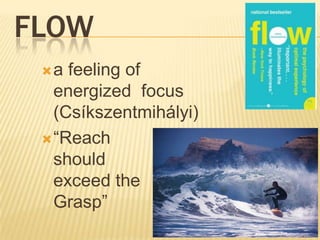
FLOWa feeling of energized  focus (Csíkszentmihályi) “Reach should exceed the Grasp”
Use ePortfolios to documentMASTERY
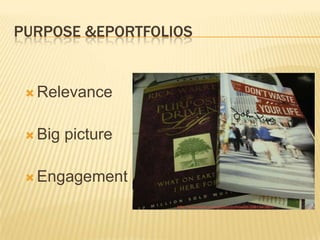
Purpose & ePortfoliosRelevanceBig pictureEngagement
Good Question…
Because Purpose and Passion Co-Exist
False StartsAction Plan
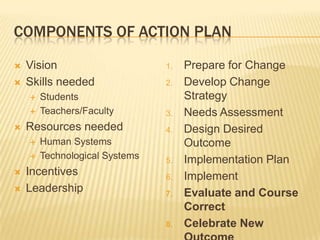
Components of Action PlanVisionSkills neededStudentsTeachers/FacultyResources neededHuman SystemsTechnological SystemsIncentives LeadershipPrepare for ChangeDevelop Change StrategyNeeds AssessmentDesign Desired OutcomeImplementation PlanImplementEvaluate and Course CorrectCelebrate New Outcome
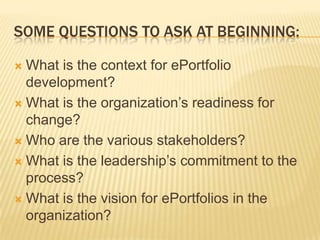
Some Questions to Ask at Beginning:What is the context for ePortfolio development?What is the organization’s readiness for change?Who are the various stakeholders?What is the leadership’s commitment to the process?What is the vision for ePortfolios in the organization?
AssessmentCautions
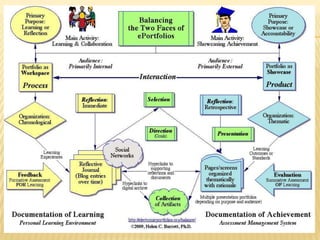
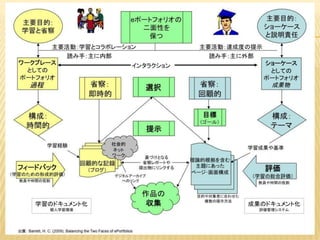
Japanese
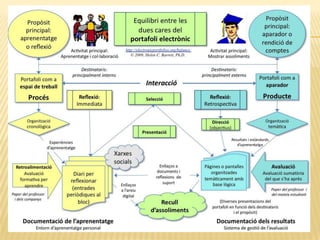
Catalan
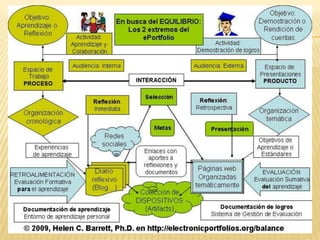
Spanish
Mandarin
Opportunity CostThe alternative you give up when you make a decision…The cost of an alternative that must be forgone in order to pursue a certain action	What is the opportunity cost of emphasizing accountability/compliance in ePortfolios over improvement/reflection and deep learning?
Portfolios can help learners find their Voice… and explore their Purpose and Passions through Choice!
ePortfolios should be more Conversationthan Presentation(or Checklist)Because Conversation transforms!
A Reminder…Reflection &Relationships… the “Heart and Soul” of a Portfolio… (and Social Networking) NOT the Technology!
My Final Wish…dynamic celebrationsstories of deep learningacross the lifespan

Eifel2010

  • 1.
    Challenges for theEducation/ePortfolioCommunity:Change!Keynote Address, July 7, 2010EIFeL ConferenceDr. Helen Barretthttp://slideshare.net/eportfolios
  • 2.
    Interactive ePortfoliosA bookunder development“Using Web 2.0 to preserve memories, share stories of deep learning, document achievements, and envision the future”
  • 3.
    Tentative ContentsIntro -“Why”-PurposesReflection AssessmentWeb 2.0 ToolsPlanning & ChangeBalancing 2 FacesLifelong ePortfoliosExamples & Stories:- ECE & Primary- Middle School- High School- College - ProfessionalHow-to’s- GoogleApps- WordPressDigital Storytelling in ePortfolios
  • 4.
    Roadmap for ChangeePortfolios=complexCHANGErequiring a roadmap to:Assess needPlanImplementEvaluate
  • 5.
  • 6.
    What Type ofChange?Developmental Change Increasing skills of staff and leadership. Improving the performance of a team or group. Improving the quality of services.Transitional ChangeDoing something differently. Dismantling the old way of doing things and putting into place the new, desired state. Transformational ChangeA fundamental shift in the way stakeholders views themselves and their world that results in changes in how they operate and interact with others.
  • 7.
  • 8.
    Roadmap – pt.1-2Step 1: Prepare for ChangeBuild a case for changeAssess organization readiness for changeStep 2: Develop a Change StrategyConsider different strategies for different types of change Develop a Communications StrategyChange Strategies, Target, Tools
  • 9.
    Roadmap pt. 3-4Step3: Conduct a Needs AssessmentAssess Current State Determine technical requirementsAssess staff and other stakeholders’ skills and attitudesConduct a risk analysisStep 4: Design Desired State/OutcomeConfirm the old way is going away Assess the impact of the desired change on all aspects of the organization Gather and respond to feedback from key stakeholdersEnsure managerial alignment and commitment to support the new state
  • 10.
    Roadmap Pt. 5-6Step5: Develop an Implementation PlanBuild a Project PlanDevelop a Human Resource PlanDevelop a Process for Monitoring and EvaluatingDevelop a Communications PlanStep 6: Implement the ChangeImplement the project action plan(s)Monitor and acknowledge progress toward milestonesMonitor and manage risksCommunicate with key stakeholders
  • 11.
    Roadmap pt. 7-8Step 7: Evaluate and Course CorrectMonitor desired outcomes Make course correctionsEvaluate impact to business, technology and human systemsCapture “lessons learned” for future effortsEstablish a process for continuous improvementStep 8: Celebrate and Integrate the New State Declare and celebrate completion of the implementation phaseAcknowledge and reward extra effort and achievementsShare “lessons learned” with key stakeholdersReinforce desired state in performance reviews, policies and procedures
  • 12.
  • 13.
    ChangeVisionClarity of MultiplePurposesSkillsPortfolio ProcessesResourcesTimeIncentivesIntrinsic MotivationAction Plan
  • 14.
  • 15.
    Golden Circle 16What?How?Why?
  • 16.
    Multiple Purposes fromHidden AssumptionsWhat are yours?• Showcase • Assessment • Learning •http://www.rsc-northwest.ac.uk/acl/eMagArchive/RSCeMag2008/choosing%20an%20eportfolio/cool-cartoon-346082.png
  • 17.
    1 paragraph!What isyour “elevator Speech” describing your Vision for ePortfolios?
  • 18.
    A California SchoolDistrict K-12 VisionElectronic portfolios foster meaningful learning by allowing all students to evaluate their growth over time, to share their achievements and strengths with others, and to improve their own skills through reflection and goal setting.
  • 19.
    One NYC school’sVisionAn electronic portfolio will allow students to create a collaborative, portable, personal space that fosters self-reflection, promotes academic accomplishments, and highlights individual growth. Through the integration of technology and the collection of digital artifacts, students will be able to showcase their achievements to peers and educators, while helping envision their future goals.
  • 20.
  • 21.
    Two Skills acrossthe Lifespan with ePortfolio Development and Social NetworkingTechnology & Reflection
  • 22.
    Boundaries Blurring (betweene-portfolios & social networks)Structured Accountability Systems? or…Lifelong interactive portfoliosPicasaMash-upsFacebookFlickrblogsYouTubeNingwikisTwitter
  • 23.
    ProcessesTechnologyArchivingLinking/Thinking Digital Storytelling Collaborating PublishingPortfolioCollectingSelectingReflectingDirectingPresentingFeedbackSocial NetworksConnecting(“Friending”)Listening(Reading)Responding(Commenting)Sharing(linking/tagging)
  • 24.
    Dual Skill DevelopmentStudentsCollection/DigitizingSelection/ OrganizingReflectingGoal-SettingPresentationTeacher/Faculty/MentorPedagogy – Facilitate portfolio processesRole of ReflectionAssessmentModel own Portfolio Learning+ Technology Skills
  • 25.
  • 26.
  • 27.
    Tools, Tools, Tools!RecommendationsCommercialVendors: keep up with current technology trends – interactivity & mobile!Institutions: Value student learning as much as data collection or accountabilitySchools: Recognize/incorporate students’ out-of-school technology experiences – Don’t block! Educate about Digital Citizenship!Web 2.0 Tool Providers: Don’t pull a “Ning”
  • 28.
  • 29.
    Add-ons to GoogleApps by FallAdditional Google Applications soon to be included inside GoogleApps Education domains:
  • 30.
  • 31.
    Integrate into everydayActivitiesPhotos: Flickr by Kim Cofino
  • 32.
  • 33.
    “everyday-ness”How can wemake ePortfolio developmenta natural process integrated into everyday life with everyday tools?Lifelong and Life Wide Learning
  • 34.
    Mobile Phone Appsfor ePortfoliosAdd: PebblePad & WordPress Apps
  • 35.
  • 36.
    XO-3One Laptop perChild Available in 2012 ~$100 Android-based tablet
  • 37.
  • 38.
  • 39.
  • 40.
  • 41.
  • 42.
    Intrinsic MotivationSimilarities inProcessMajor differences:extrinsic vs. intrinsic motivation Elements of True (Intrinsic) Motivation:AutonomyMasteryPurpose
  • 43.
    Pink’s Motivation BehaviorX Type X - Extrinsicfueled more by extrinsic rewards or desiresType I – IntrinsicBehavior is self-directed.I
  • 44.
    Successful websites =Type I ApproachPeople feel good about participating.Give users autonomy.Keep system as open as possible.- Clay Shirky
  • 45.
    Autonomy & ePortfoliosChoiceVoiceSharingFeedbackImmediacyhttp://www.flickr.com/photos/kenturamon/342946821/
  • 46.
    Mastery & ePortfoliosExhilarationin LearningSports? Games?Compliance vs. Personal MasteryOpen Source movement (Wikipedia vs. Encarta) Make a contribution
  • 47.
    Mastery & ePortfolios(2)ePortfolio:FlowShowcasing AchievementsIncreased self-awareness and self-understanding“Only engagement can produce Mastery.” (Pink, 2009, p.111)
  • 48.
    FLOWa feeling ofenergized focus (Csíkszentmihályi) “Reach should exceed the Grasp”
  • 49.
    Use ePortfolios todocumentMASTERY
  • 50.
  • 51.
  • 52.
    Because Purpose andPassion Co-Exist
  • 53.
  • 54.
    Components of ActionPlanVisionSkills neededStudentsTeachers/FacultyResources neededHuman SystemsTechnological SystemsIncentives LeadershipPrepare for ChangeDevelop Change StrategyNeeds AssessmentDesign Desired OutcomeImplementation PlanImplementEvaluate and Course CorrectCelebrate New Outcome
  • 55.
    Some Questions toAsk at Beginning:What is the context for ePortfolio development?What is the organization’s readiness for change?Who are the various stakeholders?What is the leadership’s commitment to the process?What is the vision for ePortfolios in the organization?
  • 56.
  • 58.
  • 59.
  • 60.
  • 61.
  • 62.
    Opportunity CostThe alternativeyou give up when you make a decision…The cost of an alternative that must be forgone in order to pursue a certain action What is the opportunity cost of emphasizing accountability/compliance in ePortfolios over improvement/reflection and deep learning?
  • 63.
    Portfolios can helplearners find their Voice… and explore their Purpose and Passions through Choice!
  • 64.
    ePortfolios should bemore Conversationthan Presentation(or Checklist)Because Conversation transforms!
  • 65.
    A Reminder…Reflection &Relationships…the “Heart and Soul” of a Portfolio… (and Social Networking) NOT the Technology!
  • 66.
    My Final Wish…dynamiccelebrationsstories of deep learningacross the lifespan

Editor's Notes

  • #2 Process of Change
  • #5 Drawn from the literature on Organizational Development
  • #6 What is the readiness level of key stakeholders – both attitude and skill?What change management and project management processes do we need to put in place?
  • #10 Most technology projects include two or more types of change. To support this change, different strategies, targets and tools may be needed, e.g.
  • #15 The ePortfolio Community needs to pay attention to the OD Community: those professional who understand and facilitate Change.
  • #16 Is this happening in your institution?
  • #23 There are two skills that are needed across the lifespan with both ePortfolio Development and social networking: Technology and Reflection.
  • #24 The boundaries are blurring between eportfolios and social networks. As we consider the potential of lifelong e-portfolios, will they resemble the structured accountability systems that are currently being implemented in many educational institutions? Or are we beginning to see lifelong interactive portfolios emerging as… mash-ups in the Web 2.0 cloud, using Blogs or wikis or Twitter,Facebook or Ning,Flickr or Picasa or YouTube, etc.?
  • #27 Reflection = higher retention (SPU’s iTunesU videos)
  • #28 Oregon in April, Colorado & Iowa yesterday.
  • #33 iTunes U broadcast from Seattle University on bPortfolios and Reflective activities
  • #37 Just like Social NetworksRefer to my TEDxASB talk on YouTube
  • #42 There are many similarities between these two processes; the major differences are often in extrinsic vs. intrinsic motivation Dan Pink describes the essential elements of true (intrinsic) motivation in his new book, Drive, the concepts of autonomy, mastery, and purpose.
  • #43 Pink says, “It is devoted to becoming better and better at something that matters. And it connects that quest for excellence to a larger purpose.” (p. 80-81) Pink identifies two types of Motivation Behavior: Type X Extrinsic, fueled by extrinsic rewards or desires. And Type I Intrinsic, where behavior is self-directed. I am on a campaign to make electronic portfolios a more intrinsically-motivated process.
  • #44 Pink quotes Internet scholar Clay Shirky ...the most successful websites and electronic forums have a certain Type I approach [to motivation] in their DNA. They're designed-often explicitly--to tap into intrinsic motivation. You can do the same with your online presences if you listen to Shirky and: Create an environment that makes people feel good about participating.Give users autonomy.Keep the system as open as possible. That’s also good advice for developing ePortfolios.
  • #45 The urge for Self-Direction is basic human need.It is a Natural state to be Active and EngagedePortfolio Implementation should adopt the motivating characteristics of autonomy found in social networksChoiceVoiceSharing and FeedbackImmediacy
  • #46 According to a tweet I read from ChadHamady, True Mastery NOT possible without FUN! (Chad Hamady@chamady Twitter, January 16, 2010)There is an inherent exhilaration in Learning“It’s fun to get better at something!” – Why do we play Sports and Games?Is it for Compliance or Personal MasteryLook to the Open Source movement (popularity of Wikipedia vs. the demise of Microsoft’s Encarta) – Authors and programmers look for Challenge and Improvement – To make a contribution to the greater good
  • #47 In their spare time, people gravitate toward activities where they gain masteryePortfolio Implementation should adopt the motivating characteristics of mastery found in social networksFlow,Showcasing Achievements,Increased self-awareness and self-understanding“Only engagement can produce Mastery.” (Pink, 2009, p.111)
  • #48 Csíkszentmihályi popularized the concept of Flow as a feeling of energized focus. According to Wikipedia, it is a single-minded immersion and represents perhaps the ultimate in harnessing the emotions in the service of performing and learning. In flow the emotions are not just contained and channeled, but positive, energized, and aligned with the task at hand. The hallmark of flow is a feeling of spontaneous joy, even rapture, while performing a task.
  • #49 We should use ePortfolios to document our MASTERY of skills and content. Showcase our Achievements! Share our Expertise!Support Personal & Professional Development!
  • #50 Pink’s third concept is Purpose. All of us want to be part of something larger than ourselvesWhen people learn, they want to know the relevance of what they are learningThe more people understand the big picture, the more they will be engaged
  • #51 Here is a good question:
  • #52 Because Purpose and Passion Co-Exist.
  • #53 Japanese!
  • #54 Catalan
  • #55 Spanish!
  • #56 Mandarin
  • #57 “Portfolios should be less about tellingand more about talking!” Julie Hughes, University of Wolverhampton
  • #65 As I close my presentation, I want remind us that reflection and relationships are the “heart and soul: of a portfolio (and Social Networking) NOT the Technology!