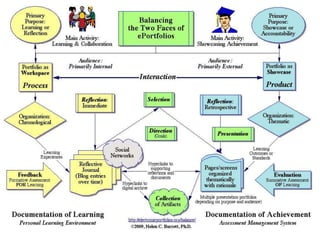
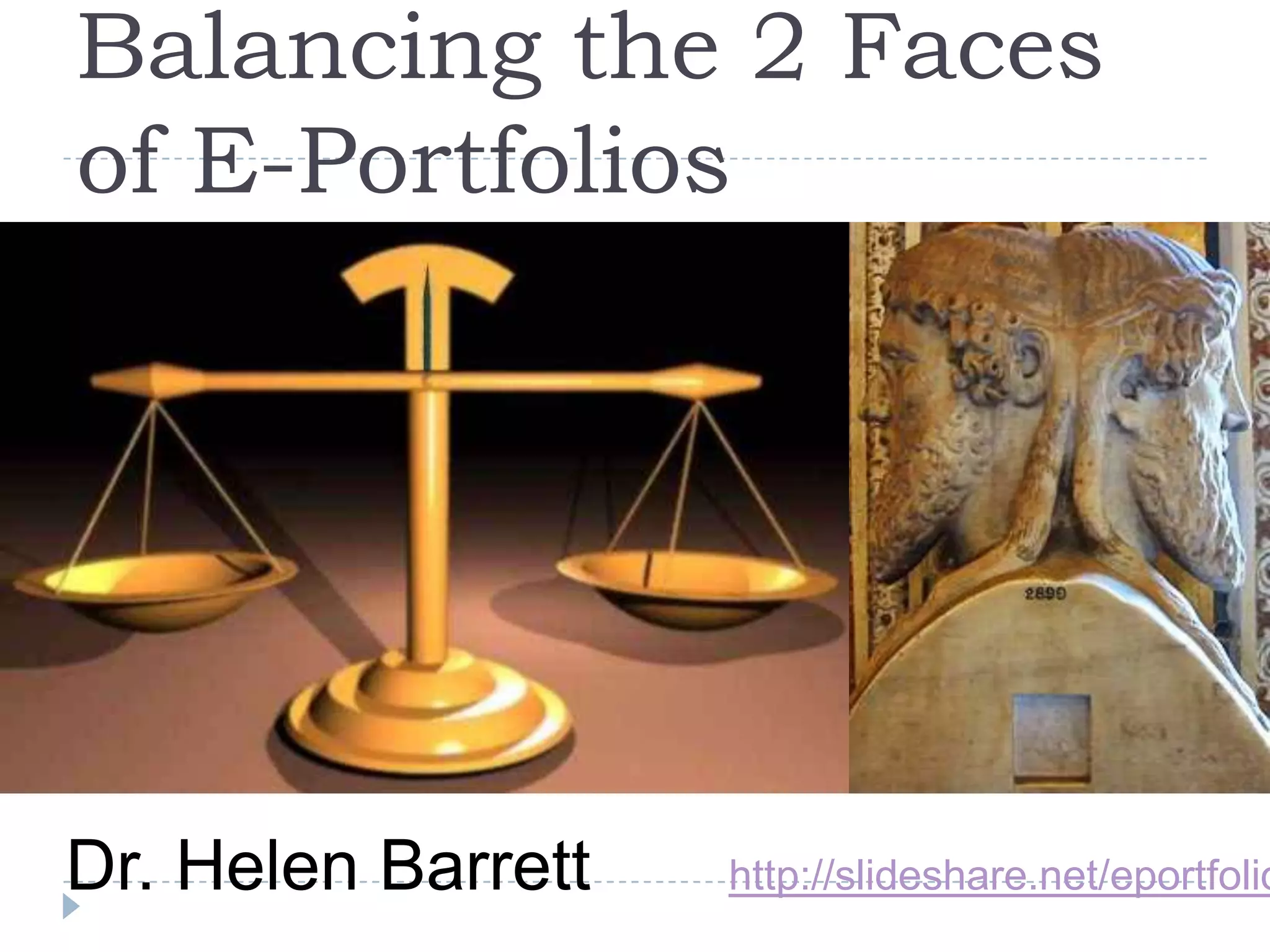
Balancing the 2 Faces of E-PortfoliosDr. Helen Barrett       http://slideshare.net/eportfolios
Key Themes of My PresentationPurposeProcessProduct
Raise your hands if you are…Implementing an ePortfolio System with your studentsThinking about itUsing e-portfolios to support student learningUsing e-portfolio evaluation data for accreditation or institutional assessment
Personal Learning Environment (PLE) Supports Self-Directed Learningwith a Personal Learning Network (PLN)
“Purpose” Drives the ProcessThis presentation will balance Student-Centered Purposes(Learning, Reflection, Showcase)withInstitution-Centered Purposes(Evaluation, Accountability)
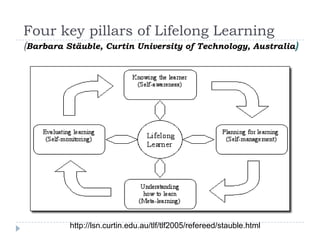
Four key pillars of Lifelong Learning(Barbara Stäuble, Curtin University of Technology, Australia)http://lsn.curtin.edu.au/tlf/tlf2005/refereed/stauble.html
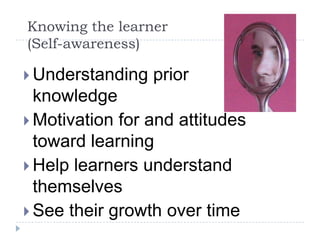
Knowing the learner (Self-awareness)Understanding prior knowledgeMotivation for and attitudes toward learningHelp learners understand themselvesSee their growth over time
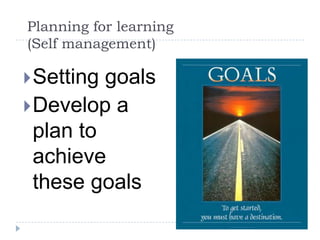
Planning for learning (Self management)Setting goalsDevelop a plan to achieve these goals
Understanding how to learn (Meta-learning)Awareness of learners to different approaches to learningDeep vs. Surface Learning, Rote vs. Meaningful LearningDifferent Learning StylesHelp learners recognize successAccommodate approaches that are not successful
Evaluating learning (Self monitoring)Systematic analysis of learners’ performanceResponsibility to construct meaningBe reflective & think criticallyLearners construct meaning, monitor learning,evaluate own outcomes
Deep Learninginvolves reflection,is developmental,is integrative,is self-directive, andis lifelongCambridge (2004)
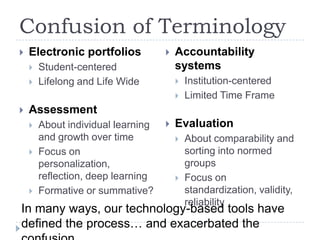
Confusion of TerminologyElectronic portfoliosStudent-centeredLifelong and Life WideAssessmentAbout individual learning and growth over timeFocus on personalization, reflection, deep learningFormative or summative?Accountability systemsInstitution-centeredLimited Time FrameEvaluationAbout comparability and sorting into normed groupsFocus on standardization, validity, reliability In many ways, our technology-based tools have defined the process… and exacerbated the confusion.
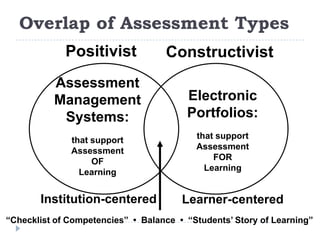
Overlap of Assessment TypesPositivistConstructivistAssessment Management Systems: that supportAssessmentOFLearningElectronic Portfolios: that supportAssessmentFORLearningInstitution-centeredLearner-centered“Checklist of Competencies”  •  Balance  •  “Students’ Story of Learning”
What is a Portfolio?Dictionary definition: a flat, portable case for carrying loose papers, drawings, etc.Financial portfolio: document accumulation of fiscalcapitalEducational portfolio: document development of humancapital
What is a Portfolio in Education?A portfolio is a purposeful collection of student work that exhibits the student's efforts, progress and achievements in one or more areas[over time].	(Northwest Evaluation Association, 1990)
What is an Electronic Portfolio?Digital DocumentsOrganized and presented with some type of "authoring" softwareStored in an electronic container CD-Recordable discDVD-Recordable disc WWW – Changing the genre!
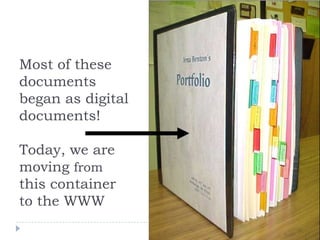
Most of these documents began as digital documents!Today, we are moving from this container  to the WWW
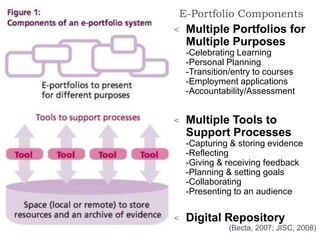
E-Portfolio Components Multiple Portfolios for Multiple Purposes-Celebrating Learning-Personal Planning-Transition/entry to courses-Employment applications-Accountability/Assessment
Multiple Tools to Support Processes-Capturing & storing evidence-Reflecting-Giving & receiving feedback-Planning & setting goals-Collaborating-Presenting to an audience
Digital Repository(Becta, 2007; JISC, 2008)
Questions to PonderWhat happens to electronic portfolios once learners leave an institution? Can learners continue to maintain their own “digital documentation of development” throughout their lifetime? (Do they even want to?) Has the process of reflective practice become a habit of mind that will support lifelong learning? Cognitive Dissonance
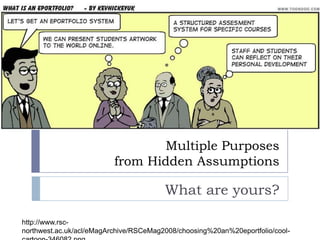
Multiple Purposes from Hidden AssumptionsWhat are yours?http://www.rsc-northwest.ac.uk/acl/eMagArchive/RSCeMag2008/choosing%20an%20eportfolio/cool-cartoon-346082.png
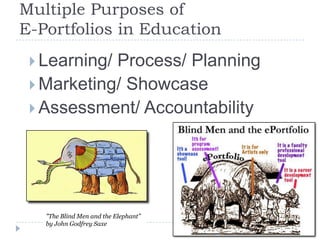
Multiple Purposes of E-Portfolios in EducationLearning/ Process/ PlanningMarketing/ Showcase Assessment/ Accountability"The Blind Men and the Elephant” by John Godfrey Saxe
ePortfolio designs/strategies for different purposes Learning Portfolios (Formative assessment)Organized chronologicallyFocus of Reflection: Learning Activities & ArtifactsTools: Reflective Journal (blog)Faculty/peer role: Feedback on artifacts and reflection
ePortfolio designs/strategies for different purposes Showcase Portfolios (Employment, Self-marketing)Organized thematically (position requirements)Focus of Reflection: Suitability for positionTools: Choice of portfolio owner – personalized web pages – digital footprintPersonal online branding
ePortfolio designs/strategies for different purposes Assessment/Accountability Portfolios (Summative assessment)Organized thematically (outcomes, goals or standards)Focus of Reflection:  Achievement of Standards (rationale)Tools: Assessment system with data from scoring rubricsFaculty role: Evaluation
Limitations of PortfoliosShavelson, Klein & Benjamin, Inside Higher Ed, October 16, 2009http://www.insidehighered.com/views/2009/10/16/shavelsonMain PointsLack of StandardizationNot Feasible for Large Scale Learning AssessmentBiasEnlightening responses to article– titles of some entries:Vision that is too narrow What's in it for the students? Why standardized tests still have not changed Maybe this approach to assessment is the real problem Accountability does not equal comparability and standardization The easy way out. . . Assessment for What? Viewpoint or ad?
A few thoughts about Assessment -- What Type?Assessment OF Learning? orAssessment FOR Learning? or Assessment AS Learning
Purposes for AssessmentAssessmentOFLearning = Summative AssessmentInstitution-centered Past-to-PresentAssessment FOR Learning = Formative AssessmentTeacher/student-centeredPresent-to-FutureAssessment AS Learning
Student-centered – embedded in learning
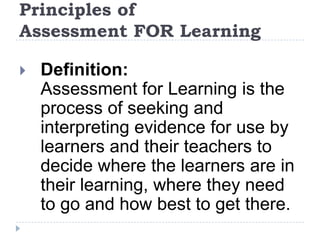
Focus on the PresentPrinciples of Assessment FOR LearningDefinition:Assessment for Learning is the process of seeking and interpreting evidence for use by learners and their teachers to decide where the learners are in their learning, where they need to go and how best to get there.
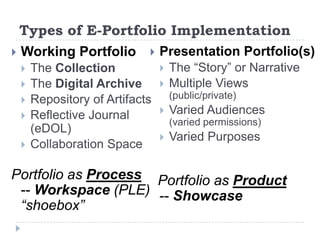
Types of E-Portfolio ImplementationWorking PortfolioThe CollectionThe Digital ArchiveRepository of Artifacts Reflective Journal(eDOL)Collaboration SpacePortfolio as Process-- Workspace (PLE)“shoebox”Presentation Portfolio(s)The “Story” or NarrativeMultiple Views (public/private)Varied Audiences(varied permissions)Varied Purposes  Portfolio as Product-- Showcase
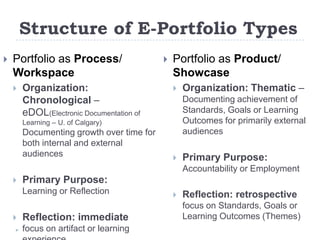
Structure of E-Portfolio TypesPortfolio as Process/ WorkspaceOrganization: Chronological – eDOL(Electronic Documentation of Learning – U. of Calgary) Documenting growth over time for both internal and external audiencesPrimary Purpose: Learning or ReflectionReflection: immediate focus on artifact or learning experiencePortfolio as Product/ ShowcaseOrganization: Thematic – Documenting achievement of Standards, Goals or Learning Outcomes for primarily external audiencesPrimary Purpose: Accountability or EmploymentReflection: retrospective focus on Standards, Goals or Learning Outcomes (Themes)
QUOTEThe e-portfolio is the central and common point for the student experience… It is a reflection of the student as a person undergoing continuous personal development, not just a store of evidence.-Geoff Rebbeck, e-Learning Coordinator, Thanet College, quoted in JISC, 2008, Effective Practice with e-Portfolios
Student-Centered Philosophy	"A portfolio tells a story. It is the story of knowing. Knowing about things... Knowing oneself... Knowing an audience... Portfolios are students' own stories of what they know, why they believe they know it, and why others should be of the same opinion.” (Paulson & Paulson,  1991, p.2)
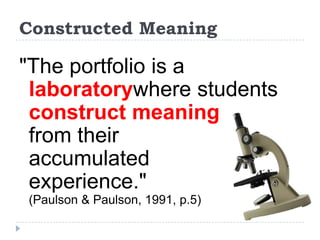
Constructed Meaning"The portfolio is a laboratorywhere students construct meaningfrom theiraccumulated experience."(Paulson & Paulson, 1991, p.5)
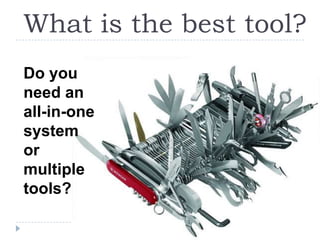
What is the best tool?	Do you need an all-in-one system or multiple tools?
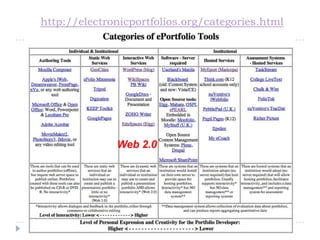
Categories of E-Portfolio SoftwareCreated as part of my study of different online tools:http://electronicportfolios.org/categories.html“Not just tools for telling[presentation]but more tools for talking![conversation]”- Julie Hughes, University of WolverhamptonConversation transforms!
http://electronicportfolios.org/categories.htmlWeb 2.0
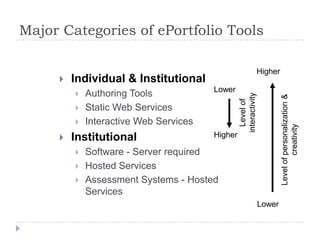
Major Categories of ePortfolio ToolsHigherIndividual & InstitutionalAuthoring ToolsStatic Web ServicesInteractive Web Services	InstitutionalSoftware - Server requiredHosted ServicesAssessment Systems - Hosted ServicesLowerLevel of interactivityHigherLevel of personalization & creativityLower
Web 2.0 tag cloud
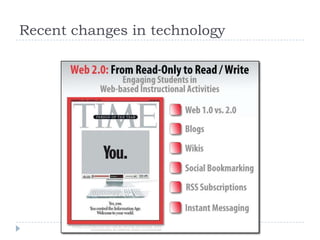
Recent changes in technology
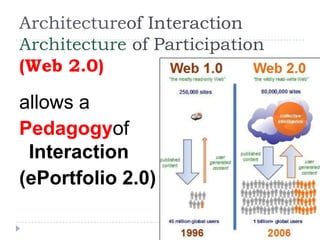
Architectureof InteractionArchitecture of Participation (Web 2.0) allows aPedagogyof Interaction(ePortfolio 2.0)
Web 2.0 is becoming the Personal Learning Environment of the “Net Generation”Learning that is… Social and Participatory
Lifelong and Life Wide
Increasingly Self-Directed
Motivating and Engaging
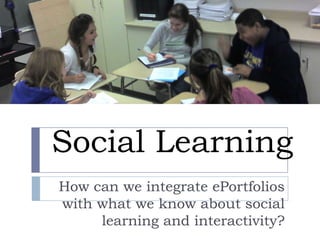
… and Online!Social LearningHow can we integrate ePortfolios with what we know about social learning and interactivity?
Some Basic Concepts“ePortfoliois both process and product”Process: A series of events (time and effort) to produce a result- From Old French proces(“‘journey’”)Product: the outcome/results or “thinginess” of an activity/process- DestinationWiktionary
Think!What are the engagement factors that drive the use of social networks and how can we incorporate those factors into ePortfolios?
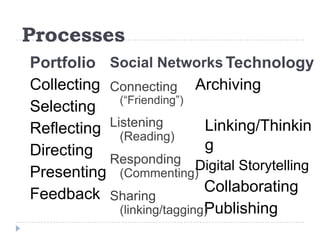
ProcessesPortfolioCollectingSelectingReflectingDirectingPresentingFeedbackTechnology  Archiving  Linking/ThinkingDigital Storytelling  Collaborating  PublishingSocial NetworksConnecting(“Friending”)Listening(Reading)Responding(Commenting)Sharing(linking/tagging)
Similarities in ProcessMajor differences:extrinsic vs. intrinsic motivation Elements of  True (Intrinsic) Motivation:AutonomyMasteryPurpose
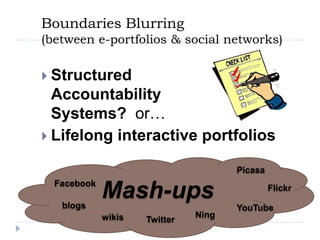
Boundaries Blurring (between e-portfolios & social networks)Structured Accountability Systems?  or…Lifelong interactive portfoliosPicasaMash-upsFacebookFlickrblogsYouTubeNingwikisTwitter
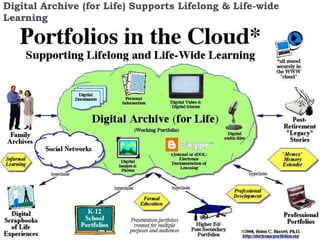
Digital Archive (for Life) Supports Lifelong & Life-wide Learning
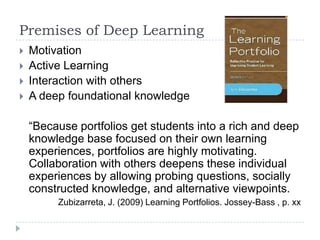
Premises of Deep LearningMotivationActive LearningInteraction with othersA deep foundational knowledge	“Because portfolios get students into a rich and deep knowledge base focused on their own learning experiences, portfolios are highly motivating. Collaboration with others deepens these individual experiences by allowing probing questions, socially constructed knowledge, and alternative viewpoints.Zubizarreta, J. (2009) Learning Portfolios. Jossey-Bass , p. xx
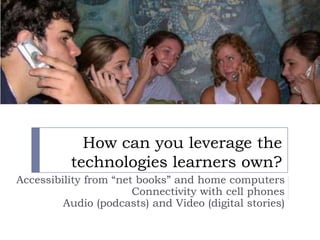
How can you leverage the technologies learners own?Accessibility from “net books” and home computersConnectivity with cell phonesAudio (podcasts) and Video (digital stories)
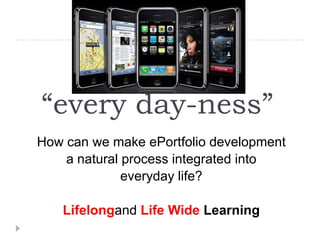
“every day-ness”How can we make ePortfolio developmenta natural process integrated into everyday life?Lifelongand Life Wide Learning
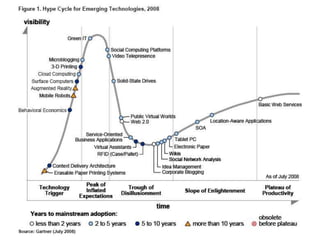
Making ePortfolios StickWill your students want to use the e-portfolio process after they graduate? Will ePortfoliotools be available to them after graduation?Gartner Group “Hype Cycle for Education” has ePortfolios "Sliding Into the Trough"
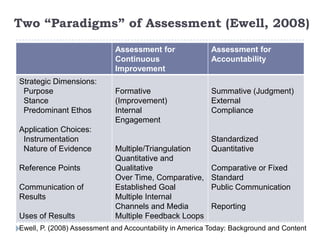
Two “Paradigms” of Assessment (Ewell, 2008)Ewell, P. (2008) Assessment and Accountability in America Today: Background and Content
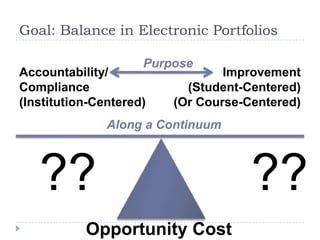
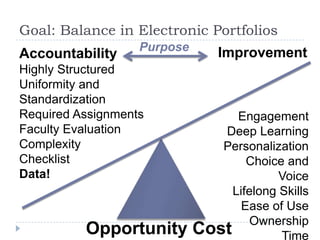
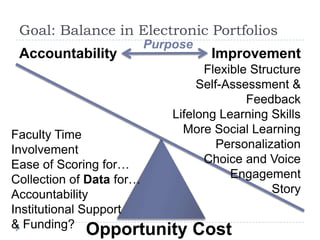
Opportunity CostThe alternative you give up when you make a decision…The cost of an alternative that must be forgone in order to pursue a certain action	What is the opportunity cost of emphasizing accountability/compliance in e-portfolios over improvement/reflection and deep learning?
Opportunity Cost – a conversation with a high school teacher:"It took all the thinking out of it. They gave me the standards and told me which artifacts to put into each one! It wasn't as effective as what my students did!” http://electronicportfolios.org/blog/2008/07/necc-2008-update.htmlWhat learning opportunities are we missing when we completely structure the learner’s portfolio?
Goal: Balance in Electronic PortfoliosPurposeAccountability/Compliance(Institution-Centered)Improvement(Student-Centered)(Or Course-Centered)Along a Continuum????Opportunity Cost
Goal: Balance in Electronic PortfoliosPurposeImprovementAccountabilityHighly StructuredUniformity and StandardizationRequired AssignmentsFaculty Evaluation   ComplexityChecklistData!EngagementDeep LearningPersonalizationChoice and VoiceLifelong SkillsEase of UseOwnershipTimeOpportunity Cost
Goal: Balance in Electronic PortfoliosPurposeAccountabilityImprovementFlexible StructureSelf-Assessment & FeedbackLifelong Learning SkillsMore Social LearningPersonalizationChoice and VoiceEngagementStoryFaculty Time InvolvementEase of Scoring for…Collection of Data for… AccountabilityInstitutional Support& Funding?Opportunity Cost
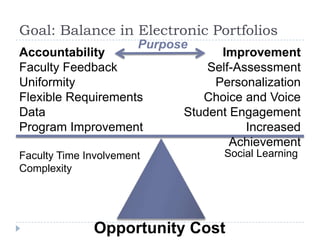
Goal: Balance in Electronic PortfoliosPurposeAccountability Faculty Feedback UniformityFlexible RequirementsDataProgram ImprovementImprovementSelf-AssessmentPersonalizationChoice and VoiceStudent EngagementIncreased Achievement Social LearningFaculty Time InvolvementComplexityOpportunity Cost
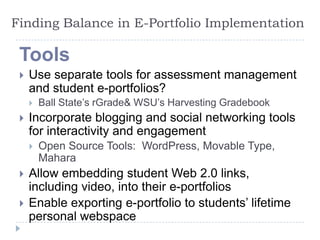
Finding Balance in E-Portfolio ImplementationToolsUse separate tools for assessment management and student e-portfolios?Ball State’s rGrade & WSU’s Harvesting GradebookIncorporate blogging and social networking tools for interactivity and engagementOpen Source Tools:  WordPress, Movable Type, MaharaAllow embedding student Web 2.0 links, including video, into their e-portfoliosEnable exporting e-portfolio to students’ lifetime personal webspace
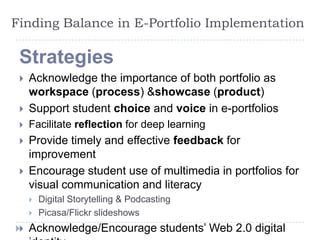
Finding Balance in E-Portfolio ImplementationStrategiesAcknowledge the importance of both portfolio as workspace (process) & showcase (product)Support student choice and voice in e-portfoliosFacilitate reflection for deep learningProvide timely and effective feedback for improvementEncourage student use of multimedia in portfolios for visual communication and literacyDigital Storytelling & PodcastingPicasa/Flickr slideshowsAcknowledge/Encourage students’ Web 2.0 digital identity
Move beyond text-only artifactsEncourage development of multimedia artifactsIntroduce alternative strategies for reflectionBloggingDigital storytelling

Wake Forest0410

  • 1.
    Balancing the 2Faces of E-PortfoliosDr. Helen Barrett http://slideshare.net/eportfolios
  • 2.
    Key Themes ofMy PresentationPurposeProcessProduct
  • 3.
    Raise your handsif you are…Implementing an ePortfolio System with your studentsThinking about itUsing e-portfolios to support student learningUsing e-portfolio evaluation data for accreditation or institutional assessment
  • 4.
    Personal Learning Environment(PLE) Supports Self-Directed Learningwith a Personal Learning Network (PLN)
  • 5.
    “Purpose” Drives theProcessThis presentation will balance Student-Centered Purposes(Learning, Reflection, Showcase)withInstitution-Centered Purposes(Evaluation, Accountability)
  • 6.
    Four key pillarsof Lifelong Learning(Barbara Stäuble, Curtin University of Technology, Australia)http://lsn.curtin.edu.au/tlf/tlf2005/refereed/stauble.html
  • 7.
    Knowing the learner(Self-awareness)Understanding prior knowledgeMotivation for and attitudes toward learningHelp learners understand themselvesSee their growth over time
  • 8.
    Planning for learning(Self management)Setting goalsDevelop a plan to achieve these goals
  • 9.
    Understanding how tolearn (Meta-learning)Awareness of learners to different approaches to learningDeep vs. Surface Learning, Rote vs. Meaningful LearningDifferent Learning StylesHelp learners recognize successAccommodate approaches that are not successful
  • 10.
    Evaluating learning (Selfmonitoring)Systematic analysis of learners’ performanceResponsibility to construct meaningBe reflective & think criticallyLearners construct meaning, monitor learning,evaluate own outcomes
  • 11.
    Deep Learninginvolves reflection,isdevelopmental,is integrative,is self-directive, andis lifelongCambridge (2004)
  • 12.
    Confusion of TerminologyElectronicportfoliosStudent-centeredLifelong and Life WideAssessmentAbout individual learning and growth over timeFocus on personalization, reflection, deep learningFormative or summative?Accountability systemsInstitution-centeredLimited Time FrameEvaluationAbout comparability and sorting into normed groupsFocus on standardization, validity, reliability In many ways, our technology-based tools have defined the process… and exacerbated the confusion.
  • 13.
    Overlap of AssessmentTypesPositivistConstructivistAssessment Management Systems: that supportAssessmentOFLearningElectronic Portfolios: that supportAssessmentFORLearningInstitution-centeredLearner-centered“Checklist of Competencies” • Balance • “Students’ Story of Learning”
  • 14.
    What is aPortfolio?Dictionary definition: a flat, portable case for carrying loose papers, drawings, etc.Financial portfolio: document accumulation of fiscalcapitalEducational portfolio: document development of humancapital
  • 15.
    What is aPortfolio in Education?A portfolio is a purposeful collection of student work that exhibits the student's efforts, progress and achievements in one or more areas[over time]. (Northwest Evaluation Association, 1990)
  • 16.
    What is anElectronic Portfolio?Digital DocumentsOrganized and presented with some type of "authoring" softwareStored in an electronic container CD-Recordable discDVD-Recordable disc WWW – Changing the genre!
  • 17.
    Most of thesedocuments began as digital documents!Today, we are moving from this container to the WWW
  • 18.
    E-Portfolio Components MultiplePortfolios for Multiple Purposes-Celebrating Learning-Personal Planning-Transition/entry to courses-Employment applications-Accountability/Assessment
  • 19.
    Multiple Tools toSupport Processes-Capturing & storing evidence-Reflecting-Giving & receiving feedback-Planning & setting goals-Collaborating-Presenting to an audience
  • 20.
  • 21.
    Questions to PonderWhathappens to electronic portfolios once learners leave an institution? Can learners continue to maintain their own “digital documentation of development” throughout their lifetime? (Do they even want to?) Has the process of reflective practice become a habit of mind that will support lifelong learning? Cognitive Dissonance
  • 22.
    Multiple Purposes fromHidden AssumptionsWhat are yours?http://www.rsc-northwest.ac.uk/acl/eMagArchive/RSCeMag2008/choosing%20an%20eportfolio/cool-cartoon-346082.png
  • 23.
    Multiple Purposes ofE-Portfolios in EducationLearning/ Process/ PlanningMarketing/ Showcase Assessment/ Accountability"The Blind Men and the Elephant” by John Godfrey Saxe
  • 24.
    ePortfolio designs/strategies fordifferent purposes Learning Portfolios (Formative assessment)Organized chronologicallyFocus of Reflection: Learning Activities & ArtifactsTools: Reflective Journal (blog)Faculty/peer role: Feedback on artifacts and reflection
  • 25.
    ePortfolio designs/strategies fordifferent purposes Showcase Portfolios (Employment, Self-marketing)Organized thematically (position requirements)Focus of Reflection: Suitability for positionTools: Choice of portfolio owner – personalized web pages – digital footprintPersonal online branding
  • 26.
    ePortfolio designs/strategies fordifferent purposes Assessment/Accountability Portfolios (Summative assessment)Organized thematically (outcomes, goals or standards)Focus of Reflection: Achievement of Standards (rationale)Tools: Assessment system with data from scoring rubricsFaculty role: Evaluation
  • 27.
    Limitations of PortfoliosShavelson,Klein & Benjamin, Inside Higher Ed, October 16, 2009http://www.insidehighered.com/views/2009/10/16/shavelsonMain PointsLack of StandardizationNot Feasible for Large Scale Learning AssessmentBiasEnlightening responses to article– titles of some entries:Vision that is too narrow What's in it for the students? Why standardized tests still have not changed Maybe this approach to assessment is the real problem Accountability does not equal comparability and standardization The easy way out. . . Assessment for What? Viewpoint or ad?
  • 28.
    A few thoughtsabout Assessment -- What Type?Assessment OF Learning? orAssessment FOR Learning? or Assessment AS Learning
  • 29.
    Purposes for AssessmentAssessmentOFLearning= Summative AssessmentInstitution-centered Past-to-PresentAssessment FOR Learning = Formative AssessmentTeacher/student-centeredPresent-to-FutureAssessment AS Learning
  • 30.
  • 31.
    Focus on thePresentPrinciples of Assessment FOR LearningDefinition:Assessment for Learning is the process of seeking and interpreting evidence for use by learners and their teachers to decide where the learners are in their learning, where they need to go and how best to get there.
  • 32.
    Types of E-PortfolioImplementationWorking PortfolioThe CollectionThe Digital ArchiveRepository of Artifacts Reflective Journal(eDOL)Collaboration SpacePortfolio as Process-- Workspace (PLE)“shoebox”Presentation Portfolio(s)The “Story” or NarrativeMultiple Views (public/private)Varied Audiences(varied permissions)Varied Purposes Portfolio as Product-- Showcase
  • 34.
    Structure of E-PortfolioTypesPortfolio as Process/ WorkspaceOrganization: Chronological – eDOL(Electronic Documentation of Learning – U. of Calgary) Documenting growth over time for both internal and external audiencesPrimary Purpose: Learning or ReflectionReflection: immediate focus on artifact or learning experiencePortfolio as Product/ ShowcaseOrganization: Thematic – Documenting achievement of Standards, Goals or Learning Outcomes for primarily external audiencesPrimary Purpose: Accountability or EmploymentReflection: retrospective focus on Standards, Goals or Learning Outcomes (Themes)
  • 35.
    QUOTEThe e-portfolio isthe central and common point for the student experience… It is a reflection of the student as a person undergoing continuous personal development, not just a store of evidence.-Geoff Rebbeck, e-Learning Coordinator, Thanet College, quoted in JISC, 2008, Effective Practice with e-Portfolios
  • 36.
    Student-Centered Philosophy "A portfoliotells a story. It is the story of knowing. Knowing about things... Knowing oneself... Knowing an audience... Portfolios are students' own stories of what they know, why they believe they know it, and why others should be of the same opinion.” (Paulson & Paulson, 1991, p.2)
  • 37.
    Constructed Meaning"The portfoliois a laboratorywhere students construct meaningfrom theiraccumulated experience."(Paulson & Paulson, 1991, p.5)
  • 38.
    What is thebest tool? Do you need an all-in-one system or multiple tools?
  • 39.
    Categories of E-PortfolioSoftwareCreated as part of my study of different online tools:http://electronicportfolios.org/categories.html“Not just tools for telling[presentation]but more tools for talking![conversation]”- Julie Hughes, University of WolverhamptonConversation transforms!
  • 40.
  • 41.
    Major Categories ofePortfolio ToolsHigherIndividual & InstitutionalAuthoring ToolsStatic Web ServicesInteractive Web Services InstitutionalSoftware - Server requiredHosted ServicesAssessment Systems - Hosted ServicesLowerLevel of interactivityHigherLevel of personalization & creativityLower
  • 42.
  • 43.
  • 44.
    Architectureof InteractionArchitecture ofParticipation (Web 2.0) allows aPedagogyof Interaction(ePortfolio 2.0)
  • 45.
    Web 2.0 isbecoming the Personal Learning Environment of the “Net Generation”Learning that is… Social and Participatory
  • 46.
  • 47.
  • 48.
  • 49.
    … and Online!SocialLearningHow can we integrate ePortfolios with what we know about social learning and interactivity?
  • 50.
    Some Basic Concepts“ePortfolioisboth process and product”Process: A series of events (time and effort) to produce a result- From Old French proces(“‘journey’”)Product: the outcome/results or “thinginess” of an activity/process- DestinationWiktionary
  • 51.
    Think!What are theengagement factors that drive the use of social networks and how can we incorporate those factors into ePortfolios?
  • 52.
    ProcessesPortfolioCollectingSelectingReflectingDirectingPresentingFeedbackTechnology Archiving Linking/ThinkingDigital Storytelling Collaborating PublishingSocial NetworksConnecting(“Friending”)Listening(Reading)Responding(Commenting)Sharing(linking/tagging)
  • 53.
    Similarities in ProcessMajordifferences:extrinsic vs. intrinsic motivation Elements of True (Intrinsic) Motivation:AutonomyMasteryPurpose
  • 54.
    Boundaries Blurring (betweene-portfolios & social networks)Structured Accountability Systems? or…Lifelong interactive portfoliosPicasaMash-upsFacebookFlickrblogsYouTubeNingwikisTwitter
  • 55.
    Digital Archive (forLife) Supports Lifelong & Life-wide Learning
  • 56.
    Premises of DeepLearningMotivationActive LearningInteraction with othersA deep foundational knowledge “Because portfolios get students into a rich and deep knowledge base focused on their own learning experiences, portfolios are highly motivating. Collaboration with others deepens these individual experiences by allowing probing questions, socially constructed knowledge, and alternative viewpoints.Zubizarreta, J. (2009) Learning Portfolios. Jossey-Bass , p. xx
  • 57.
    How can youleverage the technologies learners own?Accessibility from “net books” and home computersConnectivity with cell phonesAudio (podcasts) and Video (digital stories)
  • 58.
    “every day-ness”How canwe make ePortfolio developmenta natural process integrated into everyday life?Lifelongand Life Wide Learning
  • 59.
    Making ePortfolios StickWillyour students want to use the e-portfolio process after they graduate? Will ePortfoliotools be available to them after graduation?Gartner Group “Hype Cycle for Education” has ePortfolios "Sliding Into the Trough"
  • 61.
    Two “Paradigms” ofAssessment (Ewell, 2008)Ewell, P. (2008) Assessment and Accountability in America Today: Background and Content
  • 62.
    Opportunity CostThe alternativeyou give up when you make a decision…The cost of an alternative that must be forgone in order to pursue a certain action What is the opportunity cost of emphasizing accountability/compliance in e-portfolios over improvement/reflection and deep learning?
  • 63.
    Opportunity Cost –a conversation with a high school teacher:"It took all the thinking out of it. They gave me the standards and told me which artifacts to put into each one! It wasn't as effective as what my students did!” http://electronicportfolios.org/blog/2008/07/necc-2008-update.htmlWhat learning opportunities are we missing when we completely structure the learner’s portfolio?
  • 64.
    Goal: Balance inElectronic PortfoliosPurposeAccountability/Compliance(Institution-Centered)Improvement(Student-Centered)(Or Course-Centered)Along a Continuum????Opportunity Cost
  • 65.
    Goal: Balance inElectronic PortfoliosPurposeImprovementAccountabilityHighly StructuredUniformity and StandardizationRequired AssignmentsFaculty Evaluation ComplexityChecklistData!EngagementDeep LearningPersonalizationChoice and VoiceLifelong SkillsEase of UseOwnershipTimeOpportunity Cost
  • 66.
    Goal: Balance inElectronic PortfoliosPurposeAccountabilityImprovementFlexible StructureSelf-Assessment & FeedbackLifelong Learning SkillsMore Social LearningPersonalizationChoice and VoiceEngagementStoryFaculty Time InvolvementEase of Scoring for…Collection of Data for… AccountabilityInstitutional Support& Funding?Opportunity Cost
  • 67.
    Goal: Balance inElectronic PortfoliosPurposeAccountability Faculty Feedback UniformityFlexible RequirementsDataProgram ImprovementImprovementSelf-AssessmentPersonalizationChoice and VoiceStudent EngagementIncreased Achievement Social LearningFaculty Time InvolvementComplexityOpportunity Cost
  • 68.
    Finding Balance inE-Portfolio ImplementationToolsUse separate tools for assessment management and student e-portfolios?Ball State’s rGrade & WSU’s Harvesting GradebookIncorporate blogging and social networking tools for interactivity and engagementOpen Source Tools: WordPress, Movable Type, MaharaAllow embedding student Web 2.0 links, including video, into their e-portfoliosEnable exporting e-portfolio to students’ lifetime personal webspace
  • 69.
    Finding Balance inE-Portfolio ImplementationStrategiesAcknowledge the importance of both portfolio as workspace (process) & showcase (product)Support student choice and voice in e-portfoliosFacilitate reflection for deep learningProvide timely and effective feedback for improvementEncourage student use of multimedia in portfolios for visual communication and literacyDigital Storytelling & PodcastingPicasa/Flickr slideshowsAcknowledge/Encourage students’ Web 2.0 digital identity
  • 70.
    Move beyond text-onlyartifactsEncourage development of multimedia artifactsIntroduce alternative strategies for reflectionBloggingDigital storytelling

Editor's Notes

  • #2 This is the presentation that I gave at the CIC CAO Conference in November 2009, were I focused on Balancing the two faces of e-portfolios. Janus is the Roman god of gates and doors, beginnings and endings, and hence represented with a double-faced head, each looking in opposite directions. He was worshipped at the beginning of the harvest time, planting, marriage, birth, and other types of beginnings, especially the beginnings of important events in a person's life. Janus also represents the transition between primitive life and civilization, between the countryside and the city, peace and war, and the growing-up of young people.
  • #48 There are many similarities between these two processes; the major differences are often in extrinsic vs. intrinsic motivation Dan Pink describes the essential elements of true (intrinsic) motivation in his new book, Drive, the concepts of autonomy, mastery, and purpose.
  • #49 The boundaries are blurring between eportfolios and social networks. As we consider the potential of lifelong e-portfolios, will they resemble the structured accountability systems that are currently being implemented in many educational institutions? Or are we beginning to see lifelong interactive portfolios emerging as… mash-ups in the Web 2.0 cloud, using Blogs or wikis or Twitter,Facebook or Ning,Flickr or Picasa or YouTube, etc.?
  • #55 Essentially, industries, companies and people go through the 5 stages of: 1) heh, this is cool, 2) yeah, we all think this cool, 3) woah, we were sold down the river, 4) no, come to think of it, used in the right way, this can be good and finally 5) this has become part of what we do."
  • #58 She started her students with a blog, but many of them went far beyond the blog and created their own presentation portfolios using one of the Web 2.0 tools. She herself had to use one of the commercial e-portfolio/assessment management systems in her graduate program, and she said,