Copyright Clarity...
   Fair Use for Digital learning


                            Kristin Hokanson
Goals
★ Gain knowledge about how copyright and fair use
  apply to digital learning.
★ Develop confidence in sharing information and
  ideas about copyright/fair use with colleagues.
★ Recognize how media literacy pedagogy depends
  on the use of copyrighted materials from mass
  media and popular culture
★ Identify resources for teaching about copyright and
  fair use that are effective with students and
  colleagues
ways that students
  use copyrighted
  materials in their
creative & academic
        work
Illustration                         Digital Storytelling


Critical Analysis                        Remix


  What makes these effective learning experiences
                 for students?
Technology makes
         it easy to:
ü         Use and share
ü             Copy
ü      Modify & Repurpose
ü     Excerpt & Quote From
ü           Distribute
Owners forcefully
     assert their rights
             to:
ü           Restrict
ü            Limit
ü       Charge high fees
ü       Discourage use
ü       Use scare tactics
How do Teachers Cope?
See no Evil          Close the Door   Hyper-Comply
Image: 'fuzzy copyright'
www.flickr.com/photos/58764797@N00/1384247192
It’s time to
replace old
knowledge

with
accurate
knowledge
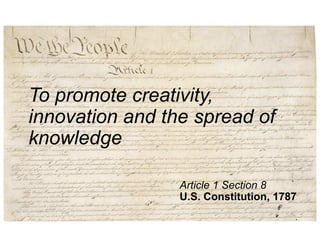
To promote creativity,
innovation and the spread of
knowledge

                 Article 1 Section 8
                 U.S. Constitution, 1787
EVERYTHING
IS COPYRIGHTED
Crea%ve	
  Control
         The Copyright Act grants five rights to a copyright
         owner:

         1. the right to reproduce the copyrighted work;

         2. the right to prepare derivative works based
         upon the work;

         3. the right to distribute copies of the work to the
         public;

         4. the right to perform the copyrighted work
         publicly; and

         5. the right to display the copyrighted work
         publicly.
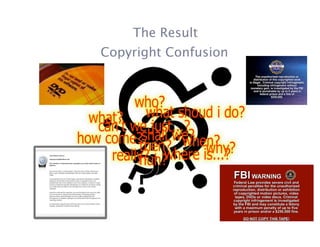
The Result
Copyright Confusion
Copyright Law Balances Rights of
           Owners and Users


OWNERS                       USERS
EVERYTHING
     IS COPYRIGHTED
…BUT THERE ARE EXEMPTIONS
The Doctrine of Fair Use


                       --Section 107
                  Copyright Act of 1976
The	
  Doctrine	
  of	
  Fair	
  Use


  For	
  purposes	
  such	
  as	
  
  cri%cism,	
  comment,	
  
news	
  repor%ng,	
  teaching	
  
                             --Section 107
                      Copyright Act of 1976
The Doctrine of Fair Use


 Fair use of copyrighted materials is               Fair use prevents
 allowed when the benefits to society          copyright law from becoming
     outweigh the private costs                         a form of
       to the copyright holder                      private censorship


                                        --Section 107
                             Copyright Act of 1976
The	
  Doctrine	
  of	
  Fair	
  Use
“It not only allows but encourages socially beneficial uses of
copyrighted works such as teaching, learning, and scholarship.
Without fair use, those beneficial uses— quoting from copyrighted
works, providing multiple copies to students in class, creating new
knowledge based on previously published knowledge—would be
infringements. Fair use is the means for assuring a robust and
vigorous exchange of copyrighted information.”

                      --Carrie Russell, American Library Association
The effective use of copyrighted
materials enhances the teaching
     and learning process.
Context & Situation
Is this Use of Copyrighted Materials
               a Fair Use?

•Did the unlicensed use “transform” the material taken from the
copyrighted work by using it for a different purpose than that of the
original, or did it just repeat the work for the same intent and value as the
original? 

•Was the material taken appropriate in kind and amount, considering the
nature of the copyrighted work and of the use?
Bill Graham Archives vs. Dorling Kindersley, Ltd.
                     (2006)
An Example of Transformative Use

          The purpose of the original: to
           generate publicity for a concert


                  The purpose of the new work:
                  to document and illustrate the
                  concert events in historical
                  context
Educational Fair Use Guidelines
The effective use of copyrighted
materials enhances the teaching
     and learning process.
Does following “rules” for
       Educational Guidelines
     require students to think
         critically about the
Copyrighted materials they are using?
Does following “rules” for
       Educational Guidelines
     require students to think
         critically about the
Copyrighted materials they are using?
Excerpts from:
    http://www.ted.com/talks/larry_lessig_says_the_law_is_strangling_creativity.html
    http://www.youtube.com/watch?v=TPAO-lZ4_hU An anthropological introduction to YouTube
Does requiring students to use
 ONLY Creative Commons content
     require students to think
        critically about the
Copyrighted materials they are using?
Does requiring students to use
 ONLY Creative Commons content
     require students to think
        critically about the
Copyrighted materials they are using?
Codes of Best Practices
http://mediaeducationlab.com/video-overview
Context & Situation

A team of elementary educators
shows the Disney movie The Little
Mermaid to three classes of Grade 3
students on the day before winter
break in the school auditorium.
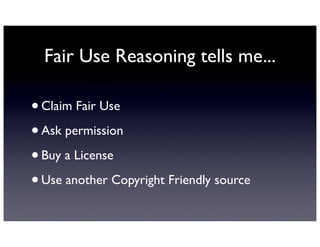
Fair Use Reasoning tells me...

• Claim Fair Use
• Ask permission
• Buy a License
• Use another Copyright Friendly source
Context & Situation

A team of elementary educators
shows the Disney movie The Little
Mermaid to three classes of Grade 3
students on the day before winter
break in the school auditorium.
Discuss
Practice exercising your
                Fair Use Muscles...

•Did the unlicensed use “transform” the material taken from the
copyrighted work by using it for a different purpose than that of the
original, or did it just repeat the work for the same intent and value as the
original? 

•Was the material taken appropriate in kind and amount, considering the
nature of the copyrighted work and of the use?
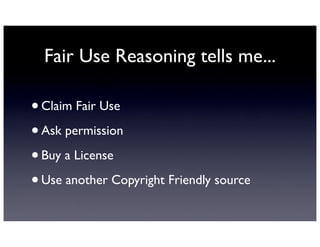
Fair Use Reasoning tells me...

• Claim Fair Use
• Ask permission
• Buy a License
• Use another Copyright Friendly source
Teach kids to reason
 http://copyrightconfusion.wikispaces.com
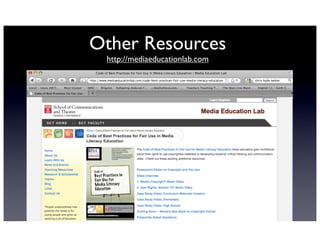
Other Resources
 http://mediaeducationlab.com
Other Examples?
Video Case Studies
             Elementary School Case Study:
             P.S. 124 The Silas B. Dutcher School
             Brooklyn, NY


             High School Case Study:
             Upper Merion Area High School
             King of Prussia, PA


             College Case Study:
             Project Look Sharp at Ithaca College
             Ithaca, NY
56
57
58
59
60
61
62
63
64
65
But what if....
67
68
69
70
71
72
73
74
75
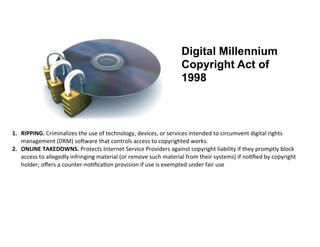
Digital Millennium
                                                                                              Copyright Act of
                                                                                              1998


1. RIPPING.	
  Criminalizes	
  the	
  use	
  of	
  technology,	
  devices,	
  or	
  services	
  intended	
  to	
  circumvent	
  digital	
  rights	
  
   management	
  (DRM)	
  soBware	
  that	
  controls	
  access	
  to	
  copyrighted	
  works.	
  
2. ONLINE	
  TAKEDOWNS.	
  Protects	
  Internet	
  Service	
  Providers	
  against	
  copyright	
  liability	
  if	
  they	
  promptly	
  block	
  
   access	
  to	
  allegedly	
  infringing	
  material	
  (or	
  remove	
  such	
  material	
  from	
  their	
  systems)	
  if	
  no%fied	
  by	
  copyright	
  
   holder;	
  offers	
  a	
  counter-­‐no%fica%on	
  provision	
  if	
  use	
  is	
  exempted	
  under	
  fair	
  use	
  
The Results of our Advocacy


Users may unlock DVDs protected by the Content Scrambling
System when circumvention is for the purpose of criticism or
comment using short sections, for educational, documentary or
non-profit use.
Digital Millennium
                                                                                              Copyright Act of
                                                                                              1998


1. RIPPING.	
  Criminalizes	
  the	
  use	
  of	
  technology,	
  devices,	
  or	
  services	
  intended	
  to	
  circumvent	
  digital	
  rights	
  
   management	
  (DRM)	
  soBware	
  that	
  controls	
  access	
  to	
  copyrighted	
  works.	
  
2. ONLINE	
  TAKEDOWNS.	
  Protects	
  Internet	
  Service	
  Providers	
  against	
  copyright	
  liability	
  if	
  they	
  promptly	
  block	
  
   access	
  to	
  allegedly	
  infringing	
  material	
  (or	
  remove	
  such	
  material	
  from	
  their	
  systems)	
  if	
  no%fied	
  by	
  copyright	
  
   holder;	
  offers	
  a	
  counter-­‐no%fica%on	
  provision	
  if	
  use	
  is	
  exempted	
  under	
  fair	
  use	
  
Join our Online Community
                http://copyrightconfusion.wikispaces.com


visit the Media Education Lab for teaching resources & to download
                      The Code of Best Practices
               http://mediaeducationlab.com/copyright


               CONTACT ME- with your stories
                       Kristin Hokanson
                kristin.hokanson@gmail.com
                     http://khokanson.net

Copyright Clarity #NYSCATE11

  • 1.
    Copyright Clarity... Fair Use for Digital learning Kristin Hokanson
  • 2.
    Goals ★ Gain knowledgeabout how copyright and fair use apply to digital learning. ★ Develop confidence in sharing information and ideas about copyright/fair use with colleagues. ★ Recognize how media literacy pedagogy depends on the use of copyrighted materials from mass media and popular culture ★ Identify resources for teaching about copyright and fair use that are effective with students and colleagues
  • 5.
    ways that students use copyrighted materials in their creative & academic work
  • 6.
    Illustration Digital Storytelling Critical Analysis Remix What makes these effective learning experiences for students?
  • 7.
    Technology makes it easy to: ü Use and share ü Copy ü Modify & Repurpose ü Excerpt & Quote From ü Distribute
  • 8.
    Owners forcefully assert their rights to: ü Restrict ü Limit ü Charge high fees ü Discourage use ü Use scare tactics
  • 9.
    How do TeachersCope? See no Evil Close the Door Hyper-Comply
  • 10.
  • 12.
    It’s time to replaceold knowledge with accurate knowledge
  • 13.
    To promote creativity, innovationand the spread of knowledge Article 1 Section 8 U.S. Constitution, 1787
  • 14.
  • 15.
    Crea%ve  Control The Copyright Act grants five rights to a copyright owner: 1. the right to reproduce the copyrighted work; 2. the right to prepare derivative works based upon the work; 3. the right to distribute copies of the work to the public; 4. the right to perform the copyrighted work publicly; and 5. the right to display the copyrighted work publicly.
  • 16.
  • 17.
    Copyright Law BalancesRights of Owners and Users OWNERS USERS
  • 18.
    EVERYTHING IS COPYRIGHTED …BUT THERE ARE EXEMPTIONS
  • 19.
    The Doctrine ofFair Use --Section 107 Copyright Act of 1976
  • 20.
    The  Doctrine  of  Fair  Use For  purposes  such  as   cri%cism,  comment,   news  repor%ng,  teaching   --Section 107 Copyright Act of 1976
  • 21.
    The Doctrine ofFair Use Fair use of copyrighted materials is Fair use prevents allowed when the benefits to society copyright law from becoming outweigh the private costs a form of to the copyright holder private censorship --Section 107 Copyright Act of 1976
  • 22.
    The  Doctrine  of  Fair  Use “It not only allows but encourages socially beneficial uses of copyrighted works such as teaching, learning, and scholarship. Without fair use, those beneficial uses— quoting from copyrighted works, providing multiple copies to students in class, creating new knowledge based on previously published knowledge—would be infringements. Fair use is the means for assuring a robust and vigorous exchange of copyrighted information.” --Carrie Russell, American Library Association
  • 23.
    The effective useof copyrighted materials enhances the teaching and learning process.
  • 25.
  • 26.
    Is this Useof Copyrighted Materials a Fair Use? •Did the unlicensed use “transform” the material taken from the copyrighted work by using it for a different purpose than that of the original, or did it just repeat the work for the same intent and value as the original?  •Was the material taken appropriate in kind and amount, considering the nature of the copyrighted work and of the use?
  • 27.
    Bill Graham Archivesvs. Dorling Kindersley, Ltd. (2006)
  • 28.
    An Example ofTransformative Use The purpose of the original: to generate publicity for a concert The purpose of the new work: to document and illustrate the concert events in historical context
  • 29.
  • 34.
    The effective useof copyrighted materials enhances the teaching and learning process.
  • 35.
    Does following “rules”for Educational Guidelines require students to think critically about the Copyrighted materials they are using?
  • 36.
    Does following “rules”for Educational Guidelines require students to think critically about the Copyrighted materials they are using?
  • 38.
    Excerpts from: http://www.ted.com/talks/larry_lessig_says_the_law_is_strangling_creativity.html http://www.youtube.com/watch?v=TPAO-lZ4_hU An anthropological introduction to YouTube
  • 39.
    Does requiring studentsto use ONLY Creative Commons content require students to think critically about the Copyrighted materials they are using?
  • 40.
    Does requiring studentsto use ONLY Creative Commons content require students to think critically about the Copyrighted materials they are using?
  • 41.
    Codes of BestPractices
  • 43.
  • 44.
    Context & Situation Ateam of elementary educators shows the Disney movie The Little Mermaid to three classes of Grade 3 students on the day before winter break in the school auditorium.
  • 45.
    Fair Use Reasoningtells me... • Claim Fair Use • Ask permission • Buy a License • Use another Copyright Friendly source
  • 46.
    Context & Situation Ateam of elementary educators shows the Disney movie The Little Mermaid to three classes of Grade 3 students on the day before winter break in the school auditorium.
  • 47.
  • 48.
    Practice exercising your Fair Use Muscles... •Did the unlicensed use “transform” the material taken from the copyrighted work by using it for a different purpose than that of the original, or did it just repeat the work for the same intent and value as the original?  •Was the material taken appropriate in kind and amount, considering the nature of the copyrighted work and of the use?
  • 49.
    Fair Use Reasoningtells me... • Claim Fair Use • Ask permission • Buy a License • Use another Copyright Friendly source
  • 50.
    Teach kids toreason http://copyrightconfusion.wikispaces.com
  • 51.
  • 54.
  • 55.
    Video Case Studies Elementary School Case Study: P.S. 124 The Silas B. Dutcher School Brooklyn, NY High School Case Study: Upper Merion Area High School King of Prussia, PA College Case Study: Project Look Sharp at Ithaca College Ithaca, NY
  • 56.
  • 57.
  • 58.
  • 59.
  • 60.
  • 61.
  • 62.
  • 63.
  • 64.
  • 65.
  • 66.
  • 67.
  • 68.
  • 69.
  • 70.
  • 71.
  • 72.
  • 73.
  • 74.
  • 75.
  • 76.
    Digital Millennium Copyright Act of 1998 1. RIPPING.  Criminalizes  the  use  of  technology,  devices,  or  services  intended  to  circumvent  digital  rights   management  (DRM)  soBware  that  controls  access  to  copyrighted  works.   2. ONLINE  TAKEDOWNS.  Protects  Internet  Service  Providers  against  copyright  liability  if  they  promptly  block   access  to  allegedly  infringing  material  (or  remove  such  material  from  their  systems)  if  no%fied  by  copyright   holder;  offers  a  counter-­‐no%fica%on  provision  if  use  is  exempted  under  fair  use  
  • 78.
    The Results ofour Advocacy Users may unlock DVDs protected by the Content Scrambling System when circumvention is for the purpose of criticism or comment using short sections, for educational, documentary or non-profit use.
  • 79.
    Digital Millennium Copyright Act of 1998 1. RIPPING.  Criminalizes  the  use  of  technology,  devices,  or  services  intended  to  circumvent  digital  rights   management  (DRM)  soBware  that  controls  access  to  copyrighted  works.   2. ONLINE  TAKEDOWNS.  Protects  Internet  Service  Providers  against  copyright  liability  if  they  promptly  block   access  to  allegedly  infringing  material  (or  remove  such  material  from  their  systems)  if  no%fied  by  copyright   holder;  offers  a  counter-­‐no%fica%on  provision  if  use  is  exempted  under  fair  use  
  • 81.
    Join our OnlineCommunity http://copyrightconfusion.wikispaces.com visit the Media Education Lab for teaching resources & to download The Code of Best Practices http://mediaeducationlab.com/copyright CONTACT ME- with your stories Kristin Hokanson kristin.hokanson@gmail.com http://khokanson.net