The Copyright Law and Fair Use Guidelines for Educational MultimediaAnn WareBald Knob High Schoolwarea@bkps.k12.ar.us
Copyright lawLaws designed to protect intellectual property rights and provide potential monetary rewards for inventiveness and hard work. The ease with which material can be copied, digitized, manipulated, incorporated into a presentation and delivered to a mass market has prompted a concern about the adequacy of copyright laws as they apply to the multimedia industry.
Copyright Act of 1976Protects certain kinds of “original works of authorship”—whether published or unpublishedProtects works “fixed in any tangible form of expression”
The copyright law covers . . .Literary works (books, poems, software)Musical works, including any accompanying wordsDramatic works, including any accompanying musicPantomimes and choreographic worksPictorial, graphic, and sculptural worksMotion pictures and other audiovisual worksSound recordingsArchitectural works
Does not cover . . .IdeasFactsTitlesNamesShort phrasesBlank forms
Trademark LawA trademark is a name, symbol, or other device identifying a productTrademarks are not covered by the copyright law, but by the Trademark LawTrademarks are frequently marked with a registered trademark symbol--® 	Example:  Coca Cola ®, Nike®
How do I obtain a copyright?You automatically own the copyright to any work you create as soon as it is fixed in a tangible medium.You can indicate ownership by using the expression “copyright by” or the © symbol.You can register for ownership with the U.S. Copyright office; this does provide you with additional legal benefits.
Exception to ownershipIn the case of works made for hire, the employer and not the employee is considered to be the author. Section 101 of the copyright law defines a “work made for hire” as:A work prepared by an employee within the scope of his or her employment; orA work specially ordered or commissioned for use
Rights of the ownerYou have the right to:
Reproduce the work
Distribute copies of the work
Make a “derivative” work (make copies or changes from the original)
Publicly perform the work
Put the work on public display
If you perform any of these tasks and are NOT the copyright owner, you are infringing on their rights.
Example:  copying software, sharing MP3 files, photocopying, uploading materials to websites, etc.What options do we have in multimedia?Fair Use Guidelines for Educational MultimediaPublic DomainRoyalty Free Products
Fair Use Guidelines forEducational MultimediaPortions, or in some cases the entirety, of copyrighted works may be usedLegitimate uses include “criticism, comment, news reporting, teaching, scholarship, or research.”
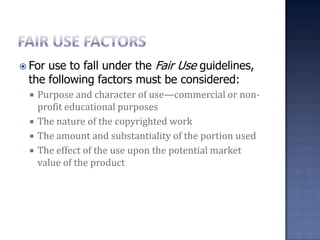
Fair Use FactorsFor use to fall under the Fair Use guidelines, the following factors must be considered:Purpose and character of use—commercial or non-profit educational purposesThe nature of the copyrighted workThe amount and substantiality of the portion usedThe effect of the use upon the potential market value of the product
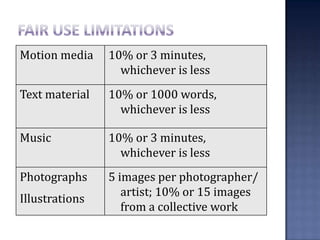
Fair Use Limitations

Copyright ann ware

  • 1.
    The Copyright Lawand Fair Use Guidelines for Educational MultimediaAnn WareBald Knob High Schoolwarea@bkps.k12.ar.us
  • 2.
    Copyright lawLaws designedto protect intellectual property rights and provide potential monetary rewards for inventiveness and hard work. The ease with which material can be copied, digitized, manipulated, incorporated into a presentation and delivered to a mass market has prompted a concern about the adequacy of copyright laws as they apply to the multimedia industry.
  • 3.
    Copyright Act of1976Protects certain kinds of “original works of authorship”—whether published or unpublishedProtects works “fixed in any tangible form of expression”
  • 4.
    The copyright lawcovers . . .Literary works (books, poems, software)Musical works, including any accompanying wordsDramatic works, including any accompanying musicPantomimes and choreographic worksPictorial, graphic, and sculptural worksMotion pictures and other audiovisual worksSound recordingsArchitectural works
  • 5.
    Does not cover. . .IdeasFactsTitlesNamesShort phrasesBlank forms
  • 6.
    Trademark LawA trademarkis a name, symbol, or other device identifying a productTrademarks are not covered by the copyright law, but by the Trademark LawTrademarks are frequently marked with a registered trademark symbol--® Example: Coca Cola ®, Nike®
  • 7.
    How do Iobtain a copyright?You automatically own the copyright to any work you create as soon as it is fixed in a tangible medium.You can indicate ownership by using the expression “copyright by” or the © symbol.You can register for ownership with the U.S. Copyright office; this does provide you with additional legal benefits.
  • 8.
    Exception to ownershipInthe case of works made for hire, the employer and not the employee is considered to be the author. Section 101 of the copyright law defines a “work made for hire” as:A work prepared by an employee within the scope of his or her employment; orA work specially ordered or commissioned for use
  • 9.
    Rights of theownerYou have the right to:
  • 10.
  • 11.
  • 12.
    Make a “derivative”work (make copies or changes from the original)
  • 13.
  • 14.
    Put the workon public display
  • 15.
    If you performany of these tasks and are NOT the copyright owner, you are infringing on their rights.
  • 16.
    Example: copyingsoftware, sharing MP3 files, photocopying, uploading materials to websites, etc.What options do we have in multimedia?Fair Use Guidelines for Educational MultimediaPublic DomainRoyalty Free Products
  • 17.
    Fair Use GuidelinesforEducational MultimediaPortions, or in some cases the entirety, of copyrighted works may be usedLegitimate uses include “criticism, comment, news reporting, teaching, scholarship, or research.”
  • 18.
    Fair Use FactorsForuse to fall under the Fair Use guidelines, the following factors must be considered:Purpose and character of use—commercial or non-profit educational purposesThe nature of the copyrighted workThe amount and substantiality of the portion usedThe effect of the use upon the potential market value of the product
  • 19.