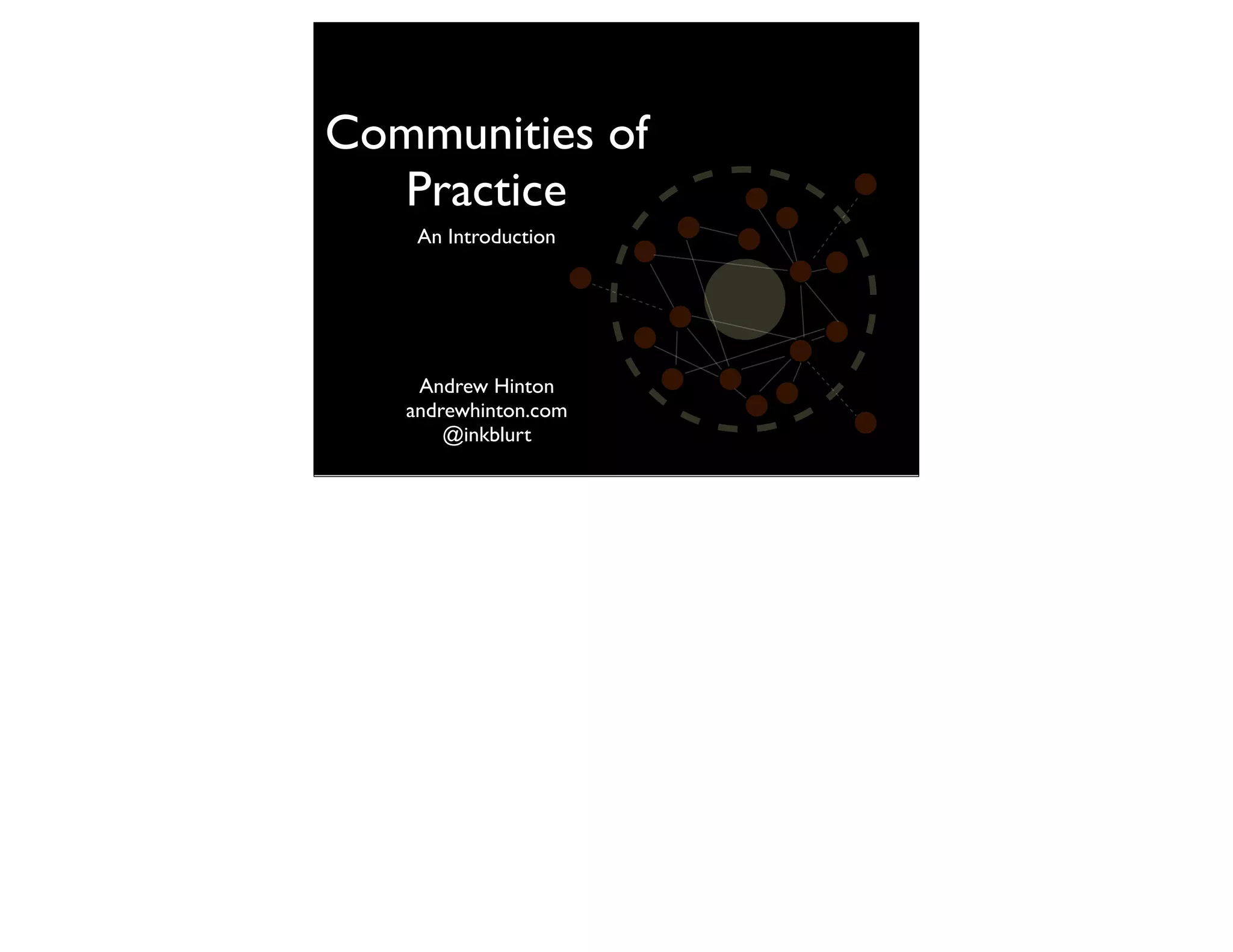
Communities of
  Practice
    An Introduction


    Andrew Hinton
   andrewhinton.com
       @inkblurt
Imagine a group of people who work together.
Because theyโ€™re at work, they have a job to do
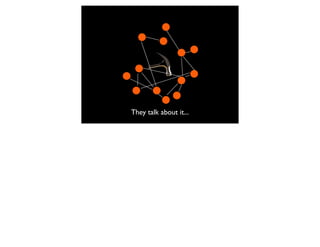
They talk about it...
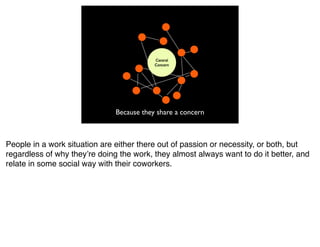
Central
                                           Concern


                               Because they share a concern


People in a work situation are either there out of passion or necessity, or both, but
regardless of why theyสผre doing the work, they almost always want to do it better, and
relate in some social way with their coworkers.
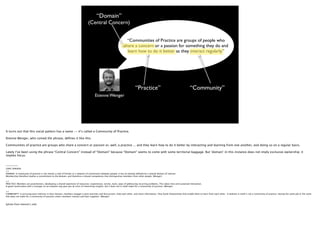
โ€œDomainโ€
                                                                                (Central Concern)


                                                                                                                     โ€œCommunities of Practice are groups of people who
                                                                                                                   share a concern or a passion for something they do and
                                                                                                                     learn how to do it better as they interact regularly.โ€


                                                                                                                              โ€œPracticeโ€                                            โ€œCommunityโ€
                                                                                       Etienne Wenger


It turns out that this social pattern has a name -- itโ€™s called a Community of Practice.

Etienne Wenger, who coined the phrase, de๏ฌnes it like this.

Communities of practice are groups who share a concern or passion or, well, a practice ... and they learn how to do it better by interacting and learning from one another, and doing so on a regular basis.

Lately Iโ€™ve been using the phrase โ€œCentral Concernโ€ instead of โ€œDomainโ€ because โ€œDomainโ€ seems to come with some territorial baggage. But โ€˜domainโ€™ in this instance does not imply exclusive ownership; it
implies focus.


-------
LONG VERSION
>>
DOMAIN: A community of practice is not merely a club of friends or a network of connections between people. It has an identity de๏ฌned by a shared domain of interest.
Membership therefore implies a commitment to the domain, and therefore a shared competence that distinguishes members from other people. (Wenger)

>>
PRACTICE: Members are practitioners, developing a shared repertoire of resources: experiences, stories, tools, ways of addressing recurring problems. This takes time and sustained interaction.
A good conversation with a stranger on an airplane may give you all sorts of interesting insights, but it does not in itself make for a community of practice. (Wenger)

>>
COMMUNITY: In pursuing joint interests in their domain, members engage in joint activities and discussions, help each other, and share information. They build relationships that enable them to learn from each other. A website in itself is not a community of practice. Having the same job or the same
title does not make for a community of practice unless members interact and learn together. (Wenger)


(photo from etienneโ€™s site)
Community of Practice


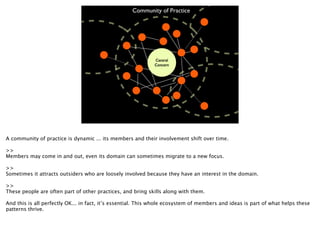
                                                             Central
                                                             Concern


A community of practice is dynamic ... its members and their involvement shift over time.

>>
Members may come in and out, even its domain can sometimes migrate to a new focus.

>>
Sometimes it attracts outsiders who are loosely involved because they have an interest in the domain.

>>
These people are often part of other practices, and bring skills along with them.

And this is all perfectly OK... in fact, itโ€™s essential. This whole ecosystem of members and ideas is part of what helps these
patterns thrive.
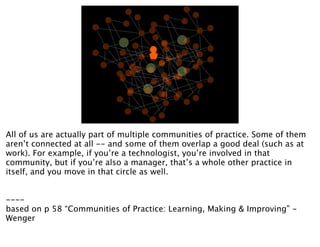
All of us are actually part of multiple communities of practice. Some of them
arenโ€™t connected at all -- and some of them overlap a good deal (such as at
work). For example, if youโ€™re a technologist, youโ€™re involved in that
community, but if youโ€™re also a manager, thatโ€™s a whole other practice in
itself, and you move in that circle as well.


----
based on p 58 โ€œCommunities of Practice: Learning, Making & Improvingโ€ -
Wenger
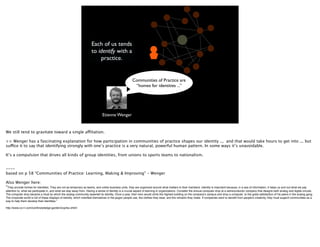
Each of us tends
                                                                     to identify with a
                                                                         practice.


                                                                                                       Communities of Practice are
                                                                                                        โ€œhomes for identities ...โ€


                                                                              Etienne Wenger


We still tend to gravitate toward a single affiliation.

>> Wenger has a fascinating explanation for how participation in communities of practice shapes our identity ... and that would take hours to get into ... but
suffice it to say that identifying strongly with oneโ€™s practice is a very natural, powerful human pattern. In some ways itโ€™s unavoidable.

Itโ€™s a compulsion that drives all kinds of group identities, from unions to sports teams to nationalism.


----
based on p 58 โ€œCommunities of Practice: Learning, Making & Improvingโ€ - Wenger

Also Wenger here:
โ€œThey provide homes for identities. They are not as temporary as teams, and unlike business units, they are organized around what matters to their members. Identity is important because, in a sea of information, it helps us sort out what we pay
attention to, what we participate in, and what we stay away from. Having a sense of identity is a crucial aspect of learning in organizations. Consider the annual computer drop at a semiconductor company that designs both analog and digital circuits.
The computer drop became a ritual by which the analog community asserted its identity. Once a year, their hero would climb the highest building on the company's campus and drop a computer, to the great satisfaction of his peers in the analog gang.
The corporate world is full of these displays of identity, which manifest themselves in the jargon people use, the clothes they wear, and the remarks they make. If companies want to bene๏ฌt from people's creativity, they must support communities as a
way to help them develop their identities.โ€

http://www.co-i-l.com/coil/knowledge-garden/cop/lss.shtml
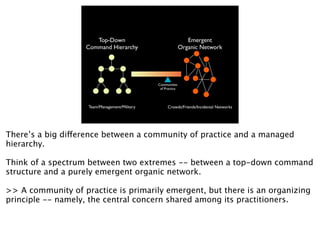
Top-Down                                   Emergent
                   Command Hierarchy                          Organic Network


                                               Communities
                                                of Practice


                    Team/Management/Military        Crowds/Friends/Incidental Networks


Thereโ€™s a big difference between a community of practice and a managed
hierarchy.

Think of a spectrum between two extremes -- between a top-down command
structure and a purely emergent organic network.

>> A community of practice is primarily emergent, but there is an organizing
principle -- namely, the central concern shared among its practitioners.
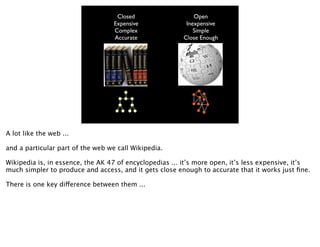
Closed                   Open
                                   Expensive              Inexpensive
                                   Complex                   Simple
                                   Accurate              Close Enough


A lot like the web ...

and a particular part of the web we call Wikipedia.

Wikipedia is, in essence, the AK 47 of encyclopedias ... itโ€™s more open, itโ€™s less expensive, itโ€™s
much simpler to produce and access, and it gets close enough to accurate that it works just ๏ฌne.

There is one key difference between them ...
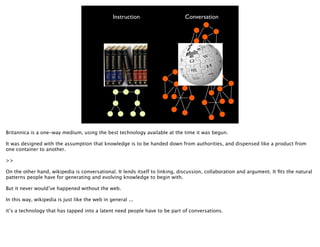
Instruction                   Conversation


Britannica is a one-way medium, using the best technology available at the time it was begun.

It was designed with the assumption that knowledge is to be handed down from authorities, and dispensed like a product from
one container to another.

>>

On the other hand, wikipedia is conversational. It lends itself to linking, discussion, collaboration and argument. It ๏ฌts the natural
patterns people have for generating and evolving knowledge to begin with.

But it never wouldโ€™ve happened without the web.

In this way, wikipedia is just like the web in general ...

itโ€™s a technology that has tapped into a latent need people have to be part of conversations.
Instruction                Conversation


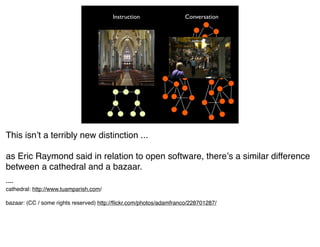
This isnสผt a terribly new distinction ...

as Eric Raymond said in relation to open software, thereสผs a similar difference
between a cathedral and a bazaar.
----
cathedral: http://www.tuamparish.com/

bazaar: (CC / some rights reserved) http://๏ฌ‚ickr.com/photos/adamfranco/228701287/
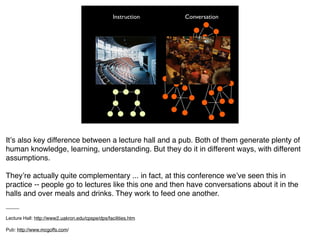
Instruction   Conversation


Itสผs also key difference between a lecture hall and a pub. Both of them generate plenty of
human knowledge, learning, understanding. But they do it in different ways, with different
assumptions.

Theyสผre actually quite complementary ... in fact, at this conference weสผve seen this in
practice -- people go to lectures like this one and then have conversations about it in the
halls and over meals and drinks. They work to feed one another.
_____

Lecture Hall: http://www2.uakron.edu/cpspe/dps/facilities.htm

Pub: http://www.mcgoffs.com/
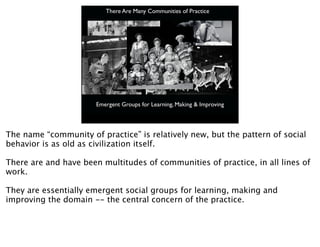
There Are Many Communities of Practice


                       Emergent Groups for Learning, Making & Improving


The name โ€œcommunity of practiceโ€ is relatively new, but the pattern of social
behavior is as old as civilization itself.

There are and have been multitudes of communities of practice, in all lines of
work.

They are essentially emergent social groups for learning, making and
improving the domain -- the central concern of the practice.
Work โ€œTeamโ€                                        Community of Practice
                                                                             Involuntary                                                Voluntary
                                                                           Product Delivery                                        Learning & Improving
                                                                           De๏ฌned by Mgmt                                                Emerges


One way to understand Communities of Practice is to compare them to something weโ€™re all familiar with, a Work or Project Team. So letโ€™s look at just a few characteristics of both.
>>
Teams are Involuntary -- youโ€™re assigned to them -- but Communities of Practice are very organic, and people get involved in them because of their interest, not to ful๏ฌll an obligation.
>>
A teamโ€™s purpose is to deliver products, on delivery dates. But a Community of Practiceโ€™s purpose is its own evolution -- Learning, Making & Improving -- the continual improvement of practice and knowledge among its members. Thereโ€™s no
delivery date -- even though the community often may set goals and work together on meeting them, itโ€™s in the service of the ongoing evolution.
>>
And not only are a teamโ€™s members and goals assigned, itโ€™s entirely de๏ฌned by the organizationโ€™s management structure. Without an org chart, it wouldnโ€™t exist.

A Community of Practice is de๏ฌned by the aggregate of its members, and whatever domain they happen to share in common.

This means that management really doesnโ€™t have much of an idea what to *do* with a CoP. It doesnโ€™t ๏ฌt the MBA concept of a managed organization. Even though, in almost any workplace, they exist in some form or another, and in many
organizations theyโ€™re essential to the orgโ€™s success.

[CLICK]
>>
Does this mean Teams and CoPs are mutually exclusive? No... in fact, sometimes the best teams eventually behave like communities of practice, but again -- it happens under the official structure, in the cracks and crevices of it.
They can work in a complementary fashion -- but often they end up blurring boundaries between other teams and branches in the organization.
By the way this is something management often doesnโ€™t understand: that when you put something organic down it tends to grow roots. If youโ€™ve ever been in a team that you felt like you really grew with, and felt like a community, then were
arbitrarily transferred to some other team ... you feel ripped out by the roots. Thatโ€™s why.


----
based in part on           http://www.nelh.nhs.uk/knowledge_management/km2/cop_toolkit.asp
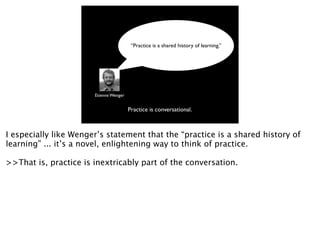
โ€œPractice is a shared history of learning.โ€


                       Etienne Wenger


                                        Practice is conversational.


I especially like Wengerโ€™s statement that the โ€œpractice is a shared history of
learningโ€ ... itโ€™s a novel, enlightening way to think of practice.

>>That is, practice is inextricably part of the conversation.
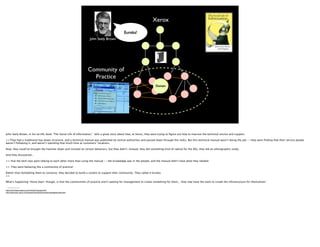
Xerox
                                                                                              Eureka!
                                                                        John Seely Brown


                                                                        Community of
                                                                          Practice
                                                                                                                        Domain


John Seely Brown, in his terri๏ฌc book โ€œThe Social Life of Information,โ€ tells a great story about how, at Xerox, they were trying to ๏ฌgure out how to improve the technical service and support.

>>They had a traditional top-down structure, and a technical manual was published by central authorities and passed down through the ranks. But this technical manual wasnโ€™t doing the job -- they were ๏ฌnding that their service people
werenโ€™t following it, and werenโ€™t spending that much time at customersโ€™ locations.

Now, they couldโ€™ve brought the hammer down and insisted on certain behaviors, but they didnโ€™t. Instead, they did something kind of radical for the 80s, they did an ethnographic study.

And they discovered...

>> that the tech reps were talking to each other more than using the manual -- the knowledge was in the people, and the manual didnโ€™t have what they needed.

>> They were behaving like a community of practice!

Rather than forbidding them to converse, they decided to build a system to support their community. They called it Eureka.
>>

Whatโ€™s happening *these days* though, is that the communities of practice arenโ€™t waiting for management to create something for them... they now have the tools to create the infrastructure for themselves!

 --------
http://www.fastcompany.com/online/01/people.html
http://www.parc.xerox.com/research/projects/commknowledge/eureka.html
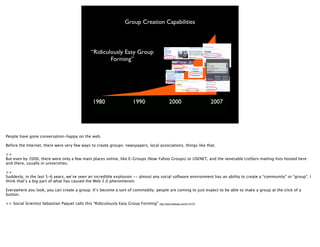
Group Creation Capabilities


                                             โ€œRidiculously Easy Group
                                                     Formingโ€


                                              1980                  1990                    2000                        2007


People have gone conversation-happy on the web.

Before the Internet, there were very few ways to create groups: newspapers, local associations, things like that.

>>
But even by 2000, there were only a few main places online, like E-Groups (Now Yahoo Groups) or USENET, and the venerable ListServ mailing lists hosted here
and there, usually in universities.

>>
Suddenly, in the last 5-6 years, weโ€™ve seen an incredible explosion -- almost any social software environment has an ability to create a โ€œcommunityโ€ or โ€œgroupโ€. I
think thatโ€™s a big part of what has caused the Web 2.0 phenomenon.

Everywhere you look, you can create a group. Itโ€™s become a sort of commodity: people are coming to just expect to be able to make a group at the click of a
button.

>> Social Scientist Sebastian Paquet calls this โ€œRidiculously Easy Group Formingโ€   http://radio.weblogs.com/0110772/
20


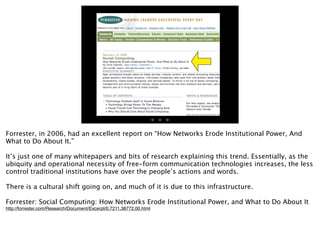
Forrester, in 2006, had an excellent report on โ€œHow Networks Erode Institutional Power, And
What to Do About It.โ€

Itโ€™s just one of many whitepapers and bits of research explaining this trend. Essentially, as the
ubiquity and operational necessity of free-form communication technologies increases, the less
control traditional institutions have over the peopleโ€™s actions and words.

There is a cultural shift going on, and much of it is due to this infrastructure.

Forrester: Social Computing: How Networks Erode Institutional Power, and What to Do About It
http://forrester.com/Research/Document/Excerpt/0,7211,38772,00.html
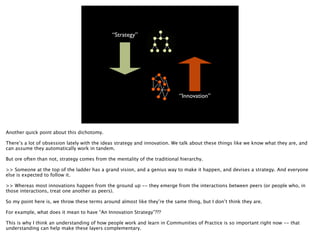
โ€œStrategyโ€


                                                                            โ€œInnovationโ€


Another quick point about this dichotomy.

Thereโ€™s a lot of obsession lately with the ideas strategy and innovation. We talk about these things like we know what they are, and
can assume they automatically work in tandem.

But ore often than not, strategy comes from the mentality of the traditional hierarchy.

>> Someone at the top of the ladder has a grand vision, and a genius way to make it happen, and devises a strategy. And everyone
else is expected to follow it.

>> Whereas most innovations happen from the ground up -- they emerge from the interactions between peers (or people who, in
those interactions, treat one another as peers).

So my point here is, we throw these terms around almost like theyโ€™re the same thing, but I donโ€™t think they are.

For example, what does it mean to have โ€œAn Innovation Strategyโ€???

This is why I think an understanding of how people work and learn in Communities of Practice is so important right now -- that
understanding can help make these layers complementary.
Traditional Institutions
                     [Instruction & Production]


                                                   ?


                        Organic Networks
                      [Learning & Innovation]


Network technologies have allowed people to form groups more easily than
ever before, and itโ€™s eroding some of the prominence that traditional
institutions have enjoyed for so long.

>>Weโ€™re left with the question: what approaches or solutions can help these
different approaches to co-exist, and work together?
Traditional Institutions
                          [Instruction & Production]


                             Organic Networks
                           [Learning & Innovation]


I suggest that the Community of Practice is one pattern for solving the problem of this
tension -- because it could help reconcile their differences. It doesnโ€™t replace either of the
other patterns, but it does help make them more complementary.
It means, however, that the traditional network is going to have to learn to let go of some
of its control, and at least when it comes to learning and community, let the group guide
the domain.
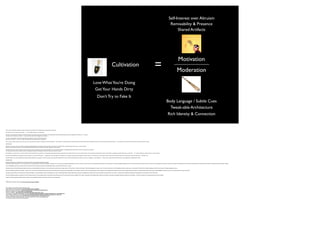
Self-Interest over Altruism
                                                                                                                                                                                                                                                                                                                                                                                                               Remixability & Presence
                                                                                                                                                                                                                                                                                                                                                                                                                    Shared Artifacts


                                                                                                                                                                                                                                                                                                                                                                                                                             Motivation
                                                                                                                                                                                                                                                                        Cultivation                                                                                                =                                    Moderation
                                                                                                                                                                                                                          Love What Youโ€™re Doing
                                                                                                                                                                                                                              Get Your Hands Dirty
                                                                                                                                                                                                                                   Donโ€™t Try to Fake It
                                                                                                                                                                                                                                                                                                                                                                                                             Body Language / Subtle Cues
                                                                                                                                                                                                                                                                                                                                                                                                               Tweak-able Architecture
                                                                                                                                                                                                                                                                                                                                                                                                             Rich Identity & Connection


There are tons of great writings out there about the best practices for designing for participation and groups.

But we donโ€™t have a week to go into that -- so Iโ€™ve boiled it down to a nice formula.

Basically, cultivating means ๏ฌnding the balance between encouraging activity (motivation) and shaping that activity toward healthy ends with moderation (โ€˜dividingโ€™ it, in a sense).
You have to love what youโ€™re doing -- or you wonโ€™t be able to care enough to be involved.

You have to be willing to get your hands dirty by getting into the mix with everyone else.
And you canโ€™t fake it -- you canโ€™t assign someone who isnโ€™t invested to be a cultivator.

This is why, actually, it makes the most sense for a community of practiceโ€™s members to be the cultivators... even if thereโ€™s a pecking order of some kind (which is ๏ฌne! hierarchies are helpful at times in the service of the practice & domain -- but they tend to be much more ๏ฌ‚uid and meritocracy-based in CoPs)

MOTIVATION

Self-Interest: Itโ€™d be nice if we could assume people will do things โ€œfor the good of the community.โ€ But give it up. People donโ€™t actually function that way on a continual basis.
Besides, a community of practice is ๏ฌrst and foremost PRACTICAL (hence the word โ€˜practiceโ€™ right there in the name!).

People want to learn skills, get better at them, and get social cred for their chops and contributions. Itโ€™s this collective effort of enlightened self-interest that causes the community to emerge.
So, think about how to best increase chances that people will get that feedback and practice improvement they so desire.

Remixability: no community is an island. People have multivariate lives, and theyโ€™re increasingly expecting to be able to grab bits of one thing and have it mix into other things. If your community infrastructure doesnโ€™t lend itself to syndication, mobile interaction, and the like -- itโ€™s risking irrelevance. People want it to come to them.

Presence: Essentially like remixability, but with emphasis on personal โ€œtherenessโ€ -- people often want to be able to contribute to an ongoing conversation throughout the day, and be โ€˜in itโ€™ whenever itโ€™s convenient to them. (Of course they want to be able to hide from it when they want too ... and thatโ€™s ok.)

Shared Artifacts: one study showed that having shared artifacts was important to CoPs in general, but especially important for virtual. Having something that everyone can work on together is very important -- which is one reason why wiki-like functions are exploding for collaboration online.

MODERATION

Most social software weสผre familiar with is on the listserv/usenet model: threaded mail/post discussions.
But there are limits to that model. For one thing, it arose in a very homogeneous community of engineers, academics, etc, who all knew one another professionally in one way or another, and who had a sort of cultural baseline they were communicating from. Any further etiquette emerged over time in the online culture (this is all pre-1994 or so). Anyone who was getting on the Internet in late 80s up to about 93 remembers the tons of stuff the community had you read before you felt like you should even post! (One origin of FAQs)

Then the ๏ฌ‚oodgates opened, and frankly broke the old model. But weสผve mostly been stuck with threaded discussions or real-time IRC-like chat for 15 years.

Gradually the more forward-thinking sites started having more nuanced feedback mechanisms, so the community can police itself to a larger extent. This is just like in real-time conversation, where body language can mean so much. You donสผt want to have to use the baseball bat, when a rolled eye or a crossed brow will do the trick. Software is getting to where it can do some of that body-language work for us.

Also, the architecture needs to be tweakable -- again by arch, I donสผt mean the labeling and taxonomy alone but how they service the structure and channeling of human activity on the site, as well as user permissions, what is surfaced and not surfaced by the system (do users see who made negative comments too or just the positive ones? is karma score made available for everyone to see or is it a private score for the userสผs eyes only?

If someone adds a friend do you let everyone see they were added or is it just between the users? what algorithm is in use for determining karma?) All these things need to be able to be adjusted as you get to know how your particular community works in it over time -- because theyสผre all different culturally and personality-wise, as well as the kind of work they do.

Also, Rich Identity/Connection is important: the more invested someone is in their identity within the community, the less likely they will be to act like a jerk and lose credibility. Their สปavatarสผ (usually just a pro๏ฌle page!) needs to allow for enough rich connection and identity expression that they can invest deeply... and feel a connection to the avatar that they donสผt want to disrupt.

These are all really important questions (which, frankly, I see as architectural questions) that make or break the community space.


-----
Communities of Practice: Going Virtual http://www.getcited.org/pub/103396967


Some research for this section came from these sources:
Communities of Practice: Going Virtual http://www.getcited.org/pub/103396967
Where is the Action in Virtual CoPs? http://www-staff.it.uts.edu.au/~lueg/papers/commdcscw00.pdf
Moderation Strategies Wiki http://social.itp.nyu.edu/shirky/wiki/
Shirky on moderation: http://radar.oreilly.com/archives/2006/03/etech_clay_shirky_1.html
Tim OสผReillyสผs โ€œArchitectures of Participationโ€ post 2004 http://www.oreillynet.com/pub/a/oreilly/tim/articles/architecture_of_participation.html
Andrew McAfeeสผs Enterprise 2.0 work: http://blog.hbs.edu/faculty/amcafee/index.php/faculty_amcafee_v3/enterprise_20_version_20/
Joi Ito on collaborating through WoW: http://video.google.com/videoplay?docid=-5160442894955175707
Evolving communities of practice (IBM study): http://www.research.ibm.com/journal/sj/404/gongla.pdf)
Tons more here: http://www.inkblurt.com/archives/446
Andrew Hinton
andrewhinton.com
    @inkblurt

Communities of Practice Intro

  • 1.
    Communities of Practice An Introduction Andrew Hinton andrewhinton.com @inkblurt
  • 2.
    Imagine a groupof people who work together.
  • 3.
    Because theyโ€™re atwork, they have a job to do
  • 4.
  • 5.
    Central Concern Because they share a concern People in a work situation are either there out of passion or necessity, or both, but regardless of why theyสผre doing the work, they almost always want to do it better, and relate in some social way with their coworkers.
  • 6.
    โ€œDomainโ€ (Central Concern) โ€œCommunities of Practice are groups of people who share a concern or a passion for something they do and learn how to do it better as they interact regularly.โ€ โ€œPracticeโ€ โ€œCommunityโ€ Etienne Wenger It turns out that this social pattern has a name -- itโ€™s called a Community of Practice. Etienne Wenger, who coined the phrase, de๏ฌnes it like this. Communities of practice are groups who share a concern or passion or, well, a practice ... and they learn how to do it better by interacting and learning from one another, and doing so on a regular basis. Lately Iโ€™ve been using the phrase โ€œCentral Concernโ€ instead of โ€œDomainโ€ because โ€œDomainโ€ seems to come with some territorial baggage. But โ€˜domainโ€™ in this instance does not imply exclusive ownership; it implies focus. ------- LONG VERSION >> DOMAIN: A community of practice is not merely a club of friends or a network of connections between people. It has an identity de๏ฌned by a shared domain of interest. Membership therefore implies a commitment to the domain, and therefore a shared competence that distinguishes members from other people. (Wenger) >> PRACTICE: Members are practitioners, developing a shared repertoire of resources: experiences, stories, tools, ways of addressing recurring problems. This takes time and sustained interaction. A good conversation with a stranger on an airplane may give you all sorts of interesting insights, but it does not in itself make for a community of practice. (Wenger) >> COMMUNITY: In pursuing joint interests in their domain, members engage in joint activities and discussions, help each other, and share information. They build relationships that enable them to learn from each other. A website in itself is not a community of practice. Having the same job or the same title does not make for a community of practice unless members interact and learn together. (Wenger) (photo from etienneโ€™s site)
  • 7.
    Community of Practice Central Concern A community of practice is dynamic ... its members and their involvement shift over time. >> Members may come in and out, even its domain can sometimes migrate to a new focus. >> Sometimes it attracts outsiders who are loosely involved because they have an interest in the domain. >> These people are often part of other practices, and bring skills along with them. And this is all perfectly OK... in fact, itโ€™s essential. This whole ecosystem of members and ideas is part of what helps these patterns thrive.
  • 8.
    All of usare actually part of multiple communities of practice. Some of them arenโ€™t connected at all -- and some of them overlap a good deal (such as at work). For example, if youโ€™re a technologist, youโ€™re involved in that community, but if youโ€™re also a manager, thatโ€™s a whole other practice in itself, and you move in that circle as well. ---- based on p 58 โ€œCommunities of Practice: Learning, Making & Improvingโ€ - Wenger
  • 9.
    Each of ustends to identify with a practice. Communities of Practice are โ€œhomes for identities ...โ€ Etienne Wenger We still tend to gravitate toward a single affiliation. >> Wenger has a fascinating explanation for how participation in communities of practice shapes our identity ... and that would take hours to get into ... but suffice it to say that identifying strongly with oneโ€™s practice is a very natural, powerful human pattern. In some ways itโ€™s unavoidable. Itโ€™s a compulsion that drives all kinds of group identities, from unions to sports teams to nationalism. ---- based on p 58 โ€œCommunities of Practice: Learning, Making & Improvingโ€ - Wenger Also Wenger here: โ€œThey provide homes for identities. They are not as temporary as teams, and unlike business units, they are organized around what matters to their members. Identity is important because, in a sea of information, it helps us sort out what we pay attention to, what we participate in, and what we stay away from. Having a sense of identity is a crucial aspect of learning in organizations. Consider the annual computer drop at a semiconductor company that designs both analog and digital circuits. The computer drop became a ritual by which the analog community asserted its identity. Once a year, their hero would climb the highest building on the company's campus and drop a computer, to the great satisfaction of his peers in the analog gang. The corporate world is full of these displays of identity, which manifest themselves in the jargon people use, the clothes they wear, and the remarks they make. If companies want to bene๏ฌt from people's creativity, they must support communities as a way to help them develop their identities.โ€ http://www.co-i-l.com/coil/knowledge-garden/cop/lss.shtml
  • 10.
    Top-Down Emergent Command Hierarchy Organic Network Communities of Practice Team/Management/Military Crowds/Friends/Incidental Networks Thereโ€™s a big difference between a community of practice and a managed hierarchy. Think of a spectrum between two extremes -- between a top-down command structure and a purely emergent organic network. >> A community of practice is primarily emergent, but there is an organizing principle -- namely, the central concern shared among its practitioners.
  • 11.
    Closed Open Expensive Inexpensive Complex Simple Accurate Close Enough A lot like the web ... and a particular part of the web we call Wikipedia. Wikipedia is, in essence, the AK 47 of encyclopedias ... itโ€™s more open, itโ€™s less expensive, itโ€™s much simpler to produce and access, and it gets close enough to accurate that it works just ๏ฌne. There is one key difference between them ...
  • 12.
    Instruction Conversation Britannica is a one-way medium, using the best technology available at the time it was begun. It was designed with the assumption that knowledge is to be handed down from authorities, and dispensed like a product from one container to another. >> On the other hand, wikipedia is conversational. It lends itself to linking, discussion, collaboration and argument. It ๏ฌts the natural patterns people have for generating and evolving knowledge to begin with. But it never wouldโ€™ve happened without the web. In this way, wikipedia is just like the web in general ... itโ€™s a technology that has tapped into a latent need people have to be part of conversations.
  • 13.
    Instruction Conversation This isnสผt a terribly new distinction ... as Eric Raymond said in relation to open software, thereสผs a similar difference between a cathedral and a bazaar. ---- cathedral: http://www.tuamparish.com/ bazaar: (CC / some rights reserved) http://๏ฌ‚ickr.com/photos/adamfranco/228701287/
  • 14.
    Instruction Conversation Itสผs also key difference between a lecture hall and a pub. Both of them generate plenty of human knowledge, learning, understanding. But they do it in different ways, with different assumptions. Theyสผre actually quite complementary ... in fact, at this conference weสผve seen this in practice -- people go to lectures like this one and then have conversations about it in the halls and over meals and drinks. They work to feed one another. _____ Lecture Hall: http://www2.uakron.edu/cpspe/dps/facilities.htm Pub: http://www.mcgoffs.com/
  • 15.
    There Are ManyCommunities of Practice Emergent Groups for Learning, Making & Improving The name โ€œcommunity of practiceโ€ is relatively new, but the pattern of social behavior is as old as civilization itself. There are and have been multitudes of communities of practice, in all lines of work. They are essentially emergent social groups for learning, making and improving the domain -- the central concern of the practice.
  • 16.
    Work โ€œTeamโ€ Community of Practice Involuntary Voluntary Product Delivery Learning & Improving De๏ฌned by Mgmt Emerges One way to understand Communities of Practice is to compare them to something weโ€™re all familiar with, a Work or Project Team. So letโ€™s look at just a few characteristics of both. >> Teams are Involuntary -- youโ€™re assigned to them -- but Communities of Practice are very organic, and people get involved in them because of their interest, not to ful๏ฌll an obligation. >> A teamโ€™s purpose is to deliver products, on delivery dates. But a Community of Practiceโ€™s purpose is its own evolution -- Learning, Making & Improving -- the continual improvement of practice and knowledge among its members. Thereโ€™s no delivery date -- even though the community often may set goals and work together on meeting them, itโ€™s in the service of the ongoing evolution. >> And not only are a teamโ€™s members and goals assigned, itโ€™s entirely de๏ฌned by the organizationโ€™s management structure. Without an org chart, it wouldnโ€™t exist. A Community of Practice is de๏ฌned by the aggregate of its members, and whatever domain they happen to share in common. This means that management really doesnโ€™t have much of an idea what to *do* with a CoP. It doesnโ€™t ๏ฌt the MBA concept of a managed organization. Even though, in almost any workplace, they exist in some form or another, and in many organizations theyโ€™re essential to the orgโ€™s success. [CLICK] >> Does this mean Teams and CoPs are mutually exclusive? No... in fact, sometimes the best teams eventually behave like communities of practice, but again -- it happens under the official structure, in the cracks and crevices of it. They can work in a complementary fashion -- but often they end up blurring boundaries between other teams and branches in the organization. By the way this is something management often doesnโ€™t understand: that when you put something organic down it tends to grow roots. If youโ€™ve ever been in a team that you felt like you really grew with, and felt like a community, then were arbitrarily transferred to some other team ... you feel ripped out by the roots. Thatโ€™s why. ---- based in part on http://www.nelh.nhs.uk/knowledge_management/km2/cop_toolkit.asp
  • 17.
    โ€œPractice is ashared history of learning.โ€ Etienne Wenger Practice is conversational. I especially like Wengerโ€™s statement that the โ€œpractice is a shared history of learningโ€ ... itโ€™s a novel, enlightening way to think of practice. >>That is, practice is inextricably part of the conversation.
  • 18.
    Xerox Eureka! John Seely Brown Community of Practice Domain John Seely Brown, in his terri๏ฌc book โ€œThe Social Life of Information,โ€ tells a great story about how, at Xerox, they were trying to ๏ฌgure out how to improve the technical service and support. >>They had a traditional top-down structure, and a technical manual was published by central authorities and passed down through the ranks. But this technical manual wasnโ€™t doing the job -- they were ๏ฌnding that their service people werenโ€™t following it, and werenโ€™t spending that much time at customersโ€™ locations. Now, they couldโ€™ve brought the hammer down and insisted on certain behaviors, but they didnโ€™t. Instead, they did something kind of radical for the 80s, they did an ethnographic study. And they discovered... >> that the tech reps were talking to each other more than using the manual -- the knowledge was in the people, and the manual didnโ€™t have what they needed. >> They were behaving like a community of practice! Rather than forbidding them to converse, they decided to build a system to support their community. They called it Eureka. >> Whatโ€™s happening *these days* though, is that the communities of practice arenโ€™t waiting for management to create something for them... they now have the tools to create the infrastructure for themselves! -------- http://www.fastcompany.com/online/01/people.html http://www.parc.xerox.com/research/projects/commknowledge/eureka.html
  • 19.
    Group Creation Capabilities โ€œRidiculously Easy Group Formingโ€ 1980 1990 2000 2007 People have gone conversation-happy on the web. Before the Internet, there were very few ways to create groups: newspapers, local associations, things like that. >> But even by 2000, there were only a few main places online, like E-Groups (Now Yahoo Groups) or USENET, and the venerable ListServ mailing lists hosted here and there, usually in universities. >> Suddenly, in the last 5-6 years, weโ€™ve seen an incredible explosion -- almost any social software environment has an ability to create a โ€œcommunityโ€ or โ€œgroupโ€. I think thatโ€™s a big part of what has caused the Web 2.0 phenomenon. Everywhere you look, you can create a group. Itโ€™s become a sort of commodity: people are coming to just expect to be able to make a group at the click of a button. >> Social Scientist Sebastian Paquet calls this โ€œRidiculously Easy Group Formingโ€ http://radio.weblogs.com/0110772/
  • 20.
    20 Forrester, in 2006,had an excellent report on โ€œHow Networks Erode Institutional Power, And What to Do About It.โ€ Itโ€™s just one of many whitepapers and bits of research explaining this trend. Essentially, as the ubiquity and operational necessity of free-form communication technologies increases, the less control traditional institutions have over the peopleโ€™s actions and words. There is a cultural shift going on, and much of it is due to this infrastructure. Forrester: Social Computing: How Networks Erode Institutional Power, and What to Do About It http://forrester.com/Research/Document/Excerpt/0,7211,38772,00.html
  • 21.
    โ€œStrategyโ€ โ€œInnovationโ€ Another quick point about this dichotomy. Thereโ€™s a lot of obsession lately with the ideas strategy and innovation. We talk about these things like we know what they are, and can assume they automatically work in tandem. But ore often than not, strategy comes from the mentality of the traditional hierarchy. >> Someone at the top of the ladder has a grand vision, and a genius way to make it happen, and devises a strategy. And everyone else is expected to follow it. >> Whereas most innovations happen from the ground up -- they emerge from the interactions between peers (or people who, in those interactions, treat one another as peers). So my point here is, we throw these terms around almost like theyโ€™re the same thing, but I donโ€™t think they are. For example, what does it mean to have โ€œAn Innovation Strategyโ€??? This is why I think an understanding of how people work and learn in Communities of Practice is so important right now -- that understanding can help make these layers complementary.
  • 22.
    Traditional Institutions [Instruction & Production] ? Organic Networks [Learning & Innovation] Network technologies have allowed people to form groups more easily than ever before, and itโ€™s eroding some of the prominence that traditional institutions have enjoyed for so long. >>Weโ€™re left with the question: what approaches or solutions can help these different approaches to co-exist, and work together?
  • 23.
    Traditional Institutions [Instruction & Production] Organic Networks [Learning & Innovation] I suggest that the Community of Practice is one pattern for solving the problem of this tension -- because it could help reconcile their differences. It doesnโ€™t replace either of the other patterns, but it does help make them more complementary. It means, however, that the traditional network is going to have to learn to let go of some of its control, and at least when it comes to learning and community, let the group guide the domain.
  • 24.
    Self-Interest over Altruism Remixability & Presence Shared Artifacts Motivation Cultivation = Moderation Love What Youโ€™re Doing Get Your Hands Dirty Donโ€™t Try to Fake It Body Language / Subtle Cues Tweak-able Architecture Rich Identity & Connection There are tons of great writings out there about the best practices for designing for participation and groups. But we donโ€™t have a week to go into that -- so Iโ€™ve boiled it down to a nice formula. Basically, cultivating means ๏ฌnding the balance between encouraging activity (motivation) and shaping that activity toward healthy ends with moderation (โ€˜dividingโ€™ it, in a sense). You have to love what youโ€™re doing -- or you wonโ€™t be able to care enough to be involved. You have to be willing to get your hands dirty by getting into the mix with everyone else. And you canโ€™t fake it -- you canโ€™t assign someone who isnโ€™t invested to be a cultivator. This is why, actually, it makes the most sense for a community of practiceโ€™s members to be the cultivators... even if thereโ€™s a pecking order of some kind (which is ๏ฌne! hierarchies are helpful at times in the service of the practice & domain -- but they tend to be much more ๏ฌ‚uid and meritocracy-based in CoPs) MOTIVATION Self-Interest: Itโ€™d be nice if we could assume people will do things โ€œfor the good of the community.โ€ But give it up. People donโ€™t actually function that way on a continual basis. Besides, a community of practice is ๏ฌrst and foremost PRACTICAL (hence the word โ€˜practiceโ€™ right there in the name!). People want to learn skills, get better at them, and get social cred for their chops and contributions. Itโ€™s this collective effort of enlightened self-interest that causes the community to emerge. So, think about how to best increase chances that people will get that feedback and practice improvement they so desire. Remixability: no community is an island. People have multivariate lives, and theyโ€™re increasingly expecting to be able to grab bits of one thing and have it mix into other things. If your community infrastructure doesnโ€™t lend itself to syndication, mobile interaction, and the like -- itโ€™s risking irrelevance. People want it to come to them. Presence: Essentially like remixability, but with emphasis on personal โ€œtherenessโ€ -- people often want to be able to contribute to an ongoing conversation throughout the day, and be โ€˜in itโ€™ whenever itโ€™s convenient to them. (Of course they want to be able to hide from it when they want too ... and thatโ€™s ok.) Shared Artifacts: one study showed that having shared artifacts was important to CoPs in general, but especially important for virtual. Having something that everyone can work on together is very important -- which is one reason why wiki-like functions are exploding for collaboration online. MODERATION Most social software weสผre familiar with is on the listserv/usenet model: threaded mail/post discussions. But there are limits to that model. For one thing, it arose in a very homogeneous community of engineers, academics, etc, who all knew one another professionally in one way or another, and who had a sort of cultural baseline they were communicating from. Any further etiquette emerged over time in the online culture (this is all pre-1994 or so). Anyone who was getting on the Internet in late 80s up to about 93 remembers the tons of stuff the community had you read before you felt like you should even post! (One origin of FAQs) Then the ๏ฌ‚oodgates opened, and frankly broke the old model. But weสผve mostly been stuck with threaded discussions or real-time IRC-like chat for 15 years. Gradually the more forward-thinking sites started having more nuanced feedback mechanisms, so the community can police itself to a larger extent. This is just like in real-time conversation, where body language can mean so much. You donสผt want to have to use the baseball bat, when a rolled eye or a crossed brow will do the trick. Software is getting to where it can do some of that body-language work for us. Also, the architecture needs to be tweakable -- again by arch, I donสผt mean the labeling and taxonomy alone but how they service the structure and channeling of human activity on the site, as well as user permissions, what is surfaced and not surfaced by the system (do users see who made negative comments too or just the positive ones? is karma score made available for everyone to see or is it a private score for the userสผs eyes only? If someone adds a friend do you let everyone see they were added or is it just between the users? what algorithm is in use for determining karma?) All these things need to be able to be adjusted as you get to know how your particular community works in it over time -- because theyสผre all different culturally and personality-wise, as well as the kind of work they do. Also, Rich Identity/Connection is important: the more invested someone is in their identity within the community, the less likely they will be to act like a jerk and lose credibility. Their สปavatarสผ (usually just a pro๏ฌle page!) needs to allow for enough rich connection and identity expression that they can invest deeply... and feel a connection to the avatar that they donสผt want to disrupt. These are all really important questions (which, frankly, I see as architectural questions) that make or break the community space. ----- Communities of Practice: Going Virtual http://www.getcited.org/pub/103396967 Some research for this section came from these sources: Communities of Practice: Going Virtual http://www.getcited.org/pub/103396967 Where is the Action in Virtual CoPs? http://www-staff.it.uts.edu.au/~lueg/papers/commdcscw00.pdf Moderation Strategies Wiki http://social.itp.nyu.edu/shirky/wiki/ Shirky on moderation: http://radar.oreilly.com/archives/2006/03/etech_clay_shirky_1.html Tim OสผReillyสผs โ€œArchitectures of Participationโ€ post 2004 http://www.oreillynet.com/pub/a/oreilly/tim/articles/architecture_of_participation.html Andrew McAfeeสผs Enterprise 2.0 work: http://blog.hbs.edu/faculty/amcafee/index.php/faculty_amcafee_v3/enterprise_20_version_20/ Joi Ito on collaborating through WoW: http://video.google.com/videoplay?docid=-5160442894955175707 Evolving communities of practice (IBM study): http://www.research.ibm.com/journal/sj/404/gongla.pdf) Tons more here: http://www.inkblurt.com/archives/446
  • 25.