Communities of Practice
                 Oliver Dreon, PhD
            Educational Foundations
               Millersville Univeristy
How do you define
learning?
Learning “in situ”
Learning is situated in authentic social practice

Learning is more than the acquisition of
decontextualized knowledge or skills, but the
mastery of knowledge and skill so that newcomers
can move toward full participation in the socio-
cultural practices of a community.

Learning implies becoming a different person with
respect to the possibilities enabled by the systems
with the community
Legitimate Peripheral
      Participation
Describes how novices are enculturated into the
practice of the community

Newcomers participate in authentic, low risk
activities that help them become acquainted with
the tools, vocabulary, social norms and
organizing principles of the communities.

LPP leads to fuller participation within the
community
Elements of a
     community of practice
The domain
      A community of practice is more than a club or a
      group. It has a shared domain of interest and
      identity.

The community
      A community of practice engage in joint activities
      and discussions. Participants build relationships,
      help one another and share information.

The practice
      Members of a community of practice are
      practitioners. They develop a shared repertoire of
      resources: experiences, stories, tools, ways of
      addressing recurring problems—in short a shared
      practice
Dualities of
a community of practice:
 Participation and reification

 The designed and the emergent

 The local and the global

 Identification and negotiability

                                    (Wenger, 1998)
Cultivating a
 Community of Practice
Design for evolution.

Open a dialogue between inside and outside
perspectives.

Invite different levels of participation.

Develop both public and private community spaces.

Focus on value.

Combine familiarity and excitement.

Create a rhythm for the community.
                               (Wenger, McDermott, and Snyder,
                               2002)
“The goal of community
design is to bring out the
community's own internal
 direction, character, and
          energy.”
              From Cultivating a
              Community of Practice
              (Wenger, McDermott, and
              Snyder, 2002)
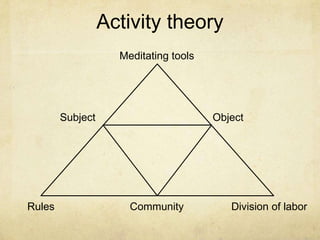
Activity theory
                    Meditating tools


        Subject                        Object


Rules                 Community           Division of labor

Communities of practice

  • 1.
    Communities of Practice Oliver Dreon, PhD Educational Foundations Millersville Univeristy
  • 2.
    How do youdefine learning?
  • 3.
    Learning “in situ” Learningis situated in authentic social practice Learning is more than the acquisition of decontextualized knowledge or skills, but the mastery of knowledge and skill so that newcomers can move toward full participation in the socio- cultural practices of a community. Learning implies becoming a different person with respect to the possibilities enabled by the systems with the community
  • 4.
    Legitimate Peripheral Participation Describes how novices are enculturated into the practice of the community Newcomers participate in authentic, low risk activities that help them become acquainted with the tools, vocabulary, social norms and organizing principles of the communities. LPP leads to fuller participation within the community
  • 5.
    Elements of a community of practice The domain A community of practice is more than a club or a group. It has a shared domain of interest and identity. The community A community of practice engage in joint activities and discussions. Participants build relationships, help one another and share information. The practice Members of a community of practice are practitioners. They develop a shared repertoire of resources: experiences, stories, tools, ways of addressing recurring problems—in short a shared practice
  • 6.
    Dualities of a communityof practice: Participation and reification The designed and the emergent The local and the global Identification and negotiability (Wenger, 1998)
  • 7.
    Cultivating a Communityof Practice Design for evolution. Open a dialogue between inside and outside perspectives. Invite different levels of participation. Develop both public and private community spaces. Focus on value. Combine familiarity and excitement. Create a rhythm for the community. (Wenger, McDermott, and Snyder, 2002)
  • 8.
    “The goal ofcommunity design is to bring out the community's own internal direction, character, and energy.” From Cultivating a Community of Practice (Wenger, McDermott, and Snyder, 2002)
  • 9.
    Activity theory Meditating tools Subject Object Rules Community Division of labor