Community e-leadership to Grow Community
Embryonic thoughts
November 2005
Derek Chirnside
Christchurch College of Education
Derek.chirnside@cce.ac.nz
Work: 03 345 8314


Introduction and background
Communities or community-like entities exist all over the place.
Groups of people united by a common practice or a common cause.
In some cases they may not know they are a community. In other
cases, they may intentionally foster and build a sense of
community.
In the past we have relied on local associations in population
centres to build community. Now with technology and the internet
we have a much greater opportunity to create links and nurture
community members who can often be widely spread.
   "Snowflakes are one of nature's most fragile things, but just
   look at what they can do when they stick together." - Vesta
   Kelly


Overview:
A community model
A brief overview, defining a few common terms, and the benefits of
an online personal and community space.

Using and Online space
OK, so you’ve got a space: what might you want to do there?

Leadership: how best to be?
Being a leader (facilitator, guide, host, co-ordinator etc) is different
to being on line. What kinds of things can you do?

The online space: features and functions
What would you want in an online space?


Community e-Leadership to grow Community                                                 1
Original material © Derek Chirnside v 1.0 November 2005          e-leadershipModelv1.2.doc
A community model
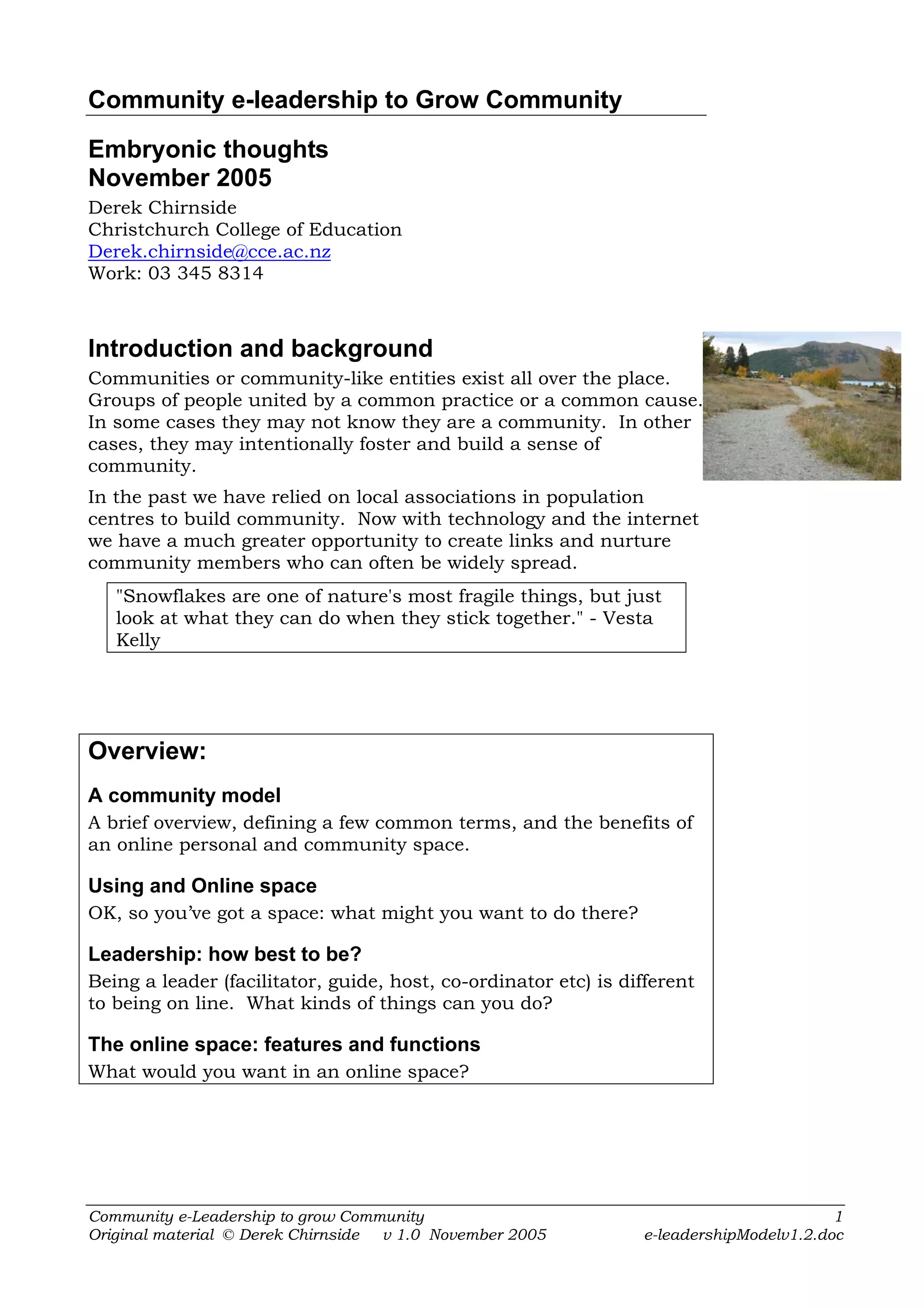
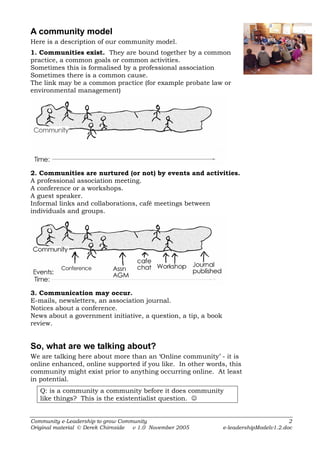
Here is a description of our community model.
1. Communities exist. They are bound together by a common
practice, a common goals or common activities.
Sometimes this is formalised by a professional association
Sometimes there is a common cause.
The link may be a common practice (for example probate law or
environmental management)


2. Communities are nurtured (or not) by events and activities.
A professional association meeting.
A conference or a workshops.
A guest speaker.
Informal links and collaborations, café meetings between
individuals and groups.


3. Communication may occur.
E-mails, newsletters, an association journal.
Notices about a conference.
News about a government initiative, a question, a tip, a book
review.


So, what are we talking about?
We are talking here about more than an ‘Online community’ - it is
online enhanced, online supported if you like. In other words, this
community might exist prior to anything occurring online. At least
in potential.
   Q: is a community a community before it does community
   like things? This is the existentialist question. ☺


Community e-Leadership to grow Community                                                2
Original material © Derek Chirnside v 1.0 November 2005         e-leadershipModelv1.2.doc
Adding online support: a personal and community space
Once upon a time communities were more localised. Now with the
power of internet connectivity they have some added tools to
nurture the community.


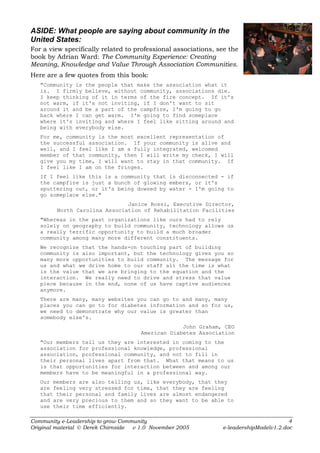
Consider now a community that exists, with an online virtual
space to occupy. The environment is
   1. private
   2. representing each member as having a unique identity
   3. the community having power to shape the future of the
      community through the interactions that occur
   4. TWO KEY TOOLS:
          a. Threaded discussions
          b. Sharing areas for file upload/download


ASIDE: the classical formulation of community practice
includes these factors:


Community e-Leadership to grow Community                                           3
Original material © Derek Chirnside v 1.0 November 2005    e-leadershipModelv1.2.doc
ASIDE: What people are saying about community in the
United States:
For a view specifically related to professional associations, see the
book by Adrian Ward: The Community Experience: Creating
Meaning, Knowledge and Value Through Association Communities.
Here are a few quotes from this book:
   "Community is the people that make the association what it
   is. I firmly believe, without community, associations die.
   I keep thinking of it in terms of the fire concept. If it's
   not warm, if it's not inviting, if I don't want to sit
   around it and be a part of the campfire, I'm going to go
   back where I can get warm. I'm going to find someplace
   where it's inviting and where I feel like sitting around and
   being with everybody else.
   For me, community is the most excellent representation of
   the successful association. If your community is alive and
   well, and I feel like I am a fully integrated, welcomed
   member of that community, then I will write my check, I will
   give you my time, I will want to stay in that community. If
   I feel like I am on the fringes.
   If I feel like this is a community that is disconnected - if
   the campfire is just a bunch of glowing embers, or it's
   sputtering out, or it's being dowsed by water - I'm going to
   go someplace else."
                               Janice Rossi, Executive Director,
         North Carolina Association of Rehabilitation Facilities
   "Whereas in the past organizations like ours had to rely
   solely on geography to build community, technology allows us
   a really terrific opportunity to build a much broader
   community among many more different constituents.
   We recognize that the hands-on touching part of building
   community is also important, but the technology gives you so
   many more opportunities to build community. The message for
   us and what we drive home to our staff all the time is what
   is the value that we are bringing to the equation and the
   interaction. We really need to drive and stress that value
   piece because in the end, none of us have captive audiences
   anymore.
   There are many, many websites you can go to and many, many
   places you can go to for diabetes information and so for us,
   we need to demonstrate why our value is greater than
   somebody else's.
                                                   John Graham, CEO
                                      American Diabetes Association
   "Our members tell us they are interested in coming to the
   association for professional knowledge, professional
   association, professional community, and not to fill in
   their personal lives apart from that. What that means to us
   is that opportunities for interaction between and among our
   members have to be meaningful in a professional way.
   Our members are also telling us, like everybody, that they
   are feeling very stressed for time, that they are feeling
   that their personal and family lives are almost endangered
   and are very precious to them and so they want to be able to
   use their time efficiently.

Community e-Leadership to grow Community                                               4
Original material © Derek Chirnside v 1.0 November 2005        e-leadershipModelv1.2.doc
So we've got sort of conflicting information. 'Give me the
   stuff and let me get out' is one strong message that we get
   from our members, but another one also is that they say they
   are feeling isolated and needing connection to others in the
   profession."
                          Susan Waters, CAE, Executive Director,
              California Society of Certified Public Accountants
   "Community building has been the heart of our association
   from the beginning. If you look at our mission, vision and
   values statement you'll see that we put in there: fostering
   relationships, shared learning, knowledge-based decision
   making, which I think is all dependent upon a community - a
   healthy functioning community."
         Adrienne Bien, Vice President, Learning and Networking,
                            Medical Group Management Association


These are some American statements. I am interested in finding
what those in New Zealand would say.
   Q: what do you look for in a community?


Community e-Leadership to grow Community                                            5
Original material © Derek Chirnside v 1.0 November 2005     e-leadershipModelv1.2.doc
Using an online space: what do you do there?
   Q: What may we wish to do in an online space with members
   from a distributed, possibly international or cross cultural
   community?

Some suggestions:

Foster routine communications.
Publicise events. A conference, a guest, a book launch.
Have a “Need Help Now!!?” forum. Q&A

Share resources, manage resources.
Sometimes there is a role for a cyber librarian, a member who
assists in the capture, storage and tagging of artefacts.

Run a members directory
Like a professional Yellow pages. Who is specialised in what?
Icohere has an “Ask me to chat about” listing in the member
profiles.

Foster members identity
Which enables matchmaking and networking

Foster dialogue and discussion
There are always issues that are relevant.

Support member initiated tasks
Provide a forum for feedback on projects of members.

Run member initiated discussions
Based on threaded discussions, these give a platform for ideas to
be shared and refined.

Run events
Online or f2f.


“No army can live on a perpetual charge”. There are rhythms, an
ebb and flow of life and activity.
Story: In the heady days of Unit Standards in New Zealand high
schools in the mid 1990’s, the whole community of physics
teachers we significantly mobilised. Conference numbers grew,
local association meetings were well attended, fun and productive.
This died down a little in the late 1990’s until the technology push
grew with cheap dataloggers. Things boomed again, with increased
interaction, revitalised conferences and idea sharing.


Community e-Leadership to grow Community                                             6
Original material © Derek Chirnside v 1.0 November 2005      e-leadershipModelv1.2.doc
Leadership: how best to be in an online
environment?
Back to the classic model again. An ecological model seems to
work best, with distributed leadership. Central directed
communities can often lack scalability.
In an online community, some power is invested in those with
admin rights. They have the power to shape the site, made
decisions, create opportunities (or not) as the case may be.
     We shape our buildings; thereafter they shape us - Winston
     Churchill


What can community leaders do??
[refer for more detail to “Disciplines of a Community Facilitator]


Communicate
A semi-regular update. Not about the content of the interaction,
but about the site (any changes, new discussions etc) about people,
events etc.
     Point: this is a function that can be shared, each of several
     members bringing their own flavour to such an event.

Site management
Providing some higher level organisation, restructuring, reshaping
as needed.
     Q: How can you think ahead for this?

Shoulder tap.
If you know person X has a strength, promote this. If a question
comes up say “Sally may have something to add here” – and you
could flick her a copy of the post.
     Q: What are the prerequisites for this to work? What are the
     benefits to Sally? Will Sally feel put upon?

Have Fun
Spontaneity . . .

??
     Q: What else??


Community e-Leadership to grow Community                                                7
Original material © Derek Chirnside v 1.0 November 2005         e-leadershipModelv1.2.doc
The online space: features and functions?
This online space needs to be
   1. user centred
   2. give real power to members
   3. fostering a sense of identity for individuals
   4. enable matchmaking
      Find those with similar interests. Create spaces to work.
   5. easy to navigate
      Navigation, tagging, quicklinks
   6. include appropriate metaphors
   7. enable easy management of data and information
   8. supportive of tagging


A quote from the philosopher:
   What has been is what will be, and what has been done is
   what will be done; there is nothing new under the sun.
   Is there a thing of which it is said,
   "See, this is new"? - It has already been, in the ages
   before us. Ecclesiastes 1:9 – 10, the Bible

Nothing new under the sun you may say. You are right actually.
The ideas here have been known for some years.
However, what we are looking for is a clearer view of what will
flourish in this country, and a much more pointed and intentional
implementation and embodiment in our practice.
It could happen.


We are interested in any feedback, reflections, questions or
comments.
With regards,
Derek Chirnside
Nov 13th 2005


Community e-Leadership to grow Community                                               8
Original material © Derek Chirnside v 1.0 November 2005        e-leadershipModelv1.2.doc

eLeadership model

  • 1.
    Community e-leadership toGrow Community Embryonic thoughts November 2005 Derek Chirnside Christchurch College of Education Derek.chirnside@cce.ac.nz Work: 03 345 8314 Introduction and background Communities or community-like entities exist all over the place. Groups of people united by a common practice or a common cause. In some cases they may not know they are a community. In other cases, they may intentionally foster and build a sense of community. In the past we have relied on local associations in population centres to build community. Now with technology and the internet we have a much greater opportunity to create links and nurture community members who can often be widely spread. "Snowflakes are one of nature's most fragile things, but just look at what they can do when they stick together." - Vesta Kelly Overview: A community model A brief overview, defining a few common terms, and the benefits of an online personal and community space. Using and Online space OK, so you’ve got a space: what might you want to do there? Leadership: how best to be? Being a leader (facilitator, guide, host, co-ordinator etc) is different to being on line. What kinds of things can you do? The online space: features and functions What would you want in an online space? Community e-Leadership to grow Community 1 Original material © Derek Chirnside v 1.0 November 2005 e-leadershipModelv1.2.doc
  • 2.
    A community model Hereis a description of our community model. 1. Communities exist. They are bound together by a common practice, a common goals or common activities. Sometimes this is formalised by a professional association Sometimes there is a common cause. The link may be a common practice (for example probate law or environmental management) 2. Communities are nurtured (or not) by events and activities. A professional association meeting. A conference or a workshops. A guest speaker. Informal links and collaborations, café meetings between individuals and groups. 3. Communication may occur. E-mails, newsletters, an association journal. Notices about a conference. News about a government initiative, a question, a tip, a book review. So, what are we talking about? We are talking here about more than an ‘Online community’ - it is online enhanced, online supported if you like. In other words, this community might exist prior to anything occurring online. At least in potential. Q: is a community a community before it does community like things? This is the existentialist question. ☺ Community e-Leadership to grow Community 2 Original material © Derek Chirnside v 1.0 November 2005 e-leadershipModelv1.2.doc
  • 3.
    Adding online support:a personal and community space Once upon a time communities were more localised. Now with the power of internet connectivity they have some added tools to nurture the community. Consider now a community that exists, with an online virtual space to occupy. The environment is 1. private 2. representing each member as having a unique identity 3. the community having power to shape the future of the community through the interactions that occur 4. TWO KEY TOOLS: a. Threaded discussions b. Sharing areas for file upload/download ASIDE: the classical formulation of community practice includes these factors: Community e-Leadership to grow Community 3 Original material © Derek Chirnside v 1.0 November 2005 e-leadershipModelv1.2.doc
  • 4.
    ASIDE: What peopleare saying about community in the United States: For a view specifically related to professional associations, see the book by Adrian Ward: The Community Experience: Creating Meaning, Knowledge and Value Through Association Communities. Here are a few quotes from this book: "Community is the people that make the association what it is. I firmly believe, without community, associations die. I keep thinking of it in terms of the fire concept. If it's not warm, if it's not inviting, if I don't want to sit around it and be a part of the campfire, I'm going to go back where I can get warm. I'm going to find someplace where it's inviting and where I feel like sitting around and being with everybody else. For me, community is the most excellent representation of the successful association. If your community is alive and well, and I feel like I am a fully integrated, welcomed member of that community, then I will write my check, I will give you my time, I will want to stay in that community. If I feel like I am on the fringes. If I feel like this is a community that is disconnected - if the campfire is just a bunch of glowing embers, or it's sputtering out, or it's being dowsed by water - I'm going to go someplace else." Janice Rossi, Executive Director, North Carolina Association of Rehabilitation Facilities "Whereas in the past organizations like ours had to rely solely on geography to build community, technology allows us a really terrific opportunity to build a much broader community among many more different constituents. We recognize that the hands-on touching part of building community is also important, but the technology gives you so many more opportunities to build community. The message for us and what we drive home to our staff all the time is what is the value that we are bringing to the equation and the interaction. We really need to drive and stress that value piece because in the end, none of us have captive audiences anymore. There are many, many websites you can go to and many, many places you can go to for diabetes information and so for us, we need to demonstrate why our value is greater than somebody else's. John Graham, CEO American Diabetes Association "Our members tell us they are interested in coming to the association for professional knowledge, professional association, professional community, and not to fill in their personal lives apart from that. What that means to us is that opportunities for interaction between and among our members have to be meaningful in a professional way. Our members are also telling us, like everybody, that they are feeling very stressed for time, that they are feeling that their personal and family lives are almost endangered and are very precious to them and so they want to be able to use their time efficiently. Community e-Leadership to grow Community 4 Original material © Derek Chirnside v 1.0 November 2005 e-leadershipModelv1.2.doc
  • 5.
    So we've gotsort of conflicting information. 'Give me the stuff and let me get out' is one strong message that we get from our members, but another one also is that they say they are feeling isolated and needing connection to others in the profession." Susan Waters, CAE, Executive Director, California Society of Certified Public Accountants "Community building has been the heart of our association from the beginning. If you look at our mission, vision and values statement you'll see that we put in there: fostering relationships, shared learning, knowledge-based decision making, which I think is all dependent upon a community - a healthy functioning community." Adrienne Bien, Vice President, Learning and Networking, Medical Group Management Association These are some American statements. I am interested in finding what those in New Zealand would say. Q: what do you look for in a community? Community e-Leadership to grow Community 5 Original material © Derek Chirnside v 1.0 November 2005 e-leadershipModelv1.2.doc
  • 6.
    Using an onlinespace: what do you do there? Q: What may we wish to do in an online space with members from a distributed, possibly international or cross cultural community? Some suggestions: Foster routine communications. Publicise events. A conference, a guest, a book launch. Have a “Need Help Now!!?” forum. Q&A Share resources, manage resources. Sometimes there is a role for a cyber librarian, a member who assists in the capture, storage and tagging of artefacts. Run a members directory Like a professional Yellow pages. Who is specialised in what? Icohere has an “Ask me to chat about” listing in the member profiles. Foster members identity Which enables matchmaking and networking Foster dialogue and discussion There are always issues that are relevant. Support member initiated tasks Provide a forum for feedback on projects of members. Run member initiated discussions Based on threaded discussions, these give a platform for ideas to be shared and refined. Run events Online or f2f. “No army can live on a perpetual charge”. There are rhythms, an ebb and flow of life and activity. Story: In the heady days of Unit Standards in New Zealand high schools in the mid 1990’s, the whole community of physics teachers we significantly mobilised. Conference numbers grew, local association meetings were well attended, fun and productive. This died down a little in the late 1990’s until the technology push grew with cheap dataloggers. Things boomed again, with increased interaction, revitalised conferences and idea sharing. Community e-Leadership to grow Community 6 Original material © Derek Chirnside v 1.0 November 2005 e-leadershipModelv1.2.doc
  • 7.
    Leadership: how bestto be in an online environment? Back to the classic model again. An ecological model seems to work best, with distributed leadership. Central directed communities can often lack scalability. In an online community, some power is invested in those with admin rights. They have the power to shape the site, made decisions, create opportunities (or not) as the case may be. We shape our buildings; thereafter they shape us - Winston Churchill What can community leaders do?? [refer for more detail to “Disciplines of a Community Facilitator] Communicate A semi-regular update. Not about the content of the interaction, but about the site (any changes, new discussions etc) about people, events etc. Point: this is a function that can be shared, each of several members bringing their own flavour to such an event. Site management Providing some higher level organisation, restructuring, reshaping as needed. Q: How can you think ahead for this? Shoulder tap. If you know person X has a strength, promote this. If a question comes up say “Sally may have something to add here” – and you could flick her a copy of the post. Q: What are the prerequisites for this to work? What are the benefits to Sally? Will Sally feel put upon? Have Fun Spontaneity . . . ?? Q: What else?? Community e-Leadership to grow Community 7 Original material © Derek Chirnside v 1.0 November 2005 e-leadershipModelv1.2.doc
  • 8.
    The online space:features and functions? This online space needs to be 1. user centred 2. give real power to members 3. fostering a sense of identity for individuals 4. enable matchmaking Find those with similar interests. Create spaces to work. 5. easy to navigate Navigation, tagging, quicklinks 6. include appropriate metaphors 7. enable easy management of data and information 8. supportive of tagging A quote from the philosopher: What has been is what will be, and what has been done is what will be done; there is nothing new under the sun. Is there a thing of which it is said, "See, this is new"? - It has already been, in the ages before us. Ecclesiastes 1:9 – 10, the Bible Nothing new under the sun you may say. You are right actually. The ideas here have been known for some years. However, what we are looking for is a clearer view of what will flourish in this country, and a much more pointed and intentional implementation and embodiment in our practice. It could happen. We are interested in any feedback, reflections, questions or comments. With regards, Derek Chirnside Nov 13th 2005 Community e-Leadership to grow Community 8 Original material © Derek Chirnside v 1.0 November 2005 e-leadershipModelv1.2.doc