1COP 19
Report of the Nineteenth Session
of the
Conference of the Parties
to the
United Nations Framework Convention
On
Climate Change.
COP 19/CMP9
What is COP??
Conference of the Parties is commonly known as COP.
The parties to the Convention have met annually from 1995 in
Conference of the Parties (COP) to assess progress in dealing with climate
change. The COP adopts decisions and resolutions, published in the reports
of the COP. Successive decisions taken by the COP make up a detailed set of
rules for practical and effective implementation of the UNFCCC. The COP also
serves as the meeting of the parties to the KYOTO PROTOCOL, which also
adopts decisions & resolution on the implementation of its provisions. This
annual meeting is referred to as the Conference of the Parties serving as the
meeting of the parties to the Kyoto Protocol(CMP).However ,parties to the
convention that are not parties to the protocol are able to participate in the
CMP as observers, but without the right to take decisions.
UNFCCC
• The United Nations Framework Convention on Climate Change (UNFCCC)
is an international environmental treaty negotiated at the United
Conference on Environment and Development informally known as the
Earth Summit, held in Rio de Janeiro from 3 to 14 June 1992.The objective
of the treaty is to stabilize greenhouse gas concentrations in the
atmosphere at a level that would prevent dangerous anthropogenic
interference with the climate system.
• The UNFCCC was opened for signature on 9May 1992, after
an Intergovernmental Negotiating Committee produced the text of the
framework convention as a report following its meeting in New York from
30April to 9May 1992.It entered into forces on 21March1994. As of March
2014, UNFCCC has 196 parties.
Some locations of preceding COPs
1. 1995 BERLIN
2. 1996 GENEVA, SWITZERLAND
3. 1997 KYOTO, JAPAN
4. 1998 BUENOS AIRES, ARGENTINA
5. 1999 BONN, GERMANY
6. 2000 THE HAGUE, NETHERLANDS
7. 2001 BONN, GERMANY
8. 2001MARRAKECH, MOROCCO
9. 2002 NEW DELHI, INDIA
10. 2003 MILAN, ITALY
11. 2004 BUENOS AIRES, ARGENTINA
12. 2005 MONTREAL, CANADA
13. 2006 NAIROBI, KENYA
14. 2007 BALI, INDONESIA
15. 2008 POZNAN, POLAND
16. 2009 COPENHAGEN, DENMARK
17. 2010 CANCUN, MEXICO
18. 2011DURBAN, SOUTH AFRICA
19. 2012 DOHA, QATAR
20. 2013 WARSAW, POLAND
21. 2014 LIMA, PERU
22. 2015 PARIS, FRANCE (to be held)
COP 19 / CMP9
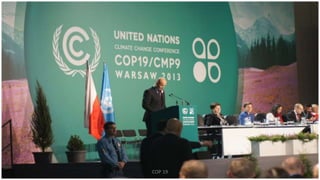
• COP 19 is the nineteenth meeting of the Congress of
Parties (COP) since the UN Convention on Climate Change
(UNFCCC) entered into force in 1995. COP 19 was held in
Warsaw, Poland from 11 to 22 November, 2013.
• The Climate Conference held in Warsaw has set
up a new international mechanism to help developing
countries affected by loss & damage from climate change,
such as the Philippines typhoons.
PURPOSE OF THE CONFERENCE
• Create a loss and damage pillar of a new
climate treaty to be finalized in 2015.
• Mitigation (emission reductions)
• Adaptation pillars.
Qualms of the Conference
• Expressing serious concern that the warming of the climate system
is unequivocal and since the 1950s, many of the observed changes
are unprecedented over decades to Millennia. The climate change
represents an urgent and potentially irreversible threat to human
societies, future generations and the planet, that continued
emissions of greenhouse gases will cause further warming and
changes in all components of the climate system and that limiting
climate change will require substantial and sustained reductions of
greenhouse gas emissions. And aggregate emission pathways
consistent with having a likely chance of holding the increase in
global average temperature below 2 °C or 1.5 °C above pre-
industrial levels.
POLICIES
• Facilitate support of actions to address loss and damage;
• Improve coordination of the relevant work of existing bodies under
the Convention;
• Convene meetings of relevant experts and stakeholders;
• Promote the development of, and compile, analyze, synthesize and
review information.
• Provide technical guidance and support;
• Make recommendations, as appropriate, on how to enhance
engagement, actions and coherence under and outside the
Convention, including on how to mobilize resources and expertise
at different levels.
ACHIEVEMENTS
• The setting up of a loss & damage international
mechanism was the major achievement of the
19th Conference of Parties of UNFCCC (COP 19)
• The new loss & damage mechanism to help
victims of typhoon, floods ,drought and other
effects of Climate Change was set up after many
days of negotiation .
Implementation of KYOTO PROTOCOL
Mexico
South
Africa
Australi
a
United
States
Canada
OECD
Europe
Japan
Total
OECD
2013 2.4 1.9 3.4 2.4 2.3 2.6 2.3 2.6
1997 0.4 1.3 1.2 1.1 1 0.3 0.1 0.8
0
1
2
3
4
5
Percentperyear
CO₂ REDUCTION
FAILURES
• Failure is a variable term here because how
we perceive the word “FAILURE” and
“SUCCESS” will change the whole notion in
milieu.
• There hasn’t been a overall success because of
some obvious constrains but apart from that
this Convention is a massive success.
Conclusion
• The main outcome of the meeting was the establishment of
an international mechanism for a loss and damage
associated with climate change; loss and damage aspect of
climate negotiations brought out the worst in some
countries.
• Some developing countries were going to resist the idea of
financing adaptation to climate change, while others
appeared to hate the idea of climate reparations for poor
countries. A few years earlier, industrialized nations had
made a legal commitment to a global climate fund.
Presented by:
ADIS SHALEH (13) KAJAL DEKA (15)
COP 19 Presentation

COP 19 Presentation

  • 1.
  • 2.
    Report of theNineteenth Session of the Conference of the Parties to the United Nations Framework Convention On Climate Change. COP 19/CMP9
  • 3.
    What is COP?? Conferenceof the Parties is commonly known as COP. The parties to the Convention have met annually from 1995 in Conference of the Parties (COP) to assess progress in dealing with climate change. The COP adopts decisions and resolutions, published in the reports of the COP. Successive decisions taken by the COP make up a detailed set of rules for practical and effective implementation of the UNFCCC. The COP also serves as the meeting of the parties to the KYOTO PROTOCOL, which also adopts decisions & resolution on the implementation of its provisions. This annual meeting is referred to as the Conference of the Parties serving as the meeting of the parties to the Kyoto Protocol(CMP).However ,parties to the convention that are not parties to the protocol are able to participate in the CMP as observers, but without the right to take decisions.
  • 4.
    UNFCCC • The UnitedNations Framework Convention on Climate Change (UNFCCC) is an international environmental treaty negotiated at the United Conference on Environment and Development informally known as the Earth Summit, held in Rio de Janeiro from 3 to 14 June 1992.The objective of the treaty is to stabilize greenhouse gas concentrations in the atmosphere at a level that would prevent dangerous anthropogenic interference with the climate system. • The UNFCCC was opened for signature on 9May 1992, after an Intergovernmental Negotiating Committee produced the text of the framework convention as a report following its meeting in New York from 30April to 9May 1992.It entered into forces on 21March1994. As of March 2014, UNFCCC has 196 parties.
  • 5.
    Some locations ofpreceding COPs 1. 1995 BERLIN 2. 1996 GENEVA, SWITZERLAND 3. 1997 KYOTO, JAPAN 4. 1998 BUENOS AIRES, ARGENTINA 5. 1999 BONN, GERMANY 6. 2000 THE HAGUE, NETHERLANDS 7. 2001 BONN, GERMANY 8. 2001MARRAKECH, MOROCCO 9. 2002 NEW DELHI, INDIA 10. 2003 MILAN, ITALY 11. 2004 BUENOS AIRES, ARGENTINA 12. 2005 MONTREAL, CANADA 13. 2006 NAIROBI, KENYA 14. 2007 BALI, INDONESIA 15. 2008 POZNAN, POLAND 16. 2009 COPENHAGEN, DENMARK 17. 2010 CANCUN, MEXICO 18. 2011DURBAN, SOUTH AFRICA 19. 2012 DOHA, QATAR 20. 2013 WARSAW, POLAND 21. 2014 LIMA, PERU 22. 2015 PARIS, FRANCE (to be held)
  • 6.
    COP 19 /CMP9 • COP 19 is the nineteenth meeting of the Congress of Parties (COP) since the UN Convention on Climate Change (UNFCCC) entered into force in 1995. COP 19 was held in Warsaw, Poland from 11 to 22 November, 2013. • The Climate Conference held in Warsaw has set up a new international mechanism to help developing countries affected by loss & damage from climate change, such as the Philippines typhoons.
  • 7.
    PURPOSE OF THECONFERENCE • Create a loss and damage pillar of a new climate treaty to be finalized in 2015. • Mitigation (emission reductions) • Adaptation pillars.
  • 8.
    Qualms of theConference • Expressing serious concern that the warming of the climate system is unequivocal and since the 1950s, many of the observed changes are unprecedented over decades to Millennia. The climate change represents an urgent and potentially irreversible threat to human societies, future generations and the planet, that continued emissions of greenhouse gases will cause further warming and changes in all components of the climate system and that limiting climate change will require substantial and sustained reductions of greenhouse gas emissions. And aggregate emission pathways consistent with having a likely chance of holding the increase in global average temperature below 2 °C or 1.5 °C above pre- industrial levels.
  • 9.
    POLICIES • Facilitate supportof actions to address loss and damage; • Improve coordination of the relevant work of existing bodies under the Convention; • Convene meetings of relevant experts and stakeholders; • Promote the development of, and compile, analyze, synthesize and review information. • Provide technical guidance and support; • Make recommendations, as appropriate, on how to enhance engagement, actions and coherence under and outside the Convention, including on how to mobilize resources and expertise at different levels.
  • 10.
    ACHIEVEMENTS • The settingup of a loss & damage international mechanism was the major achievement of the 19th Conference of Parties of UNFCCC (COP 19) • The new loss & damage mechanism to help victims of typhoon, floods ,drought and other effects of Climate Change was set up after many days of negotiation .
  • 11.
    Implementation of KYOTOPROTOCOL Mexico South Africa Australi a United States Canada OECD Europe Japan Total OECD 2013 2.4 1.9 3.4 2.4 2.3 2.6 2.3 2.6 1997 0.4 1.3 1.2 1.1 1 0.3 0.1 0.8 0 1 2 3 4 5 Percentperyear CO₂ REDUCTION
  • 12.
    FAILURES • Failure isa variable term here because how we perceive the word “FAILURE” and “SUCCESS” will change the whole notion in milieu. • There hasn’t been a overall success because of some obvious constrains but apart from that this Convention is a massive success.
  • 13.
    Conclusion • The mainoutcome of the meeting was the establishment of an international mechanism for a loss and damage associated with climate change; loss and damage aspect of climate negotiations brought out the worst in some countries. • Some developing countries were going to resist the idea of financing adaptation to climate change, while others appeared to hate the idea of climate reparations for poor countries. A few years earlier, industrialized nations had made a legal commitment to a global climate fund.
  • 14.
    Presented by: ADIS SHALEH(13) KAJAL DEKA (15)