Curated and Designed By Waste Or Create Hub
www.wasteorcreate.com
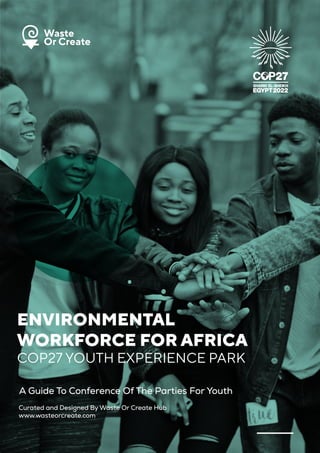
A Guide To Conference Of The Parties For Youth
ENVIRONMENTAL
WORKFORCE FOR AFRICA
COP27 YOUTH EXPERIENCE PARK
Table of Contents
Executive Summary............................................................................................................................ 1
Overview Of COP (Conference Of The Parties)........................................................................ 2
Agenda Of COP.................................................................................................................................... 4
COP27 In Focus.................................................................................................................................... 5
Youth Involvement At COP............................................................................................................... 6
Role Of Youth At COP......................................................................................................................... 7
How To Participate At COP27......................................................................................................... 8
Waste Or Create Hub’s Strategy To Enable Youth Involvement At COP........................ 9
About Waste Or Create Hub........................................................................................................... 10
Partner With Us Today....................................................................................................................... 12
Contact Us.............................................................................................................................................. 12
References
COP (Conference of the Parties) is an annual gathering of all countries that are Parties to the United
Nations Framework Convention on Climate Change (UNFCCC). It is one of the United Nations climate
change conferences which has grown exponentially in size over the past two decades and is now
among the largest international meetings in the world.
These conferences are the foremost global forums for multilateral discussion of climate change mat-
ters and serve as the formal meetings of the Conference of the Parties (COP), the Conference of the
Parties serving as the meeting of the Parties to the Kyoto Protocol (CMP) and the Conference of the
Parties serving as the meeting of the Parties to the Paris Agreement (the CMA).
The Conference of the Parties (meeting as COP, CMP and CMA) usually lasts two weeks and serves to
review the implementation of the Convention, the Kyoto Protocol and the Paris Agreement as well as
adopt decisions to further develop and implement these three instruments. The first COP conference
(COP1) was held in 1995 at Berlin, Germany. The 27th Conference of the Parties (COP27) scheduled for
6 to 18 November 2022 in Sharm El-Sheikh, Egypt, seeks renewed solidarity between countries to
deliver on the landmark Paris Agreement, for people and the planet.
It has been observed that children and youth are particularly vulnerable to climate impacts and require
tailored support to ensure their safety and protection of their rights. The UNFCCC decisions have also
emphasised that youth are a key stakeholder in implementing Action for Climate Empowerment and
they also have an important role to play in climate change governance.
In view of this, Waste Or Create Hub prepared this COP27 Starter Pack as a guide for youth intending
to know more about COP or participate at the conference. This Starter Pack contains an Overview of
COP, Agenda of COP, COP27 in Focus, as well as Youth Involvement and their Role at COP.
It also details Waste Or Create Hub’s Strategy to enable youth involvement at COP. The Environmental
Workforce for Africa is a 5-year Strategy which outlines how Waste Or Create intends to enable the
youth to the work opportunities that abound in the green economy and provide skills training that will
equip the workforce to take up challenges and innovate with the knowledge acquired, thereby provid-
ing a sustainable and viable means of livelihood that the youth can embrace. The strategy gives the
youth the opportunity to become young environmental sustainability professionals and develop their
experience in the green economy space with adequate tools, knowledge, and resources.
It is anticipated that the youth will find this starter pack insightful and also make full use of the opportu-
nities afforded them through COP.
Executive Summary
1
2
The Conference of the Parties (COP) is one of the United Nations climate change conferences and is the
supreme decision-making body of the United Nations Framework Convention on Climate Change (UN-
FCCC). It brings together the 197 nations and territories – called Parties – that have signed on to the
Framework Convention. These Parties meet every year to address the problem of climate change faced
by the planet.
During COP, heads of states, ministers and technical teams meet to negotiate international climate
action commitments. It is also a space for countries to present their accomplishments, for civil society
to advocate for greater ambitions and for institutions to exhibit their findings or services. The United
Nations climate change conferences have grown exponentially in size over the past two decades—from
small working sessions into the largest annual conferences currently held under the auspices of the
United Nations—and are now among the largest international meetings in the world. The intergovern-
mental negotiations have likewise become increasingly complex and involve an ever-increasing number
of officials from governments all over the world, at all levels, as well as huge numbers of representatives
from civil society and the global news media.
These conferences are the foremost global forums for multilateral discussion of climate change mat-
ters, and have an incredibly busy schedule. The conferences, which rotate annually among the five
United Nations regional groups, serve as the formal meetings of the Conference of the Parties (COP),
the Conference of the Parties serving as the meeting of the Parties to the Kyoto Protocol (CMP) and
the Conference of the Parties serving as the meeting of the Parties to the Paris Agreement (the CMA).
They also include sessions of the subsidiary bodies (the SBSTA and the SBI) and any ad hoc negotiating
groups. The UNFCCC secretariat supports all institutions involved in the negotiations, as well as the
Bureau of the COP/CMP/CMA, which is the executive body that advises the President of the confer-
ence. The Conference of the Parties – meeting as COP, CMP and CMA – serves two main purposes:
1. To review the implementation of the Convention, the Kyoto Protocol and the Paris Agreement,
respectively; and
2. To adopt decisions to further develop and implement these three instruments.
Overview Of COP
(Conference Of The Parties)
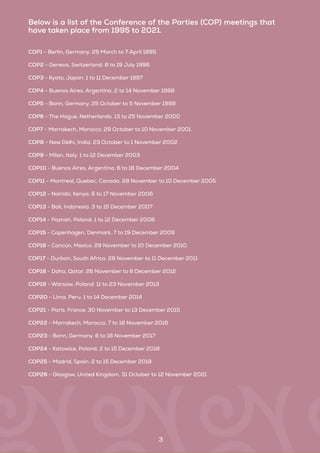
Below is a list of the Conference of the Parties (COP) meetings that
have taken place from 1995 to 2021.
COP1 - Berlin, Germany. 28 March to 7 April 1995
COP2 - Geneva, Switzerland. 8 to 19 July 1996
COP3 - Kyoto, Japan. 1 to 11 December 1997
COP4 - Buenos Aires, Argentina. 2 to 14 November 1998
COP5 - Bonn, Germany. 25 October to 5 November 1999
COP6 - The Hague, Netherlands. 13 to 25 November 2000
COP7 - Marrakech, Morocco. 29 October to 10 November 2001
COP8 - New Delhi, India. 23 October to 1 November 2002
COP9 - Milan, Italy. 1 to 12 December 2003
COP10 - Buenos Aires, Argentina. 6 to 18 December 2004
COP11 - Montreal, Quebec, Canada. 28 November to 10 December 2005
COP12 - Nairobi, Kenya. 6 to 17 November 2006
COP13 - Bali, Indonesia. 3 to 15 December 2007
COP14 - Poznań, Poland. 1 to 12 December 2008
COP15 - Copenhagen, Denmark. 7 to 19 December 2009
COP16 - Cancún, Mexico. 29 November to 10 December 2010
COP17 - Durban, South Africa. 28 November to 11 December 2011
COP18 - Doha, Qatar. 26 November to 8 December 2012
COP19 - Warsaw, Poland. 11 to 23 November 2013
COP20 - Lima, Peru. 1 to 14 December 2014
COP21 - Paris, France. 30 November to 13 December 2015
COP22 - Marrakech, Morocco. 7 to 18 November 2016
COP23 - Bonn, Germany. 6 to 18 November 2017
COP24 - Katowice, Poland. 2 to 15 December 2018
COP25 - Madrid, Spain. 2 to 15 December 2019
COP26 - Glasgow, United Kingdom. 31 October to 12 November 2021
3
AGENDA
OF COP
4
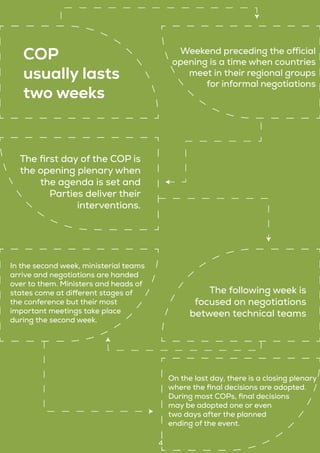
COP
usually lasts
two weeks
Weekend preceding the official
opening is a time when countries
meet in their regional groups
for informal negotiations
The first day of the COP is
the opening plenary when
the agenda is set and
Parties deliver their
interventions.
The following week is
focused on negotiations
between technical teams
On the last day, there is a closing plenary
where the final decisions are adopted.
During most COPs, final decisions
may be adopted one or even
two days after the planned
ending of the event.
In the second week, ministerial teams
arrive and negotiations are handed
over to them. Ministers and heads of
states come at different stages of
the conference but their most
important meetings take place
during the second week.
5
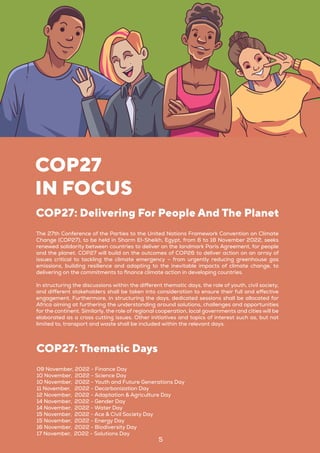
COP27
IN FOCUS
The 27th Conference of the Parties to the United Nations Framework Convention on Climate
Change (COP27), to be held in Sharm El-Sheikh, Egypt, from 6 to 18 November 2022, seeks
renewed solidarity between countries to deliver on the landmark Paris Agreement, for people
and the planet. COP27 will build on the outcomes of COP26 to deliver action on an array of
issues critical to tackling the climate emergency – from urgently reducing greenhouse gas
emissions, building resilience and adapting to the inevitable impacts of climate change, to
delivering on the commitments to finance climate action in developing countries.
In structuring the discussions within the different thematic days, the role of youth, civil society,
and different stakeholders shall be taken into consideration to ensure their full and effective
engagement. Furthermore, in structuring the days, dedicated sessions shall be allocated for
Africa aiming at furthering the understanding around solutions, challenges and opportunities
for the continent. Similarly, the role of regional cooperation, local governments and cities will be
elaborated as a cross cutting issues. Other initiatives and topics of interest such as, but not
limited to, transport and waste shall be included within the relevant days.
COP27: Delivering For People And The Planet
09 November, 2022 - Finance Day
10 November, 2022 - Science Day
10 November, 2022 - Youth and Future Generations Day
11 November, 2022 - Decarbonization Day
12 November, 2022 - Adaptation & Agriculture Day
14 November, 2022 - Gender Day
14 November, 2022 - Water Day
15 November, 2022 - Ace & Civil Society Day
15 November, 2022 - Energy Day
16 November, 2022 - Biodiversity Day
17 November, 2022 - Solutions Day
COP27: Thematic Days
YOUTH
INVOLVEMENT
AT COP
6
It is increasingly recognised that younger generations have an important role to play in climate
change governance. The global youth population is large and growing, offering significant
potential for mobilisation on climate action. According to the World Youth Report (2020), there
are 1.21 billion young people aged 15 to 24 years, accounting for 15.5% of the global population.
However, children and youth are recognised by the Intergovernmental Panel on Climate
Change (IPCC) as particularly vulnerable to climate impacts and require tailored support to
ensure their safety and protection of their rights.
Over the years, many UNFCCC decisions have emphasised that youth are a key stakeholder in
implementing Action for Climate Empowerment (ACE) and there are many individuals attend-
ing UNFCCC conferences who belong to the youth age bracket. This includes young representa-
tives of governments and other UNFCCC constituencies such as Indigenous Peoples Organisa-
tions, Women and Gender, Environmental NGOs and Farmers.
In 2009, youth participation in UN Climate Change had reached the level at which an official
constituency was formed for youth NGOs. The UNFCCC recognized youth as an official constit-
uency called “YOUNGO” (Youth Non-Governmental Organisations). After two years operating
under provisional status, “YOUNGO” became fully recognized at COP17 in Durban, South Africa.
YOUNGO has since served as both the official conduit for youth participation in the UN climate
talks and as a global network of youth and youth-focused organisations working on climate
change.
Membership of YOUNGO is open to all youth below the age of 35. Interested youth can join the
official mailing list by signing up via the membership form. For all youth attending COP, joining
YOUNGO is likely to be a great way to participate in the conference, as the constituency
provides opportunities for engagement and connecting with other young people.
Role Of Youth At COP
As an official constituency, YOUNGO has the ability to make two-minute interventions in the
plenary hall and other events. Usually these are statements during the opening and closing
ceremony, and some negotiations. Interventions are opportunities for constituencies to official-
ly express their opinion. Interventions are drafted collectively and are delivered by a member of
the drafting team. Gender and regional balance should be taken into account when selecting
individuals to deliver the remarks. Working Groups that follow specific negotiations throughout
COP are encouraged to draft their statements on the progression of the proceedings and com-
municate with the moderators so that they allow for delivering the intervention.
INTERVENTIONS
High-level figures in the UNFCCC processes, such as Executive Secretary of the UNFCCC and
President of COP, traditionally hold briefings for members of civil society where they update
NGOs about the agenda, progress of negotiations and take questions. Questions are taken
directly from the floor or have to be communicated in advance. YOUNGO usually prepares a
shared list of questions in advance to ensure that the most important points for the constituen-
cy are touched upon.
BRIEFINGS
7
Actions are strikes, sit-ins, performance or other forms of activity that are aimed at drawing
the attention of the negotiators to specific causes. Actions may take place inside or outside the
COP venue. All those happening inside the venue must obtain an approval from the Secretariat.
With the rise of the Fridays for Future movement, local participation in strikes outside of the
venue during COP is increasing in popularity
ACTIONS
Hosting a side event is an excellent opportunity to showcase the work of youth and amplify the
voice of the young generation. Most of the side events are scheduled before the COP but some-
times there is a chance to add something to the agenda during the conference, in particular in
pavilions. Additionally, it is worth trying to add a youth speaker to events that are already on
the agenda.
SIDE EVENTS
Bilateral meetings are one of the best ways to engage with other actors during COP as they
provide time and space necessary for meaningful interactions. When it comes to youth, they
usually happen between the youth constituency as a whole and the other actor, be it a Party,
UN body or organisation. It is at one’s discretion to show initiative and arrange a bilateral
meeting. YOUNGO members are particularly encouraged to reach out to delegations of their
countries or relevant intergovernmental organisations.
BILATERALS
The Green Zone often hosts an art space where pieces of art can be presented or created on
the spot. Moreover, the host city could be a space for relevant street art as long as it does not
vandalise the public areas.
ART SPACE
COP is all about Parties coming together to determine their future actions in combating climate
change. For those interested in diplomacy, it is a great lesson of how policy making looks in
practice. It is also a chance to get connected with people working on different levels of govern-
mental hierarchy and learn from them how this work looks like. The engagement will be the
most meaningful if you interact with the negotiators, ask them questions outside of the meeting
room and try to present your cause.
FOLLOW NEGOTIATIONS
Youth Day has become an integral part of COP. It is organised by YOUNGO in cooperation with
Action for Climate Empowerment (ACE) staff at the UNFCCC. ACE is a term adopted to denote
work under Article 6 of the Convention and Article 12 of the Paris Agreement. The overarching
goal of ACE and of the Youth Day is to empower all members of society to engage in climate
action, through education, training, public awareness, public participation, public access to
information, and international cooperation on these issues. Youth Day is a day devoted to rais-
ing the voice of youth and drawing attention to the work of young people around the world.
During this day, there are usually meetings of youth with high-level figures as well as events in
the main venues that showcase actions of the youth.
YOUTH DAY
8
9
Youth can engage meaningfully at the COP27 sessions via the platforms below.
- COP27 Website
- UNFCCC Website
- YOUNGO Website
- COP27 Social Media Handles
- Following the hashtags for COP27
HOW TO PARTICIPATE AT COP27
Climate action does not end after COP, quite the opposite. COP is only the
start. Now, the time has come for you to use everything you have learned and
the partnerships you developed to implement the action plan you designed
before COP in your own country to drive change by:
Organize post-COP briefings and capacity building sessions for your organiza-
tion and groups.
Write a blog post on your reflections and experiences at COP with external
partners.
Hold your countries accountable for the commitments made and outcomes
reached at COP.
Participate in other UNFCCC events that continue year round including the
Bonn sessions, Regional Climate Weeks as well as YOUNGO-led events such as
local and regional COYs.
AFTER THE COP WHAT HAPPENS?
Waste Or Create
Strategy To Enable Youth
Involvement At COP
10
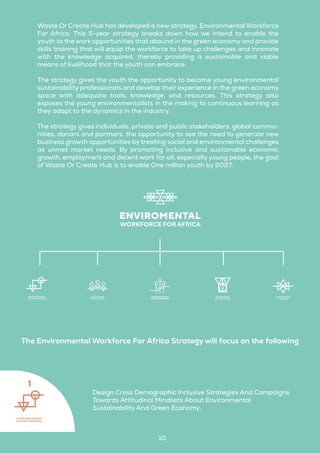
Waste Or Create Hub has developed a new strategy, Environmental Workforce
For Africa. This 5-year strategy breaks down how we intend to enable the
youth to the work opportunities that abound in the green economy and provide
skills training that will equip the workforce to take up challenges and innovate
with the knowledge acquired, thereby providing a sustainable and viable
means of livelihood that the youth can embrace.
The strategy gives the youth the opportunity to become young environmental
sustainability professionals and develop their experience in the green economy
space with adequate tools, knowledge, and resources. This strategy also
exposes the young environmentalists in the making to continuous learning as
they adapt to the dynamics in the industry.
The strategy gives individuals, private and public stakeholders, global commu-
nities, donors and partners, the opportunity to see the need to generate new
business growth opportunities by treating social and environmental challenges
as unmet market needs. By promoting inclusive and sustainable economic
growth, employment and decent work for all, especially young people, the goal
of Waste Or Create Hub is to enable One million youth by 2027.
Design Cross Demographic Inclusive Strategies And Campaigns
Towards Attitudinal Mindsets About Environmental
Sustainability And Green Economy.
The Environmental Workforce For Africa Strategy will focus on the following
11
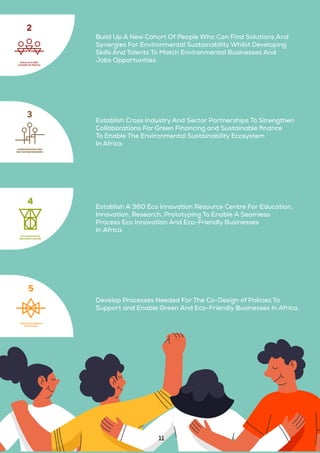
Build Up A New Cohort Of People Who Can Find Solutions And
Synergies For Environmental Sustainability Whilst Developing
Skills And Talents To Match Environmental Businesses And
Jobs Opportunities.
Establish Cross Industry And Sector Partnerships To Strengthen
Collaborations For Green Financing and Sustainable finance
To Enable The Environmental Sustainability Ecosystem
In Africa.
Establish A 360 Eco Innovation Resource Centre For Education,
Innovation, Research, Prototyping To Enable A Seamless
Process Eco Innovation And Eco-Friendly Businesses
In Africa.
Develop Processes Needed For The Co-Design of Policies To
Support and Enable Green And Eco-Friendly Businesses In Africa.
12
PARTNER WITH US TODAY
The goal of partnerships is to achieve more than individual organisations can
achieve on their own by helping to push the boundaries of what is possible.
Hence the key ingredient of every successful partnership is synergy to leverage
assets and to work together towards a common goal. The benefits of partner-
ship can be immense, but the most important of these is the ability to achieve
sustainable solutions by having each partner focus on what they do best.
Therefore, Waste or Create is delighted to invite individuals and organisations
to be part of this change process towards a greater good for Africa.
CONTACT US
Headquarters Location: 14 Haatso Atomic Road, Accra, Ghana
Website: https://www.wasteorcreate.com/
Email Address: info@wasteorcreate.com
Social Media Handle: @WASTEORCREATE
Telephone Number: +233 30 255 8377 / +233 24 583 1998 / +233 20 80 98238
REFERENCES
What are United Nations Climate Change Conferences? | UNFCCC
YOUNGO – Children and Youth constituency to United Nations Framework Conven-
tion on Climate Change
COP26 Youth Participation Policy Brief.pdf (pcancities.org.uk)
First Time at the UNFCCC COP: Guide for Youth (adobe.com)
COP27: Delivering for people and the planet | United Nations
COP27 - Presidency Vision

EWA COP27 EXPERIENCE PACK.pdf

  • 1.
    Curated and DesignedBy Waste Or Create Hub www.wasteorcreate.com A Guide To Conference Of The Parties For Youth ENVIRONMENTAL WORKFORCE FOR AFRICA COP27 YOUTH EXPERIENCE PARK
  • 2.
    Table of Contents ExecutiveSummary............................................................................................................................ 1 Overview Of COP (Conference Of The Parties)........................................................................ 2 Agenda Of COP.................................................................................................................................... 4 COP27 In Focus.................................................................................................................................... 5 Youth Involvement At COP............................................................................................................... 6 Role Of Youth At COP......................................................................................................................... 7 How To Participate At COP27......................................................................................................... 8 Waste Or Create Hub’s Strategy To Enable Youth Involvement At COP........................ 9 About Waste Or Create Hub........................................................................................................... 10 Partner With Us Today....................................................................................................................... 12 Contact Us.............................................................................................................................................. 12 References
  • 3.
    COP (Conference ofthe Parties) is an annual gathering of all countries that are Parties to the United Nations Framework Convention on Climate Change (UNFCCC). It is one of the United Nations climate change conferences which has grown exponentially in size over the past two decades and is now among the largest international meetings in the world. These conferences are the foremost global forums for multilateral discussion of climate change mat- ters and serve as the formal meetings of the Conference of the Parties (COP), the Conference of the Parties serving as the meeting of the Parties to the Kyoto Protocol (CMP) and the Conference of the Parties serving as the meeting of the Parties to the Paris Agreement (the CMA). The Conference of the Parties (meeting as COP, CMP and CMA) usually lasts two weeks and serves to review the implementation of the Convention, the Kyoto Protocol and the Paris Agreement as well as adopt decisions to further develop and implement these three instruments. The first COP conference (COP1) was held in 1995 at Berlin, Germany. The 27th Conference of the Parties (COP27) scheduled for 6 to 18 November 2022 in Sharm El-Sheikh, Egypt, seeks renewed solidarity between countries to deliver on the landmark Paris Agreement, for people and the planet. It has been observed that children and youth are particularly vulnerable to climate impacts and require tailored support to ensure their safety and protection of their rights. The UNFCCC decisions have also emphasised that youth are a key stakeholder in implementing Action for Climate Empowerment and they also have an important role to play in climate change governance. In view of this, Waste Or Create Hub prepared this COP27 Starter Pack as a guide for youth intending to know more about COP or participate at the conference. This Starter Pack contains an Overview of COP, Agenda of COP, COP27 in Focus, as well as Youth Involvement and their Role at COP. It also details Waste Or Create Hub’s Strategy to enable youth involvement at COP. The Environmental Workforce for Africa is a 5-year Strategy which outlines how Waste Or Create intends to enable the youth to the work opportunities that abound in the green economy and provide skills training that will equip the workforce to take up challenges and innovate with the knowledge acquired, thereby provid- ing a sustainable and viable means of livelihood that the youth can embrace. The strategy gives the youth the opportunity to become young environmental sustainability professionals and develop their experience in the green economy space with adequate tools, knowledge, and resources. It is anticipated that the youth will find this starter pack insightful and also make full use of the opportu- nities afforded them through COP. Executive Summary 1
  • 4.
    2 The Conference ofthe Parties (COP) is one of the United Nations climate change conferences and is the supreme decision-making body of the United Nations Framework Convention on Climate Change (UN- FCCC). It brings together the 197 nations and territories – called Parties – that have signed on to the Framework Convention. These Parties meet every year to address the problem of climate change faced by the planet. During COP, heads of states, ministers and technical teams meet to negotiate international climate action commitments. It is also a space for countries to present their accomplishments, for civil society to advocate for greater ambitions and for institutions to exhibit their findings or services. The United Nations climate change conferences have grown exponentially in size over the past two decades—from small working sessions into the largest annual conferences currently held under the auspices of the United Nations—and are now among the largest international meetings in the world. The intergovern- mental negotiations have likewise become increasingly complex and involve an ever-increasing number of officials from governments all over the world, at all levels, as well as huge numbers of representatives from civil society and the global news media. These conferences are the foremost global forums for multilateral discussion of climate change mat- ters, and have an incredibly busy schedule. The conferences, which rotate annually among the five United Nations regional groups, serve as the formal meetings of the Conference of the Parties (COP), the Conference of the Parties serving as the meeting of the Parties to the Kyoto Protocol (CMP) and the Conference of the Parties serving as the meeting of the Parties to the Paris Agreement (the CMA). They also include sessions of the subsidiary bodies (the SBSTA and the SBI) and any ad hoc negotiating groups. The UNFCCC secretariat supports all institutions involved in the negotiations, as well as the Bureau of the COP/CMP/CMA, which is the executive body that advises the President of the confer- ence. The Conference of the Parties – meeting as COP, CMP and CMA – serves two main purposes: 1. To review the implementation of the Convention, the Kyoto Protocol and the Paris Agreement, respectively; and 2. To adopt decisions to further develop and implement these three instruments. Overview Of COP (Conference Of The Parties)
  • 5.
    Below is alist of the Conference of the Parties (COP) meetings that have taken place from 1995 to 2021. COP1 - Berlin, Germany. 28 March to 7 April 1995 COP2 - Geneva, Switzerland. 8 to 19 July 1996 COP3 - Kyoto, Japan. 1 to 11 December 1997 COP4 - Buenos Aires, Argentina. 2 to 14 November 1998 COP5 - Bonn, Germany. 25 October to 5 November 1999 COP6 - The Hague, Netherlands. 13 to 25 November 2000 COP7 - Marrakech, Morocco. 29 October to 10 November 2001 COP8 - New Delhi, India. 23 October to 1 November 2002 COP9 - Milan, Italy. 1 to 12 December 2003 COP10 - Buenos Aires, Argentina. 6 to 18 December 2004 COP11 - Montreal, Quebec, Canada. 28 November to 10 December 2005 COP12 - Nairobi, Kenya. 6 to 17 November 2006 COP13 - Bali, Indonesia. 3 to 15 December 2007 COP14 - Poznań, Poland. 1 to 12 December 2008 COP15 - Copenhagen, Denmark. 7 to 19 December 2009 COP16 - Cancún, Mexico. 29 November to 10 December 2010 COP17 - Durban, South Africa. 28 November to 11 December 2011 COP18 - Doha, Qatar. 26 November to 8 December 2012 COP19 - Warsaw, Poland. 11 to 23 November 2013 COP20 - Lima, Peru. 1 to 14 December 2014 COP21 - Paris, France. 30 November to 13 December 2015 COP22 - Marrakech, Morocco. 7 to 18 November 2016 COP23 - Bonn, Germany. 6 to 18 November 2017 COP24 - Katowice, Poland. 2 to 15 December 2018 COP25 - Madrid, Spain. 2 to 15 December 2019 COP26 - Glasgow, United Kingdom. 31 October to 12 November 2021 3
  • 6.
  • 7.
    4 COP usually lasts two weeks Weekendpreceding the official opening is a time when countries meet in their regional groups for informal negotiations The first day of the COP is the opening plenary when the agenda is set and Parties deliver their interventions. The following week is focused on negotiations between technical teams On the last day, there is a closing plenary where the final decisions are adopted. During most COPs, final decisions may be adopted one or even two days after the planned ending of the event. In the second week, ministerial teams arrive and negotiations are handed over to them. Ministers and heads of states come at different stages of the conference but their most important meetings take place during the second week.
  • 8.
    5 COP27 IN FOCUS The 27thConference of the Parties to the United Nations Framework Convention on Climate Change (COP27), to be held in Sharm El-Sheikh, Egypt, from 6 to 18 November 2022, seeks renewed solidarity between countries to deliver on the landmark Paris Agreement, for people and the planet. COP27 will build on the outcomes of COP26 to deliver action on an array of issues critical to tackling the climate emergency – from urgently reducing greenhouse gas emissions, building resilience and adapting to the inevitable impacts of climate change, to delivering on the commitments to finance climate action in developing countries. In structuring the discussions within the different thematic days, the role of youth, civil society, and different stakeholders shall be taken into consideration to ensure their full and effective engagement. Furthermore, in structuring the days, dedicated sessions shall be allocated for Africa aiming at furthering the understanding around solutions, challenges and opportunities for the continent. Similarly, the role of regional cooperation, local governments and cities will be elaborated as a cross cutting issues. Other initiatives and topics of interest such as, but not limited to, transport and waste shall be included within the relevant days. COP27: Delivering For People And The Planet 09 November, 2022 - Finance Day 10 November, 2022 - Science Day 10 November, 2022 - Youth and Future Generations Day 11 November, 2022 - Decarbonization Day 12 November, 2022 - Adaptation & Agriculture Day 14 November, 2022 - Gender Day 14 November, 2022 - Water Day 15 November, 2022 - Ace & Civil Society Day 15 November, 2022 - Energy Day 16 November, 2022 - Biodiversity Day 17 November, 2022 - Solutions Day COP27: Thematic Days
  • 9.
  • 10.
    6 It is increasinglyrecognised that younger generations have an important role to play in climate change governance. The global youth population is large and growing, offering significant potential for mobilisation on climate action. According to the World Youth Report (2020), there are 1.21 billion young people aged 15 to 24 years, accounting for 15.5% of the global population. However, children and youth are recognised by the Intergovernmental Panel on Climate Change (IPCC) as particularly vulnerable to climate impacts and require tailored support to ensure their safety and protection of their rights. Over the years, many UNFCCC decisions have emphasised that youth are a key stakeholder in implementing Action for Climate Empowerment (ACE) and there are many individuals attend- ing UNFCCC conferences who belong to the youth age bracket. This includes young representa- tives of governments and other UNFCCC constituencies such as Indigenous Peoples Organisa- tions, Women and Gender, Environmental NGOs and Farmers. In 2009, youth participation in UN Climate Change had reached the level at which an official constituency was formed for youth NGOs. The UNFCCC recognized youth as an official constit- uency called “YOUNGO” (Youth Non-Governmental Organisations). After two years operating under provisional status, “YOUNGO” became fully recognized at COP17 in Durban, South Africa. YOUNGO has since served as both the official conduit for youth participation in the UN climate talks and as a global network of youth and youth-focused organisations working on climate change. Membership of YOUNGO is open to all youth below the age of 35. Interested youth can join the official mailing list by signing up via the membership form. For all youth attending COP, joining YOUNGO is likely to be a great way to participate in the conference, as the constituency provides opportunities for engagement and connecting with other young people. Role Of Youth At COP As an official constituency, YOUNGO has the ability to make two-minute interventions in the plenary hall and other events. Usually these are statements during the opening and closing ceremony, and some negotiations. Interventions are opportunities for constituencies to official- ly express their opinion. Interventions are drafted collectively and are delivered by a member of the drafting team. Gender and regional balance should be taken into account when selecting individuals to deliver the remarks. Working Groups that follow specific negotiations throughout COP are encouraged to draft their statements on the progression of the proceedings and com- municate with the moderators so that they allow for delivering the intervention. INTERVENTIONS High-level figures in the UNFCCC processes, such as Executive Secretary of the UNFCCC and President of COP, traditionally hold briefings for members of civil society where they update NGOs about the agenda, progress of negotiations and take questions. Questions are taken directly from the floor or have to be communicated in advance. YOUNGO usually prepares a shared list of questions in advance to ensure that the most important points for the constituen- cy are touched upon. BRIEFINGS
  • 11.
    7 Actions are strikes,sit-ins, performance or other forms of activity that are aimed at drawing the attention of the negotiators to specific causes. Actions may take place inside or outside the COP venue. All those happening inside the venue must obtain an approval from the Secretariat. With the rise of the Fridays for Future movement, local participation in strikes outside of the venue during COP is increasing in popularity ACTIONS Hosting a side event is an excellent opportunity to showcase the work of youth and amplify the voice of the young generation. Most of the side events are scheduled before the COP but some- times there is a chance to add something to the agenda during the conference, in particular in pavilions. Additionally, it is worth trying to add a youth speaker to events that are already on the agenda. SIDE EVENTS Bilateral meetings are one of the best ways to engage with other actors during COP as they provide time and space necessary for meaningful interactions. When it comes to youth, they usually happen between the youth constituency as a whole and the other actor, be it a Party, UN body or organisation. It is at one’s discretion to show initiative and arrange a bilateral meeting. YOUNGO members are particularly encouraged to reach out to delegations of their countries or relevant intergovernmental organisations. BILATERALS The Green Zone often hosts an art space where pieces of art can be presented or created on the spot. Moreover, the host city could be a space for relevant street art as long as it does not vandalise the public areas. ART SPACE
  • 12.
    COP is allabout Parties coming together to determine their future actions in combating climate change. For those interested in diplomacy, it is a great lesson of how policy making looks in practice. It is also a chance to get connected with people working on different levels of govern- mental hierarchy and learn from them how this work looks like. The engagement will be the most meaningful if you interact with the negotiators, ask them questions outside of the meeting room and try to present your cause. FOLLOW NEGOTIATIONS Youth Day has become an integral part of COP. It is organised by YOUNGO in cooperation with Action for Climate Empowerment (ACE) staff at the UNFCCC. ACE is a term adopted to denote work under Article 6 of the Convention and Article 12 of the Paris Agreement. The overarching goal of ACE and of the Youth Day is to empower all members of society to engage in climate action, through education, training, public awareness, public participation, public access to information, and international cooperation on these issues. Youth Day is a day devoted to rais- ing the voice of youth and drawing attention to the work of young people around the world. During this day, there are usually meetings of youth with high-level figures as well as events in the main venues that showcase actions of the youth. YOUTH DAY 8
  • 13.
    9 Youth can engagemeaningfully at the COP27 sessions via the platforms below. - COP27 Website - UNFCCC Website - YOUNGO Website - COP27 Social Media Handles - Following the hashtags for COP27 HOW TO PARTICIPATE AT COP27 Climate action does not end after COP, quite the opposite. COP is only the start. Now, the time has come for you to use everything you have learned and the partnerships you developed to implement the action plan you designed before COP in your own country to drive change by: Organize post-COP briefings and capacity building sessions for your organiza- tion and groups. Write a blog post on your reflections and experiences at COP with external partners. Hold your countries accountable for the commitments made and outcomes reached at COP. Participate in other UNFCCC events that continue year round including the Bonn sessions, Regional Climate Weeks as well as YOUNGO-led events such as local and regional COYs. AFTER THE COP WHAT HAPPENS?
  • 14.
    Waste Or Create StrategyTo Enable Youth Involvement At COP
  • 15.
    10 Waste Or CreateHub has developed a new strategy, Environmental Workforce For Africa. This 5-year strategy breaks down how we intend to enable the youth to the work opportunities that abound in the green economy and provide skills training that will equip the workforce to take up challenges and innovate with the knowledge acquired, thereby providing a sustainable and viable means of livelihood that the youth can embrace. The strategy gives the youth the opportunity to become young environmental sustainability professionals and develop their experience in the green economy space with adequate tools, knowledge, and resources. This strategy also exposes the young environmentalists in the making to continuous learning as they adapt to the dynamics in the industry. The strategy gives individuals, private and public stakeholders, global commu- nities, donors and partners, the opportunity to see the need to generate new business growth opportunities by treating social and environmental challenges as unmet market needs. By promoting inclusive and sustainable economic growth, employment and decent work for all, especially young people, the goal of Waste Or Create Hub is to enable One million youth by 2027. Design Cross Demographic Inclusive Strategies And Campaigns Towards Attitudinal Mindsets About Environmental Sustainability And Green Economy. The Environmental Workforce For Africa Strategy will focus on the following
  • 16.
    11 Build Up ANew Cohort Of People Who Can Find Solutions And Synergies For Environmental Sustainability Whilst Developing Skills And Talents To Match Environmental Businesses And Jobs Opportunities. Establish Cross Industry And Sector Partnerships To Strengthen Collaborations For Green Financing and Sustainable finance To Enable The Environmental Sustainability Ecosystem In Africa. Establish A 360 Eco Innovation Resource Centre For Education, Innovation, Research, Prototyping To Enable A Seamless Process Eco Innovation And Eco-Friendly Businesses In Africa. Develop Processes Needed For The Co-Design of Policies To Support and Enable Green And Eco-Friendly Businesses In Africa.
  • 17.
    12 PARTNER WITH USTODAY The goal of partnerships is to achieve more than individual organisations can achieve on their own by helping to push the boundaries of what is possible. Hence the key ingredient of every successful partnership is synergy to leverage assets and to work together towards a common goal. The benefits of partner- ship can be immense, but the most important of these is the ability to achieve sustainable solutions by having each partner focus on what they do best. Therefore, Waste or Create is delighted to invite individuals and organisations to be part of this change process towards a greater good for Africa. CONTACT US Headquarters Location: 14 Haatso Atomic Road, Accra, Ghana Website: https://www.wasteorcreate.com/ Email Address: info@wasteorcreate.com Social Media Handle: @WASTEORCREATE Telephone Number: +233 30 255 8377 / +233 24 583 1998 / +233 20 80 98238 REFERENCES What are United Nations Climate Change Conferences? | UNFCCC YOUNGO – Children and Youth constituency to United Nations Framework Conven- tion on Climate Change COP26 Youth Participation Policy Brief.pdf (pcancities.org.uk) First Time at the UNFCCC COP: Guide for Youth (adobe.com) COP27: Delivering for people and the planet | United Nations COP27 - Presidency Vision