COORDINATING
CONJUNCTIONS
It’s how we link words, phrases and sentences.
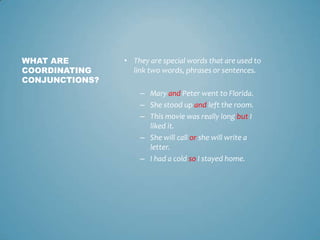
WHAT ARE
COORDINATING
CONJUNCTIONS?

• They are special words that are used to
link two words, phrases or sentences.
– Mary and Peter went to Florida.
– She stood up and left the room.
– This movie was really long but I
liked it.
– She will call or she will write a
letter.
– I had a cold so I stayed home.
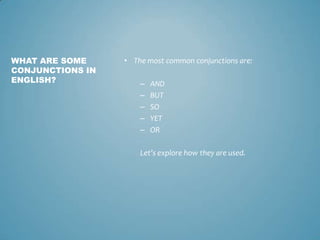
WHAT ARE SOME
CONJUNCTIONS IN
ENGLISH?

• The most common conjunctions are:

–
–
–
–
–

AND
BUT
SO
YET
OR

Let’s explore how they are used.
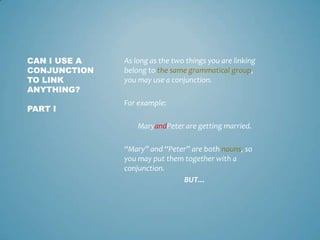
CAN I USE A
CONJUNCTION
TO LINK
ANYTHING?

As long as the two things you are linking
belong to the same grammatical group,
you may use a conjunction.

PART I

For example:
MaryandPeter are getting married.
“Mary” and “Peter” are both nouns, so
you may put them together with a
conjunction.
BUT…
CAN I USE A
CONJUNCTION TO
LINK ANYTHING?
PART II

Do you think this is ok?

Peter left and Mary.
CAN I USE A
CONJUNCTION TO
LINK ANYTHING?
PART II ½

If you said “no,” you are correct.

Peter leftandMary.
This sentence does not work because
“left” is a verb, and “Mary” is a noun.

Let’s practice that concept.
CAN I USE A
CONJUNCTION
TO LINK
ANYTHING?
PART III

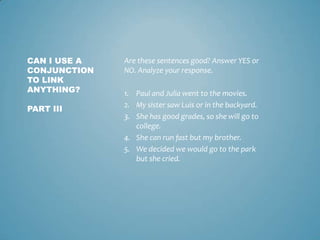
Are these sentences good? Answer YES or
NO. Analyze your response.
1. Paul and Julia went to the movies.
2. My sister saw Luis or in the backyard.
3. She has good grades, so she will go to
college.
4. She can run fast but my brother.
5. We decided we would go to the park
but she cried.
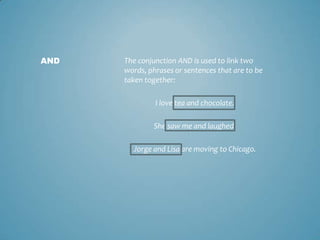
AND

The conjunction AND is used to link two
words, phrases or sentences that are to be
taken together:
I love tea and chocolate.
She saw me and laughed.
Jorge and Lisa are moving to Chicago.
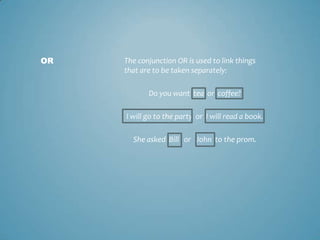
OR

The conjunction OR is used to link things
that are to be taken separately:
Do you want tea or coffee?
I will go to the party or I will read a book.

She asked Bill or John to the prom.
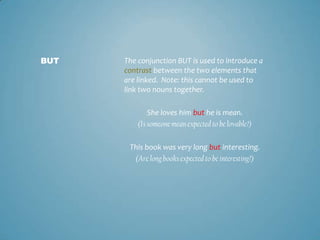
BUT

The conjunction BUT is used to introduce a
contrast between the two elements that
are linked. Note: this cannot be used to
link two nouns together.
She loves him but he is mean.
(Is someone mean expected to be lovable?)
This book was very long but interesting.
(Are long books expected to be interesting?)
YET

Similar to BUT, the conjunction YET is used
to express a contrast in the relationship
between one element and another.
She told my secret to everyone, yet I chose
to be her friend.
(It would be logical for me to decide not to be her
friend.)
Her date was a idiot, yet Lydia had a good
time.
(It would be logical to think Lydia had a bad time if
her date was an idiot.)
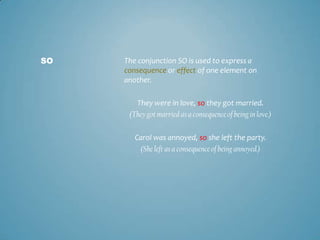
SO

The conjunction SO is used to express a
consequence or effect of one element on
another.
They were in love, so they got married.
(They got married as a consequence of being in love.)

Carol was annoyed, so she left the party.
(She left as a consequence of being annoyed.)
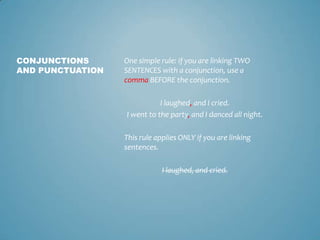
CONJUNCTIONS
AND PUNCTUATION

One simple rule: if you are linking TWO
SENTENCES with a conjunction, use a
comma BEFORE the conjunction.
I laughed, and I cried.
I went to the party, and I danced all night.

This rule applies ONLY if you are linking
sentences.
I laughed, and cried.
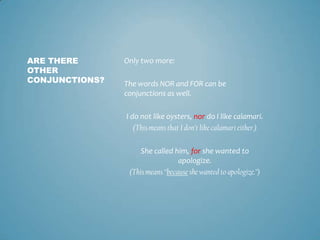
ARE THERE
OTHER
CONJUNCTIONS?

Only two more:

The words NOR and FOR can be
conjunctions as well.
I do not like oysters, nor do I like calamari.
(This means that I don’t like calamari either.)
She called him, for she wanted to
apologize.
(This means “because she wanted to apologize.”)
IS THERE AN
EASY WAY TO
REMEMBER
WHAT THE
COORDINATING
CONJUNCTIONS
ARE IN
ENGLISH?

Yes! Just remember the word FANBOYS.

For
And
Nor
But
Yet
Or
So
Easy, right?
PRACTICE I

Using AND or OR, link the two sentences
below to create just one sentence.
Example: I went to Florida. Jim went to
Brazil.  I went to Florida, and Jim went to
Brazil.
1. We ate pizza. We went to the movies.

2. Pia wrote a book. Liz made a movie.

3. I will work today. I will rest tomorrow.
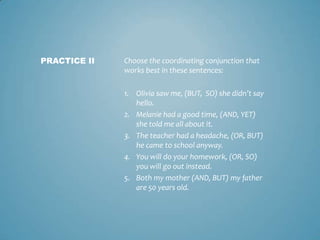
PRACTICE II

Choose the coordinating conjunction that
works best in these sentences:
1. Olivia saw me, (BUT, SO) she didn’t say
hello.
2. Melanie had a good time, (AND, YET)
she told me all about it.
3. The teacher had a headache, (OR, BUT)
he came to school anyway.
4. You will do your homework, (OR, SO)
you will go out instead.
5. Both my mother (AND, BUT) my father
are 50 years old.
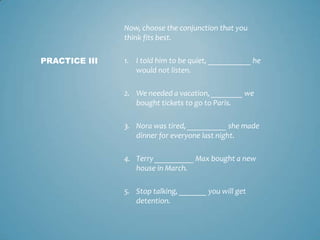
Now, choose the conjunction that you
think fits best.
PRACTICE III

1. I told him to be quiet, ___________ he
would not listen.
2. We needed a vacation, ________ we
bought tickets to go to Paris.
3. Nora was tired, __________ she made
dinner for everyone last night.
4. Terry __________ Max bought a new
house in March.

5. Stop talking, _______ you will get
detention.
PRACTICE IV

HOMEWORK

Make your own sentences. Write 5
sentences that use the coordinating
conjunctions we studied today. Use:
AND
OR
YET
BUT
SO
This is due TOMORROW.

Coordinating conjunctions

  • 1.
    COORDINATING CONJUNCTIONS It’s how welink words, phrases and sentences.
  • 2.
    WHAT ARE COORDINATING CONJUNCTIONS? • Theyare special words that are used to link two words, phrases or sentences. – Mary and Peter went to Florida. – She stood up and left the room. – This movie was really long but I liked it. – She will call or she will write a letter. – I had a cold so I stayed home.
  • 3.
    WHAT ARE SOME CONJUNCTIONSIN ENGLISH? • The most common conjunctions are: – – – – – AND BUT SO YET OR Let’s explore how they are used.
  • 4.
    CAN I USEA CONJUNCTION TO LINK ANYTHING? As long as the two things you are linking belong to the same grammatical group, you may use a conjunction. PART I For example: MaryandPeter are getting married. “Mary” and “Peter” are both nouns, so you may put them together with a conjunction. BUT…
  • 5.
    CAN I USEA CONJUNCTION TO LINK ANYTHING? PART II Do you think this is ok? Peter left and Mary.
  • 6.
    CAN I USEA CONJUNCTION TO LINK ANYTHING? PART II ½ If you said “no,” you are correct. Peter leftandMary. This sentence does not work because “left” is a verb, and “Mary” is a noun. Let’s practice that concept.
  • 7.
    CAN I USEA CONJUNCTION TO LINK ANYTHING? PART III Are these sentences good? Answer YES or NO. Analyze your response. 1. Paul and Julia went to the movies. 2. My sister saw Luis or in the backyard. 3. She has good grades, so she will go to college. 4. She can run fast but my brother. 5. We decided we would go to the park but she cried.
  • 8.
    AND The conjunction ANDis used to link two words, phrases or sentences that are to be taken together: I love tea and chocolate. She saw me and laughed. Jorge and Lisa are moving to Chicago.
  • 9.
    OR The conjunction ORis used to link things that are to be taken separately: Do you want tea or coffee? I will go to the party or I will read a book. She asked Bill or John to the prom.
  • 10.
    BUT The conjunction BUTis used to introduce a contrast between the two elements that are linked. Note: this cannot be used to link two nouns together. She loves him but he is mean. (Is someone mean expected to be lovable?) This book was very long but interesting. (Are long books expected to be interesting?)
  • 11.
    YET Similar to BUT,the conjunction YET is used to express a contrast in the relationship between one element and another. She told my secret to everyone, yet I chose to be her friend. (It would be logical for me to decide not to be her friend.) Her date was a idiot, yet Lydia had a good time. (It would be logical to think Lydia had a bad time if her date was an idiot.)
  • 12.
    SO The conjunction SOis used to express a consequence or effect of one element on another. They were in love, so they got married. (They got married as a consequence of being in love.) Carol was annoyed, so she left the party. (She left as a consequence of being annoyed.)
  • 13.
    CONJUNCTIONS AND PUNCTUATION One simplerule: if you are linking TWO SENTENCES with a conjunction, use a comma BEFORE the conjunction. I laughed, and I cried. I went to the party, and I danced all night. This rule applies ONLY if you are linking sentences. I laughed, and cried.
  • 14.
    ARE THERE OTHER CONJUNCTIONS? Only twomore: The words NOR and FOR can be conjunctions as well. I do not like oysters, nor do I like calamari. (This means that I don’t like calamari either.) She called him, for she wanted to apologize. (This means “because she wanted to apologize.”)
  • 15.
    IS THERE AN EASYWAY TO REMEMBER WHAT THE COORDINATING CONJUNCTIONS ARE IN ENGLISH? Yes! Just remember the word FANBOYS. For And Nor But Yet Or So Easy, right?
  • 16.
    PRACTICE I Using ANDor OR, link the two sentences below to create just one sentence. Example: I went to Florida. Jim went to Brazil.  I went to Florida, and Jim went to Brazil. 1. We ate pizza. We went to the movies. 2. Pia wrote a book. Liz made a movie. 3. I will work today. I will rest tomorrow.
  • 17.
    PRACTICE II Choose thecoordinating conjunction that works best in these sentences: 1. Olivia saw me, (BUT, SO) she didn’t say hello. 2. Melanie had a good time, (AND, YET) she told me all about it. 3. The teacher had a headache, (OR, BUT) he came to school anyway. 4. You will do your homework, (OR, SO) you will go out instead. 5. Both my mother (AND, BUT) my father are 50 years old.
  • 18.
    Now, choose theconjunction that you think fits best. PRACTICE III 1. I told him to be quiet, ___________ he would not listen. 2. We needed a vacation, ________ we bought tickets to go to Paris. 3. Nora was tired, __________ she made dinner for everyone last night. 4. Terry __________ Max bought a new house in March. 5. Stop talking, _______ you will get detention.
  • 19.
    PRACTICE IV HOMEWORK Make yourown sentences. Write 5 sentences that use the coordinating conjunctions we studied today. Use: AND OR YET BUT SO This is due TOMORROW.