Conjunctions
They may often be small words, but conjunctions are
highly functional and very important for constructing
sentences.
Conjunctions are known as connective or linking words.
They join thoughts, actions and ideas, as well as clauses
and phrases. Each of the three different types of
conjunctions joins different parts of a sentence together.
Let's take a look at some of the most commonly used
forms.
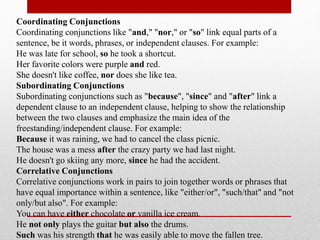
Coordinating Conjunctions
Coordinating conjunctions like "and," "nor," or "so" link equal parts of a
sentence, be it words, phrases, or independent clauses. For example:
He was late for school, so he took a shortcut.
Her favorite colors were purple and red.
She doesn't like coffee, nor does she like tea.
Subordinating Conjunctions
Subordinating conjunctions such as "because", "since" and "after" link a
dependent clause to an independent clause, helping to show the relationship
between the two clauses and emphasize the main idea of the
freestanding/independent clause. For example:
Because it was raining, we had to cancel the class picnic.
The house was a mess after the crazy party we had last night.
He doesn't go skiing any more, since he had the accident.
Correlative Conjunctions
Correlative conjunctions work in pairs to join together words or phrases that
have equal importance within a sentence, like "either/or", "such/that" and "not
only/but also". For example:
You can have either chocolate or vanilla ice cream.
He not only plays the guitar but also the drums.
Such was his strength that he was easily able to move the fallen tree.
The English language has seven coordinating conjunctions, and
they're easy to remember if you can just remember the acronym
FANBOYS:
For - Explains reason or purpose (just like "because")
I go to the park every Sunday, for I long to see his face.
And - Adds one thing to another
I like to read, and I write faithfully in my journal every night.
Nor - Used to present an alternative negative idea to an already stated negative
idea
I neither love nor hate to watch TV.
But - Shows contrast
Television is a wonderful escape, but it interferes with my writing.
Or - Presents an alternative or a choice
Would you rather read a book or watch a good TV show?
Yet - Introduces a contrasting idea that follows the preceding idea logically
(similar to "but")
I always take a book to the beach, yet I never seem to turn a single page.
So - Indicates effect, result or consequence
I like to read, so my grammar is always on-point.
In English, there are a lot of subordinating conjunctions. A
subordinating conjunction is a word that connects an independent
clause to a dependent clause. An independent clause can stand alone
as a sentence. In other words, it does not need any additional
information to operate as a sentence. The sentence "The student
failed the test" is an example of an independent clause. Let's take a
look at the most common ones :
Comparison
Than
E.g. He is cleverer than I am.
Rather than
E.g. I chose to learn German rather than French.
Whether
E.g. She was uncertain whether to stay or leave.
As much as
E.g. He doesn’t earn as much as me.
Whereas
E.g. Elliot is tall and blond, whereas his brother is short and has dark hair.
Relative Adjectives
That
E.g. She went to the school that my father went to.
Whatever
E.g. I copied in my notebook whatever he wrote on the blackboard.
Which
E.g. He developed the films which he had taken.
Whichever
E.g. Mary will eat chocolate cake or donut, whichever is delicious.
Time
After
E.g. Mary closed his diary after writing about that day’s events.
As soon as
E.g. A baby deer can stand as soon as it is born.
As long as
E.g. You can use my car as long as you drive carefully.
Before
E.g. He always feeds the dogs before he goes to school.
By the time
E.g. By the time ambulance men arrived, he was unconscious.
Now that
E.g. You can go and play now that you have finished your homework.
Once
E.g. Once you learn it, you never forget.
Since
E.g. Mary has danced since she was five.
Till
E.g. James lived with his parents till he was twenty – five.
Until
E.g. You can stay on the bus until you reach London.
When
E.g. Tom’s parents cheered for him when he crossed the finished line.
Whenever
E.g. Whenever we go abroad, we take as many pictures as possible.
While
E.g. While I was walking to the market, I met Jenny.
Concession
Though
E.g. Though it was raining, she went out.
Although
E.g. Although the kitchen is small, it is well designed.
Even though
E.g. Even though he’s a millionaire, he lives in a very small flat.
Place
Where
E.g. This is the park where we played.
Wherever
E.g. Wherever you go in the world, you’ll always find someone who speaks
English.
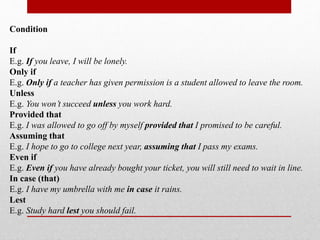
Condition
If
E.g. If you leave, I will be lonely.
Only if
E.g. Only if a teacher has given permission is a student allowed to leave the room.
Unless
E.g. You won’t succeed unless you work hard.
Provided that
E.g. I was allowed to go off by myself provided that I promised to be careful.
Assuming that
E.g. I hope to go to college next year, assuming that I pass my exams.
Even if
E.g. Even if you have already bought your ticket, you will still need to wait in line.
In case (that)
E.g. I have my umbrella with me in case it rains.
Lest
E.g. Study hard lest you should fail.
Manner
How
E.g. She taught him how to play the piano.
As though
E.g. They look as though they’re heading for divorce.
As if
E.g. At sunset, the sun looks as if it is going down.
Reason
Because
E.g. I love Matisse’s work because he uses color so brilliantly.
Since
E.g. Since we’ve got a few minutes to wait for the train, let’s have a cup of coffee.
So that
E.g. I’ll go by car so that I can take more luggage.
In order (that)
E.g. Do exercises in order that your health may improve.
That
E.g. We eat that we may live.
As
E.g. We played chess all evening as we had nothing better to do.
Correlative conjunctions are sort of like tag-team conjunctions. They come in
pairs, and you have to use both of them in different places in a sentence to
make them work. They get their name from the fact that they work together
(co-) and relate one sentence element to another. Correlative conjunctions
include pairs such as "both/and," "either/or," "neither/nor," "not/but" and
"not only/but also.“
For example:
either/or - I want either the cheesecake or the chocolate cake.
both/and - We'll have both the cheesecake and the chocolate cake.
whether/or - I didn't know whether you'd want the cheesecake or the chocolate
cake, so I got both.
neither/nor - Oh, you want neither the cheesecake nor the chocolate cake? No
problem.
not only/but also - I'll eat them both - not only the cheesecake but also the
chocolate cake.
not/but - I see you're in the mood not for desserts but appetizers. I'll help you with
those, too.
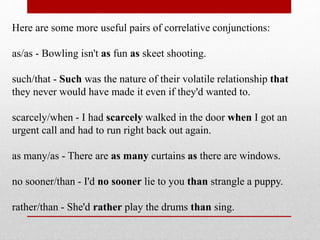
Here are some more useful pairs of correlative conjunctions:
as/as - Bowling isn't as fun as skeet shooting.
such/that - Such was the nature of their volatile relationship that
they never would have made it even if they'd wanted to.
scarcely/when - I had scarcely walked in the door when I got an
urgent call and had to run right back out again.
as many/as - There are as many curtains as there are windows.
no sooner/than - I'd no sooner lie to you than strangle a puppy.
rather/than - She'd rather play the drums than sing.
Correlative conjunctions are more similar to coordinating conjunctions than
to subordinating conjunctions because the sentence fragments they connect
are usually equal. Subordinating conjunctions connect independent clauses
and dependent clauses, which have very different functions. Coordinating
conjunctions and correlative conjunctions, on the other hand, connect words
and phrases that carry equal weight in the sentence.
For example, "both/and" connects either two subjects or two objects:
Both Jon and Lauren enjoyed the movie. (subjects)
Jon enjoyed both the movie and the company. (objects)
"As/as" compares nouns using an adjective or an adverb:
Peter is as tall as Jeff.
A lion can't run as fast as a cheetah.
"Not only/but also" can connect nouns or entire clauses:
I'm not only going to the concert, but also meeting the band backstage!
Not only will I see your $10, but also raise you $20.

Conjunctions.pptx

  • 1.
  • 2.
    They may oftenbe small words, but conjunctions are highly functional and very important for constructing sentences. Conjunctions are known as connective or linking words. They join thoughts, actions and ideas, as well as clauses and phrases. Each of the three different types of conjunctions joins different parts of a sentence together. Let's take a look at some of the most commonly used forms.
  • 4.
    Coordinating Conjunctions Coordinating conjunctionslike "and," "nor," or "so" link equal parts of a sentence, be it words, phrases, or independent clauses. For example: He was late for school, so he took a shortcut. Her favorite colors were purple and red. She doesn't like coffee, nor does she like tea. Subordinating Conjunctions Subordinating conjunctions such as "because", "since" and "after" link a dependent clause to an independent clause, helping to show the relationship between the two clauses and emphasize the main idea of the freestanding/independent clause. For example: Because it was raining, we had to cancel the class picnic. The house was a mess after the crazy party we had last night. He doesn't go skiing any more, since he had the accident. Correlative Conjunctions Correlative conjunctions work in pairs to join together words or phrases that have equal importance within a sentence, like "either/or", "such/that" and "not only/but also". For example: You can have either chocolate or vanilla ice cream. He not only plays the guitar but also the drums. Such was his strength that he was easily able to move the fallen tree.
  • 5.
    The English languagehas seven coordinating conjunctions, and they're easy to remember if you can just remember the acronym FANBOYS: For - Explains reason or purpose (just like "because") I go to the park every Sunday, for I long to see his face. And - Adds one thing to another I like to read, and I write faithfully in my journal every night. Nor - Used to present an alternative negative idea to an already stated negative idea I neither love nor hate to watch TV. But - Shows contrast Television is a wonderful escape, but it interferes with my writing. Or - Presents an alternative or a choice Would you rather read a book or watch a good TV show? Yet - Introduces a contrasting idea that follows the preceding idea logically (similar to "but") I always take a book to the beach, yet I never seem to turn a single page. So - Indicates effect, result or consequence I like to read, so my grammar is always on-point.
  • 6.
    In English, thereare a lot of subordinating conjunctions. A subordinating conjunction is a word that connects an independent clause to a dependent clause. An independent clause can stand alone as a sentence. In other words, it does not need any additional information to operate as a sentence. The sentence "The student failed the test" is an example of an independent clause. Let's take a look at the most common ones : Comparison Than E.g. He is cleverer than I am. Rather than E.g. I chose to learn German rather than French. Whether E.g. She was uncertain whether to stay or leave. As much as E.g. He doesn’t earn as much as me. Whereas E.g. Elliot is tall and blond, whereas his brother is short and has dark hair.
  • 7.
    Relative Adjectives That E.g. Shewent to the school that my father went to. Whatever E.g. I copied in my notebook whatever he wrote on the blackboard. Which E.g. He developed the films which he had taken. Whichever E.g. Mary will eat chocolate cake or donut, whichever is delicious.
  • 8.
    Time After E.g. Mary closedhis diary after writing about that day’s events. As soon as E.g. A baby deer can stand as soon as it is born. As long as E.g. You can use my car as long as you drive carefully. Before E.g. He always feeds the dogs before he goes to school. By the time E.g. By the time ambulance men arrived, he was unconscious. Now that E.g. You can go and play now that you have finished your homework. Once E.g. Once you learn it, you never forget.
  • 9.
    Since E.g. Mary hasdanced since she was five. Till E.g. James lived with his parents till he was twenty – five. Until E.g. You can stay on the bus until you reach London. When E.g. Tom’s parents cheered for him when he crossed the finished line. Whenever E.g. Whenever we go abroad, we take as many pictures as possible. While E.g. While I was walking to the market, I met Jenny.
  • 10.
    Concession Though E.g. Though itwas raining, she went out. Although E.g. Although the kitchen is small, it is well designed. Even though E.g. Even though he’s a millionaire, he lives in a very small flat. Place Where E.g. This is the park where we played. Wherever E.g. Wherever you go in the world, you’ll always find someone who speaks English.
  • 11.
    Condition If E.g. If youleave, I will be lonely. Only if E.g. Only if a teacher has given permission is a student allowed to leave the room. Unless E.g. You won’t succeed unless you work hard. Provided that E.g. I was allowed to go off by myself provided that I promised to be careful. Assuming that E.g. I hope to go to college next year, assuming that I pass my exams. Even if E.g. Even if you have already bought your ticket, you will still need to wait in line. In case (that) E.g. I have my umbrella with me in case it rains. Lest E.g. Study hard lest you should fail.
  • 12.
    Manner How E.g. She taughthim how to play the piano. As though E.g. They look as though they’re heading for divorce. As if E.g. At sunset, the sun looks as if it is going down. Reason Because E.g. I love Matisse’s work because he uses color so brilliantly. Since E.g. Since we’ve got a few minutes to wait for the train, let’s have a cup of coffee. So that E.g. I’ll go by car so that I can take more luggage. In order (that) E.g. Do exercises in order that your health may improve. That E.g. We eat that we may live. As E.g. We played chess all evening as we had nothing better to do.
  • 13.
    Correlative conjunctions aresort of like tag-team conjunctions. They come in pairs, and you have to use both of them in different places in a sentence to make them work. They get their name from the fact that they work together (co-) and relate one sentence element to another. Correlative conjunctions include pairs such as "both/and," "either/or," "neither/nor," "not/but" and "not only/but also.“ For example: either/or - I want either the cheesecake or the chocolate cake. both/and - We'll have both the cheesecake and the chocolate cake. whether/or - I didn't know whether you'd want the cheesecake or the chocolate cake, so I got both. neither/nor - Oh, you want neither the cheesecake nor the chocolate cake? No problem. not only/but also - I'll eat them both - not only the cheesecake but also the chocolate cake. not/but - I see you're in the mood not for desserts but appetizers. I'll help you with those, too.
  • 14.
    Here are somemore useful pairs of correlative conjunctions: as/as - Bowling isn't as fun as skeet shooting. such/that - Such was the nature of their volatile relationship that they never would have made it even if they'd wanted to. scarcely/when - I had scarcely walked in the door when I got an urgent call and had to run right back out again. as many/as - There are as many curtains as there are windows. no sooner/than - I'd no sooner lie to you than strangle a puppy. rather/than - She'd rather play the drums than sing.
  • 15.
    Correlative conjunctions aremore similar to coordinating conjunctions than to subordinating conjunctions because the sentence fragments they connect are usually equal. Subordinating conjunctions connect independent clauses and dependent clauses, which have very different functions. Coordinating conjunctions and correlative conjunctions, on the other hand, connect words and phrases that carry equal weight in the sentence. For example, "both/and" connects either two subjects or two objects: Both Jon and Lauren enjoyed the movie. (subjects) Jon enjoyed both the movie and the company. (objects) "As/as" compares nouns using an adjective or an adverb: Peter is as tall as Jeff. A lion can't run as fast as a cheetah. "Not only/but also" can connect nouns or entire clauses: I'm not only going to the concert, but also meeting the band backstage! Not only will I see your $10, but also raise you $20.