With Special Reference to the Caribbean By Mark-Shane Scale Presentation for ACURIL 2008
Presentation As part of a Panel on “The Internet, Social Networking and Information Literacy” at ACURIL 2008  Rose Hall Resort,  Montego Bay, Jamaica Monday, June 2, 2008, at Room 1
About Presenter Mark-Shane Scale (M.L.I.S) Departmental Librarian  Department of Library & Information Studies University of the West Indies, Mona Campus
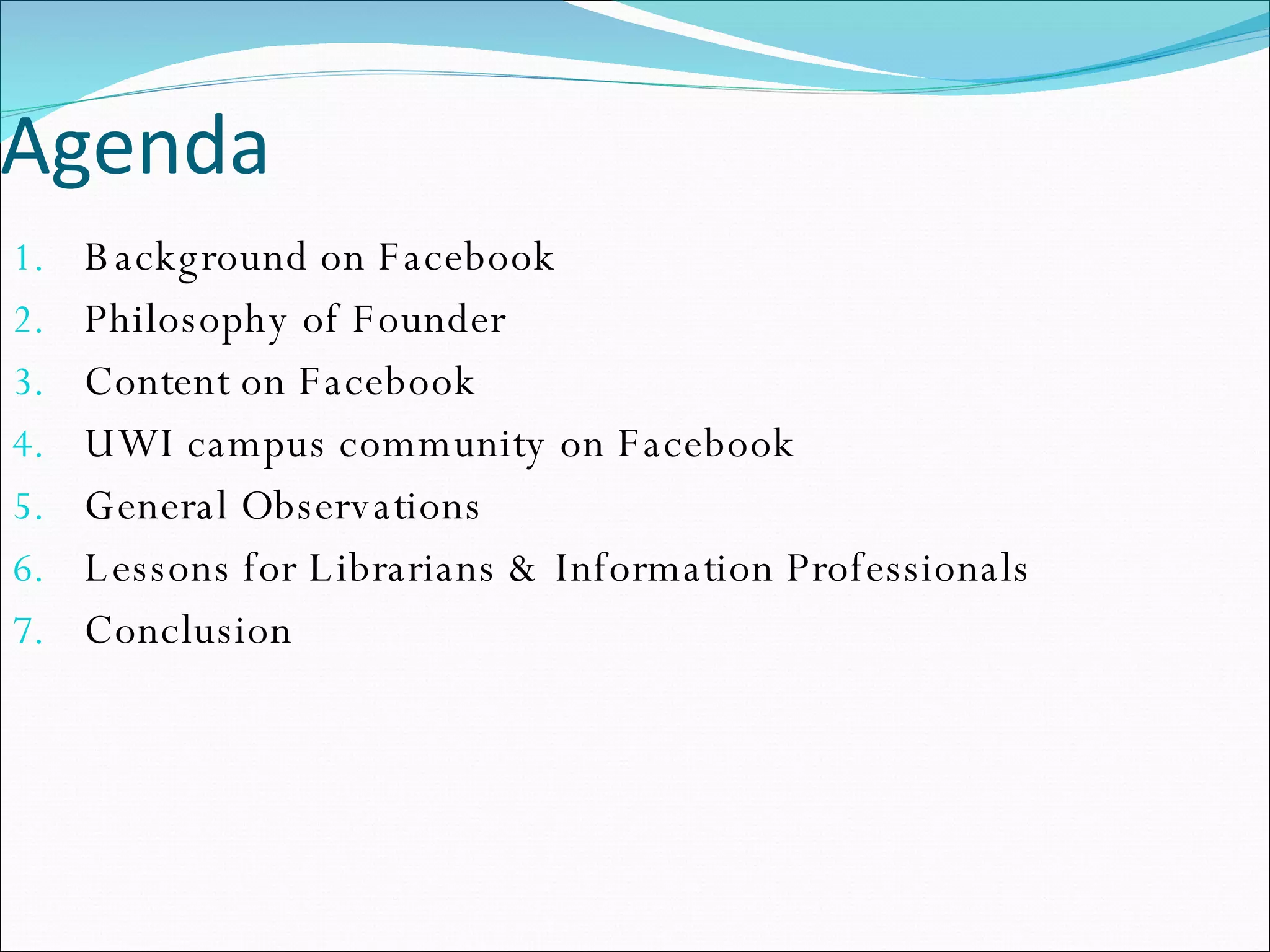
Agenda Background on Facebook Philosophy of Founder Content on Facebook UWI campus community on Facebook General Observations Lessons for Librarians & Information Professionals Conclusion
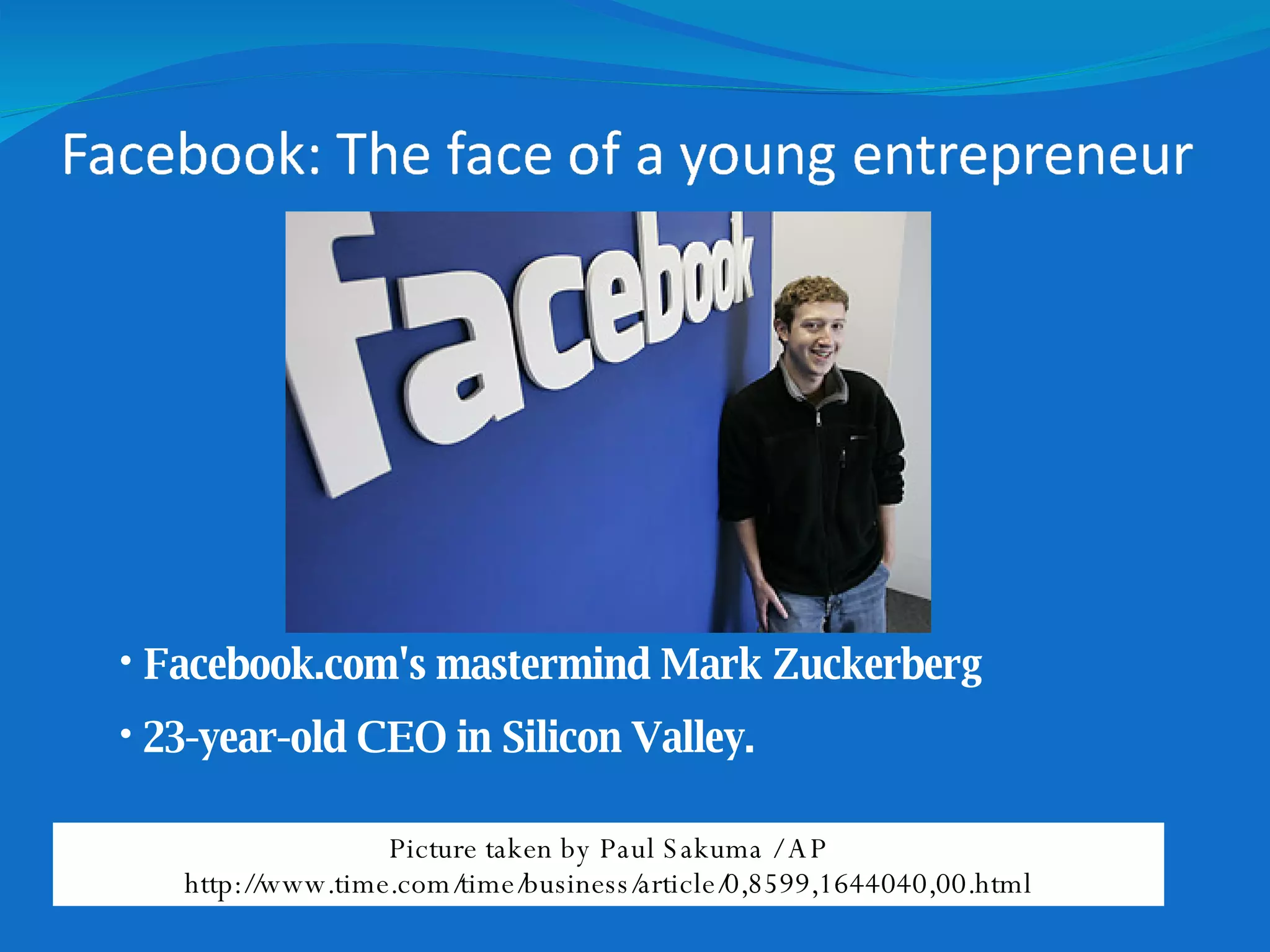
Picture taken by Paul Sakuma / AP http://www.time.com/time/business/article/0,8599,1644040,00.html Facebook.com's mastermind Mark Zuckerberg 23-year-old CEO in Silicon Valley.
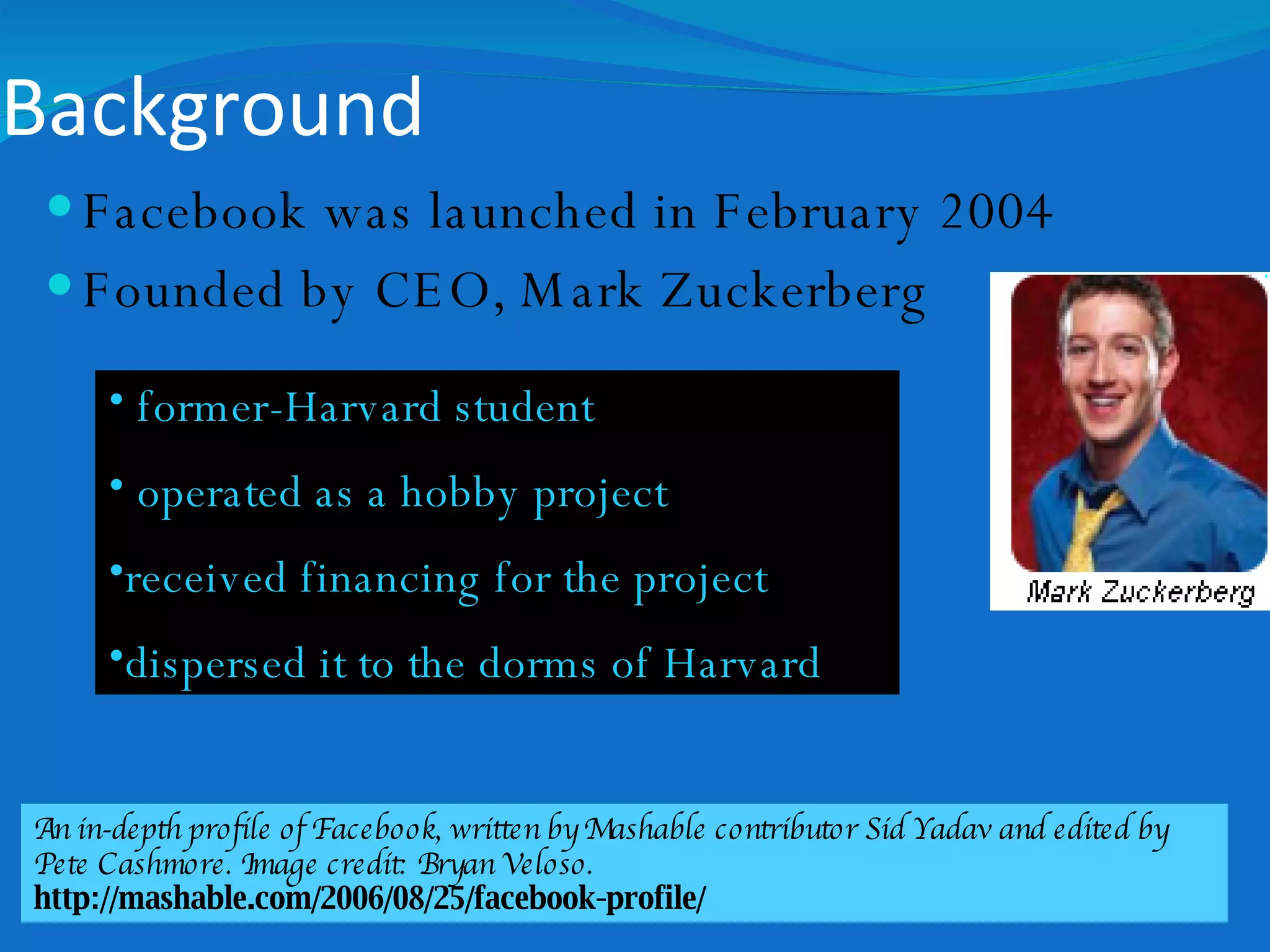
Background Facebook was launched in February 2004 Founded by CEO, Mark Zuckerberg former-Harvard student  operated as a hobby project  received financing for the project dispersed it to the dorms of Harvard  An in-depth profile of Facebook, written by Mashable contributor Sid Yadav and edited by Pete Cashmore. Image credit: Bryan Veloso. http://mashable.com/2006/08/25/facebook-profile/
Facebook is now growing at a rate of more than 150,000 new users per day More than 50% of Facebook’s users come back to the site daily ( approx 12 million people) Most of these new users are ages 25 and up
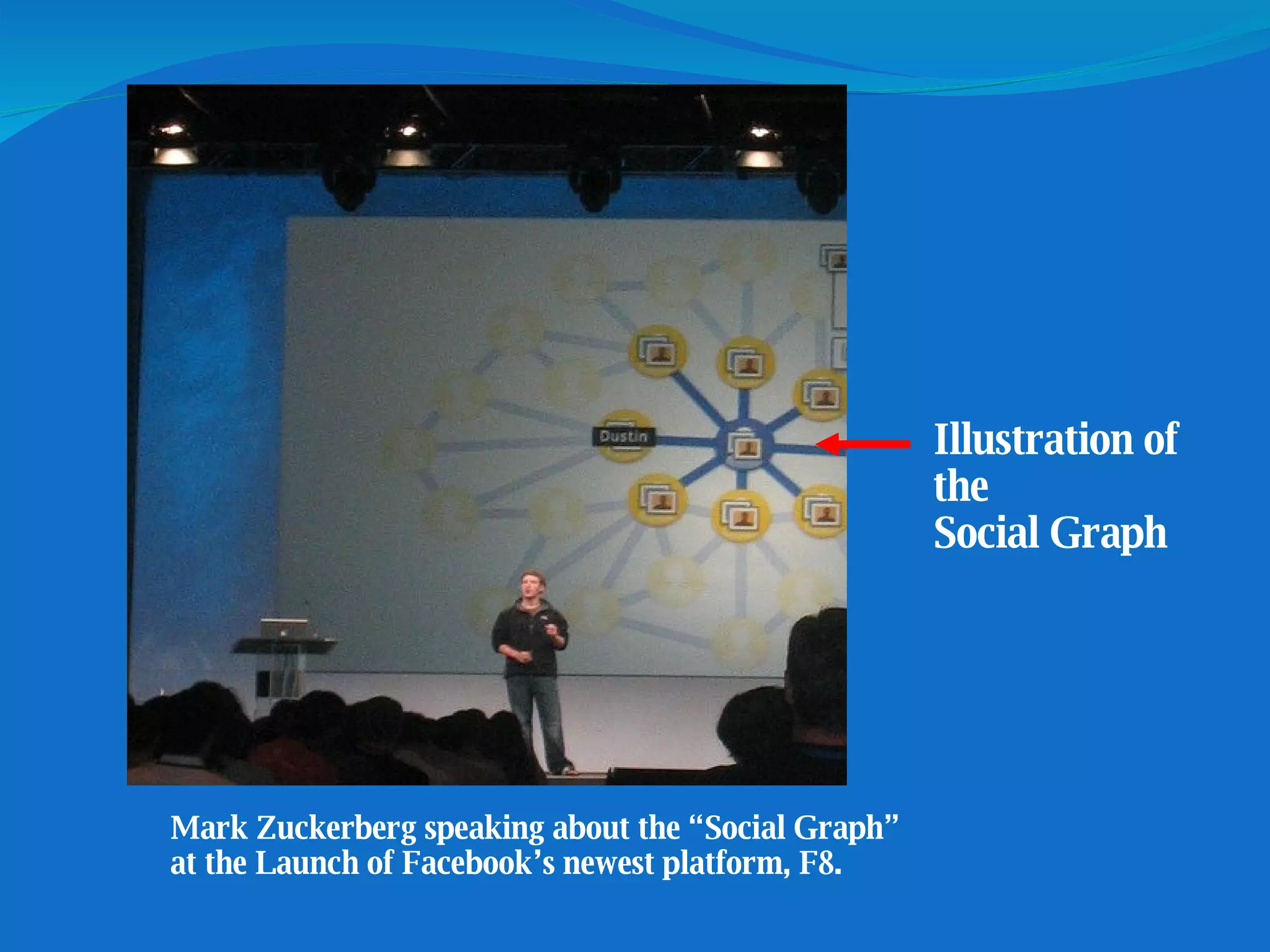
People like to  share information with their friends.  Facebook generates a social graph of each user’s friends and seeks to route updates on each persons friends immediately.
The Social Graph makes the cost of sharing information very low Each person who joins the network adds value for ultimately everyone else in the network.  As information is posted on the site, it is spread to everyone starting with the individual’s real connections (friends)
Mark Zuckerberg speaking about the “Social Graph” at the Launch of Facebook’s newest platform, F8. Illustration of  the  Social Graph
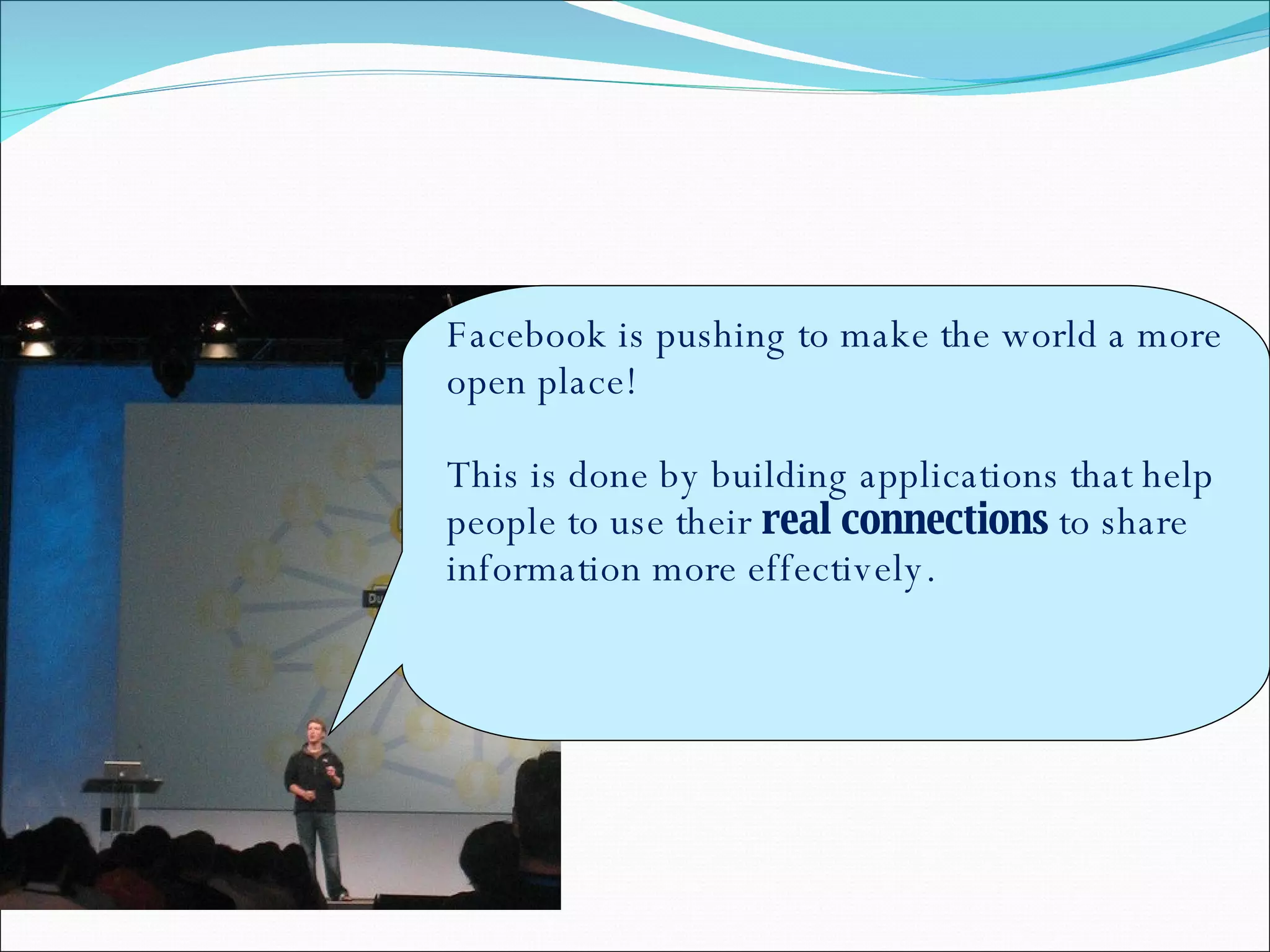
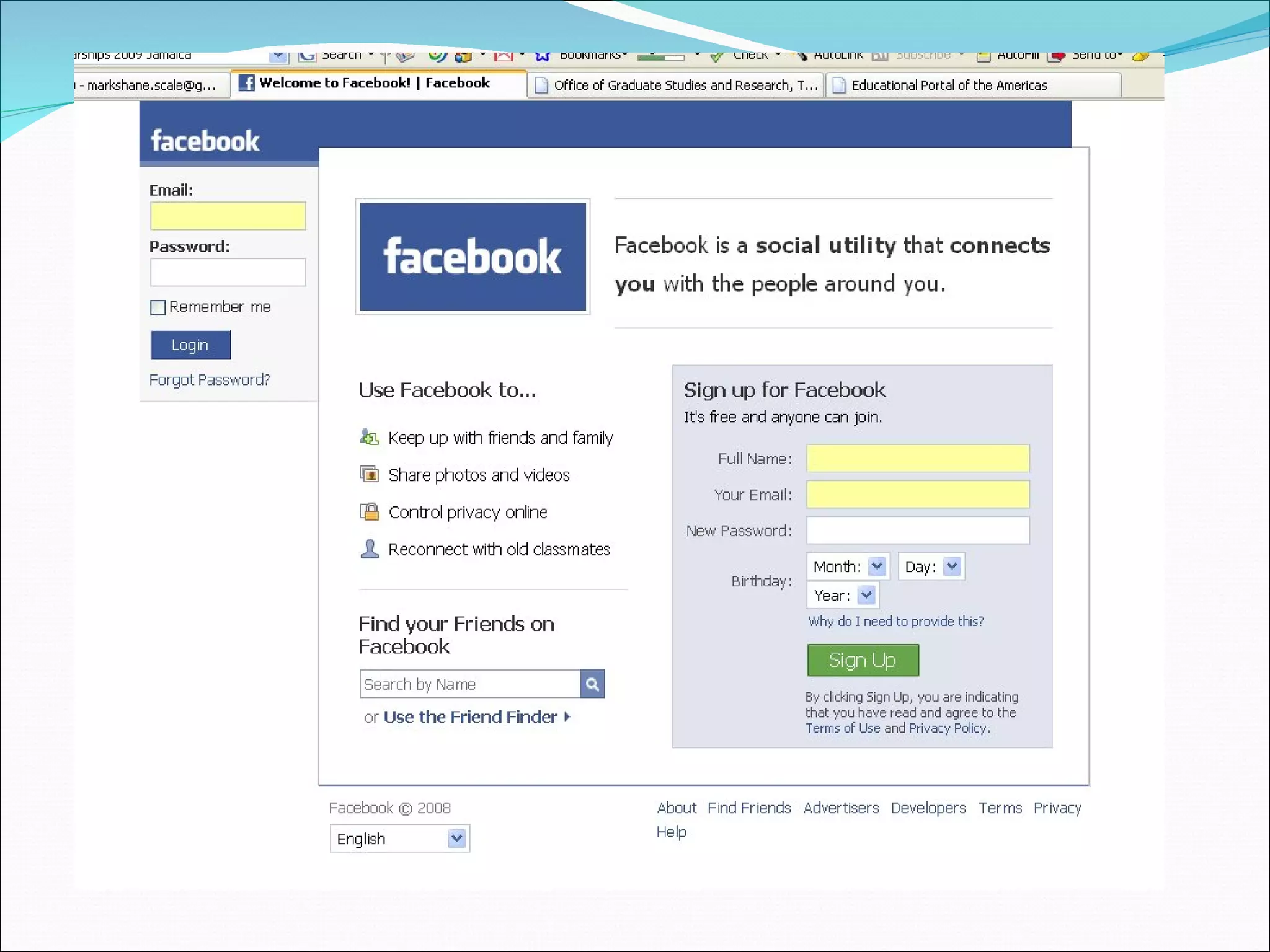
Facebook is pushing to make the world a more open place! This is done by building applications that help people to use their  real connections  to share information more effectively.
 
 
Facebook offers users to Use Facebook to… Keep up with friends and family Share photos and videos Control privacy online Reconnect with old classmates Find Friends on Facebook
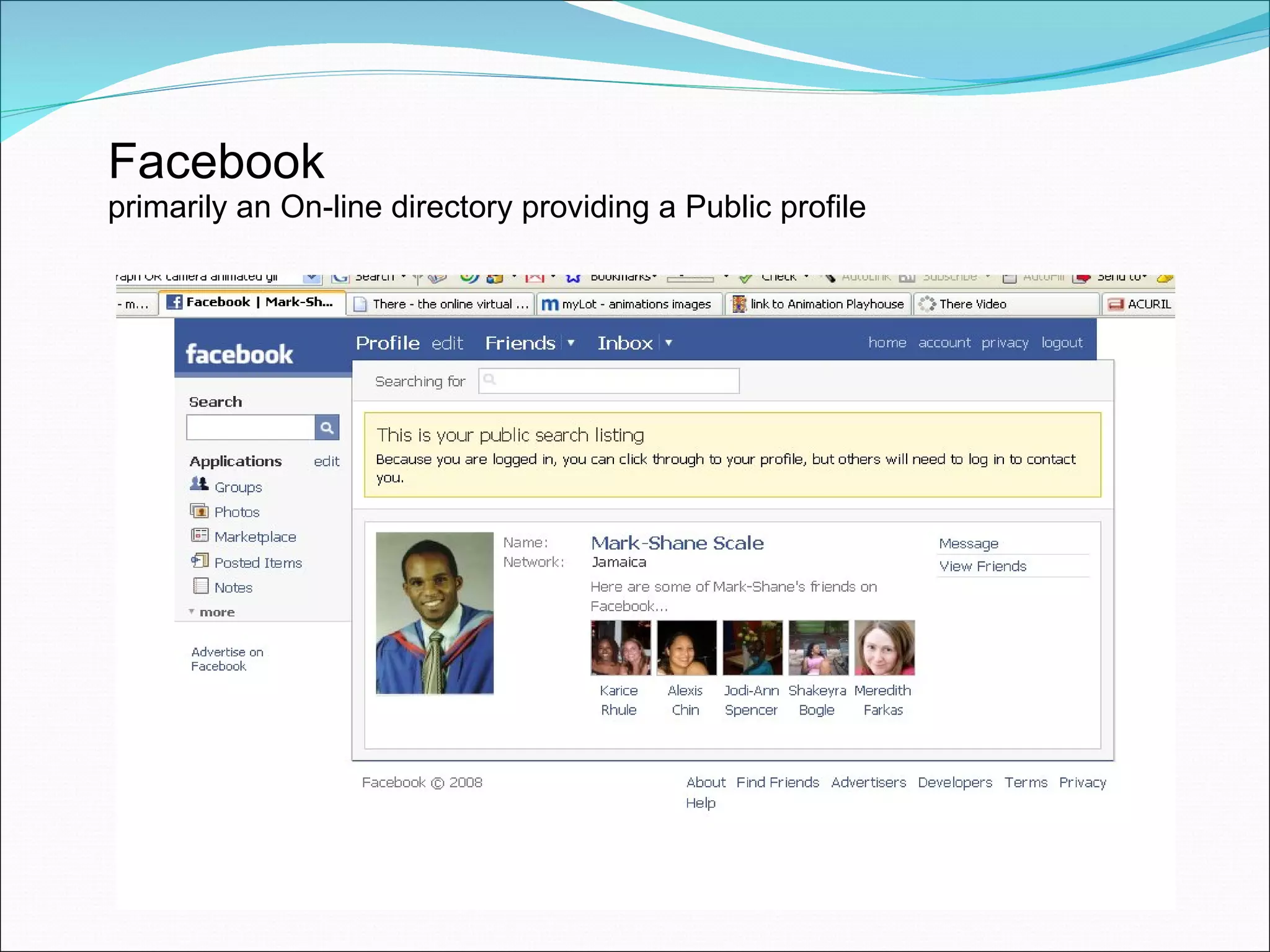
Facebook   primarily an On-line directory providing a Public profile
Popular Facebook Applications: GROUPS: connect persons of similar interest and allow them to share information. NETWORK NEWS: news about recent activities on one’s network. NEWSFEED: helps each user receive news that is specific to his/her needs/ about his friends. A home page of personalised news available to each user per day
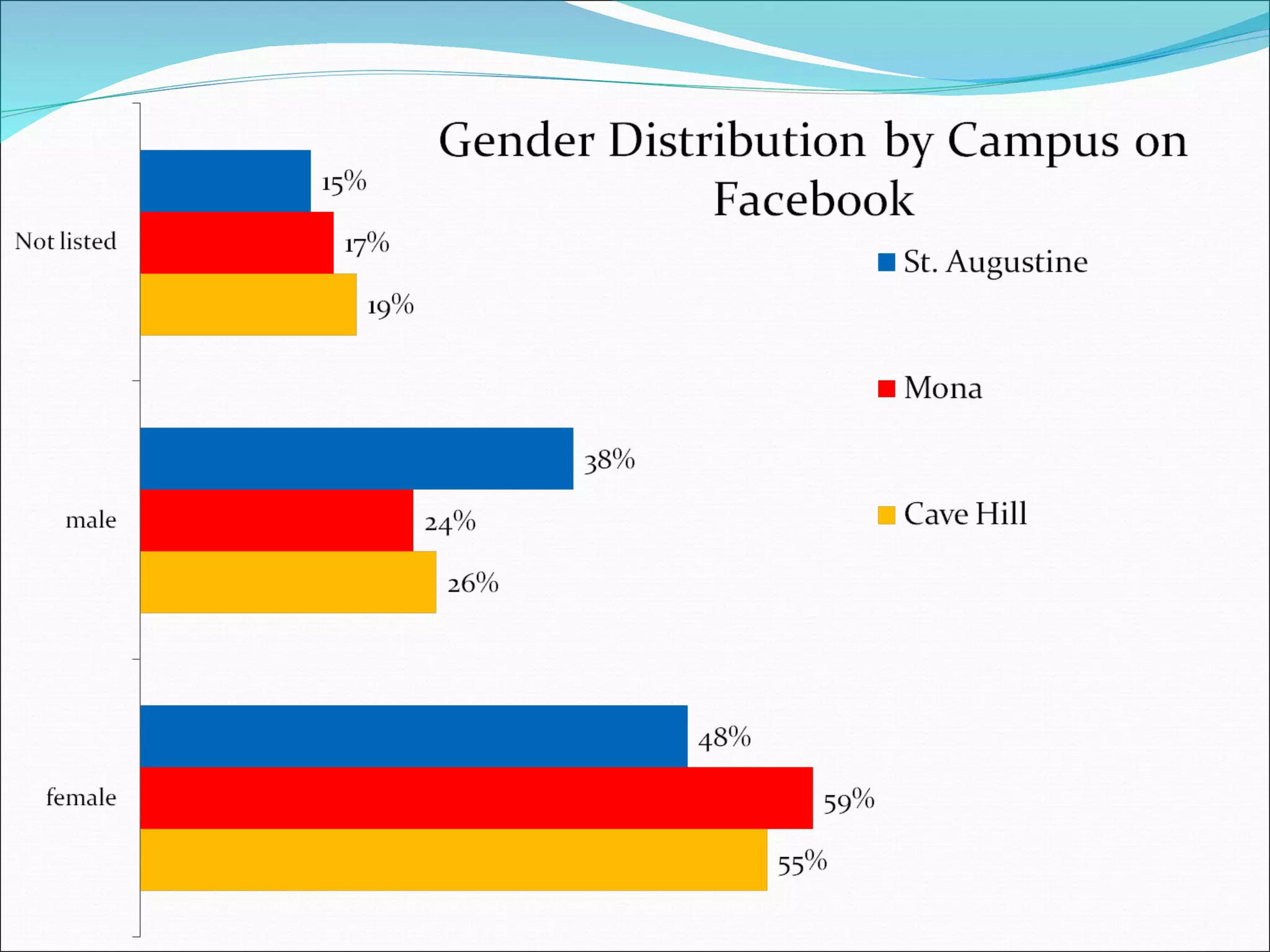
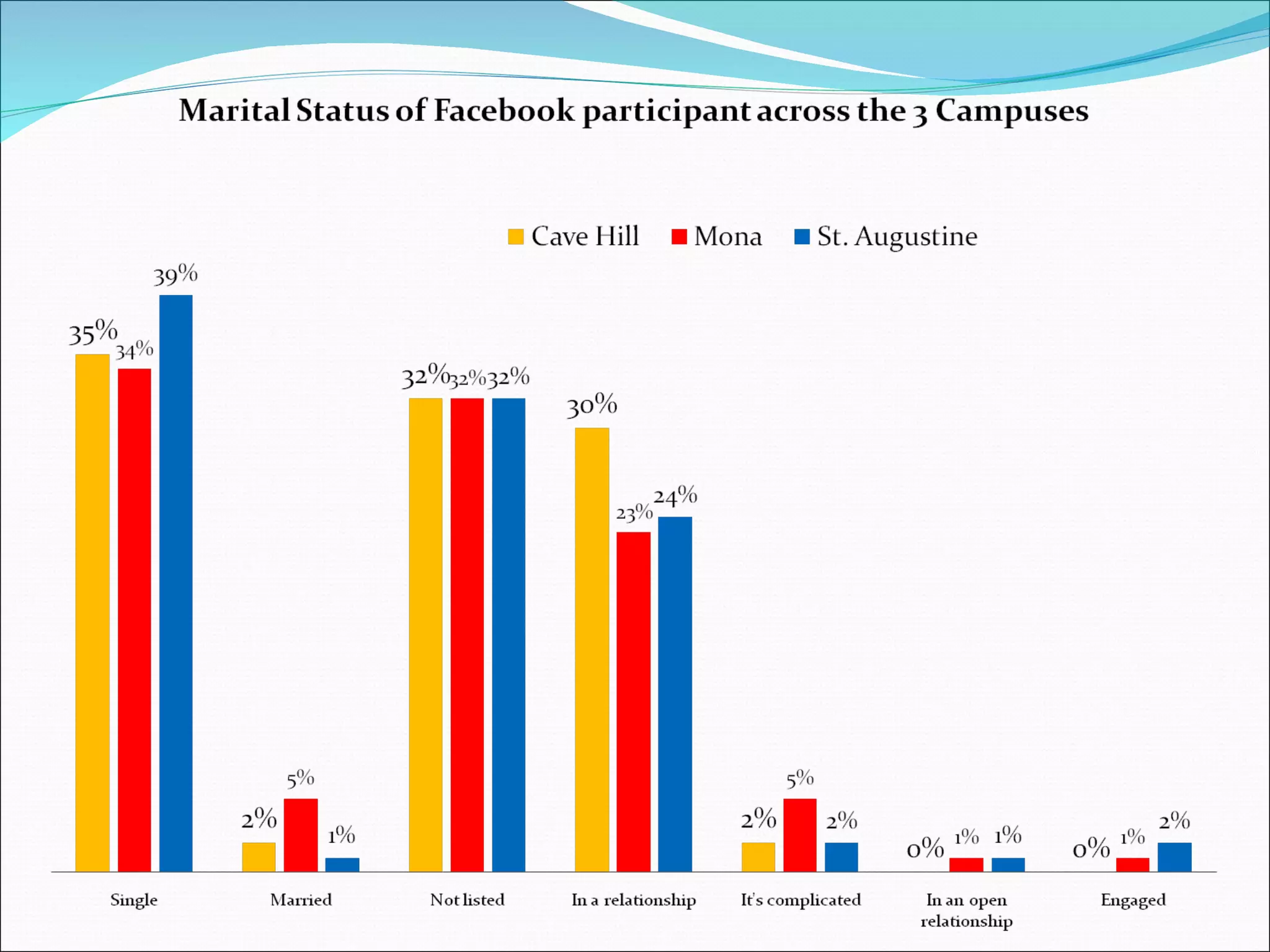
Some  Statistics and Quantitative data
 
 
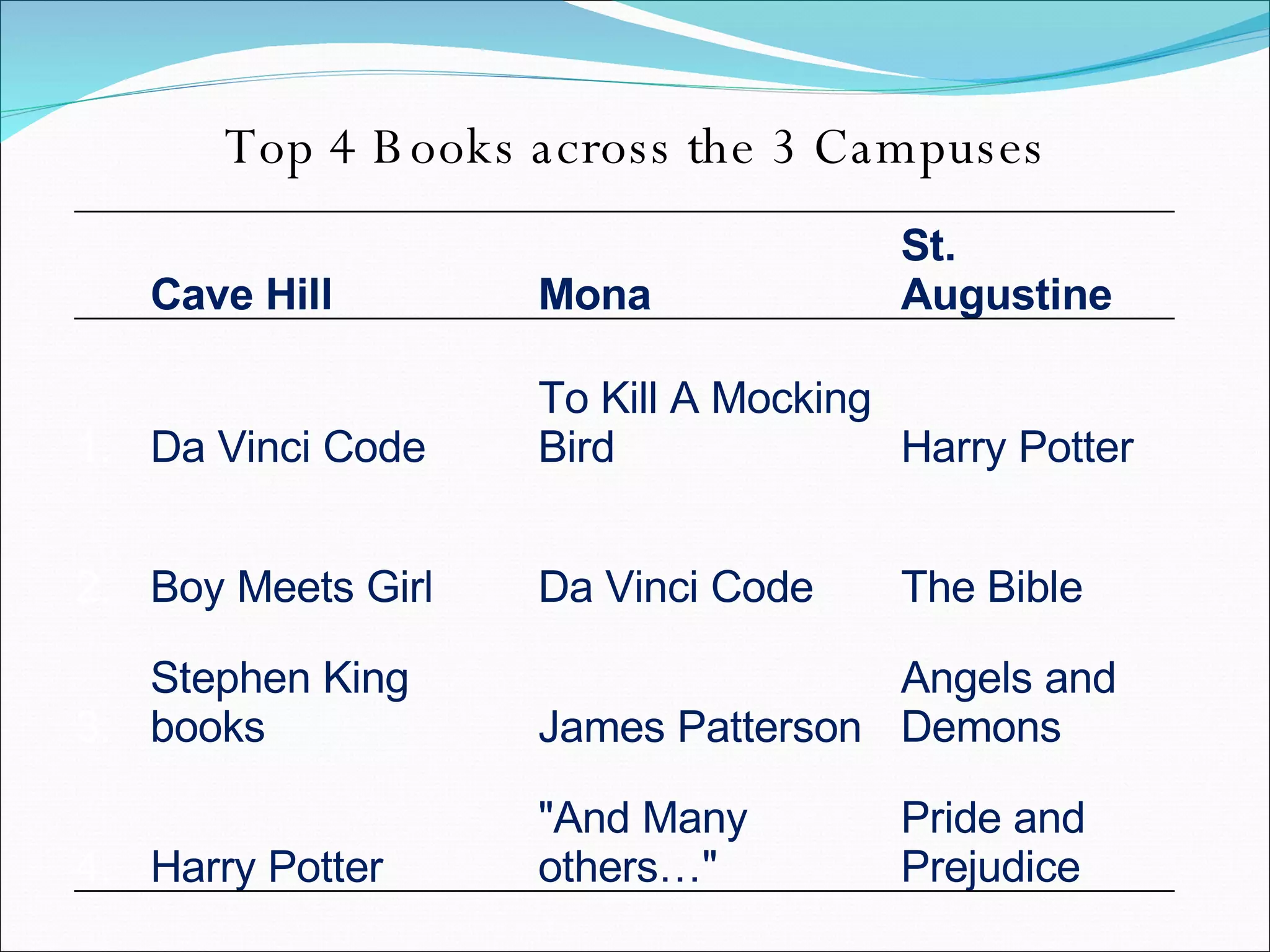
Top 4 Books across the 3 Campuses Cave Hill Mona St. Augustine 1. Da Vinci Code To Kill A Mocking Bird Harry Potter 2. Boy Meets Girl Da Vinci Code The Bible 3. Stephen King books James Patterson Angels and Demons 4. Harry Potter "And Many others…" Pride and Prejudice
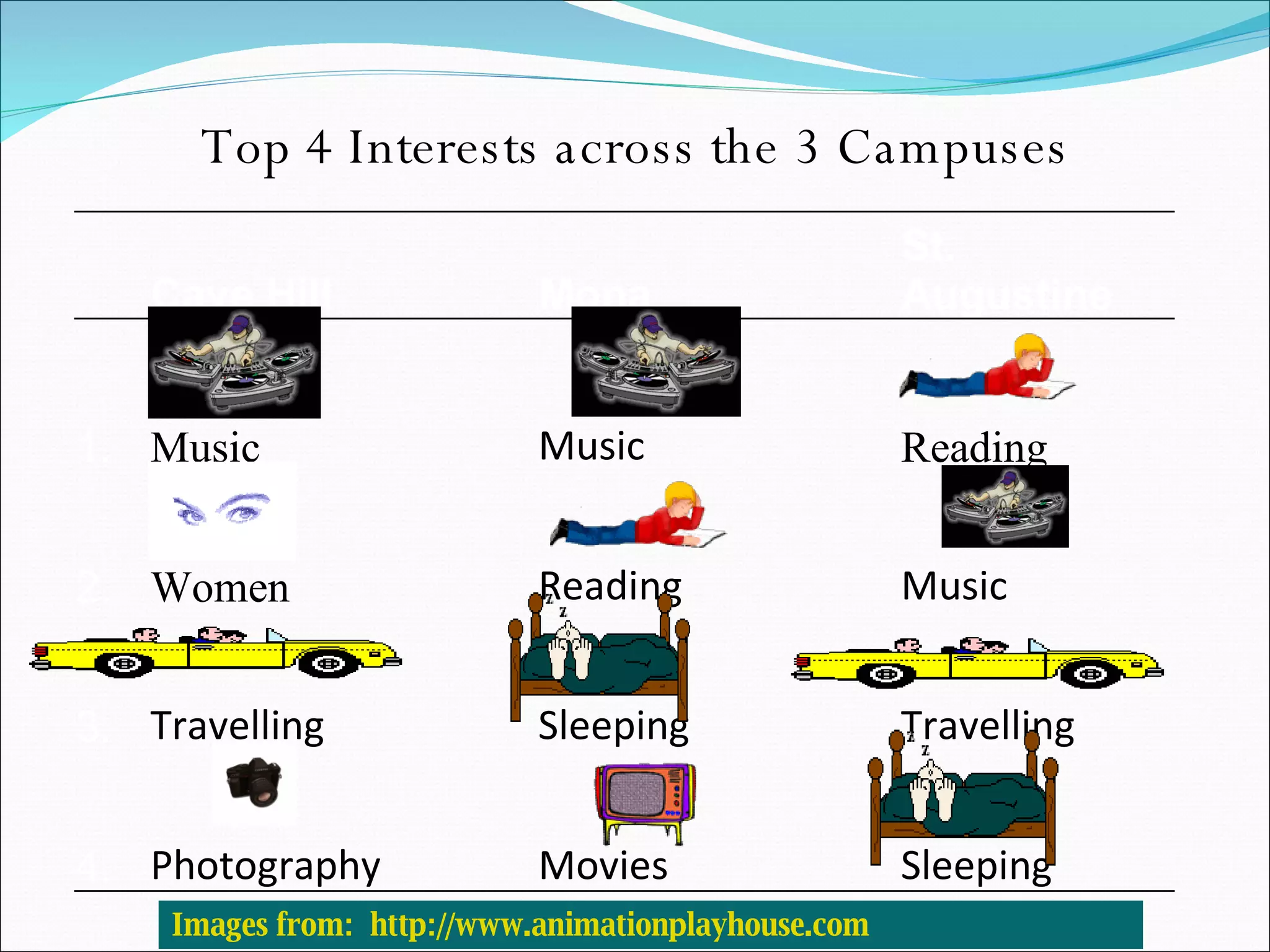
Top 4 Interests across the 3 Campuses Images from:  http://www.animationplayhouse.com Cave Hill Mona St. Augustine 1. Music  Music Reading 2. Women  Reading  Music 3. Travelling  Sleeping Travelling 4. Photography Movies Sleeping
Observations and Statistics
 
IMPLICATIONS FOR THE TRADITIONAL LIBRARY A large percentage of the world’s population consists of youth ages …. In order for the traditional library to remain viable, we have to formulate new/ creative ways of meeting the needs of this demographic group
This demographic group is accustomed to a fast paced world in which the latest information is easily packaged and readily available for use.
Facebook Networking… Threatens traditional use of Libraries by allowing users to discover a variety of information resources  access ideas from others they may not have known Facilitate communication of  ideas, experiences and knowledge with those who share similar interests or causes in a variety or formats
New mission Should you choose to accept: to educate the new generation of users about Copyright  How to earn from information Privacy control  Strategic use of information to one’s advantage
New role… On-line Information Consultant To advise clients about:  what information to put on-line  the implications of putting the information on-line.  how to earn from the information they post on-line  How to use information that they post on-line to lead them to favourable opportunities, while reducing their exposure to harm.
New Direction in our work… CATALOGUING: We must use the “wisdom of the crowd” concept as a new means of facilitating discovery of content by our clients. Change in our on-line card catalogues Adding social tagging
CIRCULATION MANAGEMENT: Collate circulations statistics by groups with similar characteristics  for instance, the top ten books borrowed or read by high school students Or the top ten books read or borrowed by persons from a particular discipline, profession or company. Make these lists public, so that it could better lead users that have similar interests to discover the materials that their colleagues use.
New Direction in our work… ACQUISITIONS: Use of “wisdom of the crowd” concepts to analyse and predict user needs.
New Direction in our work… ACQUISITIONS: Network analysis applied as methodology for studying library clientele, to  discover their information needs and use patterns.  Discovering the central nodes of users –  those who are the influential nodes of a network, whose reading habits and interests influences other members in the group to read or use a resource.
New Direction in our work… SERVICES: Allow for peer review postings invite clients to post reviews of materials that they have read or used  make reviews publicly posted.  This perhaps can have the potential of increasing circulation and traditional library usage patterns.
New Direction in our work… SERVICES: Create forum for users to comment and make views public about materials that they access and use in the information resource centres or libraries.  Use this information for further analysis and to plan for further acquisition policies  Use both qualitative and quantitative d data provided to inform acquisition and collection development policies
New Multimedia services Facilitate postings in an on-line environment, where postings can be either in a video or audio recording,  a cartoon based posting  or a text-based post.  Allow users to access or use multimedia technology & facilities Help to bridge the Digital divide and create multimedia content for the library’s collection
New Facilities & Policies… for users to create value added services for our libraries.    For users to engage other users that have similar interests, experience or views.  Facilitate social interactions.  Allow users to start Book clubs, Societies  Create meeting  in reserved spaces or rooms Creating policies regarding the formation of such interest groups, societies .  Allow these groups to also submit books/resource requests to be included in the library’s collection.
Facebook should inspire new innovations in our libraries and information centres!
New training modules for users that enlighten them about the information age New methods of getting persons to be aware of library materials New methods for identifying user needs and getting community feedback
New services that increase library multimedia content  New facilities & policies that will allow users to produce value added information create user communities within the library or information unit facilitate group/social interaction Allow for the production as well as the access to content

Libraries, Facebook and the Information Age

  • 1.
    With Special Referenceto the Caribbean By Mark-Shane Scale Presentation for ACURIL 2008
  • 2.
    Presentation As partof a Panel on “The Internet, Social Networking and Information Literacy” at ACURIL 2008 Rose Hall Resort, Montego Bay, Jamaica Monday, June 2, 2008, at Room 1
  • 3.
    About Presenter Mark-ShaneScale (M.L.I.S) Departmental Librarian Department of Library & Information Studies University of the West Indies, Mona Campus
  • 4.
    Agenda Background onFacebook Philosophy of Founder Content on Facebook UWI campus community on Facebook General Observations Lessons for Librarians & Information Professionals Conclusion
  • 5.
    Picture taken byPaul Sakuma / AP http://www.time.com/time/business/article/0,8599,1644040,00.html Facebook.com's mastermind Mark Zuckerberg 23-year-old CEO in Silicon Valley.
  • 6.
    Background Facebook waslaunched in February 2004 Founded by CEO, Mark Zuckerberg former-Harvard student operated as a hobby project received financing for the project dispersed it to the dorms of Harvard An in-depth profile of Facebook, written by Mashable contributor Sid Yadav and edited by Pete Cashmore. Image credit: Bryan Veloso. http://mashable.com/2006/08/25/facebook-profile/
  • 7.
    Facebook is nowgrowing at a rate of more than 150,000 new users per day More than 50% of Facebook’s users come back to the site daily ( approx 12 million people) Most of these new users are ages 25 and up
  • 8.
    People like to share information with their friends. Facebook generates a social graph of each user’s friends and seeks to route updates on each persons friends immediately.
  • 9.
    The Social Graphmakes the cost of sharing information very low Each person who joins the network adds value for ultimately everyone else in the network. As information is posted on the site, it is spread to everyone starting with the individual’s real connections (friends)
  • 10.
    Mark Zuckerberg speakingabout the “Social Graph” at the Launch of Facebook’s newest platform, F8. Illustration of the Social Graph
  • 11.
    Facebook is pushingto make the world a more open place! This is done by building applications that help people to use their real connections to share information more effectively.
  • 12.
  • 13.
  • 14.
    Facebook offers usersto Use Facebook to… Keep up with friends and family Share photos and videos Control privacy online Reconnect with old classmates Find Friends on Facebook
  • 15.
    Facebook primarily an On-line directory providing a Public profile
  • 16.
    Popular Facebook Applications:GROUPS: connect persons of similar interest and allow them to share information. NETWORK NEWS: news about recent activities on one’s network. NEWSFEED: helps each user receive news that is specific to his/her needs/ about his friends. A home page of personalised news available to each user per day
  • 17.
    Some Statisticsand Quantitative data
  • 18.
  • 19.
  • 20.
    Top 4 Booksacross the 3 Campuses Cave Hill Mona St. Augustine 1. Da Vinci Code To Kill A Mocking Bird Harry Potter 2. Boy Meets Girl Da Vinci Code The Bible 3. Stephen King books James Patterson Angels and Demons 4. Harry Potter "And Many others…" Pride and Prejudice
  • 21.
    Top 4 Interestsacross the 3 Campuses Images from: http://www.animationplayhouse.com Cave Hill Mona St. Augustine 1. Music Music Reading 2. Women Reading Music 3. Travelling Sleeping Travelling 4. Photography Movies Sleeping
  • 22.
  • 23.
  • 24.
    IMPLICATIONS FOR THETRADITIONAL LIBRARY A large percentage of the world’s population consists of youth ages …. In order for the traditional library to remain viable, we have to formulate new/ creative ways of meeting the needs of this demographic group
  • 25.
    This demographic groupis accustomed to a fast paced world in which the latest information is easily packaged and readily available for use.
  • 26.
    Facebook Networking… Threatenstraditional use of Libraries by allowing users to discover a variety of information resources access ideas from others they may not have known Facilitate communication of ideas, experiences and knowledge with those who share similar interests or causes in a variety or formats
  • 27.
    New mission Shouldyou choose to accept: to educate the new generation of users about Copyright How to earn from information Privacy control Strategic use of information to one’s advantage
  • 28.
    New role… On-lineInformation Consultant To advise clients about: what information to put on-line the implications of putting the information on-line. how to earn from the information they post on-line How to use information that they post on-line to lead them to favourable opportunities, while reducing their exposure to harm.
  • 29.
    New Direction inour work… CATALOGUING: We must use the “wisdom of the crowd” concept as a new means of facilitating discovery of content by our clients. Change in our on-line card catalogues Adding social tagging
  • 30.
    CIRCULATION MANAGEMENT: Collatecirculations statistics by groups with similar characteristics for instance, the top ten books borrowed or read by high school students Or the top ten books read or borrowed by persons from a particular discipline, profession or company. Make these lists public, so that it could better lead users that have similar interests to discover the materials that their colleagues use.
  • 31.
    New Direction inour work… ACQUISITIONS: Use of “wisdom of the crowd” concepts to analyse and predict user needs.
  • 32.
    New Direction inour work… ACQUISITIONS: Network analysis applied as methodology for studying library clientele, to discover their information needs and use patterns. Discovering the central nodes of users – those who are the influential nodes of a network, whose reading habits and interests influences other members in the group to read or use a resource.
  • 33.
    New Direction inour work… SERVICES: Allow for peer review postings invite clients to post reviews of materials that they have read or used make reviews publicly posted. This perhaps can have the potential of increasing circulation and traditional library usage patterns.
  • 34.
    New Direction inour work… SERVICES: Create forum for users to comment and make views public about materials that they access and use in the information resource centres or libraries. Use this information for further analysis and to plan for further acquisition policies Use both qualitative and quantitative d data provided to inform acquisition and collection development policies
  • 35.
    New Multimedia servicesFacilitate postings in an on-line environment, where postings can be either in a video or audio recording, a cartoon based posting or a text-based post. Allow users to access or use multimedia technology & facilities Help to bridge the Digital divide and create multimedia content for the library’s collection
  • 36.
    New Facilities &Policies… for users to create value added services for our libraries.   For users to engage other users that have similar interests, experience or views. Facilitate social interactions. Allow users to start Book clubs, Societies Create meeting in reserved spaces or rooms Creating policies regarding the formation of such interest groups, societies . Allow these groups to also submit books/resource requests to be included in the library’s collection.
  • 37.
    Facebook should inspirenew innovations in our libraries and information centres!
  • 38.
    New training modulesfor users that enlighten them about the information age New methods of getting persons to be aware of library materials New methods for identifying user needs and getting community feedback
  • 39.
    New services thatincrease library multimedia content New facilities & policies that will allow users to produce value added information create user communities within the library or information unit facilitate group/social interaction Allow for the production as well as the access to content