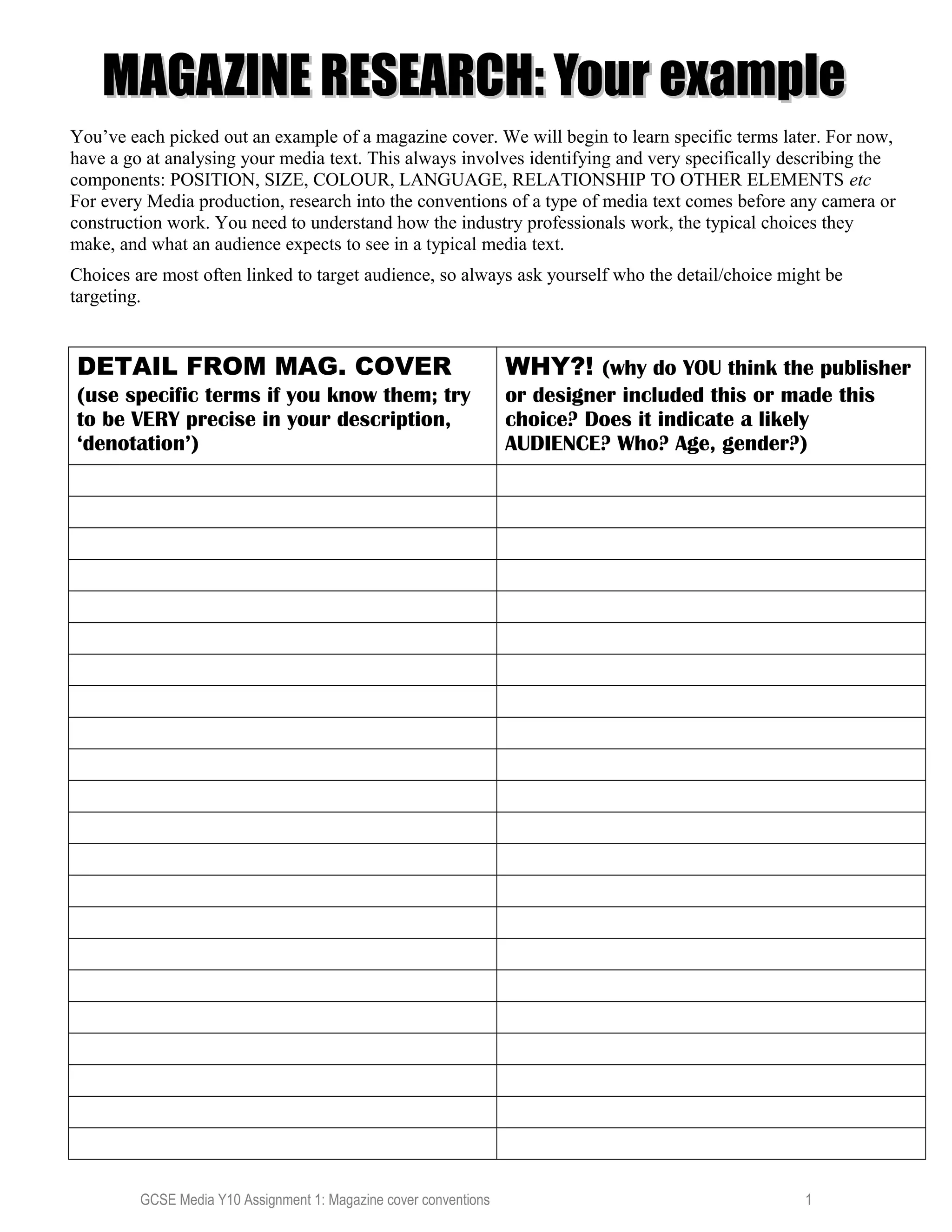
MAGAZINE RESEARCH: Your exampleMAGAZINE RESEARCH: Your example
You’ve each picked out an example of a magazine cover. We will begin to learn specific terms later. For now,
have a go at analysing your media text. This always involves identifying and very specifically describing the
components: POSITION, SIZE, COLOUR, LANGUAGE, RELATIONSHIP TO OTHER ELEMENTS etc
For every Media production, research into the conventions of a type of media text comes before any camera or
construction work. You need to understand how the industry professionals work, the typical choices they
make, and what an audience expects to see in a typical media text.
Choices are most often linked to target audience, so always ask yourself who the detail/choice might be
targeting.
DETAIL FROM MAG. COVER
(use specific terms if you know them; try
to be VERY precise in your description,
‘denotation’)
WHY?! (why do YOU think the publisher
or designer included this or made this
choice? Does it indicate a likely
AUDIENCE? Who? Age, gender?)
GCSE Media Y10 Assignment 1: Magazine cover conventions 1
DETAIL FROM MAG. COVER
(use specific terms if you know them; try
to be VERY precise in your description,
‘denotation’)
WHY?! (why do YOU think the publisher
or designer included this or made this
choice? Does it indicate a likely
AUDIENCE? Who? Age, gender?)
GCSE Media Y10 Assignment 1: Magazine cover conventions 2
DETAIL FROM MAG. COVER
(use specific terms if you know them; try
to be VERY precise in your description,
‘denotation’)
WHY?! (why do YOU think the publisher
or designer included this or made this
choice? Does it indicate a likely
AUDIENCE? Who? Age, gender?)
GCSE Media Y10 Assignment 1: Magazine cover conventions 3
CONVENTION (use specific
terms if you know them)
EXAMPLE (provide a clear
description)
GCSE Media Y10 Assignment 1: Magazine cover conventions 4
GCSE Media Y10 Assignment 1: Magazine cover conventions 5

Conventions your example

  • 1.
    MAGAZINE RESEARCH: YourexampleMAGAZINE RESEARCH: Your example You’ve each picked out an example of a magazine cover. We will begin to learn specific terms later. For now, have a go at analysing your media text. This always involves identifying and very specifically describing the components: POSITION, SIZE, COLOUR, LANGUAGE, RELATIONSHIP TO OTHER ELEMENTS etc For every Media production, research into the conventions of a type of media text comes before any camera or construction work. You need to understand how the industry professionals work, the typical choices they make, and what an audience expects to see in a typical media text. Choices are most often linked to target audience, so always ask yourself who the detail/choice might be targeting. DETAIL FROM MAG. COVER (use specific terms if you know them; try to be VERY precise in your description, ‘denotation’) WHY?! (why do YOU think the publisher or designer included this or made this choice? Does it indicate a likely AUDIENCE? Who? Age, gender?) GCSE Media Y10 Assignment 1: Magazine cover conventions 1
  • 2.
    DETAIL FROM MAG.COVER (use specific terms if you know them; try to be VERY precise in your description, ‘denotation’) WHY?! (why do YOU think the publisher or designer included this or made this choice? Does it indicate a likely AUDIENCE? Who? Age, gender?) GCSE Media Y10 Assignment 1: Magazine cover conventions 2
  • 3.
    DETAIL FROM MAG.COVER (use specific terms if you know them; try to be VERY precise in your description, ‘denotation’) WHY?! (why do YOU think the publisher or designer included this or made this choice? Does it indicate a likely AUDIENCE? Who? Age, gender?) GCSE Media Y10 Assignment 1: Magazine cover conventions 3
  • 4.
    CONVENTION (use specific termsif you know them) EXAMPLE (provide a clear description) GCSE Media Y10 Assignment 1: Magazine cover conventions 4
  • 5.
    GCSE Media Y10Assignment 1: Magazine cover conventions 5
  • 6.
    GCSE Media Y10Assignment 1: Magazine cover conventions 5