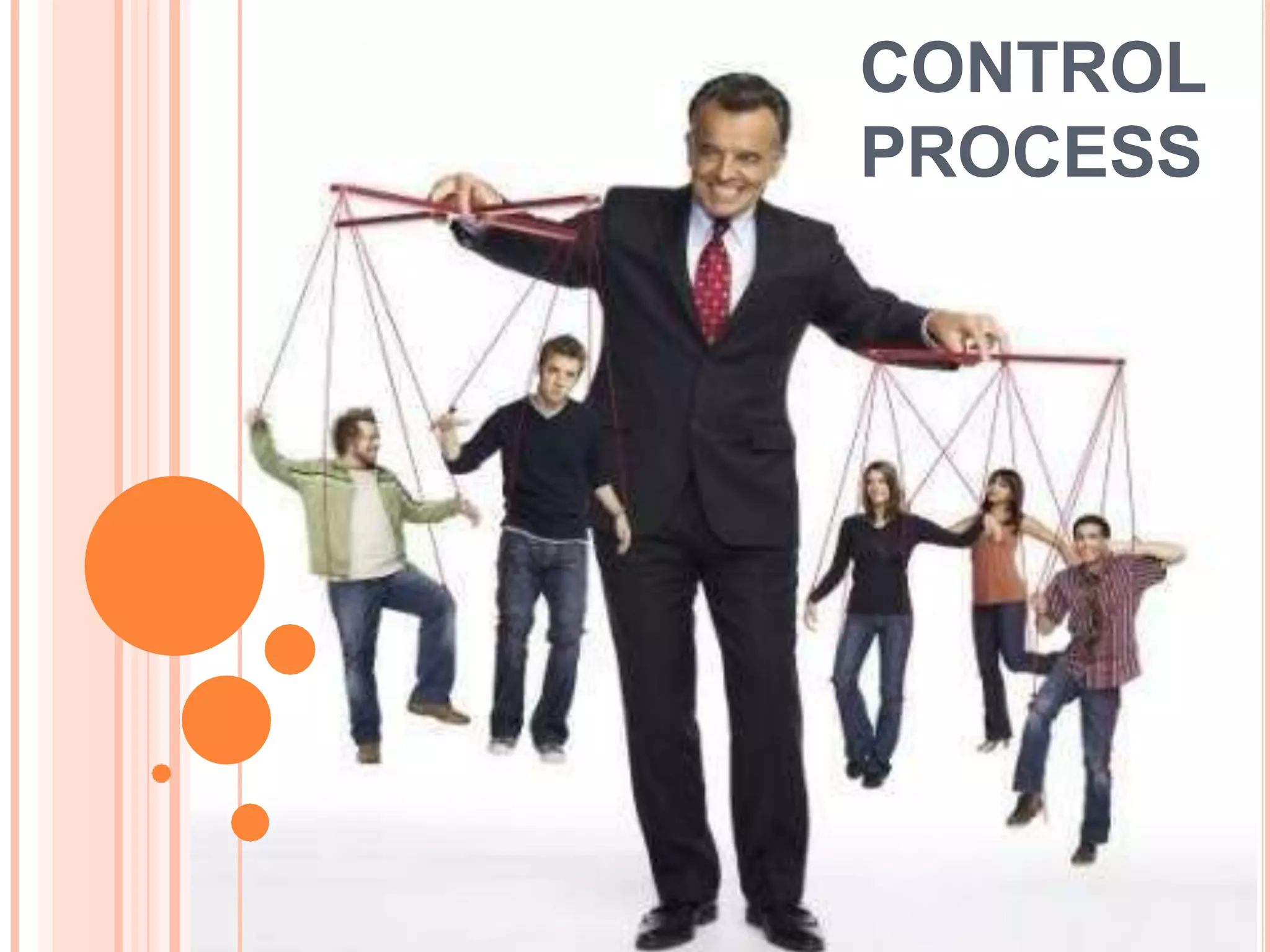
CONTROL
PROCESS
WHAT IS CONTROL?
 Setting plan, establishing the structure and
directing the people do not guarantee that
every thing in the organization is going on well.
 Thus, control process is very important for all
types of organizations.
 Before that what is CONTROL?
 Control to define is making sure that something
happens the way it was planned to happen. As
implied in this definition, planning and controlling are
inseparable functions.
 Controlling is also the task of ensuring that the
activities are providing the desired results.
WHY CONTROL IS IMPORTANT?
 Plans rarely go smoothly. Most plans are
executed by people and people vary in their
abilities, motivations and honesty.
 Plans become outdated and require revisions.
 For these reasons control is an important
management function.
 Control means controlling every task in an
organization – whether it is large, or delegated to
some employee.
 Thus for every task delegated, there has to be a
control system that ensures completion of
performances in line with the plans
PREREQUISITES OF
CONTROL SYSTEM
planning
 CONTROL REQUIRES PLANNING :
 All meaningful control techniques are,
techniques
 It is worthless to design control plans without taking
in account how well the plans are made.
 CONTROL REQUIRES ORGANIZATION
STRUCTURE :
 Purpose of control is to measure activities and take
action to assure that plans are being accomplished.
 Control of activities operates through people.
Therefore a major prerequisite of control is the
existence of an organizational structure.
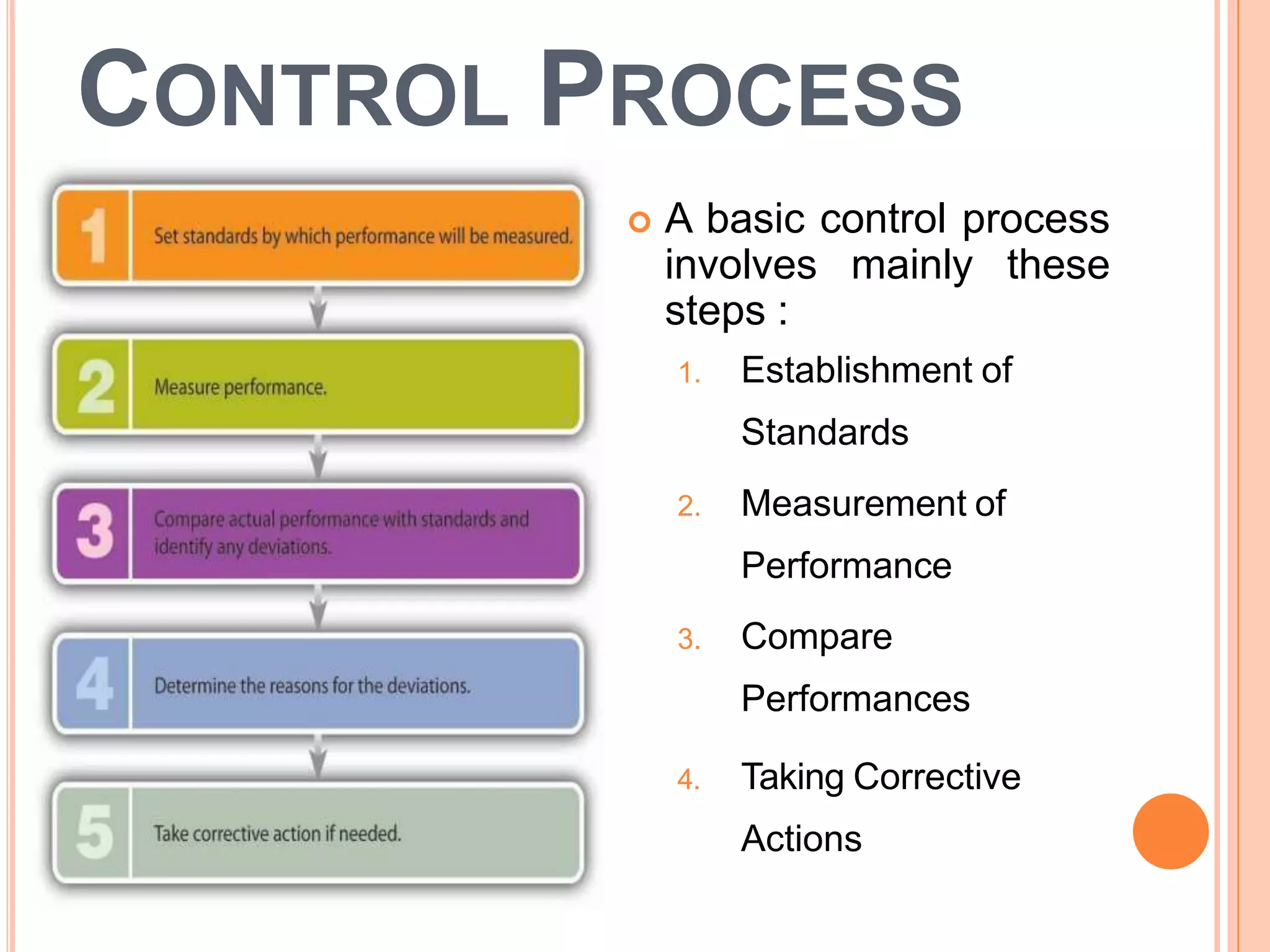
CONTROL PROCESS
 A basic control process
involves mainly these
steps :
1. Establishment of
Standards
2. Measurement of
Performance
3. Compare
Performances
4. Taking Corrective
Actions
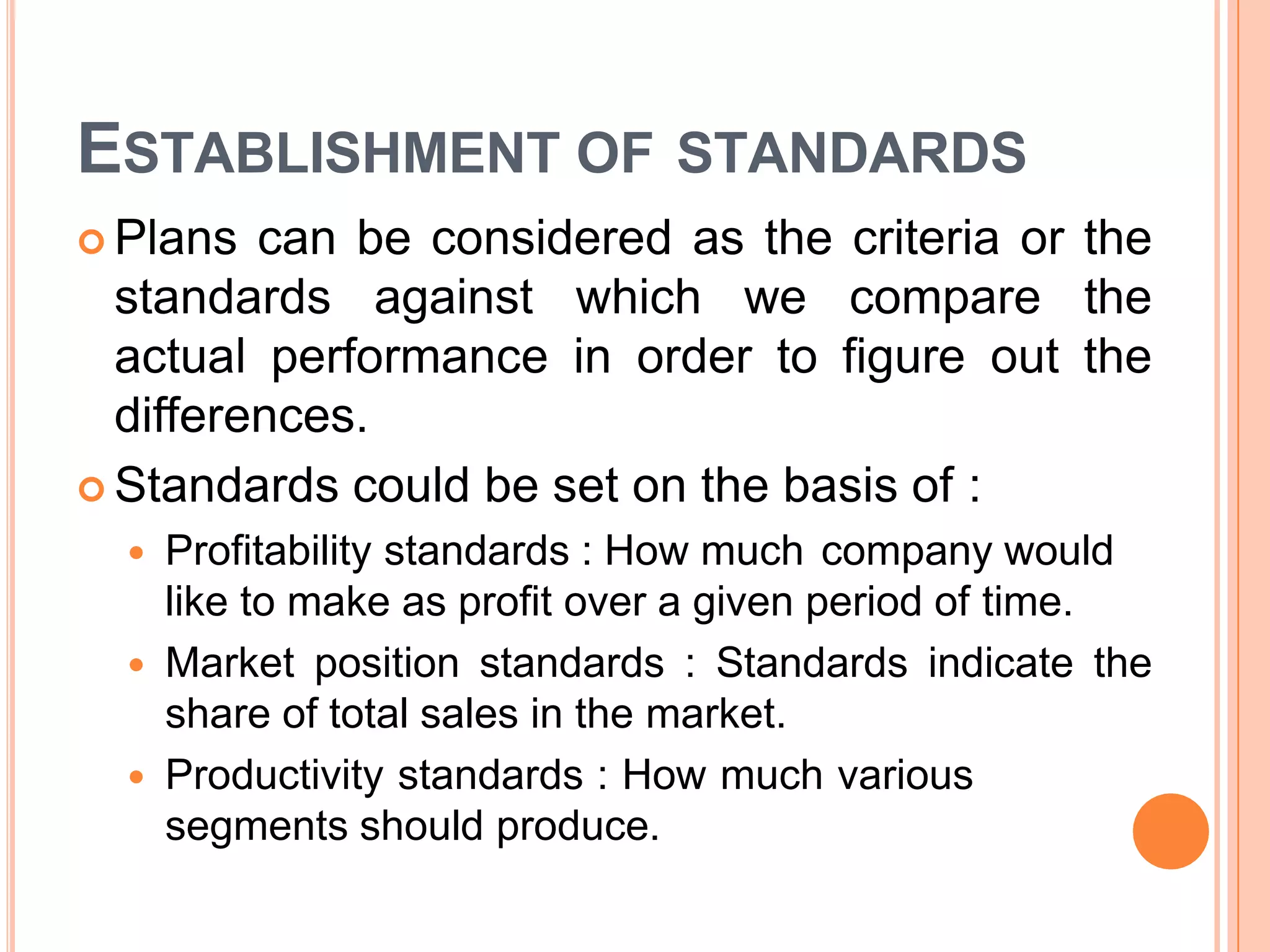
ESTABLISHMENT OF STANDARDS
 Plans can be considered as the criteria or the
standards against which we compare the
actual performance in order to figure out the
differences.
 Standards could be set on the basis of :
 Profitability standards : How much company would
like to make as profit over a given period of time.
 Market position standards : Standards indicate the
share of total sales in the market.
 Productivity standards : How much various
segments should produce.
 Employee attitude standards : Indicates what
type of attitude the company managers should
have to strive.
 Social responsibility standards : Making
contributions to the society.
 Short range goal : Standards that set a balance
between the short range and long range goals
 These are the standards an organization sets at the
beginning of a control process.
MEASUREMENT OF PERFORMANCES AND
COMPARING PERFORMANCES
 Measurement of performance is an important
procedure of the control process, the deviations can
be detected in advance by taking appropriate
actions.
 COMPARING MEASURED PERFORMANCES TO
SET STANDARDS :
 A standard is the level of activity established to serve asa
model for evaluating organizational performance.
 Performance evaluated can be for the organization as a
whole or for some individuals working within the
organization.
 In simple terms, standards are the evaluations that
determine an organizations performance is
sufficient or inadequate.
TAKING CORRECTIVE ACTION
 After the actual performance has been
measured and compared with the
established standards, the next step is to
take corrective action if necessary.
 Corrective action is managerial activity
aimed at bringing organizational mistakes
that hinder organizations performance.
 Before taking corrective actions, managers
should make sure that the standards are
properly established and that their
measurements of performance are valid and
reliable.
REQUIREMENTS FOR ADEQUATE
CONTROL
 Control should be tailored to plans and positions.
 Control must be tailored o individual managers and their
responsibilities.
 Control should point up exceptions as critical points.
 Control should be objective.
 Control should be flexible.
 Control should be economical.
 Control should lead to corrective actions.
TYPES OF CONTROL :
 Pre Control : Control that takes place before the work is
performed. It is also known as FEED-FORWARD
Control.
Pre control focuses on eliminating predicted problems.
 Concurrent Control : Refers to the control that takes
place as work is being performed.
 Feedback Control : This refers to the control that
concentrates on the post organizational performance.
BARRIERS TO SUCCESSFUL
CONTROLLING
 Barriers to controlling include :
 Control activities
overemphasis on
can create undesirable
short term production as
opposed to long term production.
 Control activities can increase employee’s
frustration.
 Control can encourage falsification of reports.
THANK YOU…

controlprocess-

  • 1.
  • 2.
    WHAT IS CONTROL? Setting plan, establishing the structure and directing the people do not guarantee that every thing in the organization is going on well.  Thus, control process is very important for all types of organizations.  Before that what is CONTROL?  Control to define is making sure that something happens the way it was planned to happen. As implied in this definition, planning and controlling are inseparable functions.  Controlling is also the task of ensuring that the activities are providing the desired results.
  • 3.
    WHY CONTROL ISIMPORTANT?  Plans rarely go smoothly. Most plans are executed by people and people vary in their abilities, motivations and honesty.  Plans become outdated and require revisions.  For these reasons control is an important management function.  Control means controlling every task in an organization – whether it is large, or delegated to some employee.  Thus for every task delegated, there has to be a control system that ensures completion of performances in line with the plans
  • 4.
    PREREQUISITES OF CONTROL SYSTEM planning CONTROL REQUIRES PLANNING :  All meaningful control techniques are, techniques  It is worthless to design control plans without taking in account how well the plans are made.  CONTROL REQUIRES ORGANIZATION STRUCTURE :  Purpose of control is to measure activities and take action to assure that plans are being accomplished.  Control of activities operates through people. Therefore a major prerequisite of control is the existence of an organizational structure.
  • 5.
    CONTROL PROCESS  Abasic control process involves mainly these steps : 1. Establishment of Standards 2. Measurement of Performance 3. Compare Performances 4. Taking Corrective Actions
  • 6.
    ESTABLISHMENT OF STANDARDS Plans can be considered as the criteria or the standards against which we compare the actual performance in order to figure out the differences.  Standards could be set on the basis of :  Profitability standards : How much company would like to make as profit over a given period of time.  Market position standards : Standards indicate the share of total sales in the market.  Productivity standards : How much various segments should produce.
  • 7.
     Employee attitudestandards : Indicates what type of attitude the company managers should have to strive.  Social responsibility standards : Making contributions to the society.  Short range goal : Standards that set a balance between the short range and long range goals  These are the standards an organization sets at the beginning of a control process.
  • 8.
    MEASUREMENT OF PERFORMANCESAND COMPARING PERFORMANCES  Measurement of performance is an important procedure of the control process, the deviations can be detected in advance by taking appropriate actions.  COMPARING MEASURED PERFORMANCES TO SET STANDARDS :  A standard is the level of activity established to serve asa model for evaluating organizational performance.  Performance evaluated can be for the organization as a whole or for some individuals working within the organization.  In simple terms, standards are the evaluations that determine an organizations performance is sufficient or inadequate.
  • 9.
    TAKING CORRECTIVE ACTION After the actual performance has been measured and compared with the established standards, the next step is to take corrective action if necessary.  Corrective action is managerial activity aimed at bringing organizational mistakes that hinder organizations performance.  Before taking corrective actions, managers should make sure that the standards are properly established and that their measurements of performance are valid and reliable.
  • 10.
    REQUIREMENTS FOR ADEQUATE CONTROL Control should be tailored to plans and positions.  Control must be tailored o individual managers and their responsibilities.  Control should point up exceptions as critical points.  Control should be objective.  Control should be flexible.  Control should be economical.  Control should lead to corrective actions.
  • 11.
    TYPES OF CONTROL:  Pre Control : Control that takes place before the work is performed. It is also known as FEED-FORWARD Control. Pre control focuses on eliminating predicted problems.  Concurrent Control : Refers to the control that takes place as work is being performed.  Feedback Control : This refers to the control that concentrates on the post organizational performance.
  • 12.
    BARRIERS TO SUCCESSFUL CONTROLLING Barriers to controlling include :  Control activities overemphasis on can create undesirable short term production as opposed to long term production.  Control activities can increase employee’s frustration.  Control can encourage falsification of reports.
  • 13.