CONTROL
Controlling is one of the managerial functions
like planning, organizing, staffing and directing. It is
an important function because it helps to check the
errors and to take the corrective action so that
deviation from standards are minimized and stated
goals of the organization are achieved in desired
manner.

According to modern concepts, control is a
foreseeing action whereas earlier concept of
control was used only when errors were detected.
Control in management means setting
standards, measuring actual performance and
taking corrective action
According to Henri Fayol,
    Control of an undertaking consists of seeing that everything
   is being carried out in accordance with the plan which has
   been adopted, the orders which have been given, and the
   principles which have been laid down. Its object is to point out
   mistakes in order that they may be rectified and prevented
   from recurring.


According to Stafford Beer,
   Management is the profession of control.
   Without control there is no use for others functions of management.

   Control is any process that guides activity towards some pre
    determined goals.

   The purpose of the control is to maximize the use of scarce
    resources and to achieve purposeful behavior of organization
    members.

   To find out deviations between planned performance and actual
    performance.

   To suggest corrective actions wherever they are needed.
    Basic requirements of good controlling system:
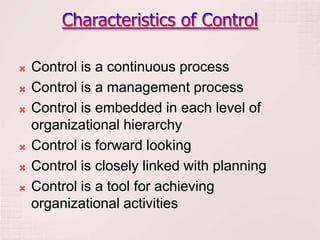
   Control is a continuous process
   Control is a management process
   Control is embedded in each level of
    organizational hierarchy
   Control is forward looking
   Control is closely linked with planning
   Control is a tool for achieving
    organizational activities
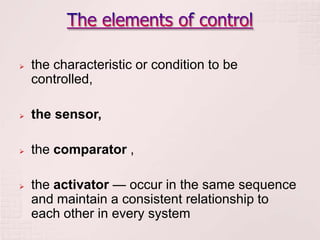
   the characteristic or condition to be
    controlled,

   the sensor,

   the comparator ,

   the activator — occur in the same sequence
    and maintain a consistent relationship to
    each other in every system
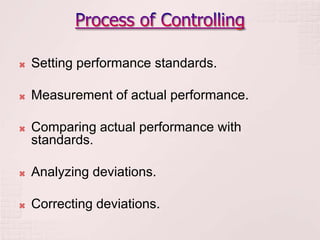
   Setting performance standards.

   Measurement of actual performance.

   Comparing actual performance with
    standards.

   Analyzing deviations.

   Correcting deviations.
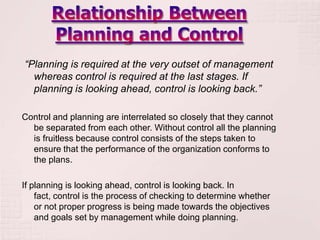
“Planning is required at the very outset of management
  whereas control is required at the last stages. If
  planning is looking ahead, control is looking back.”

Control and planning are interrelated so closely that they cannot
  be separated from each other. Without control all the planning
  is fruitless because control consists of the steps taken to
  ensure that the performance of the organization conforms to
  the plans.

If planning is looking ahead, control is looking back. In
    fact, control is the process of checking to determine whether
    or not proper progress is being made towards the objectives
    and goals set by management while doing planning.
Control theory is
   a theory that deals with influencing the behavior of dynamical systems
   an interdisciplinary subfield of science, which originated
  in engineering and mathematics, and evolved into use by the social
  sciences, likepsychology, sociology, criminology and in financial system.

    Control systems can be thought of as having four functions;
   Measure, Compare, Compute, and Correct. These four functions are
   completed by five
   elements; Detector, Transducer, Transmitter, Controller, and Final Control
   Element. The measuring function is completed by the detector, transducer
   and transmitter. In practical applications these three elements are typically
   contained in one unit. A standard example is a Resistance thermometer.
   The compare and computer functions are completed within the controller
   which may be completed electronically through a Proportional Control, PI
   Controller, PID Controller, Bistable, Hysteretic control or Programmable
   logic controller. The correct function is completed with a final control
   element. The final control element changes an input or output in the control
   system which affect the manipulated or controlled variable.
   Feedback control.

   Concurrent control.

   Feedforword control.
Feedback control focuses on organizational
activities and operations after they are completed
.Here Control process starts after the completion
of the operations.
This type of control focuses on the outputs of the organization
after transformation is complete.

Sometimes called post action or output control , fulfils a
number of important functions. For one thing, it often is used
when feed forward and concurrent controls are not feasible or
are to costly.
   It provides the necessary information to the operating
    manager to evaluate overall organ effectiveness.

   It is useful as a basis of evaluating and rewarding
    employees.

   It alerts the operating managers who needs to adjust or
    modify their activities

   It plays a vital roles in strategic level
   The major drawback of this type of control
    is that, the time the manager has the
    information and if there is significant
    problem the damage is already done. But
    for many activities, feedback control fulfils
    a number important functions .
   Concurrent control takes place while an
    activity is in progress.

   Control is applied while the operations are
    in progress.

   Since concurrent control involves
    regulating ongoing tasks, it requires a
    through understanding of the specific
    tasks involved and their relationship to the
    desired and product.
   Concurrent control sometimes is called
    screening or yes-no control , because it
    often involves checkpoints at which
    determinations are made about whether
    to continue progress, take corrective
    action, or stop work altogether on
    products or services.

   Example :

Compaq computers has set of 34 check
 points in its assembly line for successful
   This type of control is implemented before
    an activity starts.
   It is future directed.
   It focuses on preventing anticipated
    problems.
   It regulates the inputs to ensure that they
    meet the standards necessary for
    transformation process.
controlling

controlling

  • 1.
  • 2.
    Controlling is oneof the managerial functions like planning, organizing, staffing and directing. It is an important function because it helps to check the errors and to take the corrective action so that deviation from standards are minimized and stated goals of the organization are achieved in desired manner. According to modern concepts, control is a foreseeing action whereas earlier concept of control was used only when errors were detected. Control in management means setting standards, measuring actual performance and taking corrective action
  • 3.
    According to HenriFayol, Control of an undertaking consists of seeing that everything is being carried out in accordance with the plan which has been adopted, the orders which have been given, and the principles which have been laid down. Its object is to point out mistakes in order that they may be rectified and prevented from recurring. According to Stafford Beer, Management is the profession of control.
  • 4.
    Without control there is no use for others functions of management.  Control is any process that guides activity towards some pre determined goals.  The purpose of the control is to maximize the use of scarce resources and to achieve purposeful behavior of organization members.  To find out deviations between planned performance and actual performance.  To suggest corrective actions wherever they are needed. Basic requirements of good controlling system:
  • 5.
    Control is a continuous process  Control is a management process  Control is embedded in each level of organizational hierarchy  Control is forward looking  Control is closely linked with planning  Control is a tool for achieving organizational activities
  • 6.
    the characteristic or condition to be controlled,  the sensor,  the comparator ,  the activator — occur in the same sequence and maintain a consistent relationship to each other in every system
  • 7.
    Setting performance standards.  Measurement of actual performance.  Comparing actual performance with standards.  Analyzing deviations.  Correcting deviations.
  • 8.
    “Planning is requiredat the very outset of management whereas control is required at the last stages. If planning is looking ahead, control is looking back.” Control and planning are interrelated so closely that they cannot be separated from each other. Without control all the planning is fruitless because control consists of the steps taken to ensure that the performance of the organization conforms to the plans. If planning is looking ahead, control is looking back. In fact, control is the process of checking to determine whether or not proper progress is being made towards the objectives and goals set by management while doing planning.
  • 9.
    Control theory is a theory that deals with influencing the behavior of dynamical systems an interdisciplinary subfield of science, which originated in engineering and mathematics, and evolved into use by the social sciences, likepsychology, sociology, criminology and in financial system. Control systems can be thought of as having four functions; Measure, Compare, Compute, and Correct. These four functions are completed by five elements; Detector, Transducer, Transmitter, Controller, and Final Control Element. The measuring function is completed by the detector, transducer and transmitter. In practical applications these three elements are typically contained in one unit. A standard example is a Resistance thermometer. The compare and computer functions are completed within the controller which may be completed electronically through a Proportional Control, PI Controller, PID Controller, Bistable, Hysteretic control or Programmable logic controller. The correct function is completed with a final control element. The final control element changes an input or output in the control system which affect the manipulated or controlled variable.
  • 10.
    Feedback control.  Concurrent control.  Feedforword control.
  • 11.
    Feedback control focuseson organizational activities and operations after they are completed .Here Control process starts after the completion of the operations. This type of control focuses on the outputs of the organization after transformation is complete. Sometimes called post action or output control , fulfils a number of important functions. For one thing, it often is used when feed forward and concurrent controls are not feasible or are to costly.
  • 12.
    It provides the necessary information to the operating manager to evaluate overall organ effectiveness.  It is useful as a basis of evaluating and rewarding employees.  It alerts the operating managers who needs to adjust or modify their activities  It plays a vital roles in strategic level
  • 13.
    The major drawback of this type of control is that, the time the manager has the information and if there is significant problem the damage is already done. But for many activities, feedback control fulfils a number important functions .
  • 14.
    Concurrent control takes place while an activity is in progress.  Control is applied while the operations are in progress.  Since concurrent control involves regulating ongoing tasks, it requires a through understanding of the specific tasks involved and their relationship to the desired and product.
  • 15.
    Concurrent control sometimes is called screening or yes-no control , because it often involves checkpoints at which determinations are made about whether to continue progress, take corrective action, or stop work altogether on products or services.  Example : Compaq computers has set of 34 check points in its assembly line for successful
  • 16.
    This type of control is implemented before an activity starts.  It is future directed.  It focuses on preventing anticipated problems.  It regulates the inputs to ensure that they meet the standards necessary for transformation process.