KINGSCOLLEGEOFENGINEERING
CE6704-ESTIMATIONANDQUANTITYSURVEYING
CONTRACT AND ITS TYPES
SUBMITTED BY:
I. LYDIA
IV CIVIL
Contract Definition
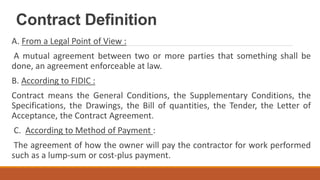
A. From a Legal Point of View :
A mutual agreement between two or more parties that something shall be
done, an agreement enforceable at law.
B. According to FIDIC :
Contract means the General Conditions, the Supplementary Conditions, the
Specifications, the Drawings, the Bill of quantities, the Tender, the Letter of
Acceptance, the Contract Agreement.
C. According to Method of Payment :
The agreement of how the owner will pay the contractor for work performed
such as a lump-sum or cost-plus payment.
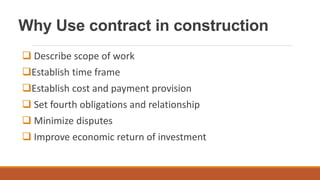
Why Use contract in construction
 Describe scope of work
Establish time frame
Establish cost and payment provision
 Set fourth obligations and relationship
 Minimize disputes
 Improve economic return of investment
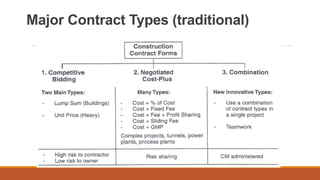
Major Contract Types (traditional)
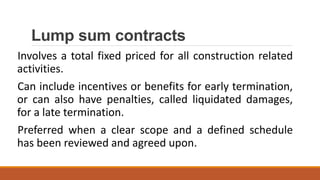
Lump sum contracts
Involves a total fixed priced for all construction related
activities.
Can include incentives or benefits for early termination,
or can also have penalties, called liquidated damages,
for a late termination.
Preferred when a clear scope and a defined schedule
has been reviewed and agreed upon.
Lump Sum Contract( Advantages)
Low risk on the owner, Higher risk to the contractor
Cost known at outset
Contractor will assign best personnel
Contractor selection is easy.
Lump Sum Contract (Disadvantages)
Changes is difficult and costly.
Contractor is free to use the lowest cost of material equipment,
methods.
The contractor carries much of the risks. The tendered price may
include high risk contingency.
Competent contractors may decide not to bid to avoid a high-risk lump
sum contract.
Unit Price contract
Require sufficient design definition to estimate quantities of units
 Contractors bid based on units of works
Time & cost risk (shared)
 Owner : at risk for total quantities
 Contractor : at risk for fixed unit price.
Large quantities changes (>15-25%) can lead to increase or
decrease of unit price.
Unit Price ( Advantages)
Easy for contract selection.
Early start is possible.
Saves the heavy cost of preparing many bills of quantities by the
contractors.
Fair basis for competition.
In comparing with lump-sum contract, changes in contract
documents can be made easily by the owner.
Lower risk for contractor.
Unit Price (Disadvantages)
Final cost not known from the beginning (BOQ only is
estimated)
Staff needed to measure the finished quantities and report
on the units not completed.
Unit price sometime tend to draw unbalanced bid.
Types of Contract
1. Valid Contract
2. Voidable Contract
3. Void Contract
4. Unenforceable Contract
5. Illegal Contract
6. Contingent Contract
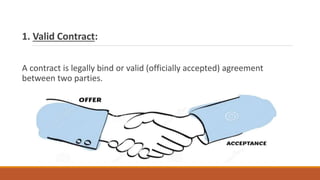
1. Valid Contract:
A contract is legally bind or valid (officially accepted) agreement
between two parties.
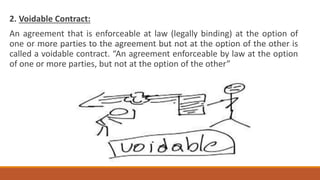
2. Voidable Contract:
An agreement that is enforceable at law (legally binding) at the option of
one or more parties to the agreement but not at the option of the other is
called a voidable contract. “An agreement enforceable by law at the option
of one or more parties, but not at the option of the other”
3. Void Contract:
A contract which is ordinarily
enforceable at law (legally binding) but
cannot be enforced due to the taking
place of a certain event is known as
void contract.
4. Unenforceable Contract:
An unenforceable contract is one
which cannot be enforced by court law
because of some technical defects
such as absence of writing or want of
stamps.
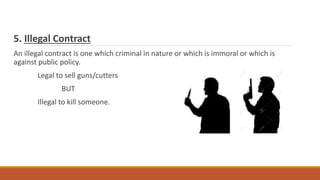
5. Illegal Contract
An illegal contract is one which criminal in nature or which is immoral or which is
against public policy.
Legal to sell guns/cutters
BUT
Illegal to kill someone.
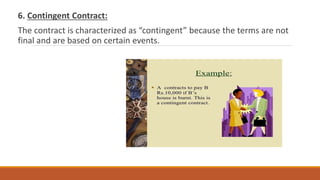
6. Contingent Contract:
The contract is characterized as “contingent” because the terms are not
final and are based on certain events.
THANK YOU!!!

Estimation

  • 1.
  • 2.
    Contract Definition A. Froma Legal Point of View : A mutual agreement between two or more parties that something shall be done, an agreement enforceable at law. B. According to FIDIC : Contract means the General Conditions, the Supplementary Conditions, the Specifications, the Drawings, the Bill of quantities, the Tender, the Letter of Acceptance, the Contract Agreement. C. According to Method of Payment : The agreement of how the owner will pay the contractor for work performed such as a lump-sum or cost-plus payment.
  • 3.
    Why Use contractin construction  Describe scope of work Establish time frame Establish cost and payment provision  Set fourth obligations and relationship  Minimize disputes  Improve economic return of investment
  • 4.
    Major Contract Types(traditional)
  • 5.
    Lump sum contracts Involvesa total fixed priced for all construction related activities. Can include incentives or benefits for early termination, or can also have penalties, called liquidated damages, for a late termination. Preferred when a clear scope and a defined schedule has been reviewed and agreed upon.
  • 6.
    Lump Sum Contract(Advantages) Low risk on the owner, Higher risk to the contractor Cost known at outset Contractor will assign best personnel Contractor selection is easy.
  • 7.
    Lump Sum Contract(Disadvantages) Changes is difficult and costly. Contractor is free to use the lowest cost of material equipment, methods. The contractor carries much of the risks. The tendered price may include high risk contingency. Competent contractors may decide not to bid to avoid a high-risk lump sum contract.
  • 8.
    Unit Price contract Requiresufficient design definition to estimate quantities of units  Contractors bid based on units of works Time & cost risk (shared)  Owner : at risk for total quantities  Contractor : at risk for fixed unit price. Large quantities changes (>15-25%) can lead to increase or decrease of unit price.
  • 9.
    Unit Price (Advantages) Easy for contract selection. Early start is possible. Saves the heavy cost of preparing many bills of quantities by the contractors. Fair basis for competition. In comparing with lump-sum contract, changes in contract documents can be made easily by the owner. Lower risk for contractor.
  • 10.
    Unit Price (Disadvantages) Finalcost not known from the beginning (BOQ only is estimated) Staff needed to measure the finished quantities and report on the units not completed. Unit price sometime tend to draw unbalanced bid.
  • 11.
    Types of Contract 1.Valid Contract 2. Voidable Contract 3. Void Contract 4. Unenforceable Contract 5. Illegal Contract 6. Contingent Contract
  • 12.
    1. Valid Contract: Acontract is legally bind or valid (officially accepted) agreement between two parties.
  • 13.
    2. Voidable Contract: Anagreement that is enforceable at law (legally binding) at the option of one or more parties to the agreement but not at the option of the other is called a voidable contract. “An agreement enforceable by law at the option of one or more parties, but not at the option of the other”
  • 14.
    3. Void Contract: Acontract which is ordinarily enforceable at law (legally binding) but cannot be enforced due to the taking place of a certain event is known as void contract. 4. Unenforceable Contract: An unenforceable contract is one which cannot be enforced by court law because of some technical defects such as absence of writing or want of stamps.
  • 15.
    5. Illegal Contract Anillegal contract is one which criminal in nature or which is immoral or which is against public policy. Legal to sell guns/cutters BUT Illegal to kill someone.
  • 16.
    6. Contingent Contract: Thecontract is characterized as “contingent” because the terms are not final and are based on certain events.
  • 17.