•The definition -variable.
•Tumors that cannot be resected without high likelihood of residual - gross or
microscopic disease - secondary to tumor fixation or adherence to adjacent
structures.
•Locally advanced rectal cancers may be defined as T4 or node-positive
lesions.
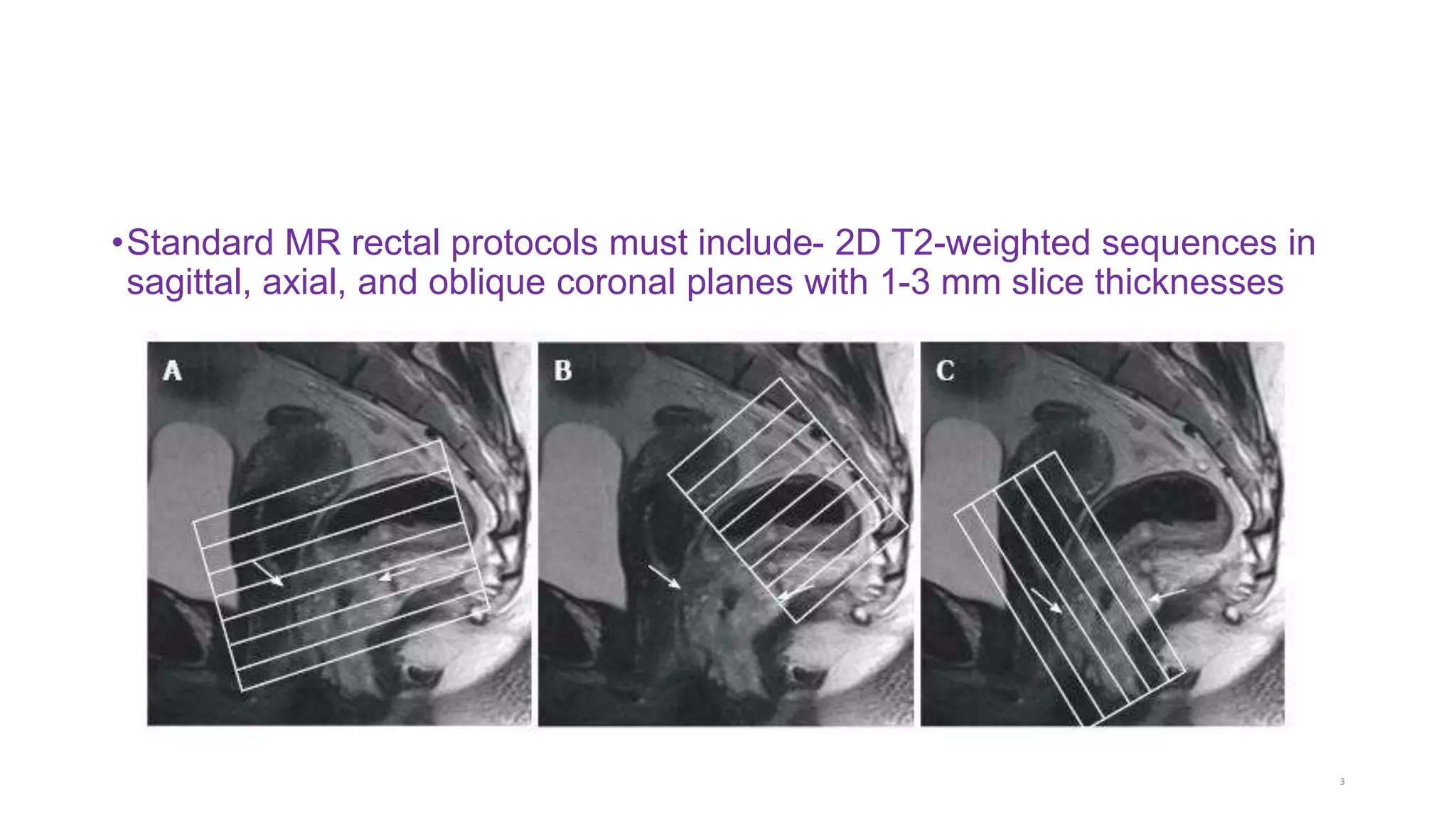
•Standard MR rectal protocols must include- 2D T2-weighted sequences in
sagittal, axial, and oblique coronal planes with 1-3 mm slice thicknesses
3
4
Anatomy –Upper ,Middle rectum
Anatomy – Lower rectum
7
T1 T2
T3 T4a
8
Mesorectal and extramesorectal lymph node involvement
9
10
TREATMENT RECOMMENDATIONS
Stage II/ Ill Pre-op -
Pre-op chemort (50.4 gy/28 fx + capecitabine or infusional 5-FU) —
LAR/APR — adjuvant 5-fu-based therapy (FOLFOX or CAPEOX preferred)
Pre-op RT (25 gy/5 fx) = LAR/APR — adjuvant 5-fu-based therapy
(FOLFOX or
CAPEOX preferred)
Pre-op chemo and then chemort (FOLFOX or CAPEOX — chemort) —
LAR or
APR (J NCCN 2014:12:513-519:andrea cercek et al.)
Ongoing clinical trials (prospect) are investigating – neoadjuvant
chemotherapy for patients-
•High tumors with intermediate risk for LR
• Nonoperative management for patients who would be ineligible for
sphincter preservation.
Stage Il/ Ill Post-op >
Adjuvant FOLFOX or CAPEOX x 2 cycles — chemoRT (50.4-55.8 Gy +
capecitabine
•or infusional 5-FU) — additional FOLFOX or CAPEOX x 2 cycles
13
1168pts
SURGERY alone
(non TME Sx)
Preop RT f/b Surgery
25Gy/5# in one week
• There was a significant reduction in local recurrence rates
(11% vs 27%, P < 0.001).
• The overall rate of local recurrence reduction in patients
who received radiotherapy was 58% (95%ci: 46%-69%).
Swedish Rectal Cancer Study Group 1987-
1990
First to demonstrate improved overall survival in those patients receiving radiotherapy prior
to undergoing curative surgery
15
1861 pts
SURGERY Alone
(TME)
Preop RT f/b Surgery
25Gy/5#
• Cohort treated with radiotherapy and
surgery -local recurrence in 2.4% of
cases vs 8.2% in the surgery only
group (P < 0.001).
• No difference in overall survival
between the two study arms.
16
Short course Vs Long course RT
Polish (buiko ann one 2016): phase III.
•515 patients
•Randomized - PRE-OP SEQUENTIAL SHORT-COURSE RT (25 GY/5 FX) + FOLFOX4
VS PRE-OP LONG-COURSE CHEMORT (50.4 GY/28 FX WITH 5-FU).
•Short-course RT-FOLFOX was associated with lower rates of acute toxicity (75% vs
83%; driven by grade l-ll toxicity)
•Higher rates of R0 resection (77% vs 71%, p = 0.07)
•pCR rates were 16% vs 12% (p = 0.17)
•3-year OS higher with short-course RT (73% vs 65%, p = 0.046);
•DFS, LR, and DM were not different.
•Post-op complication and late complication were not different.
17
18
Short & long-course seem comparable n terms of outcomes - survival, recurrence, and complications.
However, long-course RT might increase risk of distance metastasis, compared to short-course RT
19
SURGERY
1.Total Mesorectal Excision
2.Lower Anterior Resection
3.Abdominoperineal Resection
•Local recurrence rate for T3-4 or N1 rectal cancer is -25%.
•Total mesorectal excision [tme], 10year lr 11% [dutch tme study]).
•TME got its wide spread attention after herald’s articled a new approach to rectal cancer.
•(Heald rj, br j hosp med. 1979 sep; 22(3)277-81.)
•Goal of this surgery-
• 1. En bloc resection of the rectal cancer with a complete pararectal lymph
node dissection as contained in the mesorectum.
• 2. Any additional lymphadenopathy may also be dealt with depending on
the stage of the tumor.
•To reach this goal, the lateral dissection of the rectum must not breech
the fascia propria of the rectum, which stays outside the mesorectum.
•In TME the mesorectal fascia (MRF) is the resection plane and it has to be tumor-free.
•A distance of the tumor to the mesorectal fascia of <1 mm is regarded as not suitable for
TME and is called an Involved MRF.
LAR vs APR
•Abdominoperineal resection (APR) (Miles’ operation): tumoral tissue +
entire rectum + Anal canal are dissected and a permanent colostomy is
opened.
•LAR- tumor tissue + upper parts of rectum are dissected and a permanent
colostomy is not opened.
•Recommendation : if the estimated distal margin of resection is <1 cm from
the sphincter then> APR should be chosen to avoid leaving residual
disease behind.
•Also, patients who have problems with incontinence should undergo an
abdominoperineal resection.
LAR APR
Sphincter preserved Permanent colostomy
Radiation therapy
•Simulation steps-
Immobilization and patient position
•Prone with arms above the head.
•Consider belly board to displace small bowel.
•Simulate and treat with full bladder to displace small bowel.
Contrast agents and markers
•Oral contrast to delineate the small bowel.
•Barium enema to delineate the tumor (caution with respect to tumor
displacement).
•IV contrast to delineate the tumor and LN.
•Anal marker to mark anal verge.
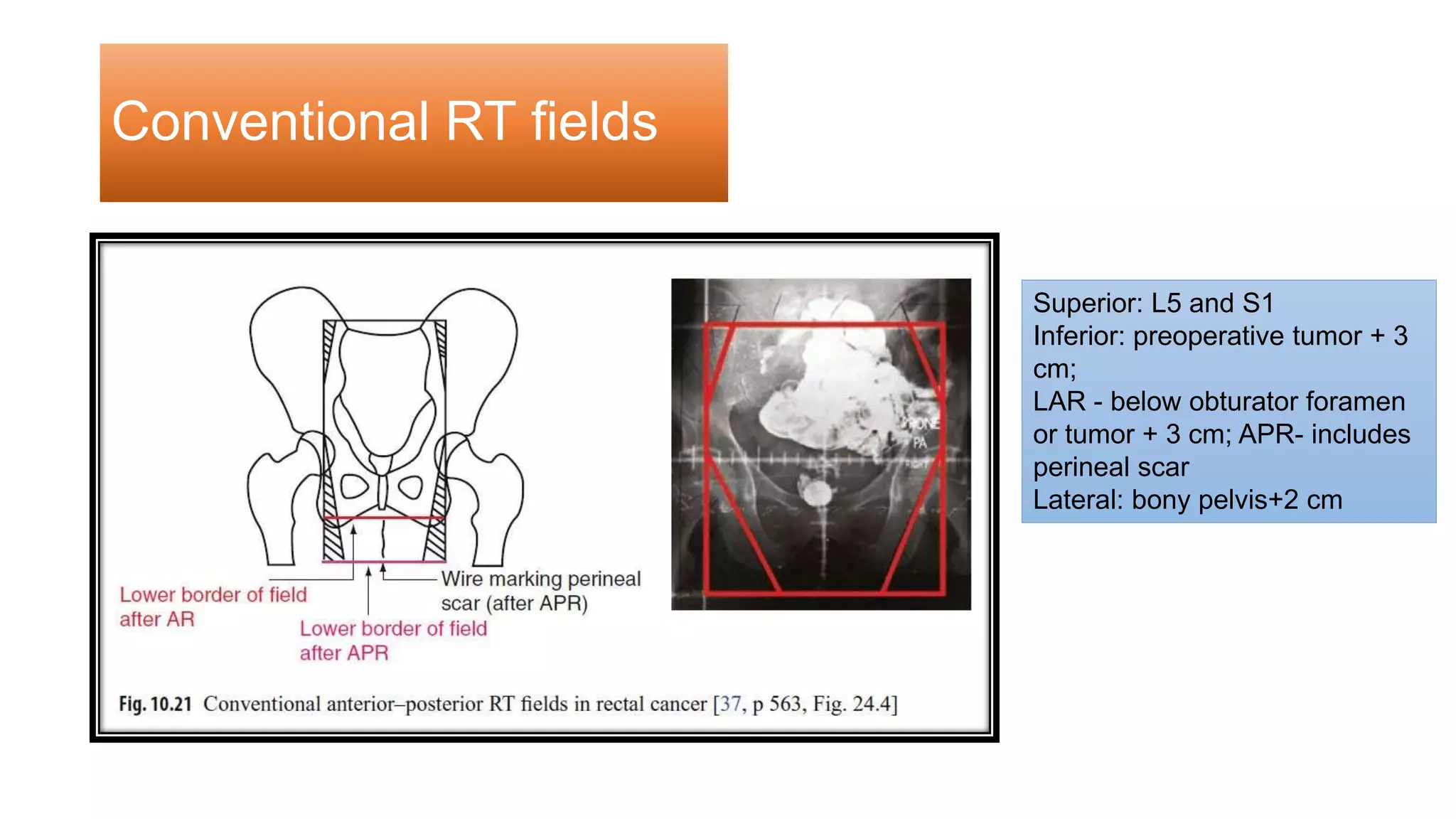
Conventional RT fields
Superior: L5 and S1
Inferior: preoperative tumor + 3
cm;
LAR - below obturator foramen
or tumor + 3 cm; APR- includes
perineal scar
Lateral: bony pelvis+2 cm
Superior–inferior:
same as anterior–posterior
fields
Anterior:
T3 tumors- posterior to pubic
symphysis;
T4 tumors- anterior to pubic
symphysis
Posterior: includes sacrum
Conformal RT Volumes
•CTV: tumor/tumor bed + perirectal
tissue, presacral region and internal
iliac LNs.
•A craniocaudal 2 cm margin is added
to the tumor.
•1-2 cm of the bladder and
prostate/vagina are included
(particularly in T4 cases).
•Anterior wall of the promontorium and
sacrum is within the CTV.
•PTV: CTV + 1–1.5 cm
• Increased rates of grade 3 events in patients who underwent short-course radiotherapy.
• These adverse events included proctitis (0% vs 3.7%, p = 0.016) and diarrhoea
(1.3% vs 14.2%, p < 0.001).
• Conversely, patients of longer course were at higher risk of an anastomotic leak (7.1% vs 3.5%)
and perineal wound breakdown (50% vs 38.3%)
• However, neither of these were found to be statistically significant.
ADJUVANT TREATMENT
32
33
• Identify a set of discriminating genes - for characterization and prediction of response to
radiotherapy
• Histopathologic examination of surgically resected specimens - classified as responders or non-
responders.
• Gene expression profiles using human u95av2 gene chip, we identified 33 novel discriminating
genes .
List of
genes- 33
• Apoptosis inducers (lumican,
thrombo- spondin 2, and
galectin-1) showed higher
expression in responders
• Apoptosis inhibitors
(cyclophilin 40 and
glutathione peroxidase)
showed higher expression in
non- responders.
35
Points to remember !!!
•Management of rectal cancer has evolved significantly over the course of
the past century.
•Novel minimally invasive approaches to accessing rectal lesions are
producing intriguing results.
•Advent of neoadjuvant therapy, and neoadjuvant radiotherapy, in particular,
has resulted in further improvements in local recurrence.
•Studies examining the benefit in enrolling patients with a complete
response to radiotherapy into surveillance programmes.
•Novel gene expression profiles – better light on case selection.
36

LA Rec.pptx

  • 2.
    •The definition -variable. •Tumorsthat cannot be resected without high likelihood of residual - gross or microscopic disease - secondary to tumor fixation or adherence to adjacent structures. •Locally advanced rectal cancers may be defined as T4 or node-positive lesions.
  • 3.
    •Standard MR rectalprotocols must include- 2D T2-weighted sequences in sagittal, axial, and oblique coronal planes with 1-3 mm slice thicknesses 3
  • 4.
    4 Anatomy –Upper ,Middlerectum Anatomy – Lower rectum
  • 7.
  • 8.
    8 Mesorectal and extramesorectallymph node involvement
  • 9.
  • 10.
  • 11.
    TREATMENT RECOMMENDATIONS Stage II/Ill Pre-op - Pre-op chemort (50.4 gy/28 fx + capecitabine or infusional 5-FU) — LAR/APR — adjuvant 5-fu-based therapy (FOLFOX or CAPEOX preferred) Pre-op RT (25 gy/5 fx) = LAR/APR — adjuvant 5-fu-based therapy (FOLFOX or CAPEOX preferred) Pre-op chemo and then chemort (FOLFOX or CAPEOX — chemort) — LAR or APR (J NCCN 2014:12:513-519:andrea cercek et al.) Ongoing clinical trials (prospect) are investigating – neoadjuvant chemotherapy for patients- •High tumors with intermediate risk for LR • Nonoperative management for patients who would be ineligible for sphincter preservation.
  • 12.
    Stage Il/ IllPost-op > Adjuvant FOLFOX or CAPEOX x 2 cycles — chemoRT (50.4-55.8 Gy + capecitabine •or infusional 5-FU) — additional FOLFOX or CAPEOX x 2 cycles
  • 13.
  • 14.
    1168pts SURGERY alone (non TMESx) Preop RT f/b Surgery 25Gy/5# in one week • There was a significant reduction in local recurrence rates (11% vs 27%, P < 0.001). • The overall rate of local recurrence reduction in patients who received radiotherapy was 58% (95%ci: 46%-69%). Swedish Rectal Cancer Study Group 1987- 1990 First to demonstrate improved overall survival in those patients receiving radiotherapy prior to undergoing curative surgery
  • 15.
    15 1861 pts SURGERY Alone (TME) PreopRT f/b Surgery 25Gy/5# • Cohort treated with radiotherapy and surgery -local recurrence in 2.4% of cases vs 8.2% in the surgery only group (P < 0.001). • No difference in overall survival between the two study arms.
  • 16.
    16 Short course VsLong course RT
  • 17.
    Polish (buiko annone 2016): phase III. •515 patients •Randomized - PRE-OP SEQUENTIAL SHORT-COURSE RT (25 GY/5 FX) + FOLFOX4 VS PRE-OP LONG-COURSE CHEMORT (50.4 GY/28 FX WITH 5-FU). •Short-course RT-FOLFOX was associated with lower rates of acute toxicity (75% vs 83%; driven by grade l-ll toxicity) •Higher rates of R0 resection (77% vs 71%, p = 0.07) •pCR rates were 16% vs 12% (p = 0.17) •3-year OS higher with short-course RT (73% vs 65%, p = 0.046); •DFS, LR, and DM were not different. •Post-op complication and late complication were not different. 17
  • 18.
    18 Short & long-courseseem comparable n terms of outcomes - survival, recurrence, and complications. However, long-course RT might increase risk of distance metastasis, compared to short-course RT
  • 19.
  • 20.
    SURGERY 1.Total Mesorectal Excision 2.LowerAnterior Resection 3.Abdominoperineal Resection
  • 21.
    •Local recurrence ratefor T3-4 or N1 rectal cancer is -25%. •Total mesorectal excision [tme], 10year lr 11% [dutch tme study]). •TME got its wide spread attention after herald’s articled a new approach to rectal cancer. •(Heald rj, br j hosp med. 1979 sep; 22(3)277-81.) •Goal of this surgery- • 1. En bloc resection of the rectal cancer with a complete pararectal lymph node dissection as contained in the mesorectum. • 2. Any additional lymphadenopathy may also be dealt with depending on the stage of the tumor. •To reach this goal, the lateral dissection of the rectum must not breech the fascia propria of the rectum, which stays outside the mesorectum.
  • 22.
    •In TME themesorectal fascia (MRF) is the resection plane and it has to be tumor-free. •A distance of the tumor to the mesorectal fascia of <1 mm is regarded as not suitable for TME and is called an Involved MRF.
  • 23.
    LAR vs APR •Abdominoperinealresection (APR) (Miles’ operation): tumoral tissue + entire rectum + Anal canal are dissected and a permanent colostomy is opened. •LAR- tumor tissue + upper parts of rectum are dissected and a permanent colostomy is not opened. •Recommendation : if the estimated distal margin of resection is <1 cm from the sphincter then> APR should be chosen to avoid leaving residual disease behind. •Also, patients who have problems with incontinence should undergo an abdominoperineal resection.
  • 24.
    LAR APR Sphincter preservedPermanent colostomy
  • 25.
    Radiation therapy •Simulation steps- Immobilizationand patient position •Prone with arms above the head. •Consider belly board to displace small bowel. •Simulate and treat with full bladder to displace small bowel. Contrast agents and markers •Oral contrast to delineate the small bowel. •Barium enema to delineate the tumor (caution with respect to tumor displacement). •IV contrast to delineate the tumor and LN. •Anal marker to mark anal verge.
  • 26.
    Conventional RT fields Superior:L5 and S1 Inferior: preoperative tumor + 3 cm; LAR - below obturator foramen or tumor + 3 cm; APR- includes perineal scar Lateral: bony pelvis+2 cm
  • 27.
    Superior–inferior: same as anterior–posterior fields Anterior: T3tumors- posterior to pubic symphysis; T4 tumors- anterior to pubic symphysis Posterior: includes sacrum
  • 28.
    Conformal RT Volumes •CTV:tumor/tumor bed + perirectal tissue, presacral region and internal iliac LNs. •A craniocaudal 2 cm margin is added to the tumor. •1-2 cm of the bladder and prostate/vagina are included (particularly in T4 cases). •Anterior wall of the promontorium and sacrum is within the CTV. •PTV: CTV + 1–1.5 cm
  • 30.
    • Increased ratesof grade 3 events in patients who underwent short-course radiotherapy. • These adverse events included proctitis (0% vs 3.7%, p = 0.016) and diarrhoea (1.3% vs 14.2%, p < 0.001). • Conversely, patients of longer course were at higher risk of an anastomotic leak (7.1% vs 3.5%) and perineal wound breakdown (50% vs 38.3%) • However, neither of these were found to be statistically significant.
  • 31.
  • 32.
  • 33.
    33 • Identify aset of discriminating genes - for characterization and prediction of response to radiotherapy • Histopathologic examination of surgically resected specimens - classified as responders or non- responders. • Gene expression profiles using human u95av2 gene chip, we identified 33 novel discriminating genes .
  • 34.
    List of genes- 33 •Apoptosis inducers (lumican, thrombo- spondin 2, and galectin-1) showed higher expression in responders • Apoptosis inhibitors (cyclophilin 40 and glutathione peroxidase) showed higher expression in non- responders.
  • 35.
  • 36.
    Points to remember!!! •Management of rectal cancer has evolved significantly over the course of the past century. •Novel minimally invasive approaches to accessing rectal lesions are producing intriguing results. •Advent of neoadjuvant therapy, and neoadjuvant radiotherapy, in particular, has resulted in further improvements in local recurrence. •Studies examining the benefit in enrolling patients with a complete response to radiotherapy into surveillance programmes. •Novel gene expression profiles – better light on case selection. 36

Editor's Notes

  • #35 growth factor, apoptosis, cell proliferation, signal transduction, or cell adhesion–related genes. Among 33 discriminating genes, apoptosis inducers (lumican, thrombo- spondin 2, and galectin-1) showed higher expression in responders whereas apoptosis inhibitors (cyclophilin 40 and glutathione peroxidase) showed higher expression in non- responders.