
Continuous Forms
General Advanced English
Budapest Corvinus University
General
We use continuous verb forms to describe actions
which we see happening over a period of time.
Temporary
Happening around a point of time
Involving change or development
Imcomplete (perfect forms)
Notice the time
I hear you’re doing a cookery course.
We were watching an interesting series about
murderers.
We’re staying with my uncle while our house is being
decorated.
At 12 o’clock, James was still working on his
computer.
There’s no doubt the world’s climate is changing.
Notice the time cont’
We were having a very interesting conversation.
(before interrupted)
I’ve been reading Nelson Mandela’s autobiography.
(but I have not finished it)
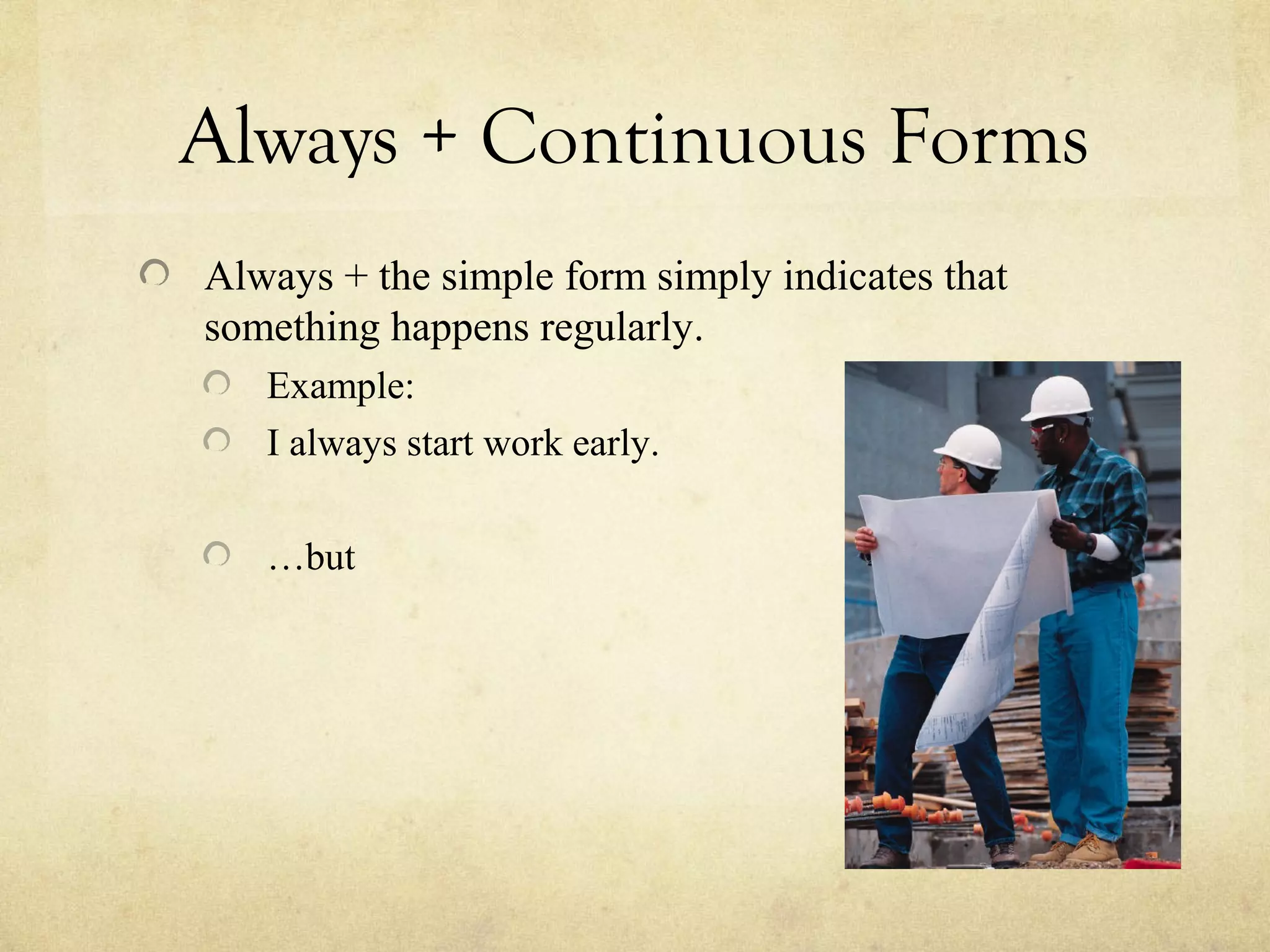
Always + Continuous Forms
Always + the simple form simply indicates that
something happens regularly.
Example:
I always start work early.
…but
Cont.
Always + continuous form is also common.
Receptiveness of the action..
Speaker finds the repeated action surprising, strange or
irritating.
Example:
Joanna was always dreaming about her wedding day.
I’m always locking myself out
Past Continuous for Polite
Requests
Used to make requests more polite and TENTATIVE
I was wondering if you could recommend a good
restaurant?
I was hoping you might help me with this application
form.
Present Continuous for future
arrangements
Used to describe arrangements (plans) for the future.
What are you doing over Christmas holiday?
They are opening a new restaurant next week!
Modal Verbs
The continuous infinitive can have a different
meaning from the simple infinitive.
They might be staying at the Marriot Hotel (present
possibility)
They might stay at the Sheraton Hotel. (future
possibility)
What a terrible noise! They must be having a party.
(logical necessity)
We must have a party soon. (personal obligation)
Verbs which change meaning in
Continuous and Simple Forms
State Verbs
Verbs which describe states only occur in the simple
form.
-Nick seems very friendly
-I didn’t know Claire’s dad
State Verbs??
Be
Verbs of possession and unchangeable states (have,
weigh, measure, fit)
Verbs to do with the senses (appear, see, look, smell
taste)
Verbs describing thoughts and processes (think, feel,
expect)
All use simple form!!!!
Verbs to describe states or
actions
If the state verbs we just mentioned are used in
continuous form, they become actions of some sort.
“To be” occurs in continuous form when it refers to
behaviour which is temporary and/or deliberate (i.e. a
kind of ‘action’)
example
Why is everybody so unhelpful??
They are always like this—a state
Why is everybody BEING so unhelpful?
They are not normally like this
REMEMBER
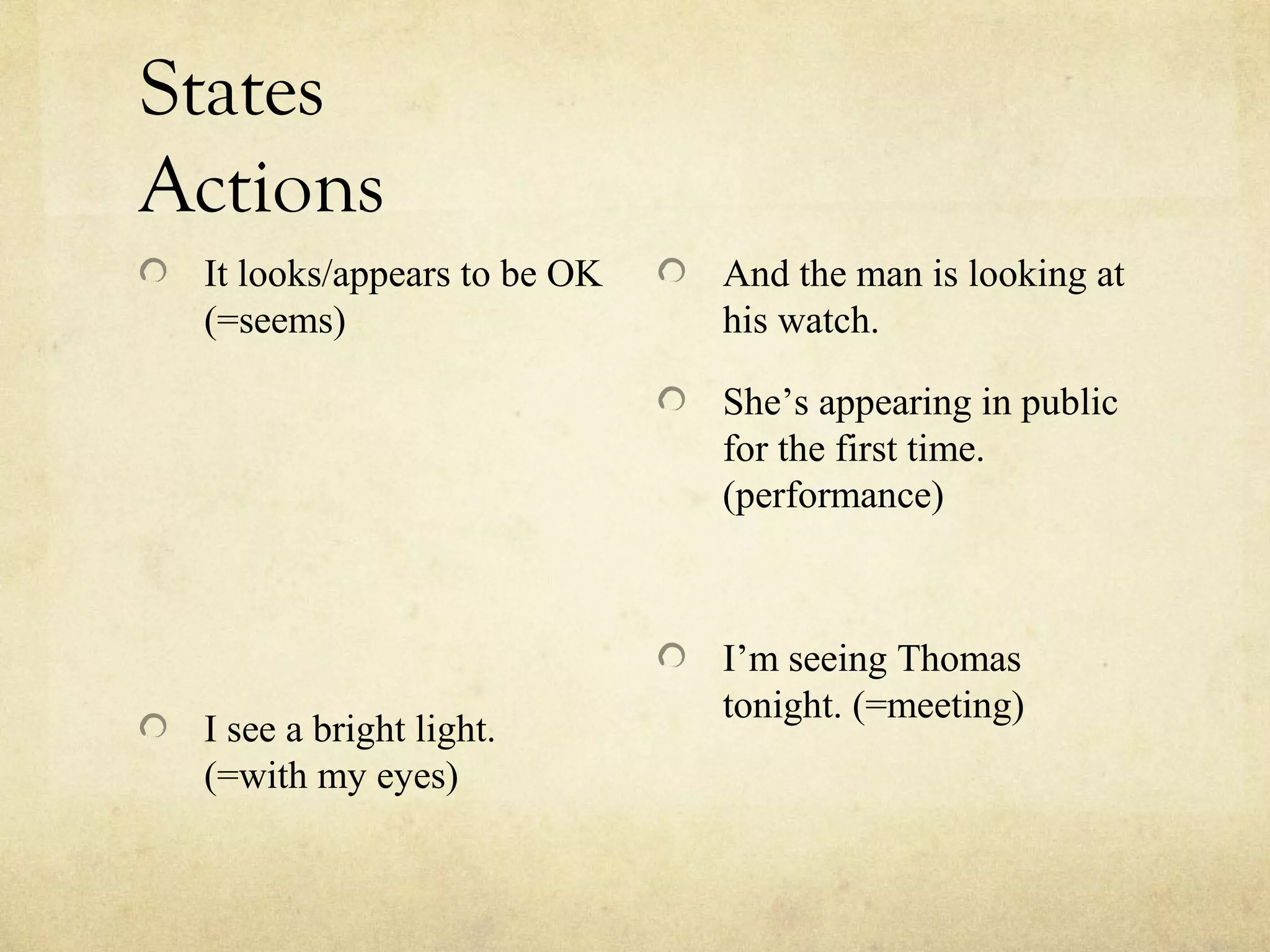
States
Actions
It looks/appears to be OK
(=seems)
I see a bright light.
(=with my eyes)
And the man is looking at
his watch.
She’s appearing in public
for the first time.
(performance)
I’m seeing Thomas
tonight. (=meeting)
States
Action
I think that’s all.
(suppose/guess)
I have a large family.
(possess)
I’m thinking about what
you said. (considering)
She’s having a coffee.
(taking)
Continuous Verb Forms

Continuous Verb Forms

  • 1.
    Continuous Forms General AdvancedEnglish Budapest Corvinus University
  • 2.
    General We use continuousverb forms to describe actions which we see happening over a period of time. Temporary Happening around a point of time Involving change or development Imcomplete (perfect forms)
  • 3.
    Notice the time Ihear you’re doing a cookery course. We were watching an interesting series about murderers. We’re staying with my uncle while our house is being decorated. At 12 o’clock, James was still working on his computer. There’s no doubt the world’s climate is changing.
  • 4.
    Notice the timecont’ We were having a very interesting conversation. (before interrupted) I’ve been reading Nelson Mandela’s autobiography. (but I have not finished it)
  • 5.
    Always + ContinuousForms Always + the simple form simply indicates that something happens regularly. Example: I always start work early. …but
  • 6.
    Cont. Always + continuousform is also common. Receptiveness of the action.. Speaker finds the repeated action surprising, strange or irritating. Example: Joanna was always dreaming about her wedding day. I’m always locking myself out
  • 7.
    Past Continuous forPolite Requests Used to make requests more polite and TENTATIVE I was wondering if you could recommend a good restaurant? I was hoping you might help me with this application form.
  • 8.
    Present Continuous forfuture arrangements Used to describe arrangements (plans) for the future. What are you doing over Christmas holiday? They are opening a new restaurant next week!
  • 9.
    Modal Verbs The continuousinfinitive can have a different meaning from the simple infinitive. They might be staying at the Marriot Hotel (present possibility) They might stay at the Sheraton Hotel. (future possibility) What a terrible noise! They must be having a party. (logical necessity) We must have a party soon. (personal obligation)
  • 10.
    Verbs which changemeaning in Continuous and Simple Forms State Verbs Verbs which describe states only occur in the simple form. -Nick seems very friendly -I didn’t know Claire’s dad
  • 11.
    State Verbs?? Be Verbs ofpossession and unchangeable states (have, weigh, measure, fit) Verbs to do with the senses (appear, see, look, smell taste) Verbs describing thoughts and processes (think, feel, expect) All use simple form!!!!
  • 12.
    Verbs to describestates or actions If the state verbs we just mentioned are used in continuous form, they become actions of some sort. “To be” occurs in continuous form when it refers to behaviour which is temporary and/or deliberate (i.e. a kind of ‘action’)
  • 13.
    example Why is everybodyso unhelpful?? They are always like this—a state Why is everybody BEING so unhelpful? They are not normally like this
  • 14.
  • 15.
    States Actions It looks/appears tobe OK (=seems) I see a bright light. (=with my eyes) And the man is looking at his watch. She’s appearing in public for the first time. (performance) I’m seeing Thomas tonight. (=meeting)
  • 16.
    States Action I think that’sall. (suppose/guess) I have a large family. (possess) I’m thinking about what you said. (considering) She’s having a coffee. (taking)

Editor's Notes