CONTINENTAL DRIFT
THEORY AND
DISCONTINUOUS
DISTRIBUTION
Presented to: Sir Asim
Presented by: Rimsha Ijaz
Course code: ZOL-510
Course title : PRINCIPLES OF
ZOOGEOGRAPHY
Table of content
Continental drift theory
History of continental drift theory
Evidence supporting the Continental Drift Theory
Discontinuous distribution
Discontinuous distribution in Mammals, Birds,
Reptiles , Amphibians and Fishes
Lung fish example in discontinuous distribution
Continental drift theory
The theory deals with the distribution of the oceans and
the continents.
The very slow movement of continental plates on the
surface of the earth due to tectonic activity through
geological time, is called continental drift.
Theory given by ---Alfred Wegner in 1915
History
Abraham Ortelius:
It was first put forward by Abraham Ortelius in 1596
He said continents wee see today was not like this, instead there
were like one continent.
He was a map maker.
Antonio Pellegrini:
He observe Africa and South America can fit together.
Alfred Wegner :
Later German Meteorologists Alfred Wagener, he was studying
weather . He experience shapes phenomena and he first thought
about the Jig saw Puzzle like shapes of continents. He first
proposed the hypothesis of continental drift in 1912
Continue
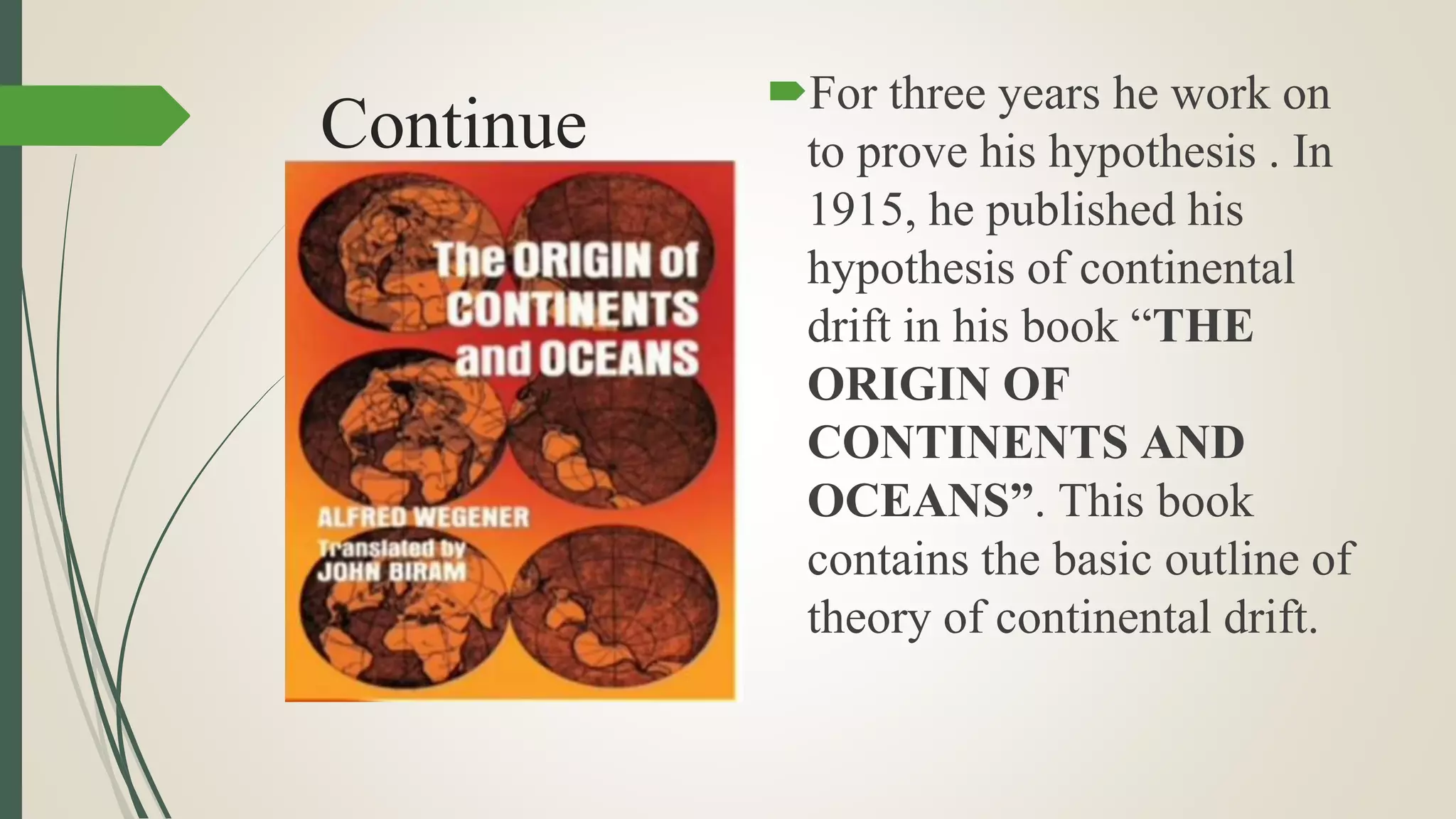
For three years he work on
to prove his hypothesis . In
1915, he published his
hypothesis of continental
drift in his book “THE
ORIGIN OF
CONTINENTS AND
OCEANS”. This book
contains the basic outline of
theory of continental drift.
Continental drift theory
According to Wegener's continental drift theory, all the
continents were one single continental mass (called a super
continent) – Pangaea and a mega ocean surrounded this
supercontinent. The mega ocean is known by the name
Panthalassa.
According to this theory, the supercontinent, Pangaea, began
to split some two hundred million years back.
Pangaea first split into 2 big continental masses known as
Gondwanaland and Laurasia forming the southern and
northern modules respectively.
Later, Gondwanaland and Laurasia continued to break into
several smaller continents that exist today.
Continental drift evidence
1. Continental puzzle / Jigsaw Puzzle
2. Fossil evidences
3. Rock of same type across the ocean
4. Climate evidence
Jigsaw puzzle evidence
The coastlines of South America and Africa fronting
each other have a remarkable and unique match.
 In 1964, Bullard created a map using a computer
program to find the right fit of the Atlantic margin
and it proved to be quiet.
Sir Edward Bullard fit continents at 900m water
depths . He use edges of continental shelves
It prove to be better fit then Wegner’s using
coastlines.
Fossil evidences
Mesosaurus was a tiny reptile adapted to shallow brackish
water.
The skeletons of these creatures are found in the Traver
formations of Brazil and Southern Cape Province of South
Africa.
Fossils of the same species were found on separate continents
and nowhere else.
These plants and animals would have had to evolve
independently or swim the distances .
Fossils found didn’t fit the climate . Like Palm tree leaf
fossils were found in Alaska.
Rocks of same type across the ocean
The radiometric dating methods have helped in
correlating the formation of rocks present in different
continents across the ocean.
The ancient rocks belts on the coast of Brazil match
with those found in Western Africa.
The old marine deposits found in the coasts of South
America and Africa belong to the Jurassic Age. This
implies that the ocean never existed before that time.
Present day Earth distribution of rocks
Climate evidences
 Parts of Antarctica , North America and the UK all contain coal
deposits of similar age that were formed in tropical conditions.
 These areas are no longer in tropical climates which suggests that
they have drifted apart since the Carboniferous period.
 Glacial Striations (scratches in the rocks) can be found that match
in Brazil and West Africa.
 Glacial deposits are also very similar in India , South America and
in the Vaal Valley in South Africa.
 These land marks suggest that these areas are very far from each
other but once they had a very similar climate.
Discontinues distribution
Often members of a particular genus, species, or a closely
related species have a continuous distribution i.e., they are
continuously distributed throughout their range
But there are a few exceptions. Some species or closely
related species are found to inhabit one or more localized
areas which are widely separated by thousands of miles but
not present in the regions in between them. These species
are said to have DISCONTINUOUS DISTRIBUTION.
Mammals showing discontinuous
distribution
CAMELIDAE: The camels are represented by only one genus
Camelus, the true camels of Old World and by another genus
Llama in South America
RHINOCERATIDAE: The rhinoceros which are present in
India and Africa but not in the region in between.
ELEPHANTIDAE: The elephants are represented by two genera
today. Genus Loxodonta is found in Africa while the genus
Elephas is found in India, Burma, Sri Lanka, Bangladesh,
Indonesia and Vietnam.
Examples of birds, reptiles and amphibians
BIRDS:
RATITAE, the flightless birds provide an excellent example of
discontinuous distribution.
Ostriches are found in deserts of Africa and Saudi Arabia.
An allied genus Rhea inhabits the plains of South America.
Cassowaries and Emus, another group of flightless birds, are found
in dense jungles of New Guinea.
Kiwi, the smallest flightless bird is restricted to New Zealand
Continue
REPTILES:
Among reptiles Alligators, the members of crocodile
family occur in South America and China.
AMPHIBIANS:
Among the amphibians, more restricted in their local
range but also discontinuously distributed is a family
of primitive frogs, the Leopelmidae. One genus of this
family is restricted to North-West America and another
to New Zealand
South American crocodile
Chinese Crocodile
New Zealand Leopelmidae
Hochstetter's frog (Leiopelma
hochstetteri)
Lung-fishes - classical example of
discontinuity
Among fishes, group Dipnoi, the so called lungfishes,
represents the classical example of discontinuous
distribution.
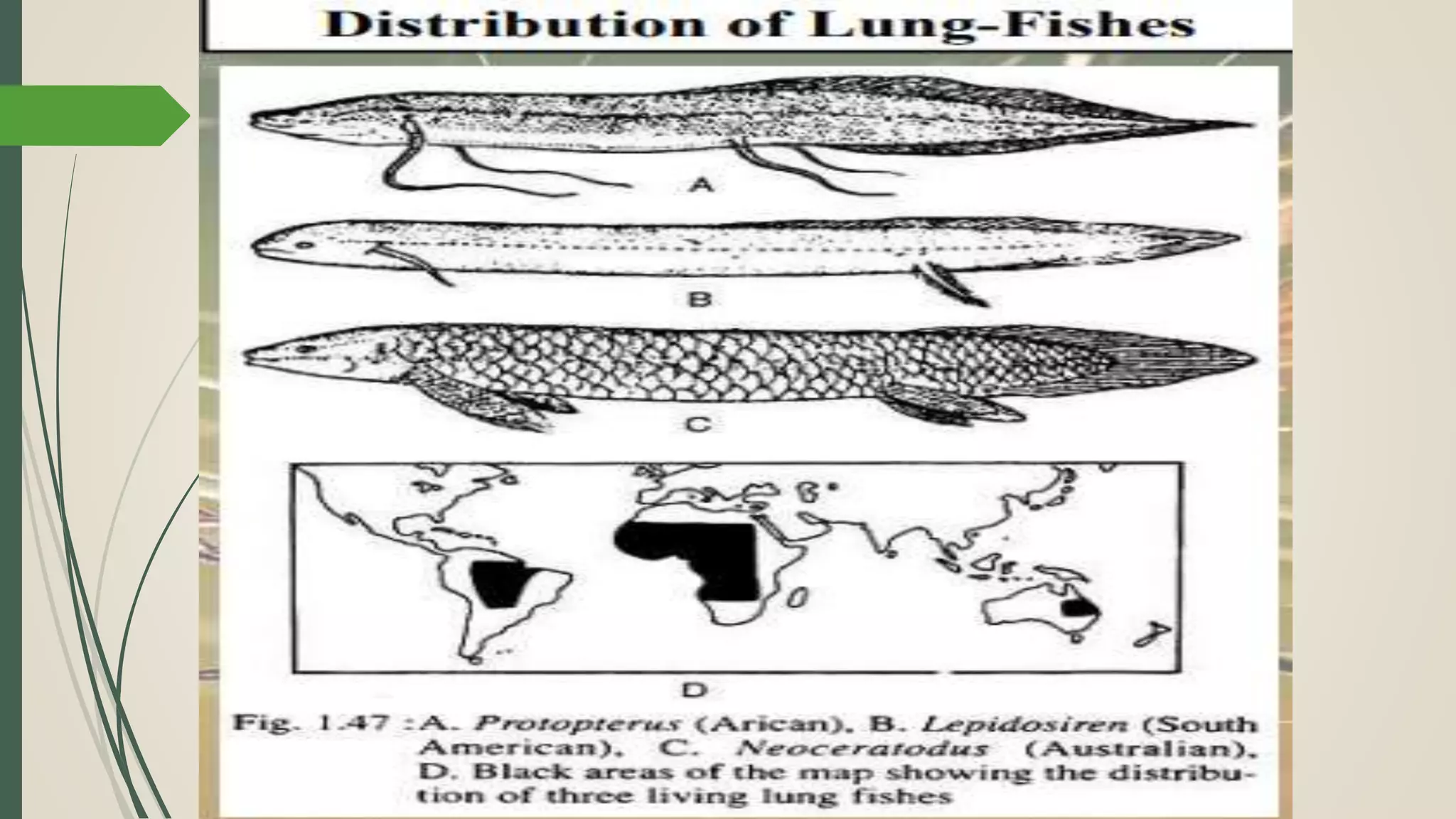
This group is represented today by only three living genera,
which are confined to southern landmasses.
Protopterus is found in the marshes and swamps of Africa.
 Lepidosiren inhabits the same ecological zone in South
America.
 Neo ceratodus is found in the rivers of Queensland,
Australia.
Continue
Fossil history of these three genera reveals that
they had a worldwide distribution in Devonian
period, being represented in India, North America
and Africa.
Invertebrates showing discontinuous
distribution
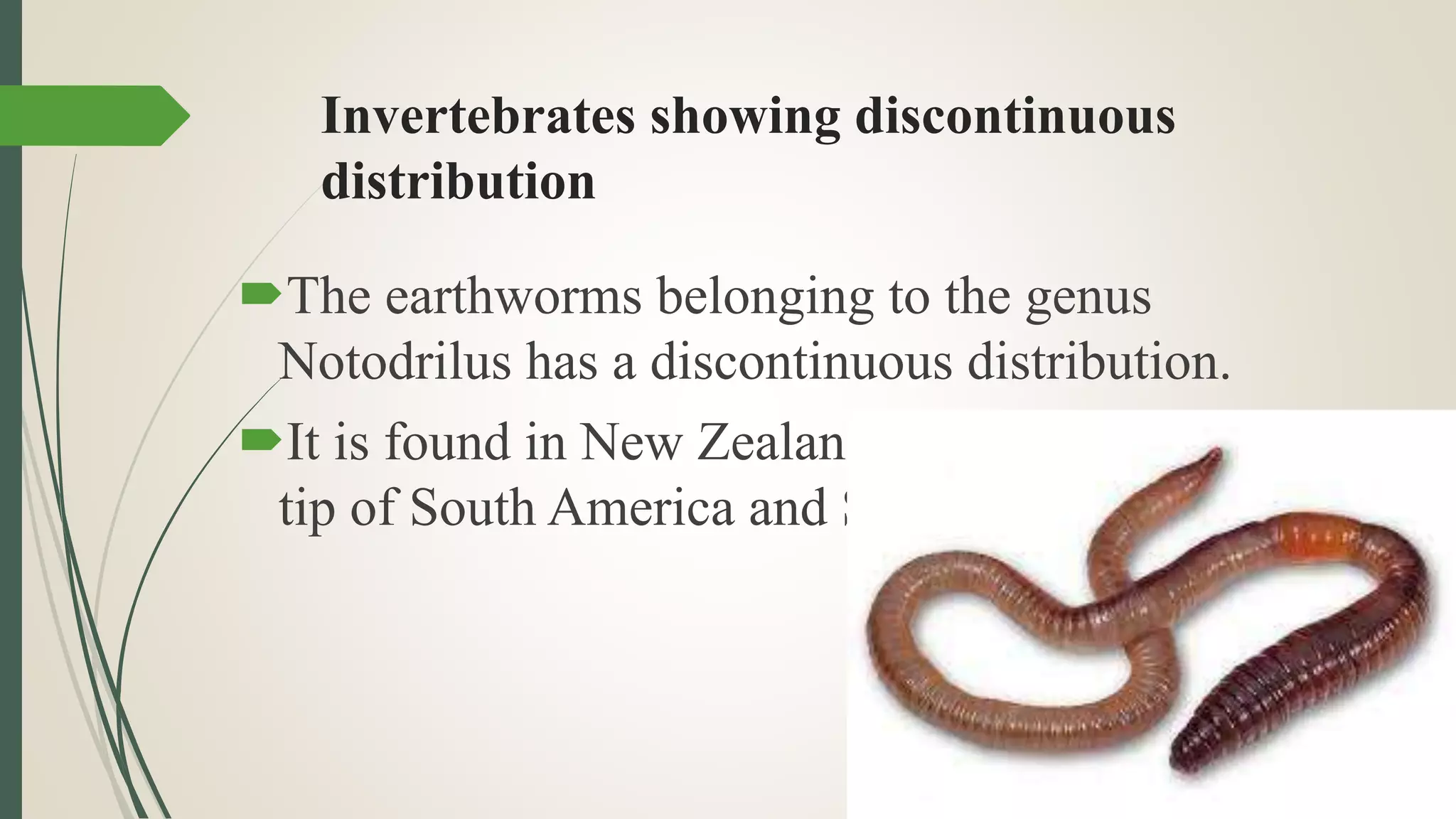
The earthworms belonging to the genus
Notodrilus has a discontinuous distribution.
It is found in New Zealand, Australia, Southern
tip of South America and South Africa
ANY
QUESTIONS?
CONTINENTAL DRIFT THEORY AND DISCONTINUOUS DISTRIBUTION.pptx

CONTINENTAL DRIFT THEORY AND DISCONTINUOUS DISTRIBUTION.pptx

  • 1.
    CONTINENTAL DRIFT THEORY AND DISCONTINUOUS DISTRIBUTION Presentedto: Sir Asim Presented by: Rimsha Ijaz Course code: ZOL-510 Course title : PRINCIPLES OF ZOOGEOGRAPHY
  • 2.
    Table of content Continentaldrift theory History of continental drift theory Evidence supporting the Continental Drift Theory Discontinuous distribution Discontinuous distribution in Mammals, Birds, Reptiles , Amphibians and Fishes Lung fish example in discontinuous distribution
  • 3.
    Continental drift theory Thetheory deals with the distribution of the oceans and the continents. The very slow movement of continental plates on the surface of the earth due to tectonic activity through geological time, is called continental drift. Theory given by ---Alfred Wegner in 1915
  • 4.
    History Abraham Ortelius: It wasfirst put forward by Abraham Ortelius in 1596 He said continents wee see today was not like this, instead there were like one continent. He was a map maker. Antonio Pellegrini: He observe Africa and South America can fit together. Alfred Wegner : Later German Meteorologists Alfred Wagener, he was studying weather . He experience shapes phenomena and he first thought about the Jig saw Puzzle like shapes of continents. He first proposed the hypothesis of continental drift in 1912
  • 5.
    Continue For three yearshe work on to prove his hypothesis . In 1915, he published his hypothesis of continental drift in his book “THE ORIGIN OF CONTINENTS AND OCEANS”. This book contains the basic outline of theory of continental drift.
  • 6.
    Continental drift theory Accordingto Wegener's continental drift theory, all the continents were one single continental mass (called a super continent) – Pangaea and a mega ocean surrounded this supercontinent. The mega ocean is known by the name Panthalassa. According to this theory, the supercontinent, Pangaea, began to split some two hundred million years back. Pangaea first split into 2 big continental masses known as Gondwanaland and Laurasia forming the southern and northern modules respectively. Later, Gondwanaland and Laurasia continued to break into several smaller continents that exist today.
  • 9.
    Continental drift evidence 1.Continental puzzle / Jigsaw Puzzle 2. Fossil evidences 3. Rock of same type across the ocean 4. Climate evidence
  • 10.
    Jigsaw puzzle evidence Thecoastlines of South America and Africa fronting each other have a remarkable and unique match.  In 1964, Bullard created a map using a computer program to find the right fit of the Atlantic margin and it proved to be quiet. Sir Edward Bullard fit continents at 900m water depths . He use edges of continental shelves It prove to be better fit then Wegner’s using coastlines.
  • 13.
    Fossil evidences Mesosaurus wasa tiny reptile adapted to shallow brackish water. The skeletons of these creatures are found in the Traver formations of Brazil and Southern Cape Province of South Africa. Fossils of the same species were found on separate continents and nowhere else. These plants and animals would have had to evolve independently or swim the distances . Fossils found didn’t fit the climate . Like Palm tree leaf fossils were found in Alaska.
  • 15.
    Rocks of sametype across the ocean The radiometric dating methods have helped in correlating the formation of rocks present in different continents across the ocean. The ancient rocks belts on the coast of Brazil match with those found in Western Africa. The old marine deposits found in the coasts of South America and Africa belong to the Jurassic Age. This implies that the ocean never existed before that time.
  • 16.
    Present day Earthdistribution of rocks
  • 18.
    Climate evidences  Partsof Antarctica , North America and the UK all contain coal deposits of similar age that were formed in tropical conditions.  These areas are no longer in tropical climates which suggests that they have drifted apart since the Carboniferous period.  Glacial Striations (scratches in the rocks) can be found that match in Brazil and West Africa.  Glacial deposits are also very similar in India , South America and in the Vaal Valley in South Africa.  These land marks suggest that these areas are very far from each other but once they had a very similar climate.
  • 21.
    Discontinues distribution Often membersof a particular genus, species, or a closely related species have a continuous distribution i.e., they are continuously distributed throughout their range But there are a few exceptions. Some species or closely related species are found to inhabit one or more localized areas which are widely separated by thousands of miles but not present in the regions in between them. These species are said to have DISCONTINUOUS DISTRIBUTION.
  • 22.
    Mammals showing discontinuous distribution CAMELIDAE:The camels are represented by only one genus Camelus, the true camels of Old World and by another genus Llama in South America RHINOCERATIDAE: The rhinoceros which are present in India and Africa but not in the region in between. ELEPHANTIDAE: The elephants are represented by two genera today. Genus Loxodonta is found in Africa while the genus Elephas is found in India, Burma, Sri Lanka, Bangladesh, Indonesia and Vietnam.
  • 26.
    Examples of birds,reptiles and amphibians BIRDS: RATITAE, the flightless birds provide an excellent example of discontinuous distribution. Ostriches are found in deserts of Africa and Saudi Arabia. An allied genus Rhea inhabits the plains of South America. Cassowaries and Emus, another group of flightless birds, are found in dense jungles of New Guinea. Kiwi, the smallest flightless bird is restricted to New Zealand
  • 28.
    Continue REPTILES: Among reptiles Alligators,the members of crocodile family occur in South America and China. AMPHIBIANS: Among the amphibians, more restricted in their local range but also discontinuously distributed is a family of primitive frogs, the Leopelmidae. One genus of this family is restricted to North-West America and another to New Zealand
  • 30.
  • 31.
    New Zealand Leopelmidae Hochstetter'sfrog (Leiopelma hochstetteri)
  • 32.
    Lung-fishes - classicalexample of discontinuity Among fishes, group Dipnoi, the so called lungfishes, represents the classical example of discontinuous distribution. This group is represented today by only three living genera, which are confined to southern landmasses. Protopterus is found in the marshes and swamps of Africa.  Lepidosiren inhabits the same ecological zone in South America.  Neo ceratodus is found in the rivers of Queensland, Australia.
  • 33.
    Continue Fossil history ofthese three genera reveals that they had a worldwide distribution in Devonian period, being represented in India, North America and Africa.
  • 35.
    Invertebrates showing discontinuous distribution Theearthworms belonging to the genus Notodrilus has a discontinuous distribution. It is found in New Zealand, Australia, Southern tip of South America and South Africa
  • 36.