The Eight-Step Research Process
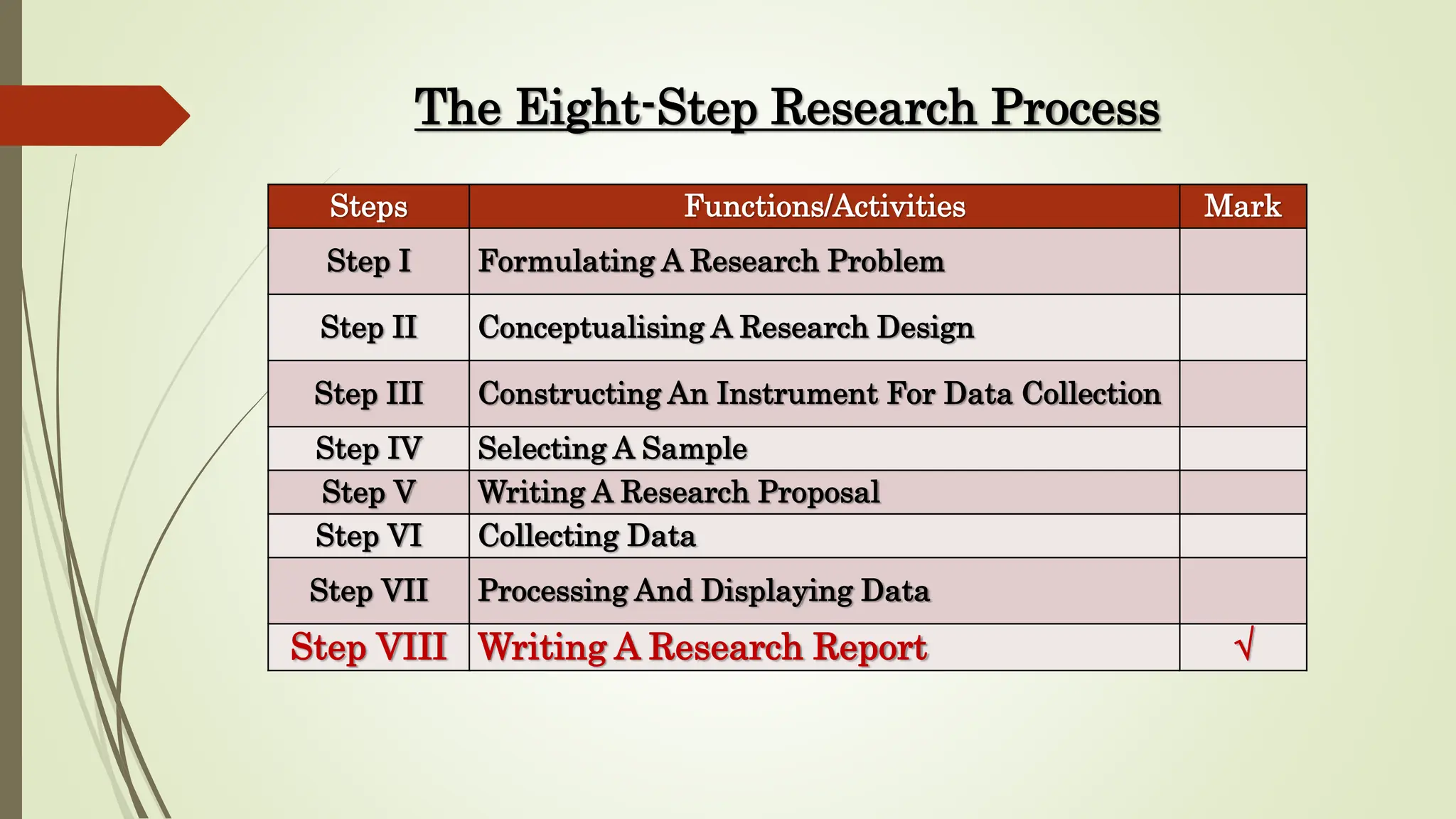
Steps Functions/Activities Mark
Step I Formulating A Research Problem
Step II Conceptualising A Research Design
Step III Constructing An Instrument For Data Collection
Step IV Selecting A Sample
Step V Writing A Research Proposal
Step VI Collecting Data
Step VII Processing And Displaying Data
Step VIII Writing A Research Report √
Writing a Research Report
 The purpose of writing a report is to present the results
of your research, but more importantly to provide a
persuasive argument to readers of what you have
found.
Purpose of Research Reports
 Research reports enable us to communicate to others:
What was carried out
How it was carried out
Why it was carried out
What was found
What the results actually mean
 Reports enable further exploration of ideas.
 Dissemination of research findings is the end goal of all
research.
Major Components of a Research Report
 Title
 Abstract
 Table of Contents
 Introduction and Literature Survey
 Theoretical Analysis
 Empirical Testing/Data Analysis and Presentation
 Conclusions
 References
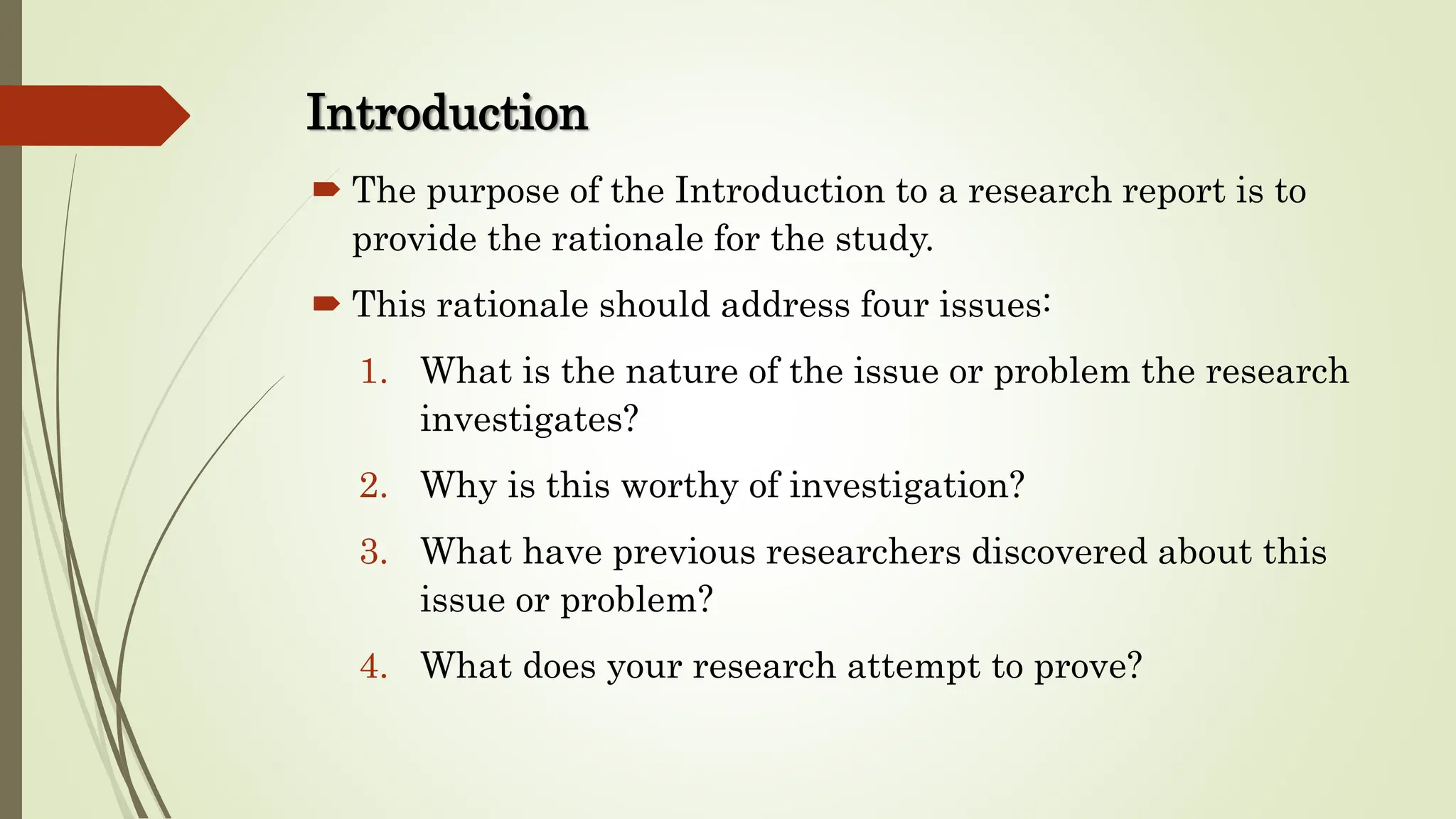
Introduction
 The purpose of the Introduction to a research report is to
provide the rationale for the study.
 This rationale should address four issues:
1. What is the nature of the issue or problem the research
investigates?
2. Why is this worthy of investigation?
3. What have previous researchers discovered about this
issue or problem?
4. What does your research attempt to prove?
Literature Review
 A literature review is a summary of the major studies that
have been published on a particular research topic.
 Literature review is usually included as part of the
introduction in research papers.
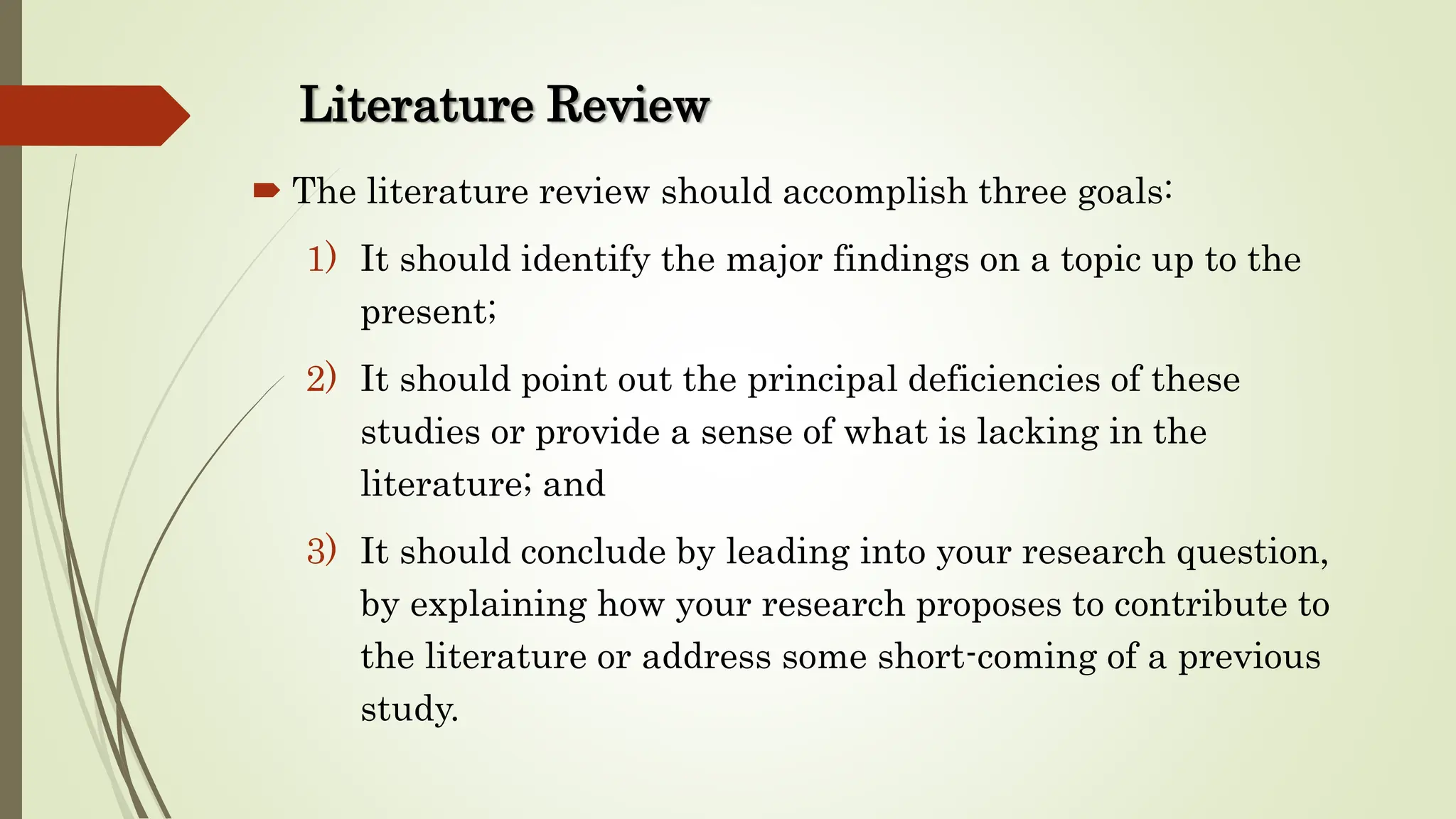
Literature Review
 The literature review should accomplish three goals:
1) It should identify the major findings on a topic up to the
present;
2) It should point out the principal deficiencies of these
studies or provide a sense of what is lacking in the
literature; and
3) It should conclude by leading into your research question,
by explaining how your research proposes to contribute to
the literature or address some short-coming of a previous
study.
Questions Frequently Asked!
 How many studies/sources should be included in the
literature survey?
 What do you think the answer should be?
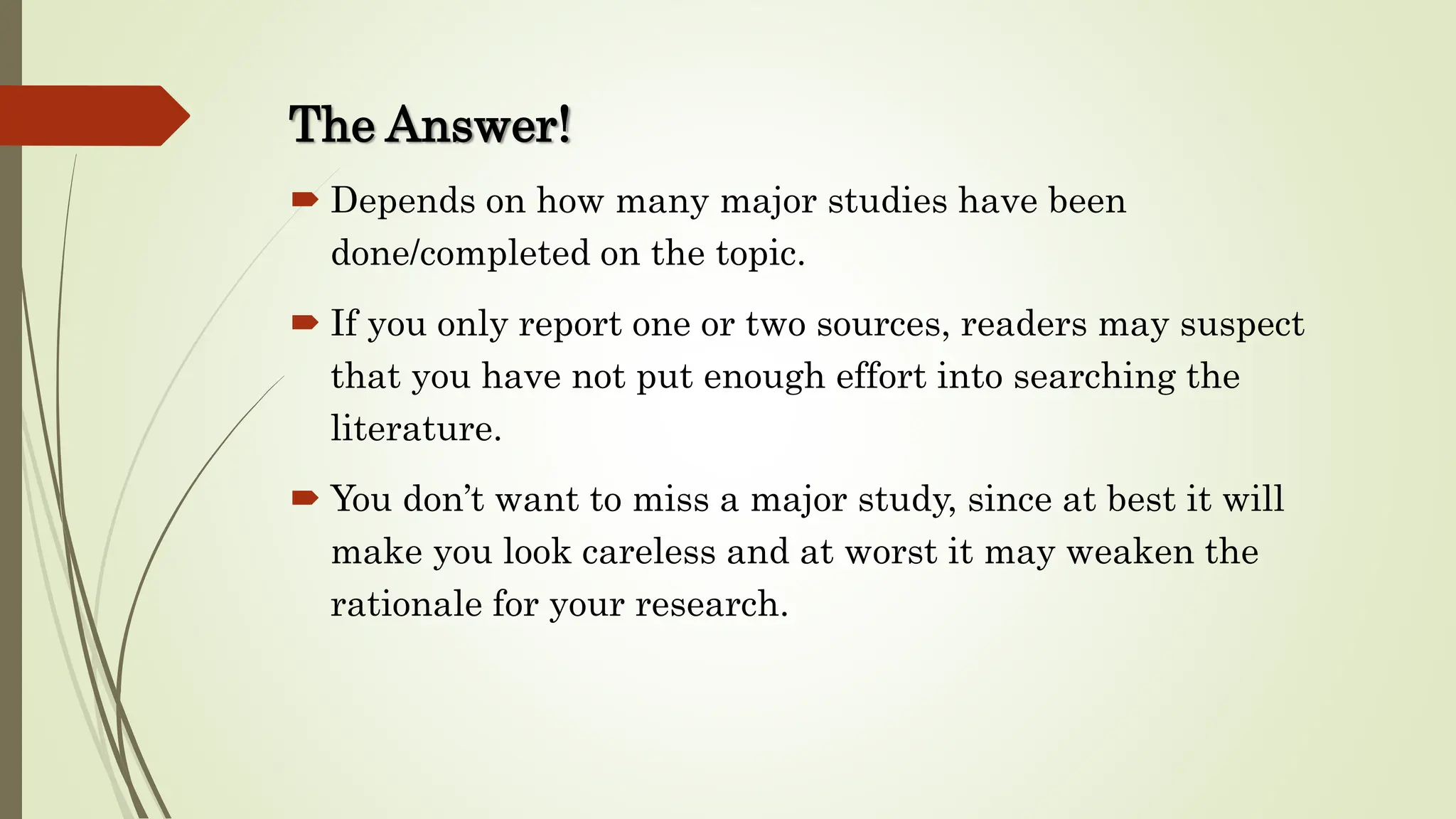
The Answer!
 Depends on how many major studies have been
done/completed on the topic.
 If you only report one or two sources, readers may suspect
that you have not put enough effort into searching the
literature.
 You don’t want to miss a major study, since at best it will
make you look careless and at worst it may weaken the
rationale for your research.
What a Literature Survey is NOT
 A list of potential sources of information about your topic;
 A list of sources that you reviewed, or even
 A list of summaries of the sources you reviewed.
Theoretical Analysis
 The purpose of this part of a research report is to present
the theoretical discussion and analysis of the issue or
problem you investigated.
 This section also describes your theoretical model you used
for the study.
Empirical Testing/Data Analysis & Presentation
 The purpose of this part of a research report is to provide the
empirical evidence in favour of your research argument.
 The theme of this section can be summarized as: Given your
hypothesis, how did you test it and what were your findings?
This is an important section of the research report and it should
include the following things:
The data used;
The empirical model and type of statistical analysis
employed;
The results you hypotheses;
Other statistical analyses and results; &
Interpretation of the results.
Empirical Testing/Data Analysis & Presentation
Conclusions
 The purpose of this part of the report is to summarize your
findings, i.e., to restate your argument and conclude
whether or not it is valid.
 In light of the statistical results, what can you infer about
your hypothesis?
 To what extent did your empirical testing confirm your
analysis?
Report Rules
 Standardised format (quick finding of details)
Format guidelines of the American Psychological
Association (APA).
 The abstract and conclusions are arguably the most
important sections of the report.
 The key aim of a report is replication
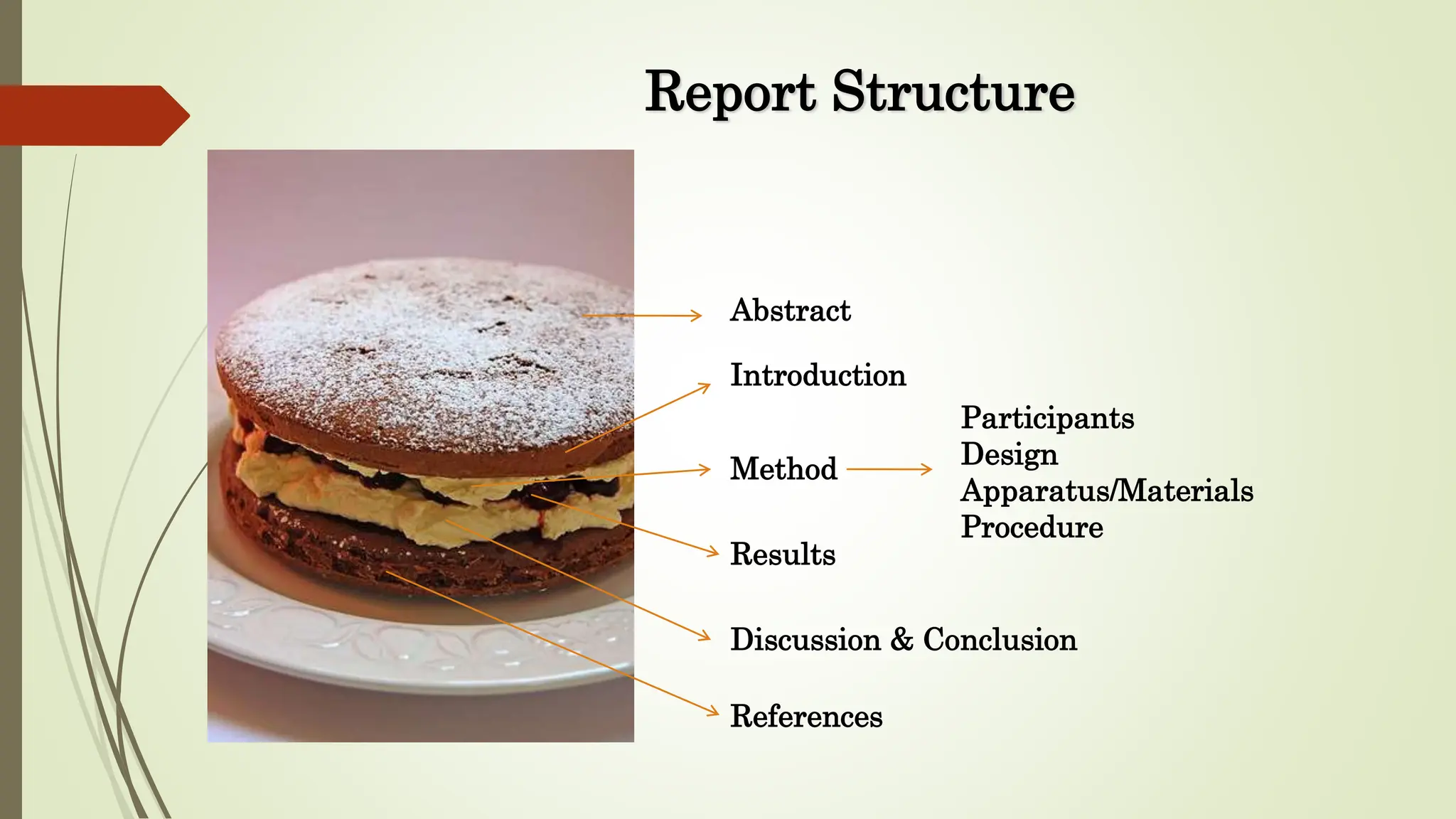
Report Structure
Abstract
Introduction
Method
Results
Discussion & Conclusion
References
Participants
Design
Apparatus/Materials
Procedure
Successful Report Writing
 Start writing early – important details about the
study may be forgotten if the write-up is left to
the last minute.
 Remember – a naive reader should be able to
follow your report and replicate your findings.
 Read – reading journal articles and past
dissertations will help you with structuring your
report and understanding the required style.
 Reflect – reflect upon the comments you receive
on your practical reports and essays – these are
provided to help you!
Report Writing: General Style
 Reports should be double-spaced.
 Each major section (Abstract, Introduction, Method,
Results and Discussion) should start on a new page with
the title of the section in bold.
 Each minor section (e.g. Paragarph/section) should be in
italics.
 All pages should be numbered.
 The last section is the Appendices and includes raw data,
Ethics Approval Form and other relevant information.
Report Title
 Each report should be given a title that is both concise and
provides the reader with an insight to the investigation
being reported.
 Titles often include the independent variable (IV) and
dependent variable (DV).
 The key aim of the title is to entice the reader into looking
further into the report – the title is the first part of a report
a reader will see, therefore it has to be interesting, concise
and descriptive.
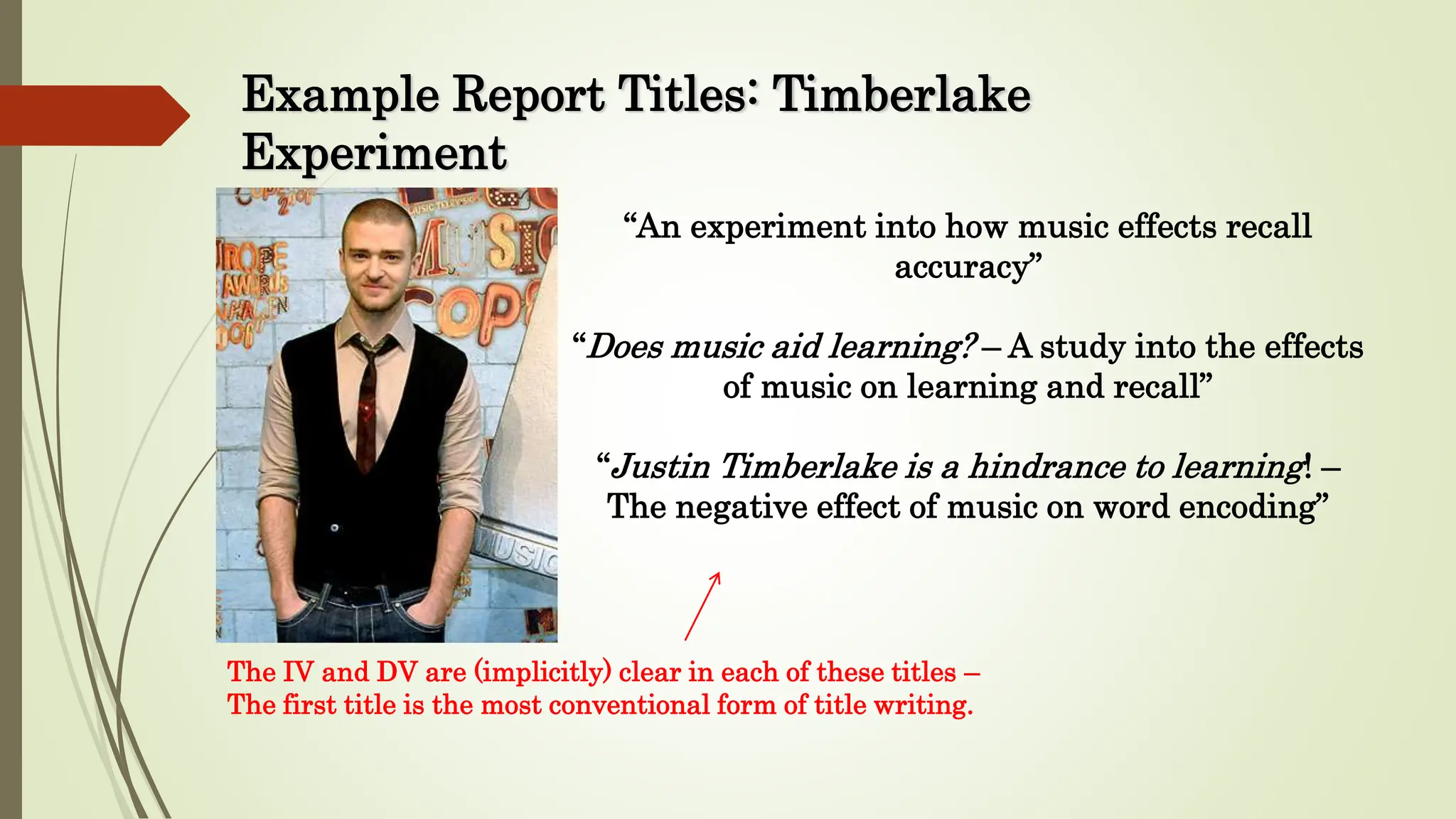
Example Report Titles: Timberlake
Experiment
“An experiment into how music effects recall
accuracy”
“Does music aid learning? – A study into the effects
of music on learning and recall”
“Justin Timberlake is a hindrance to learning! –
The negative effect of music on word encoding”
The IV and DV are (implicitly) clear in each of these titles –
The first title is the most conventional form of title writing.
Abstract
 The abstract is a self-contained and brief summary of the key
points from the study.
 The abstract (like the rest of the report) should be written in
the ‘third’ person.
The third person avoids the use of ‘I’ and ‘we’ – instead use
‘It was decided’ or ‘The investigator(s) choose to’
 Although the first section after the title, the abstract should
be written last.
 Abstracts should be no more than 150 words.
 What should an abstract contain?
Abstract Contents
 An abstract should contain the following:
 Brief statement of the problem being investigated.
 The design used (for experiments only).
 Relevant participant details (e.g. 20 males & 20 females).
 Stimulus materials used (experiments) and other important
apparatus.
 Principal results.
 Main conclusions and nature of discussion.
 Reference to a key theory or piece of research if the study is
based partly on a replication.
Thanks.

13. Writing a Research Report . demo about report Writting

  • 1.
    The Eight-Step ResearchProcess Steps Functions/Activities Mark Step I Formulating A Research Problem Step II Conceptualising A Research Design Step III Constructing An Instrument For Data Collection Step IV Selecting A Sample Step V Writing A Research Proposal Step VI Collecting Data Step VII Processing And Displaying Data Step VIII Writing A Research Report √
  • 2.
    Writing a ResearchReport  The purpose of writing a report is to present the results of your research, but more importantly to provide a persuasive argument to readers of what you have found.
  • 3.
    Purpose of ResearchReports  Research reports enable us to communicate to others: What was carried out How it was carried out Why it was carried out What was found What the results actually mean  Reports enable further exploration of ideas.  Dissemination of research findings is the end goal of all research.
  • 4.
    Major Components ofa Research Report  Title  Abstract  Table of Contents  Introduction and Literature Survey  Theoretical Analysis  Empirical Testing/Data Analysis and Presentation  Conclusions  References
  • 5.
    Introduction  The purposeof the Introduction to a research report is to provide the rationale for the study.  This rationale should address four issues: 1. What is the nature of the issue or problem the research investigates? 2. Why is this worthy of investigation? 3. What have previous researchers discovered about this issue or problem? 4. What does your research attempt to prove?
  • 6.
    Literature Review  Aliterature review is a summary of the major studies that have been published on a particular research topic.  Literature review is usually included as part of the introduction in research papers.
  • 7.
    Literature Review  Theliterature review should accomplish three goals: 1) It should identify the major findings on a topic up to the present; 2) It should point out the principal deficiencies of these studies or provide a sense of what is lacking in the literature; and 3) It should conclude by leading into your research question, by explaining how your research proposes to contribute to the literature or address some short-coming of a previous study.
  • 8.
    Questions Frequently Asked! How many studies/sources should be included in the literature survey?  What do you think the answer should be?
  • 9.
    The Answer!  Dependson how many major studies have been done/completed on the topic.  If you only report one or two sources, readers may suspect that you have not put enough effort into searching the literature.  You don’t want to miss a major study, since at best it will make you look careless and at worst it may weaken the rationale for your research.
  • 10.
    What a LiteratureSurvey is NOT  A list of potential sources of information about your topic;  A list of sources that you reviewed, or even  A list of summaries of the sources you reviewed.
  • 11.
    Theoretical Analysis  Thepurpose of this part of a research report is to present the theoretical discussion and analysis of the issue or problem you investigated.  This section also describes your theoretical model you used for the study.
  • 12.
    Empirical Testing/Data Analysis& Presentation  The purpose of this part of a research report is to provide the empirical evidence in favour of your research argument.  The theme of this section can be summarized as: Given your hypothesis, how did you test it and what were your findings?
  • 13.
    This is animportant section of the research report and it should include the following things: The data used; The empirical model and type of statistical analysis employed; The results you hypotheses; Other statistical analyses and results; & Interpretation of the results. Empirical Testing/Data Analysis & Presentation
  • 14.
    Conclusions  The purposeof this part of the report is to summarize your findings, i.e., to restate your argument and conclude whether or not it is valid.  In light of the statistical results, what can you infer about your hypothesis?  To what extent did your empirical testing confirm your analysis?
  • 15.
    Report Rules  Standardisedformat (quick finding of details) Format guidelines of the American Psychological Association (APA).  The abstract and conclusions are arguably the most important sections of the report.  The key aim of a report is replication
  • 16.
    Report Structure Abstract Introduction Method Results Discussion &Conclusion References Participants Design Apparatus/Materials Procedure
  • 17.
    Successful Report Writing Start writing early – important details about the study may be forgotten if the write-up is left to the last minute.  Remember – a naive reader should be able to follow your report and replicate your findings.  Read – reading journal articles and past dissertations will help you with structuring your report and understanding the required style.  Reflect – reflect upon the comments you receive on your practical reports and essays – these are provided to help you!
  • 18.
    Report Writing: GeneralStyle  Reports should be double-spaced.  Each major section (Abstract, Introduction, Method, Results and Discussion) should start on a new page with the title of the section in bold.  Each minor section (e.g. Paragarph/section) should be in italics.  All pages should be numbered.  The last section is the Appendices and includes raw data, Ethics Approval Form and other relevant information.
  • 19.
    Report Title  Eachreport should be given a title that is both concise and provides the reader with an insight to the investigation being reported.  Titles often include the independent variable (IV) and dependent variable (DV).  The key aim of the title is to entice the reader into looking further into the report – the title is the first part of a report a reader will see, therefore it has to be interesting, concise and descriptive.
  • 20.
    Example Report Titles:Timberlake Experiment “An experiment into how music effects recall accuracy” “Does music aid learning? – A study into the effects of music on learning and recall” “Justin Timberlake is a hindrance to learning! – The negative effect of music on word encoding” The IV and DV are (implicitly) clear in each of these titles – The first title is the most conventional form of title writing.
  • 21.
    Abstract  The abstractis a self-contained and brief summary of the key points from the study.  The abstract (like the rest of the report) should be written in the ‘third’ person. The third person avoids the use of ‘I’ and ‘we’ – instead use ‘It was decided’ or ‘The investigator(s) choose to’  Although the first section after the title, the abstract should be written last.  Abstracts should be no more than 150 words.  What should an abstract contain?
  • 22.
    Abstract Contents  Anabstract should contain the following:  Brief statement of the problem being investigated.  The design used (for experiments only).  Relevant participant details (e.g. 20 males & 20 females).  Stimulus materials used (experiments) and other important apparatus.  Principal results.  Main conclusions and nature of discussion.  Reference to a key theory or piece of research if the study is based partly on a replication.
  • 23.