
Intergenerational study of  beliefs about childcare among the Lobanas residing in rural areas of Jammu . Neeru Sharma,Reader Ruchira Sapru ,Research Scholar Ruchi Mahajan, Ex Student Deptt of Home Science, University of Jammu, Jammu neerusha@ gmail.com
Abstract The present research was conducted to study the intergenerational differences in beliefs regarding child care  among the grandmothers and mothers belonging to Lobana community of Jammu.For this 30 grandmother-mother dyads were selected from the rural areas of R.S. Pura- Dablehar,Kirpind and Kalyana.The tools used for data collection were Interview schedule, rating scale, and observation. Results reveal a difference in the beliefs of grandmothers and mothers.Grandmothers, who  were mostly illiterate , believed that the ideal place for delivery was home and the delivery should be supervised by a  Dai  (traditional midwife) whereas the mothers believed that a doctors consultation is must as they can handle any sort of complications. Mothers also consider colostrums as a must.  Folk traditions and customs of child care  are celebrated and the joint family system helps in maintaining this continuity. Some age old beliefs are not liked by the younger generation but they follow them with least modification. Both generations endorse the importance of the  role of parents in shaping the child’s personality and future.Gender discrimination was prevalent in families with low educational status. Results of the parental belief survey revealed a significant difference between mothers and grandmothers over talking and telling story to the child and beliefs regarding spoiling the child.
Introduction Parents play an important role in the all round development of children. They are the architects of the future from whom the child learns the lesson of socialization.  Parental ideas about how to raise children in the society are generally derived from a large number of resources.  Like our cultural system , each culture conveys message about appropriate child rearing techniques.  These practices shape the developmental niche of the child.  Such beliefs may come from personal experiences often reflecting the values of one’s own family. Family beliefs vary from culture to culture.  According to religious scriptures the initial nature of the child depends upon the ideology of the parents and the family.
Harkness and Super(1991) gave the concept of developmental niche which comprises of  a  Physical and social settings in which the child lives b  Cultyrally regulated customs of child care and child learning c  the psychology of the caretakers of the child The physical and social setting is important in shaping a child’s activity not only through the kinds of activities available but also through defining the activities of other people present.  Customs are refered to here as techniques of protecting, teaching and socialising that are commonly used by members of the community and so thoroughly integrated into the larger culture that individual caretakers do not need to rationalise them or even give them conscious considerations.  The psychology of the care takers , their beliefs, values and affective orientation organises not only their immediate behaviour towards childrebn but also many larger decisions such as which settings are most appropriate for children of a certain age or sex.
OBJECTIVES: The objectives of the present research are to study the beliefs of mothers and grandmothers regarding: Pregnancy, child birth and feeding practices Qualities desired in children Health and hygiene Folk traditions and practices Sources of parental beliefs for mothers Spoiling the child Floor freedom Discipline and control Talking and telling stories
METHODOLOGY: Sample - The sample for the study comprised of 30 families of Lobana community of R.S.Pura Tehsil, Jammu(J&K). From these families both mothers (n=30) and grandmothers(n=30) were selected from each family. Purposive sampling technique was used for selection of the sample.
Tool   Interview schedule  prepared to explore the beliefs  of mothers and grandmothers about child rearing  practices.  The schedule was divided into two major heads, the  background information and specific information.
Tools- Modified Parental Belief Survey  as  used by Manpreet Maan Singh(1992), Department of Human Development, Punjab Agriculture University , Ludhiana . The three-point scale is divided in to four subscales as follows: Beliefs regarding spoiling the child : Includes questions which unfold the beliefs about emotional; stimulation of the child. Beliefs regarding floor freedom : Includes statement  which reveal as to what amount of floor freedom is good for the child for better development. Beliefs regarding discipline and control : Includes statements, which show how much of discipline and control is required or employed to control the child. Beliefs regarding talking and telling stories : Includes statements that emphasize the need of talking and telling stories to children.
RESULTS AND DISCUSSION In the present study it was found that majority mothers were in the age group of 25-30 years and grandmothers were in the age group of 55-60years in majority.  Most (37%) of the mothers has studied upto higher secondary whereas majority grandmothers(77%) were illiterates. Ninety three percent mothers were homemakers while quite a few were working as teachers.
TABLE I: ANALYSIS OF MODIFIED PARENTAL BELIEF SURVEY 40  40 20 12 12 6 36.6 63.3 - 11 19 - i) Lot of effect ii) Average effect iii) No effect BELIEFS REGARDING TALKING AND TELLING STORIES 40 60 12 18 73.3 26.6 - 28 8 - i) Strict discipline ii) Average iii) Less discipline BELIEFS REGARDING DISCIPLINE AND CONTROL 56.6 40 3.3 17 12 1 36.6 63.3 - 11 19 - i) Freedom should be given ii) Less freedom should be given iii) Freedom should not be given BELIEFS REGARDING FLOOR FREEDOM - 40 60 -  12 18 76.6 16.6 6.6 23 5 2  i)  Will spoil the child ii) Average iii) Will not spoil the child % N=30 % N=30 GRANDMOTHERS MOTHERS Parental Beliefs BELIEF REGARDING SPOILING THE CHILD
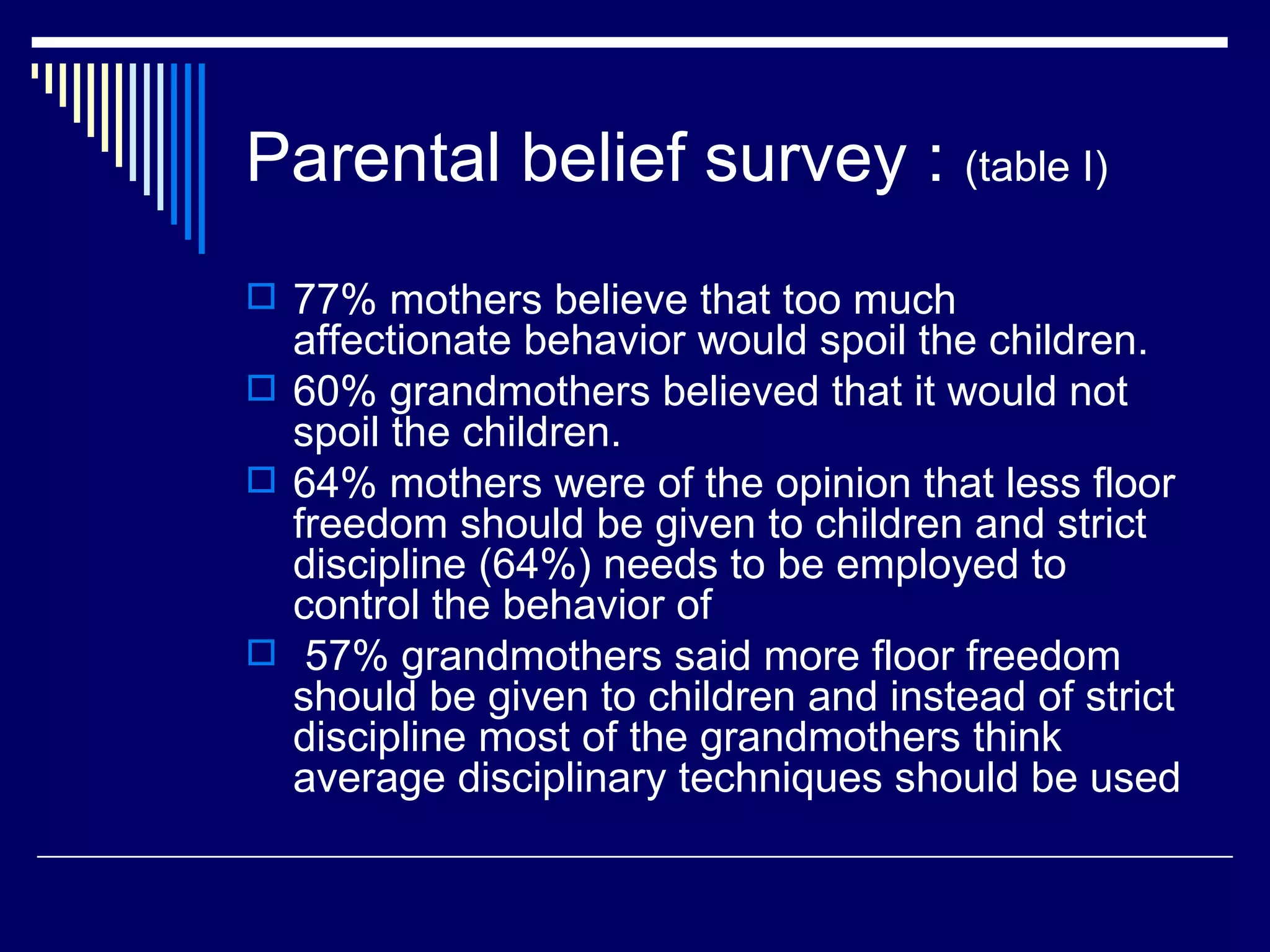
Parental belief survey :  (table I)   77% mothers believe that too much  affectionate behavior would spoil the children.  60% grandmothers believed that it would not spoil the children.  64% mothers were of the opinion that less floor freedom should be given to children and strict discipline (64%) needs to be employed to control the behavior of  57% grandmothers said more floor freedom should be given to children and instead of strict discipline most of the grandmothers think average disciplinary techniques should be used
Mothers feel that talking or telling stories to children has an average effect on their development  40% grandmothers are of the opinion that talking and telling stories to children has lot of effect on children.  Parents design the child’s home environment hence the beliefs they hold exert a significant influence on children (Sharma, 1999).  Brody et al (1999) also traced links among maternal child rearing efficiency beliefs, parenting practices and child’s psychosocial development.  The influence of beliefs of grand parents has a significant impact on the development of children as well.  Sharma, Sapru and Gupta(2004) in their study on maternal beliefs about child rearing found similar views where mother believe that more of responsive and affectionate behavior spoils children and  favor an organized environment for children .
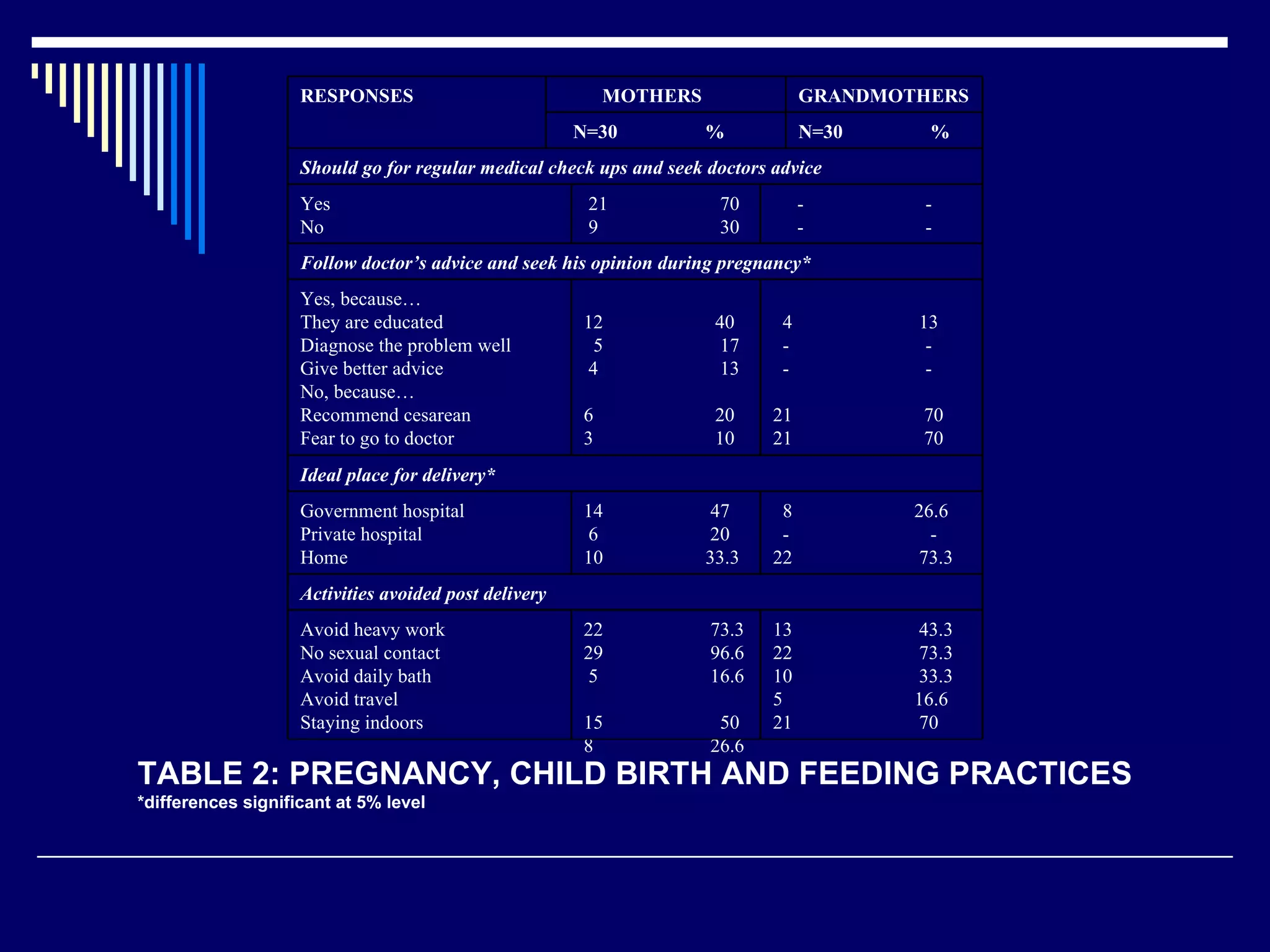
 2 significant at .05 level TABLE 2: PREGNANCY, CHILD BIRTH AND FEEDING PRACTICES *differences significant at 5% level 13  43.3 22  73.3 10  33.3 5  16.6 21  70 22  73.3 29  96.6 5  16.6  15  50 8  26.6 Avoid heavy work No sexual contact Avoid daily bath Avoid travel Staying indoors Activities avoided post delivery 8  26.6 -  - 22  73.3 14  47 6  20 10  33.3 Government hospital Private hospital Home Ideal place for delivery* 4  13 -  - -  - 21  70 21  70 12  40 5  17 4  13 6  20 3  10 Yes, because… They are educated Diagnose the problem well Give better advice No, because… Recommend cesarean Fear to go to doctor  Follow doctor’s advice and seek his opinion during pregnancy* -  - -  - 21  70 9  30 Yes  No Should go for regular medical check ups and seek doctors advice N=30  % N=30  % GRANDMOTHERS MOTHERS RESPONSES
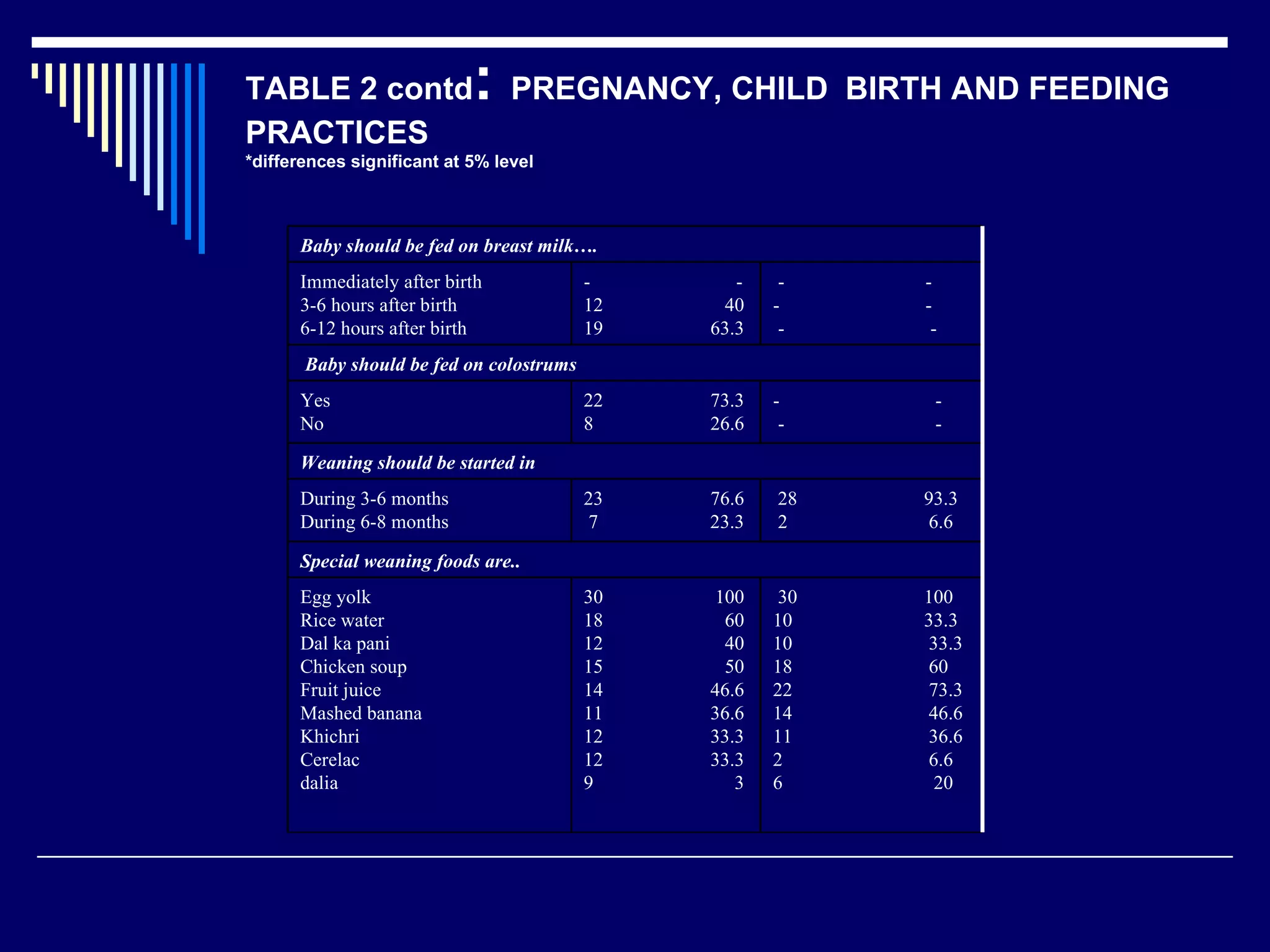
TABLE 2 contd :  PREGNANCY, CHILD   BIRTH AND FEEDING PRACTICES *differences significant at 5% level 30  100 10  33.3 10  33.3 18  60 22  73.3 14  46.6 11  36.6 2  6.6 6  20 30  100 18  60 12  40 15  50 14  46.6 11  36.6 12  33.3 12  33.3 9  3 Egg yolk Rice water Dal ka pani Chicken soup Fruit juice Mashed banana Khichri Cerelac dalia Special weaning foods are.. 28  93.3 2  6.6 23  76.6 7  23.3 During 3-6 months During 6-8 months Weaning should be started in -  - -  - 22  73.3 8  26.6 Yes No Baby should be fed on colostrums -  - -  - -  - -  - 12  40 19  63.3 Immediately after birth 3-6 hours after birth 6-12 hours after birth Baby should be fed on breast milk….
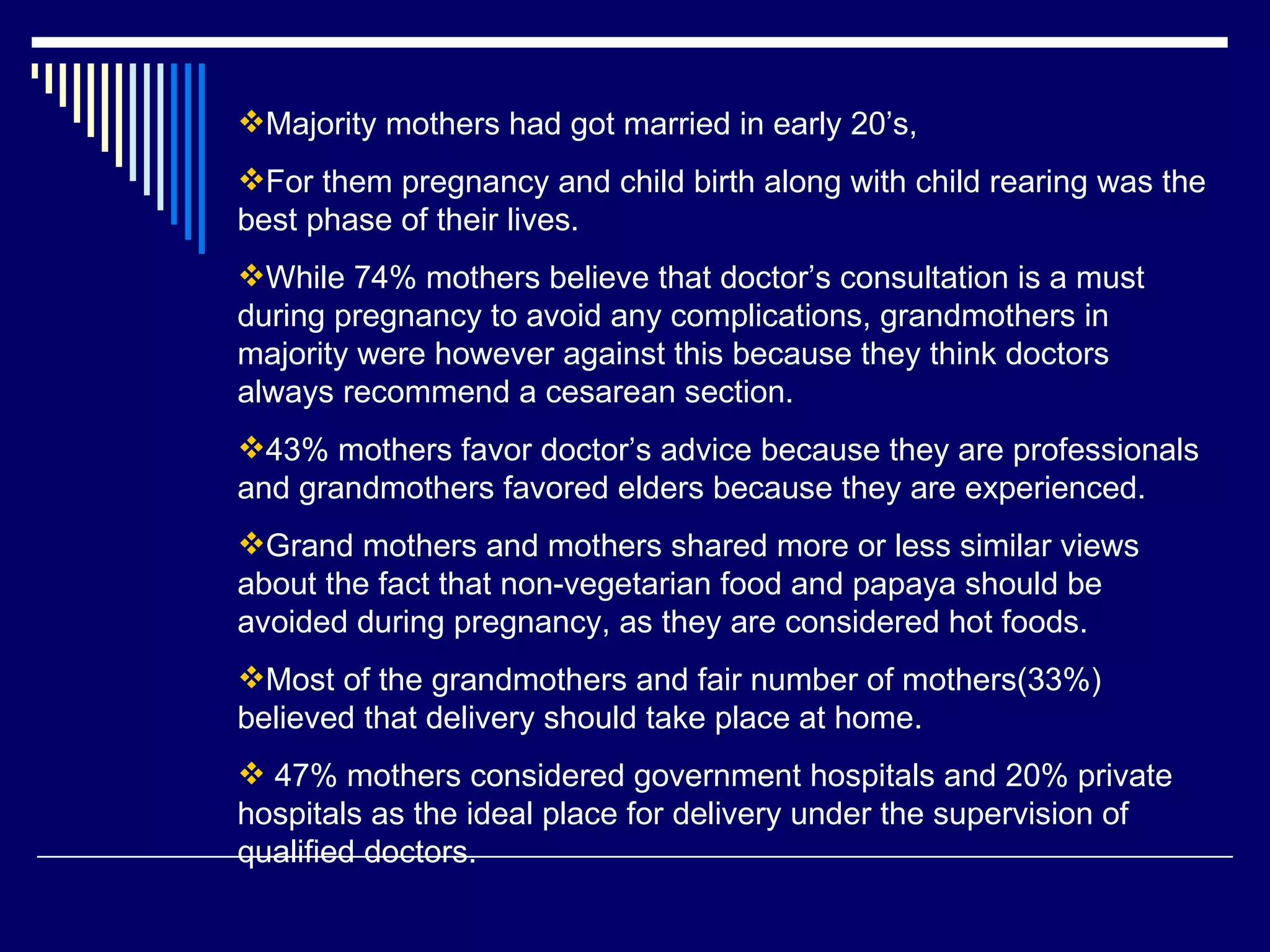
Majority mothers had got married in early 20’s,  For them pregnancy and child birth along with child rearing was the best phase of their lives.  While 74% mothers believe that doctor’s consultation is a must during pregnancy to avoid any complications, grandmothers in majority were however against this because they think doctors always recommend a cesarean section. 43% mothers favor doctor’s advice because they are professionals and grandmothers favored elders because they are experienced.  Grand mothers and mothers shared more or less similar views about the fact that non-vegetarian food and papaya should be avoided during pregnancy, as they are considered hot foods.  Most of the grandmothers and fair number of mothers(33%) believed that delivery should take place at home.  47% mothers considered government hospitals and 20% private hospitals as the ideal place for delivery under the supervision of qualified doctors.
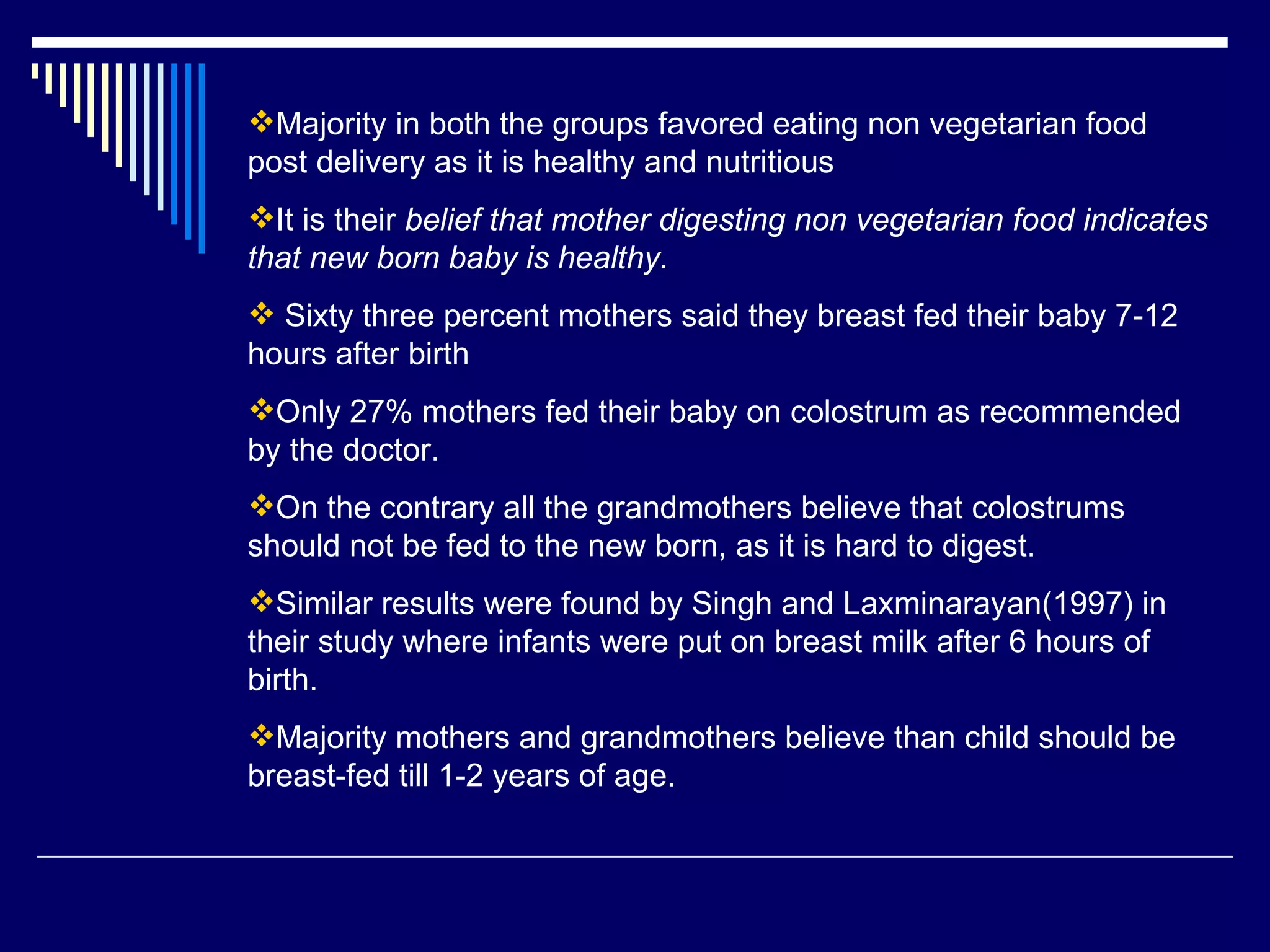
Majority in both the groups favored eating non vegetarian food post delivery as it is healthy and nutritious It is their  belief that mother digesting non vegetarian food indicates that new born baby is healthy. Sixty three percent mothers said they breast fed their baby 7-12 hours after birth Only 27% mothers fed their baby on colostrum as recommended by the doctor. On the contrary all the grandmothers believe that colostrums should not be fed to the new born, as it is hard to digest. Similar results were found by Singh and Laxminarayan(1997) in their study where infants were put on breast milk after 6 hours of birth.  Majority mothers and grandmothers believe than child should be breast-fed till 1-2 years of age.
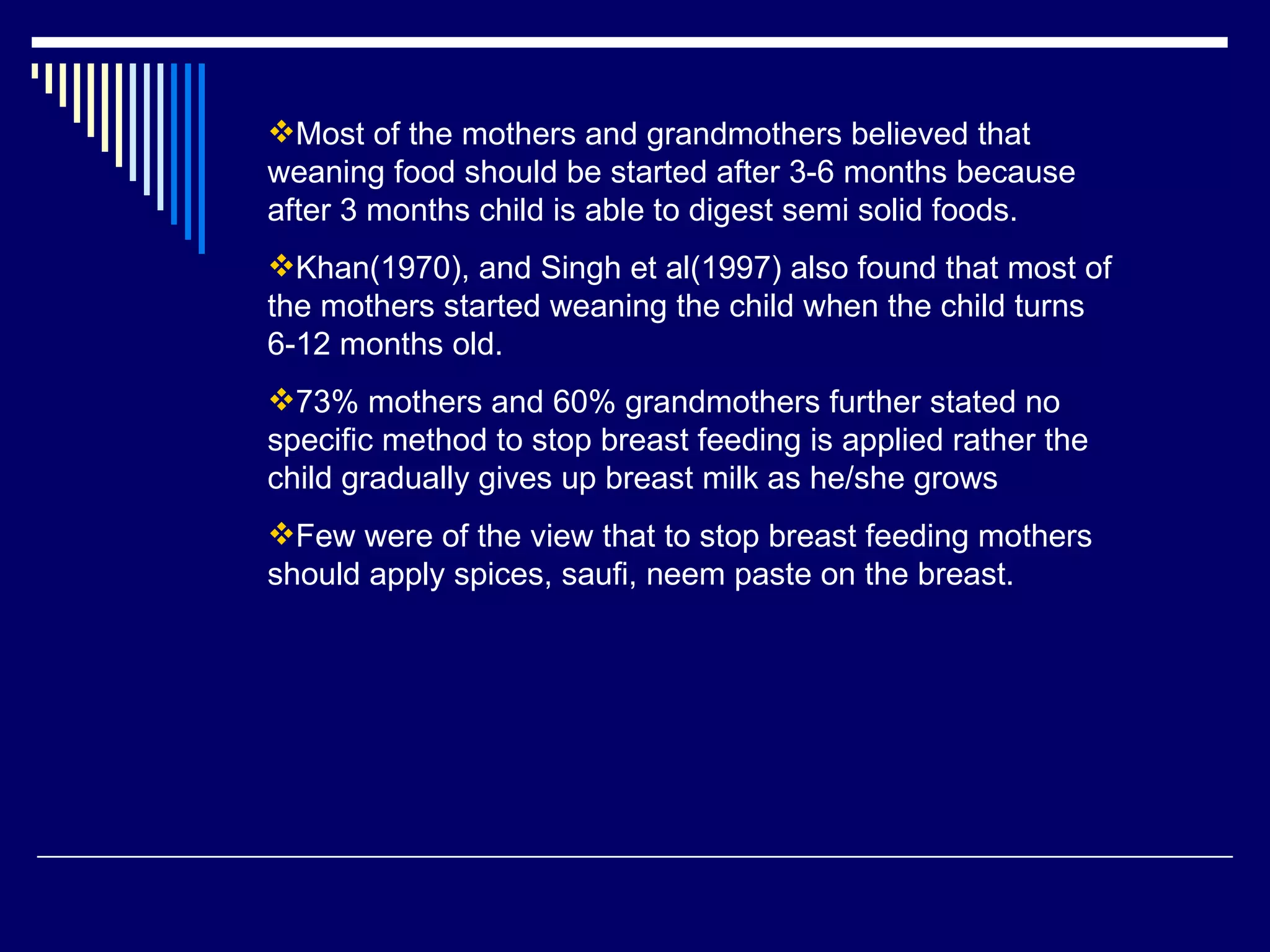
Most of the mothers and grandmothers believed that weaning food should be started after 3-6 months because after 3 months child is able to digest semi solid foods.  Khan(1970), and Singh et al(1997) also found that most of the mothers started weaning the child when the child turns 6-12 months old.  73% mothers and 60% grandmothers further stated no specific method to stop breast feeding is applied rather the child gradually gives up breast milk as he/she grows Few were of the view that to stop breast feeding mothers should apply spices, saufi, neem paste on the breast.
All grandmothers and 23%  mothers believe that mother and new born should be kept in isolation to avoid buri nazar.(evil eye). Swain(1978) found that the period when mother and new born are isolated from others for 40 days is beneficial as it reduces the chances of catching infection.  Mothers and grandmothers share almost similar views on giving daily bath to baby in summers, and massaging the baby, which helps in the muscular development of baby.  53% mothers and 70% grand mothers believe that cradle cap is present in all children, although 26% mothers and 30% grandmothers think it is not present is every child. 33% grandmothers and 23% mothers believe that dryness of scalp is the reason behind it, whereas 23% grandmothers and 10% mothers think it is the dirt from within the skull that comes out. 37% mothers said they had no idea about the reason behind it.
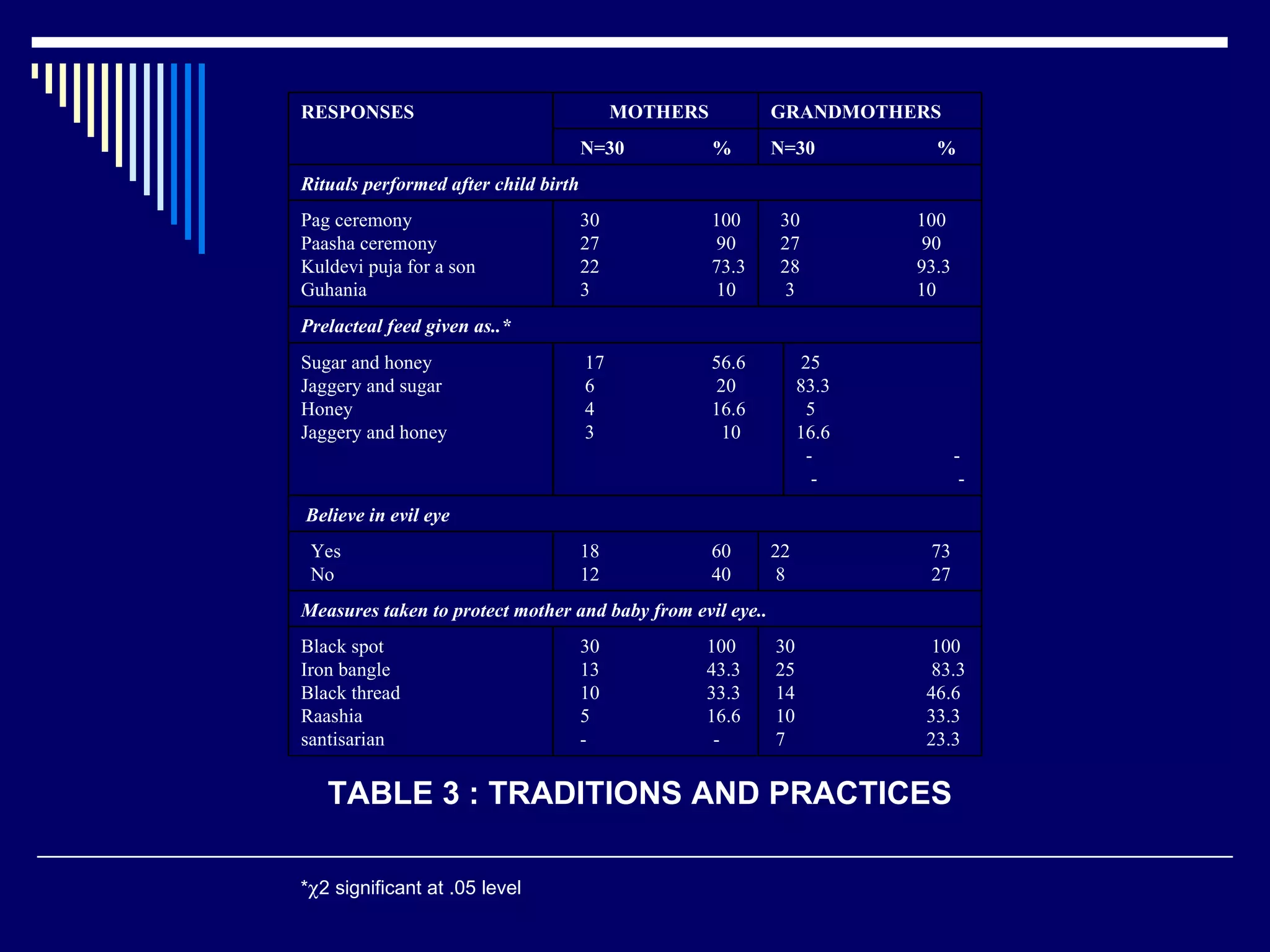
*  2 significant at .05 level TABLE 3 : TRADITIONS AND PRACTICES 30  100 25  83.3 14  46.6 10  33.3 7  23.3 30  100 13  43.3 10  33.3 5  16.6 -  - Black spot Iron bangle Black thread Raashia santisarian Measures taken to protect mother and baby from evil eye.. 22  73 8  27 18  60 12  40 Yes No Believe in evil eye 25  83.3 5  16.6 -  - -  - 17  56.6 6  20 4  16.6 3  10 Sugar and honey Jaggery and sugar Honey Jaggery and honey Prelacteal feed given as..* 30  100 27  90 28  93.3 3  10 30  100 27  90 22  73.3 3  10 Pag ceremony Paasha ceremony Kuldevi puja for a son Guhania Rituals performed after child birth N=30  % N=30  % GRANDMOTHERS MOTHERS RESPONSES
Pag ceremony is performed when the child is a 10-15 years old. 90% mother and grandmothers said that they also perform Pasha ceremony after the birth of the baby, in which the mother has to drink cardamom water for seven consecutive days.  This water is prepared by the mother’s sister-in- law(jethani).  On the seventh day the mother is then allowed to enter the kitchen, as she is considered pure and clean.  Another ceremony named Guhania is performed which is more or less like Pasha, the only difference is that in Guhania ceremony mother is allowed to enter the kitchen on the 11th day.  It was found that these practices are performed in the Lobana’s and they doe not want to change these practices.  All the mothers and grand mothers believe that Gurathi should be given to the baby as prelacteal feed, and the one who feeds the baby with the Gurathi transfers his/her sanskars and wisdom to the child.  Kishore and Garg (1999) found in their study that most of the mothers gave prelacteal feed to their infants in the form of sugar water, gur water or cow’s milk.  Namkaran ceremony is performed only for sons in Lobana community and not for daughters.
For protecting the mother and the baby from evil eye, mothers and especially grandmothers insist upon tying black thread, wear iron bangle, black spot, on the forehead. Even those who do not believes in evil eye protect their baby by tying black thread, or putting black spot.  Some of the mothers and grandmothers believe that it is not only others that caste evil eye sometimes even when the mothers say “ now the child is having adequate diet” affects the child’s diet the very next day. Taneja et al(1990) also found that majority mothers had superstitious beliefs regarding  common illness that all superstitions  are largely in joint families due to influence of older family members.
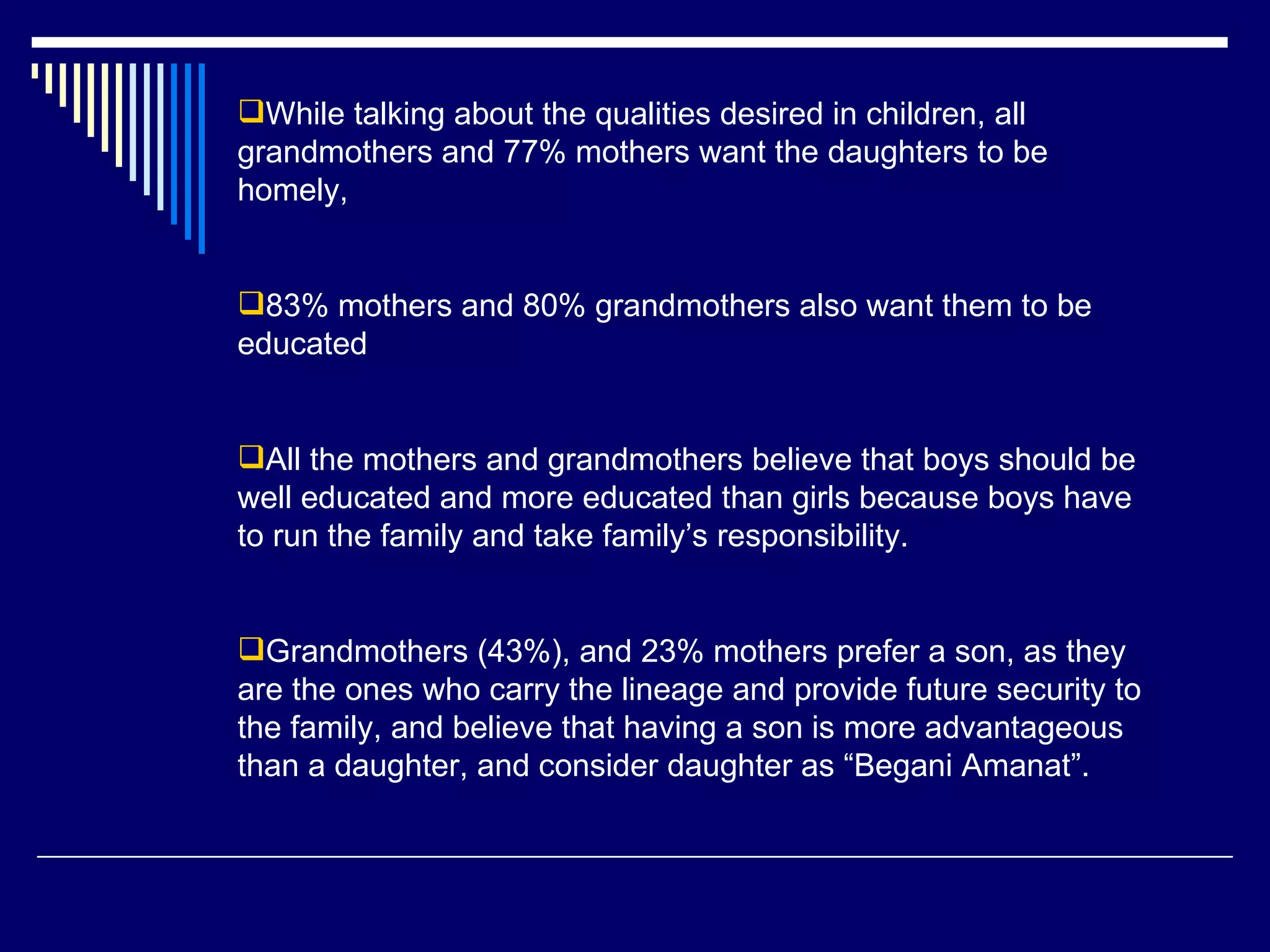
While talking about the qualities desired in children, all grandmothers and 77% mothers want the daughters to be homely,  83% mothers and 80% grandmothers also want them to be educated All the mothers and grandmothers believe that boys should be well educated and more educated than girls because boys have to run the family and take family’s responsibility.  Grandmothers (43%), and 23% mothers prefer a son, as they are the ones who carry the lineage and provide future security to the family, and believe that having a son is more advantageous than a daughter, and consider daughter as “Begani Amanat”.
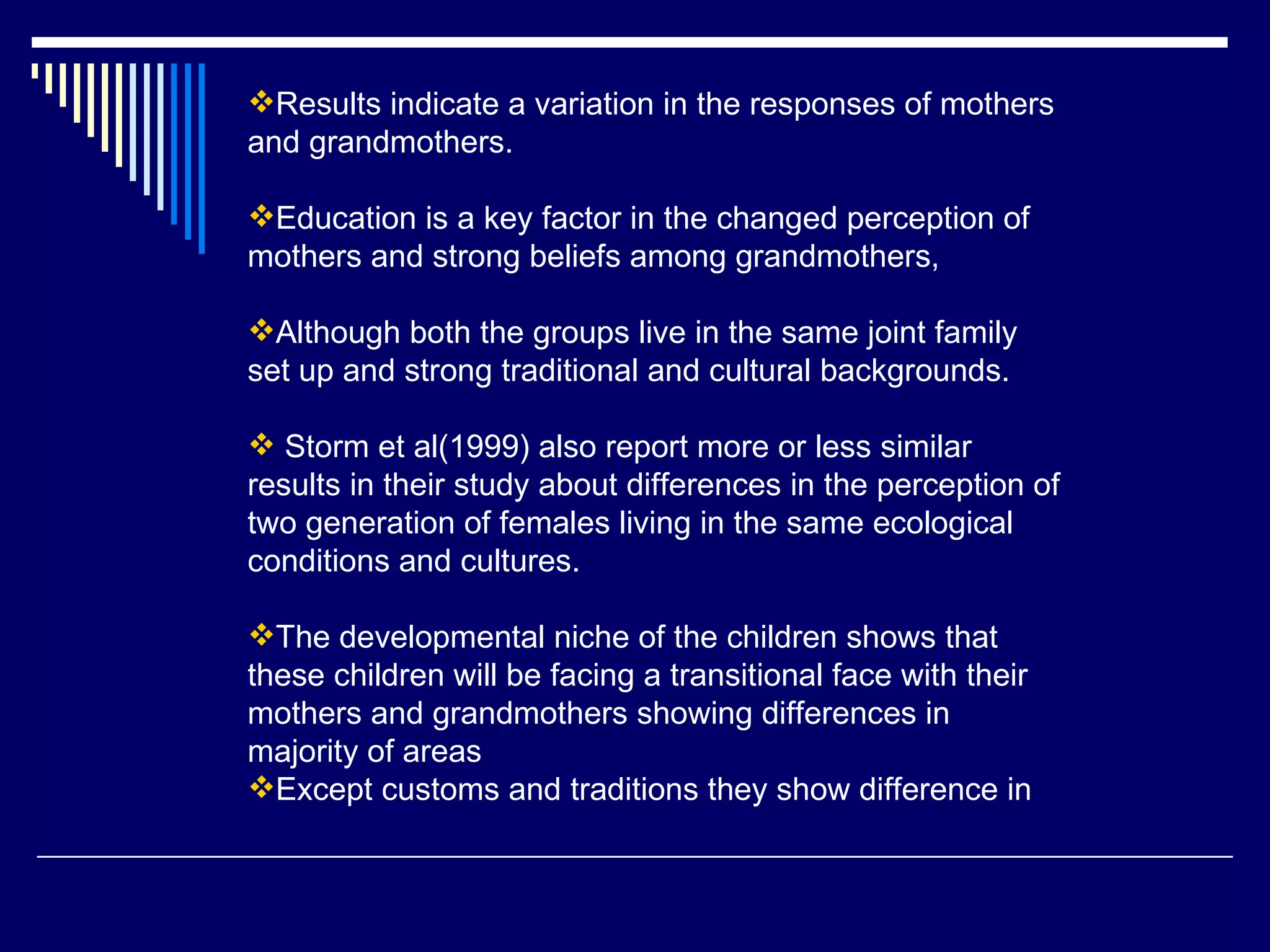
Results indicate a variation in the responses of mothers and grandmothers.  Education is a key factor in the changed perception of mothers and strong beliefs among grandmothers, Although both the groups live in the same joint family set up and strong traditional and cultural backgrounds. Storm et al(1999) also report more or less similar results in their study about differences in the perception of two generation of females living in the same ecological conditions and cultures. The developmental niche of the children shows that these children will be facing a transitional face with their mothers and grandmothers showing differences in majority of areas  Except customs and traditions they show difference in

Intergenerational Study Of Beliefs About Childcare Ppt

  • 1.
    Intergenerational study of beliefs about childcare among the Lobanas residing in rural areas of Jammu . Neeru Sharma,Reader Ruchira Sapru ,Research Scholar Ruchi Mahajan, Ex Student Deptt of Home Science, University of Jammu, Jammu neerusha@ gmail.com
  • 2.
    Abstract The presentresearch was conducted to study the intergenerational differences in beliefs regarding child care among the grandmothers and mothers belonging to Lobana community of Jammu.For this 30 grandmother-mother dyads were selected from the rural areas of R.S. Pura- Dablehar,Kirpind and Kalyana.The tools used for data collection were Interview schedule, rating scale, and observation. Results reveal a difference in the beliefs of grandmothers and mothers.Grandmothers, who were mostly illiterate , believed that the ideal place for delivery was home and the delivery should be supervised by a Dai (traditional midwife) whereas the mothers believed that a doctors consultation is must as they can handle any sort of complications. Mothers also consider colostrums as a must. Folk traditions and customs of child care are celebrated and the joint family system helps in maintaining this continuity. Some age old beliefs are not liked by the younger generation but they follow them with least modification. Both generations endorse the importance of the role of parents in shaping the child’s personality and future.Gender discrimination was prevalent in families with low educational status. Results of the parental belief survey revealed a significant difference between mothers and grandmothers over talking and telling story to the child and beliefs regarding spoiling the child.
  • 3.
    Introduction Parents playan important role in the all round development of children. They are the architects of the future from whom the child learns the lesson of socialization. Parental ideas about how to raise children in the society are generally derived from a large number of resources. Like our cultural system , each culture conveys message about appropriate child rearing techniques. These practices shape the developmental niche of the child. Such beliefs may come from personal experiences often reflecting the values of one’s own family. Family beliefs vary from culture to culture. According to religious scriptures the initial nature of the child depends upon the ideology of the parents and the family.
  • 4.
    Harkness and Super(1991)gave the concept of developmental niche which comprises of a Physical and social settings in which the child lives b Cultyrally regulated customs of child care and child learning c the psychology of the caretakers of the child The physical and social setting is important in shaping a child’s activity not only through the kinds of activities available but also through defining the activities of other people present. Customs are refered to here as techniques of protecting, teaching and socialising that are commonly used by members of the community and so thoroughly integrated into the larger culture that individual caretakers do not need to rationalise them or even give them conscious considerations. The psychology of the care takers , their beliefs, values and affective orientation organises not only their immediate behaviour towards childrebn but also many larger decisions such as which settings are most appropriate for children of a certain age or sex.
  • 5.
    OBJECTIVES: The objectivesof the present research are to study the beliefs of mothers and grandmothers regarding: Pregnancy, child birth and feeding practices Qualities desired in children Health and hygiene Folk traditions and practices Sources of parental beliefs for mothers Spoiling the child Floor freedom Discipline and control Talking and telling stories
  • 6.
    METHODOLOGY: Sample -The sample for the study comprised of 30 families of Lobana community of R.S.Pura Tehsil, Jammu(J&K). From these families both mothers (n=30) and grandmothers(n=30) were selected from each family. Purposive sampling technique was used for selection of the sample.
  • 7.
    Tool Interview schedule prepared to explore the beliefs of mothers and grandmothers about child rearing practices. The schedule was divided into two major heads, the background information and specific information.
  • 8.
    Tools- Modified ParentalBelief Survey as used by Manpreet Maan Singh(1992), Department of Human Development, Punjab Agriculture University , Ludhiana . The three-point scale is divided in to four subscales as follows: Beliefs regarding spoiling the child : Includes questions which unfold the beliefs about emotional; stimulation of the child. Beliefs regarding floor freedom : Includes statement which reveal as to what amount of floor freedom is good for the child for better development. Beliefs regarding discipline and control : Includes statements, which show how much of discipline and control is required or employed to control the child. Beliefs regarding talking and telling stories : Includes statements that emphasize the need of talking and telling stories to children.
  • 9.
    RESULTS AND DISCUSSIONIn the present study it was found that majority mothers were in the age group of 25-30 years and grandmothers were in the age group of 55-60years in majority. Most (37%) of the mothers has studied upto higher secondary whereas majority grandmothers(77%) were illiterates. Ninety three percent mothers were homemakers while quite a few were working as teachers.
  • 10.
    TABLE I: ANALYSISOF MODIFIED PARENTAL BELIEF SURVEY 40 40 20 12 12 6 36.6 63.3 - 11 19 - i) Lot of effect ii) Average effect iii) No effect BELIEFS REGARDING TALKING AND TELLING STORIES 40 60 12 18 73.3 26.6 - 28 8 - i) Strict discipline ii) Average iii) Less discipline BELIEFS REGARDING DISCIPLINE AND CONTROL 56.6 40 3.3 17 12 1 36.6 63.3 - 11 19 - i) Freedom should be given ii) Less freedom should be given iii) Freedom should not be given BELIEFS REGARDING FLOOR FREEDOM - 40 60 - 12 18 76.6 16.6 6.6 23 5 2 i) Will spoil the child ii) Average iii) Will not spoil the child % N=30 % N=30 GRANDMOTHERS MOTHERS Parental Beliefs BELIEF REGARDING SPOILING THE CHILD
  • 11.
    Parental belief survey: (table I) 77% mothers believe that too much affectionate behavior would spoil the children. 60% grandmothers believed that it would not spoil the children. 64% mothers were of the opinion that less floor freedom should be given to children and strict discipline (64%) needs to be employed to control the behavior of 57% grandmothers said more floor freedom should be given to children and instead of strict discipline most of the grandmothers think average disciplinary techniques should be used
  • 12.
    Mothers feel thattalking or telling stories to children has an average effect on their development 40% grandmothers are of the opinion that talking and telling stories to children has lot of effect on children. Parents design the child’s home environment hence the beliefs they hold exert a significant influence on children (Sharma, 1999). Brody et al (1999) also traced links among maternal child rearing efficiency beliefs, parenting practices and child’s psychosocial development. The influence of beliefs of grand parents has a significant impact on the development of children as well. Sharma, Sapru and Gupta(2004) in their study on maternal beliefs about child rearing found similar views where mother believe that more of responsive and affectionate behavior spoils children and favor an organized environment for children .
  • 13.
     2 significantat .05 level TABLE 2: PREGNANCY, CHILD BIRTH AND FEEDING PRACTICES *differences significant at 5% level 13 43.3 22 73.3 10 33.3 5 16.6 21 70 22 73.3 29 96.6 5 16.6 15 50 8 26.6 Avoid heavy work No sexual contact Avoid daily bath Avoid travel Staying indoors Activities avoided post delivery 8 26.6 - - 22 73.3 14 47 6 20 10 33.3 Government hospital Private hospital Home Ideal place for delivery* 4 13 - - - - 21 70 21 70 12 40 5 17 4 13 6 20 3 10 Yes, because… They are educated Diagnose the problem well Give better advice No, because… Recommend cesarean Fear to go to doctor Follow doctor’s advice and seek his opinion during pregnancy* - - - - 21 70 9 30 Yes No Should go for regular medical check ups and seek doctors advice N=30 % N=30 % GRANDMOTHERS MOTHERS RESPONSES
  • 14.
    TABLE 2 contd: PREGNANCY, CHILD BIRTH AND FEEDING PRACTICES *differences significant at 5% level 30 100 10 33.3 10 33.3 18 60 22 73.3 14 46.6 11 36.6 2 6.6 6 20 30 100 18 60 12 40 15 50 14 46.6 11 36.6 12 33.3 12 33.3 9 3 Egg yolk Rice water Dal ka pani Chicken soup Fruit juice Mashed banana Khichri Cerelac dalia Special weaning foods are.. 28 93.3 2 6.6 23 76.6 7 23.3 During 3-6 months During 6-8 months Weaning should be started in - - - - 22 73.3 8 26.6 Yes No Baby should be fed on colostrums - - - - - - - - 12 40 19 63.3 Immediately after birth 3-6 hours after birth 6-12 hours after birth Baby should be fed on breast milk….
  • 15.
    Majority mothers hadgot married in early 20’s, For them pregnancy and child birth along with child rearing was the best phase of their lives. While 74% mothers believe that doctor’s consultation is a must during pregnancy to avoid any complications, grandmothers in majority were however against this because they think doctors always recommend a cesarean section. 43% mothers favor doctor’s advice because they are professionals and grandmothers favored elders because they are experienced. Grand mothers and mothers shared more or less similar views about the fact that non-vegetarian food and papaya should be avoided during pregnancy, as they are considered hot foods. Most of the grandmothers and fair number of mothers(33%) believed that delivery should take place at home. 47% mothers considered government hospitals and 20% private hospitals as the ideal place for delivery under the supervision of qualified doctors.
  • 16.
    Majority in boththe groups favored eating non vegetarian food post delivery as it is healthy and nutritious It is their belief that mother digesting non vegetarian food indicates that new born baby is healthy. Sixty three percent mothers said they breast fed their baby 7-12 hours after birth Only 27% mothers fed their baby on colostrum as recommended by the doctor. On the contrary all the grandmothers believe that colostrums should not be fed to the new born, as it is hard to digest. Similar results were found by Singh and Laxminarayan(1997) in their study where infants were put on breast milk after 6 hours of birth. Majority mothers and grandmothers believe than child should be breast-fed till 1-2 years of age.
  • 17.
    Most of themothers and grandmothers believed that weaning food should be started after 3-6 months because after 3 months child is able to digest semi solid foods. Khan(1970), and Singh et al(1997) also found that most of the mothers started weaning the child when the child turns 6-12 months old. 73% mothers and 60% grandmothers further stated no specific method to stop breast feeding is applied rather the child gradually gives up breast milk as he/she grows Few were of the view that to stop breast feeding mothers should apply spices, saufi, neem paste on the breast.
  • 18.
    All grandmothers and23% mothers believe that mother and new born should be kept in isolation to avoid buri nazar.(evil eye). Swain(1978) found that the period when mother and new born are isolated from others for 40 days is beneficial as it reduces the chances of catching infection. Mothers and grandmothers share almost similar views on giving daily bath to baby in summers, and massaging the baby, which helps in the muscular development of baby. 53% mothers and 70% grand mothers believe that cradle cap is present in all children, although 26% mothers and 30% grandmothers think it is not present is every child. 33% grandmothers and 23% mothers believe that dryness of scalp is the reason behind it, whereas 23% grandmothers and 10% mothers think it is the dirt from within the skull that comes out. 37% mothers said they had no idea about the reason behind it.
  • 19.
    *  2significant at .05 level TABLE 3 : TRADITIONS AND PRACTICES 30 100 25 83.3 14 46.6 10 33.3 7 23.3 30 100 13 43.3 10 33.3 5 16.6 - - Black spot Iron bangle Black thread Raashia santisarian Measures taken to protect mother and baby from evil eye.. 22 73 8 27 18 60 12 40 Yes No Believe in evil eye 25 83.3 5 16.6 - - - - 17 56.6 6 20 4 16.6 3 10 Sugar and honey Jaggery and sugar Honey Jaggery and honey Prelacteal feed given as..* 30 100 27 90 28 93.3 3 10 30 100 27 90 22 73.3 3 10 Pag ceremony Paasha ceremony Kuldevi puja for a son Guhania Rituals performed after child birth N=30 % N=30 % GRANDMOTHERS MOTHERS RESPONSES
  • 20.
    Pag ceremony isperformed when the child is a 10-15 years old. 90% mother and grandmothers said that they also perform Pasha ceremony after the birth of the baby, in which the mother has to drink cardamom water for seven consecutive days. This water is prepared by the mother’s sister-in- law(jethani). On the seventh day the mother is then allowed to enter the kitchen, as she is considered pure and clean. Another ceremony named Guhania is performed which is more or less like Pasha, the only difference is that in Guhania ceremony mother is allowed to enter the kitchen on the 11th day. It was found that these practices are performed in the Lobana’s and they doe not want to change these practices. All the mothers and grand mothers believe that Gurathi should be given to the baby as prelacteal feed, and the one who feeds the baby with the Gurathi transfers his/her sanskars and wisdom to the child. Kishore and Garg (1999) found in their study that most of the mothers gave prelacteal feed to their infants in the form of sugar water, gur water or cow’s milk. Namkaran ceremony is performed only for sons in Lobana community and not for daughters.
  • 21.
    For protecting themother and the baby from evil eye, mothers and especially grandmothers insist upon tying black thread, wear iron bangle, black spot, on the forehead. Even those who do not believes in evil eye protect their baby by tying black thread, or putting black spot. Some of the mothers and grandmothers believe that it is not only others that caste evil eye sometimes even when the mothers say “ now the child is having adequate diet” affects the child’s diet the very next day. Taneja et al(1990) also found that majority mothers had superstitious beliefs regarding common illness that all superstitions are largely in joint families due to influence of older family members.
  • 22.
    While talking aboutthe qualities desired in children, all grandmothers and 77% mothers want the daughters to be homely, 83% mothers and 80% grandmothers also want them to be educated All the mothers and grandmothers believe that boys should be well educated and more educated than girls because boys have to run the family and take family’s responsibility. Grandmothers (43%), and 23% mothers prefer a son, as they are the ones who carry the lineage and provide future security to the family, and believe that having a son is more advantageous than a daughter, and consider daughter as “Begani Amanat”.
  • 23.
    Results indicate avariation in the responses of mothers and grandmothers. Education is a key factor in the changed perception of mothers and strong beliefs among grandmothers, Although both the groups live in the same joint family set up and strong traditional and cultural backgrounds. Storm et al(1999) also report more or less similar results in their study about differences in the perception of two generation of females living in the same ecological conditions and cultures. The developmental niche of the children shows that these children will be facing a transitional face with their mothers and grandmothers showing differences in majority of areas Except customs and traditions they show difference in