
Content ManagementContent Management
Rajendra Babu H
Asst. Professor
Dept. of Studies and Research in LIS
Tumkur University, Tumkur, India
hrajendra.babu@gmail.com
What is Content?
 Content is, in essence, any type or 'unit' of digital
information. It can be text, images, graphics, video,
sound, documents, records etc - or in other words -
anything that is likely to be managed in an electronic
format.
 Many enterprises turn to content technologies to drive
productivity around information.
 Content management applications collectively cover the
entire content life cycle: from content concept through
creation, to presentation, to retrieval, to archiving and
disposal. It is one of an enterprise's most valuable
corporate assets - its content.
Definitions of Content
 Something that is contained
 Something that is to be expressed through some medium, as
speech, writing, or any of various arts: a poetic form or any
other means.
 Content is the intellectual capital of an organization. Content
is the information contained in, for example, a product
brochure, a user manual, a web site, a Braille menu, or one of
many other Information + Product types.
 Content, stated as simply as possible, is information put to use.
 Information is put to use when it is packaged and presented
(published) for a specific purpose.
Where It (content)
Resides?
 Distributed across the intranet
 Individual desktops
 Division/ dept. , websites
 Company websites – external, internal
 Servers: Database, E-mail, Library and so on
What is Content Management?
Management of the
content is, by
combining rules,
process and/or
workflows in such
a way that its
electronic storage
is deemed to be
'managed' rather
than 'un-managed‘.
 Content creation, capturing,
publishing
organization and storage
 Search, retrieval and delivery
 Preservation
 Rights management
 Version control
 Administration
 Integration with external content
 Integration with other applications
Enterprise Content Management
Enterprise Content Management extends the concept to
interactive or transactional content used in a Web
Application, such as eCommerce, and to several related
management problems, such as document Management,
Records Management, and Digital Asset Management.
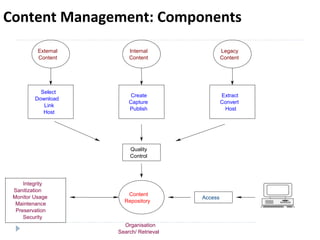
External
Content
Internal
Content
Legacy
Content
Select
Download
Link
Host
Create
Capture
Publish
Extract
Convert
Host
Quality
Control
Integrity
Sanitization
Monitor Usage
Maintenance
Preservation
Security
Access
Content
Repository
Organisation
Search/ Retrieval
Content Management: Components
Characteristics of CMSs and KMS's
 Daily work depends on granular snippets of knowledge.
 Knowledge has a shelf life.
 People don’t (and won’t) take the time to document what
they know.
 Expertise is distributed.
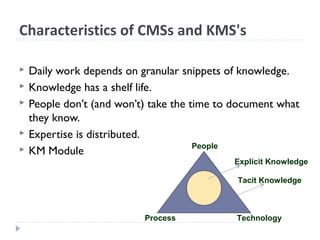
 KM Module
Explicit Knowledge
Process Technology
People
Tacit Knowledge
Why Content Management?
According to the Content Managers, the companies started their
content management projects with the following goals:
 Reuse of content
 Faster production of content and shorter time to web
 Integration of different internal information services /sources
 Improvement of enterprise and customer communication
 Integration of external information and content
 Use possibilities of multi channeling
Content management is an
inherently collaborative process.
It often consists of the
following basic roles and
responsibilities:
 Creator
 Editor
 Publisher
 Administrator
 Consumer, viewer
Content Types
 Structured/ unstructured
 Source documents with/ without metadata
 Metadata with/ without source document
 Free/ fee based
 Internal/ external
Unstructured Content
 e-mails,
 memos,
 notes from call centers and support operations,
 news,
 user groups,
 chats,
 reports,
 letters,
 surveys,
 white papers,
 marketing material,
 research, presentations; and
 Web pages.
Content: Formats
 Text (HTML,ASCII)
 Binary objects (software)
 Graphics
 Images
 WYSIWYG documents
 PDF
 Multimedia presentations
 Digital audio, video
 More bandwidth - more media rich content
Poor Content Management: Consequences
 Do not know what exists
 Do not know where something exists
 Lack of confidence in available data – enough contextual
information not available
 Too much of information
 Poor productivity
The management of unstructured
data is a very large problem.
According to projections from
Gartner, white- collar workers will
spend anywhere from 30% to 40%
of their time this year managing
documents, up from 20% of their
time.
How to resolve Unstructured Content Issues
 Raising Awareness
 The Need for Better Searches
 Adding Context to Search or social search
 Beyond Search: Classification and Taxonomy
 Content Intelligence:Toward a Solution
 Killer Applications for Content Intelligence
 Enterprise Metadata Taxonomy and Ontology
Management
 Information-Centric Infrastructures
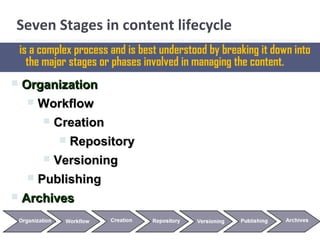
Seven Stages in content lifecycle
is a complex process and is best understood by breaking it down into
the major stages or phases involved in managing the content.
 OrganizationOrganization
 WorkflowWorkflow
 CreationCreation
 RepositoryRepository
 VersioningVersioning
 PublishingPublishing
 ArchivesArchives
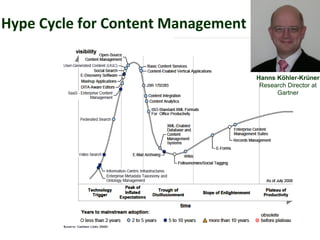
Hype Cycle for Content Management
Hanns Köhler-Krüner
Research Director at
Gartner
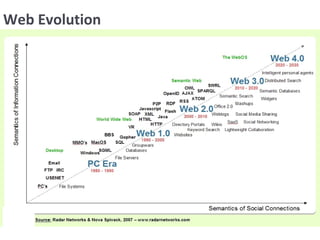
Web Evolution
Web Content Management
 In the WCMS marketplace, there are typically two types
of approach to managing the content areas within a web
page.
 The first – and one used by most of the solutions that
target the small to mid sized market place – is to create
‘unstructured content areas’ within a predefined
template that users can populate with information.
 The second – and one used by most of the mid to
enterprise level solutions – is to create ‘structured
content areas’ within a predefined template (often
referred to as content objects) that have predefined
locations within the overall page template – which users
can populate with content.
Trends in CM
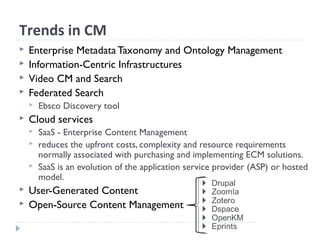
 Enterprise Metadata Taxonomy and Ontology Management
 Information-Centric Infrastructures
 Video CM and Search
 Federated Search
 Ebsco Discovery tool
 Cloud services
 SaaS - Enterprise Content Management
 reduces the upfront costs, complexity and resource requirements
normally associated with purchasing and implementing ECM solutions.
 SaaS is an evolution of the application service provider (ASP) or hosted
model.
 User-Generated Content
 Open-Source Content Management
Role of Libraries/Librarians
 Lead in using Internet, web surfing and Internet
training
 Extend the reach of library catalogs
 Increasingly sophisticated library websites
 Static to dynamic websites
 Subject gateways
 Bring external content to the intranet desktop
 Databases, e-journals, e-books, software, free content
Role of Libraries/Librarians
 Expertise in metadata handling
 Knowledge representation and organization
 Classification,Thesauri
 Increasingly called upon to participate/ handle internal
content management
 How Libraries can contribute?
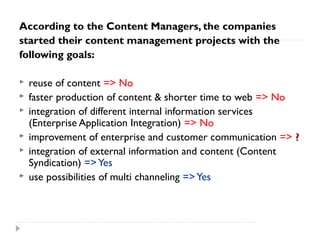
According to the Content Managers, the companies
started their content management projects with the
following goals:
 reuse of content => No
 faster production of content & shorter time to web => No
 integration of different internal information services
(Enterprise Application Integration) => No
 improvement of enterprise and customer communication => ??
 integration of external information and content (Content
Syndication) =>Yes
 use possibilities of multi channeling =>Yes
Content Management Challenges
 Develop a centrally controlled, distributed content
management system
 Integrate internal and external information
 Organize the content for efficient information access
 Provide context for searching and search results
 Bring uniformity and consistency in content
authoring, publishing and presentation
 Provide personalized services
Trends in Content Management
Content management (web based) markets at
$372 million in 2007 are anticipated to reach $2
billion by 2014. Market growth is a direct result of
movements to leverage the Internet as a channel.
According to market-research firm IDC, in the
case of the Web alone, more than 2 billion new
Web pages have been created since Internet is
been advent, with an additional 200 million
new pages being added every month, according
to market-research firm IDC.
Trends in Content Management Continued….
Merrill Lynch estimates that more than 85% of
all business information exists as unstructured
data.The management of unstructured data is
recognized as one of the major unsolved
problems in the information technology (IT)
industry, the main reason being that the tools
and techniques that have proved so successful
transforming structured data into business
intelligence and actionable information simply
don't work when it comes to unstructured data.
Trends in Content Management Continued….
To Conclude
Are “Content“-related problems solved?
According to Content Managers ...
 29% the Content Management Problems of the
companies are not solved
 36% the companies are working to solve the Content
Management Problems
 35% the Content Management Problems of the
companies are solved
ThanksThanks
Questions Please

Content management

  • 1.
    Content ManagementContent Management RajendraBabu H Asst. Professor Dept. of Studies and Research in LIS Tumkur University, Tumkur, India hrajendra.babu@gmail.com
  • 2.
    What is Content? Content is, in essence, any type or 'unit' of digital information. It can be text, images, graphics, video, sound, documents, records etc - or in other words - anything that is likely to be managed in an electronic format.  Many enterprises turn to content technologies to drive productivity around information.  Content management applications collectively cover the entire content life cycle: from content concept through creation, to presentation, to retrieval, to archiving and disposal. It is one of an enterprise's most valuable corporate assets - its content.
  • 3.
    Definitions of Content Something that is contained  Something that is to be expressed through some medium, as speech, writing, or any of various arts: a poetic form or any other means.  Content is the intellectual capital of an organization. Content is the information contained in, for example, a product brochure, a user manual, a web site, a Braille menu, or one of many other Information + Product types.  Content, stated as simply as possible, is information put to use.  Information is put to use when it is packaged and presented (published) for a specific purpose.
  • 4.
    Where It (content) Resides? Distributed across the intranet  Individual desktops  Division/ dept. , websites  Company websites – external, internal  Servers: Database, E-mail, Library and so on
  • 5.
    What is ContentManagement? Management of the content is, by combining rules, process and/or workflows in such a way that its electronic storage is deemed to be 'managed' rather than 'un-managed‘.  Content creation, capturing, publishing organization and storage  Search, retrieval and delivery  Preservation  Rights management  Version control  Administration  Integration with external content  Integration with other applications
  • 6.
    Enterprise Content Management EnterpriseContent Management extends the concept to interactive or transactional content used in a Web Application, such as eCommerce, and to several related management problems, such as document Management, Records Management, and Digital Asset Management.
  • 7.
  • 8.
    Characteristics of CMSsand KMS's  Daily work depends on granular snippets of knowledge.  Knowledge has a shelf life.  People don’t (and won’t) take the time to document what they know.  Expertise is distributed.  KM Module Explicit Knowledge Process Technology People Tacit Knowledge
  • 9.
    Why Content Management? Accordingto the Content Managers, the companies started their content management projects with the following goals:  Reuse of content  Faster production of content and shorter time to web  Integration of different internal information services /sources  Improvement of enterprise and customer communication  Integration of external information and content  Use possibilities of multi channeling
  • 10.
    Content management isan inherently collaborative process. It often consists of the following basic roles and responsibilities:  Creator  Editor  Publisher  Administrator  Consumer, viewer
  • 11.
    Content Types  Structured/unstructured  Source documents with/ without metadata  Metadata with/ without source document  Free/ fee based  Internal/ external
  • 12.
    Unstructured Content  e-mails, memos,  notes from call centers and support operations,  news,  user groups,  chats,  reports,  letters,  surveys,  white papers,  marketing material,  research, presentations; and  Web pages.
  • 13.
    Content: Formats  Text(HTML,ASCII)  Binary objects (software)  Graphics  Images  WYSIWYG documents  PDF  Multimedia presentations  Digital audio, video  More bandwidth - more media rich content
  • 14.
    Poor Content Management:Consequences  Do not know what exists  Do not know where something exists  Lack of confidence in available data – enough contextual information not available  Too much of information  Poor productivity
  • 15.
    The management ofunstructured data is a very large problem. According to projections from Gartner, white- collar workers will spend anywhere from 30% to 40% of their time this year managing documents, up from 20% of their time.
  • 16.
    How to resolveUnstructured Content Issues  Raising Awareness  The Need for Better Searches  Adding Context to Search or social search  Beyond Search: Classification and Taxonomy  Content Intelligence:Toward a Solution  Killer Applications for Content Intelligence  Enterprise Metadata Taxonomy and Ontology Management  Information-Centric Infrastructures
  • 17.
    Seven Stages incontent lifecycle is a complex process and is best understood by breaking it down into the major stages or phases involved in managing the content.  OrganizationOrganization  WorkflowWorkflow  CreationCreation  RepositoryRepository  VersioningVersioning  PublishingPublishing  ArchivesArchives
  • 18.
    Hype Cycle forContent Management Hanns Köhler-Krüner Research Director at Gartner
  • 19.
  • 20.
    Web Content Management In the WCMS marketplace, there are typically two types of approach to managing the content areas within a web page.  The first – and one used by most of the solutions that target the small to mid sized market place – is to create ‘unstructured content areas’ within a predefined template that users can populate with information.  The second – and one used by most of the mid to enterprise level solutions – is to create ‘structured content areas’ within a predefined template (often referred to as content objects) that have predefined locations within the overall page template – which users can populate with content.
  • 21.
    Trends in CM Enterprise Metadata Taxonomy and Ontology Management  Information-Centric Infrastructures  Video CM and Search  Federated Search  Ebsco Discovery tool  Cloud services  SaaS - Enterprise Content Management  reduces the upfront costs, complexity and resource requirements normally associated with purchasing and implementing ECM solutions.  SaaS is an evolution of the application service provider (ASP) or hosted model.  User-Generated Content  Open-Source Content Management
  • 22.
    Role of Libraries/Librarians Lead in using Internet, web surfing and Internet training  Extend the reach of library catalogs  Increasingly sophisticated library websites  Static to dynamic websites  Subject gateways  Bring external content to the intranet desktop  Databases, e-journals, e-books, software, free content
  • 23.
    Role of Libraries/Librarians Expertise in metadata handling  Knowledge representation and organization  Classification,Thesauri  Increasingly called upon to participate/ handle internal content management  How Libraries can contribute?
  • 24.
    According to theContent Managers, the companies started their content management projects with the following goals:  reuse of content => No  faster production of content & shorter time to web => No  integration of different internal information services (Enterprise Application Integration) => No  improvement of enterprise and customer communication => ??  integration of external information and content (Content Syndication) =>Yes  use possibilities of multi channeling =>Yes
  • 25.
    Content Management Challenges Develop a centrally controlled, distributed content management system  Integrate internal and external information  Organize the content for efficient information access  Provide context for searching and search results  Bring uniformity and consistency in content authoring, publishing and presentation  Provide personalized services
  • 26.
    Trends in ContentManagement Content management (web based) markets at $372 million in 2007 are anticipated to reach $2 billion by 2014. Market growth is a direct result of movements to leverage the Internet as a channel.
  • 27.
    According to market-researchfirm IDC, in the case of the Web alone, more than 2 billion new Web pages have been created since Internet is been advent, with an additional 200 million new pages being added every month, according to market-research firm IDC. Trends in Content Management Continued….
  • 28.
    Merrill Lynch estimatesthat more than 85% of all business information exists as unstructured data.The management of unstructured data is recognized as one of the major unsolved problems in the information technology (IT) industry, the main reason being that the tools and techniques that have proved so successful transforming structured data into business intelligence and actionable information simply don't work when it comes to unstructured data. Trends in Content Management Continued….
  • 29.
    To Conclude Are “Content“-relatedproblems solved? According to Content Managers ...  29% the Content Management Problems of the companies are not solved  36% the companies are working to solve the Content Management Problems  35% the Content Management Problems of the companies are solved
  • 30.