1
By: Gul-e-Rana
R. No: 03
M.Phil
DLIS Peshawar
Contents
• Basic concepts of information management
• History of Information Management
• Meaning & definition of IM
• Importance of IM
• Information Management Life cycle
• Model of IM
• Tools of IM
• Goal of Information Management
• Challenges of IM
3
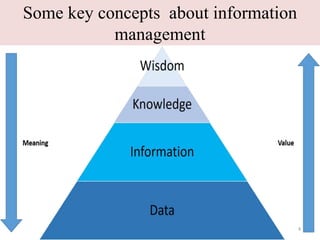
Some key concepts about information
management
4
• Unorganized and unprocessed facts, raw numbers,
figures, images, words, sounds, derived from
observations or measurements.
Bonaventura (1997, p.83) notes that data are not
knowledge. Data are the raw material for knowledge
creation. There is no inherent meaning in data. Data is
raw material for information.
5
Who creates data?
• Individuals
• Businesses
6
Wikipedia defines information as “that which
informs — the answer to a question of some kind.
It is thus related to data and knowledge, as data
represents values attributed to parameters, and
knowledge signifies understanding of real things
or abstract concepts.”
7
Where information is?
• Information seems to be everywhere. We talk of its
being encoded in the genes… disseminated by media
of communication… exchanged in conversation…
contained in all sorts of things… Libraries are
overflowing with it, institutions are bogged down by
it, and people are overloaded with it … yet, no one
seems to know exactly what & where information is”
( Case, 2002).
8
9
Knowledge
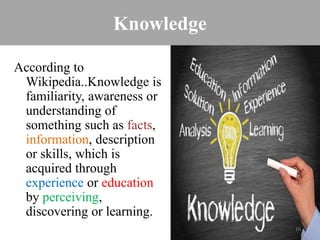
According to
Wikipedia..Knowledge is
familiarity, awareness or
understanding of
something such as facts,
information, description
or skills, which is
acquired through
experience or education
by perceiving,
discovering or learning.
10
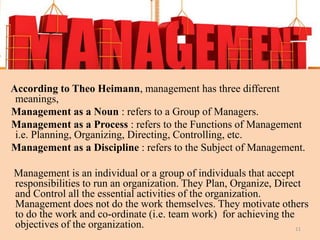
According to Theo Heimann, management has three different
meanings,
Management as a Noun : refers to a Group of Managers.
Management as a Process : refers to the Functions of Management
i.e. Planning, Organizing, Directing, Controlling, etc.
Management as a Discipline : refers to the Subject of Management.
Management is an individual or a group of individuals that accept
responsibilities to run an organization. They Plan, Organize, Direct
and Control all the essential activities of the organization.
Management does not do the work themselves. They motivate others
to do the work and co-ordinate (i.e. team work) for achieving the
objectives of the organization. 11
Function of Management
Management brings together all five Ms i.e.
Men, Money, Machines,
Materials, Methods and Markets.
They use these resources for achieving the objectives
of the organization such as maximum sales and
profits, business expansion, etc.
12
Brief History
Throughout the 1970s this was largely limited to files, file
maintenance, and the Life cycle management of paper-based files,
other media and records. With the proliferation of information
technology starting in the 1970s, the job of information management
took on a new light, and also began to include the field of data
maintenance.
As information storage shifted to electronic means, this became more
and more difficult. By the late 1990s when information was
regularly disseminated across computer networks and by other
electronic means, network managers, in a sense, became information
managers. Those individuals found themselves tasked with
increasingly complex tasks, hardware and software.
With the latest tools available, information management has become a
powerful resource and a large expense for many organizations.
13
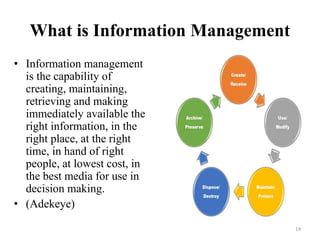
What is Information Management
• Information management
is the capability of
creating, maintaining,
retrieving and making
immediately available the
right information, in the
right place, at the right
time, in hand of right
people, at lowest cost, in
the best media for use in
decision making.
• (Adekeye)
14
Definitions
According to Wikipedia, Information management (IM) is the
collection and management of information from one or more
sources and the distribution of that information to one or more
audiences.
According to Martin White, IM involves data processing,
automation activities, systems analysis, information services,
management services, the new skills and techniques needed by the
information managers to deal with the IT and strategies for
developing a corporate information plan.
15
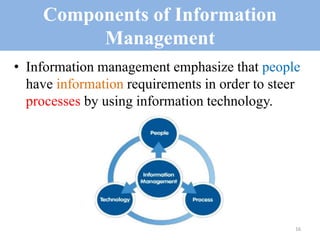
Components of Information
Management
• Information management emphasize that people
have information requirements in order to steer
processes by using information technology.
16
IM in terms of Technology
In terms of technology, information
management encompasses systems such as:
• web content management (WCM)
• document management (DM)
• records management (RM)
• digital asset management (DAM)
• learning management systems (LM)
• learning content management systems (LCM)
17
Why Information Storage?
“Digital universe – The Information Explosion”
• 21st Century is information era
• Information is being created at ever increasing rate
• Information has become critical for success
We live in an on-command, on-demand world
Example: Social networking sites, e-mails, video and
photo sharing website, online shopping,
search engines etc
18
Importance of IM
Managing information is important to an organization
because it increased knowledge, decreased
inefficiency, and helps in better creation and
implementation of action plans. A successful
management of information, is almost guarantee for
success of an organization.
Reasons are describe in three categories;
1) Managing information saves money
2) Managing information improve your economy
3) Managing information keeps you out of trouble
19
20
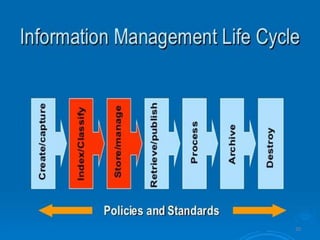
The information life cycle
The information lifecycle is the change in the
value of information over time. When data is
first created, it often has the highest value and
is used frequently. As data ages, it is accessed
less frequently and is of less value to the
organization. Understanding the information
life cycle helps to deploy appropriate storage
infrastructure, according to the changing value
of information.
21
Information Management Model
• Venkatraman (a strong advocate of this transition and
transformation, proffered a simple arrangement of ideas
that succinctly brought together the managements of
data, information, and knowledge argued that:
• Data that is maintained in IT infrastructure has to
be interpreted in order to render information.
• The information in our information systems has to
be understood in order to emerge as knowledge.
• Knowledge allows managers to take effective decisions.
• Effective decisions have to lead to appropriate actions.
• Appropriate actions are expected to deliver meaningful
results. 22
Cont…
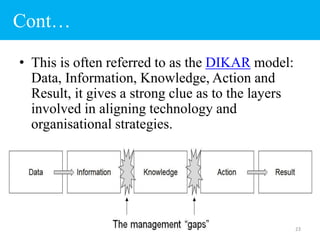
• This is often referred to as the DIKAR model:
Data, Information, Knowledge, Action and
Result, it gives a strong clue as to the layers
involved in aligning technology and
organisational strategies.
23
Tools of IM
• Some of the tools of information management are those
derived from the fields that have contributed to its
development; for example,
classification and information retrieval from
librarianship and information science;
database design and development from computer
science;
the document life cycle from records management;
communication audits from organizational psychology;
and cost-benefit analysis and value assessment from
business management.
24
Information Audit
• The idea of the information audit is derived from
financial audits in accounting, which, as Ellis et al. (1993)
note, are generally 'compliance‘ audits, undertaken to
ensure that the organization is adhering to proper fiscal
and legal standards in its financial management.
Information audits take more the character of 'advisory'
audits, which are 'more concerned with informing users of
existing systems and practices and with assessing the
appropriateness of existing systems, standards and
practices to the organization's goal or objectives'.
25
Information Mapping
A system of principles and procedures for identifying categorizing
interrelating, sequencing, and presenting graphically information
required for learning and reference.
More specifically, Information Mapping is a method for written
communication as it is currently presented in textbooks, technical
manuals, and various kinds of paper documents for complex
projects. Information Mapping improves current methods for
doing the learning and reference work itself, preparing
learning/reference materials, and maintaining/updating such
materials.
26
Communication Audit
The communication audit predates information management
as a tool for the investigation of communication in the field of
organization theory. The role of communications audits was
explored by Booth (1986, 1988) and, more recently, by Potter
(1990), who categorized communication audits as being used
to measure the effectiveness of introducing IT in an
organization, interpersonal communications, communication
between management and employees, the effectiveness of
organizational communications, or public relations activity.
Clearly, given the increasing interest in various aspects of
quality management and quality assurance, the
communications audit has a significant role in ensuring that
communication between information services and their
customers is fully effective. 27
Goals of IM
1. Supply work, business and consumption processes with
information
2. Improve and speed up business, work and consumption
processes
3. Create and maintain competitive advantage through new,
IT-based work and business processes
4. Efficient use of organization’s information assets
5. Protect Information in accordance with legislation and
policy requirement
6. Reduce unnecessary complexity of information processing
systems
28
Challenges in IM
■ Exploding digital universe:
The rate of information growth is increasing exponentially.
Duplication of data to ensure high availability and repurposing
has also contributed to the increase of information growth.
■ Increasing dependency on information:
The strategic use of information plays an important role in
determining the success of a business and provides competitive
advantages in the marketplace.
■ Changing value of information:
Information that is valuable today may become less important
tomorrow. The value of information often changes over time
29
Conclusion
Studying Information Management trough different
angles, finally it is concluded that in this modern era of
information explosion Information Management is
necessary. User of the modern world need more and
more information within no time, which is able only if
Information are managed.
Information Management is the only way to provide
Right information
To the right person
At the right time
30
References
• https://en.wikipedia.org/wiki/Information_management
• http://www.steptwo.com.au/papers/kmc_effectiveim/
• Rao, R.I.K., (1999). Information management: scope,
definition, challenges & issues, DRTC Workshop on
information management.
• Caudle, S.L. (1988) 'IRM: a look backward and forward at the
federal level', Information Management Review 3(4), 9-25.
31
ANY QUESTION?
32
33

Information management

  • 1.
  • 2.
    By: Gul-e-Rana R. No:03 M.Phil DLIS Peshawar
  • 3.
    Contents • Basic conceptsof information management • History of Information Management • Meaning & definition of IM • Importance of IM • Information Management Life cycle • Model of IM • Tools of IM • Goal of Information Management • Challenges of IM 3
  • 4.
    Some key conceptsabout information management 4
  • 5.
    • Unorganized andunprocessed facts, raw numbers, figures, images, words, sounds, derived from observations or measurements. Bonaventura (1997, p.83) notes that data are not knowledge. Data are the raw material for knowledge creation. There is no inherent meaning in data. Data is raw material for information. 5
  • 6.
    Who creates data? •Individuals • Businesses 6
  • 7.
    Wikipedia defines informationas “that which informs — the answer to a question of some kind. It is thus related to data and knowledge, as data represents values attributed to parameters, and knowledge signifies understanding of real things or abstract concepts.” 7
  • 8.
    Where information is? •Information seems to be everywhere. We talk of its being encoded in the genes… disseminated by media of communication… exchanged in conversation… contained in all sorts of things… Libraries are overflowing with it, institutions are bogged down by it, and people are overloaded with it … yet, no one seems to know exactly what & where information is” ( Case, 2002). 8
  • 9.
  • 10.
    Knowledge According to Wikipedia..Knowledge is familiarity,awareness or understanding of something such as facts, information, description or skills, which is acquired through experience or education by perceiving, discovering or learning. 10
  • 11.
    According to TheoHeimann, management has three different meanings, Management as a Noun : refers to a Group of Managers. Management as a Process : refers to the Functions of Management i.e. Planning, Organizing, Directing, Controlling, etc. Management as a Discipline : refers to the Subject of Management. Management is an individual or a group of individuals that accept responsibilities to run an organization. They Plan, Organize, Direct and Control all the essential activities of the organization. Management does not do the work themselves. They motivate others to do the work and co-ordinate (i.e. team work) for achieving the objectives of the organization. 11
  • 12.
    Function of Management Managementbrings together all five Ms i.e. Men, Money, Machines, Materials, Methods and Markets. They use these resources for achieving the objectives of the organization such as maximum sales and profits, business expansion, etc. 12
  • 13.
    Brief History Throughout the1970s this was largely limited to files, file maintenance, and the Life cycle management of paper-based files, other media and records. With the proliferation of information technology starting in the 1970s, the job of information management took on a new light, and also began to include the field of data maintenance. As information storage shifted to electronic means, this became more and more difficult. By the late 1990s when information was regularly disseminated across computer networks and by other electronic means, network managers, in a sense, became information managers. Those individuals found themselves tasked with increasingly complex tasks, hardware and software. With the latest tools available, information management has become a powerful resource and a large expense for many organizations. 13
  • 14.
    What is InformationManagement • Information management is the capability of creating, maintaining, retrieving and making immediately available the right information, in the right place, at the right time, in hand of right people, at lowest cost, in the best media for use in decision making. • (Adekeye) 14
  • 15.
    Definitions According to Wikipedia,Information management (IM) is the collection and management of information from one or more sources and the distribution of that information to one or more audiences. According to Martin White, IM involves data processing, automation activities, systems analysis, information services, management services, the new skills and techniques needed by the information managers to deal with the IT and strategies for developing a corporate information plan. 15
  • 16.
    Components of Information Management •Information management emphasize that people have information requirements in order to steer processes by using information technology. 16
  • 17.
    IM in termsof Technology In terms of technology, information management encompasses systems such as: • web content management (WCM) • document management (DM) • records management (RM) • digital asset management (DAM) • learning management systems (LM) • learning content management systems (LCM) 17
  • 18.
    Why Information Storage? “Digitaluniverse – The Information Explosion” • 21st Century is information era • Information is being created at ever increasing rate • Information has become critical for success We live in an on-command, on-demand world Example: Social networking sites, e-mails, video and photo sharing website, online shopping, search engines etc 18
  • 19.
    Importance of IM Managinginformation is important to an organization because it increased knowledge, decreased inefficiency, and helps in better creation and implementation of action plans. A successful management of information, is almost guarantee for success of an organization. Reasons are describe in three categories; 1) Managing information saves money 2) Managing information improve your economy 3) Managing information keeps you out of trouble 19
  • 20.
  • 21.
    The information lifecycle The information lifecycle is the change in the value of information over time. When data is first created, it often has the highest value and is used frequently. As data ages, it is accessed less frequently and is of less value to the organization. Understanding the information life cycle helps to deploy appropriate storage infrastructure, according to the changing value of information. 21
  • 22.
    Information Management Model •Venkatraman (a strong advocate of this transition and transformation, proffered a simple arrangement of ideas that succinctly brought together the managements of data, information, and knowledge argued that: • Data that is maintained in IT infrastructure has to be interpreted in order to render information. • The information in our information systems has to be understood in order to emerge as knowledge. • Knowledge allows managers to take effective decisions. • Effective decisions have to lead to appropriate actions. • Appropriate actions are expected to deliver meaningful results. 22
  • 23.
    Cont… • This isoften referred to as the DIKAR model: Data, Information, Knowledge, Action and Result, it gives a strong clue as to the layers involved in aligning technology and organisational strategies. 23
  • 24.
    Tools of IM •Some of the tools of information management are those derived from the fields that have contributed to its development; for example, classification and information retrieval from librarianship and information science; database design and development from computer science; the document life cycle from records management; communication audits from organizational psychology; and cost-benefit analysis and value assessment from business management. 24
  • 25.
    Information Audit • Theidea of the information audit is derived from financial audits in accounting, which, as Ellis et al. (1993) note, are generally 'compliance‘ audits, undertaken to ensure that the organization is adhering to proper fiscal and legal standards in its financial management. Information audits take more the character of 'advisory' audits, which are 'more concerned with informing users of existing systems and practices and with assessing the appropriateness of existing systems, standards and practices to the organization's goal or objectives'. 25
  • 26.
    Information Mapping A systemof principles and procedures for identifying categorizing interrelating, sequencing, and presenting graphically information required for learning and reference. More specifically, Information Mapping is a method for written communication as it is currently presented in textbooks, technical manuals, and various kinds of paper documents for complex projects. Information Mapping improves current methods for doing the learning and reference work itself, preparing learning/reference materials, and maintaining/updating such materials. 26
  • 27.
    Communication Audit The communicationaudit predates information management as a tool for the investigation of communication in the field of organization theory. The role of communications audits was explored by Booth (1986, 1988) and, more recently, by Potter (1990), who categorized communication audits as being used to measure the effectiveness of introducing IT in an organization, interpersonal communications, communication between management and employees, the effectiveness of organizational communications, or public relations activity. Clearly, given the increasing interest in various aspects of quality management and quality assurance, the communications audit has a significant role in ensuring that communication between information services and their customers is fully effective. 27
  • 28.
    Goals of IM 1.Supply work, business and consumption processes with information 2. Improve and speed up business, work and consumption processes 3. Create and maintain competitive advantage through new, IT-based work and business processes 4. Efficient use of organization’s information assets 5. Protect Information in accordance with legislation and policy requirement 6. Reduce unnecessary complexity of information processing systems 28
  • 29.
    Challenges in IM ■Exploding digital universe: The rate of information growth is increasing exponentially. Duplication of data to ensure high availability and repurposing has also contributed to the increase of information growth. ■ Increasing dependency on information: The strategic use of information plays an important role in determining the success of a business and provides competitive advantages in the marketplace. ■ Changing value of information: Information that is valuable today may become less important tomorrow. The value of information often changes over time 29
  • 30.
    Conclusion Studying Information Managementtrough different angles, finally it is concluded that in this modern era of information explosion Information Management is necessary. User of the modern world need more and more information within no time, which is able only if Information are managed. Information Management is the only way to provide Right information To the right person At the right time 30
  • 31.
    References • https://en.wikipedia.org/wiki/Information_management • http://www.steptwo.com.au/papers/kmc_effectiveim/ •Rao, R.I.K., (1999). Information management: scope, definition, challenges & issues, DRTC Workshop on information management. • Caudle, S.L. (1988) 'IRM: a look backward and forward at the federal level', Information Management Review 3(4), 9-25. 31
  • 32.
  • 33.