From Enterprise Content Management to Enterprise Information Management Dr. Ulrich Kampffmeyer FUJITSU Channel Partner Conference Marrakech, February 12, 2009 P R O J E C T  C O N S U L T Unternehmensberatung  Dr.  Ulrich  Kampffmeyer  GmbH Edited handout version – animation dissolved Animated PPS version:  www.PROJECT-CONSULT.net/files/20090212_ECM_to_EIM_Fujitsu_Marrakech_3_Kff_Show.pps
Welcome to the digital world: C ontent is King Enterprise  C ontent Management:  Pre-condition for effective information management The ‘ C ’ in ECM:  Market drivers for enterprise content management The Future:  From ECM to EIM A GENDA
Welcome to the digital world 0100101010 0111100011 1010101011 1010001110 1000111010 Content is king!
INFORMATION OVERFLOW   We suffer from information overflow,  and must laboriously search out the valuable, important information. The systematic management of exponentially growing information volumes is ever more important.
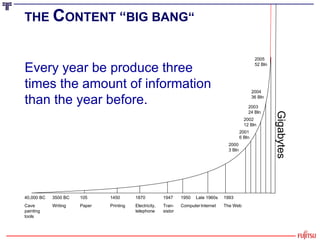
THE  C ONTENT  “ BIG BANG“   40,000 BC Cave painting tools 105 Paper 3500 BC Writing 1947 Tran-sistor 1950 Computer Late 1960s Internet 1870 Electricity, telephone 1450 Printing 1993 The Web 2004 36 B l n 2003 24 B l n 2002 12 B l n 2001 6 Bln 2000 3 Bln 2005 52 B l n Gigabytes GigaByte TeraByte PetaByte ExaByte
THE  C ONTENT  “ BIG BANG“   40,000 BC Cave painting tools 105 Paper 3500 BC Writing 1947 Tran-sistor 1950 Computer Late 1960s Internet 1870 Electricity, telephone 1450 Printing 1993 The Web 2004 36 B l n 2003 24 B l n 2002 12 B l n 2001 6 Bln 2000 3 Bln 2005 52 B l n Gigabytes Every year be produce three times the amount of information than the year before.
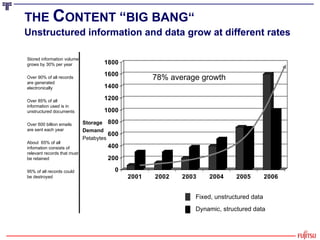
THE  C ONTENT  “ BIG BANG“   Unstructured information and data grow at different rates 78% average growth Fixed, unstructured data Dynamic, structured data Storage Demand Petabytes Stored information volume grows by 30% per year Over 90% of all records are generated electronically Over 85% of all information used is in unstructured documents Over 600 billion emails are sent each year About  65% of all infomation consists of relevant records that must be retained 95% of all records could be destroyed
THE  C ONTENT  “ BIG BANG“   Unstructured information and data grow at different rates Email, videos, audio, scanned documents, multi media objects and other unstructured information generates the majority of data. 78% average growth Fixed, unstructured data Dynamic, structured data Storage Demand Petabytes Stored information volume grows by 30% per year Over 90% of all records are generated electronically Over 85% of all information used is in unstructured documents Over 600 billion emails are sent each year About  65% of all infomation consists of relevant records that must be retained 95% of all records could be destroyed
THE  C ONTENT  “ BIG BANG“   Unstructured information and data grow at different rates Email, videos, audio, scanned documents, multi media objects and other unstructured information generates the majority of data Drowned by information, we are searching for knowledge. 78% average growth Fixed, unstructured data Dynamic, structured data Storage Demand Petabytes Stored information volume grows by 30% per year Over 90% of all records are generated electronically Over 85% of all information used is in unstructured documents Over 600 billion emails are sent each year About  65% of all infomation consists of relevant records that must be retained 95% of all records could be destroyed
C HARACTERS, DATA, INFORMATION, KNOWLEDGE THE PYRAMID Relationships between the levels  of the definition hierarchy Mechanisms of the currency market Conversion rate €  1 = US$ 1.30 1.30 1, 0, 3 and . Linkage Syntax Characters Data Information Knowledge Examples Contexts Context Character set
C HARACTERS, DATA, INFORMATION, KNOWLEDGE IT IS ONLY INFORMATION Records Documents Media Assets C ontent Characters Data Information Knowledge
C ONTENT Data, Information, Records, Knowledge a.s.o. Content stands for any electronic content. Includes “Data” and “Metadata” as well as records, documents, media assets, images and web pages. Content is an economic resource. Defined by its business value and its contents,  content may become a record. But how to manage content effectivly?
Enterprise  C ontent Management Pre-condition for effective information management
DEFINITION &  C ONCEPTS
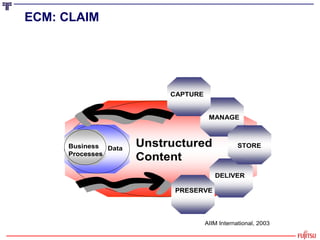
AIIM International, 2003 ECM:  C LAIM   Unstructured Content Data Business Processes STORE MANAGE DELIVER PRESERVE CAPTURE
ECM: DEFINITION   “ Enterprise  C ontent Management is the  Technologies   used to  C apture, Manage, Store, Preserve, and Deliver  Content and Documents related to Organizational Processes.” AIIM  Association for Information and Image Management International, 2006
ECM: DEFINITION   “ Enterprise  C ontent Management is the Strategies, Methods and Tools used to  C apture, Manage, Store, Preserve, and Deliver  Content and Documents related to Organizational Processes.” AIIM  Association for Information and Image Management International, 2008
STRATEGY & VISION   not a single product! Enterprise  C ontent Management is a  Strategy  or  Vision ,
ENTERPRISE  C ONTENT  MANAGEMENT –  INFRASTRUCTURE ERP Web Content Management Doc Mgmt Imaging Domino Exchange RDMS File System Workflow Collaboration Data Warehousing Mining EAI E-Business AP/AR RM/A CRM HRM Enterprise Enterprise Applications Applications Enterprise Enterprise Content Content Management Management Infrastructure Infrastructure Integration Integration
ECM  C ONCEPT #1   ERP Web Content Management Doc Mgmt Imaging Domino Exchange RDMS File System Workflow Collaboration Data Warehousing Mining EAI E-Business AP/AR RM/A CRM HRM Middleware Enterprise Enterprise Applications Applications Enterprise Enterprise Content Content Management Management Infrastructure Infrastructure Integration Integration
ECM  C ONCEPT #2   ERP Web Content Management Doc Mgmt Imaging Domino Exchange RDMS File System Workflow Collaboration Data Warehousing Mining EAI E-Business AP/AR RM/A CRM HRM Independent services  for all applications Enterprise Enterprise Applications Applications Enterprise Enterprise Content Content Management Management Infrastructure Infrastructure Integration Integration
ECM  C ONCEPT #3   ERP Web Content Management Doc Mgmt Imaging Domino Exchange RDMS File System Workflow Collaboration Data Warehousing Mining EAI E-Business AP/AR RM/A CRM HRM Uniform, federated enterprise repository for all types of information Enterprise Enterprise Applications Applications Enterprise Enterprise Content Content Management Management Infrastructure Infrastructure Integration Integration
ECM  C OMPONENTS
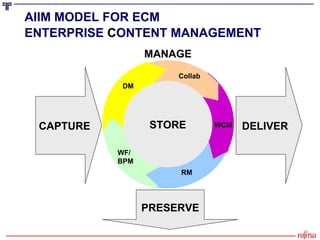
AIIM MODEL FOR ECM   ENTERPRISE  C ONTENT MANAGEMENT CAPTURE PRESERVE DELIVER STORE MANAGE STORE WCM RM WF/BPM DM Collab
C APTURE   Input Barcode COLD/ERM  E-Billing Aggregation Financial Applications XML Forms Processing E-Forms/Web-Forms ERP Application created OMR Microfilm ICR Rich Media HCR Form OCR Office Documents Indexing Input Designs Categorization Recognition Human created
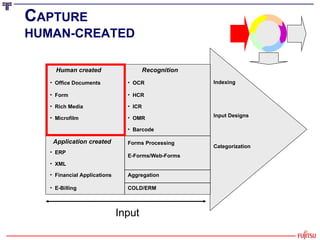
C APTURE HUMAN-CREATED   Input Barcode COLD/ERM  E-Billing Aggregation Financial Applications XML Forms Processing E-Forms/Web-Forms ERP Application created OMR Microfilm ICR Rich Media HCR Form OCR Office Documents Indexing Input Designs Categorization Recognition Human created
C APTURE   APPLICATION-CREATED Input Barcode COLD/ERM  E-Billing Aggregation Financial Applications XML Forms Processing E-Forms/Web-Forms ERP Application created OMR Microfilm ICR Rich Media HCR Form OCR Office Documents Indexing Input Designs Categorization Recognition Human created
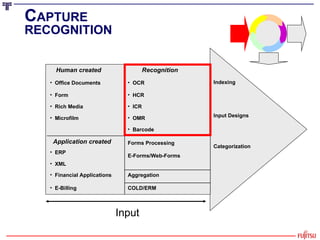
C APTURE RECOGNITION  Input Barcode COLD/ERM  E-Billing Aggregation Financial Applications XML Forms Processing E-Forms/Web-Forms ERP Application created OMR Microfilm ICR Rich Media HCR Form OCR Office Documents Indexing Input Designs Categorization Recognition Human created
C APTURE   FORMS PROCESSING Input Barcode COLD/ERM  E-Billing Aggregation Financial Applications XML Forms Processing E-Forms/Web-Forms ERP Application created OMR Microfilm ICR Rich Media HCR Form OCR Office Documents Indexing Input Designs Categorization Recognition Human created
C APTURE   COLD Input Barcode COLD/ERM  E-Billing Aggregation Financial Applications XML Forms Processing E-Forms/Web-Forms ERP Application created OMR Microfilm ICR Rich Media HCR Form OCR Office Documents Indexing Input Designs Categorization Recognition Human created
C APTURE   INDEXING & CLASSIFICATION Input Barcode COLD/ERM  E-Billing Aggregation Financial Applications XML Forms Processing E-Forms/Web-Forms ERP Application created OMR Microfilm ICR Rich Media HCR Form OCR Office Documents Indexing Input Designs Categorization Recognition Human created
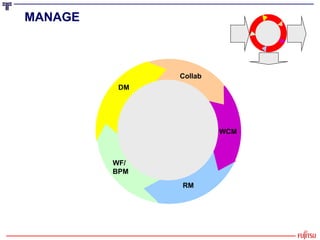
MANAGE   WCM RM WF/ BPM DM Collab
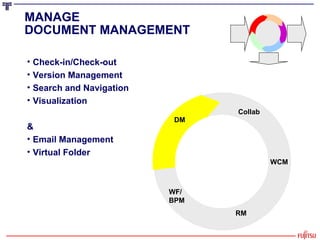
MANAGE   DOCUMENT MANAGEMENT Check-in/Check-out Version Management Search and Navigation Visualization & Email Management Virtual Folder STORE WCM RM WF/BPM DM Collab
Collaborative authoring  Knowledge bases  Whiteboards  Video conferencing Consolidation of  information & Web 2.0 Enterprise 2.0 MANAGE   C OLLABORATION STORE WCM RM WF/BPM DM Collab
MANAGE   WEB  C ONTENT MANAGEMENT Content creation Publication process Conversion Security Web site visualization & DAM Digital Asset Management Web 2.0 STORE WCM RM WF/BPM DM Collab
MANAGE   RECORDS MANAGEMENT Filing structures and file plans Thesaurus Retention periods Metadata Archive management & MoReq2 ICA-ISDF STORE WCM RM WF/BPM DM Collab
MANAGE   BUSINESS PROCESS MANAGEMENT Process and structure organization Process design Visualization of processes Routing Monitoring Parallel and  sequential processing Reminders, deadlines Checking Logging & BI Business Intelligence STORE WCM RM WF/BPM DM Collab
STORE   Repositories Library Services Technologies
STORE   File Systems Content Management   Systems Databases  Data Warehouses   Repositories
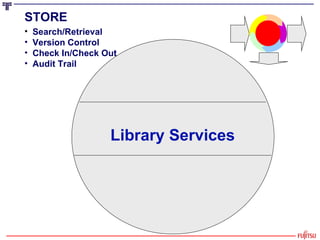
STORE   Search/Retrieval Version Control Check In/Check Out Audit Trail Library Services
STORE   Technologies Hard Disk RAID SAN NAS Optical OD DVD CD Tape
STORE   Repositories Library Services Technologies ILM Information Lifecycle Management
PRESERVE   Archive Paper Microfilm NAS/SAN WORM HD WORM OD WORM TAPE Deletion
PRESERVE   Long-Term Archiving implies C ontinuous Migration
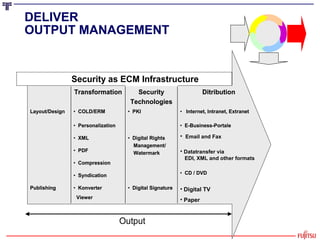
DELIVER   OUTPUT MANAGEMENT Datatransfer via   EDI, XML and other formats Digital TV Email and Fax Digital TV Paper
DELIVER   TRANSFORMATION Datatransfer via Digital TV Paper Email and Fax
DELIVER   SECURITY Digital TV Datatransfer via   EDI, XML and other formats Digital TV Paper Email and Fax Datatransfer via
DELIVER   DISTRIBUTION
The  ‘ C ’  in ECM Market drivers for  enterprise content management Let‘s talk about ECM trends …
LOTS OF  C ‘s   Capture C hange Claim C lassification C ollaboration C ommunication C ommunities C ompetition C ompetitiveness C ompliance C omplexity C omponents Concept C onnector C onservation C onsistency C onsolidation Content C ontext C ontinuity C ontrol C onvergence C ost &  C o. C oncept C apture C laim C ontent
C ollaboration & 2.0
C OLLABORATION   Jointly usable information bases. Joint, simultaneous, and controlled use/processing of information. Knowledge bases of skills, resources and background information for joint use of information. Administrative components like whiteboards for idea-gathering, scheduling, project management and more. Teamrooms. Ad-hoc workflow.
C OLLABORATION   C ommunication applications like videoconferencing. Integration of information from other applications in the  c ontext of joint information processing. Support of knowledge management with targeted preparation, delivery and formatting of the required information.
C OMMUNITIES SYNONYMOUS WITH WEB 2.0 FUNCTIONALITY Definition: Web 2.0 is an umbrella term for a number of new interactive technologies and services on the internet (especially the WWW), as well as a changed perception of the internet. Applications that give users an interactive role, for example through information exchange and use, content generation and the use of entertainment media. Is there an ECM 2.0?
C OMMUNITIES SYNONYMOUS WITH WEB 2.0 FUNCTIONALITY Selected Web 2.0 functionalities: Wikis Voting Social Bookmarks Mashups Blogs Forums RSS Community software / Social software Instant Messaging Social Tagging / Folksonomies Twittering a.s.o. What counts is reduction to the essentials and the  use of non-redundant functionality.
Governance, Risk Management &  C ompliance
C OMPLIANCE MEETING LEGAL REQUIREMENTS C ompliance with and fulfillment of legal and regulatory requirements. Legal and regulatory compliance is essential for all companies and administrative bodies.
ECM contributes to getting business value out of the necessary investment in compliance.   Current data-security scandals and growing documentation requirements are strengthening the compliance trend. C OMPLIANCE MEETING LEGAL REQUIREMENTS
GRC GOVERNANCE,  C OMPLIANCE & RISK   MANAGEMENT GRC brings together the disciplines of  C orporate  Governance, Risk Management and Compliance as a  c onsistent procedure model. Governance Compliance Risk Management
C omplexity,  C onvergence & C omponent Architectures
C OMPLEXITY REDUCING COMPLEXITY ECM solutions are almost all designed for in-house use by specially trained employees. They often feature extensive functions in numerous menus and  c omplex interfaces offering a plethora of information.  C apturing and presenting metadata is especially difficult. From the usability point of view, ECM solutions need to get simpler and more intuitive.
The “enabling” of business applications is becoming more important. Basically, within specific applications you only need 3 “buttons” to use ECM functionality: Save information  Retrieve information Display information in structured form Automated  c lassification and  c ategorization is the key for overcoming the information capture bottleneck. C OMPLEXITY REDUCING COMPLEXITY
The requirements of new user groups, who cannot be trained, but who should be involved in processing and using information, are driving the developing of new user interfaces. Simple, obvious and intuitive Web 2.0 functionality is growing in importance. To support mobile devices like telephones or PDAs is an additional  c hallenge for ECM solutions. C OMPLEXITY REDUCING COMPLEXITY
C OMPONENTS ECM SERVICES, COMPONENTS AND SUBSYSTEMS Components, Services & Subsystems provide ECM functionality as components of other applications. Subsystems may serve other ECM components as well as other non-ECM applications like ERP,  C RM;  C AD, a.s.o.
SOA Service-Oriented Architecture provides ECM services that offer ECM functionality in the middleware or on an enterprise service bus. C lient software thereby becomes less important and is replaced by the enabling of major applications and integration in portal interfaces. C OMPONENTS ECM SERVICES, COMPONENTS AND SUBSYSTEMS
C ontinuity,  C ontrol & C onservation
C ONTINUITY ENSURING INFORMATION AVAILABILITY Business Continuity is an issue whose significance in the context of ECM gets nowhere near enough attention.  We are ever more dependent on the availability and  c orrectness of electronic Information.  ECM supplies methods and technologies to store information safely and ensure the traceability of transactions, and present them in virtual electronic folders.
C ONTROL REGAIN CONTROL OF INFORMATION Getting control of information is a key task, given the growth of information and fragmentation of repositories! Holistic “end to end” solutions ensure traceability. Risk Management can be supported by ECM solutions. GRC - Governance, Risk Management & Compliance – puts compliance, control, audit trail and legal hold solutions in a larger  c ontext.
C ONSERVATION SYNONYMOUS FOR PRESERVATION AND ARCHIVING Electronic Archiving Long-term archiving Electronic long-term archiving means the provision of data and documents over a period of at least 10 years. Auditable archiving Edit-proof archiving refers to archive systems that meet the requirements of archiving legislation in archiving data and documents so that they are safe, unaltered, complete, orderly, reproducible without loss, and database-searchable. Federated repositories instead of island solutions.
C ONVERGENCE CONVERGENCE WITH OTHER ITC FUNCTIONALITIES The convergence in ECM is especially evident in the  convergence of technologies that were not originally part of the core of document management: •  Capture •  Output Management •  Asset Management •  Digital Rights Management •  Electronic Signature •  Web Content Management and Web 2.0 •  Business Process Management and Business Intelligence ECM is unravelling at the edges.
C ompetitiveness &  C ost ECM solutions to fight the  c urrent   c risis
C OMPETITIVENESS ECM is cost-effective and enhances the adaptability, efficiency, and business viability of a company. The implementation of ECM is not a matter of “if”, but of “how” and “when.” ECM’s benefits are more important than ever, and especially in a  c hallenging economic environment.
C OST REDUCE COSTS AND INCREASE EFFICIENCY Cost savings are up there with increased efficiency  and new business on deciders’ priority lists.   ECM offers the necessary means of processing,  c ombining and  controlling information from different sources.  This reduces costs in all areas of company IT. Managing  c hange in the company should be a focus in this.
“ Information has inherent value only when it is used as knowledge in processes.”   The value of information and the dependancy of  c orrectness and availability of information must be considered in planning and operations alike, and justifies investments in ECM as infrastructure. THE VALUE OF INFORMATION C ORRECTNESS, AVAILIBILITY & USE
C ompetition &  C onsolidation
C ONSOLIDATION PRODUCT AND INFRASTRUCTURE CONVERGENCE Market-driven consolidation:  Vendors and products disappear or merge as companies take over other companies. User-driven consolidation: C ombining and thinning out heterogeneous systems in order to arrive at uniform IT infrastructures. Technological convergence is accelerating consolidation and simultaneously expanding the range of options.
MAGIC QUADRANT OF THE GARTNER GROUP   SEPTEMBER 2007 Of 18 vendors, 6 are no longer independent. © Gartner Group 2007
MAGIC QUADRANT OF THE GARTNER GROUP   SEPTEMBER 2007 © Gartner Group 2007 HP Autonomy
MAGIC QUADRANT OF THE GARTNER GROUP   SEPTEMBER 2008 © Gartner Group 2008 Autonomy
MAGIC QUADRANT OF THE GARTNER GROUP   SEPTEMBER 2008 September 2007 © Gartner Group 2007 & 2008 Autonomy
MAGIC QUADRANT OF THE GARTNER GROUP   SEPTEMBER 2008 © Gartner Group 2008 Autonomy
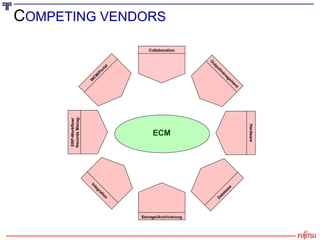
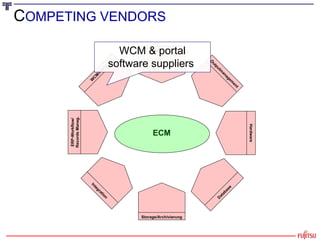
ECM Outputmanagement Storage/Archivierung Hardware Database ERP-Workflow/ Records Manag. WCM/Portal Integration C OMPETING VENDORS Collaboration
ECM Outputmanagement Storage/Archivierung Hardware Database ERP-Workflow/ Records Manag. WCM/Portal Integration C OMPETING VENDORS International & regional ECM specialists  Collaboration
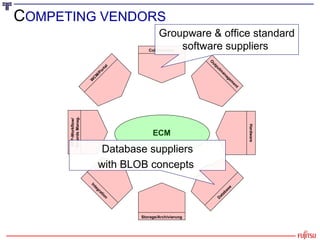
ECM Outputmanagement Storage/Archivierung Hardware Database ERP-Workflow/ Records Manag. WCM/Portal Integration C OMPETING VENDORS Groupware & office standard software suppliers  Database suppliers with BLOB concepts  Collaboration
ECM Outputmanagement Storage/Archivierung Hardware Database ERP-Workflow/ Records Manag. WCM/Portal Integration C OMPETING VENDORS Print & output management software suppliers  Printer, MFD & scanner suppliers  Collaboration
ECM Outputmanagement Storage/Archivierung Hardware Database ERP-Workflow/ Records Manag. WCM/Portal Integration C OMPETING VENDORS Storage & storage subsystems suppliers Collaboration
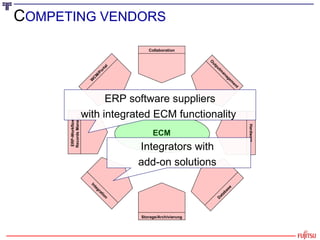
ECM Outputmanagement Storage/Archivierung Hardware Database ERP-Workflow/ Records Manag. WCM/Portal Integration C OMPETING VENDORS Integrators with  add-on solutions  ERP software suppliers with integrated ECM functionality  Collaboration
ECM Outputmanagement Storage/Archivierung Hardware Database ERP-Workflow/ Records Manag. WCM/Portal Integration C OMPETING VENDORS WCM & portal software suppliers  Collaboration
ECM Outputmanagement Storage/Archivierung Hardware Database ERP-Workflow/ Records Manag. WCM/Portal Integration C OMPETING VENDORS & SaaS offerings & Outsourcing & ASP &  C loud computing & Mobile & Open Source &, &, & … Collaboration
The market is growing fast …
The market is growing fast …     But the growth is shared  among many  old and new  c ompetitors
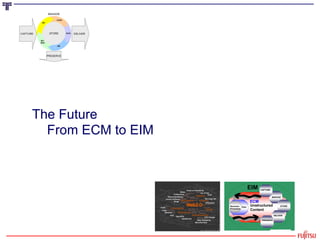
The Future From ECM to EIM
ECM: CLAIM
The combination of structured and unstructured content = information management ECM: SELF-FULFILLING PROPHECY   ECM EIM
THE FUTURE OF ECM   “ ECM is moving towards Information Management and will end up as integral part of general ITC information technology & communication solutions.” “ ECM has no future as a separate category. It will disappear into Enterprise Information Management.”
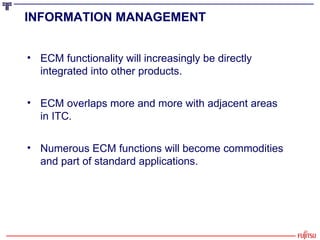
INFORMATION MANAGEMENT   ECM functionality will increasingly be directly integrated into other products. ECM overlaps more and more with adjacent areas  in ITC. Numerous ECM functions will become commodities and part of standard applications.
EIM   ENTERPRISE INFORMATION MANAGEMENT Is EIM Enterprise Information Management just ECM Enterprise Content Management  + BI Business Intelligence? …  a leap too short?!
EIM Enterprise Information Management stands for the comprehensive management of all information in an enterprise, regardless of location, user, author, generating system, application and time. EIM   ENTERPRISE INFORMATION MANAGEMENT PROJECT CONSULT DEFINITION EIM combines functional aspects of Enterprise Content Management, Business Process Management, Enterprise Search, Knowledge Management, Business Intelligence, Data Warehousing, Web 2.0 and Information Lifecycle Management.
Basic to Enterprise Information Management are: Uniform and overarching Master Data Management, Address Management and Access Management Overarching, usable information repositories Combination of applications with joint use and joint administration of data Use of services that provide the same function once and to all applications EIM   ENTERPRISE INFORMATION MANAGEMENT PROJECT CONSULT DEFINITION
Basic to Enterprise Information Management are: End-to-end processes without media breaks, transaction-safe and comprehensively logged Centralized management of all components, settings, parameters and configurations Secure platform- and application-agnostic administration of all data and information used across these platforms and applications Thorough IT governance of all systems and processes involved EIM   ENTERPRISE INFORMATION MANAGEMENT PROJECT CONSULT DEFINITION
ECM REDEFINED   When Enterprise Content Management has become part of Information Management and the acronym ECM is available again, we will use it for E nterprise  C hange  M anagement!
Outlook
THE FUTURE IN THE INFORMATION AGE   “ Electronic information suffuses every area of life, steers our cars, identifies our purchases, communicates with our appliances, follows us through the internet as a long tail, makes us transparent and thus vulnerable.”
“ Does man rule machine or machine rule man?   As the 21st century begins, information is gaining the advantage over us. People must redefine their role with respect to information, professional and no longer private existence, and to their own self-conception as human beings.” THE FUTURE IN THE INFORMATION AGE
“ We live in one of the most interesting epochs in human history.  In just one generation we are being catapulted into the virtual world of information processing.  Our era easily outdoes the invention of writing, printing, firearms and the railway.  We should enjoy this unique time. There won’t be anything comparable any time soon.” THE FUTURE IN THE INFORMATION AGE
“ The change of a physical, tangible world of information into a virtual world. Our children will laugh at the problems we face today.” THE FUTURE IN THE INFORMATION AGE
Thanks for listening ! … and have a nice time in Marrakech!
Dr. Ulrich Kampffmeyer   PROJECT CONSULT Unternehmensberatung GmbH   Breitenfelder Str. 17   20251  Hamburg   Germany   Phone: +49-40-46076220   E-Mail:  [email_address] Powerpoint version of the presentation (automated animation)   http://www.PROJECT-CONSULT.net/files/20090212_ECM_to_EIM_Fujitsu_Marrakech_3_Kff_Show.pps Company information   http://www.PROJECT-CONSULT.com ECM article on Wikipedia   http://en.wikipedia.org/wiki/Enterprise_content_management ECM Enterprise Content Management    (Book in English, French and German)    http://www.project-consult.net/Files/ECM_White%20Paper_kff_2006.pdf PROJECT CONSULT Newsletter (Archive)   http://pcnewsletter.coextant.info/ Information

[EN] From ECM Enterprise Content Management to EIM Enterprise Information Management | Ulrich Kampffmeyer | Marrakech 2009

  • 1.
    From Enterprise ContentManagement to Enterprise Information Management Dr. Ulrich Kampffmeyer FUJITSU Channel Partner Conference Marrakech, February 12, 2009 P R O J E C T C O N S U L T Unternehmensberatung Dr. Ulrich Kampffmeyer GmbH Edited handout version – animation dissolved Animated PPS version: www.PROJECT-CONSULT.net/files/20090212_ECM_to_EIM_Fujitsu_Marrakech_3_Kff_Show.pps
  • 2.
    Welcome to thedigital world: C ontent is King Enterprise C ontent Management: Pre-condition for effective information management The ‘ C ’ in ECM: Market drivers for enterprise content management The Future: From ECM to EIM A GENDA
  • 3.
    Welcome to thedigital world 0100101010 0111100011 1010101011 1010001110 1000111010 Content is king!
  • 4.
    INFORMATION OVERFLOW We suffer from information overflow, and must laboriously search out the valuable, important information. The systematic management of exponentially growing information volumes is ever more important.
  • 5.
    THE CONTENT “ BIG BANG“ 40,000 BC Cave painting tools 105 Paper 3500 BC Writing 1947 Tran-sistor 1950 Computer Late 1960s Internet 1870 Electricity, telephone 1450 Printing 1993 The Web 2004 36 B l n 2003 24 B l n 2002 12 B l n 2001 6 Bln 2000 3 Bln 2005 52 B l n Gigabytes GigaByte TeraByte PetaByte ExaByte
  • 6.
    THE CONTENT “ BIG BANG“ 40,000 BC Cave painting tools 105 Paper 3500 BC Writing 1947 Tran-sistor 1950 Computer Late 1960s Internet 1870 Electricity, telephone 1450 Printing 1993 The Web 2004 36 B l n 2003 24 B l n 2002 12 B l n 2001 6 Bln 2000 3 Bln 2005 52 B l n Gigabytes Every year be produce three times the amount of information than the year before.
  • 7.
    THE CONTENT “ BIG BANG“ Unstructured information and data grow at different rates 78% average growth Fixed, unstructured data Dynamic, structured data Storage Demand Petabytes Stored information volume grows by 30% per year Over 90% of all records are generated electronically Over 85% of all information used is in unstructured documents Over 600 billion emails are sent each year About 65% of all infomation consists of relevant records that must be retained 95% of all records could be destroyed
  • 8.
    THE CONTENT “ BIG BANG“ Unstructured information and data grow at different rates Email, videos, audio, scanned documents, multi media objects and other unstructured information generates the majority of data. 78% average growth Fixed, unstructured data Dynamic, structured data Storage Demand Petabytes Stored information volume grows by 30% per year Over 90% of all records are generated electronically Over 85% of all information used is in unstructured documents Over 600 billion emails are sent each year About 65% of all infomation consists of relevant records that must be retained 95% of all records could be destroyed
  • 9.
    THE CONTENT “ BIG BANG“ Unstructured information and data grow at different rates Email, videos, audio, scanned documents, multi media objects and other unstructured information generates the majority of data Drowned by information, we are searching for knowledge. 78% average growth Fixed, unstructured data Dynamic, structured data Storage Demand Petabytes Stored information volume grows by 30% per year Over 90% of all records are generated electronically Over 85% of all information used is in unstructured documents Over 600 billion emails are sent each year About 65% of all infomation consists of relevant records that must be retained 95% of all records could be destroyed
  • 10.
    C HARACTERS, DATA,INFORMATION, KNOWLEDGE THE PYRAMID Relationships between the levels of the definition hierarchy Mechanisms of the currency market Conversion rate € 1 = US$ 1.30 1.30 1, 0, 3 and . Linkage Syntax Characters Data Information Knowledge Examples Contexts Context Character set
  • 11.
    C HARACTERS, DATA,INFORMATION, KNOWLEDGE IT IS ONLY INFORMATION Records Documents Media Assets C ontent Characters Data Information Knowledge
  • 12.
    C ONTENT Data,Information, Records, Knowledge a.s.o. Content stands for any electronic content. Includes “Data” and “Metadata” as well as records, documents, media assets, images and web pages. Content is an economic resource. Defined by its business value and its contents, content may become a record. But how to manage content effectivly?
  • 13.
    Enterprise Content Management Pre-condition for effective information management
  • 14.
    DEFINITION & C ONCEPTS
  • 15.
    AIIM International, 2003ECM: C LAIM Unstructured Content Data Business Processes STORE MANAGE DELIVER PRESERVE CAPTURE
  • 16.
    ECM: DEFINITION “ Enterprise C ontent Management is the Technologies used to C apture, Manage, Store, Preserve, and Deliver Content and Documents related to Organizational Processes.” AIIM Association for Information and Image Management International, 2006
  • 17.
    ECM: DEFINITION “ Enterprise C ontent Management is the Strategies, Methods and Tools used to C apture, Manage, Store, Preserve, and Deliver Content and Documents related to Organizational Processes.” AIIM Association for Information and Image Management International, 2008
  • 18.
    STRATEGY & VISION not a single product! Enterprise C ontent Management is a Strategy or Vision ,
  • 19.
    ENTERPRISE CONTENT MANAGEMENT – INFRASTRUCTURE ERP Web Content Management Doc Mgmt Imaging Domino Exchange RDMS File System Workflow Collaboration Data Warehousing Mining EAI E-Business AP/AR RM/A CRM HRM Enterprise Enterprise Applications Applications Enterprise Enterprise Content Content Management Management Infrastructure Infrastructure Integration Integration
  • 20.
    ECM CONCEPT #1 ERP Web Content Management Doc Mgmt Imaging Domino Exchange RDMS File System Workflow Collaboration Data Warehousing Mining EAI E-Business AP/AR RM/A CRM HRM Middleware Enterprise Enterprise Applications Applications Enterprise Enterprise Content Content Management Management Infrastructure Infrastructure Integration Integration
  • 21.
    ECM CONCEPT #2 ERP Web Content Management Doc Mgmt Imaging Domino Exchange RDMS File System Workflow Collaboration Data Warehousing Mining EAI E-Business AP/AR RM/A CRM HRM Independent services for all applications Enterprise Enterprise Applications Applications Enterprise Enterprise Content Content Management Management Infrastructure Infrastructure Integration Integration
  • 22.
    ECM CONCEPT #3 ERP Web Content Management Doc Mgmt Imaging Domino Exchange RDMS File System Workflow Collaboration Data Warehousing Mining EAI E-Business AP/AR RM/A CRM HRM Uniform, federated enterprise repository for all types of information Enterprise Enterprise Applications Applications Enterprise Enterprise Content Content Management Management Infrastructure Infrastructure Integration Integration
  • 23.
    ECM COMPONENTS
  • 24.
    AIIM MODEL FORECM ENTERPRISE C ONTENT MANAGEMENT CAPTURE PRESERVE DELIVER STORE MANAGE STORE WCM RM WF/BPM DM Collab
  • 25.
    C APTURE Input Barcode COLD/ERM E-Billing Aggregation Financial Applications XML Forms Processing E-Forms/Web-Forms ERP Application created OMR Microfilm ICR Rich Media HCR Form OCR Office Documents Indexing Input Designs Categorization Recognition Human created
  • 26.
    C APTURE HUMAN-CREATED Input Barcode COLD/ERM E-Billing Aggregation Financial Applications XML Forms Processing E-Forms/Web-Forms ERP Application created OMR Microfilm ICR Rich Media HCR Form OCR Office Documents Indexing Input Designs Categorization Recognition Human created
  • 27.
    C APTURE APPLICATION-CREATED Input Barcode COLD/ERM E-Billing Aggregation Financial Applications XML Forms Processing E-Forms/Web-Forms ERP Application created OMR Microfilm ICR Rich Media HCR Form OCR Office Documents Indexing Input Designs Categorization Recognition Human created
  • 28.
    C APTURE RECOGNITION Input Barcode COLD/ERM E-Billing Aggregation Financial Applications XML Forms Processing E-Forms/Web-Forms ERP Application created OMR Microfilm ICR Rich Media HCR Form OCR Office Documents Indexing Input Designs Categorization Recognition Human created
  • 29.
    C APTURE FORMS PROCESSING Input Barcode COLD/ERM E-Billing Aggregation Financial Applications XML Forms Processing E-Forms/Web-Forms ERP Application created OMR Microfilm ICR Rich Media HCR Form OCR Office Documents Indexing Input Designs Categorization Recognition Human created
  • 30.
    C APTURE COLD Input Barcode COLD/ERM E-Billing Aggregation Financial Applications XML Forms Processing E-Forms/Web-Forms ERP Application created OMR Microfilm ICR Rich Media HCR Form OCR Office Documents Indexing Input Designs Categorization Recognition Human created
  • 31.
    C APTURE INDEXING & CLASSIFICATION Input Barcode COLD/ERM E-Billing Aggregation Financial Applications XML Forms Processing E-Forms/Web-Forms ERP Application created OMR Microfilm ICR Rich Media HCR Form OCR Office Documents Indexing Input Designs Categorization Recognition Human created
  • 32.
    MANAGE WCM RM WF/ BPM DM Collab
  • 33.
    MANAGE DOCUMENT MANAGEMENT Check-in/Check-out Version Management Search and Navigation Visualization & Email Management Virtual Folder STORE WCM RM WF/BPM DM Collab
  • 34.
    Collaborative authoring Knowledge bases Whiteboards Video conferencing Consolidation of information & Web 2.0 Enterprise 2.0 MANAGE C OLLABORATION STORE WCM RM WF/BPM DM Collab
  • 35.
    MANAGE WEB C ONTENT MANAGEMENT Content creation Publication process Conversion Security Web site visualization & DAM Digital Asset Management Web 2.0 STORE WCM RM WF/BPM DM Collab
  • 36.
    MANAGE RECORDS MANAGEMENT Filing structures and file plans Thesaurus Retention periods Metadata Archive management & MoReq2 ICA-ISDF STORE WCM RM WF/BPM DM Collab
  • 37.
    MANAGE BUSINESS PROCESS MANAGEMENT Process and structure organization Process design Visualization of processes Routing Monitoring Parallel and sequential processing Reminders, deadlines Checking Logging & BI Business Intelligence STORE WCM RM WF/BPM DM Collab
  • 38.
    STORE Repositories Library Services Technologies
  • 39.
    STORE File Systems Content Management Systems Databases Data Warehouses Repositories
  • 40.
    STORE Search/Retrieval Version Control Check In/Check Out Audit Trail Library Services
  • 41.
    STORE Technologies Hard Disk RAID SAN NAS Optical OD DVD CD Tape
  • 42.
    STORE Repositories Library Services Technologies ILM Information Lifecycle Management
  • 43.
    PRESERVE Archive Paper Microfilm NAS/SAN WORM HD WORM OD WORM TAPE Deletion
  • 44.
    PRESERVE Long-Term Archiving implies C ontinuous Migration
  • 45.
    DELIVER OUTPUT MANAGEMENT Datatransfer via EDI, XML and other formats Digital TV Email and Fax Digital TV Paper
  • 46.
    DELIVER TRANSFORMATION Datatransfer via Digital TV Paper Email and Fax
  • 47.
    DELIVER SECURITY Digital TV Datatransfer via EDI, XML and other formats Digital TV Paper Email and Fax Datatransfer via
  • 48.
    DELIVER DISTRIBUTION
  • 49.
    The ‘C ’ in ECM Market drivers for enterprise content management Let‘s talk about ECM trends …
  • 50.
    LOTS OF C ‘s Capture C hange Claim C lassification C ollaboration C ommunication C ommunities C ompetition C ompetitiveness C ompliance C omplexity C omponents Concept C onnector C onservation C onsistency C onsolidation Content C ontext C ontinuity C ontrol C onvergence C ost & C o. C oncept C apture C laim C ontent
  • 51.
  • 52.
    C OLLABORATION Jointly usable information bases. Joint, simultaneous, and controlled use/processing of information. Knowledge bases of skills, resources and background information for joint use of information. Administrative components like whiteboards for idea-gathering, scheduling, project management and more. Teamrooms. Ad-hoc workflow.
  • 53.
    C OLLABORATION C ommunication applications like videoconferencing. Integration of information from other applications in the c ontext of joint information processing. Support of knowledge management with targeted preparation, delivery and formatting of the required information.
  • 54.
    C OMMUNITIES SYNONYMOUSWITH WEB 2.0 FUNCTIONALITY Definition: Web 2.0 is an umbrella term for a number of new interactive technologies and services on the internet (especially the WWW), as well as a changed perception of the internet. Applications that give users an interactive role, for example through information exchange and use, content generation and the use of entertainment media. Is there an ECM 2.0?
  • 55.
    C OMMUNITIES SYNONYMOUSWITH WEB 2.0 FUNCTIONALITY Selected Web 2.0 functionalities: Wikis Voting Social Bookmarks Mashups Blogs Forums RSS Community software / Social software Instant Messaging Social Tagging / Folksonomies Twittering a.s.o. What counts is reduction to the essentials and the use of non-redundant functionality.
  • 56.
  • 57.
    C OMPLIANCE MEETINGLEGAL REQUIREMENTS C ompliance with and fulfillment of legal and regulatory requirements. Legal and regulatory compliance is essential for all companies and administrative bodies.
  • 58.
    ECM contributes togetting business value out of the necessary investment in compliance. Current data-security scandals and growing documentation requirements are strengthening the compliance trend. C OMPLIANCE MEETING LEGAL REQUIREMENTS
  • 59.
    GRC GOVERNANCE, C OMPLIANCE & RISK MANAGEMENT GRC brings together the disciplines of C orporate Governance, Risk Management and Compliance as a c onsistent procedure model. Governance Compliance Risk Management
  • 60.
    C omplexity, C onvergence & C omponent Architectures
  • 61.
    C OMPLEXITY REDUCINGCOMPLEXITY ECM solutions are almost all designed for in-house use by specially trained employees. They often feature extensive functions in numerous menus and c omplex interfaces offering a plethora of information. C apturing and presenting metadata is especially difficult. From the usability point of view, ECM solutions need to get simpler and more intuitive.
  • 62.
    The “enabling” ofbusiness applications is becoming more important. Basically, within specific applications you only need 3 “buttons” to use ECM functionality: Save information Retrieve information Display information in structured form Automated c lassification and c ategorization is the key for overcoming the information capture bottleneck. C OMPLEXITY REDUCING COMPLEXITY
  • 63.
    The requirements ofnew user groups, who cannot be trained, but who should be involved in processing and using information, are driving the developing of new user interfaces. Simple, obvious and intuitive Web 2.0 functionality is growing in importance. To support mobile devices like telephones or PDAs is an additional c hallenge for ECM solutions. C OMPLEXITY REDUCING COMPLEXITY
  • 64.
    C OMPONENTS ECMSERVICES, COMPONENTS AND SUBSYSTEMS Components, Services & Subsystems provide ECM functionality as components of other applications. Subsystems may serve other ECM components as well as other non-ECM applications like ERP, C RM; C AD, a.s.o.
  • 65.
    SOA Service-Oriented Architectureprovides ECM services that offer ECM functionality in the middleware or on an enterprise service bus. C lient software thereby becomes less important and is replaced by the enabling of major applications and integration in portal interfaces. C OMPONENTS ECM SERVICES, COMPONENTS AND SUBSYSTEMS
  • 66.
    C ontinuity, C ontrol & C onservation
  • 67.
    C ONTINUITY ENSURINGINFORMATION AVAILABILITY Business Continuity is an issue whose significance in the context of ECM gets nowhere near enough attention. We are ever more dependent on the availability and c orrectness of electronic Information. ECM supplies methods and technologies to store information safely and ensure the traceability of transactions, and present them in virtual electronic folders.
  • 68.
    C ONTROL REGAINCONTROL OF INFORMATION Getting control of information is a key task, given the growth of information and fragmentation of repositories! Holistic “end to end” solutions ensure traceability. Risk Management can be supported by ECM solutions. GRC - Governance, Risk Management & Compliance – puts compliance, control, audit trail and legal hold solutions in a larger c ontext.
  • 69.
    C ONSERVATION SYNONYMOUSFOR PRESERVATION AND ARCHIVING Electronic Archiving Long-term archiving Electronic long-term archiving means the provision of data and documents over a period of at least 10 years. Auditable archiving Edit-proof archiving refers to archive systems that meet the requirements of archiving legislation in archiving data and documents so that they are safe, unaltered, complete, orderly, reproducible without loss, and database-searchable. Federated repositories instead of island solutions.
  • 70.
    C ONVERGENCE CONVERGENCEWITH OTHER ITC FUNCTIONALITIES The convergence in ECM is especially evident in the convergence of technologies that were not originally part of the core of document management: • Capture • Output Management • Asset Management • Digital Rights Management • Electronic Signature • Web Content Management and Web 2.0 • Business Process Management and Business Intelligence ECM is unravelling at the edges.
  • 71.
    C ompetitiveness & C ost ECM solutions to fight the c urrent c risis
  • 72.
    C OMPETITIVENESS ECMis cost-effective and enhances the adaptability, efficiency, and business viability of a company. The implementation of ECM is not a matter of “if”, but of “how” and “when.” ECM’s benefits are more important than ever, and especially in a c hallenging economic environment.
  • 73.
    C OST REDUCECOSTS AND INCREASE EFFICIENCY Cost savings are up there with increased efficiency and new business on deciders’ priority lists. ECM offers the necessary means of processing, c ombining and controlling information from different sources. This reduces costs in all areas of company IT. Managing c hange in the company should be a focus in this.
  • 74.
    “ Information hasinherent value only when it is used as knowledge in processes.” The value of information and the dependancy of c orrectness and availability of information must be considered in planning and operations alike, and justifies investments in ECM as infrastructure. THE VALUE OF INFORMATION C ORRECTNESS, AVAILIBILITY & USE
  • 75.
    C ompetition & C onsolidation
  • 76.
    C ONSOLIDATION PRODUCTAND INFRASTRUCTURE CONVERGENCE Market-driven consolidation: Vendors and products disappear or merge as companies take over other companies. User-driven consolidation: C ombining and thinning out heterogeneous systems in order to arrive at uniform IT infrastructures. Technological convergence is accelerating consolidation and simultaneously expanding the range of options.
  • 77.
    MAGIC QUADRANT OFTHE GARTNER GROUP SEPTEMBER 2007 Of 18 vendors, 6 are no longer independent. © Gartner Group 2007
  • 78.
    MAGIC QUADRANT OFTHE GARTNER GROUP SEPTEMBER 2007 © Gartner Group 2007 HP Autonomy
  • 79.
    MAGIC QUADRANT OFTHE GARTNER GROUP SEPTEMBER 2008 © Gartner Group 2008 Autonomy
  • 80.
    MAGIC QUADRANT OFTHE GARTNER GROUP SEPTEMBER 2008 September 2007 © Gartner Group 2007 & 2008 Autonomy
  • 81.
    MAGIC QUADRANT OFTHE GARTNER GROUP SEPTEMBER 2008 © Gartner Group 2008 Autonomy
  • 82.
    ECM Outputmanagement Storage/ArchivierungHardware Database ERP-Workflow/ Records Manag. WCM/Portal Integration C OMPETING VENDORS Collaboration
  • 83.
    ECM Outputmanagement Storage/ArchivierungHardware Database ERP-Workflow/ Records Manag. WCM/Portal Integration C OMPETING VENDORS International & regional ECM specialists Collaboration
  • 84.
    ECM Outputmanagement Storage/ArchivierungHardware Database ERP-Workflow/ Records Manag. WCM/Portal Integration C OMPETING VENDORS Groupware & office standard software suppliers Database suppliers with BLOB concepts Collaboration
  • 85.
    ECM Outputmanagement Storage/ArchivierungHardware Database ERP-Workflow/ Records Manag. WCM/Portal Integration C OMPETING VENDORS Print & output management software suppliers Printer, MFD & scanner suppliers Collaboration
  • 86.
    ECM Outputmanagement Storage/ArchivierungHardware Database ERP-Workflow/ Records Manag. WCM/Portal Integration C OMPETING VENDORS Storage & storage subsystems suppliers Collaboration
  • 87.
    ECM Outputmanagement Storage/ArchivierungHardware Database ERP-Workflow/ Records Manag. WCM/Portal Integration C OMPETING VENDORS Integrators with add-on solutions ERP software suppliers with integrated ECM functionality Collaboration
  • 88.
    ECM Outputmanagement Storage/ArchivierungHardware Database ERP-Workflow/ Records Manag. WCM/Portal Integration C OMPETING VENDORS WCM & portal software suppliers Collaboration
  • 89.
    ECM Outputmanagement Storage/ArchivierungHardware Database ERP-Workflow/ Records Manag. WCM/Portal Integration C OMPETING VENDORS & SaaS offerings & Outsourcing & ASP & C loud computing & Mobile & Open Source &, &, & … Collaboration
  • 90.
    The market isgrowing fast …
  • 91.
    The market isgrowing fast … But the growth is shared among many old and new c ompetitors
  • 92.
    The Future FromECM to EIM
  • 93.
  • 94.
    The combination ofstructured and unstructured content = information management ECM: SELF-FULFILLING PROPHECY ECM EIM
  • 95.
    THE FUTURE OFECM “ ECM is moving towards Information Management and will end up as integral part of general ITC information technology & communication solutions.” “ ECM has no future as a separate category. It will disappear into Enterprise Information Management.”
  • 96.
    INFORMATION MANAGEMENT ECM functionality will increasingly be directly integrated into other products. ECM overlaps more and more with adjacent areas in ITC. Numerous ECM functions will become commodities and part of standard applications.
  • 97.
    EIM ENTERPRISE INFORMATION MANAGEMENT Is EIM Enterprise Information Management just ECM Enterprise Content Management + BI Business Intelligence? … a leap too short?!
  • 98.
    EIM Enterprise InformationManagement stands for the comprehensive management of all information in an enterprise, regardless of location, user, author, generating system, application and time. EIM ENTERPRISE INFORMATION MANAGEMENT PROJECT CONSULT DEFINITION EIM combines functional aspects of Enterprise Content Management, Business Process Management, Enterprise Search, Knowledge Management, Business Intelligence, Data Warehousing, Web 2.0 and Information Lifecycle Management.
  • 99.
    Basic to EnterpriseInformation Management are: Uniform and overarching Master Data Management, Address Management and Access Management Overarching, usable information repositories Combination of applications with joint use and joint administration of data Use of services that provide the same function once and to all applications EIM ENTERPRISE INFORMATION MANAGEMENT PROJECT CONSULT DEFINITION
  • 100.
    Basic to EnterpriseInformation Management are: End-to-end processes without media breaks, transaction-safe and comprehensively logged Centralized management of all components, settings, parameters and configurations Secure platform- and application-agnostic administration of all data and information used across these platforms and applications Thorough IT governance of all systems and processes involved EIM ENTERPRISE INFORMATION MANAGEMENT PROJECT CONSULT DEFINITION
  • 101.
    ECM REDEFINED When Enterprise Content Management has become part of Information Management and the acronym ECM is available again, we will use it for E nterprise C hange M anagement!
  • 102.
  • 103.
    THE FUTURE INTHE INFORMATION AGE “ Electronic information suffuses every area of life, steers our cars, identifies our purchases, communicates with our appliances, follows us through the internet as a long tail, makes us transparent and thus vulnerable.”
  • 104.
    “ Does manrule machine or machine rule man? As the 21st century begins, information is gaining the advantage over us. People must redefine their role with respect to information, professional and no longer private existence, and to their own self-conception as human beings.” THE FUTURE IN THE INFORMATION AGE
  • 105.
    “ We livein one of the most interesting epochs in human history. In just one generation we are being catapulted into the virtual world of information processing. Our era easily outdoes the invention of writing, printing, firearms and the railway. We should enjoy this unique time. There won’t be anything comparable any time soon.” THE FUTURE IN THE INFORMATION AGE
  • 106.
    “ The changeof a physical, tangible world of information into a virtual world. Our children will laugh at the problems we face today.” THE FUTURE IN THE INFORMATION AGE
  • 107.
    Thanks for listening! … and have a nice time in Marrakech!
  • 108.
    Dr. Ulrich Kampffmeyer PROJECT CONSULT Unternehmensberatung GmbH Breitenfelder Str. 17 20251 Hamburg Germany Phone: +49-40-46076220 E-Mail: [email_address] Powerpoint version of the presentation (automated animation) http://www.PROJECT-CONSULT.net/files/20090212_ECM_to_EIM_Fujitsu_Marrakech_3_Kff_Show.pps Company information http://www.PROJECT-CONSULT.com ECM article on Wikipedia http://en.wikipedia.org/wiki/Enterprise_content_management ECM Enterprise Content Management (Book in English, French and German) http://www.project-consult.net/Files/ECM_White%20Paper_kff_2006.pdf PROJECT CONSULT Newsletter (Archive) http://pcnewsletter.coextant.info/ Information