SINDH READING PROGRAM
Muhammad Yusuf
Five Essential Elements of Reading
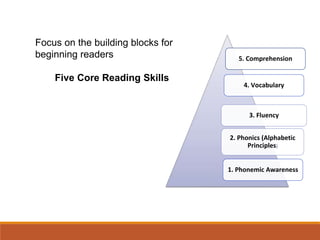
Focus on the building blocks for
beginning readers
Five Core Reading Skills
1. Phonemic Awareness
5. Comprehension
4. Vocabulary
3. Fluency
2. Phonics (Alphabetic
Principles)
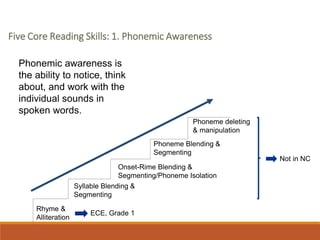
Five Core Reading Skills: 1. Phonemic Awareness
Phonemic awareness is
the ability to notice, think
about, and work with the
individual sounds in
spoken words.
Rhyme &
Alliteration
Phoneme deleting
& manipulation
Syllable Blending &
Segmenting
Onset-Rime Blending &
Segmenting/Phoneme Isolation
Phoneme Blending &
Segmenting
ECE, Grade 1
Not in NC
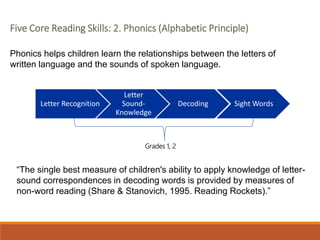
Phonics helps children learn the relationships between the letters of
written language and the sounds of spoken language.
Letter Recognition
Letter
Sound-
Knowledge
Decoding Sight Words
Grades 1, 2
“The single best measure of children's ability to apply knowledge of letter-
sound correspondences in decoding words is provided by measures of
non-word reading (Share & Stanovich, 1995. Reading Rockets).”
Five Core Reading Skills: 2. Phonics (Alphabetic Principle)
Five Core Reading Skills: 3. Fluency
Fluency is the ability to read a text accurately, quickly (automaticity), and
with expression (prosody). Fluency is important because it provides a
bridge between word recognition and comprehension.
• Grades 1 and 2 – include reading of words and simple sentences
and texts but not defined as “Fluency”
• “Fluency” per above definition is stated in Grade 3 – LO1
• Fluency is measured as Word Correct Per Minute (WCPM)
• No WCPM targets or ranges identified in National Curriculum
Five Core Reading Skills: 3. Fluency
Five Core Reading Skills: 4. Vocabulary
Vocabulary plays an important part in learning to read. Beginning
readers must use the words they hear orally to make sense of the
words they see in print. Vocabulary development directly
affects reading comprehension.
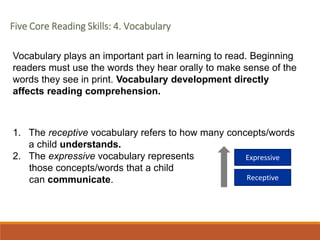
Receptive
Expressive
1. The receptive vocabulary refers to how many concepts/words
a child understands.
2. The expressive vocabulary represents
those concepts/words that a child
can communicate.
Five Core Reading Skills: 5. Comprehension
Comprehension is the reason for reading. If readers can read
the words but do not understand or connect to what they are
reading, they are not really reading. Good readers are both
purposeful and active, and have the skills to absorb what they
read, analyze it, make sense of it, and make it their own.
Pinnell, G (2008) How Does Literacy Collaborative Emphasize the Five Essential Elements of
Reading Instruction? Online available
http://literacycollaborative.org/docs/fiveEssentialElements.pdf
Penner-Wilger M, (2008) Reading Fluency:A Bridge from Decoding to Comprehension AutoSkill
International Inc Ottawa
http://eps.schoolspecialty.com/downloads/research_papers/other/Fluency_Research.pdf
http://www.readingrockets.org/teaching/reading101/comprehension

Five essential elements of reading

  • 1.
    SINDH READING PROGRAM MuhammadYusuf Five Essential Elements of Reading
  • 2.
    Focus on thebuilding blocks for beginning readers Five Core Reading Skills 1. Phonemic Awareness 5. Comprehension 4. Vocabulary 3. Fluency 2. Phonics (Alphabetic Principles)
  • 3.
    Five Core ReadingSkills: 1. Phonemic Awareness Phonemic awareness is the ability to notice, think about, and work with the individual sounds in spoken words. Rhyme & Alliteration Phoneme deleting & manipulation Syllable Blending & Segmenting Onset-Rime Blending & Segmenting/Phoneme Isolation Phoneme Blending & Segmenting ECE, Grade 1 Not in NC
  • 4.
    Phonics helps childrenlearn the relationships between the letters of written language and the sounds of spoken language. Letter Recognition Letter Sound- Knowledge Decoding Sight Words Grades 1, 2 “The single best measure of children's ability to apply knowledge of letter- sound correspondences in decoding words is provided by measures of non-word reading (Share & Stanovich, 1995. Reading Rockets).” Five Core Reading Skills: 2. Phonics (Alphabetic Principle)
  • 5.
    Five Core ReadingSkills: 3. Fluency Fluency is the ability to read a text accurately, quickly (automaticity), and with expression (prosody). Fluency is important because it provides a bridge between word recognition and comprehension. • Grades 1 and 2 – include reading of words and simple sentences and texts but not defined as “Fluency” • “Fluency” per above definition is stated in Grade 3 – LO1 • Fluency is measured as Word Correct Per Minute (WCPM) • No WCPM targets or ranges identified in National Curriculum Five Core Reading Skills: 3. Fluency
  • 6.
    Five Core ReadingSkills: 4. Vocabulary Vocabulary plays an important part in learning to read. Beginning readers must use the words they hear orally to make sense of the words they see in print. Vocabulary development directly affects reading comprehension. Receptive Expressive 1. The receptive vocabulary refers to how many concepts/words a child understands. 2. The expressive vocabulary represents those concepts/words that a child can communicate.
  • 7.
    Five Core ReadingSkills: 5. Comprehension Comprehension is the reason for reading. If readers can read the words but do not understand or connect to what they are reading, they are not really reading. Good readers are both purposeful and active, and have the skills to absorb what they read, analyze it, make sense of it, and make it their own.
  • 8.
    Pinnell, G (2008)How Does Literacy Collaborative Emphasize the Five Essential Elements of Reading Instruction? Online available http://literacycollaborative.org/docs/fiveEssentialElements.pdf Penner-Wilger M, (2008) Reading Fluency:A Bridge from Decoding to Comprehension AutoSkill International Inc Ottawa http://eps.schoolspecialty.com/downloads/research_papers/other/Fluency_Research.pdf http://www.readingrockets.org/teaching/reading101/comprehension