

Chapter 7:
Content Area
 Assessment
   Ade Dwi Putra
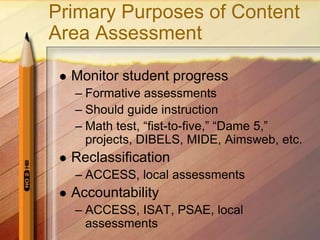
Primary Purposes of Content
Area Assessment

    Monitor student progress
     – Formative assessments
     – Should guide instruction
     – Math test, “fist-to-five,” “Dame 5,”
       projects, DIBELS, MIDE, Aimsweb, etc.
    Reclassification
     – ACCESS, local assessments
    Accountability
     – ACCESS, ISAT, PSAE, local
       assessments
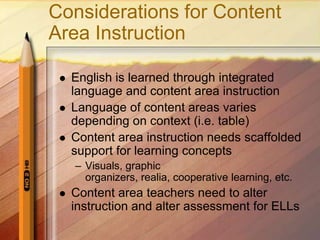
Considerations for Content
Area Instruction

    English is learned through integrated
     language and content area instruction
    Language of content areas varies
     depending on context (i.e. table)
    Content area instruction needs scaffolded
     support for learning concepts
     – Visuals, graphic
       organizers, realia, cooperative learning, etc.
    Content area teachers need to alter
     instruction and alter assessment for ELLs
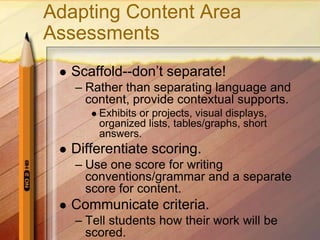
Adapting Content Area
Assessments
    Scaffold--don’t separate!
     – Rather than separating language and
       content, provide contextual supports.
           Exhibits or projects, visual displays,
            organized lists, tables/graphs, short
            answers.
    Differentiate scoring.
     – Use one score for writing
       conventions/grammar and a separate
       score for content.
    Communicate criteria.
     – Tell students how their work will be
       scored.
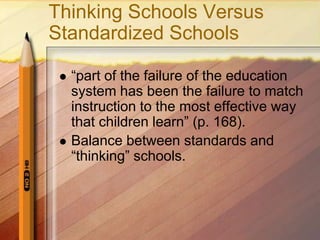
Thinking Schools Versus
Standardized Schools

    “part of the failure of the education
     system has been the failure to match
     instruction to the most effective way
     that children learn” (p. 168).
    Balance between standards and
     “thinking” schools.
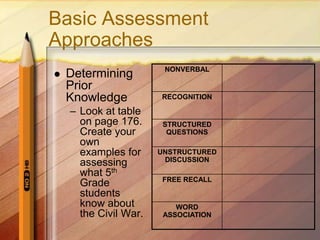
Basic Assessment
Approaches
                        NONVERBAL
   Determining
    Prior
    Knowledge          RECOGNITION

    – Look at table
      on page 176.      STRUCTURED
      Create your        QUESTIONS
      own
      examples for     UNSTRUCTURED
                        DISCUSSION
      assessing
      what 5th
                       FREE RECALL
      Grade
      students
      know about           WORD
      the Civil War.    ASSOCIATION
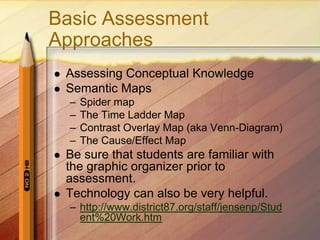
Basic Assessment
Approaches
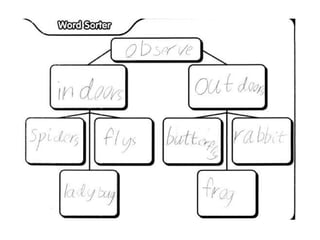
   Assessing Conceptual Knowledge
   Semantic Maps
    –   Spider map
    –   The Time Ladder Map
    –   Contrast Overlay Map (aka Venn-Diagram)
    –   The Cause/Effect Map
   Be sure that students are familiar with
    the graphic organizer prior to
    assessment.
   Technology can also be very helpful.
    – http://www.district87.org/staff/jensenp/Stud
      ent%20Work.htm
Basic Assessment
Approaches
   Reading Comprehension
    – T-lists
    – Cloze test
          Random deletion, purposive deletion, limited
           cloze
Basic Assessment
Approaches
   Vocabulary
    – Recognizing or generalizing attributes,
      examples, and nonexamples.
    – Sensing and inferring relationship
          Do the words freedom and jail go together? Why or
           why not?
          Freedom is to slave as _____ is to student.
          Categorize/classify
    – Applying concepts to a variety of contexts
          Freedom of a country, freedom from jail, freedom from
           slavery, freedom of religion, etc.
    – Generating novel contexts
          Use the word freedom and slavery in a sentence.
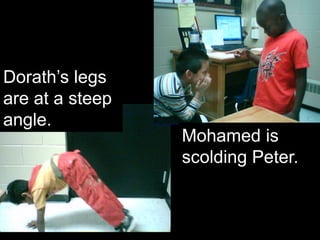
Dorath’s legs
are at a steep
angle.
                 Mohamed is
                 scolding Peter.
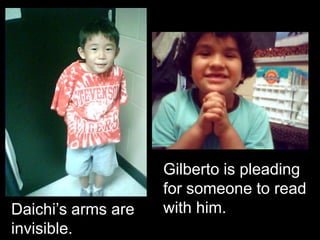
Gilberto is pleading
                    for someone to read
Daichi’s arms are   with him.
invisible.
Basic Assessment
Approaches
   Thinking Skills
    – Be sure to guide planning,
      instruction and assessment with
      thinking skills in the content areas
    – Comprehension
    – Analysis
    – Comparison
    – Synthesis
    – Evaluation
Basic Assessment
Approaches
   Writing to Integrate Language and
    Content
    – Provide writing prompts to mirror the
      thinking processes.
    – 1. What does the number sentence tell
      you?
    – 2. How did you solve the problem?
    – 3. Write a word problem.
        Write the numbers.
        Write an operation and make a number
         sentence.
        Now make a story to go with the question.
Science, Math, Social
Studies

    Declarative knowledge
     – T-lists, semantic maps, cloze tests
    Procedural knowledge
     – Scoring rubrics, check lists, self-
       assessment
General Guidelines for
Content Area Assessment
    Embed assessment into instruction
    Scaffold assessments with contextual
     supports
    Assess procedural knowledge as well as
     declarative knowledge
    Always assess prior knowledge
    Encourage self-assessment
    Use integrated assessments of language
     and content; differentiate scoring
    Make criteria visible
Questions?

Content area assessment

  • 1.
    Chapter 7: Content Area Assessment Ade Dwi Putra
  • 2.
    Primary Purposes ofContent Area Assessment  Monitor student progress – Formative assessments – Should guide instruction – Math test, “fist-to-five,” “Dame 5,” projects, DIBELS, MIDE, Aimsweb, etc.  Reclassification – ACCESS, local assessments  Accountability – ACCESS, ISAT, PSAE, local assessments
  • 3.
    Considerations for Content AreaInstruction  English is learned through integrated language and content area instruction  Language of content areas varies depending on context (i.e. table)  Content area instruction needs scaffolded support for learning concepts – Visuals, graphic organizers, realia, cooperative learning, etc.  Content area teachers need to alter instruction and alter assessment for ELLs
  • 4.
    Adapting Content Area Assessments  Scaffold--don’t separate! – Rather than separating language and content, provide contextual supports.  Exhibits or projects, visual displays, organized lists, tables/graphs, short answers.  Differentiate scoring. – Use one score for writing conventions/grammar and a separate score for content.  Communicate criteria. – Tell students how their work will be scored.
  • 5.
    Thinking Schools Versus StandardizedSchools  “part of the failure of the education system has been the failure to match instruction to the most effective way that children learn” (p. 168).  Balance between standards and “thinking” schools.
  • 6.
    Basic Assessment Approaches NONVERBAL  Determining Prior Knowledge RECOGNITION – Look at table on page 176. STRUCTURED Create your QUESTIONS own examples for UNSTRUCTURED DISCUSSION assessing what 5th FREE RECALL Grade students know about WORD the Civil War. ASSOCIATION
  • 7.
    Basic Assessment Approaches  Assessing Conceptual Knowledge  Semantic Maps – Spider map – The Time Ladder Map – Contrast Overlay Map (aka Venn-Diagram) – The Cause/Effect Map  Be sure that students are familiar with the graphic organizer prior to assessment.  Technology can also be very helpful. – http://www.district87.org/staff/jensenp/Stud ent%20Work.htm
  • 11.
    Basic Assessment Approaches  Reading Comprehension – T-lists – Cloze test  Random deletion, purposive deletion, limited cloze
  • 12.
    Basic Assessment Approaches  Vocabulary – Recognizing or generalizing attributes, examples, and nonexamples. – Sensing and inferring relationship  Do the words freedom and jail go together? Why or why not?  Freedom is to slave as _____ is to student.  Categorize/classify – Applying concepts to a variety of contexts  Freedom of a country, freedom from jail, freedom from slavery, freedom of religion, etc. – Generating novel contexts  Use the word freedom and slavery in a sentence.
  • 13.
    Dorath’s legs are ata steep angle. Mohamed is scolding Peter.
  • 14.
    Gilberto is pleading for someone to read Daichi’s arms are with him. invisible.
  • 15.
    Basic Assessment Approaches  Thinking Skills – Be sure to guide planning, instruction and assessment with thinking skills in the content areas – Comprehension – Analysis – Comparison – Synthesis – Evaluation
  • 16.
    Basic Assessment Approaches  Writing to Integrate Language and Content – Provide writing prompts to mirror the thinking processes. – 1. What does the number sentence tell you? – 2. How did you solve the problem? – 3. Write a word problem.  Write the numbers.  Write an operation and make a number sentence.  Now make a story to go with the question.
  • 17.
    Science, Math, Social Studies  Declarative knowledge – T-lists, semantic maps, cloze tests  Procedural knowledge – Scoring rubrics, check lists, self- assessment
  • 18.
    General Guidelines for ContentArea Assessment  Embed assessment into instruction  Scaffold assessments with contextual supports  Assess procedural knowledge as well as declarative knowledge  Always assess prior knowledge  Encourage self-assessment  Use integrated assessments of language and content; differentiate scoring  Make criteria visible
  • 19.