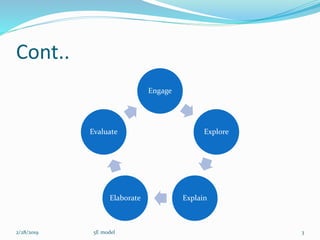
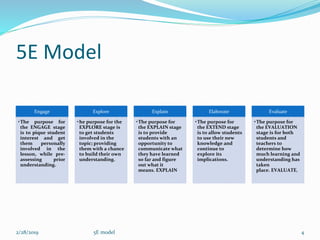
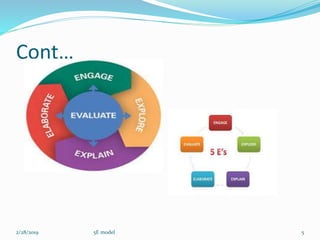
The 5E model is an instructional model for constructivism developed by the Biological Science Curriculum Study. It consists of five stages for teaching and learning: Engage, Explore, Explain, Elaborate, and Evaluate. The Engage stage piques student interest and assesses prior knowledge. The Explore stage allows students to build understanding through involvement in the topic. The Explain stage communicates what students have learned and what it means. The Elaborate stage extends student knowledge through continued exploration. The Evaluate stage determines student and teacher understanding of learning that has taken place.
Background
The 5Esrepresent five stages of a sequence for teaching and learning:
Engage, Explore, Explain, Extend (or Elaborate), and Evaluate.
ENGAGE: The purpose for the ENGAGE stage is to pique student
interest and get them personally involved in the lesson, while pre-
assessing prior understanding.
The Biological Science Curriculum Study (BSCS), a team led by
Principal Investigator Roger Bybee, developed the instructional model
for constructivism, called the "Five Es". Other models have been
adapted from this model including the 6E and 7E models.
2/28/2019 25E model
5E Model
Engage
•The purposefor
the ENGAGE stage
is to pique student
interest and get
them personally
involved in the
lesson, while pre-
assessing prior
understanding.
Explore
•he purpose for the
EXPLORE stage is
to get students
involved in the
topic; providing
them with a chance
to build their own
understanding.
Explain
•The purpose for
the EXPLAIN stage
is to provide
students with an
opportunity to
communicate what
they have learned
so far and figure
out what it
means. EXPLAIN
Elaborate
•The purpose for
the EXTEND stage
is to allow students
to use their new
knowledge and
continue to
explore its
implications.
Evaluate
•The purpose for
the EVALUATION
stage is for both
students and
teachers to
determine how
much learning and
understanding has
taken
place. EVALUATE,
2/28/2019 45E model