Full IB Diploma / IB Course

Mike Carroll - Vice Principal (Secondary)
Wednesday 29 January, 2014
 The International Baccalaureate (IB) Programme is a

comprehensive and rigorous two year curriculum

 a deliberate compromise between the specialization required

in some national systems and the breadth preferred in others.

 The Diploma Programme is highly regarded for entry to

university education throughout the world.
 IB students routinely gain admission to some of the best

known universities in the world. Most of these institutions
have established recognition policies for the IB diploma. The
IBO maintains updated information about university
recognition which can be accessed at
http://www.ibo.org/country.
Who should take the IB Diploma?
 There are two groups of students who should

undertake the IB Diploma:
 those who need it for entrance to the universities of their

choice
 those who, academically able and motivated, want to
undertake a challenging course of study.
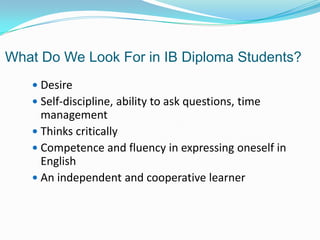
What Do We Look For in IB Diploma Students?
 Desire
 Self-discipline, ability to ask questions, time

management
 Thinks critically
 Competence and fluency in expressing oneself in
English
 An independent and cooperative learner
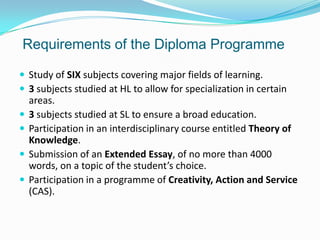
Requirements of the Diploma Programme
 Study of SIX subjects covering major fields of learning.
 3 subjects studied at HL to allow for specialization in certain





areas.
3 subjects studied at SL to ensure a broad education.
Participation in an interdisciplinary course entitled Theory of
Knowledge.
Submission of an Extended Essay, of no more than 4000
words, on a topic of the student’s choice.
Participation in a programme of Creativity, Action and Service
(CAS).
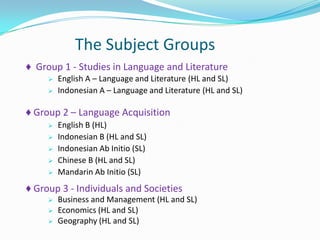
The Subject Groups
♦ Group 1 - Studies in Language and Literature



English A – Language and Literature (HL and SL)
Indonesian A – Language and Literature (HL and SL)

♦ Group 2 – Language Acquisition






English B (HL)
Indonesian B (HL and SL)
Indonesian Ab Initio (SL)
Chinese B (HL and SL)
Mandarin Ab Initio (SL)

♦ Group 3 - Individuals and Societies




Business and Management (HL and SL)
Economics (HL and SL)
Geography (HL and SL)
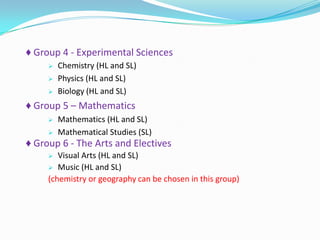
♦ Group 4 - Experimental Sciences




Chemistry (HL and SL)
Physics (HL and SL)
Biology (HL and SL)

♦ Group 5 – Mathematics



Mathematics (HL and SL)
Mathematical Studies (SL)

♦ Group 6 - The Arts and Electives
Visual Arts (HL and SL)
 Music (HL and SL)
(chemistry or geography can be chosen in this group)

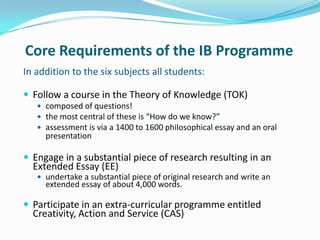
Core Requirements of the IB Programme
In addition to the six subjects all students:
 Follow a course in the Theory of Knowledge (TOK)
 composed of questions!
 the most central of these is “How do we know?”
 assessment is via a 1400 to 1600 philosophical essay and an oral

presentation

 Engage in a substantial piece of research resulting in an

Extended Essay (EE)

 undertake a substantial piece of original research and write an

extended essay of about 4,000 words.

 Participate in an extra-curricular programme entitled

Creativity, Action and Service (CAS)
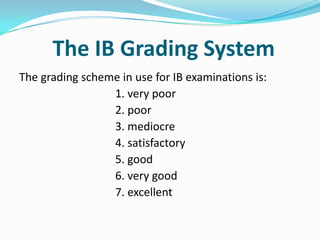
The IB Grading System
The grading scheme in use for IB examinations is:
1. very poor
2. poor
3. mediocre
4. satisfactory
5. good
6. very good
7. excellent
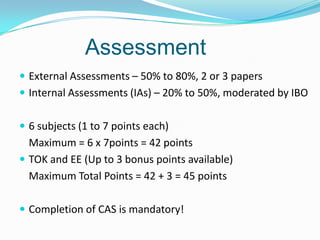
Assessment
 External Assessments – 50% to 80%, 2 or 3 papers
 Internal Assessments (IAs) – 20% to 50%, moderated by IBO
 6 subjects (1 to 7 points each)

Maximum = 6 x 7points = 42 points
 TOK and EE (Up to 3 bonus points available)
Maximum Total Points = 42 + 3 = 45 points
 Completion of CAS is mandatory!
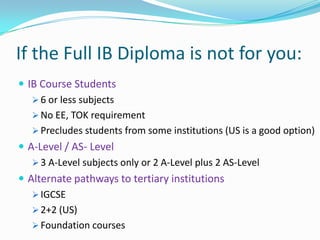
If the Full IB Diploma is not for you:
 IB Course Students
 6 or less subjects
 No EE, TOK requirement
 Precludes students from some institutions (US is a good option)
 A-Level / AS- Level
 3 A-Level subjects only or 2 A-Level plus 2 AS-Level
 Alternate pathways to tertiary institutions
 IGCSE
 2+2 (US)
 Foundation courses
Current Grade Ten
When deciding which subjects to take there are
a number of factors which should be considered:
 Which subjects do you enjoy?
 Which subjects are you good at?
 What does the course involve?
 What type of career(s) are you interested in?
 What are the requirements of the universities at
which you intend to apply?
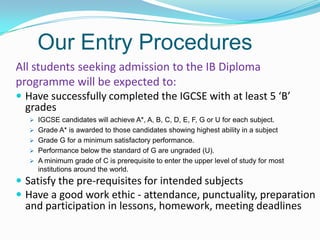
Our Entry Procedures
All students seeking admission to the IB Diploma
programme will be expected to:
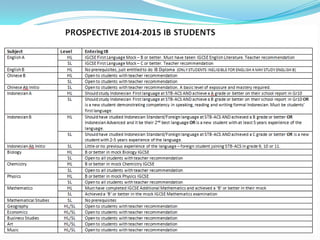
 Have successfully completed the IGCSE with at least 5 ‘B’

grades

 IGCSE candidates will achieve A*, A, B, C, D, E, F, G or U for each subject.
 Grade A* is awarded to those candidates showing highest ability in a subject

 Grade G for a minimum satisfactory performance.
 Performance below the standard of G are ungraded (U).
 A minimum grade of C is prerequisite to enter the upper level of study for most

institutions around the world.

 Satisfy the pre-requisites for intended subjects
 Have a good work ethic - attendance, punctuality, preparation

and participation in lessons, homework, meeting deadlines
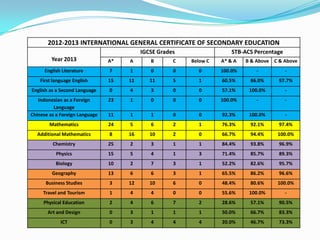
2012-2013 INTERNATIONAL GENERAL CERTIFICATE OF SECONDARY EDUCATION
IGCSE Grades

STB-ACS Percentage

Year 2013

A*

A

B

C

Below C

A* & A

English Literature

7

1

0

0

0

100.0%

-

-

First language English

15

11

11

5

1

60.5%

86.0%

97.7%

English as a Second Language

0

4

3

0

0

57.1%

100.0%

-

Indonesian as a Foreign
Language
Chinese as a Foreign Language

23

1

0

0

0

100.0%

-

-

11

1

1

0

0

92.3%

100.0%

-

Mathematics

24

5

6

2

1

76.3%

92.1%

97.4%

Additional Mathematics

8

16

10

2

0

66.7%

94.4%

100.0%

Chemistry

25

2

3

1

1

84.4%

93.8%

96.9%

Physics

15

5

4

1

3

71.4%

85.7%

89.3%

Biology

10

2

7

3

1

52.2%

82.6%

95.7%

Geography

13

6

6

3

1

65.5%

86.2%

96.6%

Business Studies

3

12

10

6

0

48.4%

80.6%

100.0%

Travel and Tourism

1

4

4

0

0

55.6%

100.0%

-

Physical Education

2

4

6

7

2

28.6%

57.1%

90.5%

Art and Design

0

3

1

1

1

50.0%

66.7%

83.3%

ICT

0

3

4

4

4

20.0%

46.7%

73.3%

B & Above C & Above
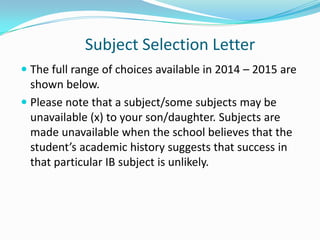
Subject Selection Letter
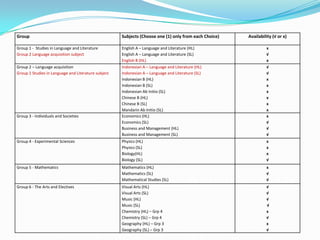
 The full range of choices available in 2014 – 2015 are

shown below.
 Please note that a subject/some subjects may be
unavailable (x) to your son/daughter. Subjects are
made unavailable when the school believes that the
student’s academic history suggests that success in
that particular IB subject is unlikely.
Group

Subjects (Choose one (1) only from each Choice)

Group 1 - Studies in Language and Literature
Group 2 Language acquisition subject

English A – Language and Literature (HL)
English A – Language and Literature (SL)
English B (HL)
Indonesian A – Language and Literature (HL)
Indonesian A – Language and Literature (SL)
Indonesian B (HL)
Indonesian B (SL)
Indonesian Ab Initio (SL)
Chinese B (HL)
Chinese B (SL)
Mandarin Ab Initio (SL)
Economics (HL)
Economics (SL)
Business and Management (HL)
Business and Management (SL)

x
√
x
√
√
x
x
x
x
x
x
x
√
√
√

Group 4 - Experimental Sciences

Physics (HL)
Physics (SL)
Biology(HL)
Biology (SL)

x
x
x
√

Group 5 - Mathematics

Mathematics (HL)
Mathematics (SL)
Mathematical Studies (SL)

x
√
√

Group 6 - The Arts and Electives

Visual Arts (HL)
Visual Arts (SL)
Music (HL)
Music (SL)
Chemistry (HL) – Grp 4
Chemistry (SL) – Grp 4
Geography (HL) – Grp 3
Geography (SL) – Grp 3

√
√
√
√
x
√
x
√

Group 2 – Language acquisition
Group 1 Studies in Language and Literature subject

Group 3 - Individuals and Societies

Availability (√ or x)
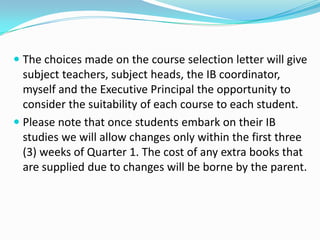
 The choices made on the course selection letter will give
subject teachers, subject heads, the IB coordinator,
myself and the Executive Principal the opportunity to
consider the suitability of each course to each student.
 Please note that once students embark on their IB
studies we will allow changes only within the first three
(3) weeks of Quarter 1. The cost of any extra books that

are supplied due to changes will be borne by the parent.
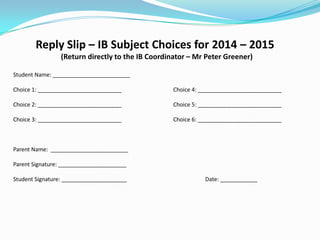
Reply Slip – IB Subject Choices for 2014 – 2015
(Return directly to the IB Coordinator – Mr Peter Greener)
Student Name: _________________________
Choice 1: ___________________________

Choice 4: ___________________________

Choice 2: ___________________________

Choice 5: ___________________________

Choice 3: ___________________________

Choice 6: ___________________________

Parent Name: _________________________
Parent Signature: ______________________

Student Signature: _____________________

Date: ____________
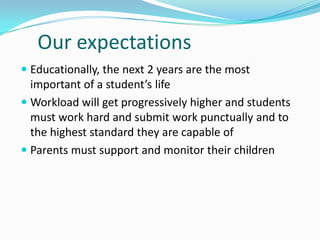
Our expectations
 Educationally, the next 2 years are the most

important of a student’s life
 Workload will get progressively higher and students
must work hard and submit work punctually and to
the highest standard they are capable of
 Parents must support and monitor their children
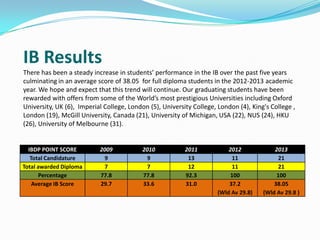
IB Results
There has been a steady increase in students’ performance in the IB over the past five years
culminating in an average score of 38.05 for full diploma students in the 2012-2013 academic
year. We hope and expect that this trend will continue. Our graduating students have been
rewarded with offers from some of the World’s most prestigious Universities including Oxford
University, UK (6), Imperial College, London (5), University College, London (4), King's College ,
London (19), McGill University, Canada (21), University of Michigan, USA (22), NUS (24), HKU
(26), University of Melbourne (31).

IBDP POINT SCORE
Total Candidature
Total awarded Diploma
Percentage
Average IB Score

2009
9
7
77.8
29.7

2010
9
7
77.8
33.6

2011
13
12
92.3
31.0

2012
11
11
100
37.2
(Wld Av 29.8)

2013
21
21
100
38.05
(Wld Av 29.8 )
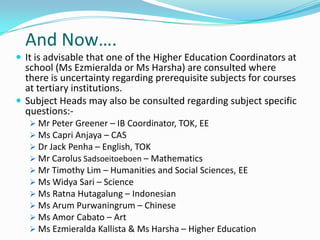
And Now….
 It is advisable that one of the Higher Education Coordinators at

school (Ms Ezmieralda or Ms Harsha) are consulted where
there is uncertainty regarding prerequisite subjects for courses
at tertiary institutions.
 Subject Heads may also be consulted regarding subject specific
questions: Mr Peter Greener – IB Coordinator, TOK, EE
 Ms Capri Anjaya – CAS
 Dr Jack Penha – English, TOK
 Mr Carolus Sadsoeitoeboen – Mathematics
 Mr Timothy Lim – Humanities and Social Sciences, EE
 Ms Widya Sari – Science
 Ms Ratna Hutagalung – Indonesian
 Ms Arum Purwaningrum – Chinese
 Ms Amor Cabato – Art
 Ms Ezmieralda Kallista & Ms Harsha – Higher Education
Questions?

IB Presentation

  • 1.
    Full IB Diploma/ IB Course Mike Carroll - Vice Principal (Secondary) Wednesday 29 January, 2014
  • 2.
     The InternationalBaccalaureate (IB) Programme is a comprehensive and rigorous two year curriculum  a deliberate compromise between the specialization required in some national systems and the breadth preferred in others.  The Diploma Programme is highly regarded for entry to university education throughout the world.  IB students routinely gain admission to some of the best known universities in the world. Most of these institutions have established recognition policies for the IB diploma. The IBO maintains updated information about university recognition which can be accessed at http://www.ibo.org/country.
  • 3.
    Who should takethe IB Diploma?  There are two groups of students who should undertake the IB Diploma:  those who need it for entrance to the universities of their choice  those who, academically able and motivated, want to undertake a challenging course of study.
  • 4.
    What Do WeLook For in IB Diploma Students?  Desire  Self-discipline, ability to ask questions, time management  Thinks critically  Competence and fluency in expressing oneself in English  An independent and cooperative learner
  • 5.
    Requirements of theDiploma Programme  Study of SIX subjects covering major fields of learning.  3 subjects studied at HL to allow for specialization in certain     areas. 3 subjects studied at SL to ensure a broad education. Participation in an interdisciplinary course entitled Theory of Knowledge. Submission of an Extended Essay, of no more than 4000 words, on a topic of the student’s choice. Participation in a programme of Creativity, Action and Service (CAS).
  • 6.
    The Subject Groups ♦Group 1 - Studies in Language and Literature   English A – Language and Literature (HL and SL) Indonesian A – Language and Literature (HL and SL) ♦ Group 2 – Language Acquisition      English B (HL) Indonesian B (HL and SL) Indonesian Ab Initio (SL) Chinese B (HL and SL) Mandarin Ab Initio (SL) ♦ Group 3 - Individuals and Societies    Business and Management (HL and SL) Economics (HL and SL) Geography (HL and SL)
  • 7.
    ♦ Group 4- Experimental Sciences    Chemistry (HL and SL) Physics (HL and SL) Biology (HL and SL) ♦ Group 5 – Mathematics   Mathematics (HL and SL) Mathematical Studies (SL) ♦ Group 6 - The Arts and Electives Visual Arts (HL and SL)  Music (HL and SL) (chemistry or geography can be chosen in this group) 
  • 8.
    Core Requirements ofthe IB Programme In addition to the six subjects all students:  Follow a course in the Theory of Knowledge (TOK)  composed of questions!  the most central of these is “How do we know?”  assessment is via a 1400 to 1600 philosophical essay and an oral presentation  Engage in a substantial piece of research resulting in an Extended Essay (EE)  undertake a substantial piece of original research and write an extended essay of about 4,000 words.  Participate in an extra-curricular programme entitled Creativity, Action and Service (CAS)
  • 9.
    The IB GradingSystem The grading scheme in use for IB examinations is: 1. very poor 2. poor 3. mediocre 4. satisfactory 5. good 6. very good 7. excellent
  • 10.
    Assessment  External Assessments– 50% to 80%, 2 or 3 papers  Internal Assessments (IAs) – 20% to 50%, moderated by IBO  6 subjects (1 to 7 points each) Maximum = 6 x 7points = 42 points  TOK and EE (Up to 3 bonus points available) Maximum Total Points = 42 + 3 = 45 points  Completion of CAS is mandatory!
  • 11.
    If the FullIB Diploma is not for you:  IB Course Students  6 or less subjects  No EE, TOK requirement  Precludes students from some institutions (US is a good option)  A-Level / AS- Level  3 A-Level subjects only or 2 A-Level plus 2 AS-Level  Alternate pathways to tertiary institutions  IGCSE  2+2 (US)  Foundation courses
  • 12.
    Current Grade Ten Whendeciding which subjects to take there are a number of factors which should be considered:  Which subjects do you enjoy?  Which subjects are you good at?  What does the course involve?  What type of career(s) are you interested in?  What are the requirements of the universities at which you intend to apply?
  • 13.
    Our Entry Procedures Allstudents seeking admission to the IB Diploma programme will be expected to:  Have successfully completed the IGCSE with at least 5 ‘B’ grades  IGCSE candidates will achieve A*, A, B, C, D, E, F, G or U for each subject.  Grade A* is awarded to those candidates showing highest ability in a subject  Grade G for a minimum satisfactory performance.  Performance below the standard of G are ungraded (U).  A minimum grade of C is prerequisite to enter the upper level of study for most institutions around the world.  Satisfy the pre-requisites for intended subjects  Have a good work ethic - attendance, punctuality, preparation and participation in lessons, homework, meeting deadlines
  • 14.
    2012-2013 INTERNATIONAL GENERALCERTIFICATE OF SECONDARY EDUCATION IGCSE Grades STB-ACS Percentage Year 2013 A* A B C Below C A* & A English Literature 7 1 0 0 0 100.0% - - First language English 15 11 11 5 1 60.5% 86.0% 97.7% English as a Second Language 0 4 3 0 0 57.1% 100.0% - Indonesian as a Foreign Language Chinese as a Foreign Language 23 1 0 0 0 100.0% - - 11 1 1 0 0 92.3% 100.0% - Mathematics 24 5 6 2 1 76.3% 92.1% 97.4% Additional Mathematics 8 16 10 2 0 66.7% 94.4% 100.0% Chemistry 25 2 3 1 1 84.4% 93.8% 96.9% Physics 15 5 4 1 3 71.4% 85.7% 89.3% Biology 10 2 7 3 1 52.2% 82.6% 95.7% Geography 13 6 6 3 1 65.5% 86.2% 96.6% Business Studies 3 12 10 6 0 48.4% 80.6% 100.0% Travel and Tourism 1 4 4 0 0 55.6% 100.0% - Physical Education 2 4 6 7 2 28.6% 57.1% 90.5% Art and Design 0 3 1 1 1 50.0% 66.7% 83.3% ICT 0 3 4 4 4 20.0% 46.7% 73.3% B & Above C & Above
  • 15.
    Subject Selection Letter The full range of choices available in 2014 – 2015 are shown below.  Please note that a subject/some subjects may be unavailable (x) to your son/daughter. Subjects are made unavailable when the school believes that the student’s academic history suggests that success in that particular IB subject is unlikely.
  • 16.
    Group Subjects (Choose one(1) only from each Choice) Group 1 - Studies in Language and Literature Group 2 Language acquisition subject English A – Language and Literature (HL) English A – Language and Literature (SL) English B (HL) Indonesian A – Language and Literature (HL) Indonesian A – Language and Literature (SL) Indonesian B (HL) Indonesian B (SL) Indonesian Ab Initio (SL) Chinese B (HL) Chinese B (SL) Mandarin Ab Initio (SL) Economics (HL) Economics (SL) Business and Management (HL) Business and Management (SL) x √ x √ √ x x x x x x x √ √ √ Group 4 - Experimental Sciences Physics (HL) Physics (SL) Biology(HL) Biology (SL) x x x √ Group 5 - Mathematics Mathematics (HL) Mathematics (SL) Mathematical Studies (SL) x √ √ Group 6 - The Arts and Electives Visual Arts (HL) Visual Arts (SL) Music (HL) Music (SL) Chemistry (HL) – Grp 4 Chemistry (SL) – Grp 4 Geography (HL) – Grp 3 Geography (SL) – Grp 3 √ √ √ √ x √ x √ Group 2 – Language acquisition Group 1 Studies in Language and Literature subject Group 3 - Individuals and Societies Availability (√ or x)
  • 18.
     The choicesmade on the course selection letter will give subject teachers, subject heads, the IB coordinator, myself and the Executive Principal the opportunity to consider the suitability of each course to each student.  Please note that once students embark on their IB studies we will allow changes only within the first three (3) weeks of Quarter 1. The cost of any extra books that are supplied due to changes will be borne by the parent.
  • 19.
    Reply Slip –IB Subject Choices for 2014 – 2015 (Return directly to the IB Coordinator – Mr Peter Greener) Student Name: _________________________ Choice 1: ___________________________ Choice 4: ___________________________ Choice 2: ___________________________ Choice 5: ___________________________ Choice 3: ___________________________ Choice 6: ___________________________ Parent Name: _________________________ Parent Signature: ______________________ Student Signature: _____________________ Date: ____________
  • 20.
    Our expectations  Educationally,the next 2 years are the most important of a student’s life  Workload will get progressively higher and students must work hard and submit work punctually and to the highest standard they are capable of  Parents must support and monitor their children
  • 21.
    IB Results There hasbeen a steady increase in students’ performance in the IB over the past five years culminating in an average score of 38.05 for full diploma students in the 2012-2013 academic year. We hope and expect that this trend will continue. Our graduating students have been rewarded with offers from some of the World’s most prestigious Universities including Oxford University, UK (6), Imperial College, London (5), University College, London (4), King's College , London (19), McGill University, Canada (21), University of Michigan, USA (22), NUS (24), HKU (26), University of Melbourne (31). IBDP POINT SCORE Total Candidature Total awarded Diploma Percentage Average IB Score 2009 9 7 77.8 29.7 2010 9 7 77.8 33.6 2011 13 12 92.3 31.0 2012 11 11 100 37.2 (Wld Av 29.8) 2013 21 21 100 38.05 (Wld Av 29.8 )
  • 22.
    And Now….  Itis advisable that one of the Higher Education Coordinators at school (Ms Ezmieralda or Ms Harsha) are consulted where there is uncertainty regarding prerequisite subjects for courses at tertiary institutions.  Subject Heads may also be consulted regarding subject specific questions: Mr Peter Greener – IB Coordinator, TOK, EE  Ms Capri Anjaya – CAS  Dr Jack Penha – English, TOK  Mr Carolus Sadsoeitoeboen – Mathematics  Mr Timothy Lim – Humanities and Social Sciences, EE  Ms Widya Sari – Science  Ms Ratna Hutagalung – Indonesian  Ms Arum Purwaningrum – Chinese  Ms Amor Cabato – Art  Ms Ezmieralda Kallista & Ms Harsha – Higher Education
  • 23.