WHAT IS CONTENTANALYSIS?
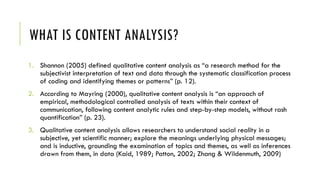
1. Shannon (2005) defined qualitative content analysis as “a research method for the
subjectivist interpretation of text and data through the systematic classification process
of coding and identifying themes or patterns” (p. 12).
2. According to Mayring (2000), qualitative content analysis is “an approach of
empirical, methodological controlled analysis of texts within their context of
communication, following content analytic rules and step-by-step models, without rash
quantification” (p. 23).
3. Qualitative content analysis allows researchers to understand social reality in a
subjective, yet scientific manner; explore the meanings underlying physical messages;
and is inductive, grounding the examination of topics and themes, as well as inferences
drawn from them, in data (Kaid, 1989; Patton, 2002; Zhang & Wildenmuth, 2009)
3.
CHARACTERISTICS OF CONTENTANALYSIS
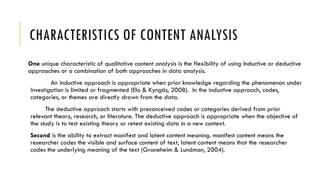
One unique characteristic of qualitative content analysis is the flexibility of using Inductive or deductive
approaches or a combination of both approaches in data analysis.
An inductive approach is appropriate when prior knowledge regarding the phenomenon under
investigation is limited or fragmented (Elo & Kyngäs, 2008). In the inductive approach, codes,
categories, or themes are directly drawn from the data.
The deductive approach starts with preconceived codes or categories derived from prior
relevant theory, research, or literature. The deductive approach is appropriate when the objective of
the study is to test existing theory or retest existing data in a new context.
Second is the ability to extract manifest and latent content meaning. manifest content means the
researcher codes the visible and surface content of text, latent content means that the researcher
codes the underlying meaning of the text (Graneheim & Lundman, 2004).
4.
ADVANTAGES AND DISADVANTAGES
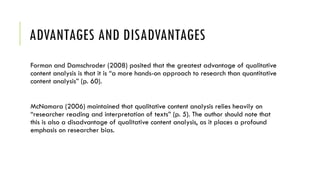
Formanand Damschroder (2008) posited that the greatest advantage of qualitative
content analysis is that it is “a more hands-on approach to research than quantitative
content analysis” (p. 60).
McNamara (2006) maintained that qualitative content analysis relies heavily on
“researcher reading and interpretation of texts” (p. 5). The author should note that
this is also a disadvantage of qualitative content analysis, as it places a profound
emphasis on researcher bias.
5.
QUALITATIVE AND QUANTITATIVE
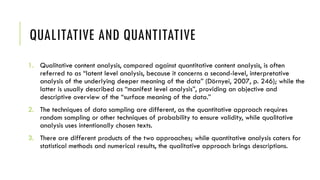
1.Qualitative content analysis, compared against quantitative content analysis, is often
referred to as “latent level analysis, because it concerns a second-level, interpretative
analysis of the underlying deeper meaning of the data” (Dörnyei, 2007, p. 246); while the
latter is usually described as “manifest level analysis”, providing an objective and
descriptive overview of the “surface meaning of the data.”
2. The techniques of data sampling are different, as the quantitative approach requires
random sampling or other techniques of probability to ensure validity, while qualitative
analysis uses intentionally chosen texts.
3. There are different products of the two approaches; while quantitative analysis caters for
statistical methods and numerical results, the qualitative approach brings descriptions.
6.
MIXING OF BOTH
1.Mixing qualitative and quantitative methods is known as one of the ways of using
triangulation, which, according to Flick (2010, p. 405), is “used as a strategy of
improving the quality of qualitative research …”.
2. Despite of these differences, it has been highlighted by numerous scholars that, in
research practice, the two approaches are often applied in combination (Dörnyei,
2007; Flick, 2007; Zhang & Wildemuth, 2009).
7.
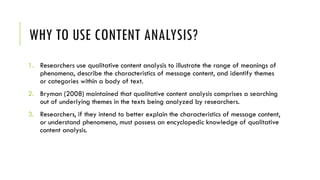
WHY TO USECONTENT ANALYSIS?
1. Researchers use qualitative content analysis to illustrate the range of meanings of
phenomena, describe the characteristics of message content, and identify themes
or categories within a body of text.
2. Bryman (2008) maintained that qualitative content analysis comprises a searching
out of underlying themes in the texts being analyzed by researchers.
3. Researchers, if they intend to better explain the characteristics of message content,
or understand phenomena, must possess an encyclopedic knowledge of qualitative
content analysis.
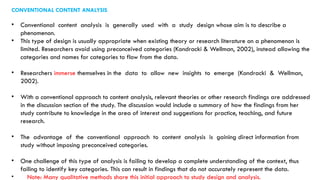
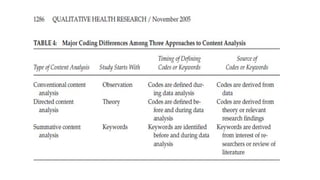
CONVENTIONAL CONTENT ANALYSIS
•Conventional content analysis is generally used with a study design whose aim is to describe a
phenomenon.
• This type of design is usually appropriate when existing theory or research literature on a phenomenon is
limited. Researchers avoid using preconceived categories (Kondracki & Wellman, 2002), instead allowing the
categories and names for categories to flow from the data.
• Researchers immerse themselves in the data to allow new insights to emerge (Kondracki & Wellman,
2002).
• With a conventional approach to content analysis, relevant theories or other research findings are addressed
in the discussion section of the study. The discussion would include a summary of how the findings from her
study contribute to knowledge in the area of interest and suggestions for practice, teaching, and future
research.
• The advantage of the conventional approach to content analysis is gaining direct information from
study without imposing preconceived categories.
• One challenge of this type of analysis is failing to develop a complete understanding of the context, thus
failing to identify key categories. This can result in findings that do not accurately represent the data.
• Note: Many qualitative methods share this initial approach to study design and analysis.
10.
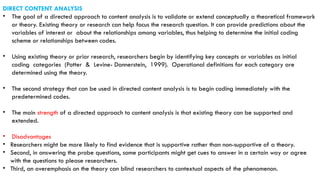
DIRECT CONTENT ANALYSIS
•The goal of a directed approach to content analysis is to validate or extend conceptually a theoretical framework
or theory. Existing theory or research can help focus the research question. It can provide predictions about the
variables of interest or about the relationships among variables, thus helping to determine the initial coding
scheme or relationships between codes.
• Using existing theory or prior research, researchers begin by identifying key concepts or variables as initial
coding categories (Potter & Levine- Donnerstein, 1999). Operational definitions for each category are
determined using the theory.
• The second strategy that can be used in directed content analysis is to begin coding immediately with the
predetermined codes.
• The main strength of a directed approach to content analysis is that existing theory can be supported and
extended.
• Disadvantages
• Researchers might be more likely to find evidence that is supportive rather than non-supportive of a theory.
• Second, in answering the probe questions, some participants might get cues to answer in a certain way or agree
with the questions to please researchers.
• Third, an overemphasis on the theory can blind researchers to contextual aspects of the phenomenon.
11.
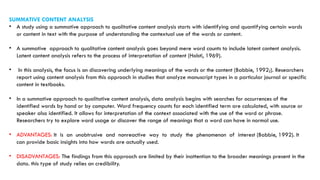
SUMMATIVE CONTENT ANALYSIS
•A study using a summative approach to qualitative content analysis starts with identifying and quantifying certain words
or content in text with the purpose of understanding the contextual use of the words or content.
• A summative approach to qualitative content analysis goes beyond mere word counts to include latent content analysis.
Latent content analysis refers to the process of interpretation of content (Holsti, 1969).
• In this analysis, the focus is on discovering underlying meanings of the words or the content (Babbie, 1992;). Researchers
report using content analysis from this approach in studies that analyze manuscript types in a particular journal or specific
content in textbooks.
• In a summative approach to qualitative content analysis, data analysis begins with searches for occurrences of the
identified words by hand or by computer. Word frequency counts for each identified term are calculated, with source or
speaker also identified. It allows for interpretation of the context associated with the use of the word or phrase.
Researchers try to explore word usage or discover the range of meanings that a word can have in normal use.
• ADVANTAGES: It is an unobtrusive and nonreactive way to study the phenomenon of interest (Babbie, 1992). It
can provide basic insights into how words are actually used.
• DISADVANTAGES: The findings from this approach are limited by their inattention to the broader meanings present in the
data. this type of study relies on credibility.
13.
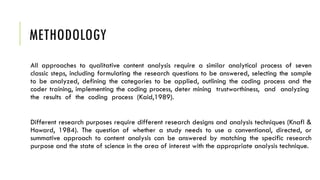
METHODOLOGY
All approaches toqualitative content analysis require a similar analytical process of seven
classic steps, including formulating the research questions to be answered, selecting the sample
to be analyzed, defining the categories to be applied, outlining the coding process and the
coder training, implementing the coding process, deter mining trustworthiness, and analyzing
the results of the coding process (Kaid,1989).
Different research purposes require different research designs and analysis techniques (Knafl &
Howard, 1984). The question of whether a study needs to use a conventional, directed, or
summative approach to content analysis can be answered by matching the specific research
purpose and the state of science in the area of interest with the appropriate analysis technique.
14.
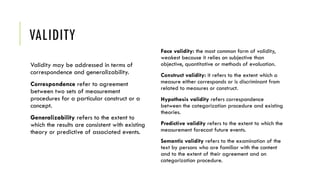
VALIDITY
Validity may beaddressed in terms of
correspondence and generalizability.
Correspondence refer to agreement
between two sets of measurement
procedures for a particular construct or a
concept.
Generalizability refers to the extent to
which the results are consistent with existing
theory or predictive of associated events.
Face validity: the most common form of validity,
weakest because it relies on subjective than
objective, quantitative or methods of evaluation.
Construct validity: it refers to the extent which a
measure either corresponds or is discriminant from
related to measures or construct.
Hypothesis validity refers correspondence
between the categorization procedure and existing
theories.
Predictive validity refers to the extent to which the
measurement forecast future events.
Semantic validity refers to the examination of the
text by persons who are familiar with the content
and to the extent of their agreement and on
categorization procedure.
15.
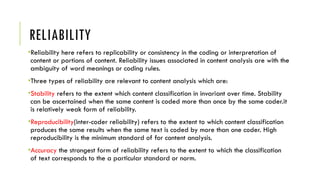
RELIABILITY
•Reliability here refersto replicability or consistency in the coding or interpretation of
content or portions of content. Reliability issues associated in content analysis are with the
ambiguity of word meanings or coding rules.
•Three types of reliability are relevant to content analysis which are:
•Stability refers to the extent which content classification in invariant over time. Stability
can be ascertained when the same content is coded more than once by the same coder.it
is relatively weak form of reliability.
•Reproducibility(inter-coder reliability) refers to the extent to which content classification
produces the same results when the same text is coded by more than one coder. High
reproducibility is the minimum standard of for content analysis.
•Accuracy the strongest form of reliability refers to the extent to which the classification
of text corresponds to the a particular standard or norm.
16.
READINGS AND REFERENCES
1.Fang Hseih, Hsiu., Shannon, Sarah. E. (2005). Three approaches to qualitative content analysis,
Qualitative Health Research- Sage Publications, Vol. 15, No. 2, pg. 1277-1285.
2. Sandorova, Zuzuna. (2014). Content analysis as a research method in investigating the cultural
components in foreign language textbooks, Journal of language and culture education, pg. 95-
123.
3. http://www.utsc.utoronto.ca/~kmacd/IDSC10/Readings/Readings/text%20analysis/CA.pdf
4. http://www.zoltandornyei.co.uk/uploads/2012-dornyei-csizer-rmsla.pdf
5. http://www.paxamerica.org/2012/09/01/qualitative-content-analysis-in-social-research-an-epi
grammatic-summation-of-presidential-state-of-the-union-addresses
/
6. http://www.utsc.utoronto.ca/~kmacd/IDSC10/Readings/Readings/text%20analysis/CA.pdf
7. http://www.utsc.utoronto.ca/~kmacd/IDSC10/Readings/Readings/text%20analysis/CA.pdf